Is Aloe Vera Toxic to Cats and Dogs? What to Do Now
Aloe vera is toxic to cats and dogs, and the culprit is the bitter yellow latex under the leaf rind rather than the clear inner gel. Here is what the signs look like, when to call, and what to grow instead.

BVMS MRCVS
Medically reviewed by Dr. Pippa Elliott, BVMS MRCVS · Last reviewed

This article contains affiliate links. Webvet may earn a commission when you buy through them, at no extra cost to you.
Is aloe vera toxic to cats? Yes. The ASPCA Animal Poison Control Center lists aloe on its toxic plant database for cats and for dogs, and the culprit is a bitter yellow layer inside the leaf rather than the clear gel people rub on sunburn.
If your cat or dog has just chewed a leaf, do not wait for symptoms and do not try to make them vomit. Call your veterinarian, the ASPCA Animal Poison Control Center on (888) 426-4435, or the Pet Poison Helpline on (855) 764-7661.
This guide answers both species, because aloe is one of the few houseplants where the cat verdict and the dog verdict are identical. Below: which part of the leaf does the damage, what the signs look like and when, what to do in the first ten minutes, and what to grow instead.
Is aloe vera toxic to cats?

Yes, aloe vera is toxic to cats. The ASPCA names saponins and anthraquinones as the toxic principles and lists vomiting, lethargy, and diarrhea as the clinical signs. Most household cases are gut upset that settles, not an organ emergency, but every one of them earns a phone call.
- 1Aloe vera, properly Aloe barbadensis miller, is toxic to cats and dogs alike. The ASPCA names saponins and anthraquinones as the toxic principles, carried as anthraquinone glycosides in the leaf latex.
- 2The problem layer is the bitter yellow latex just under the leaf rind, not the clear inner gel.
- 3Most household exposures show up as gastroenteritis: vomiting, diarrhea, drooling, poor appetite, and lethargy.
- 4The veterinary references linked here do not provide a household safe-dose threshold; ask for individual advice after an exposure.
- 5Call your vet, the ASPCA Animal Poison Control Center on (888) 426-4435, or the Pet Poison Helpline on (855) 764-7661. Never induce vomiting at home.
Cats end up in aloe more often than dogs for a simple reason: aloe lives where cats live. A sunny windowsill, a bathroom shelf, the top of a bookcase. A cat does not have to eat much of a leaf to swallow latex.
Tell the veterinarian your pet’s weight as well as the estimated amount eaten. Body size is part of the assessment, but it does not establish a safe bite size for either a cat or a dog.

A window perch gives your cat a dedicated resting spot. Install it as directed and keep it away from accessible plants.
Webvet may earn a commission when you click through to Chewy, at no extra cost to you.
Before you call, it helps to work out whether the plant was actually eaten or just knocked about. Look for chew marks along the leaf and a torn leaf edge rather than a clean break, because a tipped pot and an actual meal are two different phone calls. The quick check:
- Compare the damaged leaf against an undamaged one. Missing tissue suggests possible ingestion; look for fallen pieces too, and report what you can and cannot account for.
- Check the damaged end for a sticky yellow bead or a dried yellow-brown streak. That is the latex.
- Hunt for chewed fragments on the floor, in the pot, or in a puddle of vomit.
- Check your cat’s mouth, chin, and paws for plant fiber and soil.
- If the pot is on its side but every leaf is intact, you may have a mess rather than an ingestion. When in doubt, assume they ate some.
| Cats | Dogs | |
|---|---|---|
| ASPCA verdict | Toxic | Toxic |
| Toxic principles | Saponins, anthraquinones | Saponins, anthraquinones |
| Riskiest part | Yellow latex under the leaf rind | Yellow latex under the leaf rind |
| Lower-risk part | Clear inner gel, which the ASPCA describes as edible, though a home-cut leaf mixes it with latex | Clear inner gel, with the same home-cut caveat |
| Usual presentation | Vomiting, diarrhea, drooling, poor appetite, lethargy | Vomiting, diarrhea, drooling, poor appetite, lethargy |
| Less common signs (VCA) | Change in urine color, muscle tremors, kidney inflammation on large ingestions | The cited VCA guide describes cats; do not infer the same uncommon effects in dogs. Report any new signs to your veterinarian. |
| Published toxic dose | No home safe-dose threshold in the veterinary references linked here | No home safe-dose threshold in the veterinary references linked here |
| When to call | Any known or suspected ingestion | Any known or suspected ingestion |
Aloe is not in the same class as a true lily. Lilies destroy a cat’s kidneys and are a race to the clinic. Aloe belongs to the larger group of plants that irritate the gut. That difference should change how frightened you are, not whether you call.
Is aloe vera toxic to dogs?

Yes, aloe vera is toxic to dogs, and this page answers both species together because the biology is shared. The ASPCA lists the same plant, the same toxic principles, and the same core signs for dogs as for cats, and Pet Poison Helpline treats aloe as a gastrointestinal irritant in dogs.
Do not let dogs eat aloe leaves. Vomiting, diarrhea, and lethargy are possible signs, but neither the timing nor the severity can be predicted from a bite description alone. Call with the plant or product details.
What differs is scale. Dogs tend to take a whole leaf rather than a nibble, so the amount is often larger, though they are usually bigger animals too. Neither generalization tells you much about your own dog. These do:
- A small dog, a puppy, or a senior, where fluid loss counts for more.
- Existing kidney, liver, or inflammatory bowel disease.
- A whole leaf eaten with the rind on, which delivers the most latex.
- Aloe taken by mouth as a juice, water, or supplement rather than as a plant.
- Potting soil, gravel, fertilizer granules, or a piece of the pot swallowed alongside it.
- A dog who was already vomiting or had diarrhea for some other reason.
Vomiting and diarrhea can lead to fluid loss that needs treatment. A healthy adult dog is not automatically cleared after eating aloe; the veterinarian or poison service should assess the amount, signs, and medical history.
If your dog is unwell in ways an upset stomach does not explain, stop attributing it to the plant and get them seen. Our guide to dog vomiting and diarrhea covers the wider set of causes.
Which part of an aloe plant is toxic

The toxic part of an aloe plant is the bitter yellow latex sitting just beneath the green rind, not the clear inner gel. That latex carries the saponins and anthraquinone glycosides behind the toxicity. In the gut, saponins irritate the lining on contact and anthraquinone glycosides drive the bowel to empty.
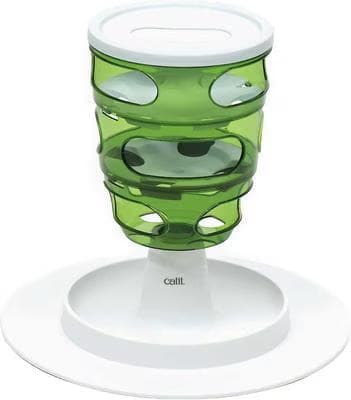
A food-tree puzzle adds an activity to everyday feeding. Introduce it gradually using part of your cat’s usual food allowance.
Webvet may earn a commission when you click through to Chewy, at no extra cost to you.
Cut a leaf of Aloe barbadensis miller across and you are looking at three layers:
- The rind: the tough green skin. Not the poison itself, but the latex sits directly under it.
- The latex: a thin, strongly bitter yellow fluid that beads at a cut edge. This is the layer carrying the aloin.
- The inner gel: the clear, slippery pulp. This is what commercial products are made from, and the ASPCA describes the gel portion as edible.
So can cats eat aloe vera leaves, and can dogs eat aloe vera leaves? No. A whole leaf delivers rind, latex, and gel in one mouthful, which is the worst version of this exposure for either species, and it is the version a bored pet is most likely to take.
Anthraquinone glycosides belong to the same family of compounds used in stimulant laxatives. Gut bacteria convert them into their active form, which drives the bowel to contract and pulls water into the intestine. The Merck Veterinary Manual groups plants that behave this way with the gastrointestinal irritants rather than the organ toxins.
That is why the diarrhea can be dramatic, and why fluid loss rather than organ damage is the practical worry with aloe.
A retail name is not enough to identify a poisonous aloe or a safe lookalike. Labels such as Aloe aristata, tiger tooth aloe, lace aloe, climbing aloe, or Blue Elf need an exact botanical identification before a veterinarian can apply a species-specific verdict for a cat or dog. Do not assume the aloe vera entry proves every similarly named plant has identical chemistry.
Keep an unidentified aloe-like plant inaccessible while you check its botanical name with the seller and a veterinary poison resource.
How much aloe does it take to make a pet sick?
The ASPCA, Pet Poison Helpline, and Merck references linked here do not provide a household safe-dose threshold for aloe in cats or dogs. Do not use the estimated amount to clear an exposure yourself.
A toxic-dose number found elsewhere is not a home treatment rule. Your veterinarian or poison service needs the exact plant or product, amount, body weight, and symptoms to decide what to do.
- 1The veterinary references linked here do not provide a home dosing rule or a safe ingestion threshold for aloe in cats or dogs.
- 2Do not use an online number to clear an exposure.
- 3Severity is driven by which part of the leaf was eaten, how much relative to body size, and how healthy your pet already was.
- 4The practical rule: any known or suspected ingestion is worth a call, and the amount is something you estimate for the person on the phone rather than something you judge alone.
What actually drives how sick a pet gets is a short list:
- Which part of the leaf was eaten. A lick of clear gel off a finger is a smaller event than a mouthful of rind and latex.
- How much, relative to body size. The same bite is a far larger dose for a 4-pound kitten than for a Labrador.
- Whether it was chewed. Crushing the leaf releases more latex than swallowing a piece whole.
- Your pet’s baseline. Kidney disease, liver disease, gut disease, very young, very old, or pregnant all narrow the margin.
- What came with it. Soil, fertilizer, gravel, an insecticide stick, or a shard of ceramic pot can matter more than the aloe did.
- Plant or product. A juice, gel, or supplement needs its own ingredient and concentration check; do not assume every formulation contains the same amount of aloin.
This is also why "my dog only ate a little bit of aloe vera" is not a reason to skip the call. A little bit for a 70-pound dog and a little bit for a 6-pound cat are different events, and the person on the poison control line does that arithmetic all day.
Symptoms of aloe poisoning in cats and dogs
Aloe poisoning looks like gastroenteritis. The ASPCA lists vomiting, lethargy, and diarrhea. In its guide to plants toxic to cats, VCA Animal Hospitals also reports reddish urine, muscle tremors, and possible kidney inflammation after large aloe ingestions. Those signs need veterinary assessment; do not assume aloe explains them.
Possible signs to report include the following; they do not have to appear in this order:
- Drooling, lip smacking, or pawing at the mouth, from the bitter and irritant taste.
- Vomiting, sometimes with recognizable plant material in it.
- Diarrhea, often loose and watery because of the way anthraquinones act on the bowel.
- Refusing food, or approaching the bowl and walking away.
- Lethargy and hiding. Depression is the word the ASPCA uses.
- Belly discomfort: a hunched posture, a tucked abdomen, or a cat who will not settle.
- Less commonly, muscle tremors, or urine that looks red or brown.
How long aloe poisoning lasts depends on the exposure and your pet’s condition. The linked primary references do not establish a reliable hour-by-hour course for symptom onset or a recovery deadline. Ask the clinician for an individual monitoring plan and escalation guidance rather than waiting for a fixed number of hours.
A reddish urine change is not a reason to panic on its own, but it is the point where monitoring at home stops. Red or brown urine has several possible causes, and only your vet can tell pigment from blood.
| Situation | What you may see | What to do |
|---|---|---|
| Known or suspected exposure | Your pet may seem normal or show mouth discomfort | Call now with the plant or product details; do not wait for signs |
| Vomiting or reduced appetite | Vomiting, sometimes with plant material; reluctance to eat | Report these signs and follow the individual plan you are given |
| Diarrhea or lethargy | Loose stool, poor appetite, or unusual quietness | Contact the veterinarian, especially if vomiting accompanies diarrhea |
| Urine color changes | Red or brown urine | Seek veterinary assessment; do not assume aloe explains the color |
| Signs persist or worsen | Continued vomiting, diarrhea, poor intake, or worsening behavior | Contact the veterinarian again; do not wait for a fixed recovery deadline |
| Any time | Collapse, weakness, tremors, seizures, blood in vomit or stool, pale gums, or a pet who cannot keep water down | Emergency. Go to the nearest open clinic |
A pet who seems normal has not been cleared by the clock. Follow the monitoring period and return precautions given for that particular exposure.
If you are not certain the aloe is the cause, and many owners are not, read the wider picture. Cat throwing up and diarrhea and dog vomiting and diarrhea cover the other common reasons a pet’s gut goes wrong overnight.

Grow a small tray of oat grass for your cat. Follow the kit instructions and keep ornamental plants out of reach.
Webvet may earn a commission when you click through to Chewy, at no extra cost to you.
What to do if your cat or dog eats aloe

Here is the first-aid sequence, and the instruction that matters most is what not to do: never induce vomiting at home. Whether your dog licked aloe vera gel, your cat chewed a leaf, or you are asking what to do if a dog eats an aloe vera plant, the first ten minutes look the same.
- Move your pet to another room and put the plant somewhere they cannot reach. Do not throw the chewed leaf away. It tells the vet what and how much.
- Wipe the mouth if your pet will let you, using a damp cloth on the gums and tongue, or offer a small drink. Never squirt water into the mouth of a distressed animal.
- Work out which part was eaten, roughly how much, and when: rind and latex, a piece of whole leaf, or a commercial gel. Photograph the plant and the damage, and keep the product package if there is one so the veterinarian or poison control specialist can check the ingredients.
- Call. Your own vet first if they are open, otherwise ASPCA Animal Poison Control on (888) 426-4435 or Pet Poison Helpline on (855) 764-7661, both staffed around the clock.
- Follow the plan they give you, whether that is a veterinary examination or monitoring at home with specific instructions for when to call again.
- Keep fresh water available and let your pet rest somewhere quiet where you can see them.
- Escalate if things turn, using the emergency signs below.
Some signs mean go now rather than monitor at home. Collapse, weakness, tremors, seizures, blood in vomit or stool, pale or tacky gums, a pet who cannot keep water down, or an animal getting visibly worse hour by hour is an emergency. Do not sit and wait for a callback.
The call determines whether your pet needs an examination or treatment. Veterinary care may include fluids and medication for vomiting, depending on the signs and examination.
If the possible bill is what is making you hesitate, say so on the call rather than sitting on it, because waiting almost always costs more than asking. Our guide to emergency vet cost sets out what an out-of-hours visit actually runs to.
What happens if a pet licks aloe vera gel
The word gel does not establish safety. The ASPCA distinguishes clear inner gel from the toxic plant components, but a commercial product must also be assessed by its full formulation, amount swallowed, and the pet involved.
There are three versions of this, and they are not the same call:
- Bottled gel labeled aloin-free: keep the label and call for product-specific advice after a lick. Do not treat that claim as clearance for the other ingredients.
- Gel from a leaf cut at home. Assume the latex came with it, treat it as a plant ingestion, and call.
- A human sunburn or after-sun product. Call regardless of quantity, because the additives are the reason, not the aloe.
Those additives are the part people underestimate. Human after-sun gels commonly contain lidocaine or benzocaine, alcohol, menthol, camphor, or fragrance. Topical anesthetics in the benzocaine family are linked to a serious red blood cell disorder in cats and dogs.
Read the whole ingredient panel to whoever you call. The aloe is often the least interesting thing on it.
Tell the clinician whether there was one lick or repeated grooming, and estimate the amount if possible. The full formulation and the pet’s condition matter as well as the volume.
Is aloe vera gel safe to put on your pet’s skin?

Before putting aloe on a cat or dog, ask the veterinarian whether that exact product is suitable for the problem and for the species. That includes witch hazel mixed with aloe: the combination is a formulation to assess, not a pet-safety verdict. Keep aloe on your own skin out of reach of licking pets.
People reach for aloe because it is what they use on themselves, so hot spots, rashes, and sunburn are where the question usually comes up. Dogs do get sunburned, particularly on a pink nose, a thin-coated belly, or a white ear tip.

Make time for supervised play with a feathered wand. Put the toy away after each session.
Webvet may earn a commission when you click through to Chewy, at no extra cost to you.
So can you put aloe on a dog’s sunburn? Not the tube from your bathroom cabinet. The answer is shade, a pet-formulated product, and a vet’s advice. Our guide to sunburn in dogs covers the safer options.
The same goes for itching and hot spots. Aloe will not fix an itchy dog, and a dog itchy enough that you are reaching for a home remedy has a cause worth finding: fleas, allergy, a yeast or bacterial infection, or a food reaction. Why your dog is itchy is the better starting point.
Should you give your dog or cat aloe vera juice?
Do not give aloe juice or an aloe supplement to a cat or dog unless your veterinarian recommends the exact product for that pet. Product names do not reveal the formulation or establish a safe dose.
Whole-leaf aloe vera juice for dogs and cats contains aloin unless it has been decolorized, and aloin is a stimulant laxative. Giving that deliberately, day after day, to an animal whose fluid balance you cannot measure is a different proposition from a one-off chew.
The specifics owners should know:
- The veterinary references linked here do not provide a general home dose for aloe juice, a gel, or an aloe powder solution. Products sold under names such as Forever Living or Fruit of the Earth still need their full label assessed for the individual cat or dog. Do not borrow a dose from another product, species, or animal.
- Human labeling varies wildly. Decolorized, inner leaf fillet, and whole leaf are different products with different aloin content.
- Do not mix aloe juice or gel with hydrogen peroxide to brush a dog’s teeth or treat dental disease. Ask your veterinarian which pet dental product to use. Aloe is also not a substitute for diagnosis and treatment of constipation, inflammatory bowel disease, or itchy skin.
- A laxative effect can change how other medications are absorbed, which makes this a conversation with your vet rather than a purchase.
- Cats have small bodies, hide illness well, and dehydrate quickly. A daily laxative effect in a cat is not a mild thing.
- If a product has already been given, keep the bottle and call. The ingredient panel is what that conversation is about.
Does the smell of an aloe plant bother cats?
The veterinary plant warnings discussed here concern exposure to the plant’s contents, especially chewing or swallowing, rather than simply smelling an intact plant. A cat’s reaction to a scent does not establish that the plant is safe to reach.
Do not rely on smell or bitterness to keep a cat away. Physical separation prevents access regardless of whether that cat finds the plant interesting.
Where scent genuinely matters is a different product entirely:
- Aloe-fragranced sprays, candles, diffusers, and cleaners are not the plant, and some carry essential oils that are a real problem for cats.
- Room sprays and plug-ins used near a cat’s resting spot deserve an ingredient check, whatever the fragrance on the front of the bottle says.
- An aloe scent on a label tells you nothing about what is underneath it.
So yes, an aloe plant can share a house with a cat, but only if the cat truly cannot reach it. For a cat, that usually means a different room with a closed door rather than a higher shelf.
Aloe and fleas: what aloe will not do
Does aloe vera get rid of fleas? No. Aloe does not repel or kill fleas on cats or dogs, and it is not a substitute for a veterinary parasite preventive. There is no evidence behind it, and using it instead of a real product leaves the infestation breeding while you wait for something to happen.
The idea comes from labels. Aloe appears on the ingredient panel of a lot of pet shampoos and sprays as a soothing agent, sitting alongside the actual insecticide or alongside nothing at all. Aloe is on the label. It is not what does the work.
Worth being blunt about:
- Aloe is a soothing-agent ingredient in grooming products, not an insecticide.
- Home-made aloe flea sprays do not work, and they put an irritant into your pet’s mouth every time they groom.
- Essential-oil flea remedies, tea tree and pennyroyal especially, are genuinely dangerous to cats. Swapping one home remedy for another makes things worse.
- A flea problem needs a veterinary preventive, every pet in the house treated, and the environment handled at the same time.
Aloe-containing grooming products need a separate assessment from the plant. Oatmeal-and-aloe shampoos, hydrating sprays, ear wipes, and skin lotions should be judged by their full ingredient list, directions, and species labeling. Ask your veterinarian about an unfamiliar product; an aloe ingredient does not prove flea control or safe licking. An ear-care kit or ear tonic such as Mister Ben’s is not interchangeable with aloe gel. Check its own directions and ingredients, and ask your veterinarian before using it to treat a sore ear.
Why cats chew on aloe, and how to keep them out of it
Do cats like aloe vera, and will cats eat aloe vera plants? Some will. Cats chew greenery for reasons nobody has pinned down, and aloe is a thick, juicy, moveable leaf at the height a cat likes. Keeping cats away from an aloe vera plant means moving it, not treating it.
The behavior itself is normal. Suggested explanations include roughage, texture, boredom, attention seeking, and moving a hairball along, and none of them is settled. What is clear is that a bored indoor cat with nothing to do chews more.
What actually works, roughly in order of reliability:
- Move the plant out of the house. For a determined chewer this is the only control that does not depend on the cat cooperating.
- If it stays, put it behind a closed door. A high shelf is not out of reach for a healthy cat.
- Offer an alternative. Cat grass grown with an Imperial Cat Easy Grow Cat Oat Grass Kit is one option to try while keeping the aloe inaccessible.
- Offer interactive play and other enrichment, and watch what interests your own cat. Keep the barrier around the aloe in place.
- Make the pot boring: a covered planter, a cloche, or a top dressing that is unpleasant to stand in.
Notice what is not on that list: spraying the plant. Safe deterrent tactics do not rely on spraying a plant a cat will chew anyway. Move the pot out of reach instead, because essential oil and citrus deterrents are toxic to cats and a bitter spray on a toxic plant fails quietly.
Pet-safe plants to grow instead of aloe

If the aloe is going, the windowsill does not have to stay empty. Named pet-safe plants from the ASPCA non-toxic list give you a straight replacement plant, and a cat grass redirection gives your cat something they are actually allowed to chew, which is the half most safe-plant advice leaves out.
One caveat belongs on every safe-plant list, including this one. Non-toxic means no known systemic poisoning. It does not mean harmless.
Any plant can cause vomiting or drooling if a pet eats enough of it, and a swallowed length of leaf can still cause an obstruction. Non-toxic means the plant will not poison your cat. It does not mean your cat should be eating it.
| Swap in | What it gives you back | Status |
|---|---|---|
| Spider plant (Chlorophytum comosum) | An easy, arching, forgiving plant for the same bright windowsill. Cats find it interesting, so place it where a nibble is not a disaster | On the ASPCA non-toxic list for cats and dogs |
| Boston fern (Nephrolepis exaltata) | Soft green volume for a bathroom or a shaded shelf, and it likes humidity aloe never needed | On the ASPCA non-toxic list for cats and dogs |
| Parlor palm (Chamaedorea elegans) | Height and structure, if the aloe was the architectural plant in the room | On the ASPCA non-toxic list for cats and dogs |
| Prayer plant (Maranta leuconeura) or calathea | Patterned foliage and low-light tolerance for a spot the aloe was struggling in anyway | On the ASPCA non-toxic list for cats and dogs |
| African violet (Saintpaulia) | Flowers, which no succulent was giving you | On the ASPCA non-toxic list for cats and dogs |
| Cat grass (oat, wheat, barley, or rye grass) | A tray your cat is allowed to chew, which is the whole point. Grow it fresh and replace it when it tires | Cereal grasses are not toxic. Grow from seed sold for pets, not lawn seed, which may be treated |
For an aloe-like succulent, Haworthia has an explicit ASPCA listing as non-toxic to cats and dogs. Check the botanical name on the tag rather than relying on the resemblance to aloe. Gasteria is a different genus; do not use the Haworthia listing to clear a plant identified only as Gasteria.
Check any specific plant by its botanical name against the ASPCA database before it comes home. Garden-center labels use common names, and common names are unreliable.
Cat grass is the most useful line in that table, because it is the only one that answers the behavior rather than just replacing the plant. Kits that arrive as tray, seed, and soil are the least effort, and running two trays means one is always ready.
Other plants and household poisons to check next
Aloe is rarely the only plant in the house, and it is not the worst one. True lilies are the emergency in this category for cats. Every part, including the pollen and the vase water, can cause acute kidney failure, and that one is a same-day trip rather than a phone call.
The other names worth checking your own rooms for:
- Sago palm, which is the dog equivalent of the lily for consequence and goes after the liver.
- Pothos, philodendron, monstera, and dieffenbachia, which carry insoluble calcium oxalate crystals that burn the mouth.
- Tulip and daffodil bulbs, which concentrate their irritants in the part a digging dog reaches.
- Cut flowers generally, because a bouquet brings in plants nobody chose for a house with pets.
Plants are also only one shelf of the problem. Human medication left on a counter, cleaning products, antifreeze in a garage, and rodent bait account for more harm every year than houseplants do. Our room-by-room guide to poison-proofing your cat home is worth an hour of a weekend.
Every plant named here, and the rest of the ASPCA toxic list, is ranked by how urgently a cat needs a veterinarian in our full guide to plants toxic to cats.
Aloe and pets: quick answers
Frequently Asked Questions
Can aloe poisoning kill a cat or a dog?
Aloe can make a cat or dog ill, and a household exposure cannot be assigned a safe outcome from this guide. The primary references linked here do not provide a fatality rate to apply to an individual pet. Call promptly for an assessment.
Dehydration is the real risk. Repeated vomiting and watery diarrhea drain fluid fast, and a kitten, a small dog, a senior, or a pet with existing kidney or gut disease has far less margin. That is the reason to call rather than wait it out.
How long does aloe poisoning last?
There is no reliable fixed recovery time in the primary references linked here. The duration depends on what was swallowed, the signs, and the pet’s condition and treatment.
Follow the veterinarian’s monitoring plan and call again for persistent or worsening signs. A pet who cannot keep water down, stops drinking, or becomes unusually quiet needs prompt reassessment; do not wait two days.
What will the vet or poison control ask me?
The vet or the poison control line will ask a standard set of questions, so have the answers ready before you dial:
- Your pet’s species, breed, age, and body weight.
- The plant, photographed, with its botanical name if the label survived.
- Which part was eaten: leaf, rind, latex, root, or a commercial gel.
- Roughly how much, and what time it happened.
- Every sign you have seen, and when each one started.
- Medical history and any current medication.
If a bottled product was involved, hold the tube while you talk and read the whole ingredient panel out. That is usually the part that changes the advice you get.
Is aloe toxic to other animals in the house?
Aloe is toxic to other animals in the house too. The ASPCA lists it as toxic to horses alongside cats and dogs, and it is not a safe plant for small mammals such as rabbits and guinea pigs either, so the pot needs to be out of reach of every pet you own.
This guide covers cats and dogs. Rabbits, birds, and reptiles differ enough in physiology that you should get species-appropriate advice rather than stretching this page to fit them. Call a vet who treats that species, or one of the poison control lines, and say which species you are calling about.

Editor
The Webvet Editorial Team is the in-house group of pet-care editors and writers behind Webvet, operated by Smart Pet Collective. The team researches, writes, and maintains Webvet's pet health, behavior, and medication content. Every article follows a defined editorial process: research from reputable veterinary and scientific sources, careful drafting, mandatory review of medical content by a credentialed veterinarian, and dated publication. Health and medication articles are medically reviewed by a licensed veterinary professional before they go live and are kept current over time.
Veterinarian · BVMS MRCVS
Dr. Pippa Elliott, BVMS, MRCVS, is a veterinarian with nearly 30 years of experience in companion animal practice. Dr. Elliott earned her Bachelor of Veterinary Medicine and Surgery from the University of Glasgow. She was also designated a Member of the Royal College of Veterinary Surgeons. Married with 2 grown-up kids, Dr. Elliott has a naughty Puggle named Poggle, 3 cats and a bearded dragon.
Related reading

Is Pothos Toxic to Cats? Yes, and So Is Philodendron

Is Monstera Toxic to Cats? Symptoms and What to Do

Are Christmas Trees Toxic to Cats? Poinsettia, Mistletoe, Holly
