Are Tulips Toxic to Cats? Yes, and the Bulb Is the Danger
Are tulips toxic to cats? Yes. The ASPCA lists Tulipa spp. as toxic to cats, and the bulb carries the highest concentration of toxin. Here is how to size the exposure that just happened, what to do first, and which flowers are safe to swap in.

BVMS MRCVS
Medically reviewed by Dr. Pippa Elliott, BVMS MRCVS · Last reviewed

This article contains affiliate links. Webvet may earn a commission when you buy through them, at no extra cost to you.
Are tulips toxic to cats? Yes. The ASPCA Animal Poison Control Center lists the tulip in its toxic plant database as Tulipa spp., family Liliaceae, toxic to cats, dogs, and horses. The toxin is present throughout the plant, and the bulb carries the highest concentration of it.
That last detail is the one most owners have never been told. A cat that licked a fallen petal and a cat that chewed a bulb out of a pot are in two different situations, but both need a call for advice suited to the exposure.
Are tulips toxic to cats?
Tulips are toxic to cats. The ASPCA toxic plant database lists the tulip as Tulipa spp., family Liliaceae, toxic to dogs, cats, and horses, names tulipalin A and tulipalin B as the toxic principles, and states that the highest concentration of toxin sits in the bulb.
The clinical signs the ASPCA publishes for tulip are vomiting, depression, diarrhea, and hypersalivation.
- 1Tulips are toxic to cats. The ASPCA lists Tulipa spp. as toxic to cats, dogs, and horses.
- 2The toxic principles are tulipalin A and tulipalin B, and Pet Poison Helpline states the toxic compounds are present throughout the plant structure.
- 3The bulb holds the highest concentration of toxin and is the part behind the serious cases.
- 4A nibbled petal or leaf typically causes drooling and stomach upset. A chewed bulb is the exposure that escalates.
- 5Call a veterinarian or a poison control line after any tulip ingestion, and never induce vomiting at home.
Tuliposide A is a precursor that a tulip enzyme converts to tulipalin A. Research identifying that enzyme explains why the two names occur in descriptions of the plant. This chemistry does not establish a safe amount for a cat to eat.
What no primary source publishes is a number, and that is worth saying plainly rather than filling the gap.
- There is no established safe amount of tulip for a cat.
- The cited poison-control entries do not provide a safe dose, lethal dose, milligram-per-kilogram threshold, fatality rate or survival percentage for an individual cat.
- The outcome depends on which part was eaten, how much of it went down, and the size, age, and health of the individual cat.
Do not use an unsourced petal count to decide whether to call. The reassurance honestly available is that most petal-sized exposures in an otherwise healthy cat are handled well when the owner calls promptly. That is a probability, not a promise.
It is also not a reason to skip the call.

A window perch gives your cat a dedicated resting spot. Install it as directed and keep it away from accessible plants.
Webvet may earn a commission when you click through to Chewy, at no extra cost to you.
Which parts of a tulip are toxic, and why the bulb is the worst

Every part of a tulip carries the toxin, but not in the same amount. Pet Poison Helpline states that tulips contain toxic plant alkaloids throughout the plant structure and that the highest concentration is found in the bulbs.
So the question that matters is not whether a tulip was involved. It is which end of the tulip your cat actually reached.
| Part of the plant | Relative toxin concentration | How a cat actually meets it in a home | What that means for your next step |
|---|---|---|---|
| Bulb | Highest | Dug out of a pot or a planter, chewed from a storage bag, lifted off a potting bench or a forcing glass | Treat as urgent. Call a vet or a poison control line straight away, before any signs appear |
| Roots and the base of the stem | No separate concentration ranking established by the cited source | Pulled up along with the bulb from soil, or chewed off a bulb sitting in water | Report exactly which plant material was eaten; do not estimate its concentration by proximity to the bulb. |
| Leaves and stems | Lower than the bulb | Chewed off a vase arrangement or a potted tulip at floor or counter height | Expect drooling and stomach upset. Call for advice on the amount and the timing |
| Petals and flower head | Lower than the bulb | Batted down off a table, licked, or nibbled straight from a bouquet | Usually the mildest route, but still a call. Watch the mouth, the appetite, and the vomiting |
| Dried, wilted, or dead material | No source says drying removes it | Fallen petals under the vase, dropped leaves, an arrangement nobody has thrown out yet | Throw out the whole arrangement, water included. A dried petal is still chewable plant material |
Two things fall out of that table. The first is that a cat who ate a petal and a cat who ate a bulb should not be given the same advice, which is exactly what happens when an article compresses the whole plant into one sentence.
The second is that lower concentration is not the same as safe. Pet Poison Helpline describes ingestion of small amounts of leaves, stems, or flowers as producing mild nausea with vomiting. Mild is still a reason to call, and mild describes the typical case rather than yours.
What happens if a cat sniffs or brushes against a tulip

If your cat sniffs tulips, smelling the bloom alone is different from licking or chewing plant material. Pet Poison Helpline describes tulip toxicity after ingestion. Check whether the cat got material in its mouth or on its coat, and ask your veterinarian if swallowing cannot be ruled out.
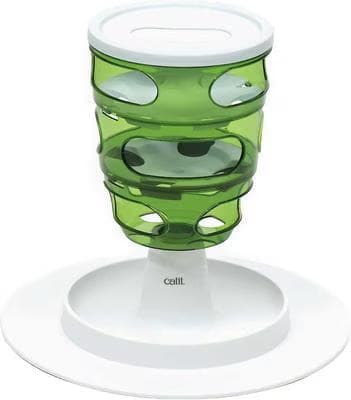
A food-tree puzzle adds an activity to everyday feeding. Introduce it gradually using part of your cat’s usual food allowance.
Webvet may earn a commission when you click through to Chewy, at no extra cost to you.
That boundary is worth stating precisely, because sniffing and eating get treated as one event in most of what gets written about tulips. Here is where the line actually sits.
- Smelling the bloom: not an established toxic exposure. Nothing has entered the mouth.
- Brushing past a stem or a leaf: contact alone is not ingestion, but tulip material can irritate the skin. Report any skin or eye contact when you call for advice.
- Licking petals, leaves, pollen, or vase water: this is ingestion. Treat it as an exposure and call.
- Chewing or swallowing any part: ingestion, and the amount and the part both matter. Call.
- Grooming plant debris out of the coat: ingestion by a slower route. Anything on the fur ends up in the mouth.
That last line is the one that catches people out. A cat does not need to eat a tulip off the table to swallow tulip material. It only needs to lie under the vase, collect fallen pollen and petal fragments on its coat, and then wash itself the way cats do all day.
So if your cat has been rolling around under a tulip arrangement, wipe the coat down with a damp cloth rather than letting the cat groom itself clean. That is a sensible precaution, not an emergency.
Tulip pollen is not the lily pollen situation
The most repeated piece of cat and flower advice online is that lily pollen on a cat's coat is an emergency. It is, and readers understandably carry that rule over to any flower with pollen on it. With tulips the carry-over is wrong, and it is wrong in both directions.
- Lily pollen is a genuine emergency. True lilies cause kidney failure in cats, and pollen on the coat delivers the toxin by the grooming route.
- What the ASPCA publishes for lily: the Easter lily, the tiger lily, and the orange day lily are toxic to cats, and cats are the only species known to be affected.
- Tulip pollen is not established as a comparable hazard. No primary source describes tulip pollen on the coat as an emergency in its own right.
The tulip and true-lily exposures need different advice. Do not let that reassurance travel backwards onto a lily, because there the rule stands and the consequence is a kidney rather than a queasy stomach.
My cat ate a tulip: symptoms and what to do right now
If your cat has eaten any part of a tulip, take the remaining plant material away, do not induce vomiting, and call a veterinarian or a poison control line now. Keep or photograph a piece of the plant so whoever you speak to can identify it.
The signs to watch for are the ones the ASPCA publishes for tulip: vomiting, depression, diarrhea, and hypersalivation.
Once the call is made, the useful thing you can do is watch and report accurately. This table maps what you are likely to see onto what it usually means and what to do about it.
| What you are seeing | What it usually means | What to do next |
|---|---|---|
| Drooling, lip smacking, or pawing at the mouth right after contact | Local irritation from plant material in the mouth, the hypersalivation the ASPCA lists for tulip | Remove the plant, offer fresh water, rinse the mouth gently if the cat allows it, and call for advice |
| One episode of vomiting, and then the cat seems like itself again | The mild nausea Pet Poison Helpline describes after a small amount of leaf, stem, or flower | Still call. Report what was eaten and when, then watch eating, drinking, and litter box use for 24 hours |
| Repeated vomiting, diarrhea, or a flat refusal of food | The persistent gastrointestinal distress Pet Poison Helpline attributes to bulb material | Veterinary appointment today. Fluid loss is the problem that compounds while you wait |
| Lethargy, hiding, weakness, or a cat that will not get up | Escalation, and the lethargy Pet Poison Helpline lists after bulb ingestion | Emergency clinic now. Do not wait to see whether the next sign arrives |
| A known or suspected bulb ingestion, with no signs at all yet | The highest-concentration exposure the plant can deliver | Call before signs appear. An absence of symptoms in the first hour tells you very little |
Two judgment calls come up constantly after a plant exposure. If the cat vomited once and then went straight back to normal, our guide to a cat vomiting but acting normal walks through when that pattern is genuinely fine and when it is not.
The other is cost, which is the real reason people hesitate before calling. Our breakdown of what an emergency vet visit costs sets expectations before you are standing in a waiting room. A poison control consultation is by far the cheapest step in the sequence.
What none of this includes is a home remedy. There is no milk, no bread, no oil, and no wait-and-see approach that treats a tulip ingestion. The treatment is a phone call followed by whatever a veterinarian decides, and everything else is a delay dressed up as an action.
Tulip bulbs, hyacinths, and the rest of the spring bulb group

The most dangerous tulip in your house is usually not the one in the vase. It is the bag of bulbs sitting in the garage in fall, because the bulb is the part with the highest concentration of toxin and a paper sack on a low shelf is not a barrier to a cat.
This is the part of the risk that almost never gets written about, because articles about tulips and cats are written about bouquets. Planting season puts loose, chewable, highest-concentration plant material into the house, often for weeks, and usually somewhere nobody has cat-proofed.

Grow a small tray of oat grass for your cat. Follow the kit instructions and keep ornamental plants out of reach.
Webvet may earn a commission when you click through to Chewy, at no extra cost to you.
That rule covers more than tulips, because the spring bulb group is bought together, stored together, and reachable together.
- Hyacinth: Pet Poison Helpline handles tulips and hyacinths under a single entry, because both carry alkaloids throughout the plant with the highest concentration in the bulbs. The ASPCA separately lists hyacinth as toxic to cats, dogs, and horses, with intense vomiting, diarrhea sometimes containing blood, depression, and tremors.
- Daffodil: the ASPCA lists Narcissus spp. as toxic to cats, dogs, and horses, names lycorine and other alkaloids as the toxic principles, and states plainly that the bulbs are the most poisonous part. It adds that large ingestions cause convulsions, low blood pressure, tremors, and cardiac arrhythmias.
- Tulip: same container, same rule. The part with the highest concentration of toxin is the part sitting loose in the bag.
Those daffodil escalation signs describe a large ingestion, not a nibbled petal, and they are the ASPCA's own wording rather than a worst case anyone invented. They are also the reason the storage rule earns the ten minutes it takes.
If a cat goes quiet and off its food after time spent near a bulb store, our guide to a cat that is not eating and is lethargic covers when that combination becomes urgent.
Can you keep tulips in a house with a cat?
You can, but only if the cat genuinely cannot reach them, and in most homes that means a different room rather than a higher shelf. If your cat is a plant chewer, the honest answer is no. Swap the tulips out rather than managing them, because management fails the one time you forget.
Multi-cat homes should assume the strictest version of these rules. Cats learn by watching each other, and the one who ignores plants entirely can pick the habit up from the one who does not.
Tulips are also one item on a much longer household list that includes cleaning products, medications, and cords. Our guide to poison-proofing your cat's home walks the whole-house pass so this does not have to be repeated plant by plant.
Cat-safe flowers to put in the vase instead

The better ending to this article is a swap rather than an empty vase. The ASPCA maintains a non-toxic plant inventory alongside the toxic one, and several florist staples sit on it, which means a spring arrangement is entirely possible without a tulip in it.
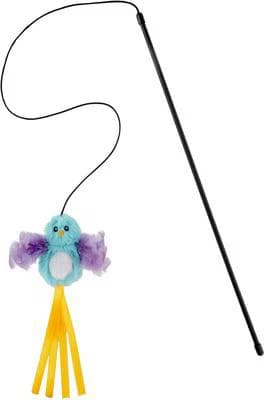
Make time for supervised play with a feathered wand. Put the toy away after each session.
Webvet may earn a commission when you click through to Chewy, at no extra cost to you.
Flowers that are not toxic to cats include roses, gerbera daisies, sunflowers, snapdragons and zinnias. For indoor houseplants instead of a vase, the ASPCA non-toxic list includes moth orchids, Boston ferns and parlor palms. Choose by botanical name, suitable light and a stable location your cat cannot reach; a non-toxic plant can still cause stomach upset if chewed.
One qualifier travels with every safe list, including this one. Non-toxic in that database means no known systemic poisoning. It does not mean harmless. Any plant a cat chews enough of can cause vomiting, drooling, or a gastrointestinal obstruction, and a knocked-over vase is its own hazard.
| Safe swap | ASPCA listing | Why it works in a cat household | Where to put it |
|---|---|---|---|
| Rose (Rosa spp.) | Non-toxic to cats, dogs, and horses | Long-lasting in the vase and the closest visual replacement for a full tulip head | Remove thorns and keep the vase where the cat cannot reach it. |
| Gerbera daisy (Gerbera jamesonii) | Non-toxic to cats, dogs, and horses | Single bold stems, the nearest thing to a tulip's silhouette in a simple vase | A tall, heavy-based vase the cat cannot tip with one shove |
| Sunflower (Helianthus spp.) | Non-toxic to cats, dogs, and horses | A large cut bloom with a different shape from a tulip. | Use a stable vase in a place the cat cannot reach; head height alone is not a barrier. |
| Snapdragon (Antirrhinum majus) | Non-toxic to cats, dogs, and horses | Tall spikes that fill the shape a tulip arrangement used to hold | Grouped with roses in one vase rather than several small ones to knock over |
| Zinnia (Zinnia spp.) | Non-toxic to cats, dogs, and horses | A colorful seasonal alternative for a mixed bouquet. | Keep the arrangement away from the cat’s routes and reachable surfaces. |
| China aster (Callistephus chinensis) | Non-toxic to cats, dogs, and horses | Fine-petaled filler that rounds out a mixed spring bouquet | Mixed arrangements, kept off the windowsill the cat uses as a perch |
| Moth orchid (Phalaenopsis spp.) | Non-toxic to cats, dogs, and horses | A potted alternative to cut stems. | Keep the pot and flower spike stable and inaccessible to a plant-chewing cat. |
Removing the tulips solves the tulip. It does not solve the reason the cat was chewing a plant in the first place, and a cat that wants to chew greenery will find something else to chew.
- That is what cat grass is for. A tray of cat grass grown with an Imperial Cat Easy Grow Cat Oat Grass Kit gives the chewing drive a legitimate target, and it works best where the cat already goes looking, near the favored window or counter rather than tucked into a corner.
- Keep the tray fresh and replace it when it browns off, because a dead tray simply sends the cat back to the arrangement. A pet-safe deterrent spray on the surfaces around the vase can help alongside the grass, but it is a supporting measure. Placement and substitution do the real work.
Sunflowers are included among the ASPCA’s non-toxic bouquet choices. The flower guide compares them with other named blooms and explains why a non-toxic flower should still be kept away from a cat that eats arrangements.
The flowers that are far more dangerous than tulips
A tulip is a serious plant, and it is still nowhere near the top of the list. If you are checking one bouquet, it is worth knowing which stems in it carry a bigger consequence than a chewed tulip petal does.
- Autumn crocus (Colchicum autumnale): the ASPCA lists colchicine and other alkaloids, with bloody vomiting, diarrhea, shock, multi-organ damage, and bone marrow suppression.
- Amaryllis (Amaryllis spp.): lycorine and related alkaloids, with vomiting, depression, diarrhea, abdominal pain, hypersalivation, loss of appetite, and tremors.
- Azalea and rhododendron (Rhododendron spp.): grayanotoxin, with vomiting, diarrhea, weakness, and cardiac failure.
- Sago palm (Cycas revoluta): cycasin, with vomiting, liver damage, liver failure, and death listed among the clinical signs.
- True lilies and daylilies: the highest-consequence flower a cat can meet, and the subject of the next section.
If a mixed bouquet has arrived and half of it is unfamiliar, the ASPCA toxic and non-toxic plant database is searchable by common name and is the fastest way to check a stem before it goes in the vase. That is a two-minute job worth doing.
Every plant named here, and the rest of the ASPCA toxic list, is ranked by how urgently a cat needs a veterinarian in our full guide to plants toxic to cats.
Lilies are the true emergency
If you take one thing away from this article beyond the tulip verdict, take this. The true lily is the flower that kills cats, and it operates on a completely different level from a tulip.
The ASPCA lists the Easter lily, the tiger lily, and the orange day lily as toxic to cats, records the toxic principle as unknown, and publishes vomiting, inappetence, lethargy, kidney failure, and possible death as the clinical signs.
It also notes that cats are the only species known to be affected. The same entries are listed non-toxic to dogs and horses.
- With a tulip, the concern scales with the part and the amount, and a nibbled petal is usually a phone call rather than a hospital visit.
- With a true lily, the pollen, the leaves, the petals, and the vase water are all treated as dangerous, and the response is an immediate veterinary visit.
Peace lily (Spathiphyllum) is a different plant from a true lily. The lily identification guide explains that its crystals cause mouth irritation rather than the kidney-injury pattern of Lilium; it still needs its own exposure advice.
So do not read a tulip verdict and generalize it. If the flower in question is a lily and your cat has had any contact with it at all, stop reading and call a veterinarian now.
Are tulips toxic to dogs too?
Yes. The ASPCA tulip entry lists Tulipa spp. as toxic to dogs and horses as well as cats, with the same tulipalin A and tulipalin B toxic principles and the same concentration of toxin in the bulb.
The exposure route is what differs.
- Cats mostly meet tulips as cut flowers on a surface, in petal-sized amounts.
- Dogs meet them in the garden, and a dog that digs goes straight for the bulb, which is the part with the highest concentration of toxin.
- A dog can also eat a great deal more of a plant in one sitting than a cat will.
That makes the storage and planting advice above dog-relevant too, with the emphasis moved outdoors: cover newly planted beds, keep bulb bags off the shed floor, and do not leave a tray of bulbs on the back step. Both poison control numbers cover dogs.
The wider list of houseplants that are toxic to cats
A tulip verdict answers one plant. Most homes hold a dozen more, and the ones that generate the most calls are not the ones that look dangerous: pothos, philodendron, peace lily, sago palm, and dieffenbachia are all ordinary furniture in rooms cats live in.
Rather than half-answering that list here, use the ASPCA toxic and non-toxic plant database as the lookup tool. It searches by common name and by scientific name, it says which species each plant affects, and it publishes the clinical signs alongside the verdict. It is the primary source these verdicts come from.
Do the pass once, room by room, and write down what you own. A single afternoon of identification means every future scare starts with a plant name rather than a photo search while your cat is drooling on the carpet.
Tulip and cat questions
Frequently Asked Questions
Are dried or dead tulips still toxic to cats?
Treat them as toxic. No primary veterinary source says that drying or wilting neutralizes the tulipalin content, and a shriveled petal is still plant material a cat can chew and swallow.
In practice a dying arrangement can be the riskier one, because it drops petals and leaves down to floor level where the cat actually lives. Throw the whole thing out at once, stems, fallen debris, and vase water together, rather than leaving it out until the weekend.
Is the water in a tulip vase dangerous for my cat to drink?
No primary poison control source publishes a toxicity finding for tulip vase water, so there is no established verdict to give you in either direction.
What is established is that the stems sitting in that water are chewable plant material, and that vase water grows bacteria and often carries commercial flower food.
The practical answer is to keep the cat out of the vase, put a fresh water bowl somewhere more appealing than the flowers, and call for advice if you saw your cat drinking from it and it then starts drooling or vomiting.
Do I need to worry about tulip pollen the way I do with lily pollen?
No, and it matters that this cuts both ways. Lily pollen on a cat's coat is a genuine emergency, because the cat grooms it off and swallows it, and true lilies cause kidney failure in cats. Tulip pollen is not established as a comparable hazard.
So a dusting of tulip pollen is not a reason to panic, and that reassurance must not travel backwards onto a lily.
If the pollen came off a lily, wipe or wash it off and call a veterinarian immediately. If it came off a tulip, wipe the coat with a damp cloth so the cat is not grooming plant material into its mouth, and watch for drooling.
My cat ate one tulip petal and seems fine. Do I still need to call?
Yes, call. No signs yet does not mean no exposure, and a poison control line can tell you in a single conversation whether a petal-sized ingestion needs a visit or just careful watching at home.
Pet Poison Helpline describes small amounts of leaves, stems, or flowers as producing mild nausea with vomiting, which is the likely outcome here. But the size of your cat and how much actually went down change that judgment, and only a veterinarian can weigh them properly.
The call is the cheapest step in the whole sequence. While you wait, do not induce vomiting.

Editor
The Webvet Editorial Team is the in-house group of pet-care editors and writers behind Webvet, operated by Smart Pet Collective. The team researches, writes, and maintains Webvet's pet health, behavior, and medication content. Every article follows a defined editorial process: research from reputable veterinary and scientific sources, careful drafting, mandatory review of medical content by a credentialed veterinarian, and dated publication. Health and medication articles are medically reviewed by a licensed veterinary professional before they go live and are kept current over time.
Veterinarian · BVMS MRCVS
Dr. Pippa Elliott, BVMS, MRCVS, is a veterinarian with nearly 30 years of experience in companion animal practice. Dr. Elliott earned her Bachelor of Veterinary Medicine and Surgery from the University of Glasgow. She was also designated a Member of the Royal College of Veterinary Surgeons. Married with 2 grown-up kids, Dr. Elliott has a naughty Puggle named Poggle, 3 cats and a bearded dragon.
Related reading

Is Pothos Toxic to Cats? Yes, and So Is Philodendron

Is Monstera Toxic to Cats? Symptoms and What to Do

Is Aloe Vera Toxic to Cats and Dogs? What to Do Now
