Is Pothos Toxic to Cats? Yes, and So Is Philodendron
Is pothos toxic to cats? Yes. The ASPCA lists golden pothos as toxic, and its philodendron lookalike carries the same insoluble calcium oxalate crystals. Here is what happens when a cat chews a leaf, the signs to watch for, and what to do first.

BVMS MRCVS
Medically reviewed by Dr. Pippa Elliott, BVMS MRCVS · Last reviewed

This article contains affiliate links. Webvet may earn a commission when you buy through them, at no extra cost to you.
Is pothos toxic to cats? Yes. The ASPCA Animal Poison Control Center's toxic plant database lists golden pothos, Epipremnum aureum, as toxic to cats and dogs, and the heartleaf philodendron sold beside it carries the identical toxin.
If your cat has just chewed a leaf, here is the short version. This is a painful mouth injury rather than a lethal poisoning, and it still deserves a phone call. Below is what the plant does, how fast signs show up, and what to do next.
Is pothos toxic to cats?
Pothos is toxic to cats. The ASPCA lists golden pothos as toxic to cats and dogs, and names insoluble calcium oxalates as the toxic principle. Chewing the plant drives microscopic needle-shaped crystals into the mouth, causing immediate burning, drooling, and difficulty swallowing. Signs start within minutes, not hours.
- 1Pothos is toxic to cats. The ASPCA Animal Poison Control plant database lists golden pothos, Epipremnum aureum, as toxic to both cats and dogs.
- 2The toxic principle is insoluble calcium oxalate: microscopic crystals that injure tissue on contact rather than a poison the body absorbs.
- 3Signs usually begin immediately or within minutes of the bite, most often intense mouth pain, heavy drooling, and difficulty swallowing.
- 4Call your veterinarian or a poison control line if your cat has chewed any part of the plant, even if the cat looks settled.
That verdict covers the whole plant, not just the leaves a cat is most likely to reach. Every part of a pothos carries the crystals.
- Leaves, including the small ones on a young vine
- Stems and leaf stalks
- The sap that weeps from a cut or broken stem
- Cuttings rooting in a jar, and any leaf that has dropped on the floor
How pothos compares with the plants that actually kill cats
Calibration matters here, because a frightened owner needs to know whether this is a drive-to-the-clinic night. Pothos causes a painful, burning injury inside the mouth. It is not in the same category as a lily.
The Merck Veterinary Manual notes that insoluble oxalate plants, unlike their soluble cousins, do not pose a concern for kidney injury, and that most exposures carry a good to excellent prognosis. True lilies are the opposite. The ASPCA lists Lilium species, including the Easter lily, as causing kidney failure in cats.
None of that is permission to do nothing. A painful mouth can stop a cat eating and drinking, swelling is unpredictable, and a veterinarian or a poison control line should still hear about it.
What happens when a cat bites a pothos leaf
What happens if a cat eats pothos is a mechanical injury rather than a poisoning in the familiar sense. Pothos toxicity works on contact: nothing has to be absorbed, digested, or carried in the blood for the damage to begin.
The plant carries bundles of needle-shaped calcium oxalate crystals, called raphides, packed inside specialized cells scattered through the leaves and stems. Those cells rupture the moment a cat bites or crushes the tissue.

A window perch gives your cat a dedicated resting spot. Install it as directed and keep it away from accessible plants.
Webvet may earn a commission when you click through to Chewy, at no extra cost to you.
The Merck Veterinary Manual describes that release as mechanical: the raphides are driven into whatever they touch, and the result is trauma and irritation of that tissue. VCA Animal Hospitals makes the same point, noting that systemic toxicity is not expected from these plants.
- The reaction is immediate. There is no quiet absorption phase where a cat looks fine while something builds up inside.
- Amount matters far less than contact. One determined bite can produce the whole set of oral signs.
- The crystals are not absorbed and do not travel to the kidneys or liver, which is what separates pothos from a genuinely systemic plant poison.
This is why the mouth takes the worst of it. The tongue, lips, gums, and the back of the throat are the first surfaces to meet the crystals, and they are densely supplied with nerves.
So when people ask whether pothos is poisonous, the honest answer is yes, and the reason matters. The plant is listed as toxic because of what the crystals do to tissue on contact, not because of anything the body absorbs and carries away.
Sap deserves its own mention. Pruning a pothos, taking cuttings, or snapping a vine leaves sap on the stem and on your hands, and a cat that walks through it and then grooms can get the same irritation without ever eating a leaf.
Symptoms of pothos poisoning in cats and how fast they appear
Symptoms of pothos poisoning in cats usually appear immediately or within minutes, because the injury happens on contact rather than after digestion. The ASPCA publishes the clinical signs for golden pothos as oral irritation, intense burning and irritation of mouth, tongue and lips, excessive drooling, vomiting, and difficulty swallowing.
In practice, most owners notice the drooling first. It can be heavy, foamy, or stringy, and it usually arrives alongside pawing at the mouth, head shaking, or a cat that suddenly bolts away from the plant.
What does philodendron poisoning look like? The same thing, which is why one list covers both plants. The ASPCA publishes the signs for heartleaf philodendron as oral irritation, pain and swelling of mouth, tongue and lips, excessive drooling, vomiting, and difficulty swallowing.
| Sign | What to know about timing | What to do |
|---|---|---|
| Intense burning and irritation of mouth, tongue and lips | Can begin at contact with chewed plant tissue | Call after suspected ingestion, even if the initial distress eases. |
| Excessive drooling | There is no safe waiting interval | Report drooling and any blood-tinged saliva to the veterinarian. |
| Pawing at the mouth, head shaking, hiding | There is no safe waiting interval | Report behavior suggesting mouth pain. |
| Difficulty swallowing | There is no safe waiting interval | An inability to swallow is an emergency. |
| Vomiting | There is no safe waiting interval | Report vomiting; do not use it to estimate how much was swallowed. |
| Refusing food and water | There is no safe waiting interval | Contact the veterinarian about refusal of food or water. |
| Swelling of lips, tongue or throat, or any difficulty breathing | There is no safe waiting interval | Emergency: go to a clinic now. |
Your veterinarian may use clinical names for some of these. Hypersalivation is drooling, dysphagia is difficulty swallowing, and oral ulceration means the raw, broken patches inside the mouth that need pain relief rather than time.
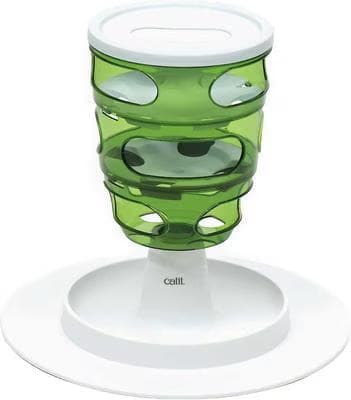
A food-tree puzzle adds an activity to everyday feeding. Introduce it gradually using part of your cat’s usual food allowance.
Webvet may earn a commission when you click through to Chewy, at no extra cost to you.
Treatment for pothos and philodendron in cats is the same, because the injury is the same: clear the mouth, relieve the pain, and manage any vomiting. The first-aid steps are in the section below.
The signs that mean go now rather than wait
The severity and duration vary. Contact a veterinarian after suspected ingestion, and treat the following signs as reasons for prompt examination rather than waiting for the mouth irritation to pass.
- Any difficulty breathing, noisy breathing, or open-mouth breathing
- Visible swelling of the lips, tongue, throat, or face
- Repeated vomiting rather than a single episode
- An inability to swallow, or persistent or worsening drooling
- A cat that stops eating and drinking altogether
- Collapse, weakness, or any change you would describe as the cat not being itself
Vomiting is the crossover sign most likely to send owners searching further. If it continues after the mouth pain has settled, our guide to a cat vomiting but acting normal explains when one episode differs from a pattern.
A cat that refuses food is the other one to watch. Mouth pain and appetite loss overlap heavily, and if the refusal outlasts the drooling, the other reasons a cat stops eating are worth reading.
How much pothos it takes to make a cat sick
How much pothos does a cat need to eat to get sick? There is no published answer, and the question has the wrong shape. No primary veterinary source publishes a minimum toxic amount, a milligram figure, or a lethal dose for pothos in cats.
That is worth saying plainly, because the opposite framing is everywhere. Search results routinely describe the danger in terms of heavy ingestion, which quietly turns a contact burn into a dose-dependent poisoning and implies that a nibble is safe.
Amount is not entirely irrelevant, though. It changes some things and leaves others untouched.
- A bigger mouthful changes how much tissue is irritated, and therefore how sore the cat is
- It changes the odds of swelling in the mouth or throat
- It changes whether vomiting repeats, and whether a cat becomes dehydrated from refusing water
- It does not change whether signs happen at all. Contact is enough.
- It does not change whether the crystals reach the kidneys or liver. They do not.
- It does not change whether the plant should stay within reach. It should not.
There is a related reason most cases stay mild, and it is easy to misread. The burning starts on the first bite, so most cats drop the leaf immediately and never come back for a second mouthful.
That is a deterrent, not a safety feature. Some cats persist, kittens explore harder than adults, and a bored cat with nothing else to chew will return to the same vine. Never leave a pothos in reach on the strength of a bad first taste.
My cat ate pothos but seems fine: what that means

If your cat ate pothos but seems fine, call with the exposure details. Oral irritation can begin when the plant is chewed, but normal behavior does not establish how much was swallowed or clear your individual cat. Follow the veterinary monitoring plan and watch for the red flags below rather than using a time cutoff.
- 1Mouth irritation can begin at the bite, but normal behavior does not clear an exposure.
- 2Tell the veterinarian whether your cat is eating, drinking, swallowing, and behaving normally, and whether there is drooling or mouth pawing.
- 3Red flags override a normal appearance: any breathing difficulty, facial or mouth swelling, repeated vomiting, an inability to swallow, or a cat that stops eating and drinking.
- 4Use the monitoring period and return precautions given by your veterinarian rather than a fixed time cutoff.
Check the mouth if your cat will let you, without forcing it. Look for redness, raw patches, or a tongue the cat keeps flicking. Anything that looks ulcerated is a reason to call rather than to keep watching.
It is also worth confirming your cat actually ate any of it. A knocked-over pot is not the same event as a chewed leaf, and a genuine bite usually leaves a ragged, torn edge rather than a clean break.
- Drooling that starts late, or comes and goes
- Reluctance to eat, or approaching food and walking away from it
- Repeated swallowing, gagging, or lip licking
- Any change in the sound of your cat's breathing
If you are unsure, call. Poison control lines exist precisely for the case where nothing has happened yet and you want a professional to tell you whether it is likely to.
What to do if your cat ate pothos
If your cat ate a pothos leaf, first aid is short, and the most important part of it is what you do not do. Get your cat away from the plant, rinse the mouth if you safely can, and get a professional on the phone.
The steps do not change if your cat ate philodendron, monstera, or another aroid instead. The crystals are the same, so the response is the same.
Two of those deserve expanding. Inducing vomiting is actively dangerous with an oral irritant, because it drags the crystals back across already injured tissue, and the products people reach for at home cause their own damage in cats.
Home remedies are the other trap. You may read that milk binds oxalate crystals, and a veterinarian may indeed use a calcium-containing dairy product as part of treatment. That is a clinical decision made after an assessment, not a first move to try alone.
- Examine the mouth and throat for ulceration and swelling
- Rinse or flush the mouth to clear remaining crystals
- Give pain relief, and anti-nausea medication if your cat is vomiting
- Offer fluids if a sore mouth has stopped the cat drinking
Follow the individual advice you receive about mouth care, food, water, monitoring, and whether an examination is needed. Do not assume recovery by the end of the day or reserve a visit only for severe signs.
Make the call even if your cat seems fine. Report the time, amount, and any signs, and follow the monitoring plan given for that exposure.
If you are told to come in, the cost question follows immediately for most owners. Our guide to what an emergency vet visit costs sets expectations before you are standing at the desk.

Grow a small tray of oat grass for your cat. Follow the kit instructions and keep ornamental plants out of reach.
Webvet may earn a commission when you click through to Chewy, at no extra cost to you.
Philodendron and pothos: the same toxin in two lookalike plants

Philodendron is toxic to cats, for exactly the same reason pothos is. The ASPCA lists heartleaf philodendron, Philodendron hederaceum, as toxic to cats, dogs, and horses, with insoluble calcium oxalates as the toxic principle.
The published sign lists differ by a word or two. The ASPCA describes intense burning and irritation for golden pothos, and pain and swelling of mouth, tongue and lips for heartleaf philodendron. Practically, an owner is watching for the same thing.
The two plants are also constantly mistaken for each other, which is why this section exists. Both are trailing aroids with glossy heart-shaped leaves, both are sold as beginner plants, and pothos is sometimes labelled as a philodendron outright.
| What to look at | Pothos (Epipremnum aureum) | Heartleaf philodendron (Philodendron hederaceum) |
|---|---|---|
| Leaf shape | Heart-like but slightly asymmetric, with a shallow notch at the stem | Evenly heart-shaped, with a deep notch and rounded lobes |
| Leaf texture | Thicker and waxy, often with a slightly puckered surface | Thinner and softer, smooth, with a matte to satiny finish |
| Variegation | Common. Irregular gold, cream, or white streaking | Usually solid green. Coloured forms are named cultivars |
| New leaves | Unfurl directly from the previous leaf, with no sheath | Emerge wrapped in a papery sheath that dries and drops off |
| New growth colour | The same green as the mature leaves | Often brown, bronze, or pink before it hardens off |
| Leaf stalk | Grooved or indented where it meets the stem | Round in cross-section |
| Aerial roots | One thick nub at each node | Several thinner roots at each node |
| ASPCA verdict for cats | Toxic. Insoluble calcium oxalates. | Toxic. Insoluble calcium oxalates. |
The last row is the point. Identification is useful for plant care and for knowing what you own, and it changes nothing about the safety answer. Both plants are on the ASPCA toxic list, for the same reason.
If you have both plants in the house, these are the quickest checks:
- Run a finger along the leaf stalk. A groove means pothos, a smooth round stalk means philodendron.
- Look at new growth. A papery sheath means philodendron, a leaf unfurling straight out of the last one means pothos.
- Check the notch at the base of the leaf. Deep and even means philodendron, shallow and slightly lopsided means pothos.
Will philodendron kill a cat? Almost never. Like pothos, it causes a painful mouth rather than organ damage, and philodendron poisoning treatment is the same supportive care: clear the mouth, control the pain, and watch for swelling that affects breathing.
There is one more naming trap. Pothos is sold as devil's ivy, taro vine, and ivy arum, and satin pothos is a different genus again, Scindapsus pictus. The ASPCA lists that one as toxic as well.
Are all pothos and philodendron varieties toxic?
Yes. Every pothos cultivar and every philodendron cultivar sold as a houseplant carries insoluble calcium oxalate crystals, because the crystals are a trait of the species rather than of the cultivar selected from it.
Is golden pothos poisonous to cats? Yes, and it is the variety the ASPCA lists by name. Heartleaf philodendron is toxic to cats on the same database, and every named cultivar of both plants inherits that verdict.
Cultivars are bred for leaf colour and pattern. Marble queen pothos, neon pothos, jade pothos, N'Joy, and manjula are all Epipremnum aureum, so the golden pothos entry is the one that applies to every one of them.
- Philodendron Brasil and philodendron micans are forms of Philodendron hederaceum, the heartleaf philodendron the ASPCA lists.
- Philodendron Birkin and pink princess philodendron are selections of Philodendron erubescens.
- Philodendron xanadu, selloum, and hope now sit in the genus Thaumatophyllum, and they carry the same crystals.
- Satin pothos is not an Epipremnum at all. It is Scindapsus pictus, and the ASPCA lists it separately as toxic.
- The collector cultivars follow the same rule. Prince of orange, imperial red, rojo congo, black cardinal, white wave, McColley's Finale, burle marx, and lickety split are all philodendron selections, and all carry the crystals.
Check the botanical name on collector plants too. Silver Sword is Philodendron hastatum, which NC State identifies as a problem for cats and dogs. UConn identifies the vining heartleaf Lemon Lime as Philodendron hederaceum. Those are philodendrons, not pet-safe substitutes for pothos; a trade name alone is not enough to identify a different plant.
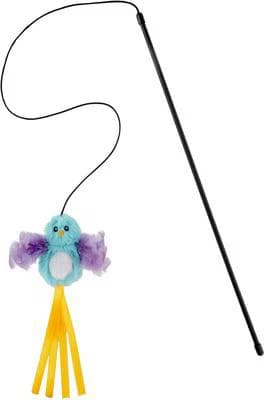
Make time for supervised play with a feathered wand. Put the toy away after each session.
Webvet may earn a commission when you click through to Chewy, at no extra cost to you.
| Variety | Botanical name | Toxic to cats and dogs? |
|---|---|---|
| Golden pothos | Epipremnum aureum | Yes. Listed by the ASPCA. |
| Marble queen pothos | Epipremnum aureum cultivar | Yes. Same species as golden pothos. |
| Neon pothos | Epipremnum aureum cultivar | Yes. Same species as golden pothos. |
| Jade pothos | Epipremnum aureum cultivar | Yes. Same species as golden pothos. |
| Pearls and Jade, N'Joy, Manjula pothos | Epipremnum aureum cultivars | Yes. Same species as golden pothos. |
| Satin pothos | Scindapsus pictus | Yes. Listed separately by the ASPCA. |
| Heartleaf philodendron | Philodendron hederaceum | Yes. Listed by the ASPCA. |
| Philodendron Brasil | Philodendron hederaceum cultivar | Yes. Same species as heartleaf. |
| Philodendron micans | Philodendron hederaceum | Yes. Same species as heartleaf. |
| Philodendron Birkin | Philodendron erubescens cultivar | Yes. Same genus, same crystals. |
| Pink princess philodendron | Philodendron erubescens cultivar | Yes. Same genus, same crystals. |
| Split-leaf philodendron | Monstera deliciosa, or Thaumatophyllum bipinnatifidum | Yes. The name covers two plants, and both are toxic. |
| Philodendron xanadu, selloum, hope | Thaumatophyllum species, formerly Philodendron | Yes. Same crystals. |
There is no cat-safe pothos and no cat-safe philodendron. If a plant listing or a shop label tells you otherwise, it is wrong, and the ASPCA plant database is the place to check it.
Names cause most of the confusion. Pothos is sold as devil's ivy, taro vine, and ivy arum, so a search for a safe golden pothos usually comes from someone who has met three names for one plant and assumed one of them was different.
Variegation is worth a line too, because it comes up often. A whiter leaf has less chlorophyll, not fewer crystals. A marble queen is exactly as toxic as the plain green pothos sitting next to it.
Monstera and the rest of the aroid family
Pothos and philodendron belong to the arum family, Araceae, and they are not the only members of it on a typical plant shelf. Insoluble calcium oxalate runs through the family, which makes the whole group worth recognising by sight.
Monstera is the plant people ask about next. The ASPCA lists Monstera deliciosa under the name cutleaf philodendron, toxic to cats and dogs, with the same insoluble calcium oxalates and the same clinical signs. It gets a full verdict page of its own on Webvet.
- Peace lily (Spathiphyllum), which is not a true lily at all
- Arrowhead vine (Syngonium podophyllum)
- Satin pothos (Scindapsus pictus)
The peace lily deserves a second look, because its name causes real harm. It is not a Lilium, it does not cause kidney failure, and it is an oral irritant like the rest of this group. A true lily is a different emergency entirely.
What about dogs?
The verdict is the same. The ASPCA lists golden pothos and heartleaf philodendron as toxic to dogs as well as cats, with the identical toxic principle and the same oral signs.
If a dog eats philodendron or pothos, oral burning, drooling, vomiting, and difficulty swallowing can follow. There is no home safe-dose threshold to apply to a bite. Tell the veterinarian the amount and the dog’s weight. Treatment may include examination of the mouth, pain relief, fluids, or other supportive care as needed; swelling or trouble breathing needs emergency care.
If your dog ate a pothos or philodendron leaf, separate the dog from the plant, gently clear loose pieces only if safe, do not induce vomiting, and call your veterinarian or a poison control line. A dog that seems fine still needs advice about the exposure. Our full list of plants toxic to dogs covers other plants in the home and garden.
Do cats know to stay away from toxic plants?
No, and this is one of the most costly assumptions in pet ownership. Cats have no reliable instinct for which plants are safe, and nothing about a pothos warns a cat off before the first bite.
There is a reason cats chew plants at all, and it is not hunger. Leaves move in a draught, they crunch, and a trailing vine behaves exactly like the string toy your cat already likes.
- They are young. Kittens and cats under two explore with their mouths.
- They are bored, which is common in indoor-only cats with little to hunt.
- The plant is new, and therefore interesting.
- The plant trails, dangles, or sits at head height on a shelf edge.
- They already graze on grass outdoors and have nothing equivalent indoors.
The last one matters most, because it is the only cause with an easy fix. A cat with an appropriate thing to chew is far less interested in the one it should not touch.
Can you keep pothos if you have a cat?

You can, if you are honest about what out of reach really means. A pothos is only safe in a house with a cat when the cat genuinely cannot get to it, and cats are better climbers than most placements assume.
Pothos is not a pet-friendly plant, whatever a shop label says. It can live in a home with a cat, but only as a managed hazard rather than as something safe.
The cuttings are the part people miss. Rooting a pothos in a glass of water puts stems, sap, and leaves at exactly cat height on a windowsill, and the water itself is worth keeping covered or out of the room.
Sweep after pruning. A single dropped leaf on the floor is far more accessible than the whole plant on a shelf, and it is the most common way a cat that lives with a well-placed pothos still ends up chewing one.
Whole-house prevention is a bigger job than one plant, and the room-by-room version is worth doing once. Our guide to poison-proofing your cat's home covers the rest of that sweep.
When the plant should go
For some cats, placement is not the answer. If your cat has already chewed the pothos, or chews houseplants repeatedly, the safest option is to rehome the plant.
That is not a hedge. A cat that has learned a plant is worth investigating will keep testing whatever you do, and the effort of managing that indefinitely is larger than the effort of giving the pothos to a friend without pets.
Replace it rather than leaving an empty hook. Cats notice a gap, and a non-toxic plant in the same spot keeps the room looking the way you wanted it to look.
Give your cat something it is allowed to chew

Taking the pothos away removes the hazard, but your cat may still want to chew greenery. Cat grass grown with an Imperial Cat Easy Grow Cat Oat Grass Kit is an alternative to try alongside non-toxic replacement plants. Keep toxic foliage inaccessible; an alternative does not make the toxic plant safe to reach.
Cat grass is not a single plant. It is a tray of cereal grasses grown from seed, usually oat grass, wheat, barley, or rye, sold as a kit or as cat grass seeds you sprout yourself. It is not catnip, and the two do different jobs.
- Put the tray somewhere your cat already likes to sit, not next to the houseplants
- Keep two trays going and rotate them, because a chewed tray recovers slowly
- Replace a tray once it yellows, or once the soil grows mould
- Offer it before you remove the pothos, so the alternative is already familiar
- Trim it back to a few inches so it stays upright and interesting
Non-toxic grass can still cause stomach upset. Do not assume vomiting is harmless because grass was involved; contact your veterinarian if it repeats, persists, or comes with other signs of illness.
Be clear about what this does and does not achieve. Redirection lowers the odds that your cat goes looking for the houseplant. It does not make a toxic plant safe to leave within reach.
Enrichment does the rest of the work. A cat with wand-toy sessions, climbing space, and something to hunt has less reason to chew the furnishings of a room, plants included.
Cat-safe plants for the spot where the pothos was
Matching the replacement to the spot is the part most swap lists skip. A trailing plant leaves a trailing gap, and a floor corner needs something upright, so the useful question is which non-toxic plant does the same job.
| The spot the pothos filled | Non-toxic swap | Botanical name |
|---|---|---|
| Trailing from a shelf or mantel | Spider plant | Chlorophytum comosum |
| Trailing or climbing, soft green foliage | Swedish ivy | Plectranthus australis |
| Trailing, low water, sunny window | Burro's tail | Sedum morganianum |
| Hanging basket with thick waxy leaves | Wax plant, or hoya | Hoya carnosa |
| Floor corner, or a tall empty space | Parlor palm | Chamaedorea elegans |
| Tabletop foliage with pattern and colour | Prayer plant, or calathea | Calathea insignis |
Every plant in that table is listed by the ASPCA as non-toxic to cats and dogs. The spider plant is the closest match to a pothos in habit, which is why it heads the list, and it carries the odd distinction of being the non-toxic plant cats most enjoy chewing.
Choosing from a wider list is a separate job, and our full guide to houseplants that are safe for cats carries it, with light and care requirements set alongside the verdicts.
For the complete vet-checked list across houseplants, flowers, herbs, and garden beds, see our guide to plants safe for cats.
Check the rest of your collection against the full list of plants toxic to cats. It separates mouth-irritating houseplants from plants that can injure organs and need immediate veterinary treatment.
Pothos and cat questions
Frequently Asked Questions
Is pothos dangerous to cats if they only touch it?
Not in the way that chewing it is. The crystals sit inside plant cells and are released when the tissue is bitten or crushed, so a cat brushing past an intact leaf is not being exposed to them.
Sap from a cut or broken stem is the exception. It can irritate skin, eyes, and the mouth, and a cat that walks through it and then grooms will carry it to the mouth anyway. Wipe up after pruning, and keep propagation jars covered.
Can pothos kill a cat?
Deaths from pothos are rare. The Merck Veterinary Manual describes a good to excellent prognosis for insoluble oxalate plants, with full recovery expected and no concern for kidney injury, which is what separates this group from the genuinely lethal plants.
The one mechanism that makes it serious is swelling of the mouth or throat that affects breathing, which Pet Poison Helpline describes as a rare outcome. The sources linked here do not provide a home safe-dose threshold; do not use an online number to clear an exposure.
Treat any breathing difficulty, facial swelling, or an inability to swallow as an emergency, and go straight to a clinic rather than calling first.
How long does pothos toxicity last in a cat?
There is no fixed recovery time that can clear every cat after a pothos exposure. Follow the veterinarian’s advice about monitoring and when normal eating and drinking should return for your cat.
Persistent or worsening drooling, mouth pain, vomiting, or refusal of food and water needs veterinary reassessment. Do not wait until the next day if your cat cannot swallow, is swelling, or has trouble breathing.

Editor
The Webvet Editorial Team is the in-house group of pet-care editors and writers behind Webvet, operated by Smart Pet Collective. The team researches, writes, and maintains Webvet's pet health, behavior, and medication content. Every article follows a defined editorial process: research from reputable veterinary and scientific sources, careful drafting, mandatory review of medical content by a credentialed veterinarian, and dated publication. Health and medication articles are medically reviewed by a licensed veterinary professional before they go live and are kept current over time.
Veterinarian · BVMS MRCVS
Dr. Pippa Elliott, BVMS, MRCVS, is a veterinarian with nearly 30 years of experience in companion animal practice. Dr. Elliott earned her Bachelor of Veterinary Medicine and Surgery from the University of Glasgow. She was also designated a Member of the Royal College of Veterinary Surgeons. Married with 2 grown-up kids, Dr. Elliott has a naughty Puggle named Poggle, 3 cats and a bearded dragon.
Related reading

Is Monstera Toxic to Cats? Symptoms and What to Do

Is Aloe Vera Toxic to Cats and Dogs? What to Do Now

Are Christmas Trees Toxic to Cats? Poinsettia, Mistletoe, Holly
