Are Spider Plants Toxic to Cats? A Vet-Reviewed Answer
Are spider plants toxic to cats? No. The ASPCA Animal Poison Control database lists Chlorophytum comosum as non-toxic to dogs and cats. Here is what that verdict covers, why cats chew the leaves, and when a chewed plant needs a vet.

BVMS MRCVS
Medically reviewed by Dr. Pippa Elliott, BVMS MRCVS · Last reviewed

This article contains affiliate links. Webvet may earn a commission when you buy through them, at no extra cost to you.
Are spider plants toxic to cats? No. The ASPCA Animal Poison Control plant database lists the spider plant, Chlorophytum comosum, as non-toxic to dogs and cats. If you have just found chewed leaves and a guilty cat, that is the answer you needed first.
The non-toxic verdict comes with a qualifier that should not be skipped. Non-toxic is a toxicology classification, not a promise that nothing will happen. A cat that strips and swallows a large amount of leaf can still be sick on your rug.
Below is exactly what the record says, why cats find this particular plant so hard to ignore, what to watch for after a chewing session, and the one part of a spider plant setup that genuinely can poison a cat.
Are spider plants toxic to cats?

Spider plants are not toxic to cats. The ASPCA Animal Poison Control plant database lists Chlorophytum comosum, family Asparagaceae, as non-toxic to dogs and cats. The record identifies no toxic principle and lists no clinical signs, which is the database saying there is nothing in this plant known to poison a cat.
- 1The ASPCA Animal Poison Control database lists Chlorophytum comosum, the spider plant, as non-toxic to dogs and cats.
- 2It sits under the Asparagaceae family listing and covers the plant under its other names: ribbon plant, anthericum, and spider ivy.
- 3Non-toxic is a toxicology classification, not a promise that nothing will happen. A cat that swallows a large amount of fibrous leaf material can still vomit.
- 4There is no published toxic dose for spider plant, because no toxin has been identified to set one against.
Variety does not change the answer. The plain green form, the white-striped variegated strap leaves most people picture, the reverse-variegated cultivars, and the curly Bonnie type are all the same species. The ASPCA plant listing is filed by species, so one record covers every spider plant on your shelf.
It is worth being precise about what that record actually covers, because a listing is a narrow document and it gets summarised loosely in a lot of places.
- It confirms that no toxic principle has been identified in the plant itself.
- It names dogs and cats. The spider plant entry does not extend the listing to horses, whatever a search summary may tell you.
- It does not cover anything sprayed on the leaves, mixed into the soil, or fed to the plant. That is a separate exposure, covered further down.
- It does not say a cat can eat unlimited quantities without consequence. No plant record says that.
Confirming the plant on your own shelf is a close-up job rather than a glance, and it is worth doing before you trust a verdict written about a different species.

A window perch gives your cat a dedicated resting spot. Install it as directed and keep it away from accessible plants.
Webvet may earn a commission when you click through to Chewy, at no extra cost to you.
A spider plant has long, narrow, arching strap leaves, usually with a pale central stripe or pale edges. Mature plants throw out thin runners with a small plantlet on a runner dangling at the end, and those dangling plantlets are the giveaway.
Why cats cannot leave a spider plant alone

Cats go for spider plants for ordinary reasons: the leaves move, they are exactly the right shape to bite, and chewing greenery is normal cat behavior. Nothing exotic is required to explain it.
Movement does most of the work. A spider plant hangs, arcs, and springs back. Every draught, passing tail, and closing door sets the leaves swinging, and a narrow object swinging at cat height is close to a purpose-built cat toy that happens to be edible.
Texture does the rest. A spider plant leaf is narrow, fibrous, and slightly ribbed, so it shreds satisfyingly under the back teeth. The plantlets are worse, because they dangle, detach, and can then be carried around the house like prey.
Why cats chew leaves at all is not fully settled. Fiber, boredom, curiosity, and a taste for the texture all get proposed, and none has been proven as the single explanation. What is clear is that a cat who chews greenery is behaving like a cat, not showing a symptom.
Speak with your veterinarian if your cat compulsively eats plant material or swallows wool or plastic. This may indicate pica or another problem and deserves assessment.
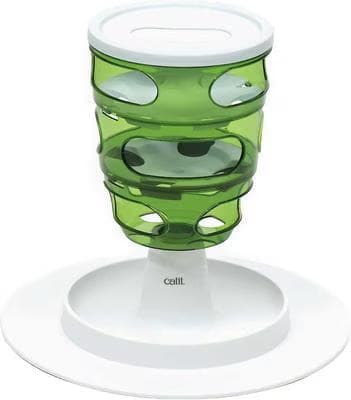
A food-tree puzzle adds an activity to everyday feeding. Introduce it gradually using part of your cat’s usual food allowance.
Webvet may earn a commission when you click through to Chewy, at no extra cost to you.
You can usually tell whether your cat is the culprit at all, because cat damage and plant trouble look different.
- Cat chewing: chewed leaf tips that are frayed, torn straight across, and often damp or flattened, usually on the leaves nearest the cat.
- Watering or humidity trouble: dry, crisp, brown tips with no tearing, appearing evenly across the whole plant.
- Both together: very common, and it is the torn tips rather than the brown ones that tell you your cat is chewing the leaves.
What happens if your cat eats a spider plant
In most cases, nothing at all. The cat chews, swallows a little leaf, and carries on with its day. Vomiting can still occur after plant material is eaten; the ASPCA listing does not give a fixed recovery time.
The ASPCA spider-plant entry gives a non-toxic verdict, not a diagnosis for a sick cat. Plant material can still upset the gut, and potting products or an incorrectly identified plant may change the assessment. Report the plant, amount and signs to your veterinarian.
A stomach loaded with fibrous leaf material irritates, and it comes back up. The rarer problem is bulk instead of irritation: a cat that swallows long strands, or a detached plantlet swallowed whole, can occasionally end up with a foreign body obstruction, which is a genuine emergency.
| What you are seeing | What it usually means | What to do |
|---|---|---|
| A single episode of vomiting, then normal behavior | Ordinary stomach irritation from swallowed leaf | Ask your veterinarian whether home observation is appropriate. |
| Persistent or repeated vomiting or diarrhea | The gut has not settled on its own | Call your veterinarian the same day |
| Drooling, pawing at the mouth, or refusing food | Mouth irritation, and a prompt to confirm what was really chewed | Call your veterinarian, and check the plant by name in the ASPCA database |
| Repeated retching or gagging with nothing produced | Possible obstruction from swallowed plant strands | Urgent. Call your veterinarian or an emergency clinic now |
| Lethargy, hiding, or a tense and painful belly | Something beyond simple irritation | Same-day veterinary examination |
| Repeated vomiting plus refusing to drink | Fluid losses adding up toward dehydration | Call your veterinarian the same day |
Two of those rows carry most of the weight. A single episode of vomiting in a cat who is then bright, eating, and using the litter box normally is different from persistent illness; ask your veterinarian if you are uncertain.
The other is duration. Vomiting or diarrhea that keeps going, or a cat that stops drinking, moves this out of housekeeping and toward dehydration. Call your veterinarian rather than waiting to see whether tomorrow looks better.
If your cat brought up plant material once and is otherwise completely themselves, our guide to a cat vomiting but acting normal walks through what usually explains it. It also helps to be sure of what you found, which is where our comparison of a hairball versus something else earns its place.
What to do if your cat just ate a spider plant
Because the plant is non-toxic, the first-aid answer is short and mostly practical. Take the plant material away, make sure your cat cannot go back for more, and then watch.
- Clear away the chewed leaves and any fragments on the floor, then move the plant somewhere the cat genuinely cannot reach.
- If your cat will let you, look in the mouth and gently rinse away any clinging pieces of leaf with a little water.
- Offer fresh water. Do not force food, and do not offer milk, oil, or any home remedy.
- Note the time and roughly how much was eaten, and keep a leaf or a photo of the plant in case you need to describe it accurately.
- Watch for the signs in the table above for the rest of the day and overnight.
That guidance is deliberately brief, because spider plant almost never needs more than it. If the chewed plant is not a spider plant, or its identity is uncertain, call your veterinarian or poison control promptly for plant-specific advice before waiting for symptoms.
If a phone call does turn into a clinic visit, it helps to know roughly what you are walking into. Our breakdown of emergency vet cost sets expectations before you are standing at a reception desk at two in the morning.
The real hazard is usually what is in the pot
Here is the part a plant record cannot cover. The ASPCA lists the plant, not your pot. Whatever you have sprayed on the leaves, pushed into the soil, or watered in is a separate exposure, and some of those products genuinely can poison a cat.
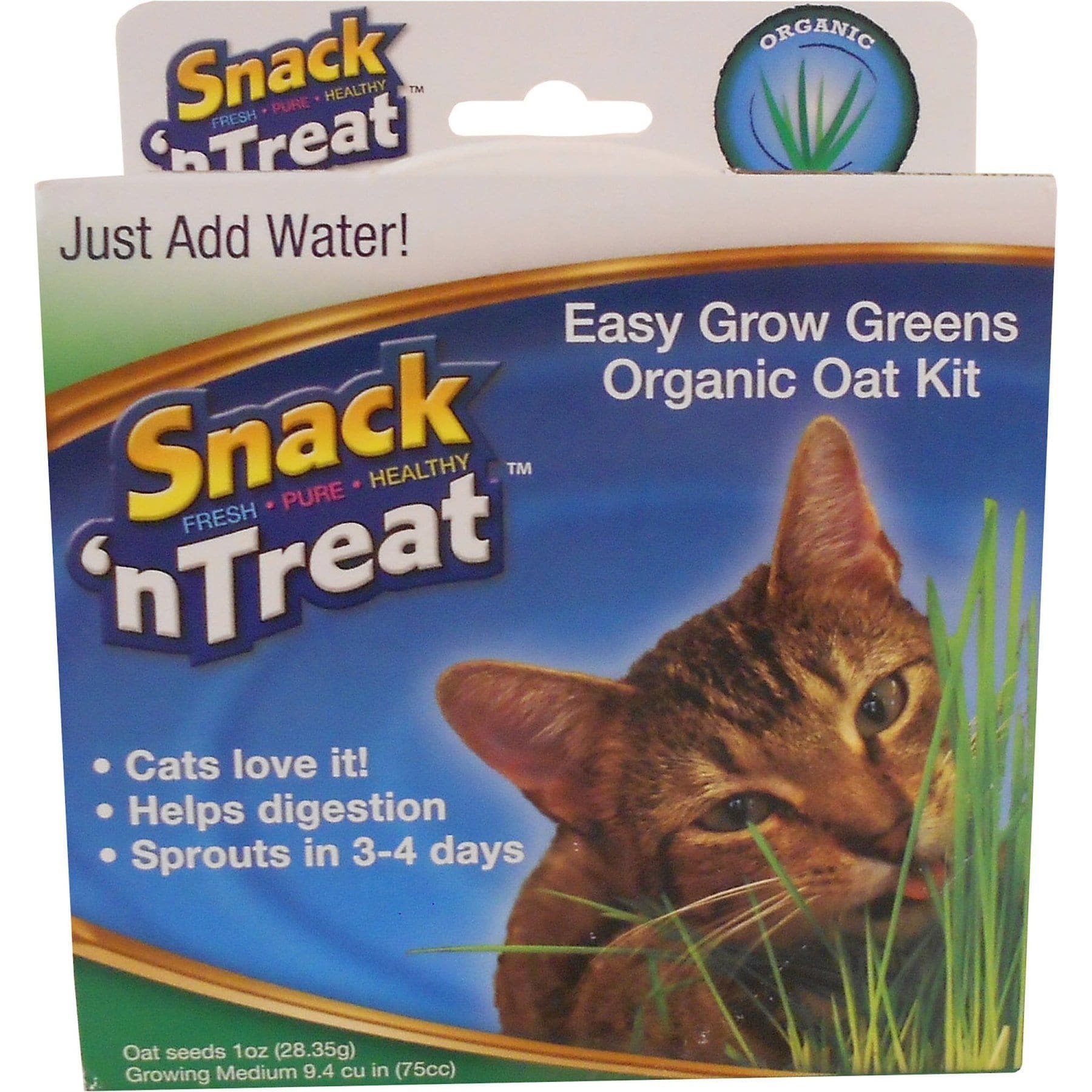
Grow a small tray of oat grass for your cat. Follow the kit instructions and keep ornamental plants out of reach.
Webvet may earn a commission when you click through to Chewy, at no extra cost to you.
Repotting does not establish that a previously treated plant is safe. Ask the seller what was applied and keep feed and pest products away from pets.
It also means a cat that vomits after chewing a spider plant is not automatically a spider plant story. Check the label before you conclude the leaf was the cause.
Can you keep a spider plant when you have cats?
Yes. A spider plant is one of the few houseplants you can keep in a house with cats without having to negotiate with yourself about it, and the ASPCA record is the reason it appears on almost every cat-safe list.
What you are actually managing is wear and tear, running in both directions. The plant loses leaf tips to a cat that likes chewing, and the cat occasionally returns some of that to you on the carpet.
That trade is usually worth making. It is still worth being honest that a cat which eats the plant every single day is telling you something, and the answer to that is a redirection plan plus a word with your vet, not a bigger plant.
- Keep it if your cat nibbles occasionally and shows no lasting effects afterward.
- Keep it if you can repot into untreated soil and skip systemic products from here on.
- Keep it if you have somewhere the cat truly cannot reach, or you are simply content to own a chewed plant.
- Rethink it if your cat eats plant material compulsively rather than casually.
- Rethink it if your cat vomits every time, which is unpleasant for both of you even when it is not dangerous.
- Rethink it if you have no way of knowing what was already applied to the plant before you bought it.
How to keep your cat out of the spider plant

The most effective tactic is also the least clever: put the plant where the cat is not. Cats jump higher and further than owners estimate, so an out of reach shelf has to mean genuinely out of reach rather than merely high up.
- Hanging planter placement in the middle of a room, away from furniture, worktops, and anything that works as a launch pad.
- A ceiling hook rather than a wall bracket, so there is nothing solid beside the plant to stand on.
- A room the cat does not have access to, if no hanging spot is available.
- Not a high shelf with a chair, radiator, or cabinet within one jump of it. That is the usual failure, and cats find it within a day.
Trailing runners quietly undo good placement. The plantlets dangle below the pot, so a plant that is out of reach at the rim can still be well within reach at the tip of a runner. Trim the runners back if your cat has started working them.
Deterrent sprays can help at the margins. Use them on surfaces and pots only, as the label allows, never on anything the cat is going to eat, and never as a replacement for moving the plant.
Redirection works better than deterrence, because it gives the behavior somewhere legitimate to go.
- Grow cat grass with an Imperial Cat Easy Grow Cat Oat Grass Kit, and put it somewhere obvious at floor level.
- Put the cat grass roughly where the houseplant used to be, so the habit has an easy new destination.
- Keep it fresh. A dried-out, yellowing tray sends your cat straight back to the houseplant.
- Add climbing, scratching, and play options if the plant is being attacked out of boredom rather than appetite.
Give any of this a few weeks before you judge it. A cat that has been chewing the same spider plant for months will keep checking its old spot, and the redirection has only worked once that checking stops.
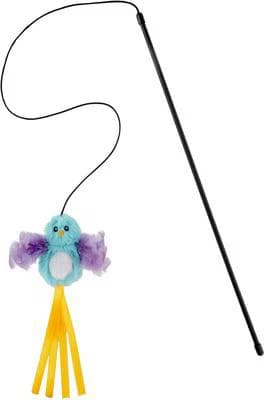
Make time for supervised play with a feathered wand. Put the toy away after each session.
Webvet may earn a commission when you click through to Chewy, at no extra cost to you.
Are spider plants toxic to dogs?
Spider plants are pet-friendly for cats and dogs in the specific sense that the ASPCA lists the plant as non-toxic. The same ASPCA Animal Poison Control record that clears the plant for cats lists Chlorophytum comosum as non-toxic to dogs. That verdict is read off the record itself rather than inferred from the cat answer, and the two species are named together on the same listing.
The practical difference is scale. A dog that decides to eat a houseplant often takes most of it, along with a mouthful of soil and sometimes a piece of the pot, so the volume of plant material involved can be far greater than anything a cat manages in a session.
That shifts what to watch for. The signs are the same, with vomiting and diarrhea the most likely, but a large mass of fibrous leaf material makes obstruction more plausible, and a mouthful of soil brings whatever was in that soil along with it.
- One episode of vomiting in a dog that is otherwise bright and eating usually means watching at home.
- Repeated or persistent vomiting or diarrhea means calling your veterinarian.
- Retching with nothing produced, lethargy, or a tense and painful abdomen means treating it as urgent.
- Both poison control lines take dog calls on the same numbers, around the clock, for the same consultation fee.
Dogs have a different toxic-plant list. Check each plant in a mixed-pet household for both species.
The houseplants that really are dangerous
A safe verdict on one plant is only useful when you know where it sits. Several plants that commonly share a windowsill with a spider plant are not in the same category at all, and that contrast is what makes the reassurance worth anything.
| Plant | ASPCA plant listing for cats | What the record describes |
|---|---|---|
| Spider plant (Chlorophytum comosum) | Non-toxic to dogs and cats | No toxic principle identified |
| True lilies (Lilium species) | Toxic to cats | Kidney failure |
| Golden pothos (Epipremnum aureum) | Toxic to dogs and cats | Insoluble calcium oxalates: burning mouth, drooling, vomiting |
| Heartleaf philodendron (Philodendron hederaceum) | Toxic to dogs and cats | Insoluble calcium oxalates: oral pain and swelling, drooling |
| Peace lily (Spathiphyllum) | Toxic to dogs and cats | Insoluble calcium oxalates: mouth irritation, difficulty swallowing |
| Snake plant (Sansevieria trifasciata) | Toxic to dogs and cats | Saponins: nausea, vomiting, diarrhea |
| Aloe vera | Toxic to dogs and cats | Saponins and anthraquinones: vomiting, lethargy, diarrhea |
The rest, and pothos and philodendron in particular, are irritants rather than organ toxins. A cat that bites one usually gets a burning mouth, drools heavily, and stops immediately. That is genuinely unpleasant and worth a veterinary call, but it is a different order of problem from lily exposure.
The snake-plant guide covers its different toxicity listing for cats and dogs. Its name resembles spider plant, but the two plants should not be treated as interchangeable.
This table is a calibration, not a list. Our complete cat toxic-plant guide carries the full comparison. You can also look any plant up by name in the ASPCA toxic and non-toxic plant database, the same source every row above comes from.
Other cat-safe plants worth swapping in

If something on that list has to go, a spider plant is not your only replacement. Several common houseplants carry the same non-toxic listing for dogs and cats in the ASPCA database.
For a flower rather than a leafy houseplant, see the rose guide. It distinguishes the plant listing from the physical risk of thorns.
True roses (Rosa species) are not toxic to cats. Their thorns and swallowed stems create different concerns from plant toxins, so a rose arrangement still needs to be inaccessible to a cat that chews or bats at flowers.
- Boston fern (Nephrolepis exaltata bostoniensis): listed non-toxic to dogs and cats.
- Parlor palm (Chamaedorea elegans): listed non-toxic to dogs and cats.
- Areca palm (Dypsis lutescens): listed non-toxic to dogs and cats.
- Bamboo palm (Chamaedorea seifrizii): listed non-toxic to dogs and cats.
- Cat grass, grown from cereal seed and sold specifically for cats to graze on, which is the only item here the cat is meant to eat.
The same qualifier applies, and it matters more on a list than on a single verdict. Non-toxic means no known systemic poisoning. It does not mean harmless. Any plant eaten in quantity can cause vomiting or drooling, and any plant can become an obstruction, so a non-toxic label is a floor rather than a guarantee.
A full cat-safe houseplant shortlist, sorted by how hard each one is to keep alive, is the job of our safe-plant guide rather than this page. Look the species up by its scientific name before you buy it.
Baby’s breath also needs a precise name check: the ASPCA lists Gypsophila elegans as non-toxic but notes that eating it may cause vomiting or diarrhea. Our flower guide explains that bouquet verdict alongside the stems that are toxic.
Catnip is a different choice from cat grass. The ASPCA catnip entry notes vomiting and diarrhea and different behavioral reactions among cats. Do not assume it is harmless in any quantity or use it as a substitute for keeping an unsuitable plant out of reach.
Poison-proofing the rest of your home
Plants are one lane, and not the busiest one. Most of what sends cats to emergency clinics is not green at all, and it is worth a pass through the house once the plant question is settled.
Our guide to poison-proofing your cat home covers the rest of it, and the usual offenders are not exotic.
- Human medication left out on a counter, a bedside table, or in an open bag.
- Cleaning products, including the residue left on floors and worktops before it dries.
- Topical treatments meant for people, applied to skin the cat then grooms or sleeps against.
Minoxidil, a hair-loss treatment found in products such as Rogaine, can cause severe poisoning in cats. Any suspected exposure needs an immediate call to a veterinarian or poison-control service; the spider plant's non-toxic listing offers no reassurance about a human medicine.
Cannabis is not a safe explanation for a cat acting oddly after chewing a plant. The ASPCA lists Cannabis sativa as toxic to cats, with effects including vomiting, incoordination and altered activity. Keep cannabis and medications secured, and call your veterinarian or poison control after possible exposure instead of attributing the signs to a spider-plant “high.”
- Flea and tick products formulated for dogs, several of which are seriously dangerous to cats.
Keep both poison control numbers somewhere you can find them at two in the morning, not just in a browser tab. ASPCA Animal Poison Control is (888) 426-4435, and the Pet Poison Helpline is (855) 764-7661. Both run 24/7 and both charge a consultation fee.
The bottom line on the plant itself has not moved. Spider plants are not toxic to cats, the ASPCA record says so plainly, and the sensible response to a chewed one is to move it up, put cat grass down, and watch your cat for the rest of the day.
Spider plant and cat questions
Frequently Asked Questions
Are spider plant babies and runners safe for cats too?
Yes. The plantlets and runners are the same species as the parent plant, so they carry the same non-toxic listing in the ASPCA Animal Poison Control database. There is no separate record for them, and no different verdict.
What changes is the mechanics rather than the toxicity. A plantlet is a compact bundle of leaf and root that a cat can bat off and carry away, and a detached plantlet swallowed whole rather than chewed is a bulk problem. Repeated retching with nothing produced needs an immediate call to your veterinarian or an emergency clinic.
Will my spider plant grow back after my cat has chewed it?
Usually, yes. Spider plants are difficult to kill and they recover well from chewing. Individual leaves do not repair themselves, so a leaf bitten across stays blunt and often browns at the cut.
Trim the chewed leaf right down at the base rather than snipping the damaged tip, and the plant puts out new growth from the crown.
If a lot has gone, cut back the worst leaves, water as normal, and give it a few weeks in decent light. Move it out of reach first, or you will be doing this again next month.
How much spider plant does a cat have to eat before it is a problem?
The ASPCA lists Chlorophytum comosum as non-toxic to cats; that listing does not establish an amount that is safe to eat. Plant material can still upset the stomach. Ask your veterinarian about the amount eaten and any symptoms rather than relying on a numerical safe dose.
What determines whether your cat is sick is the volume of fibrous material swallowed, not a dose. A nibbled leaf tip is usually nothing at all, and a mouthful of shredded leaf may well come back up.
So the useful test is your cat rather than the plant. Call your veterinarian if vomiting repeats, if your cat retches without producing anything, or if they go quiet and withdrawn.

Editor
The Webvet Editorial Team is the in-house group of pet-care editors and writers behind Webvet, operated by Smart Pet Collective. The team researches, writes, and maintains Webvet's pet health, behavior, and medication content. Every article follows a defined editorial process: research from reputable veterinary and scientific sources, careful drafting, mandatory review of medical content by a credentialed veterinarian, and dated publication. Health and medication articles are medically reviewed by a licensed veterinary professional before they go live and are kept current over time.
Veterinarian · BVMS MRCVS
Dr. Pippa Elliott, BVMS, MRCVS, is a veterinarian with nearly 30 years of experience in companion animal practice. Dr. Elliott earned her Bachelor of Veterinary Medicine and Surgery from the University of Glasgow. She was also designated a Member of the Royal College of Veterinary Surgeons. Married with 2 grown-up kids, Dr. Elliott has a naughty Puggle named Poggle, 3 cats and a bearded dragon.
Related reading

Is Pothos Toxic to Cats? Yes, and So Is Philodendron

Is Monstera Toxic to Cats? Symptoms and What to Do

Is Aloe Vera Toxic to Cats and Dogs? What to Do Now
