Are Roses Toxic to Cats? Petals, Thorns, and Sprays
Are roses toxic to cats? The ASPCA lists true roses as non-toxic, but thorns, pesticide sprays, floral preservative water, and the plants sold under a rose name are all real reasons cats end up at the vet.

BVMS MRCVS
Medically reviewed by Dr. Pippa Elliott, BVMS MRCVS · Last reviewed

This article contains affiliate links. Webvet may earn a commission when you buy through them, at no extra cost to you.
Are roses toxic to cats? No. The ASPCA Animal Poison Control Center lists the true rose, Rosa species in the family Rosaceae, as non-toxic to cats, dogs, and horses. A cat that nibbles a petal off the bouquet on your table has not eaten a poison, and there is no antidote to go chasing.
That verdict is real, and it is the first thing a worried owner deserves to hear. It is also narrower than it sounds. Non-toxic means no known systemic poison. It does not mean harmless.
The listing also says nothing at all about thorns, pesticide sprays, vase water, or the several plants sold under a rose name that are not roses at all. Those are the four things this guide works through.
- 1The ASPCA lists the true rose, Rosa species, as non-toxic to cats, dogs, and horses. Color, cultivar, spray roses, miniature roses, and dried or preserved roses all inherit that same listing.
- 2Non-toxic means no known systemic poison. It does not mean harmless: a cat that eats a lot of petal or leaf can still vomit, drool, or develop a gut obstruction.
- 3The real rose hazards are mechanical and chemical: thorns, pesticide or systemic insecticide residue, and floral preservative dissolved in vase water.
- 4Several plants sold under a rose name are genuinely toxic, including desert rose, moss rose, Christmas and Lenten rose, primrose, rosebay, and peony.
- 5If your cat is drooling, vomiting repeatedly, squinting, or acting unwell, call your veterinarian, the ASPCA Animal Poison Control Center on (888) 426-4435, or the Pet Poison Helpline on (855) 764-7661. Never induce vomiting at home.
Are roses toxic to cats?
Are roses toxic to cats? No, not the true rose. The ASPCA maintains the toxic and non-toxic plant database most veterinary triage lines work from, and Rosa species sits on the non-toxic side of it with no toxic principle recorded. In short, the ASPCA lists roses as non-toxic to cats, dogs, and horses.
That listing is written at the genus level. Rosa covers every garden rose, florist rose, hybrid tea, climbing rose, and supermarket bunch you are realistically going to bring home. It is why no reputable source publishes a separate verdict for red roses against white ones.
- It does tell you there is no cardiac glycoside, no oxalate crystal, no grayanotoxin, and no other known systemic poison in rose petals, leaves, or stems.
- It does not tell you a cat can eat a bouquet without consequence. Plant material in quantity irritates a feline stomach whether or not it is toxic.
- It does not cover what a grower or a florist sprayed on the bloom, which the plant database never assesses.
- It does not cover thorns, because a puncture is an injury rather than a poisoning.
Are all roses safe for cats, then? As plants, yes. Roses and their flowers are not poisonous to cats, and neither are the leaves or the stems, because every rose in the genus Rosa carries the same database entry whatever the color, size, or cultivar printed on the label at the shop.
That distinction is what the flat yes-or-no answers on this question keep losing. Roses are a genuinely reassuring case. They are not a risk-free one, and the sections below take each hazard that survives the verdict in turn.

A window perch gives your cat a dedicated resting spot. Install it as directed and keep it away from accessible plants.
Webvet may earn a commission when you click through to Chewy, at no extra cost to you.
How a non-toxic rose can still send a cat to the vet
A veterinarian seeing a cat after a rose incident is almost never treating a poisoning. They are treating one of four other things, and working out which one you are looking at is what decides whether tonight needs a phone call.
- Gastrointestinal upset from bulk. A cat that eats a large amount of petal or leaf may vomit, drool, or pass loose stool simply because plant fibre is not part of a feline diet. This is the common outcome, it is usually self-limiting, and it is what most owners are actually describing when they say the rose made their cat sick.
- A gastrointestinal foreign body. Stem fragments, a swallowed thorn, or a compacted wad of leaf can lodge in the stomach or the intestine, and that is a surgical problem rather than an upset-tummy one. It is uncommon, but it is the reason a cat that keeps retching without producing anything needs a vet rather than another hour of watching.
- Mechanical injury from thorns, including punctures to the paw, the mouth, and the eye.
- Chemical exposure from whatever was sprayed on the flower or dissolved into the water it is standing in.
None of those four appears on the ASPCA plant listing, because the listing rates the plant and not the situation the plant is sitting in. That is the gap this guide exists to close.
Can roses make cats sick, or kill them?
Can roses make cats sick? Yes, in the ordinary way that any large mouthful of plant can. Do roses make cats sick reliably, or badly? No. Most cats that chew a petal are completely fine, and the ones that are not usually have one bad afternoon.
Can roses kill cats? There is no poisoning mechanism by which a true rose would, and the ASPCA lists no fatal syndrome for Rosa.
Where roses hurt cats seriously, it is through an obstruction, an untreated eye injury, or a chemical that was on the flower. Each of those is treatable when it is caught early, which is the entire argument for calling rather than waiting.
Rose petals, leaves, and stems: what happens if your cat eats one

What happens if your cat eats roses? A true rose is listed as non-toxic, but swallowed plant material can still cause vomiting or stomach upset. The ASPCA rose entry does not give a symptom-onset or recovery timetable. The amount and texture, thorns, and any chemical treatments all matter.
It helps to know which part your cat actually reached, because owners routinely mistake a rose leaflet for a petal after the fact. A rose leaf is compound: one leaf is several toothed leaflets on a shared stalk. A petal is soft, single, and comes away clean.
Rose hips, the swollen red fruit left behind after the bloom drops, sit on the same non-toxic listing as the rest of the plant. They are firm, though, and a cat that swallows one whole has swallowed an object rather than a food.
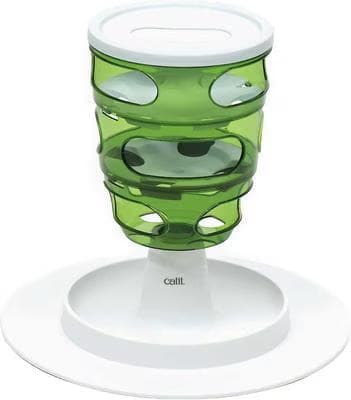
A food-tree puzzle adds an activity to everyday feeding. Introduce it gradually using part of your cat’s usual food allowance.
Webvet may earn a commission when you click through to Chewy, at no extra cost to you.
| Part of the rose | Toxic to cats? | What it can actually do | Call the vet? |
|---|---|---|---|
| Petals | No, ASPCA non-toxic | Mild stomach upset or one vomit if a lot is eaten | Only if vomiting repeats or your cat seems unwell |
| Leaves | No, ASPCA non-toxic | As petals, with more fibre, so more likely to come back up | Only if vomiting repeats or your cat stops eating |
| Stems | No, ASPCA non-toxic | Fibrous fragments can irritate the gut or lodge as a foreign body | Yes if a large piece was swallowed, or your cat retches without producing |
| Thorns | Not a poison at all | Punctures to paw, mouth, gum, or eye, and a route for infection | Yes for any eye involvement, and for a puncture that swells or oozes |
| Rose hips | No, ASPCA non-toxic | A firm whole fruit is a choking and obstruction risk, not a poison | Yes if swallowed whole by a kitten or small cat, or if retching follows |
| Sprayed blooms | The rose is not, the spray may be | Pesticide or systemic insecticide exposure that no rinse removes | Yes, and name the product when you call |
| Vase water | The rose is not, the water may be | Floral preservative, biocide, and decay bacteria in water cats like | Yes if your cat drank from a treated vase and then vomits or drools |
Read that as a triage tool rather than a ranking. A petal and a thorn are not the same kind of problem, and collapsing them into one flat hazard list is exactly why owners either panic over a petal or shrug off an eye injury.
- Part by part in plain words: the petal is the least of it, the leaf is the same story with more fibre, the stem is the piece that can lodge, the thorn is an injury rather than a poisoning, the rose hip is an object to swallow rather than a food, the sprayed bloom is a chemical question rather than a plant one, and the vase water is the part most cats actually drink.
- Can cats eat roses? They can, in the sense that it will not poison them. A cat that ate a rose petal off the table usually shows nothing worse than vomiting or drooling once, and often shows nothing at all. Volume is what turns a harmless mouthful into an unpleasant evening for both of you.
- Are roses safe for cats to eat? Not as a food. Nothing in a bouquet is feline nutrition, and a cat that grazes on petals is filling its stomach with fibre it cannot use.
- Are rose leaves toxic to cats? No. Rose leaves carry the same non-toxic listing as the flower, so a cat that eats leaves from roses has the same bulk problem, not a poisoning.
- Can cats have roses in the house at all? Yes, with the thorns stripped and the vase out of reach, which the placement section covers.
Two things matter regardless of which part was eaten: how much, and how your cat looks afterwards. One chewed petal in a bright, eating, normally behaving cat is a watch-and-see. A cat that ate a handful and is now drooling is a phone call.
Do rose color, variety, or form change the answer?
No. The ASPCA listing covers Rosa as a genus, so every rose you can buy inherits the same non-toxic verdict. There is no toxicological difference between a red rose and a white one, and no cultivar of true rose has been singled out as dangerous to cats.
One rule settles the entire long tail of this question.
- Color changes nothing at all. White roses, pink roses, red roses, yellow roses, orange roses, and lavender roses are every one of them Rosa, and color comes from pigment rather than from any toxin. There is no such thing as a variety of true rose that is safe while another one is not.
- Size and habit change nothing either. Miniature roses, mini and parade and kordana pot roses, spray roses, hybrid tea roses, climbing roses, and knockout roses all belong to the same genus and inherit the same listing. Spray roses and miniature roses are not a different plant, only a different size on the label.
- Garden against florist: the plant is identical. What differs is the spray history, which is a chemical question rather than a plant one.
- Dried roses and preserved roses keep the same non-toxic plant material, because they are the same genus after treatment as before it. Preserved roses are soaked in glycerin and dye, though, so treat preserved roses as a chemical unknown rather than a plant question and keep them well out of reach.
- Rose-scented or rose-flavored products: not plants at all, and not covered by the plant verdict.
Only two things genuinely change the answer. The first is what was applied to the flower. The second is whether the plant is a rose at all, which is where most wrong answers come from.
The plants sold as roses that really are toxic

Rose is one of the most borrowed names in horticulture. Several plants sold under a rose label are not in the genus Rosa, are not covered by the rose listing, and are genuinely toxic to cats. This is the most common way a reader gets a perfectly correct answer about the wrong plant.
A true rose has thorny stems, compound leaves with toothed leaflets, and the familiar layered bloom. If the plant on your windowsill has a fat swollen trunk, fleshy succulent leaves, a leathery evergreen shrub habit, or a low mat of tiny paddle-shaped leaves, check the label before you lean on a rose verdict.
The table identifies six rose-named plants in the ASPCA database by botanical name, toxic principle, and listed clinical signs. Common names overlap: the moss rose row describes Portulaca oleracea, and the hellebore row describes Helleborus niger. Other species also share those names, as explained below. Read the botanical name on the pot, not just the shop label.
| Plant sold under a rose name | Botanical name | ASPCA toxic principle | ASPCA-listed clinical signs |
|---|---|---|---|
| Desert rose (desert azalea, impala lily, mock azalea, sabi star) | Adenium obesum | Cardiac glycosides | Vomiting, diarrhea, anorexia, depression, irregular heart beat, death |
| Moss rose or purslane: ASPCA entry for P. oleracea; common name also used for other species | Portulaca oleracea | Soluble calcium oxalates | Kidney failure (rare in dogs and cats), tremors, salivation |
| Hellebore: ASPCA H. niger entry (Christmas, Lenten, Easter rose); Lenten rose can also mean H. orientalis | Helleborus niger | Bufadienolides, glycosides, veratrin, protoanemonin | Drooling, abdominal pain and diarrhea, colic, depression |
| Primrose | Primula vulgaris | Unknown | Mild vomiting |
| Rosebay (rhododendron, azalea) | Rhododendron spp. | Grayanotoxin | Vomiting, diarrhea, hypersalivation, weakness, coma, hypotension, CNS depression, cardiovascular collapse and death |
| Peony | Paeonia officinalis | Paeonol | Vomiting, diarrhea, depression |
So what roses are toxic to cats? True Rosa roses are non-toxic, but the six entries below describe plants from other genera. A rose name on a label is not enough to identify the plant.
- Are desert roses poisonous to cats? Yes. Adenium obesum is the swollen-trunked succulent also sold as desert azalea, impala lily, mock azalea, and sabi star. The ASPCA gives its toxic principle as cardiac glycosides, the same class of compound that makes foxglove dangerous, and lists an irregular heart beat among the signs.
- Are moss roses toxic to cats? The ASPCA moss rose entry identifies Portulaca oleracea as toxic, with soluble calcium oxalates and signs including salivation, tremors, and rarely kidney failure in cats and dogs. That common name is ambiguous: Portulaca grandiflora is also sold as moss rose. Do not use the name alone to identify your plant or transfer one species listing to another. Keep an unidentified plant away from your cat and give your veterinarian a photo and the botanical label after an exposure. Compare the ASPCA moss rose record with the NC State common-name guide.
- Are Lenten roses poisonous to cats? Yes, but the common names do not all identify one species. The ASPCA hellebore record names Helleborus niger and lists Christmas, Lenten, and Easter rose as common names; its recorded signs include drooling, abdominal pain, diarrhea, colic, and depression. NC State identifies Lenten rose as Helleborus orientalis, a distinct species that is also toxic to cats. Horticultural hybrids add to the identification problem. Keep hellebores away from your cat and use the botanical label when calling about an exposure. Check the ASPCA hellebore entry and NC State Lenten rose identification.
- Primrose is Primula vulgaris, the small clustered spring bedding plant sold in pots everywhere from February onward. The ASPCA lists it as toxic to cats with its toxic principle recorded as unknown and mild vomiting as the only clinical sign. It is the mildest entry on this list, but it is still not a rose and still not covered by the rose verdict.
- Rosebay is the rhododendron and azalea group, Rhododendron spp., a leathery evergreen shrub rather than a thorny cane. The ASPCA gives grayanotoxin as the toxic principle, and its clinical signs run from vomiting, diarrhea, and hypersalivation through weakness and CNS depression to cardiovascular collapse. This is the most serious plant on the list.
- Are peony roses toxic to cats? Yes. Peony is Paeonia officinalis, the heavy multi-petalled garden bloom that people genuinely do mistake for a rose when it turns up in a mixed bouquet. The ASPCA gives its toxic principle as paeonol and lists vomiting, diarrhea, and depression as the clinical signs it produces in cats.
Two of those deserve extra weight. Desert rose is a common houseplant, and cardiac glycosides act on the heart rather than just the gut, which is why an irregular heart beat appears in its entry at all.

Grow a small tray of oat grass for your cat. Follow the kit instructions and keep ornamental plants out of reach.
Webvet may earn a commission when you click through to Chewy, at no extra cost to you.
Rosebay is the second. Rhododendron and azalea are everywhere in gardens, and grayanotoxin can affect the heart as well as the digestive tract.
If you own one of these, or were just handed one, the rose verdict on this page does not apply to your plant. Call your veterinarian or a poison control line with the botanical name in hand rather than the shop label.
Rose thorns: punctures, eye injuries, and rose gardener’s disease

Thorns are the rose hazard that actually generates veterinary visits. Botanically they are prickles rather than true thorns, but the practical point stands: they are sharp, they sit at the height a cat bats and sniffs at, and they carry soil and plant debris into whatever they puncture.
A superficial scratch is different from a puncture that may leave a thorn or plant debris beneath the skin. Ask your veterinarian about a suspected puncture, persistent pain, swelling or bleeding. Any eye involvement needs immediate veterinary attention.
- Thorn punctures can affect the paw, the mouth, or the eye. A suspected puncture to the paw or mouth needs veterinary advice because plant material may remain in the wound. Do not probe for an embedded thorn yourself. An eye injury is an emergency rather than a wait-and-see.
- A puncture that swells, weeps, or turns hot and painful over the next day or two, which suggests a retained fragment or an infection taking hold.
- A puncture inside the mouth or on the gum. A cat that suddenly drools, paws at its face, or refuses food may have driven a thorn into soft tissue.
- Any eye involvement whatsoever, including squinting, tearing, a held-shut eye, or pawing at the face.
- Limping that has not settled within a few hours, or a paw your cat will not let you touch.
Sporotrichosis, the rose gardener’s disease
Sporotrichosis is a fungal infection caused by Sporothrix, and it carries a nickname worth knowing. The CDC describes Sporothrix as living in soil and on plants including sphagnum moss, rose bushes, and hay, and says infection happens when the fungus gets into a cut or a scrape, such as a prick from a rose thorn.
In a cat it does not look like a poisoning. It looks like a wound that will not close. Early thorn infection symptoms are easy to write off as a scratch having a slow week.
- What owners actually notice is slow-healing nodules: firm lumps under the skin, often on the head, nose, or a paw, that ulcerate and drain. A puncture wound that scabs over and then reopens instead of closing is the other classic pattern, along with lesions that appear or worsen weeks after the original injury rather than days.
- Sporotrichosis is a documented thorn-associated fungal infection in cats rather than a theoretical one, and it carries a zoonotic caution attributed to the CDC. The CDC notes that cats can pass Sporothrix to people and to other animals through bites, scratches, and even sneezes, and that cat-associated sporotrichosis is a growing global public health concern.
- Wash any scratch or bite promptly with soap and water, and tell both your veterinarian and your own doctor if a draining lesion is in the picture. A puncture wound from a thorn is the classic entry point, which is why gardeners hear about this infection rather more often than cat owners do.
Sporotrichosis is uncommon, but a wound that will not heal needs veterinary assessment. Diagnosis requires laboratory testing. Sporotrichosis treatment uses prescription antifungal medicine chosen and monitored by a veterinarian; it is not a home-remedy problem. Do not choose a drug or stop treatment yourself, and ask your veterinarian how to limit contact with draining lesions while your cat is being assessed. See the CDC guidance on feline sporotrichosis.
Symptoms to watch for after a cat eats a rose
Because a true rose carries no known systemic poison, there is no rose-specific toxic syndrome to watch for. Irritation, a swallowed object, or a chemical on the flower can cause different problems. Do not assume that they follow one predictable timeline.
The signs below separate observations to report from reasons to call a veterinarian immediately. Ask your veterinarian whether home observation is appropriate and how long to continue it; a non-toxic plant listing does not establish a recovery deadline.
- 1Report vomiting, drooling, lip-smacking, or loose stool after plant ingestion. Note when each sign started and whether it repeats.
- 2Clear away the plant material, identify the plant and any treatments, and ask your veterinarian whether home observation is appropriate for your cat.
- 3Call your veterinarian if vomiting repeats, your cat cannot keep water down, or drooling persists. Follow the observation period and callback instructions the clinician gives you.
- 4Call now, whatever the timeline, if your cat is lethargic, hiding, wobbly, breathing oddly, has a swollen face, is squinting, or is retching without bringing anything up.
- 5Call now if your cat is a kitten, is very small, has kidney or heart disease, or ate a bloom you know had been sprayed.
Two signs deserve emphasis because owners so often read them as minor. Retching or gagging without producing anything can mean an obstruction rather than a simple upset.
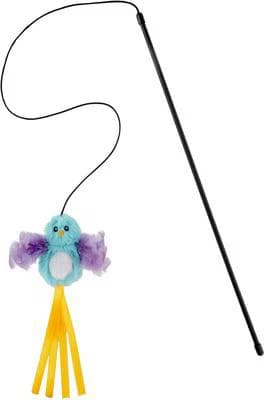
Make time for supervised play with a feathered wand. Put the toy away after each session.
Webvet may earn a commission when you click through to Chewy, at no extra cost to you.
The other is behavioral. A cat that goes quiet and hides is showing you the feline version of feeling very unwell, which is easy to mistake for a cat simply having a nap.
Note the time, the plant, the part, and roughly how much. That is the first thing you will be asked.
What to do if your cat ate a rose
Keep this simple. The job in the first ten minutes is to stop further exposure, gather information, and make one phone call. It is not to treat anything.
Two rules sit above all the rest. Never induce vomiting at home, and never treat a suspected poisoning with a home remedy of any kind. Both of those do more harm than the swallowed plant in a meaningful number of cases, and neither one replaces the phone call you should be making instead.
- Take the plant material away and move your cat to a room with no flowers in it, so nothing is being added to the problem while you are on the phone.
- Look in your cat's mouth if it is safe to do so, checking for petal fragments, a lodged thorn, or bleeding gums. Do not force it.
- Identify the plant. A photo of the whole plant and its label beats a name from memory, especially given how many things are sold under a rose name.
- Write down the time, the part eaten, and the amount, plus anything you know about sprays, treatments, or the preservative sachet.
- Call. Your own veterinarian first if they are open, an emergency clinic if they are not, or one of the two poison control lines below at any hour of the day or night.
An unplanned call like this one is also where many owners first meet the cost of an after-hours visit. If you are weighing up whether to go in, it is worth knowing what an emergency vet visit costs before you are standing at a reception desk.
Can cats be allergic to roses?
Are cats allergic to roses? Rarely. Allergy and toxicity are separate questions, and this one is worth keeping apart from the verdict above: a plant can be perfectly non-toxic and still be something an individual animal reacts to. Roses are not a common feline allergen.
VCA lists the usual environmental allergens for cats as tree pollens such as cedar, ash, and oak, grass pollens, weed pollens like ragweed, molds, mildew, and house dust mites. Roses do not appear on that list.
There is a botanical reason for that. Rose pollen is heavy and sticky, moved by insects rather than by wind, so very little of it ends up airborne where a cat would inhale it.
What an allergic reaction in a cat actually looks like
A cat can still react to direct contact, and a cat with existing atopic disease may react to plenty of things. Feline allergy signs are usually skin signs rather than the sneezing people expect.
- Severe itching, which is the hallmark sign.
- Overgrooming and hair loss, often on the belly.
- Scratching concentrated around the head and neck.
- Small scabs scattered across the body, which VCA calls miliary dermatitis.
If your cat is itching, overgrooming, or scabby, that is a veterinary conversation rather than a bouquet problem. Allergy signs are easily confused with several other disorders, and pinning down an allergen takes testing rather than guesswork.
Why cats chew roses, and how to stop it
Why do cats love roses? Mostly because a bouquet is a moving, dangling, novel plant at nose height. Cats chew plants for reasons that have nothing to do with the plant tasting good, and a vase of roses hits several of them at once.
- Movement and novelty. A fresh bouquet is the most interesting new object in the room, and the stems sway when batted.
- Texture. Some cats simply like the resistance of chewing fibrous plant material.
- Boredom and attention. Chewing the flowers reliably produces an immediate human reaction, which is a reward.
- A real interest in greens. Plenty of cats seek out grass and leafy material, and for an indoor cat the bouquet may be the only plant within reach.
Redirection works far better than policing the vase. Give your cat a plant it is allowed to have: a pot of cat grass, usually oat, wheat, barley, or rye, satisfies the same urge and is grown for exactly this purpose.
Pair that with making the bouquet boring. Put it somewhere genuinely unreachable rather than somewhere merely high, and interrupt with a redirect to a toy rather than a scold. A cat that gets yelled at learns to chew the flowers when you are out of the room.
Bringing roses into a house with a cat

Are roses toxic to cats if they only smell them? No. Scent is not a route of exposure for a plant with no systemic toxin, and a cat sniffing a rose is not being poisoned. Cats can smell roses perfectly well, and most find them thoroughly uninteresting.
Can cats be around roses day to day? Yes. Can cats be near roses unsupervised? That depends less on the flower and more on the stems, the water, and the shelf.
The practical question was never whether roses can be in the house. It is where they go and what has been done to them.
- Strip the thorns from every stem before the flowers go into the vase. A florist will do it, and a thorn stripper or a careful pass with secateurs does it at home.
- Choose a heavy, stable vase. A knocked-over vase means thorny stems on the floor plus water your cat will investigate.
- Skip the preservative sachet, or use a covered vase your cat cannot drink from. Change the water often either way.
- Put the arrangement somewhere a cat cannot climb to, not merely somewhere tall. Cats treat a shelf as a route rather than a barrier.
- Sweep up dropped petals and leaf litter, because fallen material is what most cats actually eat.
- Ask the florist or grower what the blooms were treated with, particularly if you buy them regularly.
Everything beyond the bouquet, meaning the household plant audit, the cupboards, and the cleaning products, is covered in WebVet's room-by-room guide to how to poison-proof your cat home.
Safer flowers and greens to keep instead
Roses are already one of the reassuring choices, so this is less about replacing them and more about what else can safely share a room with a cat. Two moves cover most of it: make the existing bouquet safer, and give your cat a plant of its own in the form of cat grass grown with an Imperial Cat Easy Grow Cat Oat Grass Kit.
Before you accept the next bouquet, check what else is in it. Mixed supermarket bunches routinely include stems that are a very different conversation from the roses wrapped around them.
For the complete vet-checked list across houseplants, flowers, herbs, and garden beds, see our guide to plants safe for cats.
The rest of the bouquet
Roses rarely arrive alone, and the mixed bunch around them is where the real bouquet risk usually sits. The flowers most often paired with roses do not all share the rose verdict.
Carnations make a rose bouquet unsuitable for a cat to chew. True roses are non-toxic, but carnations are listed as toxic by the ASPCA, with an unknown irritant and mild gastrointestinal signs or dermatitis. The rose petals do not change the risk from the carnation stems and flowers.
- Roses paired with sunflowers are a non-toxic combination according to the ASPCA, although chewing either plant can still upset a cat's stomach. Roses with baby's breath need a botanical-name check: the ASPCA entry for Gypsophila elegans lists it as non-toxic but notes that eating it may cause vomiting or diarrhea. Neither combination makes thorns, sprays, or vase water safe. Chrysanthemums and tulips remain separate toxic-flower questions; check every stem before keeping a mixed bouquet. See the ASPCA bouquet guidance and baby's breath entry.
- Lilies are the standout emergency of the group, and one lily in a mixed bunch is reason enough to refuse the whole thing.
The flower-by-flower version of that question belongs in WebVet’s bouquet safety guide. The safe working assumption for any mixed bunch is that the roses are the least of your concerns, and every other stem deserves checking by name before it goes on a table a cat can reach.
Every plant named here, and the rest of the ASPCA toxic list, is ranked by how urgently a cat needs a veterinarian in our full guide to plants toxic to cats.
What about dogs?
Are roses toxic to dogs? No. The rose verdict is not species-specific: the ASPCA lists Rosa species as non-toxic to dogs and horses as well as cats, so a dog that eats a rose petal has not been poisoned either.
The genus-level verdict also covers mini and spray roses and red or pink varieties when the plant is genuinely Rosa. They are non-toxic to both cats and dogs; color and flower size do not turn a true rose into a poisonous plant. For either pet, the practical hazards remain thorns, swallowed stems, and chemicals used on the flowers. Keep bouquets out of reach and call your veterinarian if your pet develops symptoms after chewing one.
- The lookalike problem also applies to dogs: desert rose, rosebay, hellebore, primrose, the ASPCA's Portulaca oleracea moss rose entry, and peony are listed as toxic to dogs. Use the botanical name rather than a rose label when deciding what your pet encountered. WebVet's dog plant guide covers the wider household plant check.
Lisianthus (Eustoma grandiflora), another flower with rose-like blooms, is included in ASPCA pet-safe bouquet guidance. Non-toxic does not mean a dog should eat it: plant material can still cause stomach upset. For the other stems in a mixed arrangement, use our dog plant safety guide and check each flower by name.
Carnations are different: the ASPCA lists them as toxic to both cats and dogs, with mild digestive signs and skin irritation. If a dog chewed a carnation stem, that is a carnation exposure, not a rose exposure; identify the flower and call your veterinarian for advice. Our carnation safety guide explains the distinction.
Rose and cat questions owners ask
Three questions come up repeatedly that the sections above do not settle, because not one of them is actually about a rose plant.
Frequently Asked Questions
Are rose-scented candles, sprays, and potpourri safe around cats?
Rose-scented candles, sprays, and potpourri are a product hazard rather than a plant hazard, and the non-toxic verdict on Rosa species does not transfer to any of them. A rose-scented product contains no rose plant material at all. What it does contain is fragrance oil, and often essential oil, which is a completely different risk.
Liquid potpourri is the one to be strict about. Pet Poison Helpline reports that even a few licks can cause corrosive burns to the mouth, with pawing at the mouth, retching, vomiting, inappetence, weakness, fever, and difficulty breathing among the signs. Cats also lack a liver enzyme that helps other species process essential oils, and their grooming habit means anything that lands on the coat gets swallowed.
Keep simmering pots and open oil warmers away from your cat, ventilate rooms where you use scented products, and never apply a concentrated essential oil to a cat. If your cat has liquid on its coat, or is drooling, unsteady, or breathing oddly, call your veterinarian or a poison control line straight away.
What should I do if my cat swallowed a rose thorn?
If your cat swallowed a rose thorn, call rather than watch and wait. A swallowed thorn is not an at-home problem, because it is a sharp object travelling through a narrow gut rather than a poison you can monitor for.
It may well pass without incident, and often does, but it can also lodge or perforate, and the early signs of that are not obvious. Do not try to make your cat bring it back up, which risks damage on the way out as well as the way in, and do not feed bread or anything else to cushion it unless your veterinarian tells you to.
Phone your veterinarian or an emergency clinic, tell them what was swallowed and when, and let them decide whether imaging is warranted.
Are roses safe for kittens?
Roses are as safe for kittens as they are for adult cats on the toxicity question, because the same non-toxic listing applies. The practical advice changes, though, because kittens have much smaller bodies and heavier chewing habits.
Kittens explore with their mouths far more indiscriminately, so they are much likelier to actually eat a quantity of petal or leaf, and the same amount of plant material fills a far smaller gut. A swallowed thorn or a rose hip is proportionally a bigger obstruction risk.
Keep bouquets completely out of reach in a house with a kitten rather than merely high up, and lower your threshold for calling your veterinarian if a kitten vomits repeatedly or goes quiet.

Editor
The Webvet Editorial Team is the in-house group of pet-care editors and writers behind Webvet, operated by Smart Pet Collective. The team researches, writes, and maintains Webvet's pet health, behavior, and medication content. Every article follows a defined editorial process: research from reputable veterinary and scientific sources, careful drafting, mandatory review of medical content by a credentialed veterinarian, and dated publication. Health and medication articles are medically reviewed by a licensed veterinary professional before they go live and are kept current over time.
Veterinarian · BVMS MRCVS
Dr. Pippa Elliott, BVMS, MRCVS, is a veterinarian with nearly 30 years of experience in companion animal practice. Dr. Elliott earned her Bachelor of Veterinary Medicine and Surgery from the University of Glasgow. She was also designated a Member of the Royal College of Veterinary Surgeons. Married with 2 grown-up kids, Dr. Elliott has a naughty Puggle named Poggle, 3 cats and a bearded dragon.
Related reading

Is Pothos Toxic to Cats? Yes, and So Is Philodendron

Is Monstera Toxic to Cats? Symptoms and What to Do

Is Aloe Vera Toxic to Cats and Dogs? What to Do Now
