Miliary Dermatitis in Cats: Causes, Treatment, and Flea Control
Miliary dermatitis is many tiny crusted bumps in a cat's fur, often along the back, neck, and tail base. Learn the usual triggers, starting with fleas, how a vet finds the cause, and what treatment and home care involve.

BVMS MRCVS
Medically reviewed by Dr. Pippa Elliott, BVMS MRCVS · Last reviewed

This article contains affiliate links. Webvet may earn a commission when you buy through them, at no extra cost to you.
What miliary dermatitis in cats is and what those tiny scabs mean
Miliary dermatitis in cats is a skin reaction, not a single disease: many tiny crusted bumps scattered through the fur, often along the back, neck, and tail base. VCA Animal Hospitals says it usually results from an allergic reaction, and flea allergy is the most common cause.
Is it urgent? Usually not. VCA calls the outlook for controlling it excellent in most cats, though the trigger still has to be found and removed with a vet's help. The first step is flea control for every pet in the home. A weak, listless cat with pale gums needs a vet right away.
- 1In plain terms, what miliary dermatitis means in a cat is an itchy skin reaction that leaves many tiny crusted bumps, most often from flea allergy.
- 2As for where the crusts usually show up, VCA lists the lower back, tail base, face, ears, neck, flanks, and belly.
- 3A cat with no visible fleas can still be flea-allergic, because grooming removes the fleas.
- 4Flea control for every pet in the home comes first; diet trials and mite tests follow if the crusts persist.
- 5Pale gums, weakness, or tremors after a flea product need a vet right away.
The name comes from millet. VCA says the small crusted spots look like millet seeds and can often be felt rather than seen. In a flea-allergic cat, Merck's owner guide explains, the bumps are not the bites themselves but a body-wide allergic reaction to having been bitten.
Fleas are the first suspect. The cat flea, Ctenocephalides felis, is by far the most common flea on cats and dogs, the Merck Veterinary Manual notes, so a dog in the house counts too. Revolution Plus, a monthly topical with selamectin and sarolaner, is a prescription drug that Chewy's pharmacy fills with a veterinary prescription.

A prescription monthly topical for cats that kills fleas before they lay eggs, filled by Chewy's pharmacy with a vet prescription.
Webvet may earn a commission when you click through to Chewy, at no extra cost to you.
Because feline miliary dermatitis is a reaction pattern, the same crusts can come from several triggers. Merck's professional manual lists four patterns a flea-allergic cat can show:
- Miliary dermatitis, or crusted papules
- Itch focused on the head and neck
- Hair loss the cat causes by overgrooming
- Eosinophilic granuloma complex, in which a smear taken from a plaque may show numerous eosinophils, a type of white blood cell, according to VCA

Merck's guide to feline atopic skin syndrome, the allergy picture driven by environmental or food allergens, names miliary dermatitis among its most common signs. And in a Veterinary Dermatology study of 502 itchy cats, no lesion pattern pointed to one specific diagnosis on its own.
Age is no protection either, and a kitten can be affected. Merck's professional manual says flea allergy can occur at any age, while its owner guide notes that cats younger than a year do not usually have it.
For an option sold without a prescription, Frontline Plus is a monthly spot-on with fipronil and (S)-methoprene, labeled for cats and kittens 8 weeks or older that weigh over 1.5 pounds. The three-pack is listed at $40.98 on Chewy when we checked in October 2026.
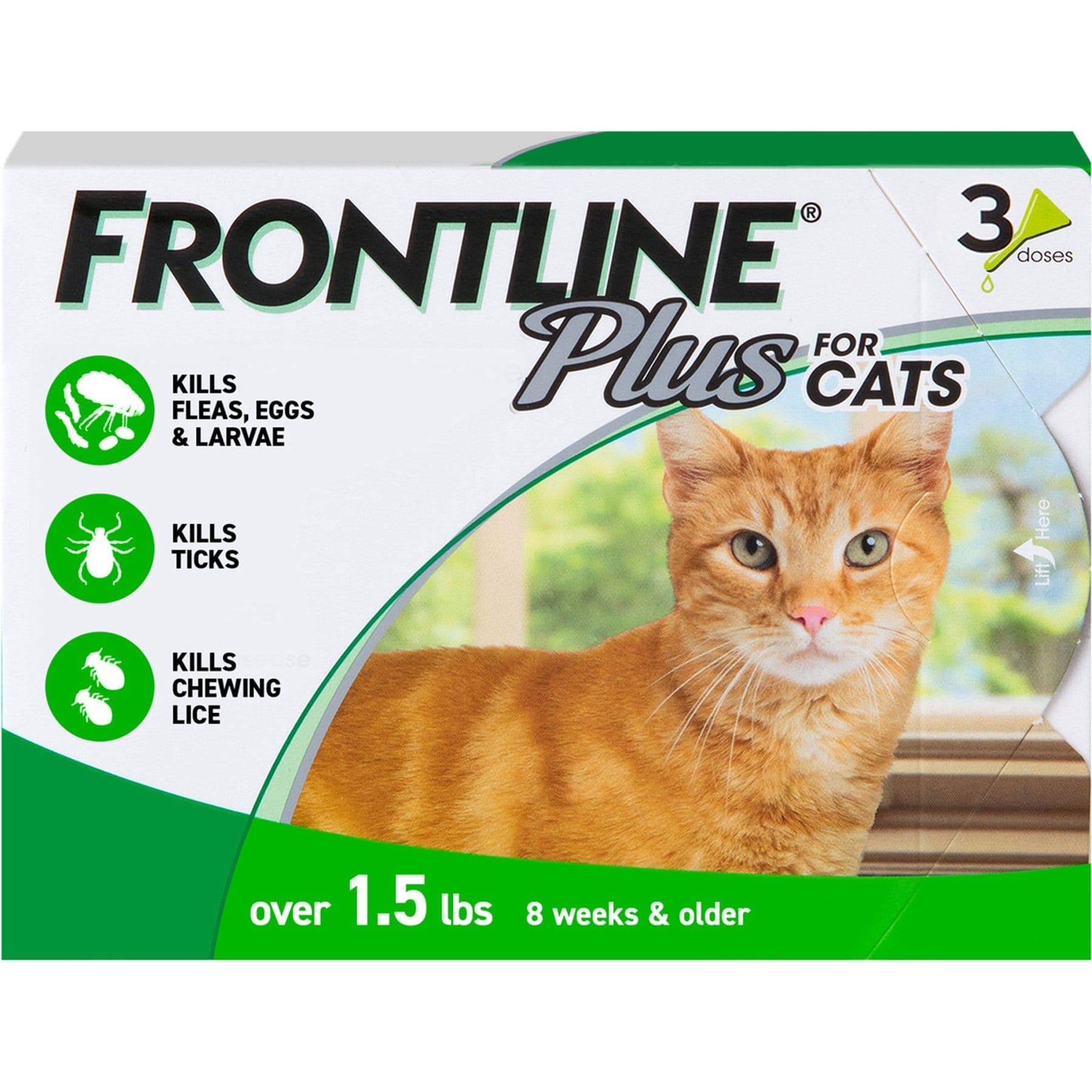
A monthly fipronil and (S)-methoprene spot-on that kills adult fleas, flea eggs, and larvae on cats and kittens over 1.5 pounds.
Webvet may earn a commission when you click through to Chewy, at no extra cost to you.
Miliary dermatitis symptoms: crusts along the back, neck, and tail base
The crusts usually show up in a predictable set of places, which VCA lists as the most affected areas:
- The lower back
- Around the base of the tail
- The face and ears
- The neck
- The flanks and belly
Merck's owner guide adds that the bumps crust over once scratching damages the skin. Other feline miliary dermatitis symptoms to watch for:
- Itch, with licking, biting, and scratching at the rash, per VCA
- Overgrooming and scratched skin on the face, neck, and back, per Merck
- Widespread hair loss or a "racing stripe" of inflamed skin down the back, both seen with flea allergy, per Merck
- Pustules or pimple-like bumps in severe cases, which VCA says means the rash has become infected

What is miliary dermatitis in cat pictures?
In pictures, miliary dermatitis can look like many tiny scabs the size and shape of millet seeds, scattered through the coat rather than gathered into one large sore. Merck says parting the fur reveals small, solid bumps, and hair thinned by licking may surround them.
Photos can understate a mild case. The lesions are often easier to feel than to see, so pictures taken at an early stage can look like a normal coat, and running your fingers along the lower back and tail base is a better check. The tail base also has a separate condition of its own, stud tail in cats.
 Sponsored
Want a vet's take on your cat's skin or coat?
Talk to a licensed vet at Dutch over video, often the same day. They can recommend treatment and prescribe it when it's appropriate.
Use code Pets60
Plans start at $12/month · covers up to 5 pets
- Licensed vets in most states
- Rx for 150+ conditions
- 4.7 on Trustpilot
What causes miliary dermatitis in cats: fleas first, then food, environment, and mites
Flea allergy is the most common trigger. VCA says an allergy to flea bites is the most common cause of feline miliary dermatitis, and a single bite can set off a severe reaction in a very sensitive cat. Because flea allergy dermatitis is the most common allergic skin disease in cats, Merck says any itchy cat needs its flea control reviewed.
In the Veterinary Dermatology study of 502 itchy cats, the diagnoses broke down this way:
- Flea allergy: 29 percent
- Allergy to something other than fleas or food: 20 percent
- Food allergy: 12 percent
- Other itchy skin diseases: 24 percent
- Allergy signs without a completed food trial: 15 percent
Season is a clue. Merck's owner guide says most flea allergy cases appear in late summer, when flea numbers peak, but they can occur year-round in warm climates or with indoor pets.
Beyond fleas, the main causes of miliary dermatitis in cats are:
- Food allergy. Merck says food allergies occur in cats about as often as airborne allergies, most often to beef, fish, or chicken. Veterinary Partner notes that most pets have eaten the problem food for years before it causes trouble. WebVet's guide to allergies in cats compares it with flea allergy.
- Environmental allergy. Cats with atopic dermatitis react abnormally to allergens they breathe in or touch, Merck says.
- Mites. Merck says walking dandruff mites (Cheyletiella) can cause crusts and many small bumps along the back, while rare but highly contagious notoedric mange starts on the ears, head, and neck. Vets confirm mites with skin scrapings under a microscope and treat every animal in contact, and no veterinary source backs a natural remedy that kills mites. Mange in cats covers mite signs and treatment.
- Ringworm. Some cats with this fungal infection develop small, solid, itchy bumps, per Merck.
- Rarer causes. VCA also links the condition to lice, nutritional deficiencies, and infectious and immune-mediated diseases.

Female walking dandruff mites can survive up to 10 days off a host, which is one way an indoor cat picks them up. Under magnification they have four pairs of legs and large hook-like mouthparts, and what mange looks like on a cat shows the skin changes.
Where the scabs sit and when they flare can point to the likely trigger before the visit, though no pattern proves a cause on its own:
| Where the crusts sit and when they flare | Likely trigger | Test the vet uses | First step |
|---|---|---|---|
| Lower back, tail base, neck, or a stripe down the back; worst in late summer, or year-round in indoor cats | Flea allergy | Flea combing, a flea dirt check, and the response to flea control | Vet-approved flea control on every pet in the home |
| Head and neck with heavy scratching; no seasonal pattern | Food allergy | Elimination diet trial of 8 weeks or longer | Vet-guided elimination diet while flea control continues |
| Any typical site, still active after strict flea control and a completed diet trial | Environmental allergy (feline atopic skin syndrome) | Ruling out fleas, infection, and food; allergy testing | Vet-prescribed itch control |
| Crusts and many small bumps along the back, often with dandruff | Cheyletiella mites (walking dandruff) | Skin scrapings checked under a microscope | Vet treatment for every animal in contact |
| Ears, head, and neck first, with severe itch | Notoedric mange (rare, highly contagious) | Skin scrapings checked under a microscope | Vet treatment for every animal in contact |
| Pimple-like or pus-filled bumps among the crusts | Secondary skin infection | Vet skin exam | Vet visit; antibiotics are a prescription decision |
Because flea allergy can flare in any month for an indoor cat, protection has to run all year. Cheristin is a monthly spot-on made only for cats; the three-dose pack, for cats over 1.8 pounds, is listed at $46.49 on Chewy when we checked in October 2026.
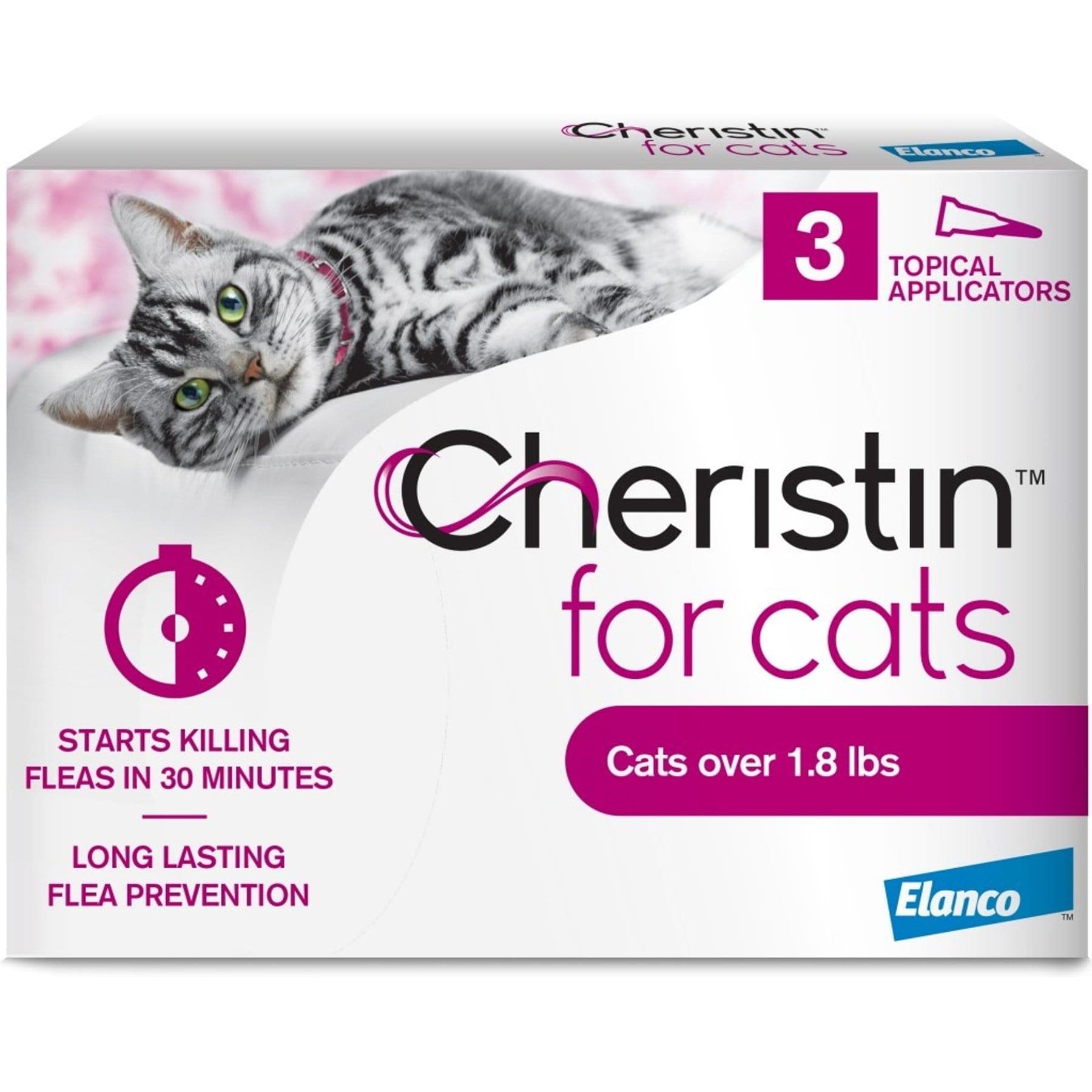
A cat-only monthly flea spot-on with a ready-to-use applicator, for cats over 1.8 pounds.
Webvet may earn a commission when you click through to Chewy, at no extra cost to you.
Why does my cat have scabs but no fleas?
Most often, because a flea-allergic cat removes the evidence. Veterinary Partner explains that allergic pets lick and chew after a bite, so the flea jumps off or gets eaten, and most severely flea-allergic pets have never been found with fleas. Merck says extremely sensitive cats can be virtually flea-free from grooming alone.
That is why VCA says a vet may recommend flea control even when no fleas are found. If the crusts persist after strict flea control on every pet, the search moves on to food, environmental allergy, and mites. A fine-toothed flea comb is the simplest way to look for the evidence at home.
SponsoredVet care that's always there
Unlimited video calls and messaging with licensed vets for less than a typical vet visit. One membership covers up to five pets.
Use code Pets60
Plans start at $12/month · covers up to 5 pets
- Licensed vets in most states
- Rx for 150+ conditions
- 4.7 on Trustpilot
How a vet diagnoses miliary dermatitis in a cat
A vet narrows down the cause in steps, starting with fleas. VCA says that if the vet sees fleas or flea dirt, or the cat is not on flea prevention, the diagnosis may be presumed to be flea allergy. When fleas are hard to find, Merck says the response to flea control serves as the test.

If flea control does not settle the crusts, VCA lists the next steps a vet may recommend:
- Skin scrapings to look for mites
- Biopsies
- Allergy tests
- A hypoallergenic food trial
- Referral to a veterinary dermatologist
Food allergy cannot be diagnosed by a blood test or skin testing, according to Merck's owner guide to itching, and VCA calls an elimination diet trial the only reliable test. Merck's professional manual says a food elimination trial belongs in nonseasonal cases once flea allergy and infection are ruled out.
Sources differ on how long the trial should run:
- Veterinary Partner: eight weeks for skin problems, though most animals respond in three to four weeks
- Merck's owner guide to cat allergies: up to 3 months
- Merck's professional manual: at least 10 weeks may be needed to identify 95 percent of food-allergic patients, based on a literature review
Flavored or chewable flea medications generally contain beef, pork, or soy protein even when the label does not list it, Merck warns, which can spoil a trial.
Whatever the later tests show, combing stays part of the flea search. Merck recommends a fine-tooth flea comb with 32 teeth per inch. Flea dirt is reddish-black and comma-shaped, and when crushed on a damp paper towel it dissolves into a reddish-brown smear, because it is digested blood.
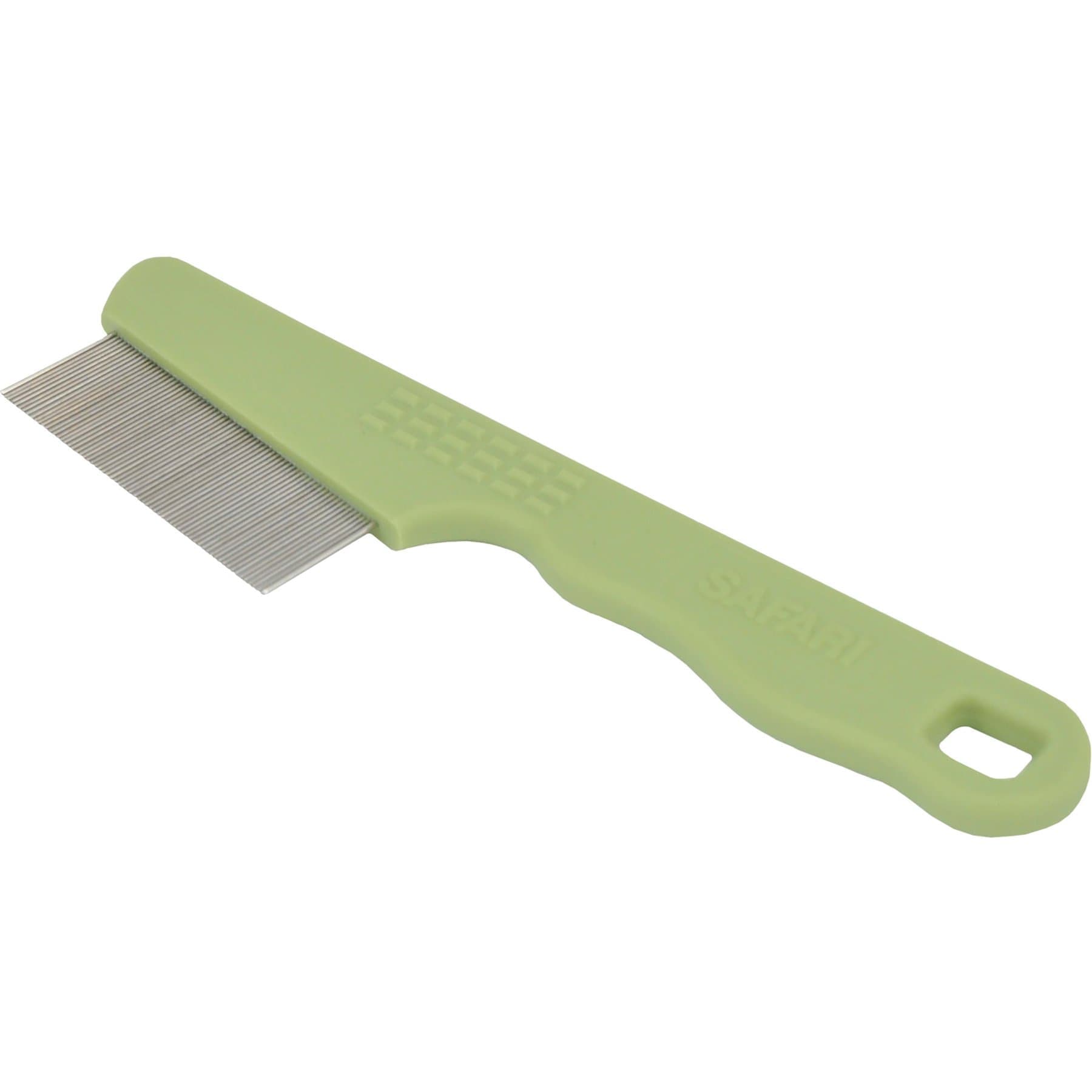
A fine-toothed cat comb with closely spaced teeth that helps you find and remove fleas and flea debris.
Webvet may earn a commission when you click through to Chewy, at no extra cost to you.
Merck's professional manual also says flea-allergy blood and skin tests are no longer recommended, though its older owner guide says antibody blood tests may help. More on testing is in how vets diagnose cat skin problems.
When to see the vet for miliary dermatitis and when it is urgent
Book a regular vet visit for any new crusts. Merck says resolving dermatitis requires finding the underlying cause and treating any secondary infection. Get help faster for these signs:
- Pale or white gums, listlessness, or a cat that feels cold. These are signs of severe flea anemia, which Veterinary Partner calls life-threatening, so treat them as an emergency.
- Many fleas on a kitten, an older cat, or a frail cat, since VCA says the blood loss can be severe.
- Pustules, open sores, bloody crusts, or draining wounds, which point to infection, per VCA and Merck.
- Tremors, seizures, or strong irritation after a flea product.
Is miliary dermatitis in cats fatal? The rash is a skin reaction that VCA expects to be well controlled in most cats. What can kill a cat is the flea burden behind it: Veterinary Partner calls flea anemia probably the number one cause of death in open-household kittens, though even late cases can often be treated with transfusions.
Is miliary dermatitis contagious? The allergic reaction is the cat's own immune response, so the crusts are not what spreads. Some triggers do, Merck says: fleas move on to other pets and bite people, and notoedric mange and ringworm spread by contact.
Will a cat's rash go away on its own?
Not reliably while the trigger remains. No published figure shows how often miliary dermatitis clears without treatment, and VCA says the offending allergen must be removed for long-term resolution. For a flea-allergic cat, Veterinary Partner says even one flea bite a week may be enough to keep the itch going.
Waiting has a cost, too. Merck says dermatitis that does not improve turns chronic, with thickened, discolored, scaly skin.
Miliary dermatitis treatment: flea control and what the vet prescribes
Treatment for miliary dermatitis in cats starts with flea control, even before every test is back. VCA says a flea preventive is applied when flea allergy is suspected, and Merck says clearing existing fleas eliminates or markedly decreases the signs.
Two kinds of flea medication do most of the work:
- Prescription monthly topicals such as Revolution Plus Topical Solution for Cats 5.6-11 lbs (Orange Box), 1 Dose (1-mos. supply). Its FDA label says it kills adult fleas in cats and kittens 8 weeks and older that weigh at least 2.8 pounds.
- Fast oral tablets such as Capstar Over 2-25lbs, 6ct, Cats Flea Tablets. Their nitenpyram starts working within 30 minutes, the FDA label says, while Veterinary Partner puts it at 20 minutes. They do nothing for fleas in the home, so monthly control still matters.

While the fleas die off, a vet may add medication for comfort:
- Corticosteroids, as a short course to ease the itch while the specific treatment takes effect, per VCA
- Antibiotics for secondary skin infection, per Merck
- Cyclosporine, which Merck says is effective for the reaction patterns of feline atopic skin syndrome
- Essential fatty acids, which Merck says limited data support as moderately helpful in miliary dermatitis; Nutramax Welactin Omega-3 Fish Oil Liquid Skin & Coat Supplement for Cats, 4-fl oz is one fish oil option, listed at $15.99 on Chewy when we checked in October 2026
- Antihistamines and calming or antiseptic sprays or mousses, per VCA
Steroids, antibiotics, and cyclosporine are prescription drugs that Chewy's pharmacy fills only with a veterinary prescription. None of them replaces flea control, Merck stresses.
How to relieve miliary dermatitis in cats?
Relief comes from stopping new bites and calming the skin at the same time. That means vet-approved flea control on every pet in the home, plus whatever the vet prescribes for the itch, often a short course of corticosteroids. Merck says anti-inflammatories can improve a cat's quality of life during flea treatment.
Is there a cure? The best treatment for miliary dermatitis in cats removes the trigger, but a flea-allergic cat stays sensitive. Merck says lifelong flea control is required to prevent reinfestation, and Veterinary Partner advises monthly control year-round for every pet in contact with the cat. Compare options in best flea treatment for cats.
Home care for miliary dermatitis: what helps, what to skip, and preventing flare-ups
Home care that is safe for cats starts with the house, not the skin. Merck notes that most owners stop flea products once an infestation clears, yet lifelong control is what prevents reinfestation, so keep flea control going for every pet in the home. Other steps that help:
- Use a product labeled for each animal's species, and repeat it at the stated intervals, as VCA advises.
- Comb regularly with a fine-toothed comb such as the Safari Flea Comb for Cats, listed at $8.49 on Chewy when we checked in October 2026; Veterinary Partner says regular combing helps catch a flea problem early.
- Vacuum carpets, floors, and soft furnishings often; VCA says this removes many flea eggs, larvae, and pupae. Merck adds washing pet blankets, throw rugs, and carriers.
- Keep flea control going through winter, as Veterinary Partner advises, and ask your vet before combining insecticides, as VCA advises.
- For a fuller plan, see how to get rid of fleas on cats.
What to skip: no veterinary source supports homeopathy, holistic blends, apple cider vinegar, or homemade anti-itch sprays as a home remedy for feline miliary dermatitis. The natural way to treat it is the same as the medical one: removing the trigger, which for most cats means fleas.
Shampoo plays a small role, because Merck says most cats dislike baths, and VCA notes that flea shampoos and powders have little lasting effect. As for treatment sold over the counter, Benadryl and other human medicines are not a home fix; any antihistamine for a cat needs a vet's dose.
What can I put on my cat's scabs to heal them?
Usually nothing beyond the vet's plan, because the scabs heal as new bites and itching stop. If the vet wants topical care, VCA describes calming or antiseptic sprays or mousses, and Merck advises using any ointment, gel, or spray sparingly so a cat does not lick off too much.
Never put concentrated essential oils on a cat. Merck says cats are especially at risk from them because they are deficient in the enzyme glucuronyl transferase.
Miliary dermatitis in cats questions
Frequently Asked Questions
Can an indoor cat get miliary dermatitis?
Yes. Merck says flea allergy can occur year-round in indoor pets, and Veterinary Partner calls the idea that indoor cats cannot get fleas a myth, since fleas thrive at indoor temperatures. VCA adds that pre-adult fleas can survive for many months in their cocoons, and food allergy has nothing to do with going outside.
How long does miliary dermatitis take to clear up?
Expect weeks to months, in step with flea control. In a Journal of the American Veterinary Medical Association trial, selamectin-treated cats with flea allergy improved significantly in miliary lesions and crusting by days 42 and 84, roughly 6 and 12 weeks. Merck says clearing fleas from a home often takes up to 3 months.
Can kittens get miliary dermatitis?
Yes, and Merck says food allergy in cats can begin as early as 3 months of age. The flea product must fit the kitten's age and weight: Revolution Plus and Frontline Plus are labeled from 8 weeks, and Capstar's label reports serious reactions more often in animals under 2 pounds or younger than 8 weeks.
Can a food allergy cause miliary dermatitis in cats?
Yes. A critically appraised review in BMC Veterinary Research found miliary dermatitis among the most common signs of food reactions in cats. A strict elimination diet confirms it, and Merck says cats respond anywhere from 1 to 9 weeks in. Never starve a cat into a new food; Merck warns that can cause serious liver damage.
Is Benadryl safe for a cat with miliary dermatitis?
Only with your veterinarian's approval and dose. VCA says diphenhydramine, the antihistamine in Benadryl, can cause excitement in cats and should not be used in very young pets. Veterinary Partner reports that an international allergy committee found little benefit from antihistamines for acute flare-ups except mild cases, and Merck names chlorpheniramine as a first-line choice for cats.

Editor
The Webvet Editorial Team is the in-house group of pet-care editors and writers behind Webvet, operated by Smart Pet Collective. The team researches, writes, and maintains Webvet's pet health, behavior, and medication content. Every article follows a defined editorial process: research from reputable veterinary and scientific sources, careful drafting, mandatory review of medical content by a credentialed veterinarian, and dated publication. Health and medication articles are medically reviewed by a licensed veterinary professional before they go live and are kept current over time.
Veterinarian · BVMS MRCVS
Dr. Pippa Elliott, BVMS, MRCVS, is a veterinarian with nearly 30 years of experience in companion animal practice. Dr. Elliott earned her Bachelor of Veterinary Medicine and Surgery from the University of Glasgow. She was also designated a Member of the Royal College of Veterinary Surgeons. Married with 2 grown-up kids, Dr. Elliott has a naughty Puggle named Poggle, 3 cats and a bearded dragon.
Related reading

Stud Tail in Cats: Causes, Treatment, and Grooming That Helps

Eosinophilic Granuloma Complex in Cats: Rodent Ulcers, Plaques, and Treatment

Cheyletiella in Dogs (Walking Dandruff): Signs, Treatment, and Contagion
