Pictures of Staph Infection in Dogs: Pyoderma From Early Bumps to Deep Infection
Vet-reviewed pictures of staph infection in dogs: early red bumps and pustules, crusty rings, moth-eaten patches, deep pyoderma, puppy impetigo, chin, nose and lip fold infections, look-alikes, and when to see a vet.

BVMS MRCVS
Medically reviewed by Dr. Pippa Elliott, BVMS MRCVS · Last reviewed

This article contains affiliate links. Webvet may earn a commission when you buy through them, at no extra cost to you.
A staph infection on a dog usually starts as red bumps and pimples with a white or yellow pus-filled center on the belly, groin or trunk. Crusty rings of peeling skin and patchy hair loss follow, and deep infection brings painful swelling and draining sores. These pictures of staph infection in dogs show each stage.
Vets call a bacterial skin infection pyoderma, and the usual cause is Staphylococcus pseudintermedius, a bacterium that lives on healthy dog skin. Photos help you judge how urgent a problem looks, but they cannot confirm pyoderma. A vet does that with a skin sample under the microscope, after ruling out mites and ringworm.
What does a staph infection look like on a dog?
- 1Early staph infection looks like red bumps and pus-filled pimples, usually on the belly, groin or trunk.
- 2When the pimples break, they leave crusty rings of peeling skin, scabs and patchy hair loss.
- 3Deep infection causes painful swelling, dark red skin, blood-tinged crusts and draining tracts, and needs a vet the same day.
- 4A photo cannot confirm staph. A vet checks a skin sample under the microscope and rules out mites and ringworm.
- 5Staph infection almost always follows another problem, often allergies, so treatment includes finding the trigger.
Most staph infections in dogs are superficial pyoderma, an infection of the top layer of skin and the hair follicles (Merck Veterinary Manual). It shows up as red bumps, pimples with a white pus-filled center, circular crusts, flaky patches and hair loss (VCA Animal Hospitals), most often on the trunk and belly (Merck).
The pimples break easily, so by the time you look you may find more crusts and rings than intact pus bumps (Today's Veterinary Practice). On short-coated dogs, infection can show up as raised tufts of hair or a moth-eaten coat instead.
Common symptoms of pyoderma in dogs:
- Red bumps (papules), often centered on a hair
- Pimples with a white or yellow pus-filled center (pustules)
- Circular crusts with a peeling edge, called epidermal collarettes
- Scabs, scale and dry, flaky patches
- Patchy or moth-eaten hair loss
- Itching, in many dogs
- With deep infection: pain, swelling, a bad smell, and blood or pus oozing from the skin (Merck Veterinary Manual)
The pyoderma pictures below run from the first bumps to deep infection, then by body site. Match what you see, then let your vet confirm it: mange, ringworm, yeast and allergies can look almost identical and need different treatment.
Early stage pictures of staph infection in dogs
Early staph infection is superficial pyoderma, sometimes called mild pyoderma. Superficial pyoderma stays in the top layer of skin and the hair follicles, where it causes papules, pustules and epidermal collarettes, plus scale, crusts and patchy hair loss (ISCAID guidelines).
These early stage pictures of bacterial skin infections in dogs show the three looks you are most likely to find: fresh bumps and pimples, crusty rings, and pimples on a puppy's belly. Each deserves a vet appointment soon, because deep infection usually starts as a superficial one that breaks through the hair follicle (MedVet).
What does the first stage of staph look like?
The first stage of staph looks like a scatter of red bumps (papules), several centered on a hair, plus a few pus-filled pimples (pustules) with a white or pale yellow center. They resemble human pimples and usually appear on the belly and groin, where the hair is thinnest (VCA Animal Hospitals; Merck).

Pustules are fragile and short-lived, so a dog with early staph may show only one or two among many bumps (Today's Veterinary Practice). Many dogs scratch or lick the area.
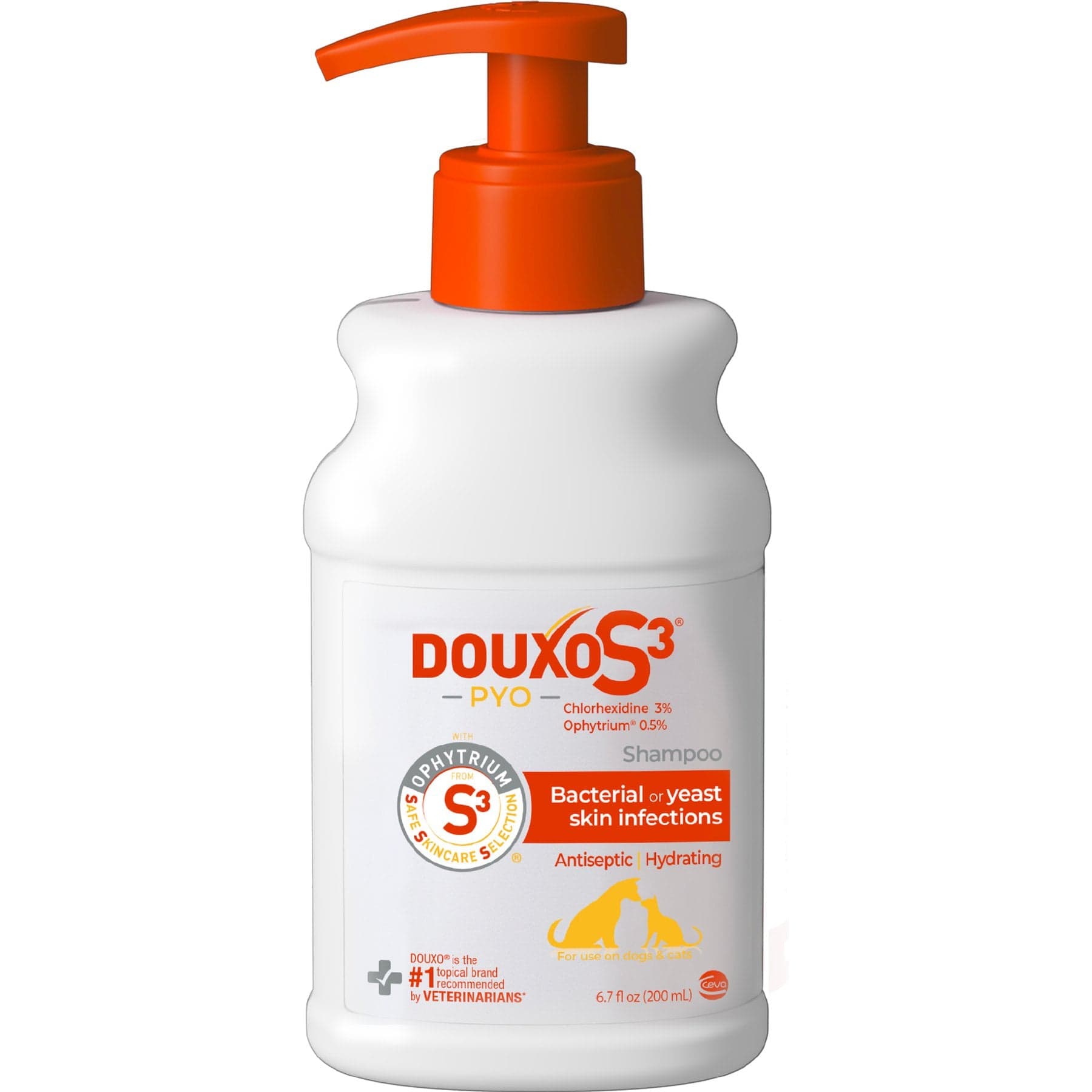
For vet-directed medicated bathing: DOUXO S3 PYO chlorhexidine shampoo. Deep infection may need other prescribed treatment.
Webvet may earn a commission when you click through to Chewy, at no extra cost to you.
If your dog's belly looks like this, book a vet check rather than waiting to see whether it spreads. Early infection can usually be treated with medicated baths alone, and your vet can look for the fleas, allergies or mites that started it (Merck Veterinary Manual).
Crusty rings and peeling edges (epidermal collarettes)
After the pimples break, many dogs develop rings. Each one is a circular red patch with a crusty edge of peeling skin, often with hair loss in the center (VCA Animal Hospitals). Vets call these rings epidermal collarettes, and they are a classic sign of superficial pyoderma (Merck Veterinary Manual).

Collarettes often cluster on the chest, flanks and belly, sometimes next to fresh bumps. As a ring heals, its center can darken. That darker skin is an after-effect of inflammation and usually fades once the infection and its cause are treated (Merck Veterinary Manual).
These rings are easy to dismiss as dry skin or mistake for ringworm. A peeling ring fits a bacterial infection, but ringworm can make circles too, so ask your vet to check a sample under the microscope (cytology), plus a hair or fungal test for ringworm, instead of guessing.
Puppy impetigo: pimples on a hairless belly
Puppy impetigo, also called puppy pyoderma, is a superficial bacterial infection of young puppies. It shows up as small pustules on the thin-haired skin of the puppy belly, groin and armpits (VCA Animal Hospitals). Unlike most staph pimples in adult dogs, these sit on bare skin rather than around the hairs (Merck Veterinary Manual).

A few pimples may dry into thin crusts. Like other superficial infections, impetigo is usually treated with topical antiseptics alone (Merck Veterinary Manual).
Impetigo still deserves a vet check to confirm it and rule out mites and ringworm. Go the same day if the puppy is lethargic, feverish or not eating, or has a swollen face or glands under the jaw. Those signs fit juvenile cellulitis (puppy strangles), an immune disorder that needs prompt treatment (VCA Animal Hospitals).
Folliculitis in dogs: bumps, tufts and moth-eaten patches
Folliculitis in dogs means inflamed hair follicles. When bacteria are the cause, vets call it bacterial folliculitis, and superficial bacterial folliculitis is a form of superficial pyoderma (ISCAID guidelines). On longer coats it looks like the bumps and pimples above. On short-coated dogs it often shows in the coat first.
In short-haired dogs, inflamed follicles make the hairs stand up, so folliculitis can look like a patch of hives: small bumps with raised hair tufts. Those hairs often pull out easily, which helps vets tell folliculitis from hives (Merck Veterinary Manual).
Many dogs also develop patchy hair loss: small round spots of thin or missing coat that give a moth-eaten look. This moth-eaten hair loss on short-coated dogs is a recognized sign of superficial pyoderma (Today's Veterinary Practice), usually on the trunk, including the back and flanks (Merck).

Folliculitis on a dog's back is easy to mistake for a normal shed or for hives. Clues that point to infection:
- Small round patches of thin coat instead of even thinning
- Tufts of hair that lift out easily
- Tiny crusts, scale or pimples inside the thin patches
Bacteria are not the only cause of folliculitis. Demodex mites and ringworm also infect hair follicles, so vets rule them out with skin scrapings and fungal tests before calling it bacterial (Merck Veterinary Manual). Treatment then follows the superficial plan: medicated baths first, antibiotics only when needed.
PetHonesty chlorhexidine shampoo is one medicated bathing option if your vet recommends its formula. Follow that product’s contact time and your vet’s plan; shampoo cannot replace antibiotics when a deep infection needs them.
Deep pyoderma: swelling, draining tracts and pain
Deep pyoderma is usually a staph infection that has spread below the hair follicles into deeper skin. It usually starts as folliculitis: the infected follicle breaks open under the skin, and the infection spreads into the dermis, a process called furunculosis (MedVet). Severe pyoderma in dogs usually means this deep form.
The hallmarks are pain, crusting, a bad smell, and blood and pus oozing from the skin (Merck Veterinary Manual). Look for swollen red skin that may turn dark red, firm lumps, blood blisters, crusts, hair loss and draining tracts: small openings that leak blood-tinged pus.

Deep infection favors the bridge of the muzzle, the chin, elbows, hocks, the outer knees and the skin between the toes. Pressure points such as elbows and hocks may get infected after repeated pressure damages the hair follicles, a pattern sometimes called callus pyoderma (Merck Veterinary Manual).
For pressure-point care alongside veterinary treatment, a padded Frisco Swirl Crate Mat is one resting option. The linked mat is 30 inches; choose enough room for your dog and keep the bedding clean and dry.
Deep infection can make dogs unwell: lymph nodes may swell, and some dogs run a fever, stop eating or seem lethargic (MedVet). One painful form on the back follows bathing or grooming, and fever can come before skin changes; it is usually Pseudomonas, often linked to old or pre-diluted shampoo, not staph (Today's Veterinary Practice).
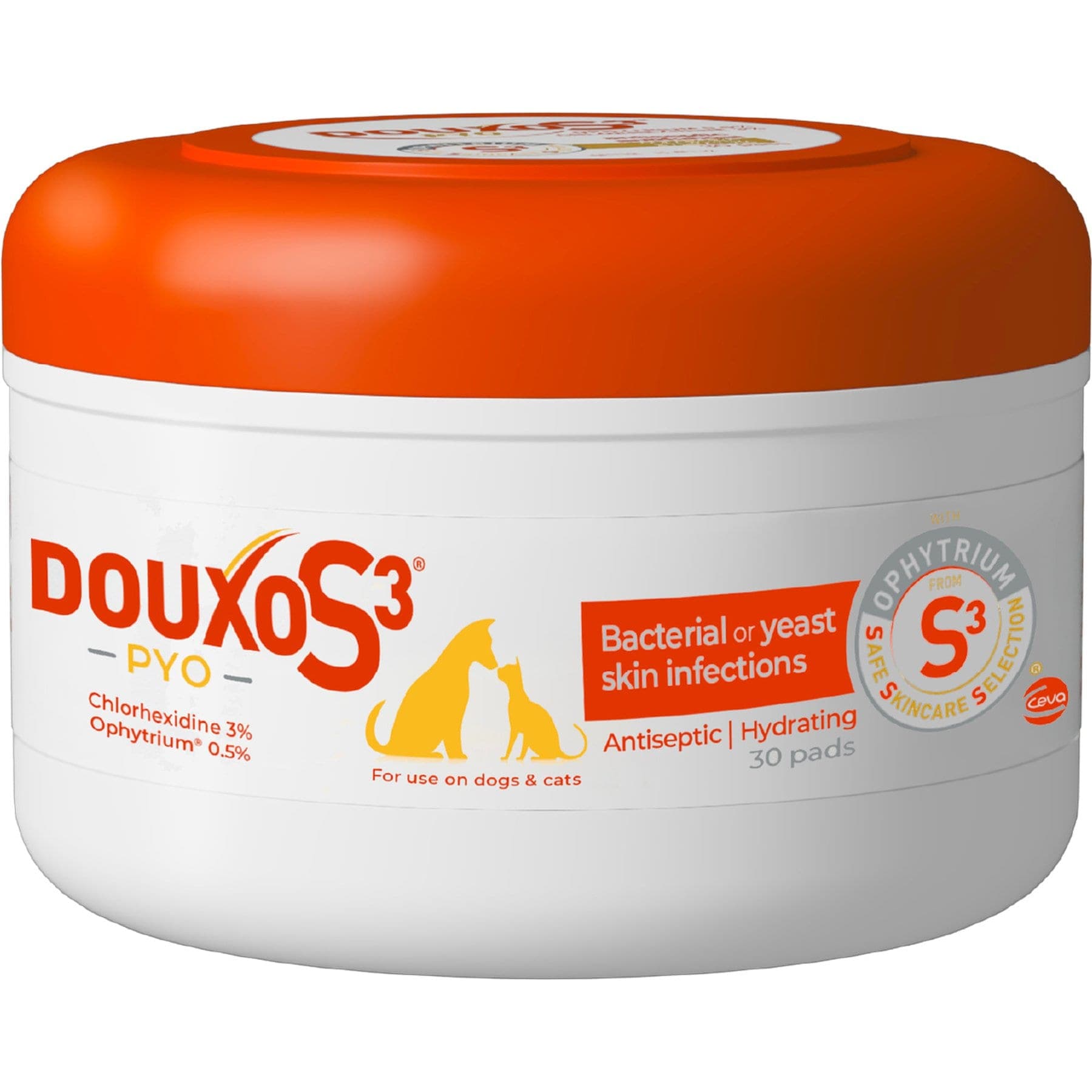
For small affected areas: DOUXO S3 PYO pads when recommended by your vet. Keep away from the eyes.
Webvet may earn a commission when you click through to Chewy, at no extra cost to you.
This table compares superficial vs deep pyoderma at a glance:
| Feature | Superficial pyoderma | Deep pyoderma |
|---|---|---|
| Where the infection sits | Top layer of skin and hair follicles | Deeper skin, after hair follicles rupture (furunculosis) |
| What you see | Red bumps, pus-filled pimples, crusty rings, patchy hair loss | Swelling, lumps, blood-tinged crusts, draining tracts |
| Pain and smell | Often itchy; pain and a bad smell suggest deeper infection | Painful, often with a bad smell |
| Typical treatment length | About three to four weeks, ending with a recheck | Longer, with rechecks every 2 weeks; few dogs need antibiotics past 6 weeks |
| How urgent | Book a vet visit soon | See a vet the same day |
Deep pyoderma in dogs always needs a vet. Guidelines strongly recommend a bacterial culture before choosing antibiotics (ISCAID guidelines). Older guidance often ran treatment two to three months or more (Merck Veterinary Manual); the 2025 guidelines start with about 3 weeks of antibiotics and recheck every 2 weeks (ISCAID guidelines).
 $65 · no membership
Is your dog's itching or skin issue getting worse?
A licensed vet can examine your dog over video and prescribe treatment online when it's appropriate.
 Talk to a vet
- Licensed vets
- All 50 states
- same-day Rx

Webvet may earn a commission if you book.
Staph infection pictures by body location
Staph can appear anywhere on a dog, but each body site has its own look. Superficial infection favors the trunk and belly, deep infection favors pressure points, paws and the face, and warm, moist folds carry more bacteria than other skin (Merck Veterinary Manual).
Where to look, and what each site usually shows:
- Belly, stomach and groin: the most common site. Staph infection on a dog's belly usually shows red bumps, pimples and crusty rings on thin-haired skin, like the photos above, and puppies get impetigo here.
- Armpits: pyoderma in a dog's armpit often comes with allergies, because allergic dogs itch there and the skin stays warm and damp (Merck Veterinary Manual).
- Back and sides: folliculitis and moth-eaten patches on short-coated dogs, plus a painful deep infection after grooming that is usually caused by Pseudomonas, not staph.
- Legs: early infection on the inner thighs looks like the belly photos. On the elbows, hocks and outer legs, infection tends to be deep, with swelling and crusts like the deep pyoderma photo.
- Paws: staph infection on a dog's paw often starts as folliculitis between the toes and can become painful, swollen lumps that burst and drain. Allergies are a common driver, and short-coated breeds such as bulldogs are prone (Today's Veterinary Practice).
- Face: the chin, lips, nose and facial folds, shown below.
The ear canal is another common site, since the same bacterium is a frequent cause of ear infections (Canadian Academy of Veterinary Dermatology). Ear problems need their own diagnosis and cleaning plan, so see our guide to ear infections in dogs.
Chin and muzzle: canine acne
Chin pyoderma, better known as canine acne, is an inflammatory problem of the lips and muzzle (VCA Animal Hospitals). Mild cases show chin bumps and pus-filled pimples, sometimes with small scabs. Severe cases can swell the lips and muzzle, with bleeding sores and scabs on the face.
Many cases are thought to start when trauma breaks hairs near the skin surface, inflaming the follicles until they rupture. Chin pyoderma is common in short-coated dogs: Boxers, bulldogs, Great Danes, Rottweilers, Doberman Pinschers and German Shorthaired Pointers are among the breeds most often affected (VCA Animal Hospitals; Today's Veterinary Practice).

Sources differ on age. PetMD reports that most dogs with chin acne are 6 months to a year old, while the University of Illinois veterinary college says pets typically develop acne in middle age. Either way, a vet checks for Demodex mites and ringworm, which can also cause bumps on the chin.
Folliculitis on a dog's chin or around the whiskers is hard to leave alone, but do not squeeze it: squeezing makes follicles more likely to rupture under the skin, which worsens the inflammation (VCA Animal Hospitals). Vets usually treat mild muzzle folliculitis with topical benzoyl peroxide and add antibiotics when lesions are infected.
Keeping the chin clean and dry helps, and so does washing food and water bowls regularly (University of Illinois).
Lips and nose: mucocutaneous pyoderma
Mucocutaneous pyoderma is a staph infection where haired skin meets the moist lining of the lips or nostrils (Merck Veterinary Manual). On the nose it causes crusts at the nostrils: mild to moderate crusting with some discharge along the nostril edges, and sometimes mild bleeding (Merck Veterinary Manual).
It usually begins as redness and swelling at the nostril edges. Crusts follow, then cracked skin and raw spots, often with pus under the crusts. German Shepherds are affected more often than any other breed (MedVet).

On the lips, the same infection starts as swelling at the corners of the mouth and in the lip folds, then crusting and oozing, then small raw sores. Losing pigment along the edge is a common after-effect (Clinician's Brief).
The main look-alike is discoid lupus erythematosus, an autoimmune disease of the nose. How they differ:
- Mucocutaneous pyoderma: redness, swelling, crusts and cracks at the nostril edges, and it improves with antibacterial treatment (Clinician's Brief).
- Discoid lupus: the nose loses pigment and its normal cobblestone texture, turning smooth and shiny (VCA Animal Hospitals).
- When it is unclear: if cytology finds no bacteria or antibiotics fail, a biopsy tells the two apart (MedVet).
Staph infection on a dog's nose can also involve the haired bridge of the nose. This nasal pyoderma is a deeper, more painful infection, since the bridge of the muzzle is one of the sites most prone to deep pyoderma (Merck Veterinary Manual).
Skin folds: lip, facial and tail folds
Skin fold pyoderma develops where skin rubs on skin: lip folds, facial folds, tail folds, the groin and the armpits. Folds trap warmth and moisture, and the bacteria that normally live there multiply into an infection (VCA Animal Hospitals).
Lip fold pyoderma shows up as moist red skin inside the lip fold, with damp hair at the fold edge and a strong smell that is easy to mistake for bad breath. Merck describes infected lip folds as very bad-smelling, inflamed, uncomfortable and swollen (Merck Veterinary Manual).

Fold breeds are most at risk: spaniels for lip folds, and Pugs, Pekingese, Boxers and bulldogs for facial folds (VCA). In a UK study, the lip was the most commonly affected fold, and English Bulldogs, French Bulldogs and Pugs had the highest odds of skin fold dermatitis (Royal Veterinary College).
Lip fold pyoderma treatment has two parts: treating the infection, then keeping the fold clean and dry. Vets often use medicated wipes for folds and may advise clipping the hair and cleaning the fold with benzoyl peroxide or a mild skin cleanser (VCA Animal Hospitals; Merck Veterinary Manual).
For deep lip folds that keep getting infected, surgery to correct the fold is a longer-lasting fix (Merck Veterinary Manual). Pyoderma in French Bulldogs and English Bulldogs often involves their folds, so check the facial, lip and tail folds as well as the belly.
What can be mistaken for staph infection?
Ringworm, mange, yeast infections, allergy rashes, hot spots and the autoimmune disease pemphigus foliaceus can all be mistaken for staph infection. Several also happen together: allergies and mites often lead to pyoderma, and yeast and bacteria often infect the same skin, so vets test rather than guess (VCA Animal Hospitals).
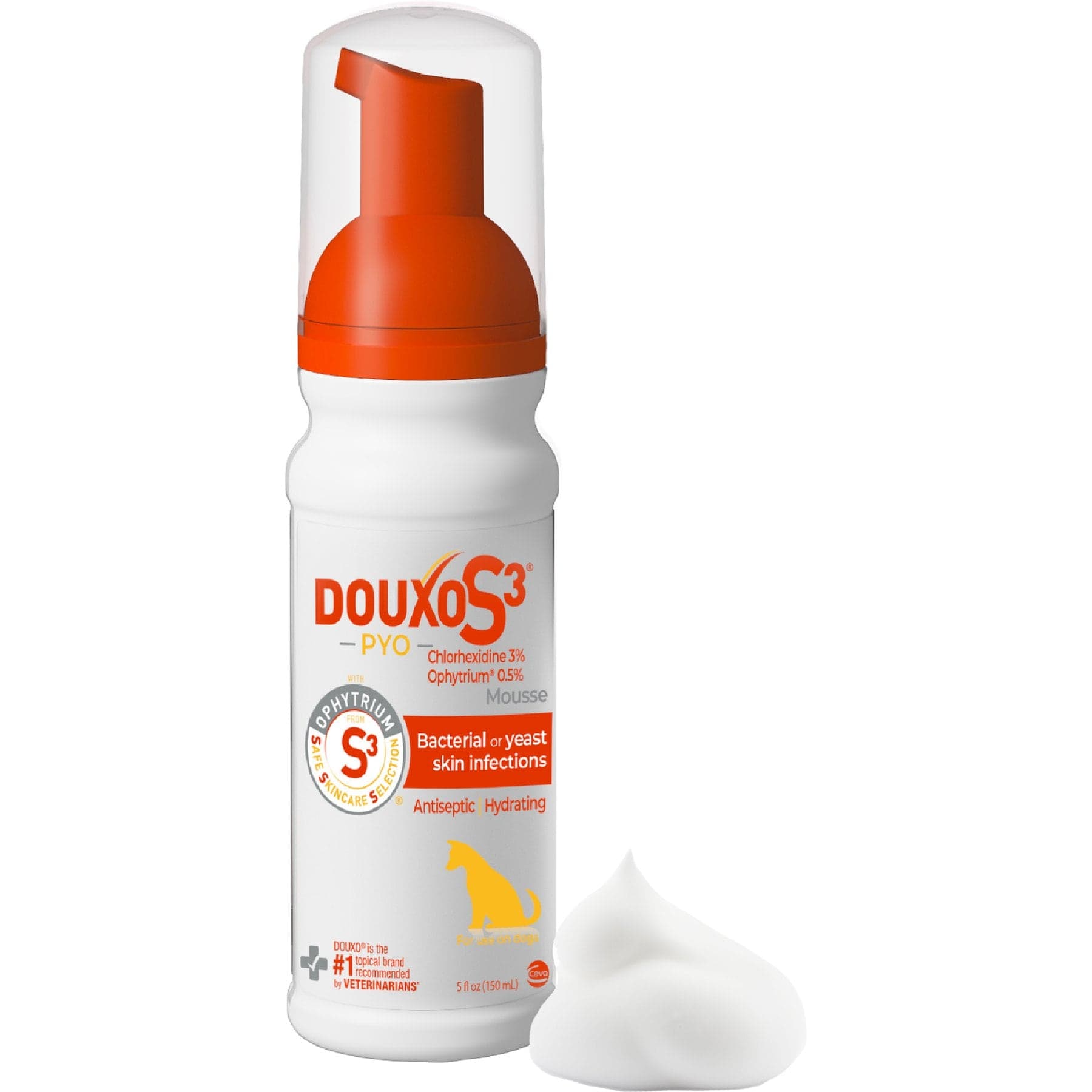
For a leave-on option: DOUXO S3 PYO mousse. Your vet can choose between shampoo, pads and mousse for the area being treated.
Webvet may earn a commission when you click through to Chewy, at no extra cost to you.
Pyoderma vs ringworm in dogs is a classic mix-up, because both can make circles. Ringworm is a fungal infection with roughly circular bald patches and broken hairs, usually without much itch, and it spreads easily to people (VCA Animal Hospitals). Compare them with our guide to what ringworm looks like on a dog.
Mites cause look-alike hair loss too. Demodex mites live in the hair follicles and cause patchy hair loss that can become infected, and sarcoptic mange causes intense itching and spreads to people and other dogs (VCA Animal Hospitals). Our mange in dogs pictures show both types.
| Condition | What you see | Where it shows up | Spreads to people? | How a vet confirms it |
|---|---|---|---|---|
| Staph infection (bacterial pyoderma) | Red bumps, pus-filled pimples, crusty rings, patchy hair loss | Belly, groin, trunk and skin folds | Rarely | Cytology, plus culture for deep or repeat infections |
| Ringworm (fungal infection) | Roughly circular bald, scaly patches with broken hairs, usually not itchy | Face, ear tips, tail and feet | Yes, easily | Fungal culture, Wood's lamp, hair exam or PCR |
| Sarcoptic or demodectic mange (mites) | Sarcoptic: sudden intense itch, bumps, crusts. Demodectic: patchy hair loss, little itch | Sarcoptic: ears, elbows, legs, chest, belly. Demodectic: face and front legs | Sarcoptic: yes, a temporary itchy rash. Demodectic: no | Skin scrapings |
| Yeast infection (Malassezia) | Itchy, greasy, red skin with a musty smell; dark, thickened skin over time | Ears, skin folds, paws and chin | No | Cytology |
| Allergy rash | Red, itchy skin and saliva-stained fur from licking | Paws, face, ears, armpits and belly | No | Ruling out other causes, diet trial or allergy tests |
| Hot spot | One fast-appearing, wet, oozing, painful sore, often under matted hair | Head, legs and hips | No | Exam, often with cytology |
| Pemphigus foliaceus (autoimmune) | Crusts, scabs and sores | Bridge of the nose, around the eyes, ears, footpads, groin | No | Skin biopsy |
Four more look-alikes to know:
- Yeast: yeast and bacteria often infect the same skin, and many dogs with yeast dermatitis also have pyoderma. A musty smell, greasy skin and dark, thickened skin point to yeast; see our dog skin yeast infection pictures (VCA Animal Hospitals).
- Hot spots: a single raw, oozing patch that appears quickly, usually where a dog has been licking or scratching (VCA Animal Hospitals).
- Allergy rash: red, itchy skin that often becomes infected with staph or yeast as the dog scratches (VCA Animal Hospitals).
- Pemphigus foliaceus: an autoimmune disease that causes crusts and sores on the bridge of the nose, around the eyes and on the ears, footpads and groin; only a biopsy confirms it (VCA Animal Hospitals).
For the wider range of conditions side by side, see our dog skin problems pictures guide.
What is a staph infection in dogs?
A staph infection in dogs is a bacterial skin infection, or pyoderma, caused by Staphylococcus bacteria; VCA calls it staphylococcal dermatitis. The main culprit, Staphylococcus pseudintermedius, normally lives on the skin and in the nose, mouth and anus of most dogs without causing trouble (Canadian Academy of Veterinary Dermatology).
It becomes an infection when something damages the skin, such as scratching, constant moisture or an underlying disease that weakens its defenses (VCA Animal Hospitals). So when a dog has a bacterial skin infection, the real question is what gave its own bacteria the opening.
Vets sort staph pyoderma by how deep it goes (Merck Veterinary Manual):
- Surface pyoderma: bacteria overgrow on the skin surface, as in hot spots and skin fold infections.
- Superficial pyoderma: infection of the top skin layer and hair follicles, with bumps, pimples, rings and patchy hair loss.
- Deep pyoderma: infection below the follicles, with swelling, pain and draining tracts.
Hot spots are the most familiar surface pyoderma, and our guide to hot spots on dogs shows them stage by stage.
Which staph bacteria cause skin infections in dogs?
Staphylococcus pseudintermedius is found in more than 90 percent of all types of canine pyoderma, according to the 2025 international guidelines for treating it (ISCAID guidelines). It is apparently not well adapted to causing disease in people, which is why human infections are rare (Canadian Academy of Veterinary Dermatology).
Older records and some lab reports use the name Staph intermedius. Many dog isolates once identified as S. intermedius should have been classified as S. pseudintermedius, which scientists later split off as its own species (Tse and colleagues, Journal of Bacteriology).
Other staph species can infect dogs but typically account for under 10 percent of lab samples (ISCAID guidelines):
- Staphylococcus aureus in dogs: the main human staph. Dogs carry it far less often than people do, and a dog's S. aureus is often picked up from people. Its antibiotic-resistant form is MRSA (Canadian Academy of Veterinary Dermatology).
- Staph schleiferi in dogs: the type found in dogs has been renamed Staphylococcus coagulans, while S. schleiferi itself turns up more often in people (ISCAID guidelines).
Only a lab culture names the species. That matters at home: MRSA is a well-known problem in people, while MRSP, the resistant form of dog staph, rarely infects people, as the contagion answer below explains.
Why dogs get pyoderma: finding the trigger
Pyoderma is usually secondary to allergies, parasites or hormone disease. The 2025 international guidelines put it more strongly: pyoderma is always secondary to an underlying cause (ISCAID guidelines). That cause can be a one-time event, but infections that keep coming back point to an ongoing problem (Merck).

For skin your dog keeps licking: a rigid recovery collar. This listing is Small; measure for fit and confirm the skin stays out of reach.
Webvet may earn a commission when you click through to Chewy, at no extra cost to you.
The most common pyoderma causes in dogs (Merck Veterinary Manual; VCA Animal Hospitals):
- Allergies: flea allergy, atopic dermatitis (environmental allergies) and food allergy. Scratching damages the skin, and S. pseudintermedius causes about 90 percent of skin infections in dogs with allergies (Canadian Academy of Veterinary Dermatology).
- Parasites: fleas, Demodex mites and sarcoptic mange.
- Hormone disease: hypothyroidism and Cushing's disease (hyperadrenocorticism).
- Folds and moisture: lip, facial, tail and vulvar folds, and skin that stays damp.
- Other skin disease: seborrhea, immune-mediated disease and hair follicle disorders.
- Medicines: steroids and other drugs that suppress the immune system.
- Pressure and grooming: calluses on the elbows and hocks, and poor grooming.
Allergies are among the most common triggers, because the itch-scratch cycle keeps opening the skin to bacteria. Our guide to the common causes of itching in dogs explains where the itch comes from, and food, fleas or the environment helps you narrow down which allergy it is.
The causes of folliculitis in dogs are the same triggers, plus Demodex mites and ringworm, which attack the follicles directly. Breed shapes which staph infections a dog is prone to: bulldogs, Pugs and Shar-Peis are prone to fold infections, short-coated breeds to chin and paw infections, and German Shepherds to mucocutaneous pyoderma of the nose.
Ask your vet what triggered your dog's infection, especially if it keeps returning. Finding the cause may take blood tests for thyroid or adrenal disease, a flea-control check or an allergy workup (VCA Animal Hospitals).
Is staph infection in dogs contagious?
Not in the usual sense. The staph bacteria behind pyoderma already live on healthy dogs, and infection takes hold only when the skin is damaged or another condition weakens it (VCA Animal Hospitals). Pyoderma in dogs is not considered contagious to other dogs with healthy skin.
Can a staph infection in dogs spread to humans? It can, but rarely. Human infections with S. pseudintermedius are rare even though dog owners are exposed to it all the time (Canadian Academy of Veterinary Dermatology). Young children, older adults and people with weakened immune systems are at somewhat higher risk.
MRSP (methicillin-resistant Staphylococcus pseudintermedius) is dog staph that resists many common antibiotics. It is common in dogs with recurring infections, but MRSP rarely infects people, and resistance does not make the infection more severe or more contagious, only harder to treat (Canadian Academy of Veterinary Dermatology).
These steps come from the Canadian Academy of Veterinary Dermatology's advice for MRSP, and they make sense for any staph infection, since only a culture shows whether a dog's staph is resistant. Other dogs in the home are mainly at risk if they have skin problems of their own, such as uncontrolled allergies or wounds.
Folliculitis in dogs is no more contagious to humans than other pyoderma: transmission is possible but rare. Look-alikes are a different story. Ringworm and sarcoptic mange spread readily to people and other pets, one more reason to get the diagnosis confirmed (VCA Animal Hospitals).
How vets confirm a staph skin infection
No photo can confirm a staph infection. Vets diagnose pyoderma from its typical look plus proof of bacteria, after ruling out other causes of folliculitis such as Demodex mites and ringworm (Merck Veterinary Manual).
What to expect at the visit:
- Exam and history: where it started, how itchy your dog is, flea control, diet and past infections.
- Skin cytology: your vet presses tape or a slide onto a pimple, a crust or moist skin, stains it and checks it under the microscope for bacteria, yeast and inflammatory cells. Guidelines call for cytology before any antibiotic (ISCAID guidelines).
- Tests for look-alikes: skin scrapings for mites, and a Wood's lamp, hair exam or fungal culture for ringworm (Merck Veterinary Manual).
- Culture and susceptibility testing: a lab grows the bacteria and tests which antibiotics work. It is strongly recommended for deep pyoderma, repeat infections, dogs given several antibiotic courses in recent months or known to carry MRSP, and infections not improving after 5 to 7 days of antibiotics (ISCAID guidelines).
- Biopsy: for unusual or stubborn cases, including suspected pemphigus or lupus (VCA Animal Hospitals).
- Tests for the trigger: blood tests for thyroid or adrenal disease, and allergy workups (VCA Animal Hospitals).
Culture results take about a week. They are worth the wait for a dog with repeat infections: MRSP causes up to 41 percent of infections in dogs with recurrent disease, and it looks exactly like ordinary staph (Canadian Academy of Veterinary Dermatology).
Pyoderma in dogs treatment
Treatment for pyoderma in dogs has three goals: clear the bacteria from the skin, use antibiotics only when needed, and control the trigger. Guidelines put topical antiseptics first for surface and superficial infections, including MRSP, and save systemic antibiotics for deep pyoderma and superficial cases that topical therapy cannot clear (Merck Veterinary Manual).
What treatment usually includes:
- Medicated bathing: chlorhexidine or benzoyl peroxide shampoos, plus sprays, mousses or wipes for small areas. Chlorhexidine is the best-studied topical treatment (Worms & Germs Blog).
- Antibiotics when needed: for deep infection, or superficial infection that bathing does not clear, chosen from culture results where possible (Merck Veterinary Manual).
- The full course: give every dose until your vet says to stop, even if the skin looks better within days. Stopping early is a common reason infections return, and finishing each prescription helps prevent resistant MRSP (Merck Veterinary Manual; Canadian Academy of Veterinary Dermatology).
- A recheck exam: treatment ends when the lesions are gone and a skin sample shows no remaining infection (Merck Veterinary Manual).
- Trigger control: flea control, allergy treatment, hormone testing or fold care, depending on the cause.
- If it is MRSP: some MRSP infections respond to topical therapy as well as ordinary staph does. When a strain resists nearly every antibiotic, your vet may rely on intensive topical therapy or refer you to a veterinary dermatologist (Canadian Academy of Veterinary Dermatology).
- No leftover or human antibiotics: dog staph makes an enzyme that inactivates plain amoxicillin, ampicillin and penicillin, so vets avoid them as first choices (Merck Veterinary Manual).
- An Elizabethan collar: a cone keeps licking and scratching from damaging healing skin (VCA Animal Hospitals).
A Dogswell rigid recovery collar can block licking if it fits correctly and extends far enough. This listing is Small; measure before buying and check that your dog cannot reach the affected skin.
Treatment for superficial pyoderma, including folliculitis, typically takes about three to four weeks (Today's Veterinary Practice). Deep infections need both parts, a chlorhexidine shampoo plus culture-guided antibiotics, and few dogs need antibiotics beyond 6 weeks under the 2025 guidelines, though healing can take longer (ISCAID guidelines).
Your vet will usually book a recheck before the antibiotics run out, to decide whether to stop or continue. The 2025 guidelines found no evidence for continuing antibiotics after the signs have fully resolved, so the recheck, not the calendar, decides when treatment ends (Worms & Germs Blog).

Pyoderma in dogs home treatment: what helps and what to avoid
Home care for pyoderma works alongside your vet's plan, not instead of it. It can speed healing, but no home remedy has been shown to cure a bacterial skin infection, and several popular ones damage the skin.
Rubbing alcohol and hydrogen peroxide harm infected skin because they damage the cells that repair it. VCA warns that both damage cells, delay healing and can be quite painful, and the Merck Veterinary Manual calls hydrogen peroxide toxic to healthy tissue (VCA Animal Hospitals; Merck Veterinary Manual).
Tea tree oil is the essential oil most often reported in pet poisonings, and essential oils are absorbed quickly through the skin. Merck says concentrated essential oils should never be applied directly to pets (Merck Veterinary Manual).
What helps at home, with your vet's approval:
- Bathe with the medicated shampoo your vet recommends, leave the lather on for the full contact time on the label, then rinse and dry the skin completely.
- Keep skin folds clean and dry, and use fold wipes as directed.
- Give your dog clean, dry, padded bedding, and wash it in hot water (VCA Animal Hospitals).
- Use a cone if your dog licks or chews the sores.
- Keep every pet in the home on flea control.
- Photograph the same spots every few days in the same light, so your vet can see whether they are healing.
- Give every dose and keep the recheck appointment.
Medicated bathing is the home treatment with the best evidence behind it (ISCAID guidelines). Our guide to medicated shampoo for itchy skin explains how antimicrobial formulas differ from gentle cleansers, and why the medicated ones need a diagnosis first.
What about natural treatment for pyoderma in dogs? The 2025 guidelines found only weak or mixed evidence for natural products. In one trial on nasal fold infection, medical honey did no better than a placebo at healing the skin, and a clove oil study was very small (ISCAID guidelines).
The same goes for home remedies for folliculitis and other staph infections: gentle cleaning, drying and stopping the licking support treatment, but they cannot replace it.
What happens if staph is left untreated?
Left untreated, a staph infection can linger, spread and go deeper. Infection inside a hair follicle can break through the follicle wall into deeper skin, turning superficial folliculitis into deep pyoderma with pain, swelling and draining tracts (MedVet).
Deep infection can make a dog sick, with fever, poor appetite, lethargy and swollen lymph nodes (MedVet). Long-running inflammation can also leave the skin darker and thicker, though most of that fades once the cause is corrected (Merck Veterinary Manual).
The trigger keeps working, too. Untreated allergies, parasites or hormone disease bring the infection back, and repeated antibiotic courses raise the risk of resistant staph such as MRSP (Canadian Academy of Veterinary Dermatology).
Mild, early infection is not an emergency. Still, book a regular vet appointment rather than waiting it out, because treating it early keeps it from going deeper.
Staph infection in dogs FAQ
Frequently Asked Questions
How long can a dog have a staph infection?
With treatment, a superficial staph infection usually clears in about three to four weeks (VCA Animal Hospitals). Deep infections take longer: older guidance often ran 8 to 12 weeks (Merck Veterinary Manual), but under the 2025 guidelines few dogs need antibiotics beyond 6 weeks, though healing can take longer (ISCAID guidelines).
Your vet decides when to stop at a recheck exam, once the lesions have healed and a skin sample shows no remaining infection. If the skin is not clearly improving within the first week of treatment, call your vet, who may run a culture (ISCAID guidelines).
What kills staph infections fast?
On a dog, the fastest reliable route is a vet-confirmed diagnosis followed by the treatment it calls for. Nothing clears a staph infection overnight, and guessing wastes time if the problem is really mites, ringworm or yeast.
For most superficial infections, that means antiseptic baths with a chlorhexidine shampoo, the best-studied topical option, plus sprays or wipes for small spots (Worms & Germs Blog). VCA notes that antibacterial shampoos, sprays and spot-ons help bring the infection under control quickly (VCA Animal Hospitals). Deep infections also need antibiotics.
Can rubbing alcohol get rid of staph?
No. Rubbing alcohol stings and damages healing tissue, which slows recovery, and VCA advises against using it on a dog's wounds or incisions (VCA Animal Hospitals).
It is also not a treatment vets use for pyoderma. The infection sits in the hair follicles and deeper skin, and it clears with antiseptic shampoos such as chlorhexidine and, when needed, antibiotics. An alcohol-based hand sanitizer is still fine for your own hands after touching your dog.
What household cleaner kills staph?
For your home, the Canadian Academy of Veterinary Dermatology advises wiping hard surfaces with diluted bleach or an accelerated hydrogen peroxide disinfectant, after cleaning them first, while a dog is treated for resistant staph (Canadian Academy of Veterinary Dermatology). Wash bedding and laundry in hot water and dry it in a dryer.
Never use a household cleaner on your dog. Household bleach contains 3 to 10 percent sodium hypochlorite and can irritate skin, and some products are corrosive (Merck Veterinary Manual). Veterinary skin products that use this ingredient are specially formulated for skin, which is not the same as diluting bleach yourself.
Why does my dog's staph infection keep coming back?
Recurrent pyoderma that keeps coming back usually means the underlying trigger has not been found or controlled. The Merck Veterinary Manual lists the most common reasons: a missed trigger such as allergies or hypothyroidism, too short a course or the wrong antibiotic, steroid use, and skipped rechecks (Merck Veterinary Manual).
Ask your vet about a culture, since MRSP is behind up to 41 percent of infections in dogs with recurrent disease, and give the full course every time (Canadian Academy of Veterinary Dermatology). Routine bathing with a medicated shampoo can also help keep infections from returning (VCA Animal Hospitals).
Should I pop the pimples on my dog?
No. Do not squeeze or pop the pimples or pustules, even when they look ready to burst. Squeezing can rupture hair follicles under the skin and worsen inflammation, which can push a surface infection deeper (VCA Animal Hospitals).
Leave them for your vet, who can sample an intact pimple for cytology to confirm the infection (Merck Veterinary Manual).
$65 · no membershipIs your dog's itching or skin issue getting worse?
A licensed vet can examine your dog over video and prescribe treatment online when it's appropriate.
Talk to a vet- Licensed vets
- All 50 states
- same-day Rx
Webvet may earn a commission if you book.

Editor
The Webvet Editorial Team is the in-house group of pet-care editors and writers behind Webvet, operated by Smart Pet Collective. The team researches, writes, and maintains Webvet's pet health, behavior, and medication content. Every article follows a defined editorial process: research from reputable veterinary and scientific sources, careful drafting, mandatory review of medical content by a credentialed veterinarian, and dated publication. Health and medication articles are medically reviewed by a licensed veterinary professional before they go live and are kept current over time.
Veterinarian · BVMS MRCVS
Dr. Pippa Elliott, BVMS, MRCVS, is a veterinarian with nearly 30 years of experience in companion animal practice. Dr. Elliott earned her Bachelor of Veterinary Medicine and Surgery from the University of Glasgow. She was also designated a Member of the Royal College of Veterinary Surgeons. Married with 2 grown-up kids, Dr. Elliott has a naughty Puggle named Poggle, 3 cats and a bearded dragon.
Related reading

Skin Rash Dog Food Allergy Pictures: What Allergic Skin Looks Like

Dog Skin Problems Pictures: 15 Conditions and When to See a Vet

Dog Skin Yeast Infection Pictures: Paws, Belly, Skin Folds and Face
