Demodectic Mange in Dogs: Signs, Treatment, and Recovery Time
Demodectic mange happens when the Demodex mites that live in every dog's hair follicles overgrow, most often in puppies. This guide explains the localized and generalized forms, how vets confirm and treat it, and how long recovery takes.

BVMS MRCVS
Medically reviewed by Dr. Pippa Elliott, BVMS MRCVS · Last reviewed

This article contains affiliate links. Webvet may earn a commission when you buy through them, at no extra cost to you.
Demodectic mange in dogs: what it is, what you are seeing, and whether today is a vet day
Demodectic mange in dogs is an overgrowth of Demodex mites, microscopic parasites that live in small numbers in the hair follicles of virtually all dogs. It is not contagious to people and rarely spreads between healthy dogs. Localized cases in puppies often clear on their own; generalized disease needs veterinary mite treatment.
Whether demodectic mange in dogs makes today a vet day depends on how much skin is involved. One or two small, thin, scaly patches on an otherwise bright puppy often point to the mild localized form, so a routine appointment fits. Spreading patches, swollen paws, fever, or lethargy call for a prompt exam.
- 1Knowing what Demodex mites are explains the disease: nearly every dog carries them in its hair follicles, and mange appears only when they overgrow.
- 2The central split is localized versus generalized disease: a few patches often clear alone, while widespread or paw disease needs prescription mite treatment.
- 3Demodectic mange is not contagious to people, and exposure is not considered dangerous for a healthy dog.
- 4Fever, lethargy, swelling, or infected paws mean a prompt vet visit; treatment continues until two monthly skin scrapes find no mites.

Demodex mites are normal residents of canine skin. The Merck Veterinary Manual explains that canine demodicosis, the medical name for demodectic mange, develops when large numbers of Demodex canis crowd the hair follicles and oil glands. In small numbers they cause no disease and spend their entire life cycle on the dog.
Veterinary Partner lists three Demodex species in dogs: Demodex canis, the most common, plus Demodex cornei and Demodex injai. VCA Animal Hospitals describes a cigar-shaped mite with eight legs, a size seen only under a microscope, and gives the common names demodex and red mange.
Hair loss is the main symptom of canine demodicosis. The clinical signs owners usually see include:
- Thinning fur or bald patches, most often on the face and front legs in the localized form, per VCA.
- Small, hairless, red, scaly areas, usually 1 to 5 of them, per the Merck Veterinary Manual's dog owner edition.
- Little or no itching unless a secondary bacterial infection sets in, as the Western College of Veterinary Medicine notes.
- In widespread disease, red and swollen skin, darkened skin, acne-like bumps, and scabs.
- Swollen, infected paws when the mites settle in the feet.
Getting rid of demodectic mange depends on the form. Mild patches often fade without treatment, generalized disease needs prescription mite control, and medicated shampoos are often part of care, Merck's owner edition notes. VCA explains that benzoyl peroxide shampoo helps flush out and open the hair follicles where the mites live.

A 2.5% benzoyl peroxide shampoo labeled for conditions associated with demodectic mange; it helps flush and open hair follicles.
Webvet may earn a commission when you click through to Chewy, at no extra cost to you.
What causes demodectic mange in dogs is a shift in balance, not a new infection: puppies pick up the mites from their mother in the first days of life, and Veterinary Partner explains that disease follows when something, such as immune suppression, lets the mites gain the upper hand.
Appearance alone cannot confirm the problem, because Veterinary Partner notes that many skin conditions look just like demodicosis. WebVet covers other causes of thin fur in hair loss in dogs and another skin mite in cheyletiella in dogs.
Owners of a Staffy, Doberman, German Shepherd, Boxer, Pug, French Bulldog, Great Dane, Husky, or Collie often ask whether breed explains the mange. The risk factor Merck and Veterinary Partner spell out is family history, through an inherited immune defect and advice not to breed any dog that has had generalized mange.

 Sponsored
Want a vet's take on your dog's skin or coat?
Talk to a licensed vet at Dutch over video, often the same day. They can recommend treatment and prescribe it when it's appropriate.
Use code Pets60
Plans start at $12/month · covers up to 5 pets
- Licensed vets in most states
- Rx for 150+ conditions
- 4.7 on Trustpilot
Localized vs generalized demodectic mange: how the two forms differ
Merck describes three forms of canine demodicosis: localized demodectic mange, juvenile-onset generalized demodicosis, and adult-onset generalized demodicosis. Localized versus generalized disease is the split that drives nearly every later decision, from whether a dog needs treatment to how long it lasts.
Localized demodectic mange in dogs is the early stage most owners spot first: a few small, thin, scaly patches with little itch. Sources draw the line slightly differently:
- Merck's owner edition counts 1 to 5 small, isolated areas.
- Veterinary Partner allows no more than four spots in no more than two body regions.
- The Western College counts 1 to 4 isolated lesions and calls 5 or more discrete sites generalized.
Generalized demodectic mange, also spelled generalised demodicosis, spreads over many areas of the dog, especially the paws, according to VCA. The Western College says untreated generalized demodex lesions gather on the head and limbs and rarely on the belly, and Merck states that this form requires treatment.

Secondary bacterial infection, which Merck's owner edition calls pyodemodicosis, is common in generalized cases, and VCA says it often needs antibiotic or shampoo therapy. The red, inflamed skin explains the old name red mange; WebVet's guide to pyoderma in dogs pictures covers bacterial skin infection in more detail.
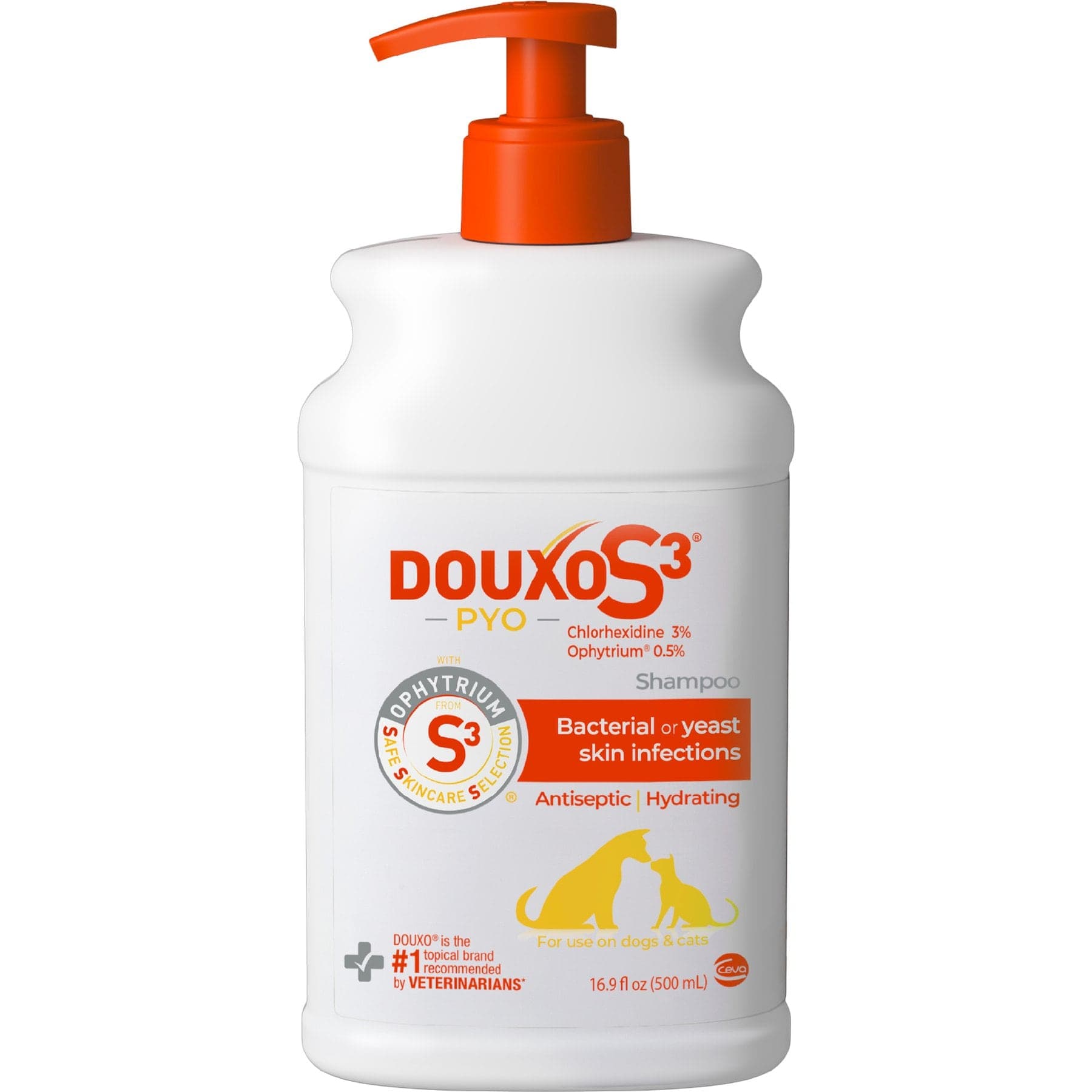
A 3% chlorhexidine shampoo labeled for bacterial or yeast skin infections; it targets secondary infection rather than the mites.
Webvet may earn a commission when you click through to Chewy, at no extra cost to you.
Pododemodicosis is demodectic mange limited to the feet. The Western College notes that these lesions can be severe and often carry bacterial complications, and Veterinary Partner says the foot is often the last stronghold of the mite as generalized disease is treated. Paw inflammation from other causes is covered in pododermatitis in dogs.
Extent, age of onset, and infection set the usual treatment path and the recovery time for each localized or generalized form:
| Localized versus generalized demodectic mange | Extent | Age of onset | Usual treatment path | Recovery time |
|---|---|---|---|---|
| Localized | A few small patches (1 to 4 or 1 to 5, by source), often face and front legs, little itch | Mostly puppies under 12 to 18 months | Often monitoring only; about 90 percent clear untreated | Partly better by 1 month; full resolution can take up to 3 months |
| Juvenile-onset generalized | 5 or more sites, often paws, secondary infection common | Usually 3 to 18 months | Prescription isoxazoline, infection treatment, regular skin scrapes | Several months, until two negative scrapes a month apart |
| Adult-onset generalized | Widespread, same signs as the juvenile form | Typically over 3 years, as young as 1.5 | Isoxazoline plus a search for underlying disease | May take longer; some dogs need lifelong treatment |
Sources disagree on how often generalized disease clears unaided. Veterinary Partner says 30 to 50 percent of dogs under a year old recover spontaneously, though it usually still recommends treatment; the Western College says it does not resolve on its own. Merck calls the prognosis historically guarded, the Western College good in young treated dogs.
 Sponsored
Vet care that's always there
Unlimited video calls and messaging with licensed vets for less than a typical vet visit. One membership covers up to five pets.
Use code Pets60
Plans start at $12/month · covers up to 5 pets
- Licensed vets in most states
- Rx for 150+ conditions
- 4.7 on Trustpilot
Demodectic mange in puppies vs adult-onset demodicosis
Demodectic mange in puppies is more common than in adults: VCA says the disease occurs primarily in dogs younger than 12 to 18 months, because an immature immune system lets mites multiply. Puppies get it most because they carry the mites from birth; Merck notes the dam passes them on in the first 72 hours of nursing.
Juvenile demodicosis takes two shapes. The localized form is a common puppyhood ailment with about a 90 percent chance of clearing, which Veterinary Partner says drops to 50 percent when related dogs have a history of demodicosis. Juvenile-onset generalized disease usually first appears between 3 and 18 months of age, according to the Western College.
Merck traces juvenile-onset generalized disease to an inherited defect in cell-mediated immunity that lets mites multiply and destroy the hair follicles they live in. The outlook is still encouraging: the Western College calls the prognosis good with modern treatment, and Veterinary Partner reports that most dogs under one and a half years old recover completely.
Demodex in older dogs
Demodectic mange in older dogs is a different situation. Merck describes adult-onset generalized demodicosis in dogs typically older than 3 years, though it can start as young as 1.5 years, and links it to diseases that suppress the immune system, including:
- malignant lymphosarcoma or malignant melanoma
- hyperadrenocorticism
- hypothyroidism
- diabetes mellitus
Many adult cases have no cause found, Merck adds, but Veterinary Partner treats new demodicosis in an older dog as a reason to look for hidden cancer, liver or kidney disease, or a hormone imbalance. The Western College links generalized disease first diagnosed after age five to underlying illness and a poor prognosis.
Adult-onset cases may also take longer to clear, according to Merck, and Veterinary Partner says the disease is often controlled rather than cured. Young dogs, meanwhile, can relapse until about 12 to 18 months of age, when VCA says the immune system matures.
Age also limits treatment. Veterinary Partner notes that most puppies with localized disease clear on a regular isoxazoline flea product if they are old enough, and that not all flea products kill Demodex. These are prescription chews that Chewy's pharmacy dispenses only with a vet prescription, and their labels set minimum ages:
- NexGard (afoxolaner): puppies 8 weeks and older weighing at least 4 pounds, per its FDA label.
- Simparica Trio: puppies as young as 8 weeks weighing at least 2.8 pounds, per Zoetis.
- Credelio Quattro: 8 weeks and older and at least 3.3 pounds, per Elanco; the Credelio Quattro/Credelio Quattro-CA1 Chewable Tablets for Dogs, 12.1-25 lbs, 1 Chewable (1-mo. supply) was listed at $37.94 on Chewy when we checked in October 2026.
- Bravecto: the 12-week chew is labeled from 6 months and the separate Bravecto 1-Month chew from 8 weeks, per MSD Animal Health; the 22-44 lbs, Bravecto Chews for Dogs, 1 treatment, 500 mg Fluralaner 12-week chew was listed at $83.99 on Chewy when we checked in October 2026.
Each chew is sold in weight bands, and Merck notes that for demodicosis vets use the same dose and dosing interval printed on the flea and tick label.
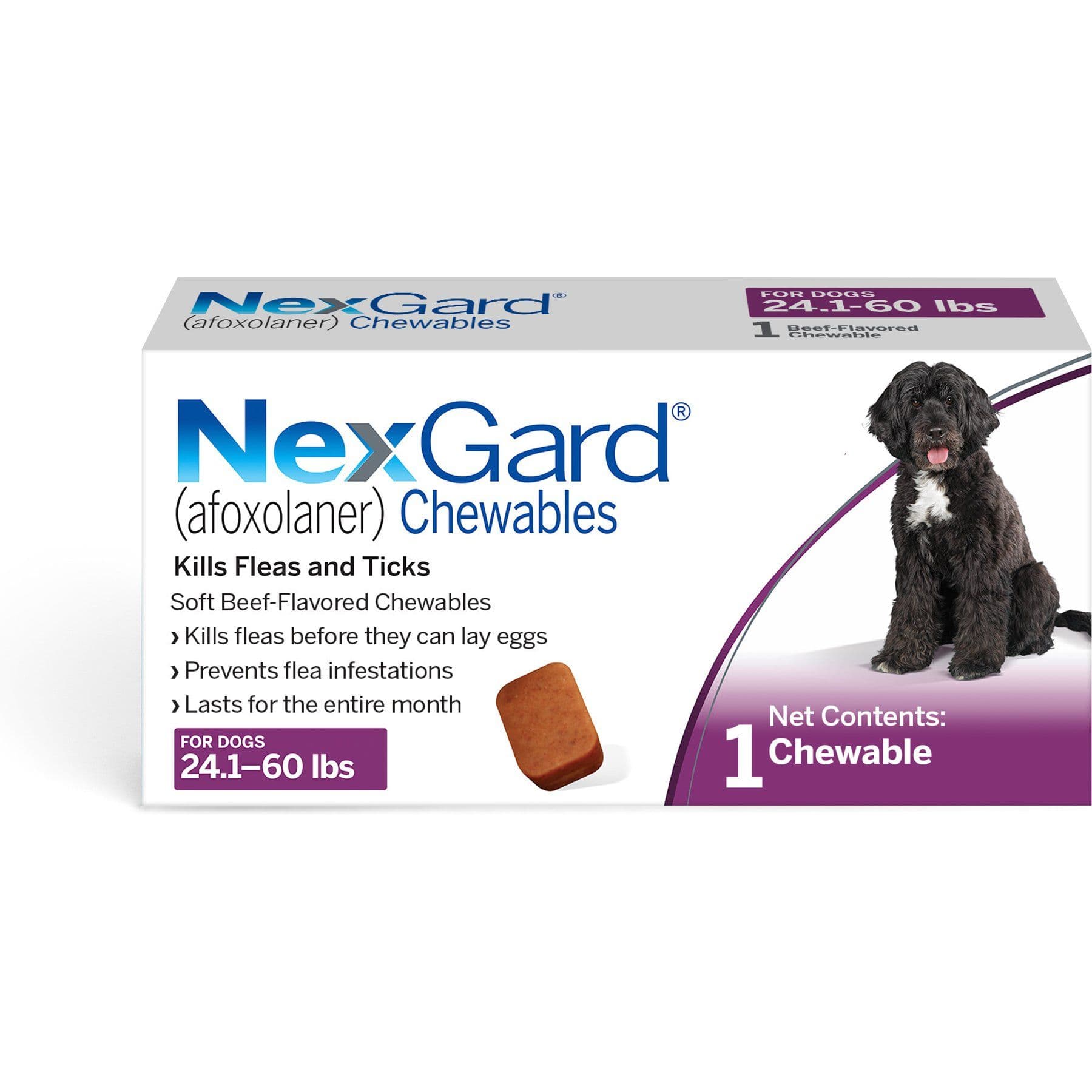
A monthly afoxolaner chew for dogs 24.1 to 60 lbs, sold by Chewy's pharmacy with a vet prescription and used extra-label for demodex.
Webvet may earn a commission when you click through to Chewy, at no extra cost to you.
Is demodectic mange contagious to other dogs or to people?
Demodectic mange is not considered contagious. Merck explains that the mites spend their entire life cycle on the host, and VCA says the condition does not spread to other animals or humans. Veterinary Partner contrasts it with contagious sarcoptic mange in dogs.

Are demodex mites contagious?
Rarely, and not in a way that harms a healthy dog. Veterinary Partner says mites can pass between dogs but simply join a healthy dog's natural mite population, with disease spread possible only in rare, severe cases. The Western College calls natural transmission very rare, and isolation is generally unnecessary.
Can humans catch demodex mites from dogs?
No. Veterinary Partner says there is no question that the mites cannot pass to humans or cats. Demodex canis is not zoonotic: people carry their own human-specific Demodex mites in eyelash and eyebrow follicles and cannot be infected with the canine species, the Western College explains.
Can Demodex mites live in your bedding?
Not for long. The Western College notes that Demodex mites do not survive well off the host and are not thought to be a source of infection for dogs. Treatment guidance for demodectic mange includes no bedding-cleaning step for that reason.
When demodectic mange needs a vet visit fast
Most demodectic mange is not an emergency, but deep infection can make a dog sick: Merck describes fever, lethargy, and enlarged lymph nodes once deep pyoderma, furunculosis, or cellulitis sets in. Book a prompt exam if a dog with thin patches shows:
- fever, lethargy, or a dog that seems unwell
- swollen skin or pus-filled infection in the deeper skin
- enlarged lymph nodes, which Veterinary Partner calls a bad sign
- swollen, infected paws, the hallmark of demodex in the feet
- crusted, bleeding scabs spreading over the head and legs
- recurring demodectic mange after treatment, or new patches in an adult dog
Veterinary Partner warns that skin infections from mite damage sometimes become life-threatening, so untreated generalized disease can kill a dog. Merck adds that corticosteroids are contraindicated in demodicosis, so a steroid for itch should wait until a vet has ruled Demodex out.
How a vet diagnoses demodectic mange: skin scrapes, hair plucks, and follow-up checks
Vets confirm the mites with a deep skin scrape: the Western College describes squeezing a pinch of skin to push mites out of the follicles, and Veterinary Partner a scalpel blade scraping gently but firmly. Under the microscope, VCA says, higher-than-normal numbers of Demodex mites confirm the diagnosis.

Hair plucks are the other main test: the ESVD and ACVD guideline says deep scrapings or trichograms usually make the diagnosis and biopsy is rarely needed, though Veterinary Partner notes paw infections can be deep enough to require one. Generalized cases also need testing for underlying health problems.
Follow-up checks repeat the scrape during treatment, so progress shows up as falling mite counts rather than in photos of mites dying; WebVet's mange in dogs pictures page shows how mange looks on the skin.
How do you know if your dog has demodex mites?
Every dog carries a few Demodex mites, so the question is whether there are too many. Thin, scaly patches raise suspicion, but many skin conditions look the same, so only testing can tell. The Western College says a single mite in a dog with typical signs supports diagnosing demodex.
Treating demodectic mange: prescription mite control, medicated baths, and recovery time
Treatment for demodectic mange in dogs now centers on isoxazolines, the oral flea and tick drugs that Merck calls the preferred treatment for generalized demodicosis, used extra-label at the flea and tick label dose.
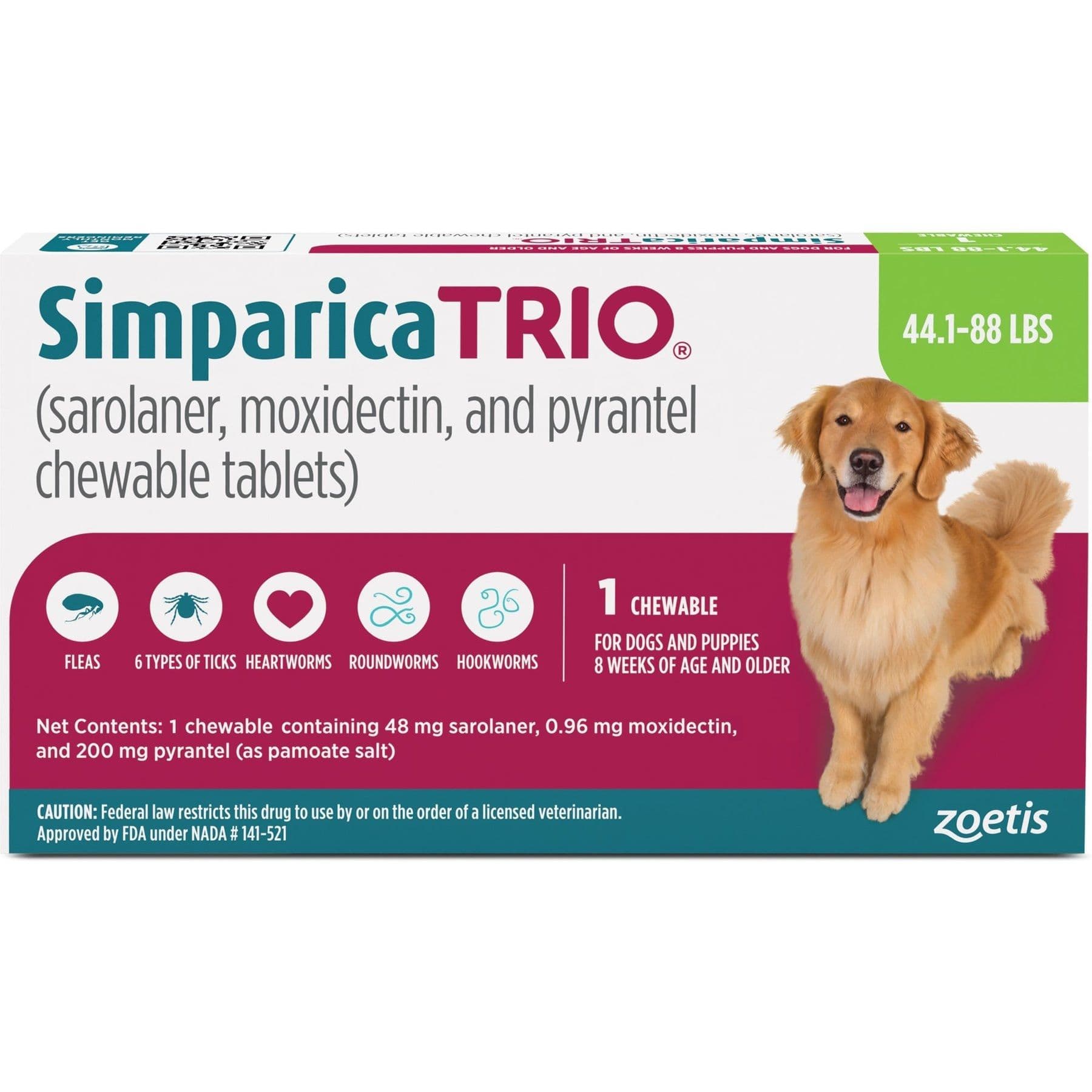
A monthly prescription chew for dogs 44.1 to 88 lbs that also covers heartworm; vets use isoxazolines extra-label for demodex.
Webvet may earn a commission when you click through to Chewy, at no extra cost to you.
Protocols vary. Merck cites studies of monthly afoxolaner (NexGard), lotilaner, or sarolaner (Simparica) and of fluralaner every 12 weeks, while Veterinary Partner describes dosing every two to four weeks depending on the protocol.
The prescribing vet sets that interval, and VCA notes that a vet may also weigh a dog's MDR1 (ABCB1) gene status when choosing a product. The NexGard label and MSD Animal Health both note that isoxazolines have been associated with tremors, ataxia, and seizures, and the NexGard label advises caution in dogs with a seizure history.
Beyond safety, the choice turns on dosing interval, weight band, and what else each chew covers; WebVet's guide to the best flea and tick prevention for dogs covers their everyday parasite role. For demodex in dogs, the four differ like this:
- NexGard: a monthly afoxolaner chew for fleas and ticks; the 24.1 to 60 pound size was listed at $38.99 on Chewy when we checked in October 2026.
- Simparica Trio: a monthly chew whose listing adds heartworm disease, roundworms, hookworms, and flea tapeworms; the 44.1 to 88 pound size was listed at $44.63 on Chewy when we checked in October 2026.
- Bravecto Chews: one fluralaner dose covers up to 12 weeks; in a European field study of 134 dogs with generalized demodicosis, a single oral or spot-on fluralaner dose cleared mites from at least 98 percent of treated dogs by days 56 and 84.
- Credelio Quattro: a monthly lotilaner chew combined with heartworm, roundworm, hookworm, and tapeworm ingredients; its label lists no demodex indication.
Medicated baths support mite treatment rather than replace it, and Merck's owner edition notes that medicated shampoos are often used. For broader options, see WebVet's guide to medicated dog shampoo. Bathing a dog with demodex mange usually involves one of two shampoo types:
- Benzoyl peroxide to flush the follicles: Davis Benzoyl Peroxide Dog & Cat Shampoo, 12-fl oz bottle is a 2.5% benzoyl peroxide formula labeled for conditions associated with demodectic mange, seborrhea dermatitis, and acne, listed at $14.39 on Chewy when we checked in October 2026.
- Chlorhexidine for infected skin: Douxo S3 PYO Antiseptic Antifungal Chlorhexidine Dog & Cat Shampoo, 16.9-oz bottle contains 3% chlorhexidine digluconate and is labeled for bacterial or yeast skin infections, not for killing mites; it was listed at $41.99 on Chewy when we checked in October 2026.
- Contact time: both labels call for leaving the lather on for 5 to 10 minutes before rinsing thoroughly.
- Eyes: the Davis label says to keep the shampoo out of the eyes and mucous membranes and to rinse with water after any contact.
- Frequency: VCA's benzoyl peroxide guidance is to use it for only a few weeks at a time because it can be extremely drying.

Home treatment for demodectic mange means carrying out the prescribed plan: giving every dose on schedule, bathing as directed, and keeping each recheck. No veterinary source supports apple cider vinegar, creams, natural or homeopathic products, or other home remedies as a cure, and Merck's treatment of choice remains a prescription isoxazoline.
Some common itch drugs make demodex worse. Merck states that corticosteroids, applied or given by mouth, are contraindicated in any dog diagnosed with demodicosis, and Veterinary Partner and VCA advise against the prescription itch drug oclacitinib (Apoquel) in dogs with current, recent, or past demodectic mange.
How is demodectic mange treated?
Localized patches in a puppy often need no treatment, though most clear once a regular isoxazoline is started. Generalized disease is treated with a prescribed isoxazoline, plus antibiotics or medicated shampoo for any secondary infection, and skin scrapes every two to four weeks. Veterinary Partner reports that most dogs are simply cured this way.
What kills demodex mites immediately?
Nothing works instantly; even the best-studied drugs clear Demodex mites over weeks. In a study of the one-month fluralaner chew, mean mite counts above 600 fell by 99.7 percent by day 28, compared with 89.5 percent for an imidacloprid and moxidectin spot-on, and three monthly doses eliminated the mites from dogs with generalized disease.
Veterinary Partner adds that once an isoxazoline kills the mites, deep paw infections can resolve in weeks instead of months. Secondary infection still needs its own care: antibiotics may be required, but Veterinary Partner says the infection will probably not fully resolve until the mites are gone.
Older chemical treatments still come up when owners research options:
- Amitraz dips, once the approved US treatment, are no longer available, Merck notes.
- Benzoyl peroxide baths followed by amitraz dipping, VCA says, are now used much less because of side effects and safer medicines.
- Daily oral macrocyclic lactones such as ivermectin, milbemycin oxime, and moxidectin have good evidence behind them, per the guideline.
- For ivermectin, the Merck Veterinary Manual's pharmacology chapter lists an extra-label daily oral dosing protocol that a veterinarian prescribes and adjusts, continued until two negative scrapes a month apart.
How long does it take to get rid of demodectic mange?
A localized patch left alone should look at least partly better within a month, though full resolution may take up to three months, per Veterinary Partner. Generalized demodectic mange takes several months, says Merck: some dogs respond quickly, others need months, and adult-onset cases may take longer. No single number of weeks fits every dog.
Treatment continues past the first clear scrape because one negative result does not prove every mite is gone. Veterinary Partner recommends skin scrapes every two to four weeks so the vet can judge progress and adjust dosing, and the guideline calls for monthly scrapings.
Merck says therapy must continue until at least two consecutive negative scrapings a month apart, and the guideline advises extending treatment beyond clinical and microscopic cure to minimize recurrence. Veterinary Partner notes that some dogs with generalized disease need treatment for life while others are cured after a variable number of months.
Demodectic mange in dogs questions
Frequently Asked Questions
Can demodectic mange kill a dog?
Localized demodectic mange carries an excellent prognosis, according to the Western College, but generalized demodectic mange can turn dangerous when a secondary infection reaches the deeper skin. Merck's owner edition calls generalized demodicosis a serious disease with a guarded outlook.
The Western College describes untreated cases that, after several months, leave the skin crusted, bleeding, and full of pus, and notes that owners of such dogs often request euthanasia. Merck links that deep infection to fever, lethargy, and enlarged lymph nodes. Young dogs treated with modern isoxazolines usually recover, so early care changes the outcome.
Does demodectic mange come back after treatment?
It can. Merck notes that recurrence within the first year of treatment is not uncommon, and Veterinary Partner explains that relapse is always possible with generalized disease because there is no easy way to confirm every mite has died.
The sources differ on timing: VCA says relapses usually appear three to six months after treatment stops, while Veterinary Partner says most happen within six to 12 months of the dog appearing cured.
VCA adds that dogs with suppressed immune systems may be susceptible to relapse, one reason vets look for an underlying illness in adult-onset cases. Veterinary Partner also warns that oclacitinib can trigger recurrence years after recovery.
Can I bathe my dog during demodectic mange treatment?
Yes. Baths are often part of the plan, as long as they sit alongside the prescribed mite drug rather than replace it. A benzoyl peroxide shampoo helps open and flush the hair follicles, and the Davis label on DailyMed directs letting it soak in for 5 to 10 minutes before a thorough rinse.
Because benzoyl peroxide dries the skin, VCA advises using it only a few weeks at a time. A chlorhexidine shampoo, such as Douxo S3 PYO per its DailyMed label, targets bacterial or yeast infection rather than the mites, and the label says to stop and consult the vet if irritation develops or worsens.
Is ivermectin still used for demodectic mange?
Yes, though isoxazolines have largely taken its place. The ESVD and ACVD guideline found good evidence for daily oral ivermectin, and Merck notes that all ivermectin use for skin disease in dogs is extra-label in the US.
The main risk is genetic: Collies, Shetland Sheepdogs, Old English Sheepdogs, Australian Collies, and their crosses can carry an MDR1 mutation that lets more ivermectin into the brain and causes toxicity. Veterinary Partner adds that side effects are more common in herding breeds and that a genetic test can show whether a dog is sensitive.
The guideline also suggests raising the dose gradually, particularly in herding breeds.
Do home remedies work for demodectic mange?
There is no evidence that home remedies cure demodectic mange. Among the treatments the ESVD and ACVD guideline reviewed, good evidence existed only for weekly amitraz rinses and daily oral macrocyclic lactones, and Merck now names isoxazolines the treatment of choice; no home remedy appears in either.
The one home remedy Veterinary Partner discusses, motor oil dipping, harms the skin. Because many skin diseases mimic demodicosis and generalized cases need prescription drugs, a veterinarian should confirm the diagnosis with skin tests before anything is tried at home.

Editor
The Webvet Editorial Team is the in-house group of pet-care editors and writers behind Webvet, operated by Smart Pet Collective. The team researches, writes, and maintains Webvet's pet health, behavior, and medication content. Every article follows a defined editorial process: research from reputable veterinary and scientific sources, careful drafting, mandatory review of medical content by a credentialed veterinarian, and dated publication. Health and medication articles are medically reviewed by a licensed veterinary professional before they go live and are kept current over time.
Veterinarian · BVMS MRCVS
Dr. Pippa Elliott, BVMS, MRCVS, is a veterinarian with nearly 30 years of experience in companion animal practice. Dr. Elliott earned her Bachelor of Veterinary Medicine and Surgery from the University of Glasgow. She was also designated a Member of the Royal College of Veterinary Surgeons. Married with 2 grown-up kids, Dr. Elliott has a naughty Puggle named Poggle, 3 cats and a bearded dragon.
Related reading

Stud Tail in Cats: Causes, Treatment, and Grooming That Helps

Eosinophilic Granuloma Complex in Cats: Rodent Ulcers, Plaques, and Treatment

Miliary Dermatitis in Cats: Causes, Treatment, and Flea Control
