Best Flea and Tick Prevention for Dogs: 13 Vet-Checked Picks
The best flea and tick prevention for dogs is the vet-recommended product your dog actually tolerates and you give on schedule. This guide compares oral chews, topical spot-ons, and collars so you can match protection to your dog's age, lifestyle, and region.

BVMS MRCVS
Medically reviewed by Dr. Pippa Elliott, BVMS MRCVS · Last reviewed

This article contains affiliate links. Webvet may earn a commission when you buy through them, at no extra cost to you.
We compared 13 flea and tick preventives for dogs against their FDA or EPA labels: which tick species each one covers, minimum age and weight, how fast it kills, how long a dose lasts, prescription status and price per month. The best flea and tick prevention for dogs for most healthy adults is Simparica TRIO. See WebVet’s guide to the safest flea treatments for dogs.
The right pick changes with your dog's weight, age and health history, with the tick species where you live, and with whether a cat shares the house. Every pick below states what it kills, what it does not, and who should skip it. Three of them cover no ticks at all.
For most healthy adult dogs, the best flea and tick prevention is Simparica TRIO: one monthly chew that covers fleas, six tick species, heartworm, roundworms and hookworms from 8 weeks and 2.8 pounds. If you want protection today without a vet visit, Frontline Plus is the strongest over-the-counter option, and Seresto covers 8 months from a single collar. Read the tick column before you buy: three picks below deliberately do not kill ticks. Prices are for the exact size we linked and change with your dog's weight.

 Sponsored
Need flea, tick, or parasite care for your dog?
A licensed vet at Dutch can recommend the right preventive and prescribe it when it's appropriate. Annual members get 20% off their first flea and tick order.
Use code Pets60
Plans start at $12/month · covers up to 5 pets
- Licensed vets in most states
- Rx for 150+ conditions
- 4.7 on Trustpilot
Our picks at a glance
- Best overall: Simparica TRIO. Monthly chew, Rx. Kills ticks: 6 species. Price varies by weight band.
- Best flea and tick chew without heartworm coverage: NexGard. Monthly chew, Rx. Kills ticks: 6 species. $167.89 for 6.
- Best flea and tick chew alternative: Credelio. Monthly chew, Rx. Kills ticks: 5 species. Price varies by weight band.
- Best long-lasting chew, 12 weeks per dose: Bravecto Chew. Chew, every 12 weeks, Rx. Kills ticks: 4 species for 12 weeks, lone star for 8. $161.98 for 24 weeks.
- Best all-in-one alternative: NexGard PLUS. Monthly chew, Rx. Kills ticks: 6 species. Price varies by weight band.
- Best non-isoxazoline oral, fleas and worms only, no ticks: Trifexis. Monthly chew, Rx. Does NOT kill ticks. $162.19 for 6.
- Best flea and tick collar, 8 months per collar: Seresto. Collar, 8 months, OTC. Kills ticks: 4 species, repels and kills. $59.92.
- Best tick and mosquito repellent, not for homes with cats: K9 Advantix II. Monthly spot-on, OTC. Kills ticks: 4 species, repels and kills. $79.92 for 6.
- Best over-the-counter topical: Frontline Plus. Monthly spot-on, OTC. Kills ticks: 4 species. $74.98 for 6.
- Best budget pick: PetArmor Plus. Monthly spot-on, OTC. Kills ticks: 4 species. $39.99 for 6.
- Best flea-only topical, no tick coverage: Advantage II. Monthly spot-on, OTC. Does NOT kill ticks. $66.99 for 6.
- Best for puppies from six weeks: Revolution. Monthly spot-on, Rx. Kills ticks: American dog tick only. $106.88 for 3, 40.1 to 85 lb band.
- Fastest knockdown for an active flea infestation, no tick coverage: Capstar. Single-dose tablet, OTC. Does NOT kill ticks. $43.19 for 6.
Trifexis, Advantage II and Capstar do not kill ticks. Trifexis covers fleas, heartworm and intestinal worms, Advantage II covers fleas and lice, and Capstar clears adult fleas for about a day. On a flea and tick plan each of those three has to be paired with something that covers ticks.
How we chose these picks
Every clinical figure on this page was read off a primary source: the FDA-approved label on DailyMed for the prescription drugs, the EPA-stamped label for the pesticides, and AVMA or Companion Animal Parasite Council guidance for anything about timing and technique. Where a label publishes no figure, we say so rather than estimate one.
Each product was scored on seven checkable criteria:
- Regulatory status. Whether it is an FDA-approved animal drug or an EPA-registered pesticide, and which agency reviewed it.
- Exact parasite coverage. Fleas, ticks by named species, and whether heartworm or intestinal worms appear on the label at all.
- Minimum age and minimum weight. Taken from the label, not the marketing copy.
- Dosing interval. Monthly, every 12 weeks, or 8 months for a collar.
- Onset of kill. Published only where the label publishes it. Trifexis, Frontline Plus and PetArmor Plus do not publish an hour figure, so we do not print one.
- Prescription status. Including how hard the product is to actually get this week.
- Price per month of protection. Calculated at the exact weight band we linked, so a collar, a 12-week chew and a monthly spot-on can be compared honestly.
Two rules kept the list honest:
- We do not name a product as a pick unless we can link it and have read its label. Advantage Multi, Comfortis, Credelio Quattro, Vectra 3D, Sentinel and Wondercide all appear in competing roundups. None of them is one of our picks.
- We do not hide a warning to make a pick look cleaner. The isoxazoline neurologic warning, the permethrin cat-fatality box and the 2023 EPA action on Seresto each appear next to the product they belong to, not buried at the bottom of the page.
None of this replaces your veterinarian, who can see your dog's record and knows which tick species are active where you live.
Best overall: Simparica TRIO Chewable Tablets for Dogs
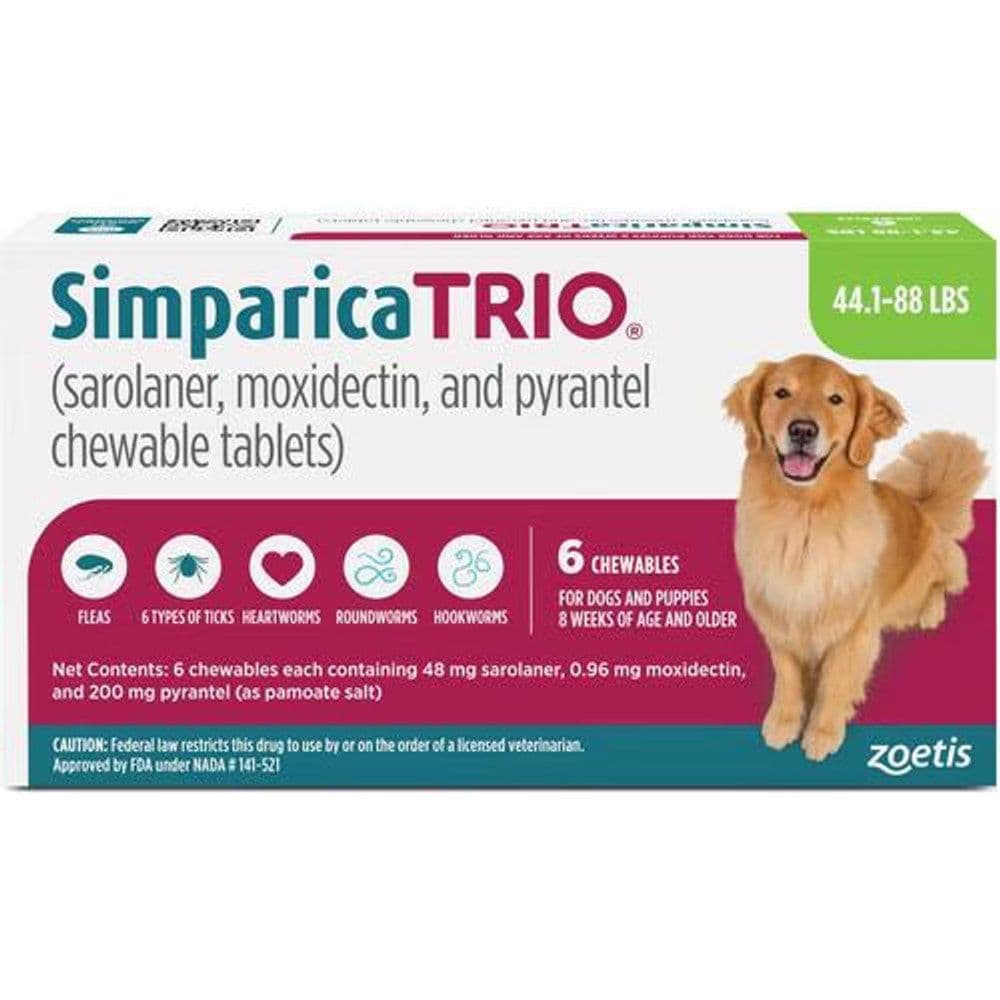
Monthly chew that protects dogs from fleas, six species of ticks, heartworm disease, roundworms, and hookworms.
Webvet may earn a commission when you click through to Chewy, at no extra cost to you.

One monthly chew covers fleas, six tick species, heartworm, roundworms and hookworms. Only two picks here do all of that in a single tablet, and Simparica TRIO is the one that reaches further down the scale. It is labeled from 8 weeks and 2.8 pounds, where NexGard PLUS starts at 4 pounds.
- Active ingredients: sarolaner, moxidectin and pyrantel pamoate. Prescription only.
- Ticks covered: lone star, Gulf Coast, American dog, black-legged, brown dog and Asian longhorned. That is the widest tick list in this slate, matched only by NexGard and NexGard PLUS.
- Also on the label: prevention of heartworm disease, treatment and control of roundworms and hookworms, prevention of tapeworm infections as a direct result of killing vector fleas, and prevention of Borrelia burgdorferi infections as a direct result of killing black-legged ticks.
- Speed: began to kill fleas at 4 hours and showed 100 percent effectiveness at 8 hours, with 100 percent effectiveness against adult fleas within 24 hours.
- Minimums: 8 weeks of age and 2.8 pounds. One dose lasts a month.
- Size we linked: the listing we linked does not specify a weight band, so match the band to your dog's current weight at checkout.
Who should skip it: dogs with a seizure history or known neurologic disease. Sarolaner is an isoxazoline, and the label says to use with caution in dogs with a history of seizures. Skip it too if you cannot get a prescription, or if your dog is under 8 weeks or 2.8 pounds.
Best flea and tick chew without heartworm coverage: NexGard
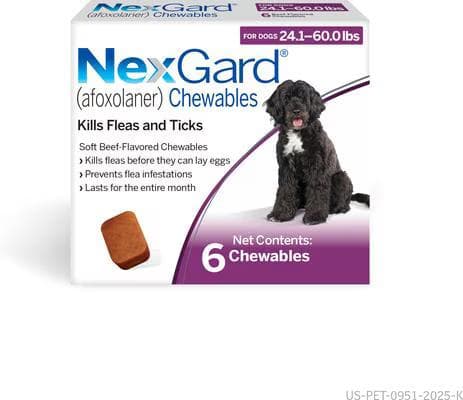
A monthly beef-flavored prescription chew (afoxolaner) that kills fleas before they lay eggs and kills ticks. A popular oral pick for dogs who do better with a chew than a topical.
Webvet may earn a commission when you click through to Chewy, at no extra cost to you.
Six tick species, the same breadth as Simparica TRIO, without paying again for heartworm coverage you already buy separately. If your dog is settled on a heartworm preventive that works, this is the chew that slots in beside it.
- Active ingredient: afoxolaner. Prescription only.
- Ticks covered: black-legged, American dog, lone star, Gulf Coast, brown dog and longhorned.
- Lyme claim: the label carries an approved claim for prevention of Borrelia burgdorferi infections as a direct result of killing black-legged ticks. It is one of four picks here that carries it, alongside Simparica TRIO, NexGard PLUS and Credelio.
- Does not cover: heartworm or intestinal worms. You still need a separate heartworm preventive.
- Speed: began to kill fleas 4 hours after the first dose and showed greater than 99 percent effectiveness at 8 hours.
- Minimums: 8 weeks of age and 4 pounds. One dose lasts a month.
- Size we linked: 24.1 to 60 pounds, $167.89 for six chews, about $27.98 a month.
Who should skip it: dogs with a seizure or neurologic history, because afoxolaner is an isoxazoline. Skip it too if your dog is not already on a separate heartworm preventive, because NexGard does not prevent heartworm.
Best flea and tick chew alternative: Credelio
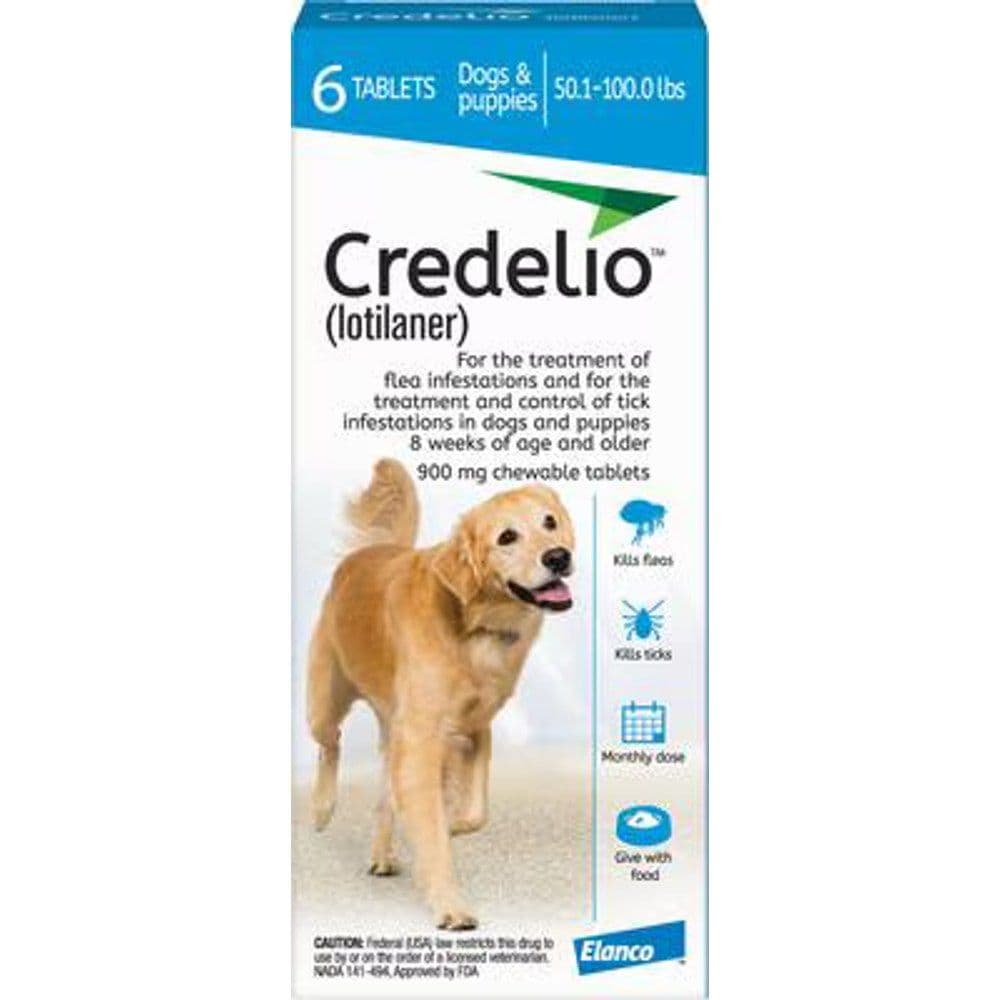
Monthly prescription chew that kills fleas and ticks on dogs, including the black-legged (deer) ticks that can spread Lyme disease.
Webvet may earn a commission when you click through to Chewy, at no extra cost to you.
The same monthly job as NexGard, with a documented 4-hour flea onset and the same approved Lyme-prevention claim. This is the one to reach for when a dog turns its nose up at the beef-flavored afoxolaner chew.
- Active ingredient: lotilaner. Prescription only.
- Ticks covered: lone star, American dog, black-legged, brown dog and longhorned. Five species, one short of NexGard.
- Lyme claim: the label carries the approved claim for prevention of Borrelia burgdorferi infections as a direct result of killing black-legged ticks.
- Does not cover: heartworm or intestinal worms. Nothing beyond fleas, those five tick species and that Lyme claim.
- Speed: began to kill fleas 4 hours after administration with greater than 99 percent killed within 8 hours in European laboratory studies. A US laboratory study showed 100 percent effectiveness against adult fleas 12 hours after administration.
- Minimums: 8 weeks of age and 4.4 pounds. One dose lasts a month.
- Size we linked: the listing we linked does not specify a weight band, so match the band to your dog's current weight at checkout.
Who should skip it: dogs with a seizure or neurologic history, because lotilaner is an isoxazoline. Skip it if Gulf Coast tick coverage matters where you live, since that species is on the NexGard label and not this one, and skip it for dogs under 4.4 pounds.
Best long-lasting chew, 12 weeks per dose: Bravecto Chew for Dogs
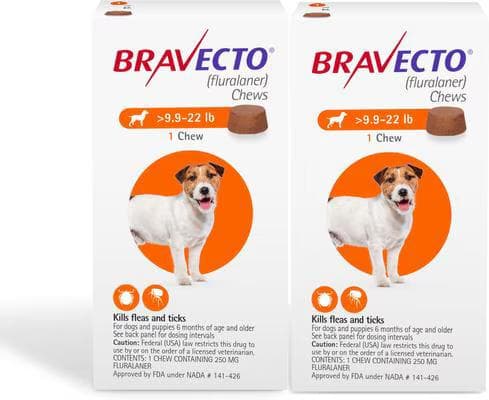
A prescription fluralaner chew that protects against fleas and most ticks for up to 12 weeks per dose, so one chew covers a full season quarter. A low-frequency option for owners who forget monthly doses.
Webvet may earn a commission when you click through to Chewy, at no extra cost to you.
Four doses a year instead of twelve. That is the single best fix for the real failure mode in this category, which is not a product that stops working but an owner who forgets the monthly dose. It also has the fastest documented flea onset of any preventive here at 2 hours.
- Active ingredient: fluralaner. Prescription only.
- Ticks covered: black-legged, American dog, brown dog and Asian longhorned for the full 12 weeks. Lone star tick is covered for 8 weeks only, and the label directs redosing every 8 weeks where that species is active.
- Does not cover: heartworm or intestinal worms, and this label carries no Lyme-prevention claim.
- Speed: began to kill fleas within 2 hours of administration in a well-controlled laboratory study. Capstar is faster, but Capstar is a one-day knockdown rather than a preventive.
- Minimums: 6 months of age and 4.4 pounds. That 6-month floor is the strictest age minimum in this slate.
- Size we linked: 9.9 to 22 pounds, $161.98 for a 24-week supply, about $29.25 a month of protection.
Who should skip it: puppies under 6 months, dogs with a seizure or neurologic history, and dogs in lone star tick country who want a true 12-week interval rather than an 8-week one.
Best all-in-one alternative: NexGard PLUS
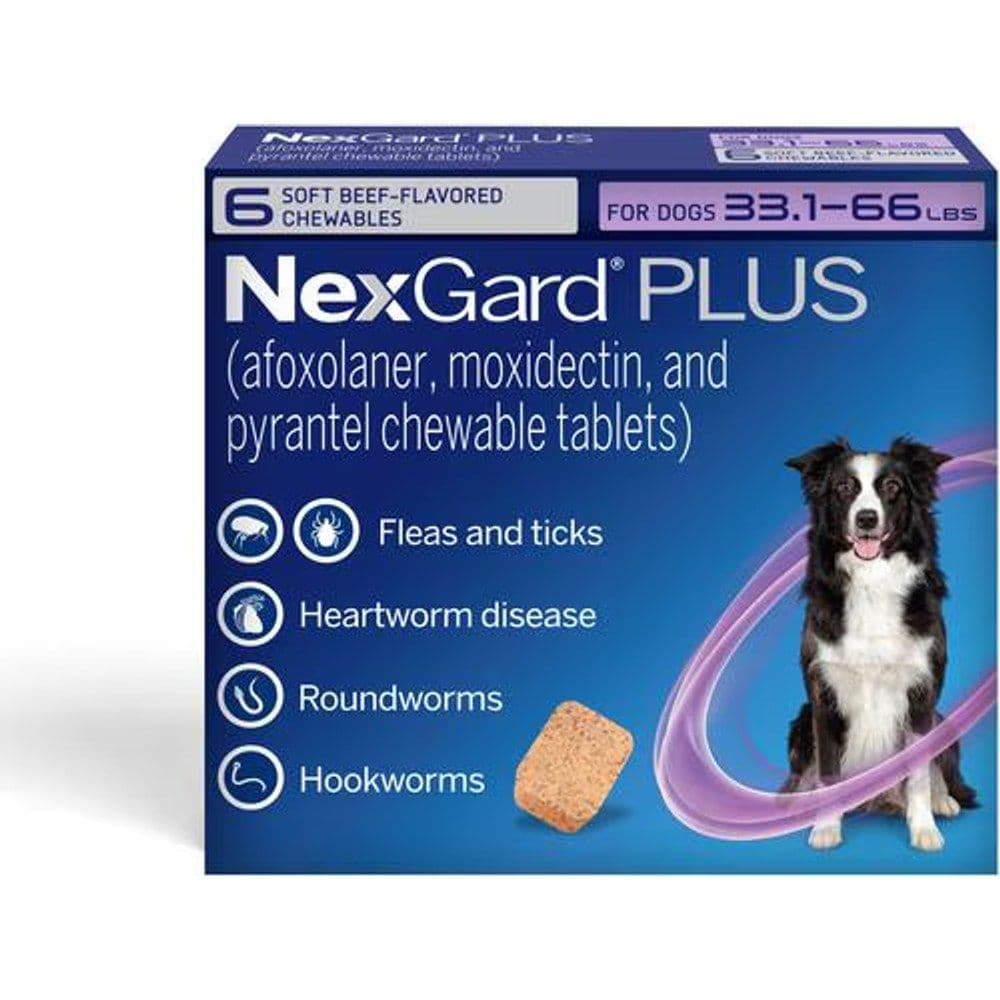
Beef-flavored monthly chew that protects dogs from fleas, ticks, heartworm disease, roundworms, and hookworms.
Webvet may earn a commission when you click through to Chewy, at no extra cost to you.
The same job as Simparica TRIO, the same six-species tick list and the same Lyme-prevention claim. Reach for it when your clinic stocks Boehringer rather than Zoetis, or when a dog does not tolerate sarolaner. The fact that decides between the two all-in-ones is the weight floor.
- Active ingredients: afoxolaner, moxidectin and pyrantel (as pamoate salt). Prescription only.
- Ticks covered: black-legged, brown dog, American dog, lone star, Gulf Coast and longhorned.
- Also on the label: prevention of heartworm disease, treatment and control of adult hookworm (Ancylostoma caninum, Ancylostoma braziliense, Uncinaria stenocephala) and roundworm (Toxocara canis, Toxascaris leonina), plus the approved claim for prevention of Borrelia burgdorferi infections as a direct result of killing black-legged ticks.
- Speed: afoxolaner alone began to kill fleas 4 hours after the first dose and showed greater than 99 percent effectiveness at 8 hours.
- Minimums: 8 weeks of age and 4 pounds. One dose lasts a month.
- Size we linked: the listing we linked does not specify a weight band, so match the band to your dog's current weight at checkout.
Who should skip it: dogs with a seizure or neurologic history, and dogs under 4 pounds, where the 2.8-pound minimum on Simparica TRIO is the better fit. Like every heartworm preventive, it requires a negative heartworm test before you start.
Best non-isoxazoline oral, fleas and worms only, no ticks: Trifexis
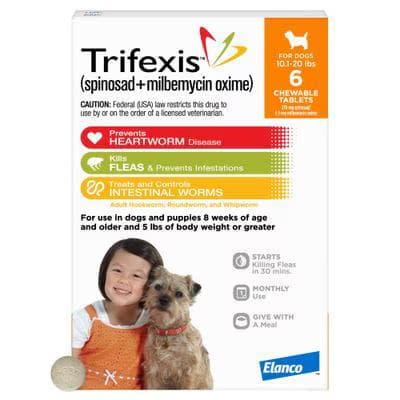
A monthly chew (spinosad and milbemycin oxime) that kills fleas, prevents heartworm, and treats intestinal worms. A non-isoxazoline oral option that starts killing fleas within 30 minutes.
Webvet may earn a commission when you click through to Chewy, at no extra cost to you.
Trifexis kills no ticks. It earns a place here for one reason: it is the only monthly oral preventive in this slate that is not an isoxazoline, so it does not carry the FDA isoxazoline class warning. It also adds whipworm, which none of the isoxazoline combinations cover.
- Active ingredients: spinosad and milbemycin oxime. Prescription only.
- Ticks covered: none. This product has no tick claim of any kind.
- Also on the label: prevention of heartworm disease, plus treatment and control of adult hookworm, roundworm and whipworm infections.
- Speed: no onset-of-kill figure is published on the FDA label, so we do not publish one.
- Minimums: 8 weeks of age and 5 pounds. One dose lasts a month.
- Size we linked: 10.1 to 20 pounds, $162.19 for six chews, about $27.03 a month.
Who should skip it: any dog that needs tick coverage, which is most dogs that go outside. Being outside the isoxazoline class is also not a free pass, because this label carries cautions of its own:
- It says to use with caution in dogs with pre-existing epilepsy.
- It notes that puppies less than 14 weeks of age may experience a higher rate of vomiting.
- It warns about serious adverse reactions following concomitant extra-label use of ivermectin with spinosad.
Best flea and tick collar, 8 months per collar: Seresto
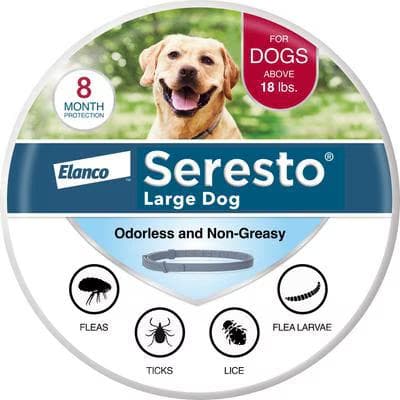
An eight-month flea and tick collar for dogs over 18 lbs that releases protection steadily. A low-effort layer to help keep ticks off between vet-recommended preventives.
Webvet may earn a commission when you click through to Chewy, at no extra cost to you.

One purchase covers roughly two thirds of a year with no monthly reminder to miss, and it needs no prescription. It also repels ticks as well as killing them, which an oral chew cannot do. At $59.92 for 8 months it works out to about $7.49 a month, the second-cheapest per-month option in this slate.
- Active ingredients: imidacloprid 10.0 percent and flumethrin 4.5 percent. It is an EPA-registered pesticide (EPA Reg. No. 11556-155), not an FDA-approved drug, and it is sold over the counter.
- Ticks covered: black-legged, American dog, brown dog and lone star. The label reads that it repels and kills.
- Also covers: chewing lice.
- Speed: kills existing fleas on dogs 24 hours after application, after which new fleas are killed within 2 hours. Prevention of new tick infestations starts 48 hours after application, and new ticks are repelled or killed as quickly as 6 hours after that point.
- Duration: 8 months as labeled. For dogs bathed more than once a month or swimming once a month or more, the label drops that to 5 months for flea control and 7 months for tick control.
- Minimum age: 7 weeks.
- Size we linked: the over-18-pound collar at $59.92.
Who should skip it: dogs that swim or are bathed often, where the labeled duration falls. Skip it too if you want a product with no adverse-event history in the public record, because this one has been through public scrutiny and the label reflects it.
Best tick and mosquito repellent, not for homes with cats: K9 Advantix II
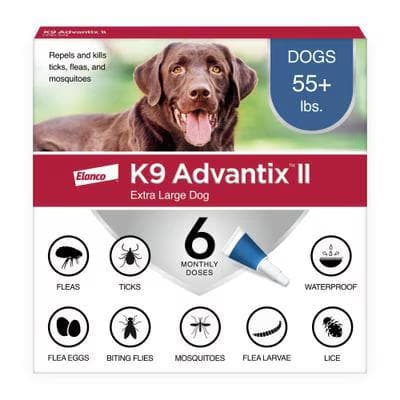
A monthly topical for dogs over 55 lbs that repels and kills ticks, fleas, and mosquitoes. Repelling ticks before they bite is a useful layer during heavy tick season.
Webvet may earn a commission when you click through to Chewy, at no extra cost to you.

This is one of only two picks here that repels parasites rather than waiting for them to bite, and the only one that adds mosquitoes and biting flies. Seresto repels too, but carries no mosquito claim.
For a dog that hikes wooded trails or lives under heavy mosquito pressure, that combination is something an oral chew cannot offer.
- Active ingredients: imidacloprid 8.80 percent, permethrin 44.00 percent and pyriproxyfen 0.44 percent. EPA-registered pesticide (EPA Reg. No. 11556-144 for the over-55-pound size), sold over the counter.
- Ticks covered: deer or black-legged, American dog, brown dog and lone star, repelled and killed.
- Also covers: repels and kills mosquitoes and biting flies, kills chewing lice, and kills flea eggs and larvae.
- Speed: kills existing fleas on dogs within 12 hours of application.
- Minimum age: 7 weeks. Smaller sizes go down to 4 pounds.
- Size we linked: over 55 pounds, $79.92 for six doses, about $13.32 a month.
Who should skip it: any household with a cat that has close contact with the dog. Skip it too for dogs bathed or swimming often, since the label requires the dog stay dry for 24 hours after application, and for puppies under 7 weeks.
Best over-the-counter topical: Frontline Plus
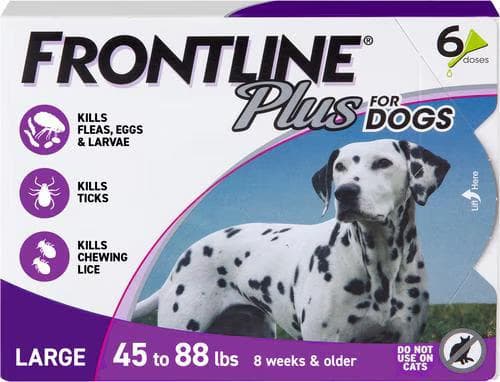
A monthly topical spot-on for large dogs 45 to 88 lbs that kills fleas, ticks, and chewing lice. A waterproof pick for dogs who do better with a topical than an oral chew.
Webvet may earn a commission when you click through to Chewy, at no extra cost to you.

No prescription and no vet visit, and the mechanism is the strongest argument for a topical over an oral chew: a tick does not have to bite your dog to die. The label states plainly that fleas and ticks do not need to bite the dog in order to die.
- Active ingredients: fipronil 9.8 percent and (S)-methoprene 8.8 percent. EPA-registered pesticide (EPA Reg. No. 65331-5), sold over the counter.
- Ticks covered: brown dog, American dog, lone star and deer ticks, at all life stages (larva, nymph and adult).
- Also covers: kills flea eggs and flea larvae and chewing lice, and aids in control of sarcoptic mange infestations.
- Speed: the label says fleas, ticks and chewing lice are killed quickly after coming into contact with a treated dog, but it publishes no hour figure, so neither do we.
- Minimum age: 8 weeks. It is approved for use on breeding, pregnant and lactating bitches, which the prescription chews are not: the Simparica TRIO, NexGard, NexGard PLUS and Credelio labels each state that safe use in breeding, pregnant or lactating dogs has not been evaluated.
- Size we linked: 45 to 88 pounds, $74.98 for six doses, about $12.50 a month.
Who should skip it: dogs in Gulf Coast or Asian longhorned tick country, since those two species sit on the isoxazoline labels and not this one. Skip it too in households where a topical residue on the coat is a problem, for dogs bathed very frequently, and for puppies under 8 weeks.
Best budget pick: PetArmor Plus
Webvet may earn a commission when you click through to Chewy, at no extra cost to you.
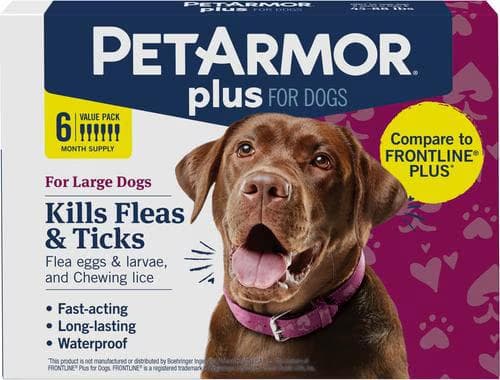
Identical active ingredients at identical concentrations to Frontline Plus, in the same 45 to 88 pound size, for $39.99 against $74.98. That is $6.67 a dose against $12.50, roughly half price for the same chemistry, and it is the clearest value call on this page.
- Active ingredients: fipronil 9.8 percent and (S)-methoprene 8.8 percent, the same two actives at the same strengths as Frontline Plus. EPA Reg. No. 85495-2, sold over the counter.
- Ticks covered: brown dog, American dog, lone star and deer ticks, including ticks that may transmit Lyme disease, at all stages.
- Also covers: kills flea eggs and chewing lice, and aids in control of sarcoptic mange infestations. The (S)-methoprene insect growth regulator continues to control flea reinfestation for up to three months after an application.
- Speed: no onset-of-kill hour figure is published on the label, so we do not print one.
- Minimum age: 8 weeks, and the label covers breeding, pregnant and lactating bitches.
- Size we linked: 45 to 88 pounds, $39.99 for six doses, about $6.67 a month. That is the cheapest month of protection on this page.
Who should skip it: same limits as Frontline Plus, meaning no Gulf Coast or Asian longhorned tick coverage and nothing for puppies under 8 weeks. Skip it if you specifically want the originator brand rather than the same actives from a different registrant.
Best flea-only topical, no tick coverage: Advantage II
Webvet may earn a commission when you click through to Chewy, at no extra cost to you.
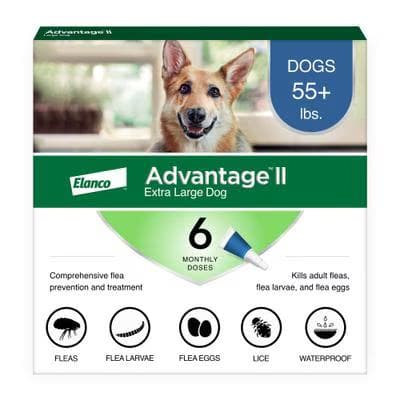
Advantage II kills no ticks. Its label is titled as a once-a-month topical treatment for fleas and lice, and that is exactly what it is.
If your dog genuinely has no tick exposure, this is the honest answer: pay for fleas and lice, skip the tick chemistry, and still cover all three flea life stages without a prescription.
- Active ingredients: imidacloprid 9.10 percent and pyriproxyfen 0.46 percent. EPA-registered pesticide, sold over the counter.
- Ticks covered: none.
- Also covers: kills adult fleas, flea larvae and flea eggs, plus biting and chewing lice.
- Speed: kills existing fleas on dogs within 12 hours, and reinfesting fleas within 2 hours.
- Minimum age: 7 weeks.
- Size we linked: over 55 pounds, $66.99 for six doses, about $11.17 a month.
One more thing worth knowing at the shelf: the two names are almost identical, which does cover ticks and repels mosquitoes. They are different products with different active ingredients, and shoppers mix them up constantly.
Who should skip it: almost every dog that goes outdoors in the United States, because it does not kill ticks. Do not treat it as flea and tick prevention.
 Sponsored
Vet care that's always there
Unlimited video calls and messaging with licensed vets for less than a typical vet visit. One membership covers up to five pets.
Use code Pets60
Plans start at $12/month · covers up to 5 pets
- Licensed vets in most states
- Rx for 150+ conditions
- 4.7 on Trustpilot
Best for puppies from six weeks: Revolution
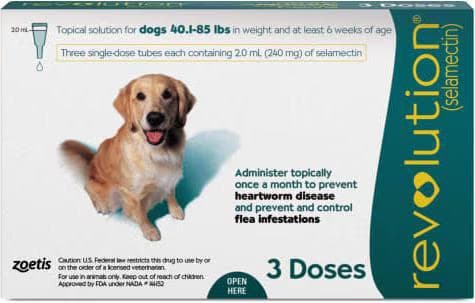
A monthly topical (selamectin) that prevents heartworm and controls fleas, and is well tolerated in herding breeds at the label dose. A prescription pick for dogs who need a non-isoxazoline option.
Webvet may earn a commission when you click through to Chewy, at no extra cost to you.
Six weeks is the earliest age minimum of any monthly preventive in this slate, two weeks earlier than the isoxazoline chews and one week earlier than the collar and the over-the-counter topicals. For a young puppy that also needs heartworm, ear mite and sarcoptic mange cover, one product does all of it at that age.
- Active ingredient: selamectin. Prescription only.
- Ticks covered: American dog tick only. That is the hard limit on this product and the reason it is a bridge rather than a destination.
- Also on the label: kills adult fleas and prevents flea eggs from hatching for one month, prevents heartworm disease, and treats and controls ear mite infestations and sarcoptic mange.
- Speed: in controlled laboratory studies greater than 98 percent of fleas were killed within 36 hours, and clinical field studies showed greater than 90 percent control of flea infestations within 30 days of the first dose.
- Minimum age: 6 weeks. One dose lasts a month.
- Size we linked: 40.1 to 85 pounds, $106.88 for three doses, about $35.63 a month.
Who should skip it: any dog living where Lyme disease, ehrlichiosis or Rocky Mountain spotted fever is a real risk. The label controls tick infestations due to Dermacentor variabilis only, so it is not labeled against black-legged, lone star or brown dog ticks.
Treat Revolution as a puppy bridge and move to broader coverage once your puppy reaches the age and weight for it.
Fastest knockdown for an active flea infestation, no tick coverage: Capstar
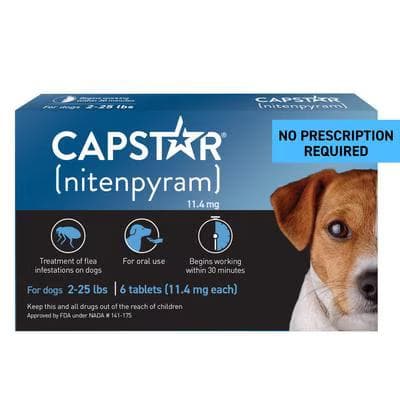
An over-the-counter nitenpyram tablet that starts killing adult fleas within 30 minutes. A fast knockdown for an active infestation, no prescription required, useful alongside a longer-term preventive.
Webvet may earn a commission when you click through to Chewy, at no extra cost to you.
Nothing else on this page works in 30 minutes. Capstar is not prevention. It is the tablet that clears the adult fleas off a dog the same afternoon while a real preventive gets started, and it has the lowest age and weight thresholds in this slate.
- Active ingredient: nitenpyram. Sold over the counter.
- Ticks covered: none.
- What it covers: adult fleas on the dog and nothing else. No flea eggs, no larvae, no ticks and no residual protection.
- Speed: starts killing fleas within 30 minutes and kills over 90 percent of fleas within 4 hours in dogs.
- Duration: roughly one day of action. A single dose kills the adult fleas on the pet and can be redosed as often as once per day if the dog is reinfested.
- Minimums: 4 weeks of age and 2 pounds.
- Size we linked: 2 to 25 pounds, $43.19 for six tablets, about $7.20 a tablet.
Who should skip it: anyone shopping for prevention. The manufacturer says so directly, recommending a monthly flea preventive for long-term flea prevention. Because it does not touch ticks, flea eggs or larvae, fleas will keep coming back from the environment unless you also treat the dog long-term and treat the home.
Flea and tick prevention for dogs compared side by side
Read this table across rather than down. For most buyers the column that settles the purchase is tick species covered, and the column that settles the rest is minimum age and weight.
Three shortcuts if you already know your constraint:
- You want heartworm in the same product: Simparica TRIO or NexGard PLUS.
- You want repellency, not just a kill after the bite: Seresto or K9 Advantix II. K9 Advantix II is not an option in a home with a cat.
- You cannot get a prescription: Frontline Plus, PetArmor Plus, Seresto or K9 Advantix II for flea and tick cover. Advantage II and Capstar are also sold over the counter, but neither kills ticks.
| Product | Type | Active ingredient | Kills fleas | Tick species covered | Duration | Minimum age | Minimum weight | Rx or OTC | Safe in a cat household |
|---|---|---|---|---|---|---|---|---|---|
| Simparica TRIO | Oral chew | Sarolaner, moxidectin, pyrantel | Yes, 100% at 8 hours | 6: lone star, Gulf Coast, American dog, black-legged, brown dog, Asian longhorned | 1 month | 8 weeks | 2.8 lb | Rx | Yes, no coat residue |
| NexGard | Oral chew | Afoxolaner | Yes, over 99% at 8 hours | 6: black-legged, American dog, lone star, Gulf Coast, brown dog, longhorned | 1 month | 8 weeks | 4 lb | Rx | Yes, no coat residue |
| Credelio | Oral chew | Lotilaner | Yes, over 99% at 8 hours | 5: lone star, American dog, black-legged, brown dog, longhorned | 1 month | 8 weeks | 4.4 lb | Rx | Yes, no coat residue |
| Bravecto Chew | Oral chew | Fluralaner | Yes, begins at 2 hours | 4 for 12 weeks: black-legged, American dog, brown dog, Asian longhorned. Lone star for 8 weeks | 12 weeks | 6 months | 4.4 lb | Rx | Yes, no coat residue |
| NexGard PLUS | Oral chew | Afoxolaner, moxidectin, pyrantel | Yes, over 99% at 8 hours | 6: black-legged, brown dog, American dog, lone star, Gulf Coast, longhorned | 1 month | 8 weeks | 4 lb | Rx | Yes, no coat residue |
| Trifexis | Oral chew | Spinosad, milbemycin oxime | Yes | None. No tick coverage | 1 month | 8 weeks | 5 lb | Rx | Yes, no coat residue |
| Seresto | Collar | Imidacloprid 10%, flumethrin 4.5% | Yes, existing fleas by 24 hours, new fleas in 2 hours | 4: black-legged, American dog, brown dog, lone star. Repels and kills | 8 months, 5 for fleas and 7 for ticks if bathed or swimming monthly | 7 weeks | Over 18 lb for this size | OTC | Yes |
| K9 Advantix II | Topical spot-on | Imidacloprid 8.8%, permethrin 44%, pyriproxyfen 0.44% | Yes, within 12 hours | 4: deer, American dog, brown dog, lone star. Repels and kills | 1 month | 7 weeks | Over 55 lb for this size | OTC | NO. Permethrin may be fatal to cats. Label says keep cats away from treated dogs for 24 hours |
| Frontline Plus | Topical spot-on | Fipronil 9.8%, (S)-methoprene 8.8% | Yes, plus flea eggs and larvae | 4: brown dog, American dog, lone star, deer, all life stages | 1 month | 8 weeks | 45 lb for this size | OTC | Use caution. Keep the cat off the application site until dry |
| PetArmor Plus | Topical spot-on | Fipronil 9.8%, (S)-methoprene 8.8% | Yes, plus flea eggs | 4: brown dog, American dog, lone star, deer, all stages | 1 month, IGR controls reinfestation up to 3 months | 8 weeks | 45 lb for this size | OTC | Use caution. Keep the cat off the application site until dry |
| Advantage II | Topical spot-on | Imidacloprid 9.1%, pyriproxyfen 0.46% | Yes, within 12 hours, plus larvae and eggs | None. Fleas and lice only | 1 month | 7 weeks | Over 55 lb for this size | OTC | No. Label says do not use on cats and keep cats away for 24 hours |
| Revolution | Topical spot-on | Selamectin | Yes, greater than 98 percent of fleas killed within 36 hours in laboratory studies | 1: American dog tick only | 1 month | 6 weeks | 40.1 lb for this size | Rx | Use caution. Keep the cat off the application site until dry |
| Capstar | Single-dose tablet | Nitenpyram | Yes, adults only, from 30 minutes | None | About 24 hours | 4 weeks | 2 lb | OTC | Yes, no coat residue |
Every figure in this table comes from the product label or the FDA or EPA record for that product. Prices and the exact weight band we linked are in the picks above, and both change with your dog's weight. Three products here kill no ticks: Trifexis, Advantage II and Capstar.
What to consider before you buy
Start with what your veterinarian says is active where you live, then work down this list. Each factor removes products from the shortlist rather than adding them, which is why the list is short.

- Parasite coverage. Tick lists are not equal. Six species on Simparica TRIO, NexGard and NexGard PLUS, five on Credelio, four on Bravecto, Seresto, K9 Advantix II, Frontline Plus and PetArmor Plus, one on Revolution, and none at all on Trifexis, Advantage II or Capstar. Decide separately whether you want heartworm and intestinal worms in the same product.
- Age and weight. These are hard label limits, not suggestions. Capstar starts at 4 weeks and 2 pounds, Revolution at 6 weeks, Seresto, K9 Advantix II and Advantage II at 7 weeks, most chews and the fipronil topicals at 8 weeks, and Bravecto not until 6 months.
- Health history. A seizure or neurologic history moves you away from the isoxazolines and toward a topical or a non-isoxazoline oral. Pregnancy and nursing matter too: Frontline Plus and PetArmor Plus are labeled for breeding, pregnant and lactating bitches, while the prescription chews are not labeled for them.
- Who else lives in the house. A cat with close contact rules out K9 Advantix II outright, because permethrin can be fatal to cats. It is also a reason many owners in mixed households prefer an oral chew, which leaves nothing on the coat.
- Water and bathing. A chew cannot be washed off. A collar loses labeled duration on a dog that swims or is bathed monthly, and K9 Advantix II needs the dog to stay dry for 24 hours after application.
- Prescription access. Seven of the thirteen picks need a vet. If you cannot get one this week, the over-the-counter shortlist is the real shortlist.
- What you will actually give on time. A perfect product you forget is worse than a good one you give on schedule. That is the whole argument for a 12-week chew or an 8-month collar.
Bring the answers to your veterinarian rather than a brand name. They can match your dog's record and your local tick species to a specific product faster than any page can.
Oral chews vs topical spot-ons vs collars
Almost every product here is one of three things: a flavored tablet, a liquid applied to the skin, or a collar. The format decides how the drug reaches the parasite, whether water is a problem, and whether a tick has to bite your dog before it dies.
Oral flea and tick chews
Chews are swallowed, absorbed into the bloodstream and kill the parasite once it feeds. Five of our picks are isoxazolines: Simparica TRIO, NexGard, NexGard PLUS, Bravecto and Credelio. Trifexis is an oral preventive from a different class, and Capstar is an oral knockdown rather than a preventive.
- Strengths: nothing on the coat to rub off on children, furniture or a cat, no swimming or bathing restriction, and the widest tick lists in this roundup.
- Trade-off: an oral chew does not repel. The tick has to attach and feed before the drug reaches it, although that happens fast.
- Interval: monthly, except Bravecto at 12 weeks.
- Access: every oral preventive here needs a prescription. Capstar does not, but it is not a preventive.
Topical spot-on treatments
Spot-ons are liquids applied to the skin between the shoulder blades, usually once a month. What they cover depends entirely on the active ingredient, and the differences between them are larger than the packaging suggests.
- Fipronil plus (S)-methoprene (Frontline Plus, PetArmor Plus) kills fleas, flea eggs and larvae and four tick species at all life stages. The label states fleas and ticks do not need to bite the dog in order to die.
- Permethrin combinations (K9 Advantix II) repel as well as kill, and add mosquitoes and biting flies. Permethrin is toxic to cats and must never be used where a cat has close contact with the treated dog.
- Imidacloprid plus pyriproxyfen (Advantage II) covers fleas and lice only, with no tick coverage at all.
- Selamectin (Revolution) covers fleas, heartworm, ear mites and sarcoptic mange, but only one tick species.
- Trade-off: the product sits on the coat, so the dog needs to stay dry after application and frequent bathing can shorten what you paid for.
Flea and tick collars
A modern collar is a slow-release delivery system rather than the crude product the format used to be. Seresto releases imidacloprid and flumethrin over 8 months, and it repels ticks as well as killing them.
- Strengths: one purchase covers most of a year, no monthly reminder, no prescription, and it is the second-cheapest per-month option here.
- Trade-off: duration falls to 5 months for fleas and 7 months for ticks on a dog bathed more than monthly or swimming monthly, and the collar has a documented adverse-event record that EPA acted on in 2023.
- Fit: it has to sit snugly against the skin to work, not loose, and the neck should be checked regularly for irritation.
Best flea and tick prevention for dogs without a vet prescription
Six of our thirteen picks need no prescription: Frontline Plus, PetArmor Plus, Seresto, K9 Advantix II, Advantage II and Capstar. The reason has nothing to do with strength and everything to do with which agency reviewed the product.
- FDA-approved animal drugs are absorbed into the dog and are dispensed on a veterinarian's prescription. Simparica TRIO, NexGard, NexGard PLUS, Bravecto, Credelio, Trifexis and Revolution are in this group.
- EPA-registered pesticides act on or at the skin surface and are sold over the counter. Seresto, K9 Advantix II, Frontline Plus, PetArmor Plus and Advantage II are in this group.
- Capstar is the outlier: an oral tablet sold without a prescription, and a one-day knockdown rather than a preventive.
If you cannot get to a vet this week, here is how the over-the-counter shortlist sorts out:
- Broadest over-the-counter coverage: Frontline Plus. Four tick species at all life stages, plus flea eggs and larvae, and a contact kill that does not require the parasite to bite.
- Same chemistry for less: PetArmor Plus, with identical actives at identical concentrations for about half the price at the size we linked.
- Longest coverage per purchase: Seresto, at 8 months from one collar.
- Repellency plus mosquitoes: K9 Advantix II, but never in a home with a cat.
- Fleas only: Advantage II, which kills no ticks.
- Emergency knockdown: Capstar, which kills adult fleas for about a day and no ticks at all.
What you give up by skipping the prescription is worth stating plainly:
- No heartworm coverage. Every heartworm preventive is a prescription drug, because it requires a negative heartworm test first. No over-the-counter flea and tick product covers heartworm.
- A shorter tick list, in most cases. The over-the-counter picks top out at four tick species. Gulf Coast and Asian longhorned ticks sit on the isoxazoline labels only.
- No professional review of your dog's history. A prescription means someone checked the record for seizures, pregnancy, weight and drug interactions before the product went home with you.
Best flea and tick prevention for puppies
Puppies are where label minimums stop being paperwork and start being safety. Every product below has a minimum age, most have a minimum weight, and using one early is not a small shortcut. Confirm the label and the dose with your veterinarian, because formulations differ inside the same brand family.

| Product | Minimum age | Minimum weight | Kills ticks |
|---|---|---|---|
| Capstar | 4 weeks | 2 lb | No |
| Revolution | 6 weeks | Match the size band to current weight | American dog tick only |
| Seresto | 7 weeks | Sized by collar | Yes, 4 species |
| K9 Advantix II | 7 weeks | Smaller sizes from 4 lb | Yes, 4 species |
| Advantage II | 7 weeks | Sized by band | No |
| Simparica TRIO | 8 weeks | 2.8 lb | Yes, 6 species |
| NexGard | 8 weeks | 4 lb | Yes, 6 species |
| NexGard PLUS | 8 weeks | 4 lb | Yes, 6 species |
| Credelio | 8 weeks | 4.4 lb | Yes, 5 species |
| Frontline Plus | 8 weeks | Sized by band | Yes, 4 species |
| PetArmor Plus | 8 weeks | Sized by band | Yes, 4 species |
| Trifexis | 8 weeks | 5 lb | No |
| Bravecto Chew | 6 months | 4.4 lb | Yes, 4 species for 12 weeks |
A few practical notes on reading that table:
- The smallest puppies have the fewest options. Under 2.8 pounds, no monthly flea and tick preventive here is labeled for your puppy. That is a conversation with your vet, not a product to buy around.
- Age and weight both have to clear. An eight-week-old puppy that weighs 3 pounds does not qualify for NexGard, which needs 4 pounds, even though it clears the age minimum.
- Trifexis carries its own puppy note. The label says puppies less than 14 weeks of age may experience a higher rate of vomiting, and it covers no ticks.
- Revolution is a bridge, not a destination. It is the earliest starter at 6 weeks, but it is labeled against the American dog tick only. Plan the move to broader coverage as soon as your puppy reaches the age and weight for it.
- Never split a dose. Buy the weight band your puppy weighs today and rebuy the next band as it grows. Splitting a large-dog dose or combining small ones is how puppies get hurt.
Choosing by dog size: small dogs and large dogs
Weight decides two things: which products your dog is eligible for at all, and which box you buy. Both matter more than most owners expect.

For small dogs, the floor is what counts:
- Capstar reaches the lowest at 2 pounds, but it is a one-day knockdown with no tick coverage.
- Simparica TRIO is the lowest-weight monthly preventive here at 2.8 pounds, which is why it wins over NexGard PLUS for toy breeds.
- NexGard and NexGard PLUS start at 4 pounds, Credelio at 4.4 pounds, Bravecto at 4.4 pounds and 6 months, and Trifexis at 5 pounds.
For large dogs the constraint is usually price rather than eligibility, because every product here is sold in a big-dog band. These are the exact bands we linked and priced:
- Over 55 pounds: K9 Advantix II and Advantage II.
- 45 to 88 pounds: Frontline Plus and PetArmor Plus.
- 40.1 to 85 pounds: Revolution.
- 24.1 to 60 pounds: NexGard.
- Over 18 pounds: Seresto.
- 9.9 to 22 pounds: Bravecto Chew.
- 10.1 to 20 pounds: Trifexis.
- 2 to 25 pounds: Capstar.
- Not specified on the listing we linked: Simparica TRIO, Credelio and NexGard PLUS, which are priced by weight band at the pharmacy.
If your dog sits near the top of a band, weigh before you rebuy. A dog that crosses into the next band mid-supply is being underdosed, and an underdosed preventive is the most common reason an owner concludes a product stopped working.
Dogs with a seizure history or neurologic disease
This is the single most searched safety question in the category, and it deserves a straight answer rather than reassurance.
FDA considers products in the isoxazoline class to be safe and effective for dogs and cats. The class labeling also warns that these products have been associated with muscle tremors, ataxia and seizures, including in animals with no history of seizures.
Both statements are true at the same time, which is why the answer here is a conversation with your vet rather than a rule. Here is where our picks fall:
- Isoxazolines: Simparica TRIO (sarolaner), NexGard and NexGard PLUS (afoxolaner), Bravecto (fluralaner) and Credelio (lotilaner).
- Not isoxazolines: Trifexis, Revolution, Frontline Plus, PetArmor Plus, Advantage II, K9 Advantix II, Seresto and Capstar.
Being outside the class is not the same as having no caution attached:
- Trifexis is the only monthly oral preventive here that is not an isoxazoline, and its own label says to use with caution in dogs with pre-existing epilepsy. It also covers no ticks, so a dog that needs tick protection needs a second product alongside it.
- Frontline Plus and PetArmor Plus are EPA-registered topicals carrying no neurologic class warning, which is why they come up so often for dogs with a seizure history that still need tick coverage.
- Seresto carries no isoxazoline warning, but muscle tremor, convulsion and ataxia do appear on its label in the list of commonly reported adverse effects.
Take the medical record to your veterinarian and let them choose. If your dog has ever had a seizure, a tremor, a collapse or any diagnosed neurologic disease, say so before any product goes home, and report anything unusual after a dose.
Multi-pet homes: what is safe when you also have cats
One rule matters more than everything else on this page: never put a permethrin product on a dog that shares a home with a cat.

The K9 Advantix II label carries a fatality box reading 'DO NOT USE ON CATS - MAY BE FATAL. Keep cats away from treated dogs for 24 hours.' AVMA's guidance is to use only products approved for your specific pet species and never to apply a dog product to a cat.
Cats groom dogs, sleep against them and lie where they lie, so close contact is the normal state of a mixed household rather than the exception. Safer defaults when a cat lives with your dog:
- Oral chews first. Simparica TRIO, NexGard, NexGard PLUS, Bravecto and Credelio leave nothing on the coat for a cat to groom off.
- Advantage II for dogs is not a cat-safe workaround. The dog product warns 'DO NOT USE ON CATS. Keep cats away from treated dogs for 24 hours.'
- If you do use a topical, keep the cat away from the application site until it is completely dry, and separate the animals for the period the label specifies.
- Treat the cat separately with a product labeled for cats, chosen with your veterinarian. Fleas move between pets, so treating only the dog leaves the household infested.
If a cat in your home shows drooling, tremors, twitching or unsteadiness after any contact with a treated dog, call a veterinarian or an animal poison control line immediately.
Natural and non-toxic flea and tick options: what the evidence supports
Plenty of owners want the lowest-chemical plan they can get. The honest version of that plan is a labeled preventive on the dog plus environmental control, not plant oils instead of a preventive.
Products built on peppermint oil and eugenol (clove extract) are typically sold under the FIFRA section 25(b) minimum-risk exemption. EPA has exempted this category from the requirement that products be registered, so they do not go through the registration review that Frontline Plus and Seresto do.
Exemption is not the same as review, and neither is the same as evidence. What that means in practice:
- No plant-oil product on the US market carries an approved claim to prevent tick-borne disease in dogs. If a page tells you one does, ask to see the label.
- They can be useful outdoors. A yard and kennel spray treats the part of the problem that lives off the dog, which is where much of the flea life cycle happens.
- They are not a substitute for a labeled preventive on the dog. Nothing about a low-chemical preference changes the fact that ticks transmit disease.
- Natural does not mean harmless. Concentrated essential oils can irritate skin and are a genuine hazard to cats. Garlic is not a flea preventive and is toxic to dogs in quantity.
Vet's Best Flea & Tick Yard & Kennel Spray sits in this category and is our yard pick further down, precisely because the yard is where a minimum-risk product makes sense. It is applied outdoors through a hose-end sprayer and marketed against fleas, ticks and mosquitoes.
We are not going to attach an efficacy figure to it, because its own label does not publish one.
If your goal is fewer chemicals on the dog rather than none, an 8-month collar or a monthly chew means far fewer applications across a year than a product you reapply weekly, which is worth weighing.
What flea and tick prevention actually costs
Box prices mislead in this category, because an 8-month collar, a 12-week chew and a monthly spot-on are not the same purchase. The only unit that compares them is cost per month of protection.
| Product | Price per dose | What one dose covers | Per month | Per year |
|---|---|---|---|---|
| PetArmor Plus | $6.67 | 1 month | $6.67 | $79.98 |
| Seresto | $59.92 per collar | 8 months | $7.49 | $89.88 |
| Advantage II | $11.17 | 1 month | $11.17 | $133.98 |
| Frontline Plus | $12.50 | 1 month | $12.50 | $149.96 |
| K9 Advantix II | $13.32 | 1 month | $13.32 | $159.84 |
| Trifexis | $27.03 | 1 month | $27.03 | $324.38 |
| NexGard | $27.98 | 1 month | $27.98 | $335.78 |
| Bravecto Chew | $80.99 | 12 weeks | $29.25 | $350.96 |
| Revolution | $35.63 | 1 month | $35.63 | $427.52 |
Four things to read alongside those numbers:
- Capstar is not in the ranking on purpose. At about $7.20 a tablet it buys roughly one day of adult-flea kill, so ranking it against monthly products would be meaningless.
- Three picks carry no price here. Simparica TRIO, Credelio and NexGard PLUS are priced by weight band at the pharmacy, so we are not going to invent a figure for them.
- Bravecto is level with the monthly chews, not triple them. Twelve weeks is 2.76 calendar months, so a $80.99 dose works out to $29.25 a month rather than the $27.00 a lazy division suggests.
- These products do not all buy the same thing. Cheapest is not best when three of the cheaper options (Trifexis, Advantage II and Capstar) kill no ticks at all.
Every figure above is for the exact weight band we linked and moves with your dog's weight. Prescription products bought through a clinic also carry the exam cost, which does not show up in any online price.
Treating your home and yard
Treating the dog is half the job. AVMA notes that much of the flea life cycle happens off the pet, and the Companion Animal Parasite Council reports that in temperate climates roughly 90 to 95 percent of fleas emerge within 21 to 35 days.

That is why an infestation keeps producing new adults for weeks after you treat the dog, and why owners so often conclude a good product failed.
Best flea and tick shampoo for immediate relief
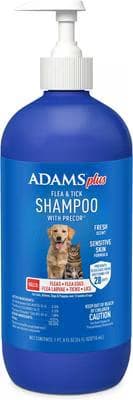
A gentle flea and tick shampoo for cats and dogs that kills ticks on contact and soothes sensitive skin. Handy for washing your dog down after a hike.
Webvet may earn a commission when you click through to Chewy, at no extra cost to you.
The fastest way to strip a heavy flea burden off a coat at home, and the sensitive-skin base is gentler than a standard pyrethrin dip on a dog already itchy from flea allergy dermatitis.
- Active ingredients: pyrethrins 0.15 percent, piperonyl butoxide 1.88 percent and (S)-methoprene 0.10 percent.
- Covers: kills fleas, flea eggs, ticks and lice, and the insect growth regulator helps control flea reinfestation for up to 28 days.
- Minimum age: 12 weeks. Not for puppies or kittens younger than that.
- Limits: it is a treatment bath, not prevention, and it does not replace a monthly product.
Best yard treatment
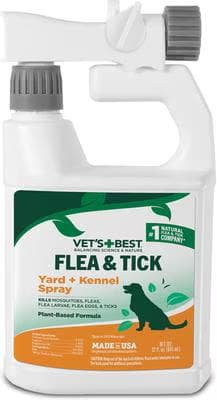
Outdoor yard and kennel treatment for tick habitat, not for use on pets. Peppermint oil and eugenol, so it treats the leaf litter and tall grass where ticks wait.
Webvet may earn a commission when you click through to Chewy, at no extra cost to you.
This handles the part of the problem your dog's preventive cannot reach. It is applied outdoors through a hose-end sprayer to yard and kennel areas, and it is marketed against fleas, ticks and mosquitoes.
- Active ingredients: peppermint oil 0.60 percent and eugenol (clove extract) 1.40 percent, with sodium lauryl sulfate 3.45 percent.
- Where it goes: outdoor use only, on the shaded borders, leaf litter and kennel runs where fleas and ticks actually sit.
- Limits: plant-oil products of this type fall under the FIFRA section 25(b) minimum-risk exemption, so EPA has exempted them from the requirement that they be registered. They do not go through the registration review that Frontline Plus and Seresto do, and nothing about a yard spray replaces a preventive on the dog.
Best flea comb for spotting an infestation early
Webvet may earn a commission when you click through to Chewy, at no extra cost to you.

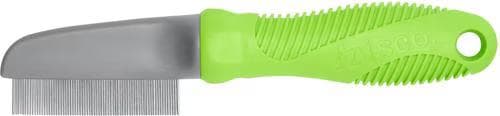
At $3.24 this is the cheapest diagnostic on the page. Combing over a white towel is how you tell flea dirt from ordinary debris before an infestation gets established.
- How to use it: comb against the lie of the coat over the rump, groin and base of the tail, then tap the comb onto a damp white towel. Flea dirt smears rust red because it is digested blood. Ordinary dirt does not.
- Limits: it removes some adult fleas and confirms a problem. It treats nothing.
Best tick removal kit
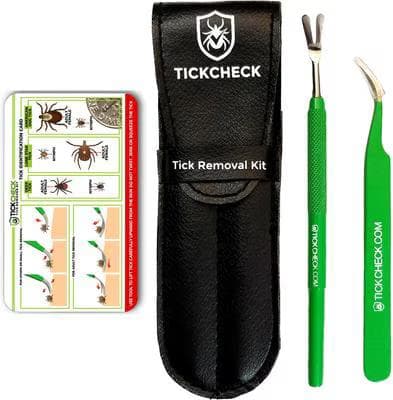
A vet-style tick removal kit with fine-tip tools that grip the tick right at the skin for a clean, straight pull, plus a tick ID card. Easy to keep in your dog-walking bag.
Webvet may earn a commission when you click through to Chewy, at no extra cost to you.
Every product on this page still leaves you finding the occasional attached tick, and technique matters more than the tool.
AVMA guidance is to carefully use tweezers to firmly grip the tick as close to the pet's skin as possible, then gently and steadily pull the tick free without twisting or crushing it.
- Do not crush, twist or jerk the tick.
- Do not smother it with alcohol or petroleum jelly, and do not apply heat. Each of those raises the risk of disease transmission.
- After removal, clean the site, wash your hands, and watch the dog for lameness, lethargy or fever over the following weeks.
Why flea and tick prevention for dogs matters
Fleas and ticks are not just an itch. Both carry consequences that show up long after the parasite is gone, which is why prevention is cheaper and safer than treatment in almost every case.

What fleas do to a dog:
- Flea allergy dermatitis. Many dogs are allergic to flea saliva, so a handful of bites can drive weeks of chewing, hair loss and secondary skin infection.
- Tapeworms. A dog that swallows an infected flea while grooming picks up tapeworm, which is why a flea problem often becomes a worm problem.
- Anemia. A heavy infestation drains real blood volume, and in puppies and small dogs that can become a medical emergency.
- Household infestation. Fleas breed off the pet, so an untreated dog seeds carpets, bedding and yard for weeks.
Ticks are the bigger long-term threat, because they transmit disease:
- Lyme disease, spread by black-legged ticks.
- Anaplasmosis, which can cause fever, lethargy and joint pain.
- Ehrlichiosis, which can become a chronic blood disorder.
- Rocky Mountain spotted fever, which can be rapidly serious.
None of these announce themselves early. A dog on a consistent preventive breaks the cycle before there is anything to notice, which is the whole point of buying one.
Year-round vs seasonal prevention
Veterinary parasitology guidance favors year-round, lifelong prevention for nearly all dogs, and there are good reasons. Many ticks stay active any time the temperature climbs above roughly 40 degrees Fahrenheit, so a mild winter day is enough for them to feed.

Fleas, meanwhile, happily survive indoors where your home stays warm regardless of the season, which means an indoor-leaning dog is still at risk. Year-round prevention for dogs also avoids the gaps that happen when owners stop and restart, and it is simpler to remember than a seasonal calendar.
If you and your vet do choose a seasonal approach in a region with hard winters, define the start and stop dates together rather than guessing.
The Companion Animal Parasite Council does not hedge on this: all dogs should be treated year round and throughout their life, with both flea control and tick control.
The reasoning is practical rather than commercial:
- Seasonal use lets home infestations establish. Fleas breed indoors where the temperature never drops, so a winter gap gives the population inside your house a clear run.
- Reactive use arrives late. Products often are not applied until tick activity has already commenced, which means the first ticks of the season feed on an unprotected dog.
- Tick season is not a fixed date. CAPC notes that seasonal tick activity varies widely by geographic region and climatic cues, so a calendar rule that works in one state is wrong two states over.
If you and your veterinarian still decide a seasonal plan makes sense where you live, set the start and stop dates together and write them down. Guessing at the shoulder months is how dogs pick up the first tick of the year.
Safety, regulation, and what the warnings actually mean
Two different federal agencies regulate the products on this page, and that split explains most of what confuses buyers, including why some need a prescription and others do not.
- FDA-approved animal drugs: Simparica TRIO, NexGard, NexGard PLUS, Bravecto, Credelio, Trifexis and Revolution. These are absorbed into the dog, reviewed by FDA's Center for Veterinary Medicine, and dispensed on prescription.
- EPA-registered pesticides: Seresto, K9 Advantix II, Frontline Plus, PetArmor Plus and Advantage II. These act on or at the skin surface, are registered by EPA rather than approved by FDA, and are sold over the counter.
Neither route means "stronger" or "safer" on its own. They are different review processes for different kinds of product, and both come with warnings worth reading.
Isoxazolines and neurologic signs
On September 20, 2018, FDA issued an Animal Drug Safety Communication alerting pet owners and veterinarians about the potential for neurologic adverse events in dogs and cats treated with isoxazoline products, and asked manufacturers to add that information to the class labeling.
- The class: afoxolaner, fluralaner, sarolaner and lotilaner. On this page that means NexGard, NexGard PLUS, Bravecto, Simparica TRIO and Credelio.
- The FDA position: FDA considers products in the isoxazoline class to be safe and effective for dogs and cats.
- The warning: the class labeling notes association with muscle tremors, ataxia and seizures, including in animals with no prior history of seizures.
- What to do with that: tell your veterinarian about any seizure, tremor or neurologic diagnosis before starting one, and report anything unusual after a dose.
The 2023 EPA action on Seresto
Seresto has been through public scrutiny, and the outcome is on the current label. In 2023 EPA required Elanco to add label warnings describing commonly reported adverse effects, split the registration into separate dog and cat registrations, report incident and sales data to EPA annually, and evaluate changes to the collar's emergency release mechanism.
The label now lists, in decreasing order of reporting frequency: pruritus, eczema, lethargy, behavioral disorders, application site reactions, anorexia, hyperactivity, muscle tremor, vocalization, convulsion and ataxia. It instructs owners to remove the collar and consult a veterinarian if these occur. EPA did not cancel the product.
Rules that apply to every product here
- Dose by current weight. Weigh the dog rather than guessing, and rebuy the correct band as a puppy grows.
- Never split or combine a dose. A large-dog dose divided between small dogs is not a smaller dose, and two small doses do not safely make a large one.
- Read the whole label, including the species. Dog products are not cat products, and the difference can be fatal.
- Pregnant and nursing dogs need a specific choice. Frontline Plus and PetArmor Plus are labeled for breeding, pregnant and lactating bitches. The Simparica TRIO, NexGard, NexGard PLUS and Credelio labels each state that safe use in those dogs has not been evaluated.
- Watch after the first dose. Stomach upset, skin irritation at an application site or any change in behavior is worth a call to your veterinarian.
Frequently asked questions
For most healthy adult dogs, Simparica TRIO is the best flea and tick prevention for dogs on this list: one monthly chew covering fleas, six tick species, heartworm and intestinal worms from 8 weeks and 2.8 pounds.
If a prescription is not realistic this week, Frontline Plus is the strongest over-the-counter alternative, and PetArmor Plus delivers the same two actives for about half the price at the size we linked.
Then do the part that actually decides the outcome:
- Pick one product and stop comparing.
- Buy the weight band your dog weighs today.
- Give it on schedule, every month of the year.
- Take any seizure history, pregnancy, nursing, a puppy under 8 weeks, or a cat in the house to your veterinarian before you buy.
Frequently Asked Questions
What is the safest most effective flea and tick prevention for dogs?
There is no single safest product for every dog. For most healthy adults the FDA-approved isoxazoline chews are the most complete monthly option, and FDA considers the class safe and effective while warning it has been associated with tremors, ataxia and seizures. For a dog with a seizure history, a fipronil topical is more cautious.
Which is the best tick and flea treatment for dogs?
Simparica TRIO for most dogs, because one monthly chew covers fleas, six named tick species, heartworm, roundworms and hookworms from 8 weeks and 2.8 pounds. If you want the widest tick list without paying again for heartworm, NexGard covers the same six species. Without a prescription, Frontline Plus and Seresto are strongest.
What is the best non-prescription flea and tick medicine for dogs?
Frontline Plus. Fipronil plus (S)-methoprene kills fleas, flea eggs, flea larvae, four tick species at every life stage and chewing lice, and the label states fleas and ticks do not need to bite the dog in order to die. PetArmor Plus carries identical actives at identical concentrations for roughly half the price.
What flea and tick medicine do vets recommend?
Veterinarians reach for FDA-approved prescription products, because prescribing means reviewing the dog's record first. On timing rather than brand, the Companion Animal Parasite Council is explicit that all dogs should be treated year round and throughout their life with both flea and tick control. The right product changes with age, weight, health and local ticks.
What flea and tick pill do vets recommend?
Oral options fall into three groups. Isoxazolines (afoxolaner in NexGard and NexGard PLUS, sarolaner in Simparica TRIO, fluralaner in Bravecto, lotilaner in Credelio) cover fleas and ticks, and the combination versions add heartworm and worms. Spinosad combinations such as Trifexis cover fleas and worms but no ticks. Capstar is a knockdown, not a preventive.
Is Nexgard safer than Frontline?
Not straightforwardly. NexGard is an FDA-approved oral drug carrying the isoxazoline warning for tremors, ataxia and seizures, including in dogs with no seizure history. Frontline Plus is an EPA-registered topical with no such class warning, so for a dog with a neurologic history the topical is more cautious. NexGard covers six tick species to four.
What is the safest most effective flea and tick treatment for dogs?
For an active infestation rather than prevention, the sequence is a fast knockdown, then a real preventive, then the environment. Capstar starts killing adult fleas within 30 minutes and kills over 90 percent within 4 hours in dogs, but has no residual effect and no tick coverage. Treat the home and yard too.
Is Frontline or NexGard better?
Three questions settle it. Can you get a prescription today? If no, Frontline Plus. Does your dog have a seizure or neurologic history? If yes, Frontline Plus, because NexGard is an isoxazoline. Do Gulf Coast or Asian longhorned ticks live where you do? If yes, NexGard, because those species are on its label only.
Do dogs need flea and tick prevention year-round?
Yes, per the Companion Animal Parasite Council, which recommends all dogs be treated year round and throughout their life with both flea and tick control. Its reasoning is that seasonal use allows home infestations to establish and permits disease transmission, because products often are not applied until tick activity has already commenced.
What flea and tick prevention is safe if I also have a cat?
Never permethrin. The K9 Advantix II label carries a fatality box reading 'DO NOT USE ON CATS - MAY BE FATAL. Keep cats away from treated dogs for 24 hours.' AVMA advises using only products approved for your pet's species. The lowest-risk choice in a mixed home is an oral chew.
Do natural flea and tick preventives actually work?
Peppermint oil and eugenol products are typically sold under the FIFRA section 25(b) minimum-risk exemption, so EPA has exempted them from the requirement that they be registered. They can help as a yard treatment alongside a labeled preventive. No plant-oil product on the US market carries an approved claim to prevent tick-borne disease in dogs.
How much does flea and tick prevention for dogs cost?
Compare cost per month of protection, not per box. At the sizes we linked: PetArmor Plus about $6.67, Seresto $7.49, Advantage II $11.17, Frontline Plus $12.50, K9 Advantix II $13.32, Trifexis $27.03, NexGard $27.98, Bravecto $29.25 and Revolution $35.63. Cheapest is not best, because three of the cheaper options kill no ticks.
What kills fleas on a dog instantly?
Nitenpyram, sold as Capstar, is the closest thing to instant. The manufacturer states it starts killing fleas within 30 minutes and kills over 90 percent within 4 hours in dogs, and it is labeled from 4 weeks and 2 pounds. It clears adult fleas only: no ticks, no eggs, no larvae.
Is the Seresto collar safe for dogs?
Seresto is EPA registered, sold without a prescription, and EPA has not cancelled it. In 2023 EPA required Elanco to add label warnings describing commonly reported adverse effects, split the dog and cat registrations, report incident data annually, and evaluate the emergency release mechanism. Remove the collar and call your vet if signs appear.
Veterinarian · BVMS MRCVS
Dr. Pippa Elliott, BVMS, MRCVS, is a veterinarian with nearly 30 years of experience in companion animal practice. Dr. Elliott earned her Bachelor of Veterinary Medicine and Surgery from the University of Glasgow. She was also designated a Member of the Royal College of Veterinary Surgeons. Married with 2 grown-up kids, Dr. Elliott has a naughty Puggle named Poggle, 3 cats and a bearded dragon.


