NSAIDs for Dogs: Types, Side Effects, and Safety
NSAIDs for dogs are prescription anti-inflammatory drugs, such as carprofen, meloxicam, and grapiprant, that ease arthritis and surgery pain. Here are the types, the side effects to watch for, why bloodwork matters, and why ibuprofen is dangerous.

BVMS MRCVS
Medically reviewed by Dr. Pippa Elliott, BVMS MRCVS · Last reviewed

This article contains affiliate links. Webvet may earn a commission when you buy through them, at no extra cost to you.
NSAIDs for dogs are prescription nonsteroidal anti-inflammatory drugs that FDA has approved to control the pain and inflammation of osteoarthritis and of surgery. They include carprofen, meloxicam, and grapiprant, and they are not interchangeable with human ibuprofen or naproxen, which are dangerous for dogs.
Safe use of NSAIDs for dogs runs through a veterinarian, who decides whether the drug suits your dog, checks liver and kidney bloodwork, and explains which side effects to watch for at home. FDA also warns owners against two avoidable mistakes: combining an NSAID with a steroid or a second NSAID, and giving a dog an NSAID meant for people.
- 1Most NSAIDs for dogs are drugs that block the COX (cyclooxygenase) enzymes that make prostaglandins, which contribute to pain and inflammation.
- 2The FDA-approved dog NSAIDs are carprofen, meloxicam, deracoxib, firocoxib, and robenacoxib, plus grapiprant as the non-COX option.
- 3Every FDA-approved dog NSAID needs a prescription, and FDA says no over-the-counter NSAID for dogs is approved.
- 4Watch for vomiting, diarrhea, black tarry stool, and eating less, and stop the drug and call your vet if any of them appear.
- 5Human ibuprofen and naproxen are dangerous for dogs, so if your dog swallows either one, call your vet or a pet poison control line right away.

 Sponsored
Need a prescription or refill for your dog?
A licensed vet at Dutch can assess your dog over video and prescribe treatment when it's appropriate, delivered to your door.
Use code Pets60
Plans start at $12/month · covers up to 5 pets
- Licensed vets in most states
- Rx for 150+ conditions
- 4.7 on Trustpilot
What Are NSAIDs for Dogs?
NSAIDs for dogs are prescription anti-inflammatory drugs, such as carprofen and meloxicam, that ease pain and inflammation by blocking COX enzymes, and a dog should take only the NSAID its vet prescribes, never human ibuprofen or naproxen.
In plain terms, most NSAIDs are drugs that block the COX enzymes that make prostaglandins. The Merck Veterinary Manual explains that NSAIDs work mainly by inhibiting cyclooxygenase (COX), which cuts prostaglandin production, while corticosteroids block many more pathways. That is the difference between a nonsteroidal dog anti-inflammatory medication and a steroid.
Prostaglandins are not only troublemakers. The FDA Center for Veterinary Medicine says they contribute to pain and inflammation but also do protective work in the body:
- Protecting the lining of the stomach and intestines
- Helping maintain blood flow to the kidneys
- Supporting platelet function
That double role explains NSAID side effects: blocking prostaglandins to ease pain can also leave the stomach lining, kidney blood flow, and platelets less protected. It is also why the answer to whether NSAIDs are safe for dogs is an individual one that your vet makes for your dog.
Dogs can take NSAIDs for pain when a vet prescribes one, and NSAIDs treat osteoarthritis pain plus pain after surgery. FDA has approved several NSAIDs for dogs to control the pain and inflammation of osteoarthritis and several for pain and inflammation after surgery, and carprofen is among the approved drugs.
If you are unsure whether your dog's stiffness is arthritis, read what osteoarthritis in dogs is and the signs your dog has it.
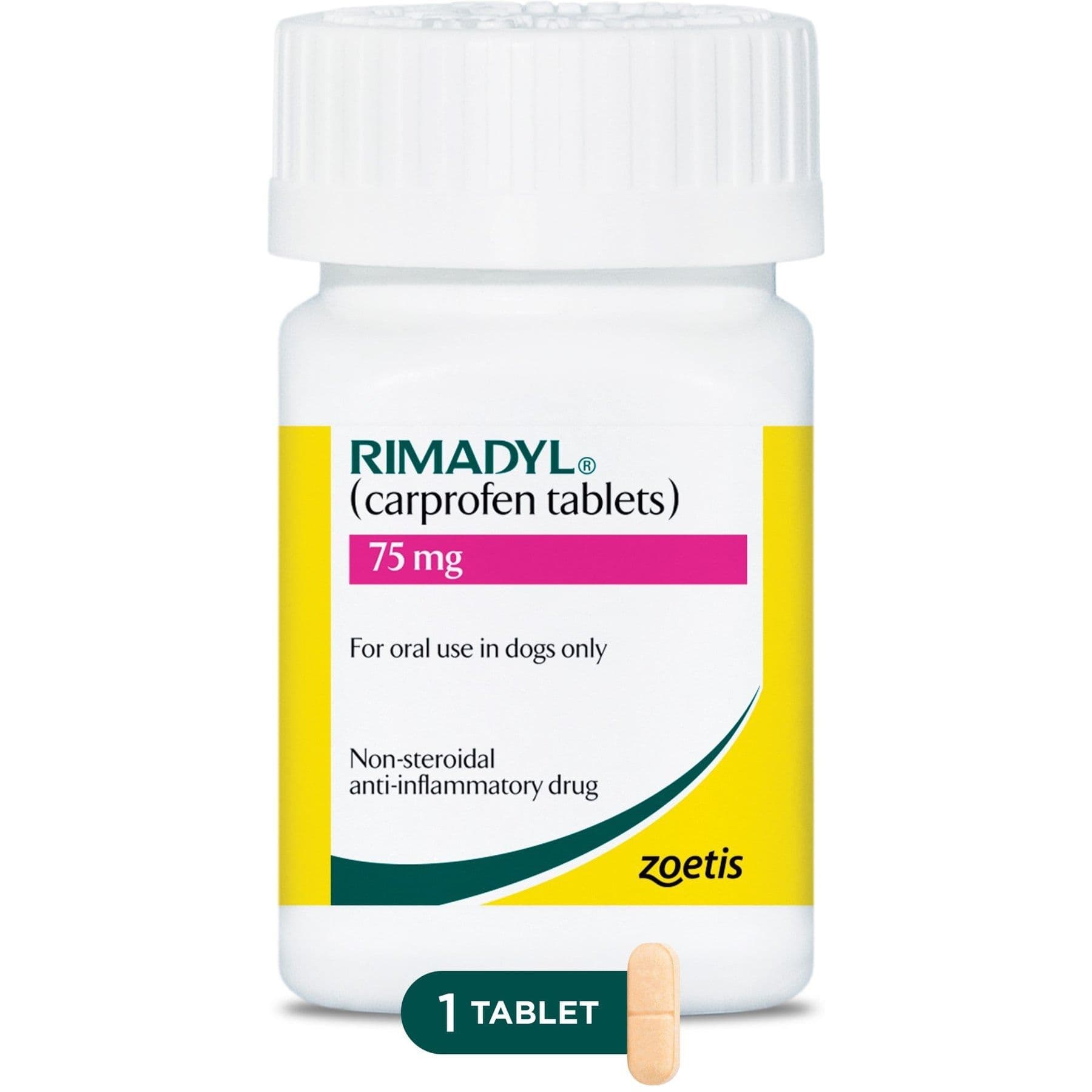
Rimadyl is a prescription carprofen caplet for dogs, dispensed only with a vet prescription.
Webvet may earn a commission when you click through to Chewy, at no extra cost to you.
Types of NSAIDs Vets Prescribe for Dogs
FDA has approved six NSAIDs for dogs in the US: carprofen, meloxicam, deracoxib, firocoxib, and robenacoxib, plus grapiprant as the non-COX option. The FDA list of NSAIDs approved for dogs gives the brand names and forms for each type of NSAID:
- Carprofen: Rimadyl and multiple generics, given by mouth or by injection
- Deracoxib: Deramaxx, Doxidyl, and generic deracoxib chewable tablets, given by mouth
- Firocoxib: Previcox and multiple generics, given by mouth
- Grapiprant: Galliprant, given by mouth
- Meloxicam: Metacam and multiple generics, given by mouth or by injection
- Robenacoxib: Onsior, given by mouth or by injection, for a maximum of 3 days

Carprofen vs meloxicam is less a contest than a fit: both block COX and come in oral and injectable forms, with brand-name and generic versions. Carprofen is dispensed as products such as Rimadyl (Carprofen) Caplets for Dogs, 75-mg, 30 caplets, and meloxicam also comes as a liquid, such as Metacam 32-mL Oral Suspension for Dogs, 1.5 mg/mL. Meloxicam for dogs and cats covers that drug in detail.
Grapiprant works differently. Its FDA-approved label describes it as an EP4 receptor antagonist, a non-COX-inhibiting NSAID in the piprant class, so it acts at the EP4 receptor rather than on the COX enzymes. It is sold as Galliprant (grapiprant) Tablets for Dogs, 20-mg, 30 tablets.
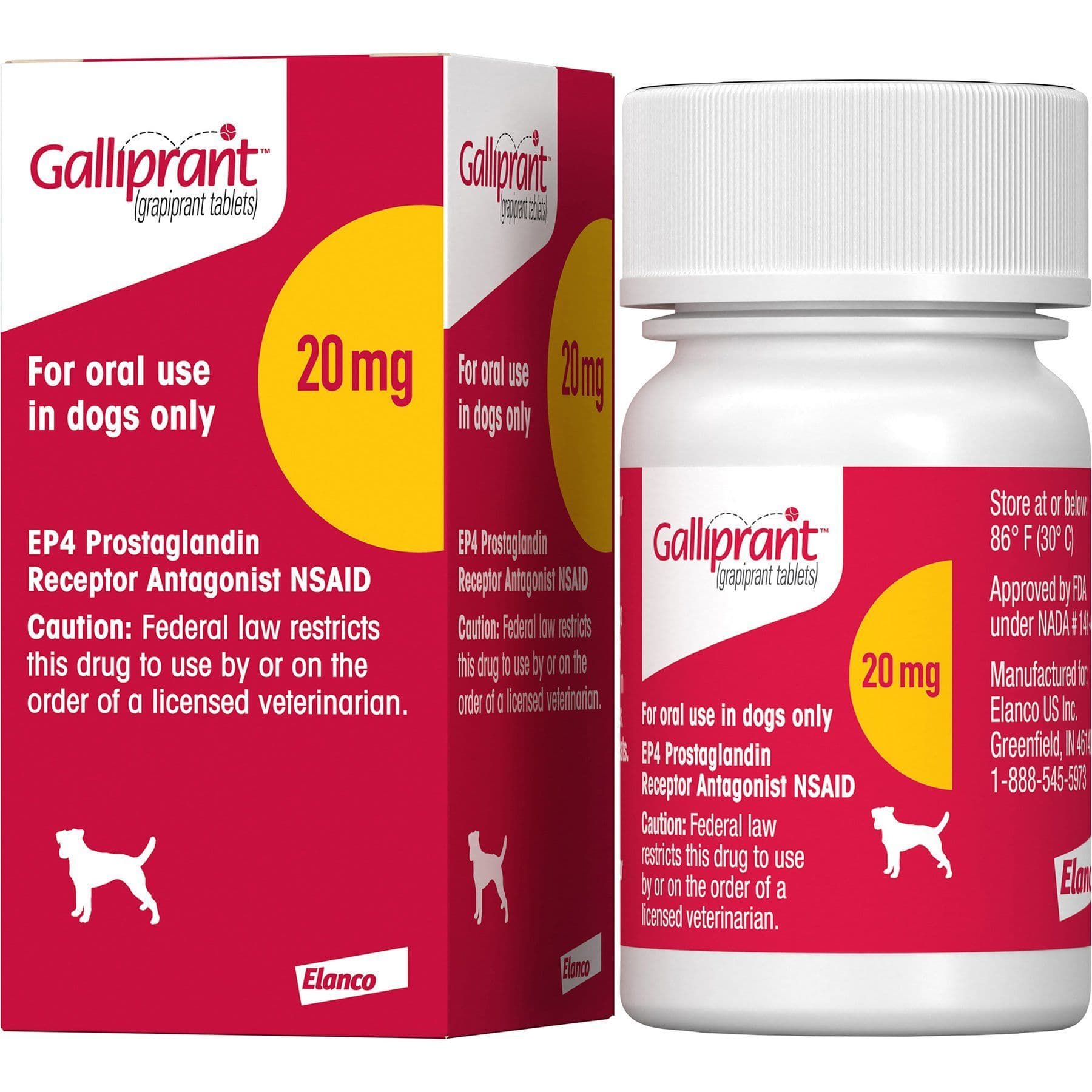
Galliprant is a prescription grapiprant tablet for dogs, dispensed only with a vet prescription.
Webvet may earn a commission when you click through to Chewy, at no extra cost to you.
Injectable NSAIDs for dogs on the FDA list are carprofen, meloxicam, and robenacoxib, and each of those also comes in an oral form. Deracoxib, firocoxib, and grapiprant are given by mouth only.
What can I give my dog as an anti-inflammatory?
Give your dog only the anti-inflammatory your vet prescribes, such as one of the six FDA-approved NSAIDs above. Two have narrow approvals, FDA notes: robenacoxib only for pain and inflammation after soft tissue surgery, for a maximum of 3 days, and grapiprant only for osteoarthritis pain and inflammation.
What is the safest anti-inflammatory for dogs?
No single NSAID is the safest for every dog, and an approved NSAID that is safe for one dog may not suit another. FDA guidance for veterinarians says that because the response is individual, no one NSAID is considered more effective than another, and because every NSAID can cause side effects, none is considered safer than the others.
That makes the best anti-inflammatory for dogs an individual choice: the drug your vet picks from your dog's health history and bloodwork, then adjusts by how your dog responds.
Side Effects of NSAIDs in Dogs
NSAID side effects in dogs most often show up as vomiting, diarrhea, black tarry stool, or eating less, and the most serious ones include stomach ulcers and kidney or liver damage. FDA says most side effects are mild, but some are serious and need medical care, so treat any dog anti-inflammatory side effect as a reason to call your vet.

Every NSAID prescription, including each refill, should come with a Client Information Sheet, also called the Information for Dog Owner Sheet, FDA says. It explains the possible side effects and when to call your vet, so ask for it if you are not given one.
What are the side effects of anti-inflammatory medications in dogs?
The side effects of anti-inflammatory medications in dogs that FDA's owner guide lists are:
- Not eating or eating less
- Being less active, or acting withdrawn or generally off
- Vomiting
- Diarrhea, which may be bloody or tarry (black)
- Yellowing of the gums, skin, or whites of the eyes (jaundice)
- A change in drinking, either more or less thirst
- Skin changes such as redness, scabs, or scratching
FDA's memory aid is BEST: Behavior changes, Eating less, Skin redness and scabs, and Tarry (black) stool, diarrhea, or vomiting. If you see any of them, stop the drug and call your veterinarian. WebVet's guide to black dog poop covers dark stool in more detail.
The non-COX option has side effects too. In the 28-day field study on the grapiprant label, vomiting was reported in 24 of 141 treated dogs versus 9 of 144 dogs given tablets without the drug, diarrhea or soft stool in 17 versus 13, poor appetite in 9 versus 7, and lethargy in 6 versus 2.
What are the bad side effects of NSAIDs?
The bad side effects of NSAIDs are bleeding ulcers, perforations (holes) in the stomach or intestines, kidney and liver problems, and, in some cases, death, according to FDA. These need medical care, so stop the drug and call your vet at the first sign.
Liver damage tends to come early: FDA says most NSAID-associated liver damage occurs within the first three weeks of starting the medication.
Ulcers can happen at a correct dose. In a 2024 JAVMA study of 33 dogs already diagnosed with stomach or intestinal ulcers, 11 had been receiving a single NSAID at an appropriate dose, 7 of them carprofen at the recommended dose, study author Dr. Townes Hillier of the University of Georgia told Today's Veterinary Practice.
 Sponsored
Vet care that's always there
Unlimited video calls and messaging with licensed vets for less than a typical vet visit. One membership covers up to five pets.
Use code Pets60
Plans start at $12/month · covers up to 5 pets
- Licensed vets in most states
- Rx for 150+ conditions
- 4.7 on Trustpilot
Which Dogs Should Not Take NSAIDs?
Which dogs should not take NSAIDs is your vet's call, and the conditions that weigh against them are kidney disease, liver disease, dehydration, stomach ulcers, and bleeding disorders. Tell your vet about any of the following before your dog's first dose, because FDA guidance or the drug labels flag each one:
- Kidney disease: FDA warns that an NSAID can unmask hidden disease, and a dog with underlying kidney disease may see its kidney function worsen on the drug.
- Liver or heart disease: Existing liver, heart, or kidney dysfunction puts a dog among those FDA lists at greatest risk of side effects.
- Dehydration or diuretics: Dehydrated dogs and dogs on diuretics are on the same greatest-risk list.
- Stomach or intestinal ulcers, or past gut surgery: FDA asks owners to report this history, and notes that a dog with no past digestive problems may still not have a healthy digestive tract.
- Bleeding disorders: The FDA-approved carprofen caplet label on DailyMed says the drug is not recommended for dogs with bleeding disorders such as von Willebrand's disease.
- Recent steroid treatment: A dog recently treated with a corticosteroid is also in FDA's greatest-risk group.
Age and breeding status matter as well. The carprofen label says its safe use has not been established in dogs under 6 weeks old or in pregnant, breeding, or nursing dogs. The firocoxib (Previcox) label warns that doses above the recommended amount in puppies under seven months old have been associated with serious adverse reactions, including death.
NSAID Dosing, Bloodwork, and Long-Term Use
NSAID dosage for dogs is set by your vet from your dog's body weight, and FDA guidance pairs the lowest dose that works with bloodwork before and during treatment.
Each approved label sets its dose per pound or kilogram of body weight, so a tablet that suits one dog can be wrong for another. The meloxicam oral suspension label uses a higher first-day dose, then a lower once-daily dose, and the grapiprant label says dogs under 8 lb cannot be accurately dosed with its tablets. Give exactly what your dog's prescription says.
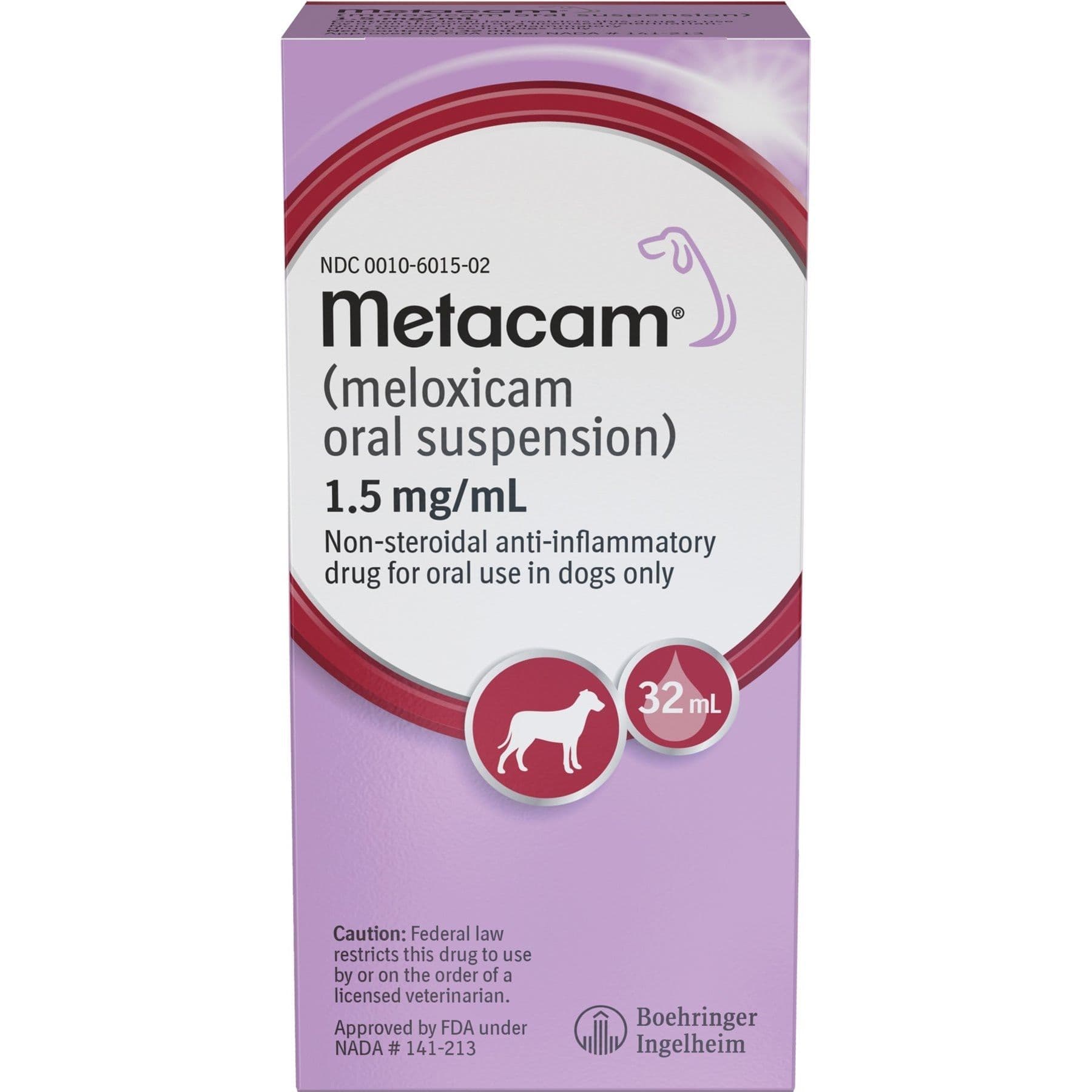
Metacam is a prescription meloxicam oral suspension for dogs, dispensed only with a vet prescription.
Webvet may earn a commission when you click through to Chewy, at no extra cost to you.
Baseline bloodwork before starting plus rechecks during long-term use is the core of NSAID monitoring. For a dog taking an NSAID long-term for osteoarthritis, FDA advises checking liver and kidney function with blood tests before the medication starts and then repeating those tests on a regular basis.

How often to recheck varies by drug and clinic, and VCA Animal Hospitals gives two different schedules:
- Carprofen: liver enzymes and kidney values two to four weeks after starting, then every three to six months during long-term therapy, per VCA
- Meloxicam: annual blood testing to monitor liver and kidney function, per VCA
Neither is an FDA schedule, since FDA says only that the tests should be repeated regularly, so your vet sets the interval for your dog. If a recheck shows raised liver values, elevated liver enzymes in dogs explains what that result can mean.
How long can dogs be on anti-inflammatories?
How long a dog stays on an anti-inflammatory depends on its response, except for robenacoxib, which is approved for a maximum of 3 days. FDA guidance for veterinarians advises the lowest effective dose for the shortest duration the dog's response allows; if your dog improves to the point of not needing the drug, discuss stopping it with your vet.
A long course means many daily doses, so giving medicine safely at home also means avoiding mix-ups, such as two people each giving a dose. A weekly planner such as the Ezy Dose Weekly 7-Day Dog Pill Organizer is made for this: its maker, Apothecary Products, says it provides a daily reminder, helps prevent multiple doses by other family members, and makes pet medication easy to tell apart from human medication.

The Ezy Dose Weekly 7-Day Dog Pill Organizer is a dog pill planner that provides a daily medication reminder.
Webvet may earn a commission when you click through to Chewy, at no extra cost to you.
Can Dogs Take NSAIDs With Other Medications?
An NSAID should never be given with aspirin, a corticosteroid, or a second NSAID, and any other drug, including another anti-inflammatory, needs your vet's approval first. FDA tells owners never to give aspirin or corticosteroids such as prednisone along with an NSAID; prednisone for dogs and cats covers that steroid.
Never combine an NSAID with a steroid or another NSAID, and allow a washout period, a stretch with no NSAID at all, when switching, FDA guidance for veterinarians advises. In the 2024 JAVMA ulcer study, all 5 dogs given two NSAIDs at once had full-thickness stomach or intestinal perforations, Dr. Hillier told Today's Veterinary Practice.
How long the washout lasts is your vet's decision: FDA and the drug labels set no number of days, saying only to consider appropriate washout times when switching NSAIDs or moving from a corticosteroid to an NSAID. Clinician approaches are opinion, not label guidance:
- Dr. Butch KuKanich, Kansas State University: writing in dvm360, he notes no controlled trials have studied the right washout in dogs; he waits at least one week after a side effect and until signs resolve, or at least three to four days when a dog in severe pain switches after a drug fails.
- Dr. Hillier, in Today's Veterinary Practice: at least 3 to 4 times the half-life of the drug being stopped is generally recommended.
Gabapentin is not on the FDA list of NSAIDs approved for dogs. Whether gabapentin and NSAIDs can be given together is your vet's decision, and gabapentin for dogs and cats covers that drug itself.
Are There Over-the-Counter NSAIDs for Dogs?
No. There are no FDA-approved over-the-counter (OTC) NSAIDs for dogs: FDA says any NSAID sold for dogs online or in a pet store without a vet's prescription is an unapproved animal drug that FDA has not reviewed.
Every FDA-approved dog NSAID needs a prescription because a veterinarian's expertise is needed to decide whether an NSAID suits your dog and to monitor its health while on the drug, FDA explains. Any non-prescription NSAID for dogs is, by definition, not an approved one.
Can I buy carprofen over the counter?
No. Carprofen's FDA-approved label states that federal law restricts it to use by or on the order of a licensed veterinarian, and generic carprofen is prescription-only too, like every approved dog NSAID. Carprofen for dogs and cats covers the drug itself.
Can I buy anti-inflammatory over-the-counter for my dog?
Not an NSAID. Any NSAID sold for dogs without a prescription is either an unapproved pet product or a human medicine, and human ibuprofen and naproxen are dangerous for dogs.
Aspirin and Tylenol are not safe stand-ins either. The Merck Veterinary Manual says plain aspirin can erode and ulcerate a dog's stomach lining even at therapeutic doses, and FDA notes acetaminophen (Tylenol) is not an NSAID; see aspirin for dogs and cats and can dogs have Tylenol.
Before giving your dog anything for pain without a vet, FDA's advice is to stop and call your veterinarian, since a medicine meant for you or another pet may hurt your dog. For a broader look at the pain relief options vets use for dogs, see pain meds for dogs.
Can Dogs Take Ibuprofen or Naproxen?
No. Human ibuprofen or naproxen is dangerous for dogs, and dogs should not take either one: published toxic doses in mg/kg show that one ordinary tablet can reach a harmful level, especially in a small dog. The Merck Veterinary Manual says ibuprofen is no longer recommended in dogs because it may cause stomach ulcers and perforations.

Dogs are not small people. FDA explains that, compared with a person, a dog given a human NSAID may have the drug last longer, process it differently, absorb it faster, and reach higher blood levels.
This dose-by-weight human NSAID toxicity table turns published ibuprofen and naproxen toxic thresholds into what one common tablet means for a small, medium, or large dog: the drug, its published toxic dose in mg/kg, the expected effect, and what one 200 mg ibuprofen or 220 mg naproxen tablet equals for a 10, 25, 50, or 80 lb dog. No amount in it is a safe home dose.
| Drug and source | Published toxic dose | Expected effect | 10 lb dog | 25 lb dog | 50 lb dog | 80 lb dog |
|---|---|---|---|---|---|---|
| One 200 mg ibuprofen tablet, 2022 J Vet Intern Med study | Above 25, 100, and 400 mg/kg | Stomach and intestinal, then kidney, then nervous system toxicity | 44.1 mg/kg | 17.6 mg/kg | 8.8 mg/kg | 5.5 mg/kg |
| One 200 mg ibuprofen tablet, Merck Veterinary Manual | 8 to 16 daily for 30 days; 100 to 125 once; 175 to 300; above 400; above 600 (all mg/kg) | Stomach ulcers or erosions; vomiting and diarrhea; possible kidney failure; seizures or coma; potentially lethal | 44.1 mg/kg | 17.6 mg/kg | 8.8 mg/kg | 5.5 mg/kg |
| One 220 mg naproxen tablet, 2022 J Vet Intern Med study | Above 5, 25, and 50 mg/kg | Stomach and intestinal, then kidney, then nervous system toxicity | 48.5 mg/kg | 19.4 mg/kg | 9.7 mg/kg | 6.1 mg/kg |
Strengths come from the Advil label (ibuprofen 200 mg) and the Aleve label (naproxen sodium 220 mg, or 200 mg naproxen, which lowers the naproxen figures by about 9 percent). By the 2022 study's lines, one ibuprofen tablet crosses the stomach and intestinal threshold only under about 18 lb, while one naproxen tablet crosses it up to about 97 lb.
How much ibuprofen is harmful to dogs?
No amount is safe to give a dog at home. The 2022 Journal of Veterinary Internal Medicine study defines ibuprofen toxic doses in dogs as above 25 mg/kg for the stomach and intestines, above 100 mg/kg for the kidneys, and above 400 mg/kg for the nervous system.
The Merck Veterinary Manual's single-ingestion figures start higher: 100 to 125 mg/kg for vomiting and diarrhea, possible kidney failure at 175 to 300 mg/kg, and potentially lethal above 600 mg/kg. With figures that far apart, any ibuprofen ingestion warrants a call to your vet or poison control right away.
Can I give my 20 pound dog ibuprofen?
No. One 200 mg tablet is about 22.0 mg/kg for a 20 lb dog, close to the 2022 study's stomach and intestinal line of 25 mg/kg and above the 8 to 16 mg/kg a day that caused stomach ulcers over 30 days in Merck's figures. Ask your vet for an approved dog NSAID instead.
What human anti-inflammatories are safe for dogs?
None is approved for dogs: no human NSAID product is on the FDA list for dogs, and FDA warns a human NSAID may not be safe or effective in a dog. That includes diclofenac, so it is not an approved option for dog arthritis; ask your vet about an approved dog NSAID instead.
What to Do If Your Dog Ate Ibuprofen or Naproxen
If your dog ate ibuprofen or naproxen, call your vet or a pet poison control line right away, even if your dog seems fine. After any accidental ibuprofen or naproxen dose, speed matters: in a 2023 study of 434 dogs with NSAID toxicosis, a longer delay before reaching care was linked to more severe illness.
In the clinic, treating NSAID poisoning, including ibuprofen toxicity in dogs, means removing unabsorbed drug (inducing vomiting and giving activated charcoal after a recent exposure) and protecting the stomach, intestines, and kidneys with supportive care, the Merck Veterinary Manual explains.
Veterinary Partner says treatment typically includes about 48 hours of intravenous fluids, with kidney tests repeated over three days. With treatment, the 2023 study reported an overall survival rate of 99 percent.
My dog accidentally ate a naproxen pill. What should I do?
Call your vet or Pet Poison Helpline immediately. Pet Poison Helpline says as little as one 220 mg naproxen tablet can cause very serious symptoms, even death, even in a large dog, and that the sooner naproxen poisoning is treated, the better the outcome. Do not wait for signs, and do not induce vomiting at home.
My 50 pound dog ate 200mg of ibuprofen. What should I do?
Call your vet or a poison control line now: any ibuprofen ingestion warrants a call. One 200 mg tablet is about 8.8 mg/kg for a 50 lb dog, under the published single-dose toxic lines, but not a safe dose: Merck calls ibuprofen's margin of safety in dogs narrow, and each extra tablet adds another 8.8 mg/kg.
NSAIDs for Dogs FAQs
Frequently Asked Questions
Is Rimadyl a painkiller?
Yes. Rimadyl is the brand name for carprofen, a prescription NSAID that its owner information sheet says is used to reduce pain and inflammation from osteoarthritis and pain after surgery in dogs. Like the other COX-blocking NSAIDs, it works by cutting prostaglandin production.
Will 800 mg ibuprofen hurt a dog?
Yes, it can. 800 mg is a prescription-strength human ibuprofen tablet, and one equals about 176.4 mg/kg for a 10 lb dog, 35.3 mg/kg for a 50 lb dog, and 22.0 mg/kg for an 80 lb dog.
For the 10 lb and 50 lb dogs, that is above the 2022 study's stomach and intestinal line of 25 mg/kg, and even 22.0 mg/kg for the 80 lb dog is close to it. Merck lists stomach ulcers and kidney damage among ibuprofen's most common toxic effects in dogs. Call your vet or poison control right away.
Is carprofen the same as ibuprofen?
No. The carprofen label places carprofen in the propionic acid class of NSAIDs, the same class as ibuprofen, naproxen, and ketoprofen, but they are different drugs. Carprofen is FDA-approved for dogs and dispensed by prescription, while Merck says ibuprofen is no longer recommended for dogs.
Can I give my dog an NSAID prescribed for another dog?
No. Never give your dog an NSAID prescribed for another dog or left over from an earlier course. The label dose is set by body weight, the carprofen owner sheet says it should only be given to the dog for which it was prescribed, and FDA's advice for leftover carprofen is to stop and call your veterinarian.
How quickly do NSAIDs work in dogs?
Carprofen, one of the approved NSAIDs, works within hours of a dose: VCA says it takes effect in about 1 to 2 hours, and its label reports peak blood levels 1 to 3 hours after an oral dose. Improvement in signs should follow, VCA says; for a dog with arthritis, tell your vet if you do not see it, rather than giving extra.

Editor
The Webvet Editorial Team is the in-house group of pet-care editors and writers behind Webvet, operated by Smart Pet Collective. The team researches, writes, and maintains Webvet's pet health, behavior, and medication content. Every article follows a defined editorial process: research from reputable veterinary and scientific sources, careful drafting, mandatory review of medical content by a credentialed veterinarian, and dated publication. Health and medication articles are medically reviewed by a licensed veterinary professional before they go live and are kept current over time.
Veterinarian · BVMS MRCVS
Dr. Pippa Elliott, BVMS, MRCVS, is a veterinarian with nearly 30 years of experience in companion animal practice. Dr. Elliott earned her Bachelor of Veterinary Medicine and Surgery from the University of Glasgow. She was also designated a Member of the Royal College of Veterinary Surgeons. Married with 2 grown-up kids, Dr. Elliott has a naughty Puggle named Poggle, 3 cats and a bearded dragon.
Related reading

Dog Anxiety Meds: What Vets Prescribe, Over-the-Counter Options, and How to Choose

Interceptor Plus for Dogs: What It Prevents, Dosing by Weight, Side Effects, and vs. Heartgard Plus

Heartgard Plus for Dogs: What It Prevents, Dosing by Weight, Side Effects, and Missed Doses
