Matted Dog Hair: How to Remove Mats Safely and When to See a Groomer
Mats pull on the skin, trap moisture, and can hide sores. Small loose tangles can be worked out at home, but tight or widespread mats are a job for a groomer or vet. Why mats form, safe removal, and prevention by coat type.

BVMS MRCVS
Medically reviewed by Dr. Pippa Elliott, BVMS MRCVS · Last reviewed

This article contains affiliate links. Webvet may earn a commission when you buy through them, at no extra cost to you.
Matted dog hair: why mats hurt, and the safe way to deal with them
Matted dog hair is hair that has knotted into tight clumps close to the skin. Mats pull on the skin every time your dog moves, hold moisture against it, and can hide sores. Small, loose tangles can usually be worked out at home with a detangler, your fingers, and a comb, starting at the tip of the hair.
Tight mats are a different job. Scissors near a mat easily cut the skin, so getting rid of matted dog hair that sits flat against the body is safer with a groomer, or a vet who can offer sedation.
The Merck Veterinary Manual warns that matted hair can irritate the skin and lead to infections, and that scissors make it easy to cut the skin by accident.
- 1Why tight mats hurt: they pull on the skin, trap moisture, and can hide sores, skin disease, and parasites.
- 2Where mats form first: under the collar, behind the ears, in the armpits, and on the feet and ears.
- 3Small loose tangles: detangler, fingers, then a comb or slicker brush, working from the tip toward the skin.
- 4Tight mats at the skin, mats over most of the body, or a mat with a sore under it: book a groomer or your vet.
- 5Never cut a mat out with scissors, and never bathe a matted dog before the mats are out.

The USDA's animal care guidance on coat care lists what a mat can do to a dog. According to USDA APHIS Animal Care, matted hair may:
- be painful and cause skin irritation
- hide tumors, injuries, other skin disease, or foreign bodies such as an ingrown collar
- trap leaves, twigs, mud, urine, or feces
- interfere with vision, hearing, chewing, urination, defecation, normal movement, and temperature regulation
What to do with matted dog hair depends on how tight it is. A tangle you can lift away from the skin and slide a comb under is a home job.
Early mild mats can be brushed out, the ASPCA says, while mats that have progressed need the hair clipped. For the loose tangles, a two-sided dematting comb lets you start with the wider side and finish with the finer one.
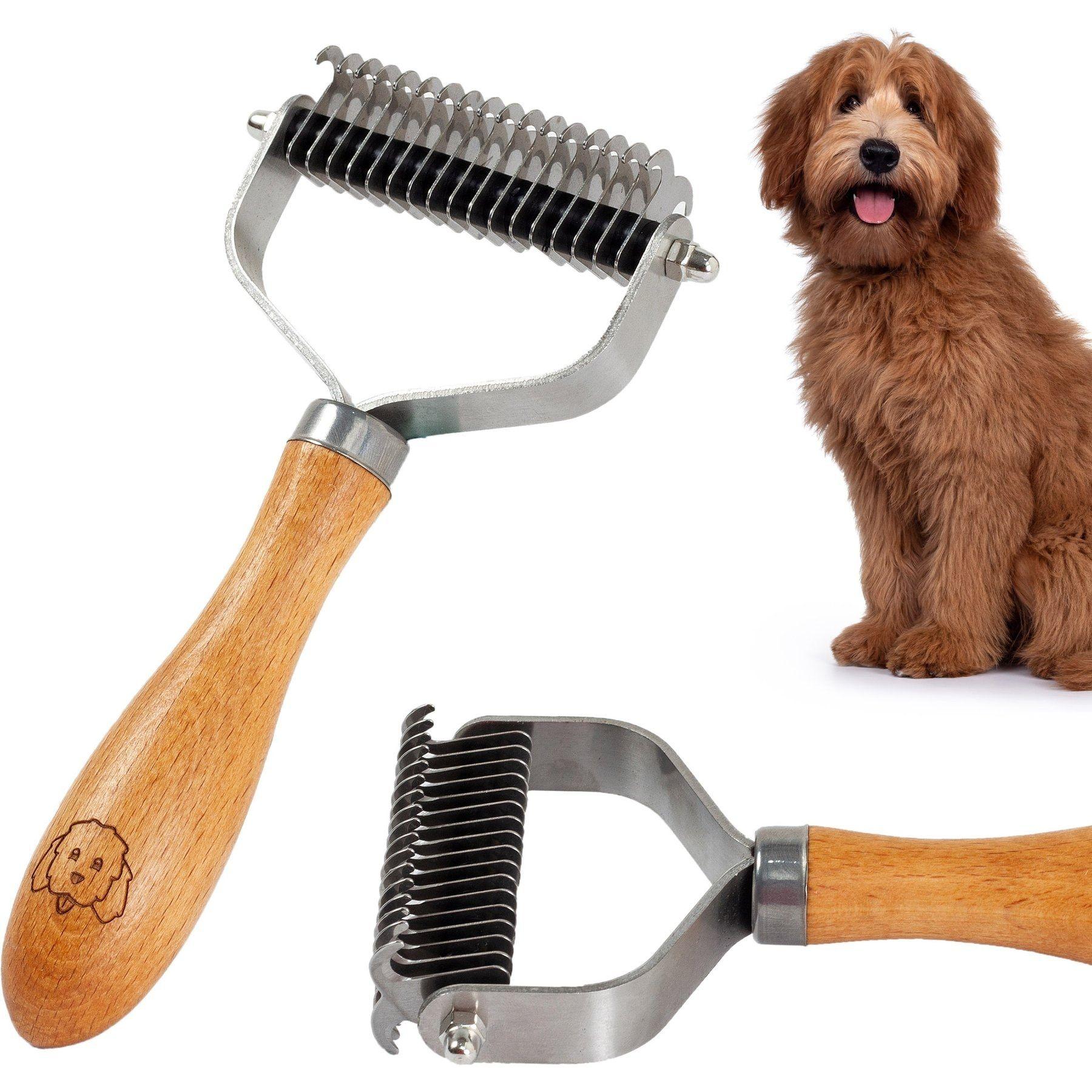
A two-sided dematting comb with rounded steel blades for loose tangles that lift away from the skin.
Webvet may earn a commission when you click through to Chewy, at no extra cost to you.
Why dogs get matted, and where mats form first
A mat starts simply: dead hair that has not shed stays in the coat and knots together with the hair around it. RSPCA Australia links daily grooming of thick coats to fewer mats for exactly this reason.
Friction makes it worse. Mats are commonly found under the collar, behind the ears, and in the armpits, where there is rubbing, according to USDA APHIS Animal Care.
What does matted dog hair look like? Early on it feels like a small lump or a cord in the coat. Later it turns into a flat, felt-like patch that lies tight to the skin and will not part when you push a comb into it. Check these spots first:
- behind the ears and under the ear flaps
- under the collar or harness line
- the armpits and between the hind legs
- the backs of the legs and the tail
- between the toes and the paw pads
- around the hind end

Feet and ears mat easily and can trap moisture that may lead to skin infections, the USDA notes. RSPCA Australia advises checking between the toes, in and around the ears, under the armpits, and between the hind legs, because problems there are hard to spot.
The problems mats cause go beyond looks. Fleas and ticks can live deep in a mat, out of the owner's sight, and mats around the hind end can collect feces and, in severe cases, make it hard for a dog to pass stool, according to the ASPCA.
A 2022 study in Frontiers in Veterinary Science adds ear and eye infections and urine scalding to the list of problems chronic matting can cause.
Matted dog hair around the eyes and behind the ears
Long hair around the eyes can damage the eyes if it is not kept tidy, the ASPCA grooming guide notes. Matted dog hair around the eyes sits next to delicate skin, so it is a groomer's job, not a home one.
Behind the ears, the skin is thin and the mats are often hidden under the ear flap. To get rid of matted dog hair behind the ears, comb only what lifts easily and let a groomer handle any mat that does not. To remove matted dog hair around the eyes, book a groomer.
 Sponsored
Want a vet's take on your dog's skin or coat?
Talk to a licensed vet at Dutch over video, often the same day. They can recommend treatment and prescribe it when it's appropriate.
Use code Pets60
Plans start at $12/month · covers up to 5 pets
- Licensed vets in most states
- Rx for 150+ conditions
- 4.7 on Trustpilot
How to remove small mats at home without hurting your dog
| What you see or feel | Safe home step | Tool that fits | Groomer or vet |
|---|---|---|---|
| Loose tangle that lifts away from the skin | Detangler, fingers, then comb from the tip | Wide-tooth comb, slicker brush | Not needed |
| Small mat behind the ear or in the armpit, comb slides under it | Hold the hair at the base, tease the edges apart | Dematting comb, then fine comb | Groomer if it will not loosen in a few minutes |
| Tight mat lying flat against the skin | Stop, do not cut or pull | None at home | Groomer to clip it out |
| Mats over most of the body, coat feels like one sheet | Stop, do not bathe | None at home | Groomer to shave, or vet with sedation |
| Mat with heat, odor, discharge, or a sore under it | Leave it alone | None at home | Vet visit |
| Mat around a leg, with swelling or limping | Leave it alone | None at home | Vet visit the same day |
| Dog cries, snaps, or pulls away when touched | Stop the session | None at home | Groomer or vet, sedation may be kinder |
A mat that lifts clear of the skin but is too thick for a comb can be split into smaller pieces first with a serrated mat tool, with the blade pointed away from your dog.
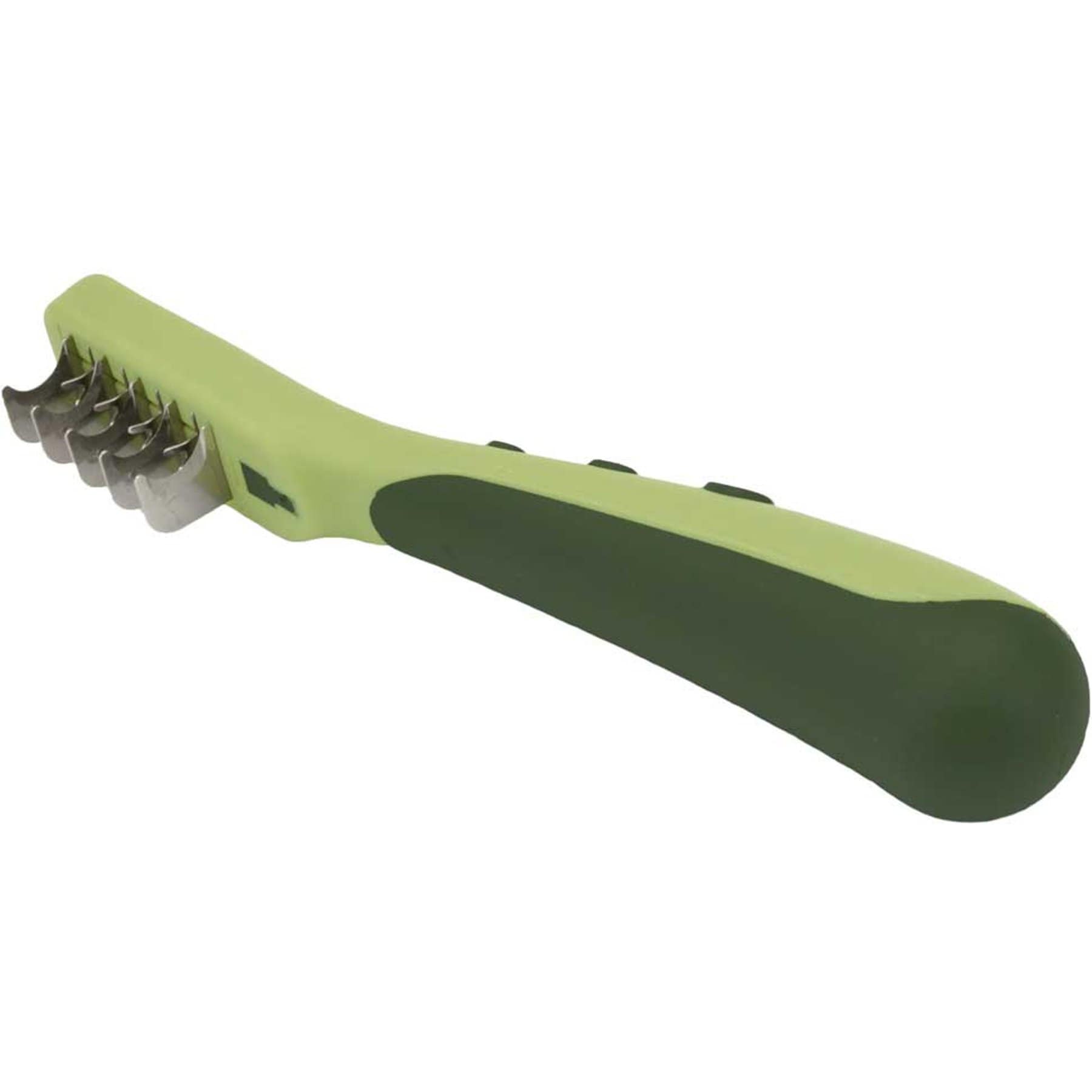
A serrated-blade mat tool for splitting loose mats on long coats, used only with the hair lifted away from skin.
Webvet may earn a commission when you click through to Chewy, at no extra cost to you.
The safe removal order for small mats is gentle and slow. Only work on a tangle you can lift away from the skin; anything tighter belongs to a groomer. If you are going to tackle a mat yourself, this is how to detangle matted dog hair without scissors.
- Spray the tangle with a dog detangler and let it soak in for a minute to soften the hair.
- Hold the hair between the mat and the skin with your fingers so the comb never tugs on the skin.
- Pull the outer edges of the mat apart with your fingers into smaller pieces.
- Comb from the tip of the hair, working a few millimeters closer to the skin with each stroke.
- Finish with a slicker brush, then run a fine comb through to the skin to confirm the knot is gone.
For step 1, an unscented spray such as the We Love Doodles Unscented Dog Detangler Spray, 16-fl oz bottle keeps fragrance off sensitive skin. For step 4, the We Love Doodles Professional Grooming Dog Dual Sided Dematting Comb has rounded stainless-steel blades on a wooden handle, listed at $10.48 on Chewy when checked in November 2026.
Brushing matted dog hair goes best in the direction the hair grows. RSPCA Australia suggests starting with a soft brush or wider-tooth comb to loosen tangles, then moving to a finer comb for the stubborn ones. Work through the coat that way, then comb out what is left.

What to do when dogs' hair is matted?
Check how tight the mat is, then brush out loose tangles at home and take tight mats to a groomer. A tangle you can lift and comb from the tip can be loosened at home with a detangler, fingers, and a comb.
A mat that cannot be easily brushed out should go to a groomer or veterinarian, who can clip it out safely, according to the ASPCA.
How to untangle matted hair without pain?
Hold the hair between the mat and the skin so the pull lands on your fingers, not on your dog. Comb from the tip, keep sessions short, and reward calm behavior. RSPCA Australia advises stopping immediately if your dog becomes uncomfortable or stressed, then trying again later or asking a groomer or veterinary nurse for help.
Short sessions help a dog learn to accept grooming, too. RSPCA Australia suggests that even a few strokes of the brush is a fine start, as long as you stop before your dog shows discomfort and reward the calm.
Is it better to untangle matted hair wet or dry?
Dry is better, with only a light mist of detangler. Soaking a matted coat makes it worse: wet mats tighten as they dry and pull at the skin, and dense mats hold moisture that can lead to infection, the Schwarzman Animal Medical Center explains. Its advice is to never bathe without brushing or clipping out mats first.
That is also why bath day comes after the brush-out, not before. The WebVet guide to how often you should bathe your dog covers bath timing by coat. RSPCA Australia suggests brushing again once the hair is fully dry after a bath.
 Sponsored
Vet care that's always there
Unlimited video calls and messaging with licensed vets for less than a typical vet visit. One membership covers up to five pets.
Use code Pets60
Plans start at $12/month · covers up to 5 pets
- Licensed vets in most states
- Rx for 150+ conditions
- 4.7 on Trustpilot
Tools for matted dog hair: dematting combs, slicker brushes, detanglers, and clippers
The best way to remove matted dog hair is to match the tool to the mat. Combs and brushes loosen a tangle; a detangler softens it; clippers remove what cannot be combed out. RSPCA Australia notes that long-haired dogs need brushes with longer bristles and combs with long, wide teeth.

Here is what each tool does:
- Dematting comb: blades or long teeth that split a loose mat into smaller pieces so a regular comb can finish.
- Slicker brush: fine wire pins that tease out tangles and catch loose hair, with gentle pressure only.
- Wide-tooth and fine combs: the wide side loosens, the fine side shows whether the knot is gone down to the skin.
- Undercoat rake: reaches into a thick double coat where packed undercoat starts mats.
- Detangler spray or conditioner: softens and slicks the hair so a comb glides; a mat that has progressed still needs clipping.
- Clippers: remove mats that cannot be brushed out, and are the tool groomers use on tight mats.
A splitting tool such as the Master Grooming Tools Dog Mat & Tangle Splitter uses a sharp stainless steel blade to cut a loose mat lengthwise. The Safari Dog Mat Remover uses serrated stainless steel blades on a gripping handle.
Both work only on a mat you can lift clear of the skin, with the blade pointed away from your dog. They are one way to detangle matted dog hair that is loose but too thick for a comb alone. If the mat does not split easily, stop and book a groomer.
What is the best detangler for severely matted hair?
No detangler removes a severe mat. A detangling spray or conditioner can soften small tangles so a comb glides through, but mats that have progressed need the hair clipped, according to the ASPCA. For severe matting, the kind choice is a groomer's clippers.
For everyday tangles, choose a detangling spray made for dogs. An unscented formula keeps fragrance off the skin of sensitive dogs, and a light mist on a dry coat is all a small tangle needs.
Shampoo follows the same rule: a dog shampoo is for washing a coat that has already been brushed out, not for loosening mats. The WebVet dog conditioner guide covers conditioners for tangle-prone coats after bath day.
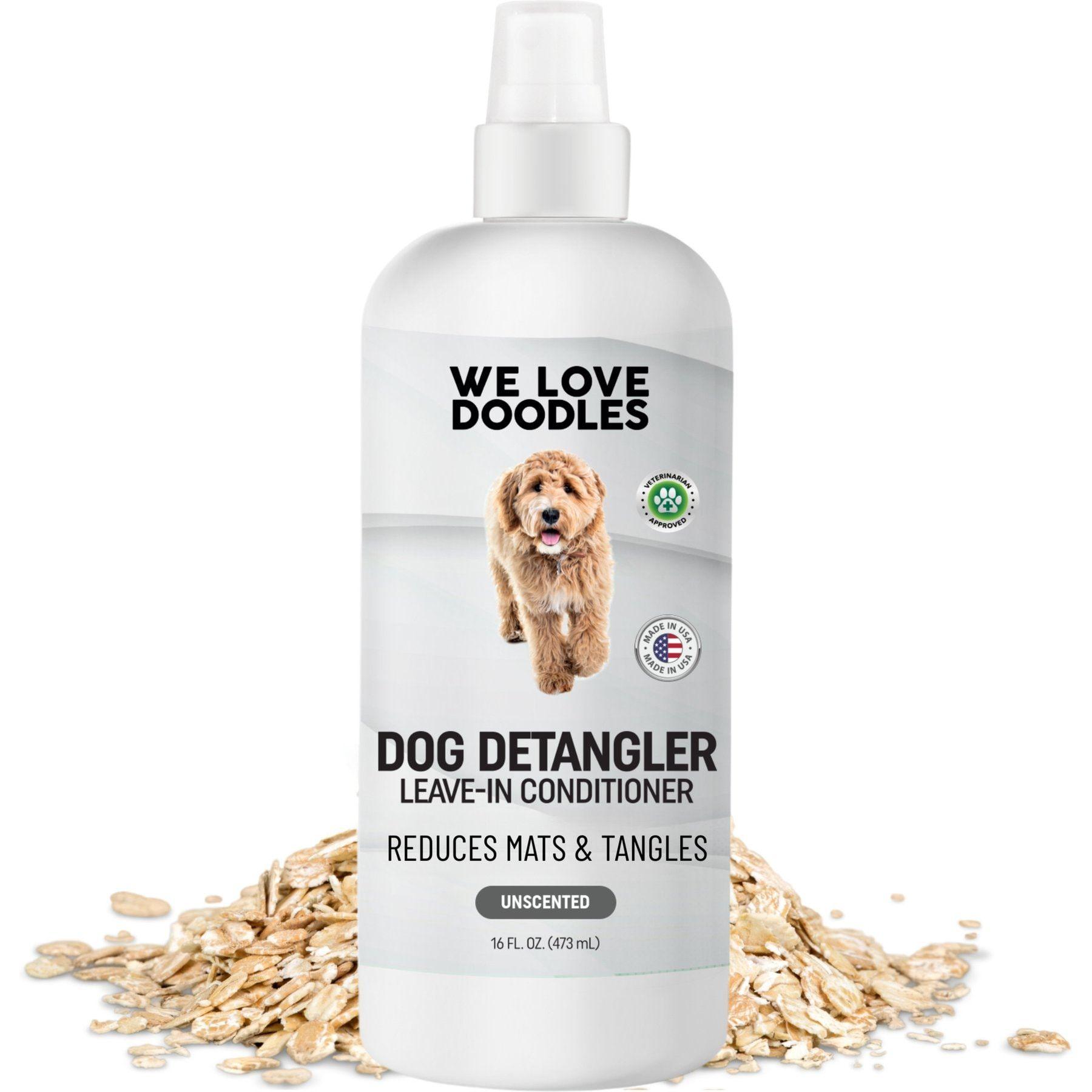
An unscented dog detangler spray for the first step of loosening small tangles before combing.
Webvet may earn a commission when you click through to Chewy, at no extra cost to you.
Clippers for matted dog hair
Clippers are where home grooming gets harder. The Merck Veterinary Manual advises electric clippers made for pets' hair rather than scissors. Which clipper and blade suit a thick, matted coat is a choice a groomer makes for each dog.
You do not need to wait for the next scheduled groom. Mats can be removed by shaving with clippers even if the dog is not due to be groomed, the USDA notes, so ask your groomer for a mat appointment.
Clippers carry their own risk:
- Heat: clippers get hot with use and may burn the skin, so the USDA suggests a clipper cooling product or alternating between two pairs.
- Skill: clipping takes practice, so RSPCA Australia says it is usually advisable to have a trusted, reputable professional groomer do the clipping.
Read how to use dog clippers safely and the WebVet guide to dog grooming clippers before trying any clipping at home.
Which brush or comb suits which coat
Matching the comb and brush to the coat makes every session easier. The ASPCA grooming guide pairs tools with coats like this:
- Smooth, short coats: a rubber brush to loosen dead skin and dirt, then a bristle brush.
- Short, dense coats prone to matting: a slicker brush for tangles, then a bristle brush.
- Long coats: a slicker brush every day for tangles, then a bristle brush, plus a comb through the fur on coats like a collie's.
- Soft massage brushes and mitts: pleasant for most dogs, but RSPCA Australia notes they are often not enough on their own to remove knots and mats.
Whatever brush you use, keep the strokes short and gentle. RSPCA Australia warns against pulling hard or scraping the skin with undercoat rakes, slickers, and de-shedders.
When choosing a slicker, size matters as much as pins. A large head covers a big dog's back and sides quickly, while a smaller brush or a comb is easier around the face, ears, and legs where mats start. Use it with light pressure, letting the pins do the work.
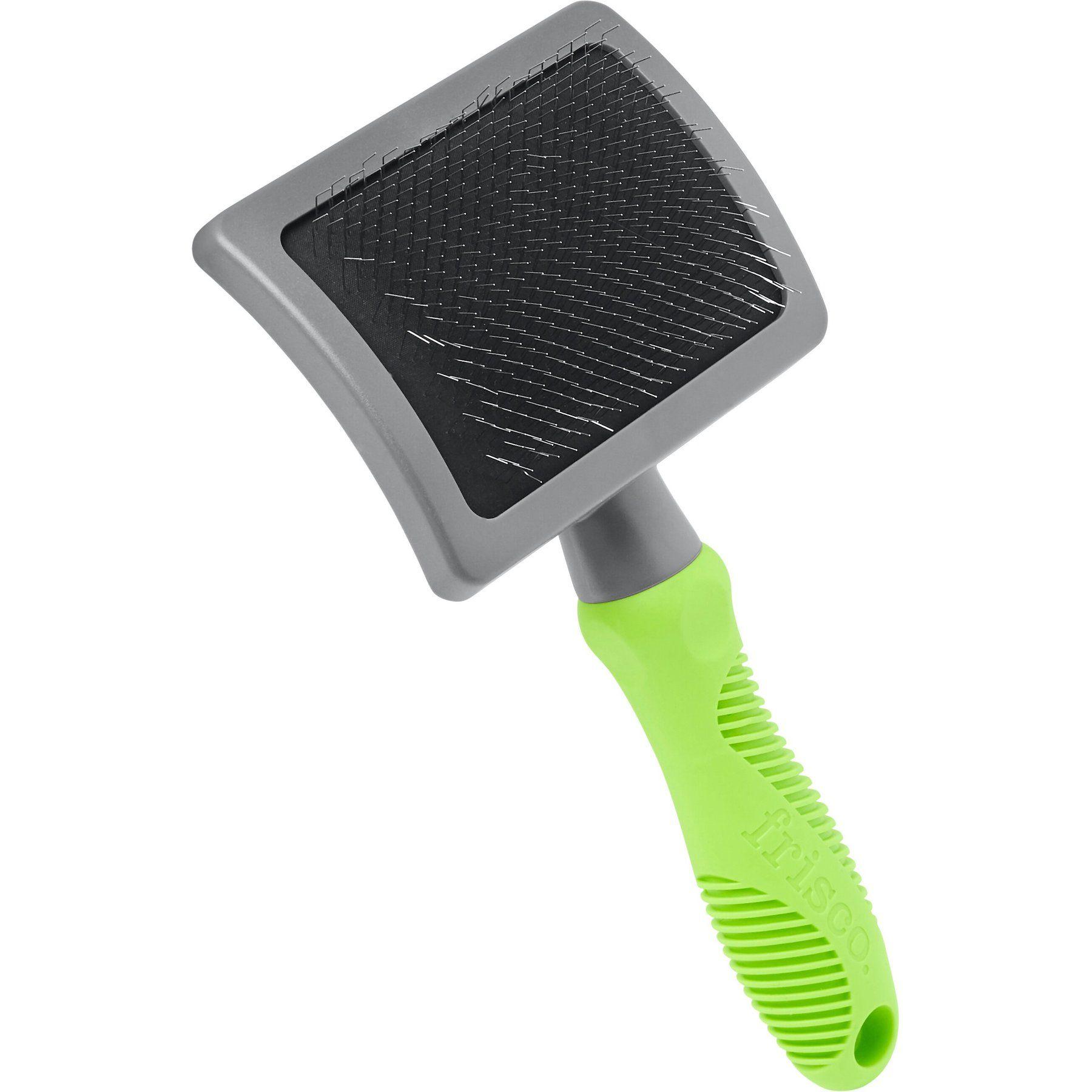
A large slicker brush with stainless-steel pins for teasing out tangles and loose hair between full grooms.
Webvet may earn a commission when you click through to Chewy, at no extra cost to you.
A slicker brush is the everyday follow-up tool for curly and long coats. The WebVet guide to the slicker brush for dogs explains pin types and how much pressure to use.
When a severely matted dog needs a groomer or a vet
Is matted hair painful for dogs? Yes. Mats are extremely uncomfortable, the ASPCA says, and a severe mat pulls on the skin with every step. Mats can also hide wounds: even very mild mats can cause skin irritation and progress to infected lesions, according to the ASPCA.
Sores under matted dog hair are easy to miss. The ASPCA grooming guide notes that matted, dirty coats can make dogs prone to hot spots, and the ASPCA describes one Shih Tzu in its care that was treated for skin allergies related to untended mats. Red, itchy, or flaking skin under a mat may be dermatitis, which needs a vet's diagnosis.
The most serious harm is a strangulating mat. Severe mats can grow around a leg and cut off its blood supply, and in irreversible cases the limb may need amputation, the ASPCA explains.
In a case series in Veterinary Radiology & Ultrasound, all dogs with strangulating hair mats had soft tissue damage on X-rays, and over half of the limbs examined had bone lesions.

How groomers and vets handle an extremely matted dog:
- Shaving under the mats: clipping close to the body, under the mat rather than through it, removes the coat in one pass. In one ASPCA case, a Shih Tzu's matting came off in one intact piece weighing more than one pound. Groomers call this kind of solid sheet of mats pelting.
- Sedation: a severely matted pet may require sedation and full body clipping, the ASPCA says. RSPCA Australia notes that dogs who become stressed when clipped can be clipped at a veterinary clinic, where sedation is available.
- Skin care afterward: the vet treats any sores, infection, or parasites the mats were hiding.
When is shaving the kind choice? When a mat cannot be brushed out without pain. The ASPCA describes clipping as instant relief for a matted pet.
One caution for thick coats: hair usually regrows within 3 to 4 months of clipping, but in some dogs full regrowth takes 12 to 24 months, and plush-coated breeds may be predisposed, according to the University of Minnesota dermatology handbook. Raise slow regrowth with your vet alongside other causes of hair loss in dogs.
Wondering how to cut or shave matted dog hair on a severely matted dog? Leave it to a groomer or your vet. Trimming close to the skin at home risks cuts and clipper burns, and hours of pulling at a severe mat only adds to the pain.
Is matted fur considered neglect?
It can be. Chronically matted hair and strangulating mats are recognized by veterinarians as a medical finding in animal neglect, according to Veterinary Radiology & Ultrasound. A 2022 ASPCA study found that 13 percent of ASPCA-NYPD cruelty cases involved matting or strangulating mat wounds, and 93 percent were long-haired dog breed types.
A single mat behind the ear is not neglect; it is a normal part of owning a long coat. The same paper notes that owners may be willing to groom when barriers to care are addressed, so booking a groomer or vet as soon as mats appear is the responsible step.
Scissors, home remedies, and other mat fixes to avoid
Can I cut matted dog hair with scissors? No. The ASPCA's advice is to never cut mats out with scissors, because a pet can move or jerk and end up with a severe laceration or puncture. A tight mat sits right against the skin, so the blade can catch skin along with the hair.
The Schwarzman Animal Medical Center says every veterinarian can list patients who needed stitches after a do-it-yourself mat removal. The ASPCA grooming flyer says not to use scissors close to the skin, and to see a groomer if you are unsure.
Where the sources differ on scissors
Two welfare sources are less absolute, and both stress the risk to the skin:
- USDA APHIS Animal Care: scissors can cut the skin as well as the mat, so it suggests blunt-tipped bandage scissors.
- RSPCA Australia: blunt-nosed safety scissors may be used on a stubborn tangle without touching the skin, but a mat that is close to the skin should go to a groomer or veterinary nurse.
For a tight mat, the safest scissors are the ones left in the drawer. A skin laceration turns a grooming job into a vet visit.
Kitchen remedies
Home remedies for matted dog hair do not change this. Common suggestions include:
- coconut oil or olive oil worked into the mat overnight
- cornstarch dusted into the mat to make the hairs slip
- a vinegar rinse
- a homemade detangler made from human conditioner
None of these appear in the mat advice from the Merck Veterinary Manual, the ASPCA, or the USDA, which rely on gentle brushing and combing for small mats and clippers for the rest. No home remedy loosens a tight mat overnight.
Can I use human hair detangler on my dog?
It is better not to. The ASPCA advises using only grooming products meant for dogs. Human shampoos are not toxic to pets, it says, but some contain fragrances or other substances that can irritate the skin. A detangler formulated for dogs is the safer choice.
Can vinegar detangle matted hair?
There is no veterinary support for it. Vinegar is not part of the mat-removal guidance from the Merck Veterinary Manual, the ASPCA, or the USDA. For a small tangle, a dog detangler and a comb do the job; for a tight mat, clipping by a groomer does.
How to prevent matted dog hair: brushing routines for each kind of coat
The way to prevent matted dog hair is regular brushing that reaches the skin, at a frequency that suits the coat. The USDA notes that brushing frequency, daily or weekly, varies by breed, type, and length of hair.
Brushing at home also saves money, the ASPCA points out, since groomers often charge extra for mats.
How often should I brush my dog?
Daily for long-haired dogs and about once a week for short coats. Long-haired dogs should be brushed daily to prevent tangling, according to the ASPCA.
Smooth, short coats such as a Chihuahua's or Boxer's need brushing once a week, and short, dense coats like a retriever's can be brushed weekly with a slicker brush. Double coats need more during shedding seasons.
Here is how to prevent matting in dogs by coat type:
- Shih Tzu and other long, silky coats: Matted dog hair on a Shih Tzu is a daily-brushing problem: a Shih Tzu with a long coat requires daily brushing, layering the hair to reach the skin, according to the American Kennel Club. A short puppy trim by a groomer is an easier option.
- Pomeranian: mats tend to start in the profuse double coat. The AKC advises brushing with a pin brush and a slicker brush down to the skin once a week to keep the hair from matting.
- Siberian Husky: mats tend to form where shed undercoat is not raked out. The AKC notes the undercoat is shed twice a year and should be raked out with a pin brush and metal comb. RSPCA Australia says double coats such as the Husky's should normally be groomed every day.
- German Shepherd: the AKC describes a medium-length double coat that needs a quick brushing every few days, with more brushing during the heavy shedding that comes once or twice a year. Mats tend to start in that shed undercoat.
- Poodles, Maltese, and Schnauzers: these coats do not shed, so they need regular clipping, RSPCA Australia notes.
Prevention also means checking the friction spots every few days, so a tangle is caught while it is still loose:
- behind the ears and under the ear flaps
- the collar and harness line
- the armpits and between the hind legs
- between the toes
For long-haired double coats, RSPCA Australia suggests dividing the coat into sections and starting with an undercoat rake, then a wide-tooth comb. The Evolution Dog Undercoat Grooming Rake with Rotating Pins is a double-row rake with rotating, rounded pins designed for thick, dense coats.
For long and curly coats between grooms, the Frisco Slicker Dog Brush, Large has stainless-steel pins for tangles and loose hair, listed at $7.99 on Chewy when checked in November 2026. The WebVet guide to the best dog brush for shedding compares brushes for heavy shedders.
On bath day, brush out every tangle first, then wash. A detangling conditioner such as BioSilk Silk Therapy Detangling Dog Conditioner, made with silk and added vitamins, helps a tangle-prone coat comb out after the rinse. Dry the coat fully, then brush again.
Matted dog hair questions
Frequently Asked Questions
Does matted hair hurt a dog?
Yes. Mats pull on the skin every time your dog moves, lies down, or is touched. Mats can also cause discomfort, skin conditions, and even open wounds, according to the ASPCA.
Can I cut matted dog hair out with scissors?
No. Mats sit tight to the skin, and scissors can cut the skin as well as the mat, the USDA notes. A sudden movement by your dog can turn one snip into a deep cut that needs stitches. Clippers in a groomer's hands are the safe route.
Does coconut oil help loosen mats?
It is not a step vets recommend. Coconut oil is not part of the mat guidance from the Merck Veterinary Manual, the ASPCA, or the USDA. For a small, loose tangle, a dog detangler and a comb worked from the tip do the job; a tight mat needs clipping, not oil.
Can matted hair cause sores on a dog?
Yes. Even mild mats can cause skin irritation that progresses to infected sores, and a wound left unattended under a mat can attract maggots, the ASPCA says. If you notice redness, odor, discharge, or your dog licking at one spot, see your vet so the sore can be treated once the mat is clipped.
Should you bathe a matted dog before brushing out the mats?
No. Brush or clip the mats out first. Water makes mats tighten as they dry, so a bath can turn a loose tangle into a tight one. The ASPCA advises brushing out or clipping mats before bath time.
How do groomers handle a severely matted dog?
A groomer will usually shave the coat short with clippers, working under the mats rather than through them. If your dog is in pain or very stressed, a vet clinic can clip with sedation.
Veterinarian · BVMS MRCVS
Dr. Pippa Elliott, BVMS, MRCVS, is a veterinarian with nearly 30 years of experience in companion animal practice. Dr. Elliott earned her Bachelor of Veterinary Medicine and Surgery from the University of Glasgow. She was also designated a Member of the Royal College of Veterinary Surgeons. Married with 2 grown-up kids, Dr. Elliott has a naughty Puggle named Poggle, 3 cats and a bearded dragon.


