Slicker Brush for Dogs: Best Picks and How to Use One Without Hurting Skin
A slicker brush lifts loose hair and small tangles from medium, long, and curly coats, but pressed too hard it scrapes skin. Which pins and size suit your dog, how to brush in layers without brush burn, and our picks.

BVMS MRCVS
Medically reviewed by Dr. Pippa Elliott, BVMS MRCVS · Last reviewed

This article contains affiliate links. Webvet may earn a commission when you buy through them, at no extra cost to you.
Slicker brush for dogs: what it does and which coats need one
A slicker brush for dogs is a pad of fine bent wire pins that lifts loose hair and small tangles out of medium, long, curly, and double coats. Used with light strokes, in layers down to the skin and followed by a comb, it keeps a coat clear of mats. Pressed hard, the pins can scrape skin.
Purdue University's Canine Welfare Science group calls the slicker the most commonly used brush and good for most coat types, useful for removing dead hair and loosening tangles, with one condition: use it gently so you don't hurt your dog. Tight mats need a groomer or a vet, not a harder brush.
- 1Know what a slicker brush does: its fine bent wire pins pull out loose hair and loosen small tangles in medium, long, curly, and double coats.
- 2Pick soft versus firm pins by coat and skin: soft or coated pins for puppies, toy breeds, and thin skin, firm pins for thick double coats.
- 3Brush with light strokes in thin layers down to the skin, then run a comb through to confirm no tangles remain.
- 4Stop at tight mats, red or scraped skin, or a dog that freezes or tries to bite, and call a groomer or your vet.
| Pick | Pin style | Best for | Key specification |
|---|---|---|---|
| Safari Self-Cleaning Slicker Brush for Dogs, Medium | Retractable stainless steel pins | Everyday brushing of medium and long coats | Push-button pin retraction for cleanup |
| Kenchii Slicker Dog & Cat Brush, Medium | Finely polished rounded pins | Curly and long coats | Maplewood handle with rubber non-slip grip |
| CHI Soft Pivoting Slicker Dog Brush, Small | Soft slicker on a pivoting head | Puppies and sensitive skin | Pivoting head and button fur release |
| Safari Curved Firm Slicker Dog Brush, Medium | Firm pins with coated tips on a curved pad | Thick double coats | Curved pad and non-slip handle |
| Li'l Pals Coated Tips Dog Slicker Brush | Flexible wire pins with plastic tips | Toy breeds and small puppies | 4.9 inches long |
| Frisco Slicker Dog Brush, Large | Stainless steel pins | Large dogs on a budget | Large size, lowest price of the six |
The design is simple. Each fine pin is bent near its tip, so the brush catches loose hair and shed undercoat and draws it out while it works through knots. That is why a slicker suits coats that tangle and trap hair, and why it adds little on a sleek, short coat.
Which coats need one, according to veterinary and animal welfare sources:
- Curly coats: VCA Animal Hospitals says slicker brushes work well for dogs with curly, non-shedding coats, like Poodles, and Texas A&M's veterinary college recommends a slicker-style brush, a flat head with rows of wire pins, for curly-coated dogs.
- Long, silky coats: the ASPCA advises removing tangles with a slicker brush every day on a long coat like a Yorkshire terrier's.
- Dense and double coats: the ASPCA uses a slicker weekly on short, dense fur prone to matting, like a retriever's, and Cornell's Riney Canine Health Center says regular brushing of double-coated dogs helps prevent painful matting.
- Wire coats: Purdue lists wire coats among the coats a slicker fits, alongside curly, double, long, and short coats.
- Smooth, short coats: usually not. The ASPCA recommends a rubber brush, then a bristle brush, for coats like a Chihuahua's, Boxer's, or Basset Hound's.

What is a slicker brush used for dogs?
A slicker brush is used to remove dead hair and loosen tangles before they tighten into mats, which is how Purdue's veterinary welfare group describes its role. It also gives you a close look at the coat: Purdue notes that careful brushing lets you inspect your dog's hair and skin for cuts, sores, or bumps.
Every slicker uses the same kind of fine wire pins. Slickers differ in how those pins are mounted and finished, and each type has its own uses:
- Flat slickers: a rectangular pad that is easy to control on legs, ears, and small areas.
- Curved slickers: a pad that follows the body's contour on broad areas like the back and sides.
- Soft or flexible slickers: thinner, more flexible pins or a cushioned pad for puppies and thin coats.
- Firm slickers: stiffer pins that push through a dense undercoat.
- Coated or rounded tips: a bead or polished end on each pin to soften contact with the skin.
- Self-cleaning slickers: retractable pins that release collected hair at the press of a button.
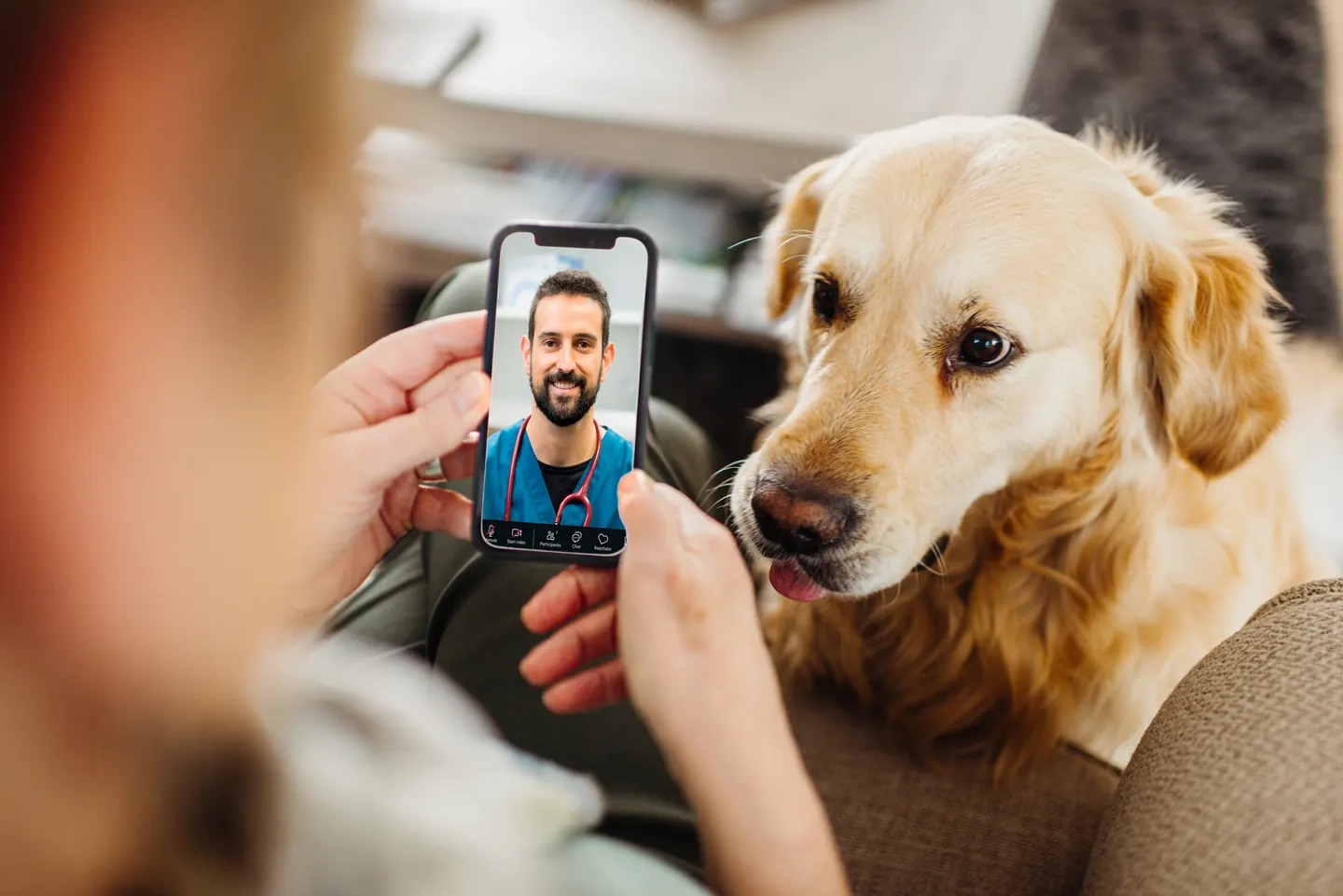
 Sponsored
Want a vet's take on your dog's skin or coat?
Talk to a licensed vet at Dutch over video, often the same day. They can recommend treatment and prescribe it when it's appropriate.
Use code Pets60
Plans start at $12/month · covers up to 5 pets
- Licensed vets in most states
- Rx for 150+ conditions
- 4.7 on Trustpilot
Our picks: the best slicker brushes for dogs
The best slicker brush for most dogs is a self-cleaning medium slicker for everyday brushing, with a rounded-pin slicker for curly coats, a soft small slicker for puppies, and a firm curved slicker for thick double coats. Each pick is judged on its label, the maker's stated specification, and its Chewy catalog listing, not on hands-on testing. Prices were checked on Chewy in November 2026. Whatever you buy, method matters more than brand: light pressure, thin sections, and a comb afterward.
The useful question is which pin style and size suit your dog's coat, so each pick names who it suits and who should skip it.
Safari Self-Cleaning Slicker Brush for Dogs: best overall
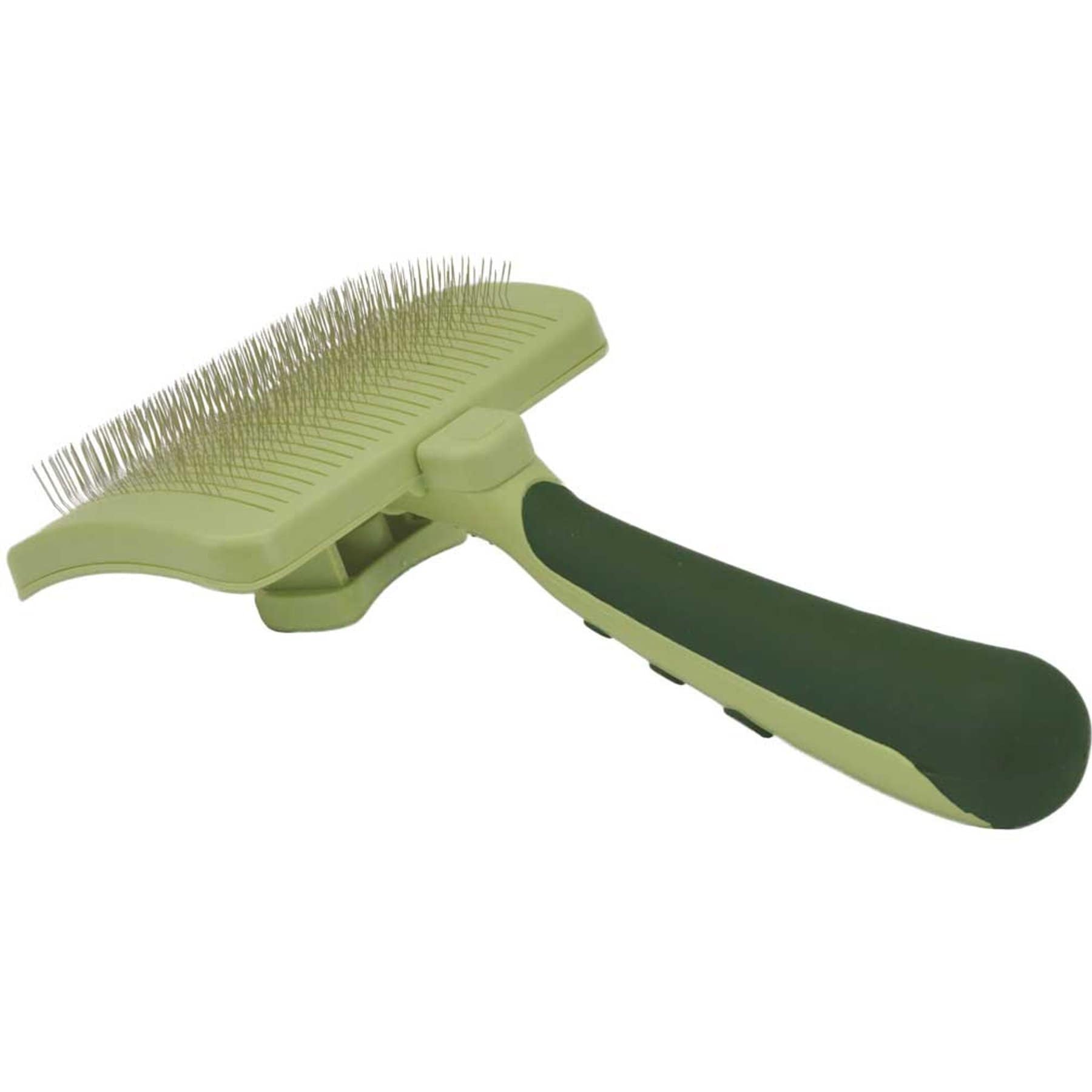
A self-cleaning slicker with retractable stainless steel pins for everyday brushing of medium and long coats.
Webvet may earn a commission when you click through to Chewy, at no extra cost to you.
The Safari Self-Cleaning Slicker Brush for Dogs, Medium has stainless steel pins that retract for cleanup at the press of a button. Coastal, which makes Safari, lists the medium at 7.625 by 4.0625 inches and says it works on all coat types. It is listed at $20.49 on Chewy when checked in November 2026.
Retractable pins are still wire pins, so the light-pressure rule applies here as with any slicker.
- Suits: owners of medium and long coats who brush often and want an everyday slicker that is quick to clean.
- Skip it if: your dog has a dense double coat that needs a firmer, curved pad, or is a toy breed that needs a smaller head.
- How it differs: it is the pick whose pins retract into the pad; the CHI brush uses a button release on a pivoting head instead.
Kenchii Slicker Dog & Cat Brush: best for curly and long coats
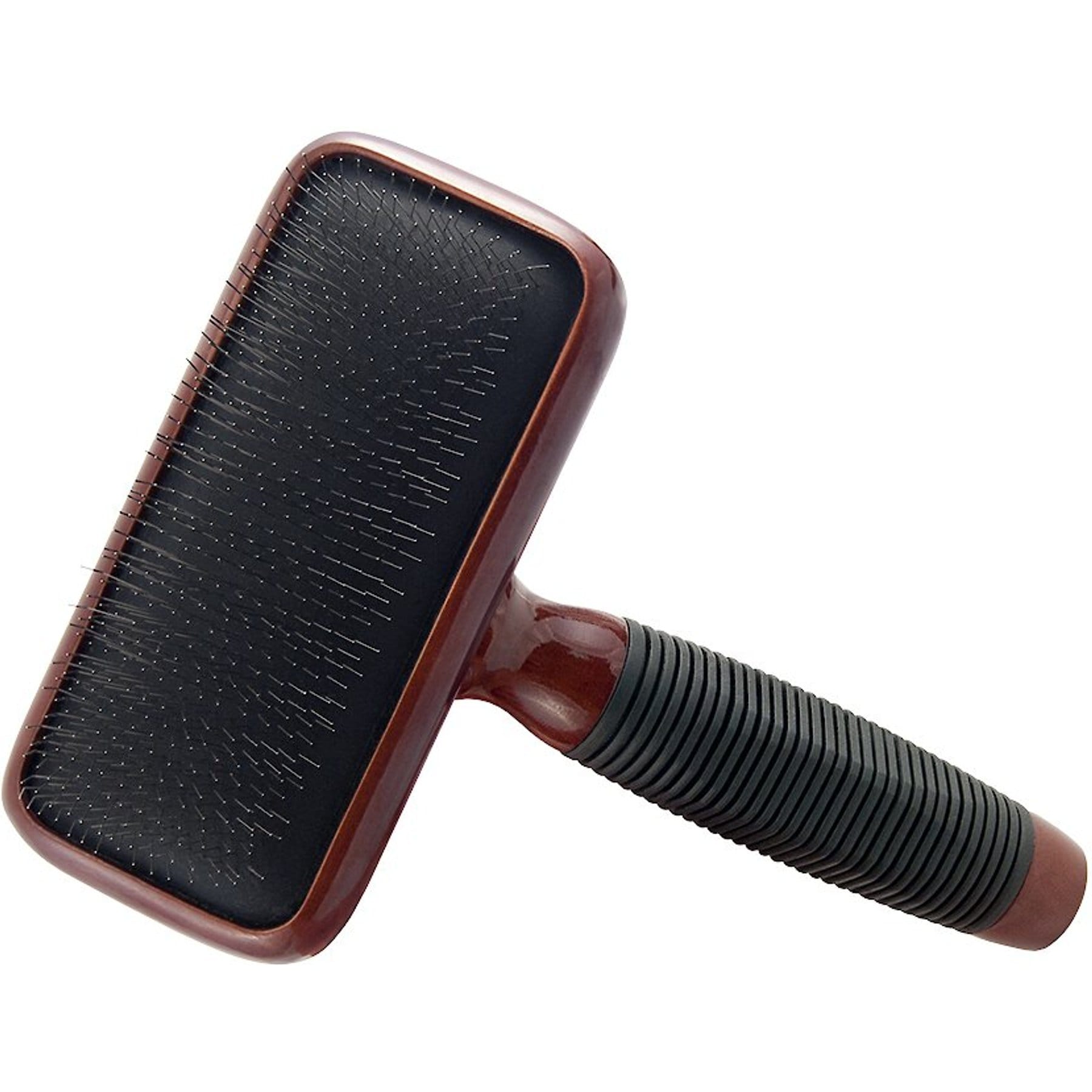
A groomer-style slicker with finely polished rounded pins and a maplewood handle for curly and long coats.
Webvet may earn a commission when you click through to Chewy, at no extra cost to you.
The Kenchii Slicker Dog & Cat Brush, Medium has finely polished rounded pins, a maplewood handle, and a rubber non-slip grip, according to its catalog listing, which pitches it at home groomers and professionals alike. It is listed at $28 on Chewy when checked in November 2026, the most expensive of the six.
Rounded pins and a wooden handle suit the slow line brushing that curly coats need, whether a cockapoo, a Poodle cross, or a Portuguese Water Dog, whose coat the American Kennel Club describes as ranging from tight and curly to loose and wavy. Its listing names cats as well as dogs, so one brush can serve both.
- Suits: curly, wavy, and long coats brushed in sections to the skin.
- Skip it if: you want a self-cleaning brush or are shopping on a tight budget.
- How it differs: a maplewood handle with a rubber grip, and its listing describes it as designed for undercoat removal.
CHI Soft Pivoting Slicker Dog Brush: best for puppies and sensitive skin
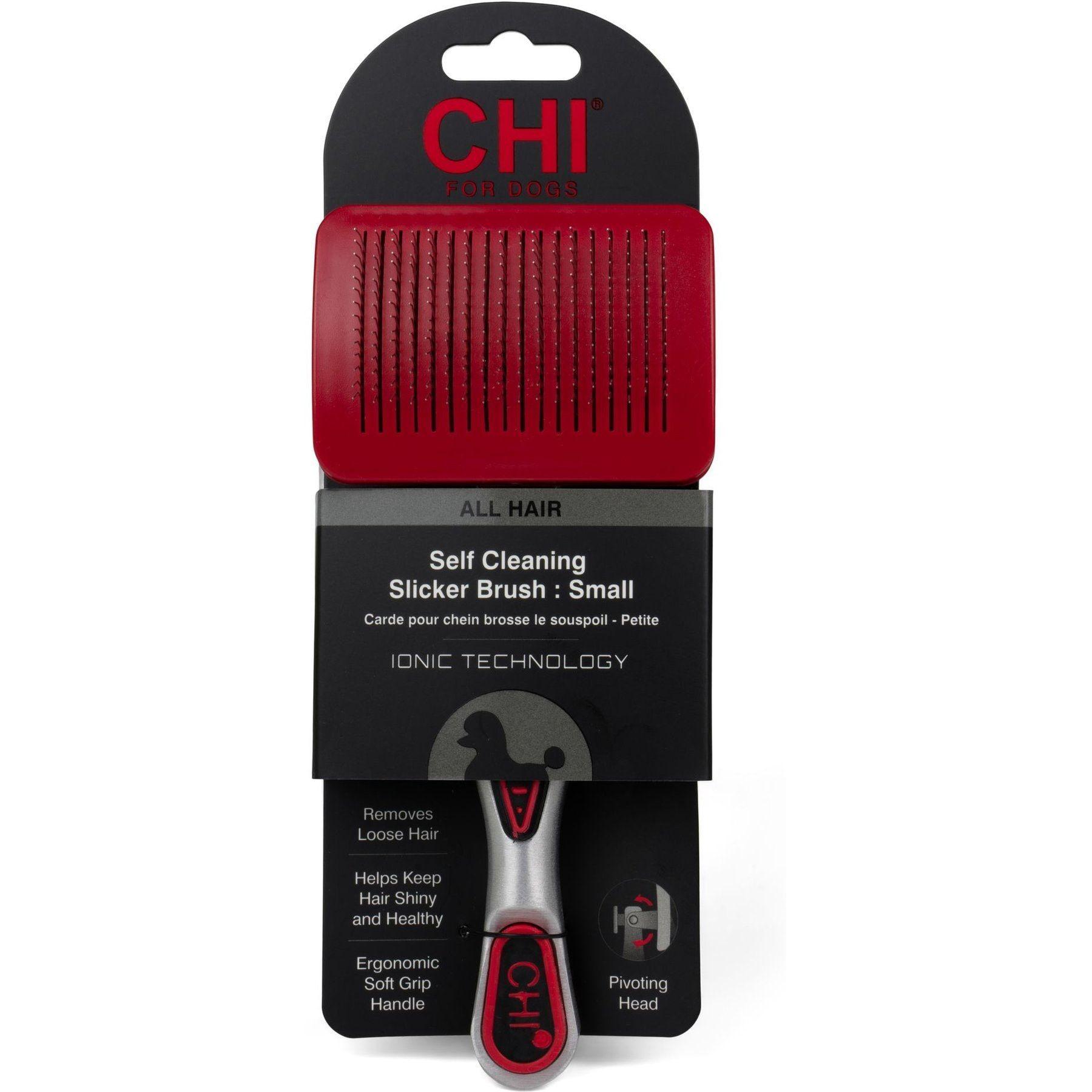
A soft slicker with a pivoting head and button fur release, sized small for puppies and sensitive skin.
Webvet may earn a commission when you click through to Chewy, at no extra cost to you.
The CHI Soft Pivoting Slicker Dog Brush, Small has a pivoting head for hard-to-reach areas and a button that releases collected fur, per its catalog listing. The listing also says ionic technology helps reduce static in fur; treat that as the maker's description. It is listed at $19.19 on Chewy when checked in November 2026.
A soft, small brush is a gentle way to introduce grooming, and Purdue advises getting puppies used to being brushed when they are young.
- Suits: puppies, small dogs, and adults with thin coats or sensitive skin.
- Skip it if: you brush a thick double coat, where soft pins may not reach the skin through the undercoat.
- How it differs: the head pivots to reach hard-to-reach areas, and a button releases collected fur.
Safari Curved Firm Slicker Dog Brush: best for thick double coats
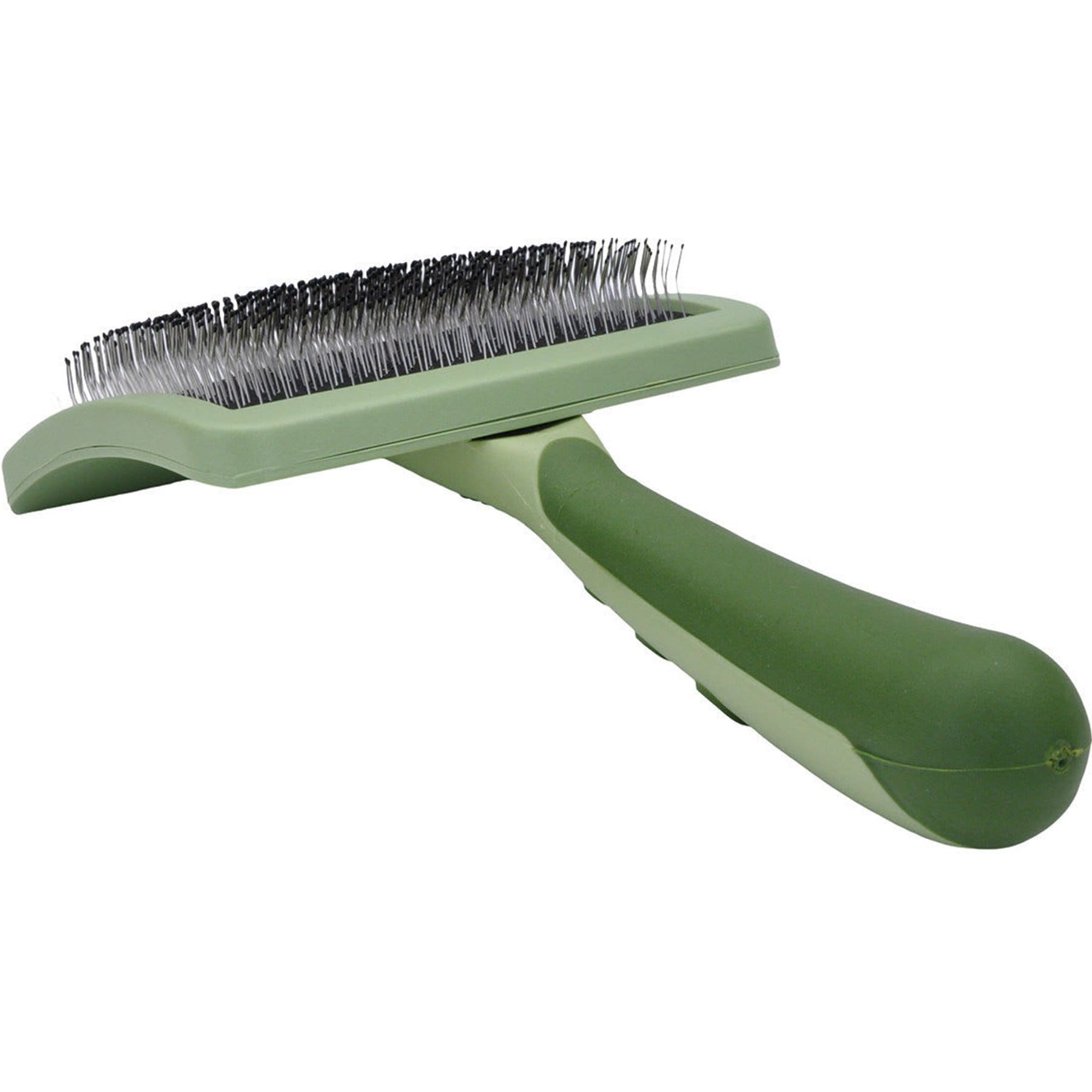
A firm, curved slicker with coated tips for working through thick double coats with long, gentle strokes.
Webvet may earn a commission when you click through to Chewy, at no extra cost to you.
The Safari Curved Firm Slicker Dog Brush, Medium has coated stainless steel tips, a curved pad, and a non-slip handle. Coastal's directions call for long, gentle strokes that avoid removing excess undercoat, and list it for thin, medium, and thick fur. It is listed at $13.99 on Chewy when checked in November 2026.
Firm pins work through the dense undercoat of a Golden Retriever, Newfoundland, or Samoyed. Purdue's reminder to use a slicker gently matters most with firm pins, so keep the pressure as light as with a soft brush.
- Suits: thick double coats and broad areas like the back, chest, and hindquarters.
- Skip it if: your dog is a puppy, a toy breed, or has thin, sensitive skin.
- How it differs: firm pins on a curved pad, where the Safari self-cleaning brush has retractable pins.
Li'l Pals Coated Tips Dog Slicker Brush: best for toy breeds
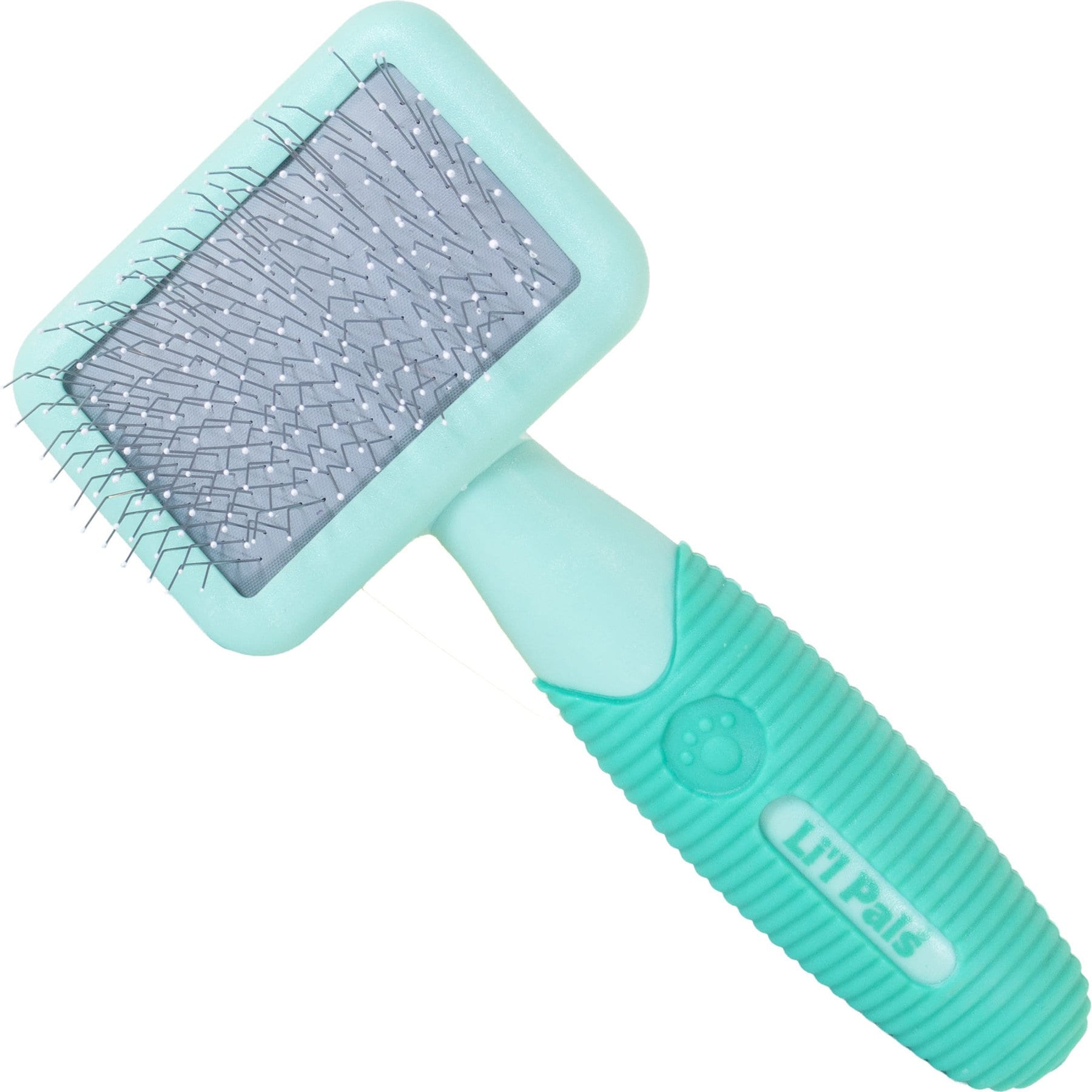
A 4.9-inch slicker with flexible, plastic-tipped wire pins sized for toy breeds and small puppies.
Webvet may earn a commission when you click through to Chewy, at no extra cost to you.
The Li'l Pals Coated Tips Dog Slicker Brush is 4.9 inches long, with a pad of flexible wire pins that contour to the body and plastic tips on each bristle, according to Coastal, its maker. It is listed at $8.49 on Chewy when checked in November 2026.
A small head lets you work under the legs, behind the ears, and around the face of a Yorkie or Maltese without sweeping across skin you cannot see. Purdue notes that a smaller dog usually needs a smaller comb, and the same scaling makes sense for the brush.
- Suits: toy breeds, small puppies, and touch-ups on the face and feet of bigger dogs.
- Skip it if: you groom a large dog; the head is too small to be practical over a whole body.
- How it differs: at 4.9 inches long it is the pick sized for toy breeds, with flexible, plastic-tipped pins.
Frisco Slicker Dog Brush, Large: best budget slicker for large dogs
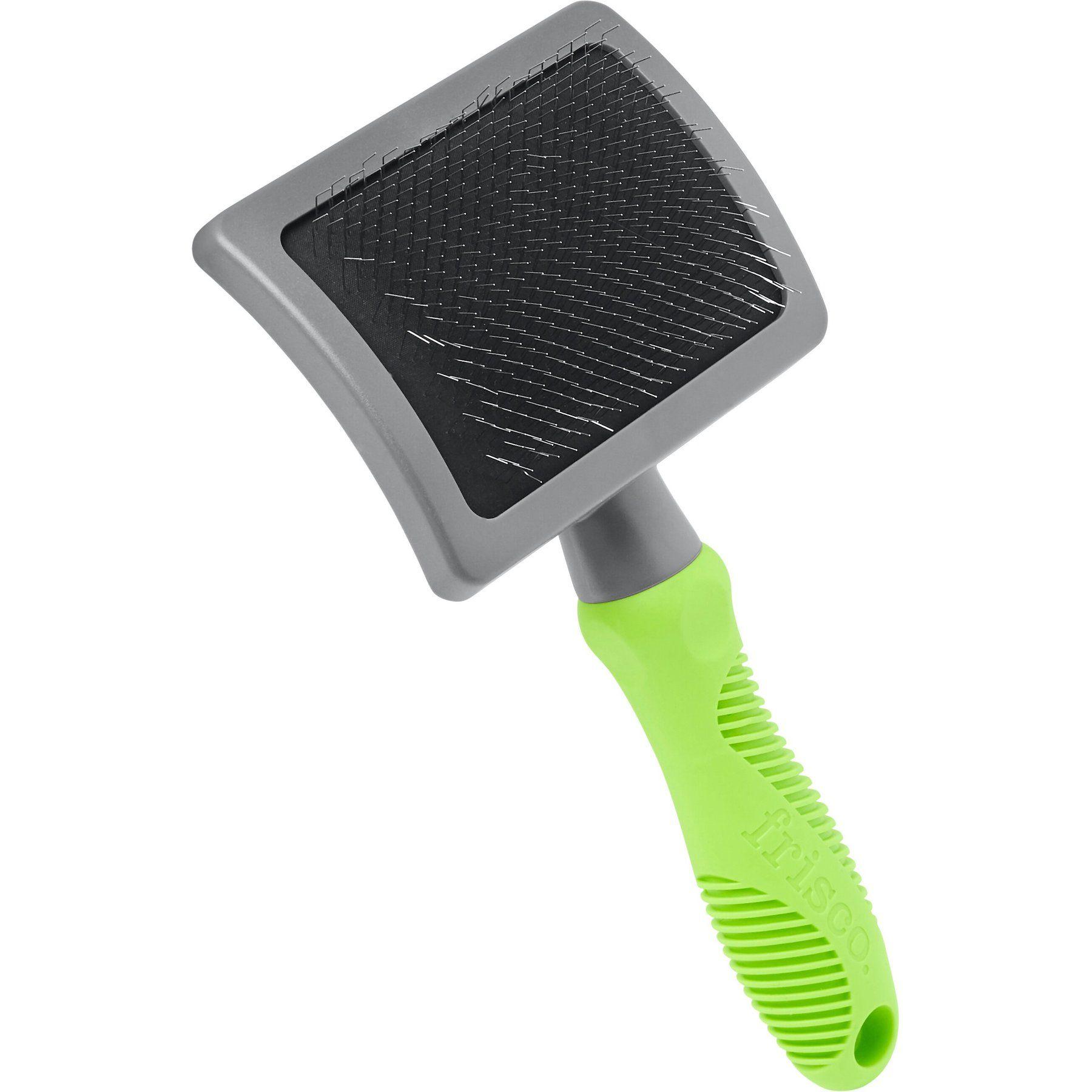
A low-cost, large slicker with stainless steel pins for brushing out loose hair and tangles on big dogs.
Webvet may earn a commission when you click through to Chewy, at no extra cost to you.
The Frisco Slicker Dog Brush, Large is Chewy's own-brand slicker, with stainless steel pins that the listing says remove tangles and loose, dead hair from dogs and cats. It is listed at $7.99 on Chewy when checked in November 2026, the lowest price of the six.
A large head covers a big dog's back and sides quickly during seasonal shedding. A low-cost slicker still has wire pins, so the same light-pressure rule applies, and tight mats still go to a groomer.
- Suits: large dogs with medium or long coats, and a spare brush for the car or kennel.
- Skip it if: you need soft pins, a small head, or a self-cleaning design.
- How it differs: the lowest price in this group, in a large size.
 Sponsored
Vet care that's always there
Unlimited video calls and messaging with licensed vets for less than a typical vet visit. One membership covers up to five pets.
Use code Pets60
Plans start at $12/month · covers up to 5 pets
- Licensed vets in most states
- Rx for 150+ conditions
- 4.7 on Trustpilot
How to choose a slicker brush: pin length, firmness, size, and coat type
Choose a slicker brush by matching pin length, firmness, and size to your dog's coat type: pins long enough to reach the skin, soft pins for puppies and sensitive skin, firm pins for thick double coats, and a head sized to your dog. Find your dog's coat below to see the pin style, pressure, and comb check that fit it.
| Coat type | Example breeds | Pin length | Firmness | Brush size | Pressure and method | Comb check |
|---|---|---|---|---|---|---|
| Curly or doodle | Poodle, goldendoodle, labradoodle, bernedoodle, cockapoo | Long enough to reach the skin through the curl | Medium, rounded or coated tips | Medium; small for minis and puppies | Light; line brushing in thin layers to the skin | Comb slides from skin to tip everywhere, including ears, armpits, and legs |
| Long and silky | Yorkshire Terrier, Maltese, Shih Tzu, Havanese, Cavalier | Medium | Soft to medium | Small to medium | Very light; line brushing, then a fine comb | Fine comb passes to the skin with no snag |
| Thick double coat | Samoyed, Newfoundland, Golden Retriever | Long, to pass through the undercoat | Firm | Medium to large | Light even with firm pins; line brushing section by section | Comb reaches the skin through the undercoat |
| Medium double coat | German Shepherd, Australian Shepherd, Sheltie, Rough Collie | Medium | Medium to firm | Medium to large | Light; extra passes behind the ears and elbows | Comb clears behind the ears, elbows, and under the tail |
| Wire coat | Miniature Schnauzer, rough-coated Parson Russell Terrier | Short to medium | Medium | Small to medium | Light, short strokes with the hair | Comb runs cleanly through leg and beard hair |
| Short, smooth coat | Pug, Boxer, French Bulldog, smooth Dachshund | Not needed | Not needed | Not needed | Rubber brush or bristle brush instead | Not needed |
| Puppy, any coat | Any breed | Short | Soft, coated tips | Small | Very light, short sessions with treats | Gentle comb pass; stop at any snag |
Pin length matters because the pins have to reach the skin through the coat. AKC's breed guidance for the Standard Poodle says a full coat not brushed and combed completely to the skin will mat near the roots and have to be shaved off. A short-pin brush on a deep coat smooths the surface while tangles build underneath.
Soft versus firm pins is the second choice, and it follows the skin as much as the coat:
- Soft or coated pins: puppies, toy breeds, thin coats, sensitive skin, and any dog that dislikes brushing.
- Firm pins: dense double coats where soft pins bend before reaching the skin.
- Flexible pads: pins on a cushioned or flexible base give a little under pressure, a gentler feel over bony areas.
Size is the third. A small slicker reaches the face, feet, and armpits; a medium one covers most dogs; a large one saves time on a big dog's back.
For a toy breed, the Li'l Pals Coated Tips Dog Slicker Brush is sized for small areas at 4.9 inches long. For a puppy of any size, the CHI Soft Pivoting Slicker Dog Brush, Small pairs a small head with soft pins.

Labels use many names for a few features:
- Professional or pro: a marketing term with no set standard; check the pin and handle details instead.
- Ergonomic or wooden handle: more comfortable on long sessions.
- Double sided: a soft face and a firm face on one brush.
- Heavy duty pins: made for a working double coat.
- Self cleaning: pins that retract so hair wipes off quickly.
None of these replaces the right pin length for your dog's coat.
Breed by breed, AKC coat notes and veterinary guidance point to these choices:
- Pomeranian: AKC's Pomeranian guidance is to brush with a pin brush and a slicker brush down to the skin once a week. A small or medium slicker with pins long enough to reach the skin fits that routine; start a puppy on soft pins.
- Poodles, miniature to standard: Purdue says wavy-coated dogs such as Poodles and their hybrids need daily brushing. A slicker with rounded tips, such as the Kenchii Slicker Dog & Cat Brush, Medium, suits Poodle hair as long as the pins reach the skin.
- Doodles: a goldendoodle, labradoodle, bernedoodle, or other Poodle cross can inherit a Poodle-type coat, so brush choice follows the Poodle rules. Many owners find these crosses on lists of hypoallergenic dog breeds, but low shedding is not low maintenance: AKC notes the Bichon Frise sheds little because shed hair is caught in the coat, and it must be brushed out to prevent mats. Use soft pins on a doodle puppy.
- Cocker Spaniel and Cavalier King Charles Spaniel: AKC's Cocker Spaniel notes call the metal comb key, followed by a gentle slicker brush; the Cavalier silky coat needs little more than regular brushing.
- Yorkies, Maltese, Shih Tzus, and Havanese: AKC advises daily gentle brushing and combing to the skin for the Maltese, and a wire brush with flexible pins for the Shih Tzu. A small, flexible slicker suits a Yorkie of any age.
- Samoyed, Newfoundland, Golden Retriever, and Chow Chow: AKC says Samoyed mats or tangles can be worked out with a slicker brush or metal comb, and recommends a slicker and long-toothed comb for the Newfoundland. The Safari Curved Firm Slicker Dog Brush, Medium is the firm option among the picks for these dogs.
- Husky and Malamute: AKC's Alaskan Malamute and Siberian Husky guidance leans on a pin brush and metal comb, so for these breeds a slicker is an extra, not the main tool.
- German Shepherd, Australian Shepherd, shelties, and collies: AKC describes the German Shepherd Dog coat as a medium-length double coat, and says Rough Collies need attention behind the ears and elbows. A long-coated German Shepherd does well with a medium slicker, and a puppy of either breed starts on soft pins.
- Long haired Dachshund: AKC says Longhaired Dachshunds may need more frequent brushing depending on coat thickness; a small, soft slicker fits.
- Wire haired dogs: AKC lists a pin or slicker brush for the rough coat of the Parson Russell Terrier, so a slicker suits a rough-coated Jack Russell too.
- Shiba Inu: AKC says that unless a Shiba is a long coat, the coat does not mat; a slicker on a Shiba is mainly for shedding season.
- Pugs, French Bulldog, and Boxer: AKC lists a medium-bristle brush, rubber grooming mitt, or hound glove for the Pug, so short-haired dogs rarely need a slicker.
What is the hardest dog breed to groom?
Breeds with long, dense, or continuously growing coats are the hardest to groom at home. AKC says the Old English Sheepdog needs grooming down to the skin over the entire dog at least weekly, and a full-coated Poodle mats at the roots without it. Purdue adds that Shih Tzus, Yorkshire Terriers, Poodles and their crossbreeds need regular trimming.
What breed of dog has matted hair?
Dogs with long, curly, silky, or dense double coats mat most readily. VCA says long, silky, or curly coats need daily brushing to prevent mats, and AKC's breed notes flag mats in Cocker Spaniels and a Chow Chow puppy coat. Today's Veterinary Nurse adds senior pets and dogs with decreased mobility to the higher-risk group.
Slicker brush vs pin brush, deshedding tool, and comb
The difference between a slicker and a pin brush comes down to pin design. Purdue describes a pin brush as similar to a human hairbrush, with coated pin tips, and says it may tug and pull, so it is not a first choice for most dogs. A slicker's finer pins catch loose hair and small tangles a pin brush glides past.
That does not make a pin brush useless. AKC's Pomeranian notes use a pin brush and slicker brush together, and its Malamute notes pair a pin brush with a metal comb. On long or double coats, a pin brush works as a finisher, while the slicker does the tangle work.
A two-sided comb covers the finishing step. The Wahl Flea & Finishing Dog Comb, Orange/White has a flea comb side that its maker says helps detect fleas, flea eggs, and ticks, and a finishing side for untangling light mats. It is listed at $13.59 on Chewy when checked in November 2026.
- Deshedding tools: these have blades or several pins that remove undercoat, and Purdue warns they can irritate or even cut the skin, so treat any blade-style undercoat tool with the same care. For heavy shedders, see the best dog brush for shedding.
- Combs: Purdue calls the comb a finishing touch rather than a primary tool for most dogs, and notes it can tug the skin if tangles remain. Use the slicker first, the comb second.
- Bristle and steel pin brushes: a bristle brush suits short coats, a steel pin brush finishes long coats, and a slicker handles tangles and shed hair.
- Curved or flat pads: a curved pad covers broad areas like the back; a flat pad is easier on legs, ears, and the face.
- Soft or firm pins: soft pins for thin coats and sensitive skin, firm pins for dense undercoat.
- Rubber brush: Purdue lists rubber brushes for short-haired, smooth-coated dogs, noting they can minimally reduce shedding.
A dematting comb does not change the rule for tight mats: Purdue and VCA both send larger or severe mats to a groomer or vet.
How to use a slicker brush without hurting your dog's skin
Safe slicker brushing starts with your hand, not the brush. Hold it loosely, let the pins do the work, and keep strokes short and light. Purdue's rules are to brush in the direction the hair grows, always brush gently, and avoid tools that pull your dog's hair. How often depends on the coat: the ASPCA brushes a long coat daily and short, dense fur weekly, and Purdue says Poodles and their hybrids need daily brushing.
The method groomers use on long and curly coats is line brushing, which works through the coat one thin layer at a time:
- Start with a dry coat. AKC's Golden Retriever notes say the dog must be completely dry before brushing begins.
- Part a line. Start low on a leg or at the bottom of a section, hold the hair above it up with your free hand, and brush the band below down and out with light strokes.
- Drop the next layer and repeat. Move up the body a line at a time. This is the layering AKC describes for the Shih Tzu, so the pins reach the skin.
- Brush all over, not one spot. Purdue notes that focusing too much on one part of the body can be uncomfortable for your dog.
- Finish with a comb check. Run a metal comb from the skin outward through each section, and brush any line where it snags again, gently. AKC's Cocker Spaniel guidance is to comb until you can see through to the skin everywhere.

Slicker pins are fine and can feel sharp. Pressed into the skin, or worked over one patch again and again, they can leave red, scraped skin, often called brush burn. Watch the skin you have just brushed for:
- Redness, small scrapes, or pinpoint scabs
- Licking, chewing, or scratching at the brushed area
- Flinching or pulling away when the brush returns to that spot
The ASPCA lists redness, bumps, rashes, scabs, and open sores among the skin changes that need your vet, so do not brush over irritated skin.
If your dog dislikes the slicker brush, treat that as information: the pressure, the pins, or the pace may be too much. A slicker with soft, coated pins, plus shorter sessions, often helps. These steps come from veterinary behavior and welfare guidance:
- Pair brushing with high-value treats, and brush when your dog is relaxed or tired, such as after exercise, as Purdue suggests.
- Keep sessions short and predictable, and end on a good note; Cornell's Riney center warns that pushing past a dog's comfort level can cause setbacks.
- Watch for lip licking, yawning when not tired, freezing, pulling away, or showing the whites of the eyes, the early stress signs Cornell lists, and pause.
- If your dog freezes, tries to escape, or tries to bite, stop and ask your vet for help, as Purdue advises.
Tangles and small mats: what a slicker can fix and when to stop
A slicker handles tangles and small, loose mats. Purdue says small mats can often be detangled by hand if you go slow and are careful, and the ASPCA advises gently teasing out tangles with a slicker brush. Hold the hair at its base so any pull lands on your fingers, not your dog's skin.
For small tangles in a doodle or other long coat, a fragrance-free conditioning spray can help the brush slide. The We Love Doodles Unscented Dog Detangler Spray, 16-fl oz bottle is an unscented detangler its maker says moisturizes and conditions the coat while removing knots. It is listed at $12.79 on Chewy when checked in November 2026.

Check the places mats start. The USDA's Animal Care guidance says mats are commonly found under the collar, behind the ears, and in the armpits, where there is rubbing, and that feet and ears mat easily and can trap moisture that may lead to skin infections.
What do dog groomers use to detangle matted hair?
Groomers work loose tangles with a slicker brush and comb, and remove tight mats with electric clippers, which Purdue notes a groomer may use. Learn more about using dog clippers safely.
The sources differ on scissors. VCA says to use only clippers to remove mats, never scissors. The USDA suggests blunt-tipped scissors but warns they can cut the skin as well as the mat, and that clippers get hot with use.
What loosens up matted hair?
Slow work by hand loosens a small mat. Purdue says small mats can often be detangled by hand: tease the edges apart with your fingers, then work the freed hair with the slicker's tips and a comb.
Water makes it worse. VCA warns tangles can become impossible to remove after a bath, so brush first, then check how often you should bathe your dog.
Knowing when tangles need a groomer protects your dog's skin. Stop brushing and book a groomer or your vet when:
- The mat is tight against the skin or larger than a small knot; Purdue sends larger or tighter mats to a vet or professional groomer.
- Tangles are severe or extensive, which VCA says call for professional care.
- The skin under or around the mat looks red, raw, or irritated.
- You are tempted to cut it out; Purdue warns that cutting mats out yourself can lead to accidental cuts or injuries.
For a coat that is already badly matted, matted dog hair explains what safe removal involves.
When skin or coat problems need a vet
Brushing doubles as a regular skin check. VCA says your dog's coat appearance may be the first indicator of health problems, and that a healthy coat is shiny and free from dandruff or greasiness. The ASPCA lists the changes that need a veterinary exam:
- Skin irritation, including redness, bumps, rashes, or scabs
- Open sores of any kind
- Bald spots or thinning of the coat
- Dull, dry hair that pulls out easily
- Scratching, constant foot licking, or face rubbing
Itching with redness can point to dog skin allergies, and patchy hair loss in dogs has many causes a vet needs to sort out. Texas A&M's veterinary college notes that dogs may shed excessively or have a dry coat and skin because of a medical condition.
Mats raise the stakes. The ASPCA says dogs with matted, dirty coats can be prone to hot spots, and that thick-coated, longhaired breeds are most commonly affected. The USDA notes that matted hair can hide tumors, injuries, or other skin disease.

Do dogs feel when they are matted?
Yes. Mats are painful because they pull on the skin, Purdue explains, and the USDA lists pain and skin irritation among the effects of matted hair. Today's Veterinary Nurse adds that mats can trap debris, hide wounds, and provide a hospitable environment for parasites, so a matted dog can be uncomfortable before the skin looks wrong.
Older dogs need extra attention here. Today's Veterinary Nurse places senior pets and dogs with decreased mobility or chronic health issues at higher risk, so ask your vet or groomer for a brushing and trimming schedule that fits your dog's age and coat.
Slicker brush for dogs questions
Frequently Asked Questions
Can a slicker brush hurt a dog?
It can, if it is used with too much pressure. Fine wire pins pressed into the skin or dragged over one spot can scrape it, a problem often called brush burn. Purdue's advice is to use a slicker gently so you don't hurt your dog. Light pressure and short strokes keep the pins in the coat, not the skin.
Should I buy a soft or a firm slicker brush?
Buy a soft slicker for puppies, toy breeds, thin coats, and dogs with sensitive skin. Buy a firm slicker for dense double coats, where soft pins bend before they reach the skin. Households with more than one coat type often keep one of each, and a firm brush still needs the same light hand as a soft one.
Are self-cleaning slicker brushes better?
They are easier to clean, not gentler. A self-cleaning slicker has retractable pins: press a button and the collected hair lifts off the pad. That saves time on heavy shedders, but the pins meet the coat and skin the same way as on any slicker, so pressure and technique matter just as much.
Can you use a slicker brush on a short-haired dog?
Usually it is not the best tool for a short coat. For smooth coats like a Chihuahua's, Boxer's, or Basset Hound's, the ASPCA recommends a rubber brush followed by a bristle brush. The exception is short, dense fur prone to matting, like a retriever's, where the ASPCA uses a slicker once a week.
Can you use a slicker brush on a puppy?
Yes, with a small brush, soft pins, and short, rewarding sessions. Purdue advises getting a puppy used to brushing while young and pairing it with treats. Start with a few strokes on the back and stop while your puppy is still relaxed.
Veterinarian · BVMS MRCVS
Dr. Pippa Elliott, BVMS, MRCVS, is a veterinarian with nearly 30 years of experience in companion animal practice. Dr. Elliott earned her Bachelor of Veterinary Medicine and Surgery from the University of Glasgow. She was also designated a Member of the Royal College of Veterinary Surgeons. Married with 2 grown-up kids, Dr. Elliott has a naughty Puggle named Poggle, 3 cats and a bearded dragon.
Related reading

Dog Grooming Clippers: Best Picks and How to Choose for Your Dog's Coat

Dog Wipes: Vet-Reviewed Picks for Paws, Coats, and Sensitive Skin

Dry Shampoo for Dogs: Vet-Reviewed Picks and When Waterless Works
