Dry Shampoo for Dogs: Vet-Reviewed Picks and When Waterless Works
Dry shampoo can freshen a dog between baths, but it is not a fix for itchy, flaky, or smelly skin. When waterless works, how to pick a foam, spray, or powder for your dog's coat, the ingredients to skip, and our picks.

BVMS MRCVS
Medically reviewed by Dr. Pippa Elliott, BVMS MRCVS · Last reviewed

This article contains affiliate links. Webvet may earn a commission when you buy through them, at no extra cost to you.
Dry shampoo for dogs: what makes a good one for coat and skin, and when waterless works
A dog-labeled dry or waterless shampoo can freshen a coat between baths, spot-clean a muddy patch, or help a dog that cannot handle a full wash. It is a convenience product, not a substitute for a real bath when a dog is filthy, smelly, or skunked, and not a treatment for itchy or flaky skin.
The best dry shampoo for dogs matches the coat, skips fragrance, essential oils, and alcohol for a dog that licks itself, and never comes from a human bathroom shelf.
Dog skin runs closer to neutral than ours, at pH 6.2 to 7.5 against 5.2 to 6.2 for people, according to VCA Animal Hospitals. Itching, flaking, hair loss, or odor is a vet visit, not a grooming job.
| Product | Pick for | Scent on the listing | Named for |
|---|---|---|---|
| TropiClean Dry No Rinse Waterless Hypo Allergenic Dog & Cat Shampoo, 7.4-fl oz bottle | Sensitive skin, all-round use | Light fragrance | Dogs and cats |
| PetSilver Waterless Hypoallergenic Fragrance-Free Dog Shampoo, 5-fl oz bottle | Dogs that lick their coat | Fragrance-free | Dogs |
| Bio-Groom Waterless Bath Tearless Dog Shampoo, 8-fl oz bottle | Seniors and spot cleaning | Not stated in the listing | Dogs |
| Wahl Waterless No-Rinse Oatmeal Dog Shampoo, 7.10-fl oz bottle | Budget between-bath freshening | Coconut lime verbena | Dogs |
| Davis Dry Dog & Cat Shampoo, 5-fl oz bottle | Oily coats in dog and cat homes | Fresh fruit fragrance | Dogs and cats |
| We Love Doodles Waterless Unscented Dog Shampoo, 7.1-fl oz bottle | Curly and doodle coats | Unscented | Dogs |
- 1Know when a waterless clean is enough: light dirt, mild odor, a spot cleanup, or a dog that cannot have a full bath right now.
- 2Choose foam versus spray versus powder by coat: foam for thick, curly, or double coats; spray for short coats; powder for oily coats you can brush out.
- 3Pick a dog-labeled product without fragrance, essential oils, or alcohol for any dog that licks its coat.
- 4Brush before and after, and towel off residue so nothing sits on the skin.
- 5Itching, flaking, hair loss, sores, or a stubborn smell need a vet, not another product.
Can you use a dry shampoo on dogs?
Yes, as long as it is a shampoo made for dogs and used as the label directs. VCA Animal Hospitals advises always using shampoo formulated specifically for pets, because human products are built for more acidic skin. A dry or waterless shampoo works best as a between-bath refresher on healthy skin, not as the only way a dog ever gets clean.

Most healthy dogs do not need frequent full baths. The Virginia Tech Veterinary Teaching Hospital says many healthy dogs do well with baths every 4 to 12 weeks, depending on coat type and lifestyle. VCA Animal Hospitals puts non-shedding breeds with no health issues at about every six to eight weeks.
That leaves a long gap where a waterless shampoo earns its place. For the full schedule by coat and lifestyle, see how often should you bathe your dog.
A waterless clean is enough when:
- The dog has light surface dirt, dust, or a mild doggy smell on otherwise healthy skin.
- One patch needs attention, such as muddy paws, a dirty bib, or a messy rear end.
- The dog is a senior, recovering, or anxious, and standing in a tub is not realistic today.
- You are traveling, it is too cold to bathe and dry the dog fully, or there is no water handy.
A real bath with water is the better call when:
- The coat is caked in mud, oil, or anything sticky that will not brush out.
- The dog rolled in something foul or got sprayed by a skunk.
- The coat is heavily matted, since product trapped in mats sits against the skin.
- The skin is red, sore, scaly, or itchy, which needs a vet before any product.
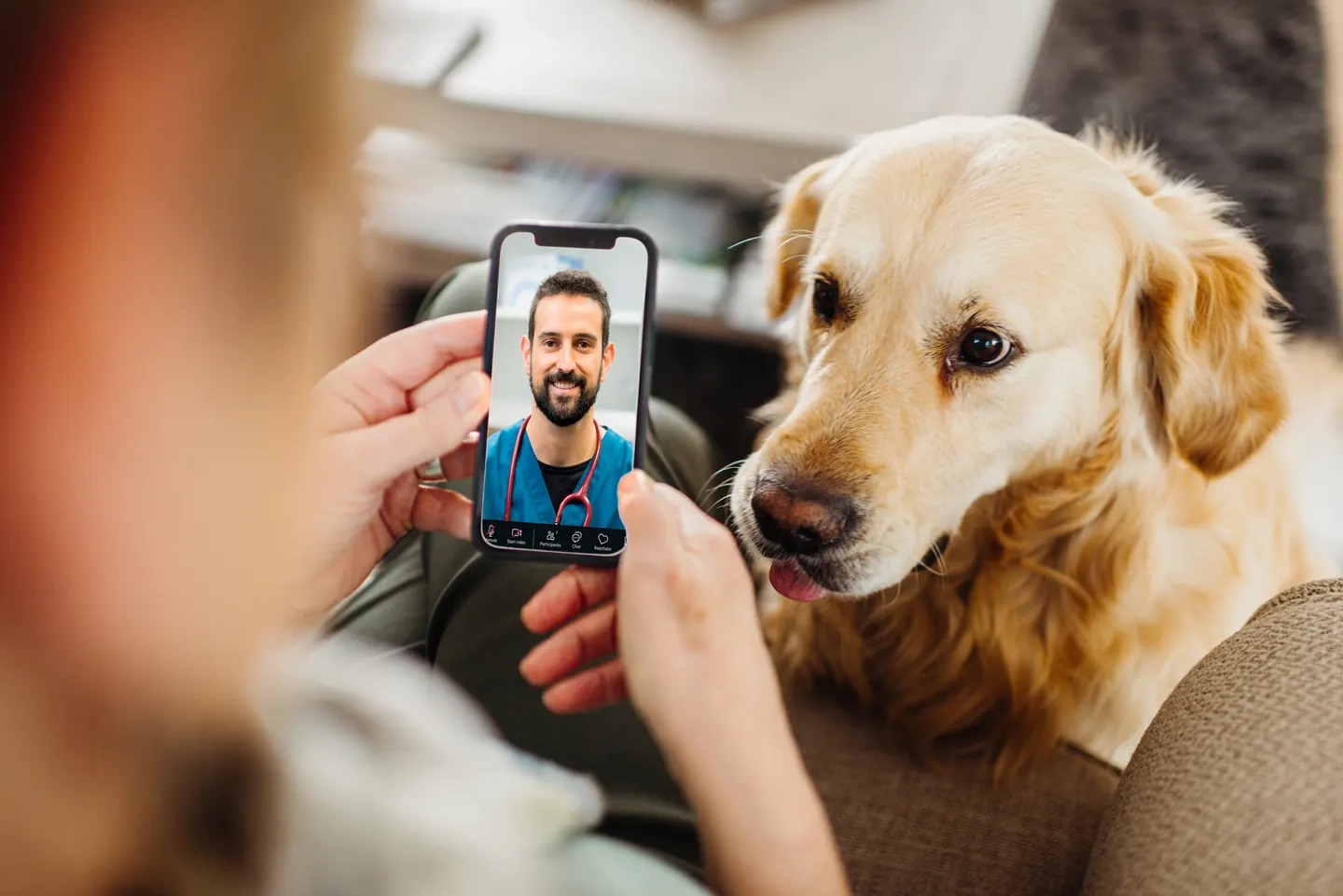
 Sponsored
Want a vet's take on your dog's skin or coat?
Talk to a licensed vet at Dutch over video, often the same day. They can recommend treatment and prescribe it when it's appropriate.
Use code Pets60
Plans start at $12/month · covers up to 5 pets
- Licensed vets in most states
- Rx for 150+ conditions
- 4.7 on Trustpilot
Our picks: the best dry shampoos for dogs
Pet stores sell these products under several names, but every one is rubbed into the coat and removed without a rinse.
Each pick is judged on its label and the maker's own description, not on hands-on reviews, testing, or how it felt on any particular dog.
Every pick is labeled for dogs and sold at Chewy. The differences that matter are scent, format, whether a cat in the house can share it, and which coat it suits. A good choice is one that leaves little for a dog to lick off and that you can fully brush or towel out.
TropiClean Dry No Rinse Waterless Hypo Allergenic Dog & Cat Shampoo: best overall for sensitive skin
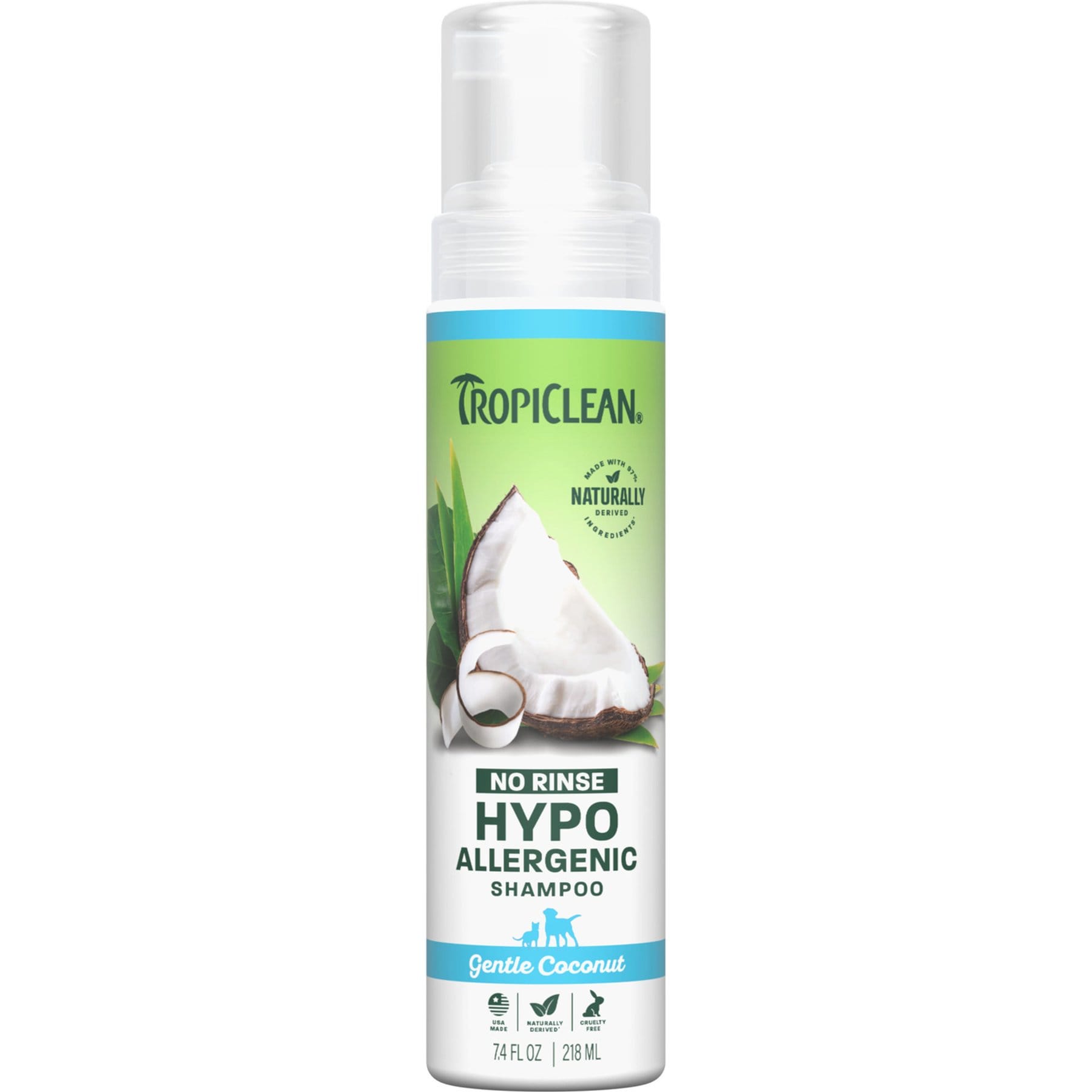
A hypoallergenic no-rinse shampoo you massage in by hand, for between-bath cleaning of dogs with sensitive skin.
Webvet may earn a commission when you click through to Chewy, at no extra cost to you.
TropiClean labels this no-rinse shampoo as hypoallergenic, and the listing describes a gentle formula that washes away dirt and odors while nourishing skin and coat. You massage it into the coat with no water. It is listed at $13.99 on Chewy when checked in November 2026, for a 7.4-fl oz bottle.
The same listing also mentions a light, fresh fragrance, so hypoallergenic here does not mean unscented. That is a fair trade for most sensitive-skinned dogs that do not lick much, and a reason to look at the fragrance-free PetSilver Waterless Hypoallergenic Fragrance-Free Dog Shampoo, 5-fl oz bottle instead for a dog that grooms itself constantly.
- Suits: dogs with sensitive skin that need a gentle between-bath clean, and homes where the cat may need a wipe-down too, since the label covers dogs and cats.
- Skip if: your dog licks its coat heavily or reacts to scented products, or the skin is already itchy or inflamed.
- How it differs: it is the all-rounder, labeled hypoallergenic and for two species, where the PetSilver pick is narrower but fragrance-free.
PetSilver Waterless Hypoallergenic Fragrance-Free Dog Shampoo: best fragrance-free
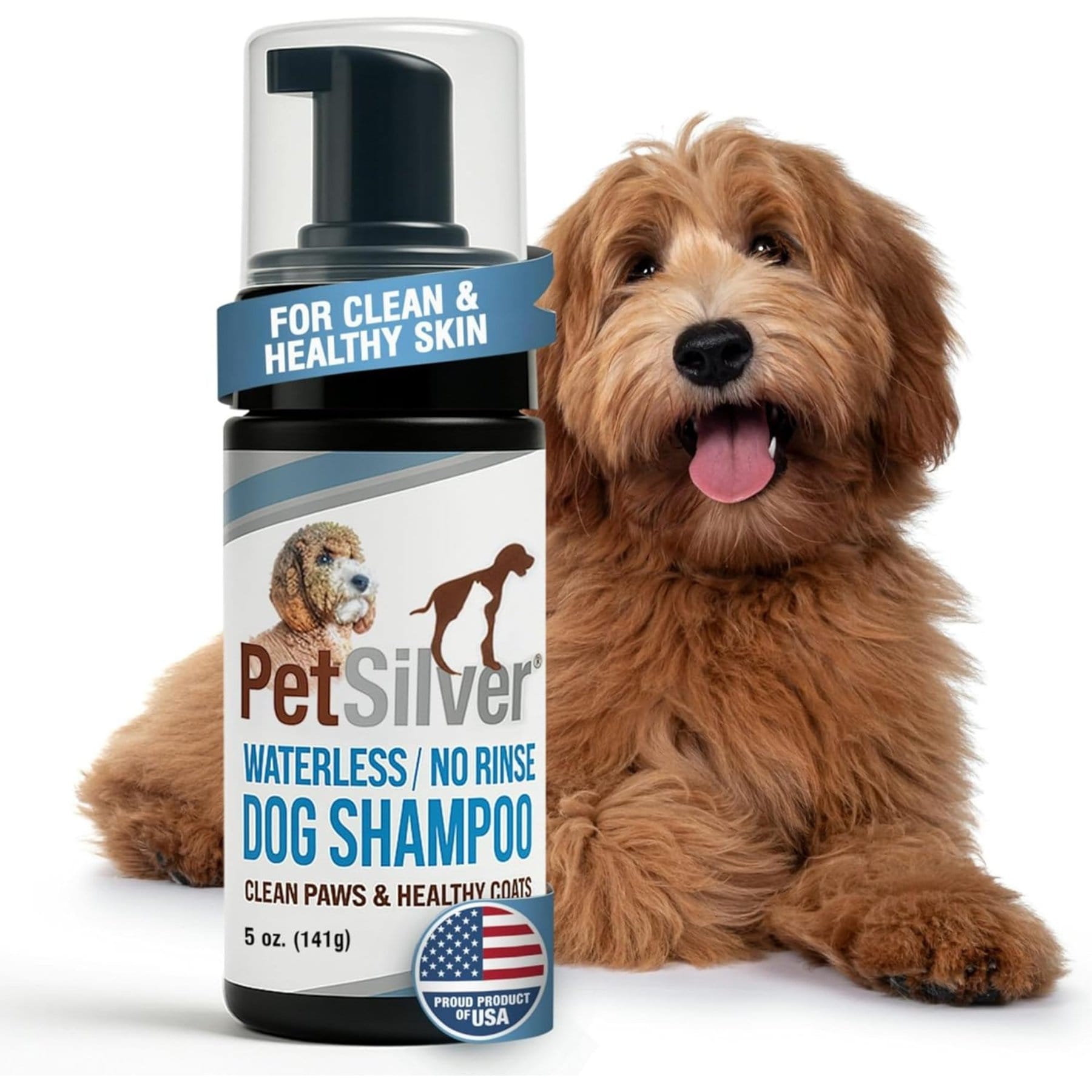
A fragrance-free no-rinse foam for dogs that lick their coat, so no added scent ends up on the tongue.
Webvet may earn a commission when you click through to Chewy, at no extra cost to you.
PetSilver describes this as a no-rinse foaming formula that cleanses, deodorizes, and conditions without water. The listing calls it hypoallergenic, fragrance-free, and pH balanced, and says its chelated silver helps control odor-causing bacteria. That last point is the maker's description, not a medical claim, and it is not a treatment for skin infection.
It is listed at $19.99 on Chewy when checked in November 2026 for a 5-fl oz bottle, which makes it the priciest per ounce here. What the extra cost buys is the absence of added scent, the one label feature that matters most for a dog that grooms off whatever you put on it.
- Suits: dogs that lick their coat, dogs with sensitive skin, and owners who want the dog to smell like nothing at all.
- Skip if: the dog has itching, sores, or a skin infection, which need a vet and often a prescribed medicated shampoo.
- How it differs: unlike the scented TropiClean and Wahl picks, there is no fragrance on the label.
Bio-Groom Waterless Bath Tearless Dog Shampoo: best for seniors and spot cleaning
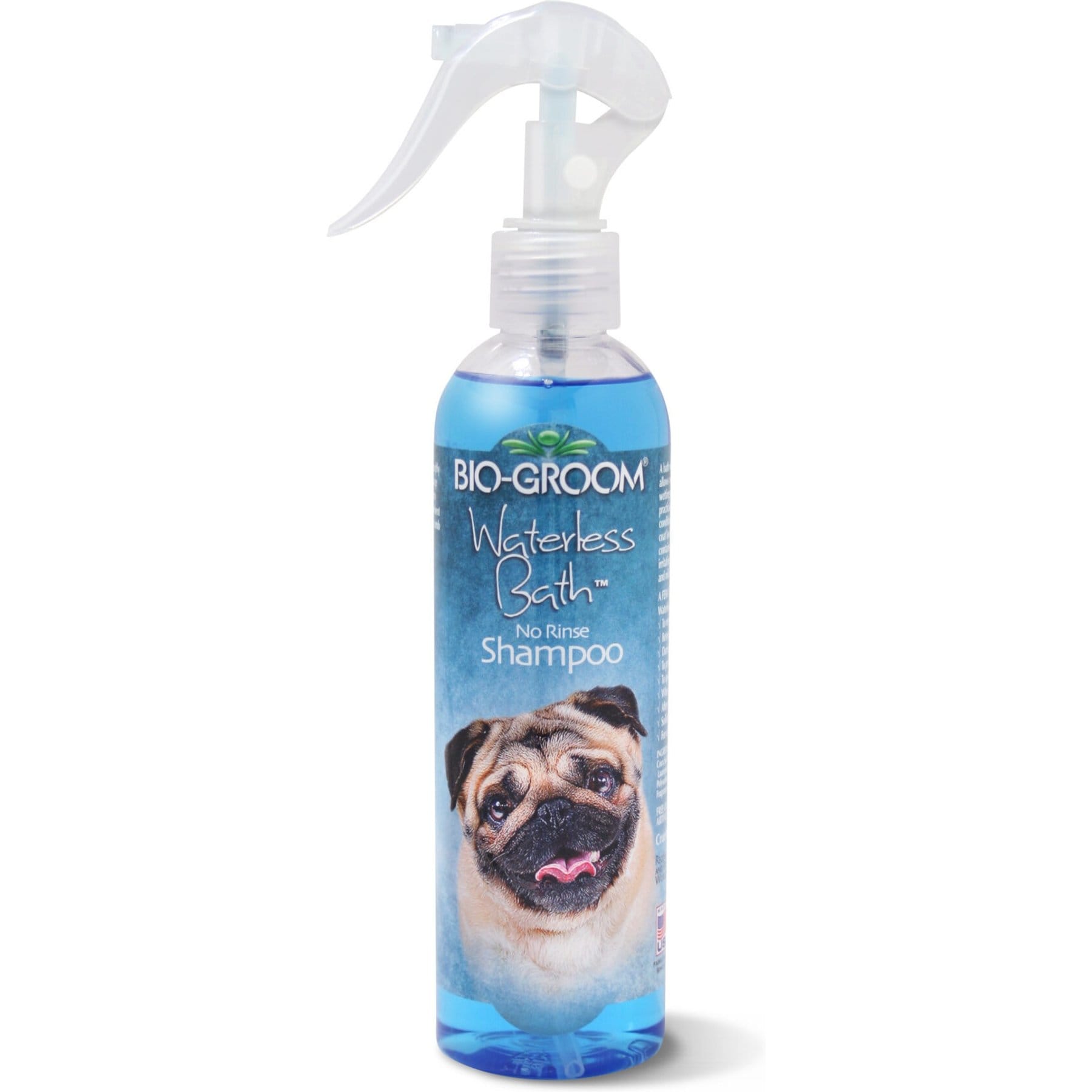
A tearless waterless bath for spot cleaning paws and the rear end of seniors and dogs that cannot be bathed.
Webvet may earn a commission when you click through to Chewy, at no extra cost to you.
Bio-Groom's waterless bath needs no wetting or rinsing. The listing pitches it for spot cleaning and for helping sick or old pets freshen up, and says the formula removes stains and coat odors, including after a potty accident. It is listed at $13.99 on Chewy when checked in November 2026 for an 8-fl oz bottle.
Tearless on the label does not mean you can work it into the eyes. Keep any shampoo away from the eyes, ears, and nose, as the Virginia Tech hospital advises, and use a damp cloth for the face itself.
- Suits: seniors and recovering dogs that cannot stand for a bath, and small spot cleanups.
- Skip if: you need a fragrance-free product, since the listing does not state the scent.
- How it differs: its listing is framed around sick or old pets and spot cleaning rather than routine freshening.
Wahl Waterless No-Rinse Oatmeal Dog Shampoo: best budget
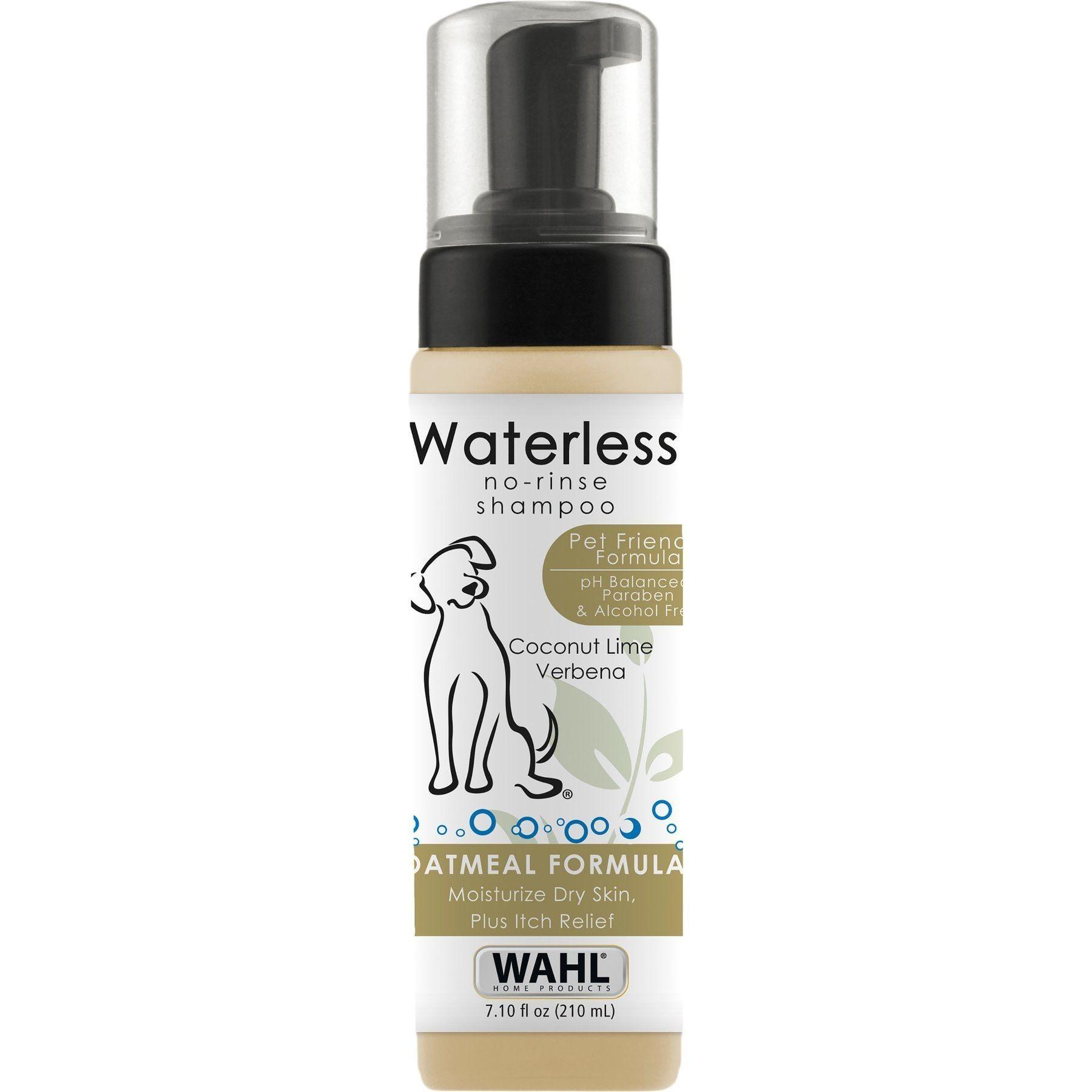
A low-cost no-rinse oatmeal shampoo for quick between-bath freshening of dogs with healthy skin.
Webvet may earn a commission when you click through to Chewy, at no extra cost to you.
This is the lowest-priced pick, listed at $7.99 on Chewy when checked in November 2026 for a 7.10-fl oz bottle. Wahl describes plant-based cleansers, an oatmeal formula designed to avoid harsh chemicals, and a coconut lime verbena scent meant to cover odor.
That scent is the catch. A dog that licks itself will taste whatever fragrance is in the coat, so this is a better fit for a dog that leaves its coat alone. Oatmeal on the label is about feel and conditioning, not a treatment for itch.
- Suits: healthy-skinned dogs that get a little smelly between baths, and owners who want a cheap bottle for the car or a trip.
- Skip if: your dog licks constantly, has sensitive skin, or dislikes strong smells.
- How it differs: lowest price of the six, but scented, where the PetSilver and We Love Doodles picks are not.
Davis Dry Dog & Cat Shampoo: best for dog and cat homes
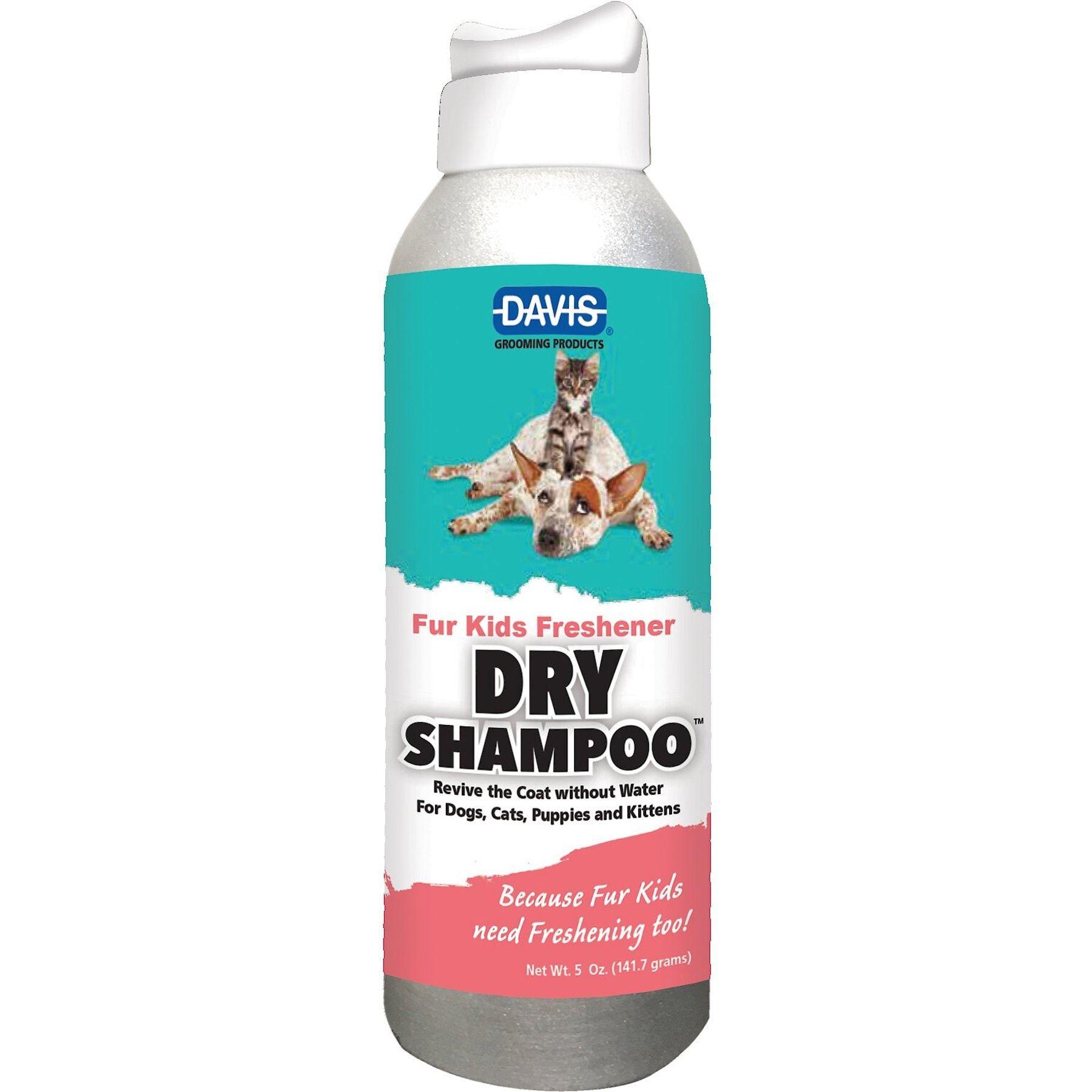
A true dry shampoo that soaks up excess coat oil, labeled for both dogs and cats in multi-pet homes.
Webvet may earn a commission when you click through to Chewy, at no extra cost to you.
This is the closest thing on the list to a classic dry shampoo. Davis says it soaks up excess oils, volumizes coats, and adds texture, with no water needed. The listing calls it sulfate-free, paraben-free, suited to all fur types, and infused with a fresh fruit fragrance.
It is listed at $18.52 on Chewy when checked in November 2026 for a 5-fl oz bottle.
Because it works by absorbing oil rather than by lathering, it has to be brushed out well. Read the full label for the format and the alcohol content before using it on a cat, since cats groom far more than most dogs do.
- Suits: dogs with oily coats that look greasy between baths, and homes with a dog and a cat that both get a between-bath clean.
- Skip if: the dog licks heavily or has a sensitive nose, given the added fragrance, or has a flat face where product near the nose is hard to avoid.
- How it differs: it is the pick described as absorbing excess oil, where the others are described as no-rinse cleansers.
We Love Doodles Waterless Unscented Dog Shampoo: best for curly and doodle coats
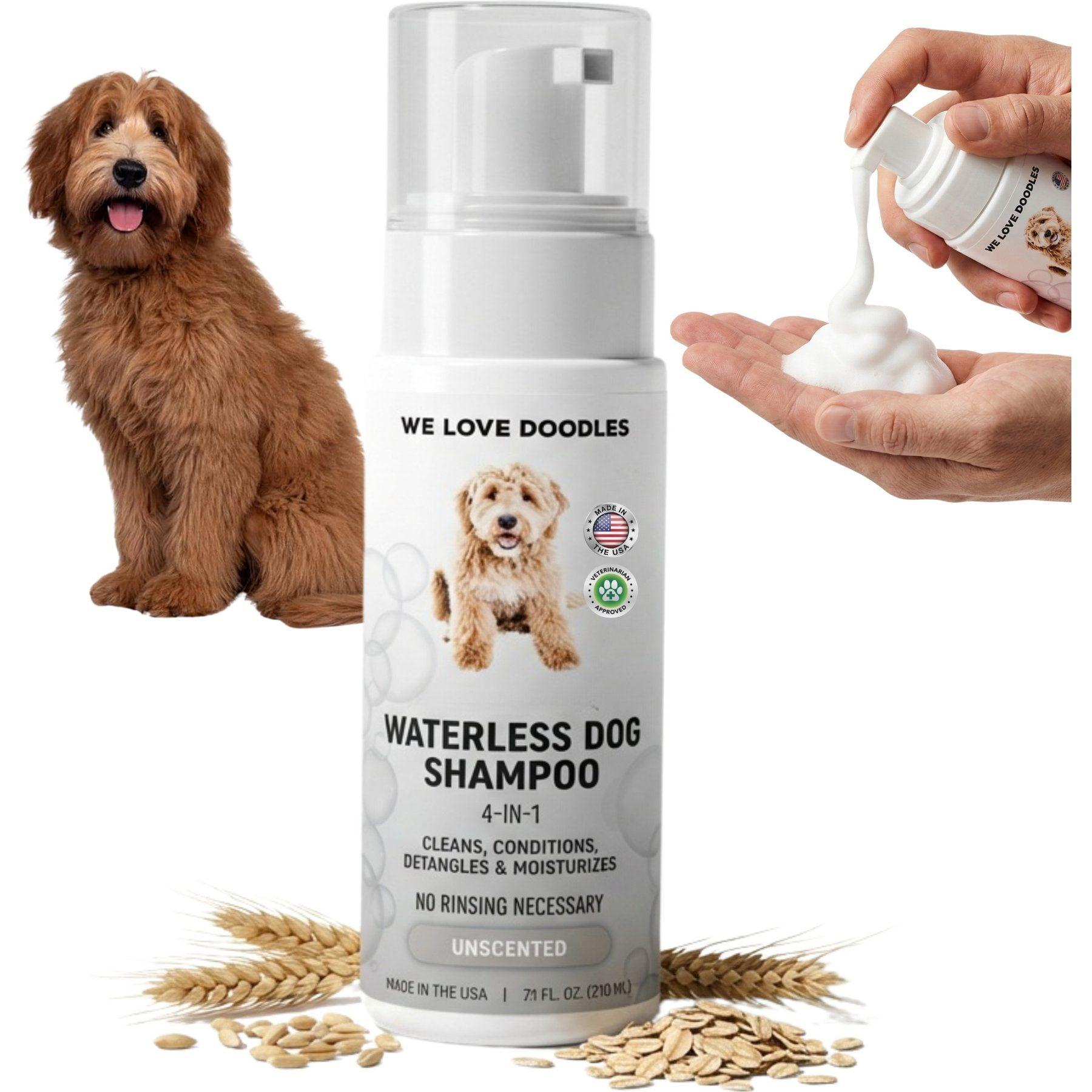
An unscented no-rinse shampoo for curly and doodle coats, used with a good brush-out after.
Webvet may earn a commission when you click through to Chewy, at no extra cost to you.
We Love Doodles markets this as a three-in-one formula that cleans, deodorizes, and conditions without a rinse, and the maker calls it professional grade and made in the USA. The unscented version is listed at $10.39 on Chewy when checked in November 2026 for a 7.1-fl oz bottle. The listing copy also mentions coats smelling great, so confirm the unscented version on the listing before ordering.
Curly coats trap product, so the brush-out step matters more here than for any other pick. VCA Animal Hospitals notes that long, silky, or curly coats need daily brushing to stay free of tangles.
- Suits: doodles, poodle mixes, and other curly coats that get freshened often between grooms, and dogs that lick.
- Skip if: the coat is already matted, which needs a groomer before any product goes on.
- How it differs: unscented like PetSilver, but costs less and is sold by a doodle-focused brand rather than labeled for sensitive skin.
Foam, spray, or powder: how to choose a dry shampoo by coat and skin
Choose by coat type: a foam for long, curly, or double coats, a spray for short coats, and a powder only for oily coats you can brush out completely. Whatever the format, check the label for ingredients to avoid on a dog that licks.
| Dog or coat | Format that fits | How to apply and remove | Label flags |
|---|---|---|---|
| Short coat | Spray or light foam | Mist or rub in, wipe with a towel along the coat | Alcohol, strong fragrance |
| Long or silky coat | Foam | Brush first, work foam in by section, towel and brush out | Heavy oils that weigh hair down |
| Curly or doodle coat | Foam, unscented | Brush first, massage foam to the skin, towel, then a full slicker brush-out | Fragrance, any product left in mats |
| Double coat | Foam | Part the outer coat so foam reaches the undercoat, towel, then brush through both layers | Powder that clumps in the undercoat |
| Oily coat | Powder or dry formula | Work in, wait as the label directs, brush out completely | Loose powder near the face |
| Sensitive or allergic skin | Fragrance-free foam | Small amount, towel off well, stop if redness appears | Essential oils, fragrance, alcohol |
| Puppy | Dog-labeled, puppy-safe foam | Spot clean only, towel dry fully | Label age limit, fragrance |
| Senior that cannot stand for a bath | Foam or tearless no-rinse | Spot clean lying down, towel off, dry skin folds | Slippery residue on paws |
| Dog living with cats | Product labeled for dogs and cats | Keep the cat away until the dog is dry and brushed | Essential oils, sodium lauryl sulfate |
The three formats do different jobs. A no-rinse foam is a waterless shampoo you can massage down to the skin and then towel off, which suits thick coats.
A spray is a mist that sits on the surface of the coat, which suits short hair. A powder absorbs oil and must be brushed out.
No veterinary study compares foam, spray, and powder head to head, so the choice comes down to coat, skin, and how well you can remove what you put on. The Virginia Tech hospital warns that shampoo left on skin causes irritation that makes it easier for bacteria to take hold, which is why removal decides the format.

Matching the format to the coat
Coat structure decides how far a product travels. A double coat, as Purdue University's Center for Animal Welfare Science describes it, is a short undercoat under a longer top coat. Powder tends to collect in that undercoat, while foam can be worked down and lifted out with a towel.
- Short coats: a spray or a little foam, wiped along the coat with a towel, is usually all it needs.
- Long or silky coats: foam worked in section by section, after the tangles are out.
- Curly and doodle coats: an unscented no-rinse formula such as We Love Doodles Waterless Unscented Dog Shampoo, 7.1-fl oz bottle, followed by a slicker brush. VCA notes slicker brushes work well for curly, non-shedding coats like poodles.
- Double coats: foam, with the outer coat parted so it reaches the undercoat, then a brush through both layers.
- Oily coats: a dry, oil-absorbing formula such as Davis Dry Dog & Cat Shampoo, 5-fl oz bottle, brushed out completely.
Sensitive skin, puppies, seniors, and smelly dogs
For sensitive skin, choose a fragrance-free, dog-labeled foam and use it sparingly, such as PetSilver Waterless Hypoallergenic Fragrance-Free Dog Shampoo. A product labeled hypoallergenic still deserves a read of the ingredient list, since the word is the maker's description.
How the other common needs break down:
- Oatmeal: oatmeal formulas can feel pleasant on a dry-feeling coat, but they do not treat itchy skin.
- Puppies: use a dog-labeled product whose label covers the puppy's age, for spot cleaning only.
- Seniors: a no-rinse clean is often the kindest option for a stiff or frail dog, and a tearless formula lets you clean the body and rear without a tub.
- Smelly dogs: what helps depends on why the dog smells. Mud and a walk can be freshened; an odor that returns within days, or smells musty or yeasty, may be a skin problem that any scented product will only mask.
- White dogs: a dry formula can lift surface grime between baths, but stains around the eyes or mouth that keep returning are worth mentioning to your vet.
Coconut and other scented formulas carry the same fragrance trade-off as the Wahl Waterless No-Rinse Oatmeal Dog Shampoo, so pick unscented for heavy lickers.
 Sponsored
Vet care that's always there
Unlimited video calls and messaging with licensed vets for less than a typical vet visit. One membership covers up to five pets.
Use code Pets60
Plans start at $12/month · covers up to 5 pets
- Licensed vets in most states
- Rx for 150+ conditions
- 4.7 on Trustpilot
How to use dry shampoo on a dog safely
Dry shampoo does a limited job well. The Merck Veterinary Manual explains that cleansing shampoos remove dirt and excess oils and must be rinsed from the coat. A no-rinse product skips that rinse, so how effective it is depends on how thoroughly you brush and towel it out.
The benefits are real for the right job: less stress than a bath, faster cleanup, and a way to keep a senior or recovering dog fresh. The mechanism is simple: the product loosens or absorbs surface dirt and oil, and the towel and brush take it away.

Step by step:
- Brush first. The Virginia Tech hospital says to brush thoroughly to remove loose hair and mats that trap shampoo against the skin. A Frisco Slicker Dog Brush, Large works through most coats, used with gentle strokes, since rough brushing creates tiny scrapes that sting when shampoo goes on.
- Read the label directions and use the amount it gives. More product means more to remove.
- Apply away from the face. Keep shampoo away from the eyes, ears, and nose, and clean the face with a damp cloth instead.
- Work it in. Massage a no-rinse liquid or foam such as TropiClean Dry No Rinse Waterless Hypo Allergenic Dog & Cat Shampoo down toward the skin. Mist a spray over the coat. Sprinkle a powder into your hand first, then into the coat.
- Remove it. Press a towel into the coat rather than rubbing, as the Virginia Tech hospital advises. An absorbent Frisco Embroidered Bones Microfiber Dog Bath Towel, Teal, Large lifts foam and spray residue.
- Brush out again until the coat feels clean, not sticky, slick, or dusty.
- Let the coat dry completely, especially in skin folds and between the toes.
Foam needs one extra step: it has to reach the skin and then come back out on the towel. With a powder, the brush-out matters most, because any powder left in the coat sits on the skin.
Why residue matters
Leftover product is the main thing that goes wrong. VCA Animal Hospitals stresses that it is important not to leave residual shampoo on the skin. The Merck Veterinary Manual adds that animals tend to groom off topical products and might vomit after swallowing them.
That gives residue two ways to cause trouble: on the skin, where it can irritate, and in the stomach, after the dog licks it off. Towel and brush until the coat feels like coat again.
Can you use it every day?
Daily use is not something veterinary guidance supports, and the more often product goes on, the more there is to remove. Use it as a between-bath tool and follow the label's frequency.
If a dog seems to need daily cleaning to stay fresh, that pattern is worth raising with your vet. Mats are a separate problem: VCA Animal Hospitals says to use only clippers on mats, never scissors, and Purdue warns that cutting mats out yourself can lead to accidental cuts. Severe mats go to a groomer.
Ingredients to avoid in dog dry shampoo: fragrance, essential oils, alcohol, and human products
A dog-labeled dry shampoo, used as directed and removed well, is a reasonable between-bath tool for a dog with healthy skin. It turns bad when the formula contains ingredients a licking dog swallows, or when the product was never meant for dogs.
Whatever you put on the coat ends up partly on the tongue, as the Merck Veterinary Manual notes about grooming off topical products. Merck also lists nausea, vomiting, and diarrhea as the most common signs after a dog swallows soaps or shampoos.
Essential oils, including tea tree and lavender
Natural is not the same as safe, and essential oils are the clearest example. The ASPCA Animal Poison Control Center says essential oils in concentrated (100%) form can be a danger for pets, and that it is best to completely avoid applying them directly to your pet.
VCA Animal Hospitals lists oils poisonous to dogs and states that both ingestion and skin exposure can be toxic. The list includes:
- Cinnamon, citrus, and pennyroyal oil
- Peppermint, pine, and sweet birch oil
- Tea tree (melaleuca) oil
- Wintergreen and ylang ylang oil
Lavender is not on that list, and a lightly scented product made for dogs is not the same as a bottle of concentrated oil.
Veterinary guidance does not establish how much risk a dilute scent in a finished pet product carries. For a dog that licks, unscented is the cautious choice.
Organic describes how ingredients were grown, not whether a licking dog should swallow them.
Alcohol and fragrance
Alcohol is a reason to read the label twice. VCA Animal Hospitals says ethanol exposure by ingestion, inhalation, or skin absorption can cause alcohol poisoning, and lists perfumes and some pet flea sprays among products containing alcohols.
The Merck Veterinary Manual states that alcohols are readily absorbed across the GI tract and skin, and that toxicosis from overspraying pets with alcohol-based flea sprays is not uncommon. An alcohol-based spray used heavily on a small dog is the scenario to avoid.
Human dry shampoo on a dog
Human dry shampoos such as Batiste or Dove are not labeled for dogs, and veterinary guidance on human products is consistent. The Merck Veterinary Manual says never use a shampoo formulated for people without the consent of your veterinarian.
The Virginia Tech hospital says human products disrupt a pet's natural balance, creating conditions where harmful bacteria thrive. A salon dry shampoo falls in the same category unless the product itself is labeled for dogs.
The safest choice is a product that is:
- Labeled for dogs, and for cats too if a cat shares the house
- Free of essential oils, or at least of the oils VCA lists as poisonous
- Free of alcohol high on the ingredient list
- Unscented or lightly scented for dogs that lick
- Used at the label's age limit and frequency
If your dog swallows or reacts to a product
Wash a product off skin or fur with liquid dishwashing detergent, as VCA advises for essential oil exposure, and do not induce vomiting. Call your vet, the ASPCA Animal Poison Control Center at (888) 426-4435, or the Pet Poison Helpline, a 24/7 animal poison center, at 1-800-213-6680. Unsteadiness, trouble walking, tremors, or vomiting after grooming need a vet urgently.
When skin or coat problems need a vet instead of a dry shampoo
Itchy dogs are the group most often sold a dry shampoo that will not help. The Merck Veterinary Manual says the most common causes of itching are parasites, infections, and allergies, and that successful treatment depends on identifying the underlying cause.
A dry shampoo marketed for itchy skin can at best leave the coat feeling clean. It does nothing about fleas, mites, infection, or an allergy, and leftover product can add irritation to skin that is already inflamed.

Signs that need a vet instead of a grooming product:
- Scratching, biting, or licking the skin more than usual
- Red skin, bumps, pimple-like spots, or circular crusts
- Dry or flaky patches, dandruff with redness, or greasy scale
- Patches of hair loss
- A musty, yeasty, or sour odor, especially between toes or in skin folds
- Licking and chewing the feet, rubbing the face, or scooting
- Fleas or flea dirt in the coat
Those signs map onto conditions vets see often. VCA Animal Hospitals describes pyoderma, a bacterial skin infection, with crusts, flaky patches, hair loss, itching, and sometimes a musty odor, and notes it is often secondary to allergic dermatitis.
VCA's yeast dermatitis page names the fungus Malassezia pachydermatis, with itching, redness, musty odor, and crusty, flaky skin, and says medicated shampoos are a vital part of treatment. To see what fungal and yeast dermatitis can look like, the yeast infection skin pictures guide shows examples, and the yeast infection in dogs guide covers what clears skin fungus.
For what triggers dermatitis and how fungal dermatitis presents, the dermatitis in dogs overview walks through the signs and the common triggers your vet will check.
Which shampoo is best for dog itching?
The best shampoo for an itchy dog is the one your vet chooses for the cause, not a dry shampoo. VCA Animal Hospitals says the veterinarian will select the most appropriate medicated shampoo for the skin condition, and those products usually need a set contact time and a full rinse.
That is where a dry shampoo sold as antifungal, antibacterial, or medicated falls short: medicated care is a vet-directed treatment with instructions to match. For the options, see medicated dog shampoo and dog shampoo for itchy skin.
Allergies and atopic skin
A dry shampoo is not, on its own, part of a vet-recommended plan for a dog with skin allergies. Cornell's Riney Canine Health Center says atopic dogs typically start to show signs between 6 months and 3 years old.
Cornell lists shampoos, rinses, mousses, and medicated wipes as topical tools that can help remove allergens, moisturize, and treat secondary infections. VCA Animal Hospitals says many allergic dogs benefit from frequent bathing with special shampoos, sprays, or mousses, because allergens are absorbed through the skin.
The word that matters is special: these are products your vet picks for allergic skin, not a general dry shampoo. Two useful next reads before the appointment:
- Dog skin allergies, for the common allergy types and the questions to take to your vet.
- Flea shampoo for dogs, since Merck notes parasites are the first cause a vet rules out, and a flea shampoo works alongside a vet-recommended preventive.
For an itchy dog, a homemade powder or spray is the riskiest choice of all, since many online recipes add essential oils that VCA lists as poisonous to dogs.
What to do if your dog has dry, flaky skin and is losing hair?
See your vet, because flaking plus hair loss points to a skin condition rather than a dirty coat. The Merck Veterinary Manual says hair loss is a sign whose underlying cause must be found for treatment to work, and lists infections, parasites, and allergies among common causes.
Flaky, greasy, or scaly skin can be seborrhea. Merck describes increased scale and sometimes greasiness, and notes secondary seborrhea most often stems from hormonal disorders and allergies. A dry shampoo will not correct either.
Treating dry, flaky, itchy skin starts with the cause, then vet-directed bathing, and often parasite control or allergy management. The dry skin on dogs guide covers that plan in more depth.
Dry shampoo versus a bath, wipes, and homemade recipes
A dry shampoo is one of several between-bath tools, and each one fits a different job:
- Full bath: the real clean for a dirty, smelly, or skunked dog, and the only way to rinse out a cleansing shampoo the way Merck describes.
- Dry or waterless shampoo: a whole-coat refresh between baths on healthy skin.
- Grooming wipes: quick spot cleaning of paws, face, and rear. See dog wipes for options.
- Dry shampoo mitts: a pre-moistened mitt you rub over the coat, useful for small dogs and seniors.
For a senior or a dog that cannot stand, a tearless spot cleaner such as Bio-Groom Waterless Bath Tearless Dog Shampoo, 8-fl oz bottle can cover the gap until a full bath is practical.

Skunk smell needs a wet wash
A dry shampoo is the wrong tool for skunk smell. Skunk spray needs a wash that neutralizes it. Penn State Extension gives this mixture:
- 1 quart (.95 L) fresh 3% hydrogen peroxide
- 1/4 cup (70 g) baking soda
- 1 to 2 teaspoons (5 to 10 ml) liquid dish soap
Penn State says to mix it in an open container and use it immediately, wash the dog, leave it on for 5 minutes, then rinse, and repeat if needed. Keep it well away from the eyes, as with any shampoo.
Homemade dry shampoo: cornstarch, baking soda, and DIY sprays
Homemade dry shampoo recipes usually rely on the same handful of ingredients: cornstarch, baking soda, oatmeal powder, and essential oils.
There is no veterinary evidence on how well homemade recipes clean or how they affect the skin.
The risks are better documented:
- Baking soda: a dog that licks its coat will swallow some of it. The American College of Veterinary Pharmacists says baking soda can be harmful to pets if ingested in large quantities, and that vomiting is most often the first sign.
- Cornstarch and other starches: any powder has to be brushed completely out, or it becomes the residue the Virginia Tech hospital warns about.
- Homemade sprays: a spray that adds tea tree, peppermint, or citrus oil adds oils VCA lists as poisonous to dogs.
If you still make your own, these limits apply:
- Leave out essential oils entirely.
- Use only a small amount, away from the face, and brush it all out.
- Do not use homemade mixes on puppies, cats, or dogs with any skin problem.
- Stop if the skin reddens or the dog starts scratching.
A dog-labeled product with a stated ingredient list is the more predictable choice.
What can I wash my puppy with if I don't have puppy shampoo?
Use a dog-labeled shampoo whose label covers your puppy's age, not a human or baby shampoo. VCA Animal Hospitals says human shampoo, including baby shampoo, is far too harsh for a dog's skin. Until you can buy one, clean only the soiled spot with plain lukewarm water and dry the puppy fully.
VCA's puppy shampoo guidance recommends a dermatologist-formulated, soap-free shampoo made for pets, since soapy shampoos may affect a puppy's natural skin barrier. VCA also notes young puppies being house-trained will soil themselves and should be cleaned right away. For picks, see puppy shampoo.
Dry shampoo for dogs questions
Frequently Asked Questions
Is dry shampoo safe for dogs?
A dry shampoo made for dogs is generally a reasonable between-bath option on healthy skin when you follow the label. The risk comes from what a dog may lick off the coat: fragrance, essential oils, and alcohol. Choose an unscented, dog-labeled formula for any dog that grooms itself, and remove it well.
Can I use human dry shampoo on my dog?
No. Human dry shampoos are made for human hair and skin, which is more acidic than a dog's. Veterinary sources say not to use human shampoo products on dogs without your vet's agreement. Buy a dog-labeled formula instead, and keep any aerosol can of human dry shampoo out of reach.
How do you use dry shampoo on a dog?
Brush out tangles first, apply the amount on the label away from the eyes, ears, and nose, and work it into the coat. Then press a towel into the coat to lift product and dirt, brush again until no residue remains, and let skin folds and paws dry fully.
Can you use dry shampoo on puppies?
Only a dog-labeled product whose label age includes your puppy, and only for spot cleaning. Check the label age before the first use, skip scented formulas, and clean the face with a damp cloth. If the puppy has itchy, flaky, or patchy skin, ask your vet before using any product.
Is baking soda safe as a dry shampoo for dogs?
Baking soda is not a good choice. A dog that grooms itself will lick it off the coat, and veterinary pharmacists warn that baking soda can harm pets when swallowed in large amounts. Keep any powder away from the face so the dog does not inhale it. A dog-labeled dry shampoo with a clear ingredient list is the safer option.
Veterinarian · BVMS MRCVS
Dr. Pippa Elliott, BVMS, MRCVS, is a veterinarian with nearly 30 years of experience in companion animal practice. Dr. Elliott earned her Bachelor of Veterinary Medicine and Surgery from the University of Glasgow. She was also designated a Member of the Royal College of Veterinary Surgeons. Married with 2 grown-up kids, Dr. Elliott has a naughty Puggle named Poggle, 3 cats and a bearded dragon.
Related reading

Pemphigus in Dogs: Pemphigus Foliaceus Signs, Treatment, and Outlook

Lupus in Dogs: DLE vs SLE, Symptoms, Treatment, and Life Expectancy

Stud Tail in Cats: Causes, Treatment, and Grooming That Helps
