Why Is My Cat Peeing Outside the Litter Box? A Vet's Guide
A cat peeing outside the litter box is almost always a sign that something is wrong, from a painful urinary problem to stress at home. A vet explains every cause, the emergency red flags, and how to fix it.

BVMS MRCVS
Medically reviewed by Dr. Pippa Elliott, BVMS MRCVS · Last reviewed

This article contains affiliate links. Webvet may earn a commission when you buy through them, at no extra cost to you.
A cat peeing outside the litter box is almost always telling you something is wrong. The cause is either medical, behavioral, or environmental.
Medical triggers include a painful urinary problem like infection, crystals, or bladder inflammation. Behavioral triggers include litter box aversion or stress. The single most important first step is a vet visit and urinalysis to rule out disease before assuming it is just behavior.
- 1See your vet for a urinalysis first. Medical causes (urinary infection, crystals, bladder inflammation, kidney disease) are ruled out by a vet, never by guessing at home.
- 2Any cat straining with little or no urine is a true emergency (possible urethral blockage), and the risk is highest in male cats. Go to an ER vet immediately.
- 3Once disease is ruled out, follow the litter box rules: one box per cat plus one extra, large and uncovered, unscented clumping litter, scooped daily, in quiet low-traffic spots.
- 4Clean accidents with an enzymatic cleaner only. Never use ammonia-based products, and never punish your cat.
- 5Stress and changes at home are major behavioral triggers. Spite and revenge peeing are myths.
Emergency First: When Peeing Outside the Box Is a Life-Threatening Sign

Before we talk about litter and behavior, we have to cover the one scenario where minutes matter. A cat that is straining to urinate but producing little or nothing may be physically unable to pass urine.
This is most often caused by a urethral blockage, where crystals, mucus, inflammation, or a small stone plug the narrow tube that carries urine out of the body.
When urine cannot leave, it backs up into the bladder and kidneys. Toxins that the body normally pees out climb in the bloodstream, the bladder can rupture, and potassium rises to levels that disturb the heart.
Collapse can come on within hours once the bladder is full, and an untreated blockage is commonly fatal within a day or two. This is one of the most time-critical emergencies in feline medicine, so the right response is to go now rather than wait and watch.
Why male cats block far more often than females
Male and neutered male cats have a longer, narrower urethra that tapers at the tip. That narrow channel clogs much more easily than the shorter, wider female urethra, so a complete, life-threatening obstruction is far more common in males.
Do not assume a female is safe, though: females can block too, from mucus plugs, stones, urethral plugs, or a mass. A straining female with little or no output is still an emergency.
If you have any cat straining outside the box, and especially an adult male, treat it as an emergency until a vet says otherwise.
Other red flags that cannot wait
- Repeated trips to the box with crying, meowing, or vocalizing in pain
- Blood in the urine or pink, red, or brown puddles
- Vomiting, hiding, or refusing to eat
- Crying or flinching when you touch the belly, or a hard, painful lower abdomen
- Lethargy, weakness, hiding in unusual places, or collapse
Here is the part owners often get wrong: even if your cat seems otherwise normal between trips to the box, any straining with no output still warrants a same-day call. Cats are masters at masking pain, and a partial blockage can become complete within hours.

Crystal litter that changes color alongside some urinary changes, as a prompt to call your vet.
Webvet may earn a commission when you click through to Chewy, at no extra cost to you.
Is It a Medical Problem or a Behavior Problem? Start Here

The most common mistake is assuming a cat peeing outside the litter box is being naughty, then trying to fix the behavior while a real illness goes untreated. So the first step is not a new litter box. It is a vet visit with a urinalysis, and often bloodwork.
A simple urine test tells your vet whether there is blood, crystals, infection, dilute urine, or signs of kidney trouble. You can read more about how veterinarians diagnose urinary problems in cats before your appointment so you know what to expect.
While you wait for that visit, this quick triage can help you read the situation. It does not replace a diagnosis, but it tells you how urgent things are.
| Signs that point toward MEDICAL | Signs that point toward BEHAVIORAL or ENVIRONMENTAL |
|---|---|
| Small, frequent puddles or only a few drops | Normal-volume puddles of urine |
| Straining, crying, or visible discomfort | Calm posture, no straining or vocalizing |
| Blood or unusual color in the urine | Clear, normal-looking urine |
| Drinking and urinating noticeably more | Drinking and output unchanged |
| Excessive licking of the genitals | Goes on soft surfaces like beds, rugs, or laundry |
| Any age, often comes on suddenly | Started right after a change (move, new pet, new baby) |
| May avoid the box for both pee and poop | Often still uses the box for poop but not pee |
You may be thinking, but my cat is acting completely normal otherwise. That is reassuring, and most cats who are bright, eating, and not straining are not in immediate danger. But acting normal does not rule out disease.
Cats instinctively hide illness, and early feline idiopathic cystitis or early kidney disease can be subtle. A normal-seeming cat with new accidents still deserves a vet check, just not necessarily an emergency dash.
Inappropriate urination versus spraying
It also helps to know whether you are seeing inappropriate urination or spraying, because they look different and often mean different things.
- Emptying the bladder: the cat squats low on a horizontal surface (the floor, a rug, a bed) and leaves a puddle.
- Spraying: the cat stands upright, backs up to a vertical surface like a wall or door frame, and quivers its tail while releasing a small jet of urine.
Spraying is usually territorial marking rather than a litter box failure, though both can be driven by stress. It is also fairly common: marking is seen in roughly one in ten neutered males and around one in twenty neutered females.
Medical Causes of a Cat Peeing Outside the Litter Box
Many of the medical reasons a cat stops using the box fall under one umbrella term: feline lower urinary tract disease, or FLUTD. This describes any condition affecting the bladder or urethra, and it is common: by some estimates around 60 percent of cats seen for peeing outside the box turn out to have FLUTD.
It produces a recognizable cluster of signs, including straining, frequent small urinations, blood, and going outside the box. FLUTD is a description, not a single diagnosis, so your vet works to find the specific cause underneath it.
Feline idiopathic cystitis (FIC)
In cats under about ten years old, the single most common cause of FLUTD is feline idiopathic cystitis: painful bladder inflammation with no infection and no stones. Idiopathic means there is no single identifiable cause, but it is strongly linked to stress.
The bladder lining becomes irritated, urinating hurts, and the cat starts to associate the box with pain. FIC often flares and settles, and managing stress is central to controlling it.
Bladder stones and crystals
Minerals in the urine can clump into crystals or solidify into bladder stones (commonly struvite or calcium oxalate). These scrape and inflame the bladder wall, cause bleeding and pain, and in male cats can lodge in the urethra to create the blockage described above.
Struvite stones can often be dissolved with a prescription diet, while calcium oxalate stones usually have to be removed surgically. This is one reason your vet may recommend an X-ray or ultrasound.
Urinary tract infections
True bacterial urinary tract infections are actually uncommon in young, otherwise healthy cats, which surprises many owners. They become more likely in older cats and in cats with other conditions such as kidney disease or diabetes.
Because the signs overlap with FIC and stones, a urine culture is the way to confirm whether antibiotics are truly needed rather than guessed at.
Kidney disease and diabetes
Conditions that make a cat produce more urine, such as chronic kidney disease and diabetes, can cause accidents simply because the bladder fills faster than the cat can reach the box. Watch for increased thirst, more frequent or larger urinations, and unexplained weight loss.
If you are unsure what is normal, here is what healthy cat urine should look like in terms of color and clarity, which can help you describe changes to your vet.
Arthritis, pain, and cognitive decline
In senior cats, the problem may be mechanical rather than urinary. Arthritis makes climbing into a high-sided box or walking down the hall to a far-off box genuinely painful, so the cat goes where it is easier. When a veterinarian confirms that temporary protection is appropriate, the cat diaper guide covers fit, stress, skin protection, and preserving litter-box choice.
A cat that squats inside the box but pees over the edge is a classic sign of this: the sides are too high or the cat cannot fully turn and crouch because of joint pain or weakness.
Very old cats can also develop cognitive decline (a feline form of dementia) and simply forget the box or get disoriented. These cats are not being difficult. They need the box brought to them and made easy to enter.
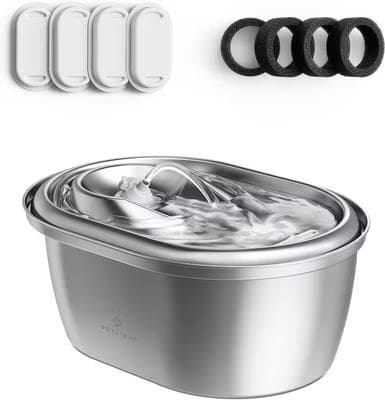
304 food-grade stainless steel pet water fountain, 101 oz. The circulating, filtered water encourages cats to drink more, which supports urinary tract and kidney health.
Webvet may earn a commission when you click through to Chewy, at no extra cost to you.
 $65 · no membership
Worried about your cat's urinary or kidney symptoms?
A licensed vet can examine your cat over video and prescribe treatment online when it's appropriate.
 Talk to a vet
- Licensed vets
- All 50 states
- same-day Rx
Webvet may earn a commission if you book.
Litter Box Aversion: Why Your Cat Is Avoiding the Box Itself
Once your vet has cleared your cat medically, the next suspect is the box itself. Cats are fastidious, and many will refuse a box that fails their standards.
If your cat is peeing right next to the box, that is a strong clue: the cat wants to go there, but something about the box is unacceptable. Here are the usual culprits.
- It is too dirty. Cats dislike a soiled box the way you would dislike an unflushed toilet. Scoop at least once a day, twice in multi-cat homes.
- The wrong litter. Scented, dusty, or coarse litter, or a sudden brand change, can put a cat off. Most cats prefer an unscented, fine-grained clumping clay. If odor is your concern, here is how to balance choosing the best cat litter for odor control without driving your cat away.
- The wrong box. Many boxes are simply too small. A box should be about one and a half times your cat's body length, measured from the nose to the base of the tail. Covered or hooded boxes trap odor and can feel like an ambush trap, especially in multi-cat homes.
- A bad location. A box next to a noisy washing machine, in heavy foot traffic, or right beside the food and water bowls will be avoided. Cats do not like to eliminate where they eat.
- A scary self-cleaning box. Automatic boxes that whir and rake can frighten sensitive cats into avoiding them entirely.
Litter preferences also change with life stage. Kittens are still learning and need a low, accessible box and a starter litter that is safe if a little is ingested, which is why many owners use the right non-clumping litter for kittens before transitioning to clumping clay as they grow.
Stress, Anxiety, and Territory: The Emotional Triggers
Cats are deeply routine-driven, and disruption is the number-one behavioral trigger for accidents. What feels minor to you can feel destabilizing to a cat, and the stress response can show up as both inappropriate urination and as flares of feline idiopathic cystitis. Common stressors include:
- A new pet, a new baby, or a new partner moving in
- Moving house, rearranging furniture, or even new carpet
- A change in your schedule, houseguests, or construction noise
- An outdoor or stray cat visible through a window, which can trigger marking indoors
In multi-cat homes, the most overlooked cause is conflict between the cats themselves. Tension does not always look like fighting. It can be a quiet standoff, one cat guarding the hallway to the boxes, or staring that keeps a more timid cat from feeling safe.
Our guide to maintaining harmony in a multi-cat household walks through spotting and easing that friction.
Marking and spraying are territorial and anxiety responses, not acts of revenge. A stressed cat deposits its scent to feel more secure in contested space.
Sometimes the trigger is indirect, as with stress and redirected aggression in cats, where a cat upset by something it cannot reach (like that window cat) takes its tension out on a housemate, which then spills into the litter box.
How to lower the emotional temperature
- Keep feeding and play on a predictable routine.
- Add vertical space (cat trees and shelves) and cozy hiding spots.
- Schedule daily interactive play to burn off tension.
- Try a synthetic feline pheromone diffuser, which mimics the calming facial scent cats leave on safe objects.
The Litter Box Rules Every Cat Owner Should Follow

Most litter box problems trace back to a setup that breaks one of a few simple rules. Get these right and you remove the most common environmental triggers in one pass.
- Go big and open. Use a large, uncovered box about one and a half times your cat's length. Most cats prefer no hood.
- Get the litter depth right. About two inches of unscented clumping litter is the sweet spot. Too shallow feels exposed; too deep feels unstable.
- Keep it clean. Scoop daily and do a full wash periodically with mild, unscented soap and water. Skip strong chemicals and citrus, which cats dislike.
- Place boxes thoughtfully. Choose quiet, low-traffic spots with a clear escape route, away from food, water, and loud appliances.
- Adapt for age. Kittens and arthritic seniors need low entry sides and boxes placed close by, ideally one on each level the cat uses.

Lickable cat treats with real chicken, made to support comfort and tranquility. 12 single-serve 0.5-oz tubes.
Webvet may earn a commission when you click through to Chewy, at no extra cost to you.
In a multi-cat home it can be hard to know who is having the accident. One vet trick is to ask your clinic about a harmless fluorescent dye (fluorescein) given to one cat at a time.
It makes that cat's urine glow under a UV blacklight for about a day, so you can match a fresh accident to the culprit. Some vets instead use a safe oral stain that tints the urine.
Our guide on how to monitor urinary health in multi-cat households covers more practical ways to track who-did-what so you can target the right cat and the right cause.
How to Clean Cat Urine So They Don't Re-Offend

Cleaning is not just cosmetic. If a soiled spot still smells like urine to your cat (even when it smells clean to you), the lingering scent acts as a signpost that says go here again. Breaking that cycle is essential, and the type of cleaner matters more than the effort.
Choosing a cleaner for cat urine
Pros
- Enzymatic cleaners (such as Nature's Miracle or Anti-Icky-Poo) break down the uric acid crystals that ordinary cleaners leave behind
- They remove the odor at its source, so the spot no longer invites a repeat
- A UV blacklight helps you find dried, invisible old spots to treat
Cons
- Ammonia-based cleaners are the worst choice: urine itself contains ammonia, so they smell like a marking spot and actually invite re-offending
- Ordinary soap or all-purpose sprays only mask the smell to human noses, not to your cat
- Steam cleaners and hot water can bake the proteins into the fibers and set the stain permanently
Use this step-by-step approach for each accident:
- Blot up as much urine as possible with paper towels. Do not scrub or rub it deeper.
- Saturate the area generously with an enzymatic cleaner, enough to reach as deep as the urine soaked.
- Let it dwell for the time on the label (often ten minutes or more) so the enzymes can work.
- Let it air dry fully. Do not use heat, steam, or a hair dryer, which can set the stain.
- Re-treat stubborn spots, and use a blacklight to catch any you missed.
Change what the spot means to your cat
While a favorite spot heals, you can discourage repeats by changing what that spot means. Temporarily cover it with foil or double-sided tape (cats dislike both textures), place a food or water bowl there (cats avoid eliminating near food), or turn it into a play or scratching zone.
For a cat that has built a strong habit, a short reset helps: confine the cat to a small room with its box, fresh litter, food, and water, then gradually re-expand its access to the home as it reliably uses the box.
This relearning, paired with thorough enzymatic cleaning, is far more effective than cleaning alone.
Special Cases: Senior Cats, Male Cats, Kittens, and Peeing but Pooping in the Box

Senior and elderly cats
In older cats, new accidents often signal a medical change:
- Arthritis that makes the box hard to enter (watch for a cat that pees over the edge because climbing in or crouching hurts)
- Chronic kidney disease or hyperthyroidism that increases urine volume
- Cognitive decline
Make boxes easy to reach with low sides, add more of them closer to where your cat rests, and keep up regular wellness checks. Our vet's guide to preventative care for feline urinary health covers the screening that catches these issues early.
Male cats
Because of their narrow urethra, male cats carry the highest risk of a dangerous blockage, and overweight neutered males are especially prone. For any male cat straining with little output, return to the emergency section above and act immediately.
For males who are otherwise stable, the same medical workup and litter box rules apply, with extra attention to hydration and weight.
Kittens

Probiotic supplement formulated to help cats maintain calm behavior, with the BL999 strain. 30 daily sachets.
Webvet may earn a commission when you click through to Chewy, at no extra cost to you.
Kittens are still learning, so accidents are common and rarely a cause for alarm on their own. Give them a small box with very low sides they can climb into easily, keep it close, and use a safe starter litter. Praise and gentle consistency teach the habit far better than scolding ever could.
Peeing outside but pooping inside (or the reverse)
When a cat pees outside the box but still poops in it, the split is informative. It often points to urinary pain (peeing hurts, so the cat blames the box for that act specifically) or to a surface preference, where the cat seeks out soft footing to urinate.
If your cat has the opposite pattern, see why your cat is pooping outside the litter box.
And if your cat targets soft, absorbent surfaces, there is a reason for that specific choice, which we cover in if your cat is peeing specifically on your bed or laundry.
How Vets Diagnose and Treat the Problem
At your appointment, expect your vet to take a thorough history (when it started, what changed at home, what the urine looks like) and then run a urinalysis.
Depending on the findings, they may add a urine culture, bloodwork to check kidney values and blood sugar, and imaging such as X-rays or ultrasound to look for stones. The goal is to land on the specific cause rather than treat blindly.
Treatment follows the diagnosis
- Confirmed infection: a targeted course of antibiotics based on the culture.
- Crystals or stones: a prescription urinary diet to dissolve or prevent certain stones, with surgery for stones that will not dissolve or that are causing a blockage.
- Feline idiopathic cystitis: pain relief during flares, increased water intake, and (most importantly) stress reduction and environmental enrichment.
- Kidney disease or diabetes: management of the underlying disease, which usually reduces the accidents.
- Refractory behavioral cases: a vet-directed anti-anxiety medication alongside the behavior plan.
In nearly every case, the medical treatment works hand in hand with environmental change. Even a purely medical problem benefits from a clean, appealing, low-stress box setup, because that is what rebuilds the cat's positive association with the box.
- 1Keep your cat well hydrated. Wet food and water fountains help.
- 2Maintain multiple clean boxes following the N+1 rule.
- 3Manage stress proactively with routine, play, and enrichment.
- 4Keep up routine wellness visits so problems are caught early.
When to Call the Vet (and How Fast)
Use this as your quick reference for urgency.
| Urgency | What you are seeing | What to do |
|---|---|---|
| Emergency (go now) | Straining with little or no urine, crying, repeated trips, blood, vomiting, lethargy, especially in a male cat | Emergency vet immediately; do not wait or try home fixes |
| Same week | Sudden new accidents, increased thirst or urination, weight loss, or any change in a senior cat | Book a vet visit and bring a fresh urine sample if possible |
| Vet-checked, behavioral-first | Started after a clear change at home, normal urine volume, cat otherwise healthy and acting normal | Vet check to confirm, then work the litter box and stress plan |
The bottom line: medical causes are ruled out by a vet, never by guessing at home. Start with that visit, then move through the box, the location, and the stress factors in order. Most cats can get back to reliably using their box once the real reason is found and addressed.
Frequently Asked Questions
Why is my cat suddenly peeing outside the litter box?
A sudden change almost always has a trigger. The two big categories are a new medical problem (urinary infection, crystals, bladder inflammation, kidney disease) and a stressor at home (a new pet, move, schedule change, or conflict with another cat). Because a sudden onset often signals discomfort or illness, the first step is a vet visit with a urinalysis before you assume it is behavioral.
My cat is peeing outside the litter box but acting normal. Is it still serious?
Possibly. Cats instinctively hide illness, so a cat that is bright, eating, and playing can still have early urinary disease, kidney disease, or stress-driven cystitis. A cat that is acting normal and not straining is usually not an emergency, but new accidents still warrant a vet check with a urinalysis. The one exception is straining with little or no urine: that is an emergency even if the cat otherwise seems fine, so go to an ER right away.
My cat peed outside the litter box for the first time. What should I do?
A single, isolated accident is not always a crisis, but it is worth taking seriously. Clean the spot thoroughly with an enzymatic cleaner, check that the box is clean and accessible, and think about anything that recently changed at home. Then watch closely: if it happens again, if you see straining, blood, or frequent small amounts, or if your cat seems off, book a vet visit and bring a fresh urine sample. When in doubt, a quick urinalysis rules out a medical cause early.
What are the signs of a cat UTI or urinary problem?
Common signs include straining or visible effort in the box, passing only small amounts very frequently, blood or a pink or red tinge in the urine, crying or vocalizing while urinating, and excessive licking of the genitals. Peeing outside the box is itself a red flag. True bacterial UTIs are actually uncommon in young cats, so these signs more often mean cystitis or crystals; either way, a urinalysis and sometimes a culture are needed to find the real cause. Straining with little or no output is an emergency.
What smells deter cats from peeing in a spot?
Cats tend to dislike citrus and vinegar, so those scents can discourage repeat visits to a particular spot, as can textures like foil or double-sided tape. Important: these deterrents only mask or block a spot, they do not fix the underlying medical or stress cause, so they are not a substitute for a vet check and a proper box setup. Do not use essential oils as a deterrent: many, including citrus oils, tea tree, and others, are toxic to cats.
What deters cats from peeing outside the litter box?
After ruling out medical causes, the most effective deterrents are a clean, appealing box setup (one box per cat plus one, large and uncovered, unscented clumping litter, scooped daily, in quiet spots) plus thorough enzymatic cleaning of past accidents. On a re-offended spot, foil, double-sided tape, or a food bowl discourage repeats. Reducing stress with routine, play, and pheromone diffusers helps too. Never use punishment, which backfires.
Will Prozac stop my cat from peeing?
Fluoxetine (the generic of Prozac) can help cats whose inappropriate urination or spraying is driven by anxiety, but it is not a quick fix and not a substitute for finding the cause. It only makes sense after a vet has ruled out medical disease and you are also addressing the environment. It is prescription-only, takes several weeks to work, and must be started and monitored by your veterinarian. Never give it without veterinary guidance.
What medication is used for a cat's inappropriate peeing?
It depends entirely on the cause. A true infection needs antibiotics, painful bladder inflammation may need pain relief, certain stones are managed with a prescription urinary diet, and stress-driven behavior may be treated with an anti-anxiety medication such as fluoxetine. There is no single pill for inappropriate urination, which is exactly why a diagnosis comes first.
Why is my cat peeing outside the litter box but pooping in it?
This split usually points to urinary discomfort or a surface preference. If urinating is painful, the cat may associate the box with that specific pain while still feeling fine to defecate there. Other cats simply prefer a softer surface to pee on. Because urinary pain is a common driver, this pattern still warrants a vet check and urinalysis rather than a behavioral assumption.
How do I clean cat pee so my cat stops going in the same spot?
Use an enzymatic cleaner made for pet urine (such as Nature's Miracle or Anti-Icky-Poo), which breaks down the uric acid that ordinary cleaners leave behind. Blot first, saturate the spot, let it dwell, then air dry with no heat or steam (heat sets the stain). Never use ammonia-based cleaners, because urine contains ammonia and they actually invite re-marking. A blacklight helps you find hidden old spots to treat.
How many litter boxes should I have for my cats?
Follow the N+1 rule: one box per cat plus one extra. So two cats need three boxes and three cats need four. Just as important, spread them across different rooms and floors rather than lining them up in a row, since cats see a row of boxes as a single location and may feel trapped if a housemate guards it.
$65 · no membershipWorried about your cat's urinary or kidney symptoms?
A licensed vet can examine your cat over video and prescribe treatment online when it's appropriate.
Talk to a vet- Licensed vets
- All 50 states
- same-day Rx
Webvet may earn a commission if you book.

Editor
The Webvet Editorial Team is the in-house group of pet-care editors and writers behind Webvet, operated by Smart Pet Collective. The team researches, writes, and maintains Webvet's pet health, behavior, and medication content. Every article follows a defined editorial process: research from reputable veterinary and scientific sources, careful drafting, mandatory review of medical content by a credentialed veterinarian, and dated publication. Health and medication articles are medically reviewed by a licensed veterinary professional before they go live and are kept current over time.
Veterinarian · BVMS MRCVS
Dr. Pippa Elliott, BVMS, MRCVS, is a veterinarian with nearly 30 years of experience in companion animal practice. Dr. Elliott earned her Bachelor of Veterinary Medicine and Surgery from the University of Glasgow. She was also designated a Member of the Royal College of Veterinary Surgeons. Married with 2 grown-up kids, Dr. Elliott has a naughty Puggle named Poggle, 3 cats and a bearded dragon.
Related reading

Kidney Disease in Dogs: Why Tracking Water Intake Can Help Your Vet

Best Cat Water Fountain Picks of 2026, Vet Informed

Dog Bladder Stones: Symptoms, Treatment, and Surgery Costs
