Why Is My Cat Peeing on the Bed? A Vet-Reviewed Guide
If your cat is peeing on the bed, it is not spite. It is usually a medical problem, stress, or an unhappy litter box, and the bed gets targeted for a specific reason. Here is how to find the cause and stop it.

BVMS MRCVS
Medically reviewed by Dr. Pippa Elliott, BVMS MRCVS · Last reviewed

This article contains affiliate links. Webvet may earn a commission when you buy through them, at no extra cost to you.
If your cat is peeing on the bed, it is almost never spite or revenge. The usual reasons are an underlying medical problem, stress or anxiety, or unhappiness with the litter box. The bed gets targeted because it is soft, absorbent, and saturated with your scent.
So if you are asking why is my cat peeing on the bed, the honest answer is that your cat is trying to tell you something is wrong. A cat that suddenly changes where it pees is not being difficult. It is communicating discomfort, fear, or pain in the only way it can.
This guide explains exactly why beds get chosen over the floor or a chair, how to tell a normal habit from a medical emergency, how to stop it, and when to call your vet. For the bigger picture beyond beds, see our complete guide to why cats pee outside the litter box.
- 1Bed-peeing is a symptom, not misbehavior, and it is never done out of spite.
- 2Always rule out a medical cause first. Pain and urgency send cats to the nearest soft surface.
- 3A male cat straining with little or no urine is a life-threatening emergency. Go to a vet now.
- 4Any cat that cannot pass urine is an emergency regardless of sex. Females block far less often but still can.
- 5Cats target the bed because it smells like you and feels soft, secure, and absorbent.
- 6Never punish your cat. Punishment raises stress and makes the problem worse.
Rule out a medical problem first
Before you change anything in the home, get your cat checked by a veterinarian. This comes first for a simple reason: pain and urgency drive a cat to the closest soft, absorbent surface, and a bed fits that description perfectly.
Your cat cannot tell you its bladder hurts, so it shows you by peeing somewhere unusual. In fact, a sudden change in litter box habits can signal a medical problem well before any other sign appears.
Common medical causes
The common medical culprits behind bed-peeing include:
- FLUTD and feline idiopathic cystitis: a painful, stress-linked bladder inflammation that is one of the most common reasons cats pee outside the box.
- Bladder stones or crystals: they irritate the bladder lining and create a constant urge to go.
- Urinary tract infection (UTI): actually uncommon in young cats, but more likely in older cats and those with other conditions.
- Kidney disease and diabetes: they increase thirst and urine volume, so the bladder fills faster than your cat can reach the box.
- These are serious systemic illnesses with their own warning signs: weight loss, vomiting, lethargy, poor appetite, and in diabetics, diabetic ketoacidosis, which is itself an emergency.
- A cat that suddenly starts drinking and urinating much more needs a prompt vet visit, not just a closer litter box.
- Arthritis and joint pain: climbing into a high-sided box can hurt enough that a soft bed becomes the easier option.
- Feline cognitive dysfunction (senior cats): a dementia-like decline that can make an older cat forget or struggle to reach the box and seek out familiar, comforting spots like your bed.

Crystal litter that changes color alongside some urinary changes, as a prompt to call your vet.
Webvet may earn a commission when you click through to Chewy, at no extra cost to you.
- Bladder tumor or mass (senior cats): less common, but it can irritate the bladder much like stones do. Flag both senior causes to your vet.
Older cats and overweight cats sit at higher risk across nearly all of these. A senior cat with sore joints may not be rejecting the litter box at all. It may simply be unable to step over a tall rim comfortably, and the bed is right there.
Medical red flags to watch for
Watch for these signs:
- Straining in the box.
- Crying or vocalizing while urinating.
- Frequent trips that produce only a few drops.
- Blood-tinged or discolored urine.
- Excessive licking of the genitals.
Knowing what healthy cat urine should look like makes it far easier to spot blood or an off color early.
The urgency depends on which signs you see. Straining or repeated trips that produce little or no urine can be the early stage of a urethral blockage, so treat that combination as a go-now, same-day emergency (see below), not a wait-and-see.
A single episode of mildly discolored urine in a cat that is otherwise well and still passing normal amounts warrants a prompt, same-week vet visit. When in doubt, call your vet the same day.
When it is a urethral blockage emergency
Why beds specifically? The scent, comfort, and security explanation
Plenty of articles list the causes of inappropriate urination. Far fewer explain why the bed, of all places, keeps getting chosen over the kitchen floor or the back of the couch. There are three reasons, and they often work together.
- 1Scent: the bed is the most you-scented spot in the house.
- 2Comfort: soft, warm, elevated bedding mimics a texture cats seek.
- 3Self-reinforcing: soaked-in odor invites your cat back to the same place.
It smells like you (scent comfort)

Your bed is the most you-scented spot in the house. Thanks to a cat's powerful sense of smell, your cat reads that bedding as the heart of its safe territory.
An anxious or insecure cat may urinate there to mix its own scent with yours. To us that sounds bizarre, but to a stressed cat it is self-soothing.
It is not a protest, an insult, or a bid for attention. It is a comfort behavior aimed at feeling more secure in an environment that suddenly feels uncertain.
It is soft, warm, and absorbent
Comfort and absorbency play a role too. Soft, warm, elevated bedding mimics the texture many cats instinctively seek for toileting. A balled-up blanket or a pile of sheets reads to a cat with a urinary problem as an ideal, cushioned spot.
And once urine soaks into a mattress or duvet, the lingering odor becomes a beacon that invites your cat back to the exact same place, turning a one-time accident into a stubborn habit.
Peeing vs. spraying on the bed
These look similar but mean different things.
Full-bladder urination means your cat squats and empties its bladder, leaving a large puddle on a horizontal surface like the bedspread. This usually points to a medical issue, stress, or litter box dissatisfaction.
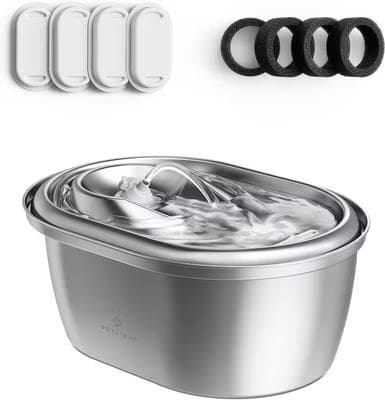
304 food-grade stainless steel pet water fountain, 101 oz. The circulating, filtered water encourages cats to drink more, which supports urinary tract and kidney health.
Webvet may earn a commission when you click through to Chewy, at no extra cost to you.
Spraying, or marking, is different: the cat stands upright, quivers its tail, and deposits a small amount of urine on a vertical surface such as the headboard or a wall. Spraying is more often territorial and is more common in unneutered cats or multi-cat homes with tension.
Telling the two apart helps you and your vet zero in on the right cause.
| Full-bladder peeing | Spraying (marking) | |
|---|---|---|
| Posture | Squats | Stands upright, tail quivers |
| Surface | Horizontal (bedspread) | Vertical (headboard, wall) |
| Amount | Large puddle | Small amount |
| Usual driver | Medical, stress, or litter box | Territorial; unneutered or multi-cat tension |
Stress and anxiety triggers
Cats are deeply attached to routine and predictability, so emotional stress is a leading behavioral cause of bed-peeing once a vet has ruled out illness. The trigger is often a change that seems small to you but enormous to your cat.
- 1Stress is a top behavioral cause, but only after a vet has ruled out illness.
- 2A small-seeming change (move, new pet, schedule shift) can be huge to your cat.
- 3Multi-cat tension is a common hidden trigger owners miss.
- 4Pheromone diffusers can support an anxious cat, but they are not a cure on their own.
Common household changes that trigger it
Frequent triggers include:
- Moving to a new home.
- A new baby or new partner.
- A new pet in the home.
- A change in your work schedule that leaves your cat alone more.
- Rearranged furniture.
- A strange outdoor cat appearing at the window.
Separation anxiety is a real one here: a cat that is left alone more, or that is strongly bonded to you, may pee on the bed when you are gone because that is where your scent is strongest.
Any of these can be enough to unsettle a sensitive cat and send it to your bed for the scent-blending comfort described above. The pee often shows up on the bed because that is where your cat feels closest to you while it copes.
Multi-cat stress and litter box guarding
In homes with more than one cat, tension is a major hidden trigger that owners frequently miss. A dominant cat may quietly guard the litter box or block the hallway leading to it, leaving a more timid cat too anxious to use it.
That cat then retreats to the bedroom and uses the bed instead. Reducing tension in a multi-cat household often resolves bed-peeing on its own.
To support an anxious cat:
- Identify and reduce the stressor.
- Keep daily routines consistent.
- Add vertical space and hiding spots so each cat has its own territory.
- Consider a feline pheromone diffuser as a supporting aid. Pheromones can help, but they are not a cure by themselves.
 $65 · no membership
Worried about your cat's urinary or kidney symptoms?
A licensed vet can examine your cat over video and prescribe treatment online when it's appropriate.
 Talk to a vet
- Licensed vets
- All 50 states
- same-day Rx

Webvet may earn a commission if you book.
Litter box problems that push cats onto the bed
Cats are famously particular about their toilet. A dirty box, the wrong litter, a covered or too-small box, a plastic liner, or a box tucked in a noisy, high-traffic, or hard-to-reach spot can all drive avoidance. When the box feels unpleasant, the bed becomes the appealing alternative.

Lickable cat treats with real chicken, made to support comfort and tranquility. 12 single-serve 0.5-oz tubes.
Webvet may earn a commission when you click through to Chewy, at no extra cost to you.
The litter box math (one per cat plus one)

The standard rule is one litter box per cat plus one extra, with boxes spread out rather than lined up side by side. Here is the quick setup checklist most cats prefer:
| Factor | What most cats want |
|---|---|
| Number of boxes | One per cat, plus one extra |
| Cleaning | Scooped daily, washed regularly with mild soap |
| Litter type | Unscented, fine-grained clumping litter |
| Litter depth | About 2 inches |
| Box style | Large, uncovered, low entry for seniors |
| Location | Quiet, low-traffic, easy to reach on each main floor |
Pees on the bed but poops in the box?
This very common pattern confuses owners, because it looks like the cat has rejected the box for one task but not the other. Usually it points to urinary discomfort or a texture aversion specific to urinating, rather than a fully rejected box.
A cat with a painful bladder may associate the litter box with the pain it feels while peeing and seek a softer surface for that one act, while still happily using the box to defecate. That is exactly why a vet check comes first: it is one of the clearest signals of a urinary issue.
How to stop your cat from peeing on the bed
Here is a clear, ordered action plan. Work through it in sequence, because skipping the first step undermines everything after it.
- 1Vet first: a bladder problem will not respond to a new litter box.
- 2Clean with an enzymatic cleaner, not soap or vinegar, which leave the scent marker behind.
- 3Block or cover the bed while you fix the underlying cause.
- 4Make the box the better choice: more boxes, unscented clumping litter, daily scooping.
- See the vet first. Rule out or treat any medical cause before you try a single behavioral fix. A bladder problem will not respond to a new litter box.
- Clean the bed the right way with an enzymatic cleaner (more on this below). Wash all bedding on the hottest setting the fabric allows.
- Block access while you resolve the cause. Keep the bedroom door closed, or cover the bed with a waterproof mattress cover or a shower curtain so it stops being an appealing target.
- Make the bed less appealing and the box more appealing. Add boxes, upgrade the litter, and place a few treats or a feeding station near former accident spots, since cats avoid eliminating where they eat.
- Reduce stressors and add pheromone support, then reassess once any medical treatment is underway.
Clean it the right way (enzymatic cleaners)

This step is non-negotiable. Cat urine contains uric acid, which ordinary detergent, soap, and vinegar do not fully break down. Even when the spot smells clean to you, your cat's nose still detects the leftover scent markers and is drawn back to the same place.
Only an enzymatic cleaner designed for pet urine breaks down uric acid completely. Saturate the area, let it sit per the label, and wash fabrics hot. Pairing thorough cleanup with a litter built for odor control in a freshened box helps draw your cat back to the right spot.
Make the bed less appealing, the box more appealing
While the bed is off-limits or covered, pour your energy into making the litter box irresistible. Scoop twice a day, switch to an unscented fine-grained clumping litter at about 2 inches deep, and add an extra uncovered box in a quiet spot.
The goal is to flip the math so the box is clearly the better choice and the bed is simply not available.
Do scent deterrents and home remedies work?

99% dust-free, low-tracking clumping clay litter with superior odor control and hard clumping. Unscented, natural ingredients, multi-cat strength.
Webvet may earn a commission when you click through to Chewy, at no extra cost to you.
Scent deterrents (vinegar, citrus) for bed-peeing
Pros
- Cheap and easy to try at home
- Citrus and vinegar smells are mildly off-putting to some cats
- Can be a minor supporting tactic alongside the real fix
Cons
- Do nothing to address the actual cause (medical, stress, or litter box)
- Wear off quickly and often need constant reapplication
- Vinegar does not neutralize uric acid, so the urine scent marker remains
- Can simply push the cat to pee somewhere else instead of the box
What NOT to do: never punish your cat
Reframe the behavior: your cat is communicating distress or pain, not misbehaving. What helps instead is staying calm, cleaning thoroughly, finding and fixing the cause, and giving your cat its own secure resting spots and enough resources (boxes, food stations, and perches) so it never feels cornered.
When to see your veterinarian
Book a vet visit for any sudden or repeated bed-peeing. Treat straining, crying while urinating, blood in the urine, very frequent tiny urinations, or no urine at all as an emergency and seek care immediately.
At the clinic, expect:
- A physical exam.
- A urinalysis.
- Possibly a urine culture, blood work, and imaging to check for stones.
If you want the full walkthrough, here is how veterinarians diagnose urinary problems in cats.
The reassuring news is that most causes are very treatable once identified, and behavioral fixes work far better after a medical cause has been ruled out or treated. Once your cat is stable, focus on long-term urinary health to lower the odds of a repeat.
Before the visit, note when the bed-peeing started and how often it happens, and photograph the spot if you can. Those details help your vet pin down the cause faster.
Frequently asked questions
Why would a cat suddenly start peeing on the bed?
A sudden start almost always signals a medical problem (such as a urinary tract issue or pain) or a new stressor like a move, a new pet, or a schedule change. Because illness is common and can be urgent, see your vet first to rule out a physical cause before assuming it is purely behavioral.
How do I stop my cat from peeing on the bed?
First, see your vet to rule out illness. Then clean the bed with an enzymatic cleaner, block access or cover the bed, improve the litter box setup (more boxes, unscented clumping litter, daily scooping), and reduce stress. Tackle the cause and the bed-peeing usually stops.
Is my cat peeing on the bed for attention or out of spite?
No. Cats do not pee on beds for spite, revenge, or attention. The behavior reflects a medical issue, stress, or litter box dissatisfaction. Peeing on your bed can even be a self-soothing attempt to mix its scent with yours, which is about comfort and insecurity, not punishment.
How do you punish a cat for peeing on the bed?
You should not punish a cat at all. Punishment increases stress and worsens the problem, and cats do not link discipline to an earlier act, so they only learn to fear you. Stay calm, clean thoroughly, find the cause, and give your cat secure spaces and enough litter boxes instead.
What smell deters a cat from peeing on the bed?
Citrus and vinegar smells deter some cats, but scent deterrents rarely fix the problem alone and can just push the cat elsewhere. More important is removing the existing urine scent with an enzymatic cleaner, since leftover uric acid keeps drawing your cat back to the same spot.
Could my cat have a UTI?
Possibly, though true UTIs are uncommon in young cats and more likely in older cats. More often the cause is FLUTD or feline idiopathic cystitis, bladder stones, or crystals. Signs include straining, frequent tiny urinations, and blood in the urine. Only a vet can confirm it with a urinalysis.
Why is my cat peeing on the bed but pooping in the litter box?
This pattern usually points to urinary discomfort or a texture aversion specific to urinating, not a fully rejected box. A cat with a painful bladder may link the box to the pain it feels while peeing and choose a soft surface for that act, while still using the box to defecate. See your vet.
Does my cat pee on the bed because it misses me?
It can be connected to separation anxiety, but not to spite. A strongly bonded cat that is left alone more may pee on the bed because your scent is strongest there and mixing its scent with yours is self-soothing. It is a stress response, not punishment for leaving. Rule out a medical cause first, then ease the anxiety with consistent routines, enrichment, and sometimes a pheromone diffuser. If it persists, ask your vet about behavioral support.
What if my cat pees on the bed right in front of me, or on me?
It still is not spite or attention-seeking. A cat that pees on the bed while you watch, or even on you, is usually driven by the same things: a medical problem, stress, or a litter box it is avoiding, and the urgency of a full or painful bladder can override any hesitation about doing it in front of you. The response is the same: see your vet first to rule out a urinary issue, then address stress and the litter box setup. Do not scold or punish.
Why is my female cat peeing on the bed?
Female cats pee on the bed for the same reasons as males: a medical problem (such as FLUTD, idiopathic cystitis, stones, or a UTI), stress, or litter box dissatisfaction, plus the bed's soft, owner-scented appeal. The key difference is risk: females are far less prone to a life-threatening urethral blockage than males. A straining female still needs a prompt vet visit, but it is generally not the same minutes-count emergency. That said, if a female cat cannot pass any urine at all, treat it as an emergency and go now, because females can block too.
$65 · no membershipWorried about your cat's urinary or kidney symptoms?
A licensed vet can examine your cat over video and prescribe treatment online when it's appropriate.
Talk to a vet- Licensed vets
- All 50 states
- same-day Rx
Webvet may earn a commission if you book.

Editor
The Webvet Editorial Team is the in-house group of pet-care editors and writers behind Webvet, operated by Smart Pet Collective. The team researches, writes, and maintains Webvet's pet health, behavior, and medication content. Every article follows a defined editorial process: research from reputable veterinary and scientific sources, careful drafting, mandatory review of medical content by a credentialed veterinarian, and dated publication. Health and medication articles are medically reviewed by a licensed veterinary professional before they go live and are kept current over time.
Veterinarian · BVMS MRCVS
Dr. Pippa Elliott, BVMS, MRCVS, is a veterinarian with nearly 30 years of experience in companion animal practice. Dr. Elliott earned her Bachelor of Veterinary Medicine and Surgery from the University of Glasgow. She was also designated a Member of the Royal College of Veterinary Surgeons. Married with 2 grown-up kids, Dr. Elliott has a naughty Puggle named Poggle, 3 cats and a bearded dragon.
Related reading

Kidney Disease in Dogs: Why Tracking Water Intake Can Help Your Vet

Best Cat Water Fountain Picks of 2026, Vet Informed

Dog Bladder Stones: Symptoms, Treatment, and Surgery Costs
