Catit Flower Fountain Review: Why Cats Drink From It and What to Watch
Our expert-analysis review of the Catit Flower fountain: what the flower top and flow settings do, what filters and cleaning are really like, which cats it suits, and when a different fountain is the better buy.

BVMS MRCVS
Medically reviewed by Dr. Pippa Elliott, BVMS MRCVS · Last reviewed

This article contains affiliate links. Webvet may earn a commission when you buy through them, at no extra cost to you.
The Catit Flower Fountain is a cat water fountain that pushes filtered water up through a flower-shaped top. Catit says it can be set three ways: a gentle water flow, a bubbling top, or calm streams. Some cats drink more from a fountain, though the Cornell Feline Health Center notes that preferences differ.
Our verdict: if you are buying one now, choose the Catit Flower Stainless Steel Top Cat Fountain. It has the same 100 fl oz (3L) reservoir and three flow settings as the plastic original, and Catit lists it with a dishwasher-safe stainless steel top, a water level window, and an LED nightlight. The tradeoff is upkeep.
How we reviewed it: WebVet did not obtain the product or test it hands-on. This review is expert analysis of the manufacturer's published specifications, the Chewy listing, and veterinary guidance. No manufacturer or retailer paid for or reviewed this article. WebVet may earn a commission on Chewy links; that relationship did not influence the verdict.
 Sponsored
Have questions about your cat's urinary health?
Talk to a licensed vet at Dutch over video, often the same day. They can recommend treatment and prescribe it when it's appropriate.
Use code Pets60
Plans start at $12/month · covers up to 5 pets
- Licensed vets in most states
- Rx for 150+ conditions
- 4.7 on Trustpilot
Catit Flower Fountain at a glance: what it is and who it suits
- 1The Catit Flower gives a cat a steady supply of filtered, moving water from a 100 fl oz (3L) reservoir.
- 2Its flower top runs in three flow settings, and some cats drink more from a fountain than from a still bowl.
- 3The stainless steel top version is the one to buy: same reservoir and flow settings, plus a dishwasher-safe top and a nightlight.
- 4Plan on a new Triple Action filter every 30 days and taking the pump apart for cleaning every two weeks.
At heart, the Catit Flower is a fresh-water station. The pump draws water from the reservoir through the Triple Action filter, which Catit says softens the water and removes odors, impurities, hair, and debris, then sends it up through the flower top. The standard model is made from BPA-free plastics.

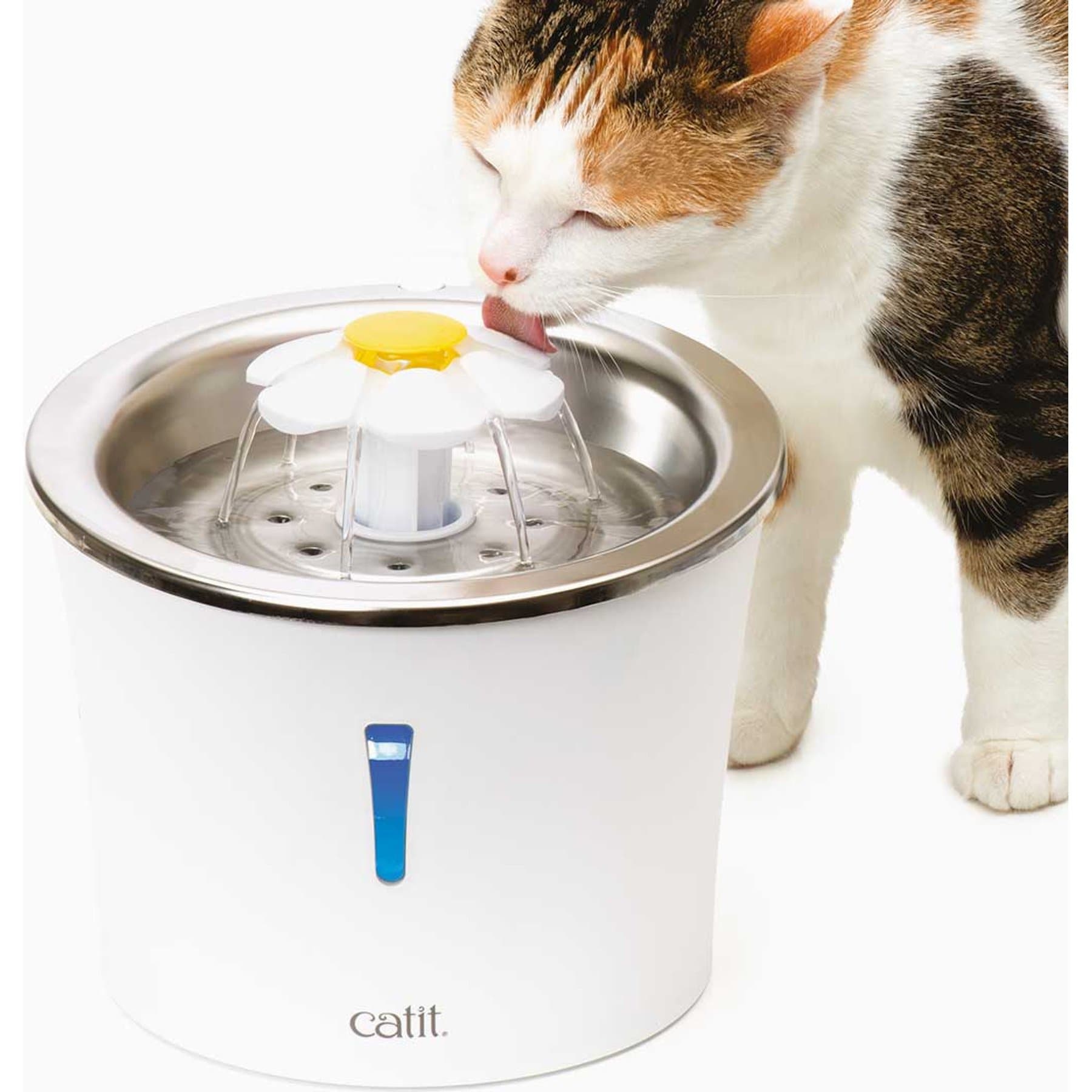
Catit's 100 fl oz Flower Fountain with a dishwasher-safe stainless steel top, three flow settings, and an LED nightlight.
Webvet may earn a commission when you click through to Chewy, at no extra cost to you.
Water intake is why the format matters. Cornell says cats need about 4 ounces of water per five pounds of lean body weight per day, so a cat with 10 pounds of lean body weight needs about 8 ounces. Our guide to how much water a cat should drink goes into more detail.
The Flower is a reasonable fit when:
- Your cat is curious about moving water, since some cats drink more from a fountain.
- You will change the filter on schedule and take the pump apart for cleaning.
- You have a sturdy, level spot on the floor for it.
- You want a fountain that stays put: Catit says a fully filled fountain is nearly impossible for a cat to knock over.
Is the Catit Flower Fountain good?
For a cat that likes moving water, yes, if you maintain it. The Catit Flower Stainless Steel Top Cat Fountain, listed at $39.97 on Chewy when we checked in October 2026, pairs three flow settings with a dishwasher-safe top. Skip the cleaning, though, and cat hair and debris clog the pump and weaken the flow.
No fountain guarantees a cat will drink more. Cornell notes that wet cat food is typically about 70 to 80 percent water, which makes diet another route to hydration. If your cat still drinks very little, our guide to a cat not drinking water covers what to check next.
Why cats drink from it: the flower top and three flow settings
The flower top is where the choice happens. On the Catit Flower Fountain page, Catit says the fountain can be set in three ways: a gentle water flow, a bubbling top, or calm streams. If your cat ignores one flow setting, try another before deciding the fountain has failed.
Underneath, a circulating pump keeps the water moving up through the flower, which is why a clean pump matters for every setting. A cat that prefers drinking from a spout has another Catit option in the Catit Pixi Cat Drinking Fountain, White, which offers a calm flow, a stream with a spout, and a bubbling top.
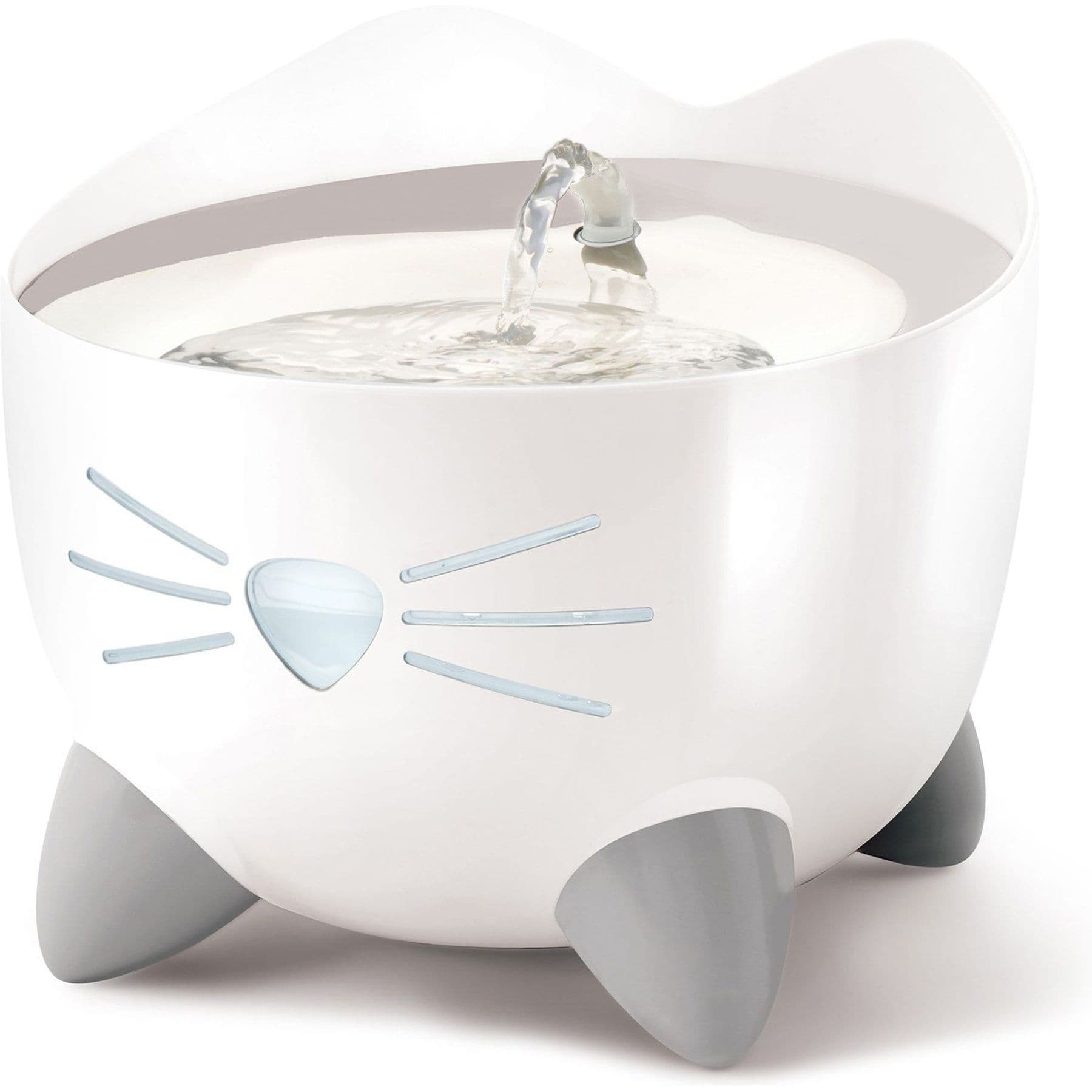
Catit's Pixi fountain offers a calm flow, a spout stream, and a bubbling top, with a drip zone that returns stray drops.
Webvet may earn a commission when you click through to Chewy, at no extra cost to you.
Cornell says cats can be prompted to drink more when fresh water is always available in places they can easily reach, and that some cats increase their intake when given a water fountain. The same guidance is clear that cats have their own preferences, so treat a fountain as a trial, not a sure thing.
To set it up for a first try:
- Rinse a new filter and submerge it in water before it goes into the fountain, as Catit advises.
- Fill the reservoir up to the wavy line in the plastic rim, the level Catit specifies.
- Place the fountain on the floor, on a sturdy and completely level surface rather than a table or countertop.
- Start with one flow setting and switch if your cat hesitates.
The Chewy listing for the stainless model makes a bolder claim. It says eliminating stale water encourages a cat to drink more and reduces the risk of urinary tract infections. That is the seller's wording; Cornell's is more cautious.
If a urinary problem is what sent you shopping, start with our guide on why a cat pees on the bed.
SponsoredVet care that's always there
Unlimited video calls and messaging with licensed vets for less than a typical vet visit. One membership covers up to five pets.
Use code Pets60
Plans start at $12/month · covers up to 5 pets
- Licensed vets in most states
- Rx for 150+ conditions
- 4.7 on Trustpilot
Plastic, LED nightlight, stainless top, or Mini: which version to buy
Catit's cleaning guide lists three full-size Flower Fountains by item number: the original (#43742), the LED (#43747), and the stainless steel version (#43725). All three hold 100 fl oz (3L) and use the same Triple Action filter. The Mini is the outlier, with half the water and its own filter.
- Plastic original: a 100 fl oz (3L) reservoir, BPA-free plastics, and three flow settings.
- LED: the same 3L reservoir, with an LED on the pump that makes the water level window glow a calming blue as a nightlight.
- Stainless steel top: a 3L reservoir, three flow settings, the Triple Action filter, a water level window, an LED nightlight, and a dishwasher-safe stainless steel top.
- Mini: a 1.5 L (50.7 fl oz) capacity, three flow settings through a mini flower accessory, and a small filter pad of its own.
On materials, International Cat Care advises feeding cats from glass or ceramic rather than plastic because plastic bowls can pick up odours. That advice is about food bowls, not fountains, so read it as a reason to lean toward steel, not as evidence that the plastic Flower is unsafe.
| Version | Capacity | Top material | Yearly filter cost | Who it suits |
|---|---|---|---|---|
| Plastic original (#43742) | 100 fl oz (3L) | BPA-free plastic | About 12 Triple Action filters a year at Catit's 30-day interval; Catit's filter page lists no price | Owners who want the basic Flower with three flow settings |
| LED (#43747) | 100 fl oz (3L) | Not listed as stainless | About 12 Triple Action filters a year | Homes that want a soft blue nightlight at the water bowl |
| Stainless steel top (#43725) | 100 fl oz (3L) | Dishwasher-safe stainless steel | About 12 Triple Action filters a year | Owners who want a top that goes in the dishwasher, plus the nightlight and level window |
| Mini | 1.5 L (50.7 fl oz) | Not stated in Catit's listing | Its own small filter pad; Catit's listing gives no change interval | Owners who want a smaller fountain and can refill it more often |
The version we would buy is the Catit Flower Stainless Steel Top Cat Fountain, which Chewy listed at $39.97 in October 2026. It is the version Catit lists with a dishwasher-safe top, and it already includes the water level window and LED nightlight that define the LED model. Chewy prices change, so check the current listing.
The Mini is the smaller option. At 1.5 L, it holds about half the water of the full-size models, so it needs topping up more often, and Triple Action filters do not fit it.
If you want stainless steel beyond the top, the Petlibro Stainless Steel Dog & Cat Fountain, 101-oz is made with rust- and corrosion-resistant stainless steel, according to its Chewy listing, which also says most parts are dishwasher safe. It is sold for homes with dogs as well as cats.
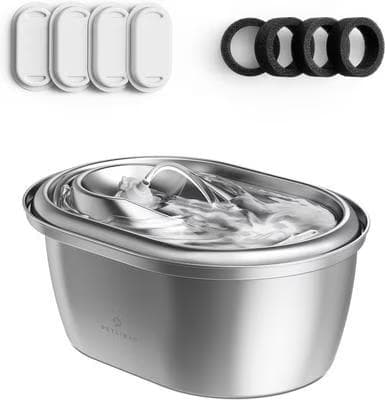
A 101-oz Petlibro fountain made with rust- and corrosion-resistant stainless steel, sold for dogs and cats.
Webvet may earn a commission when you click through to Chewy, at no extra cost to you.
Triple Action filters: how often to change them and the yearly cost

The Triple Action filter does the cleaning work in every full-size Flower. On its filter page, Catit describes three layers: cotton mesh that catches hair, active carbon (charcoal) for odors, and ion exchange resin for softening the water by filtering out excess calcium and magnesium.
The same cartridge fits the plastic, LED, and stainless steel Flowers, but not the Mini. Catit says Flower Fountains are only for use with certified Catit filters, so third-party filters fall outside its guidance.
- How often to change it: Catit recommends a new filter every 30 days, or sooner when the filter is visibly saturated. Count on about 12 filters a year.
- Pack sizes: Catit sells them in packs of 2, 5, and 12, so one 12-pack covers a year at that pace.
- Yearly filter cost: Catit's filter page lists no price, so the yearly cost depends on where you buy. Multiply the price of one filter in your pack by 12, and compare pack sizes before you commit.
How to replace Catit fountain filter?
Catit's steps for a new Triple Action filter are short:
- Take the used filter out of the fountain.
- Rinse the new filter with water.
- Submerge it in water before placing it in the fountain.
- Check that it stays fully under water, which Catit says prevents mold from forming on top of the filter.
Can I run my cat's water fountain without a filter?
Catit does not cover running the Flower without a filter, and it says Flower Fountains are only for use with certified Catit filters. The filter is also what removes hair and debris from the water, and Catit says those are what clog the pump. Keep a filter in place and swap it when it is due.
If you want a different fountain at a lower price, the PawPerfect Cat & Dog Water Fountain, White has its own layered filter: a cotton layer, activated carbon, and an ion exchange resin system, according to its Chewy listing. It also offers three water flow modes.
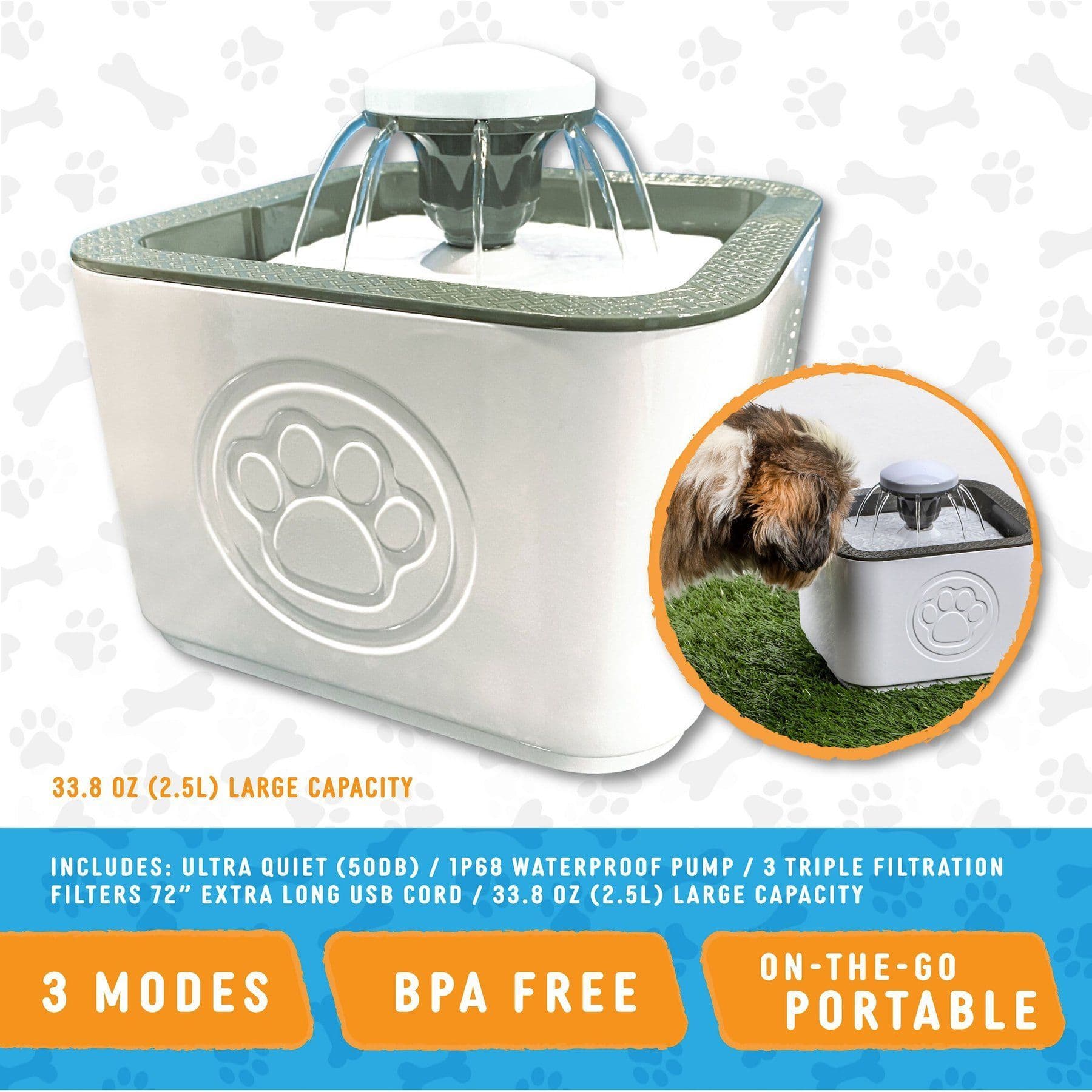
A lower-priced fountain with three water flow modes and a cotton, activated carbon, and ion exchange resin filter.
Webvet may earn a commission when you click through to Chewy, at no extra cost to you.
Cleaning the pump and flower: the weekly routine
Catit's own pages disagree on the pump. Its cleaning guide says to remove the pump and take it apart for cleaning every two weeks, while its Flower Fountain Q&A says to clean the pump each month. Follow the stricter two-week schedule, since Catit also says hair and debris make the pump less powerful.

For the wash itself, Catit says all components can be washed with warm water, a soft sponge, and dish soap, with no aggressive detergents or abrasive sponge. Rinse each pump part separately with water before reassembling. Clean the top parts regularly as well, since Catit says that keeps scale from settling on the fountain.
Catit does not set a weekly schedule of its own, but its guidance fits this routine:
- Every week: top up the water, clean the flower and other top parts so scale does not settle, and look at the filter for saturation.
- Every two weeks: with the power off, lift out the pump, take it apart, and rinse each part separately.
- Every 30 days: fit a new Triple Action filter, rinsed and submerged first.
- Stainless steel model: the stainless steel top can go in the dishwasher; wash the pump by hand.
Catit also sells a Fountain Cleaning Set of three cleaning tools made to fit every Catit drinking fountain and pump.
How do I refill my Catit water fountain?
Fill it up to the wavy line in the plastic rim, the water level line Catit tells owners to use. Catit lists a water level window on the stainless and LED versions for checking the level at a glance. Keeping it full matters: Catit's first fix for a loud motor is filling to that line.
How often should you change the water in a Catit fountain?
Catit's pages set schedules for the filter and the pump, not for a full water change. Empty and refill with fresh water at least at every pump cleaning, every two weeks, and top up in between. Fresh water matters: Cornell says always having it available helps prompt cats to drink more.
If the water level starts dropping much faster than usual, read our guide to a cat drinking a lot of water to see what that change can mean.
Noise, motor hum, and a fountain that stops flowing
Catit's troubleshooting advice comes down to the water level, a clean pump, and where the fountain sits. For a loud motor or a hum, Catit suggests:
- Filling the fountain all the way up to the wavy line in the plastic rim.
- Setting it on a sturdy, completely level surface.
- Placing it on the floor rather than a table or countertop, keeping in mind that a wooden floor will be noisier than concrete or tile.
When the flow weakens or water stops coming through the flower, Catit points first to the pump: it becomes less powerful when it is clogged with cat hair or other debris.
Why is my Catit Flower Fountain not working?
Work through these checks in order:
- Water level: top it up to the wavy line.
- Pump: remove it, take it apart, and rinse each part to clear hair and debris.
- Flow slider: only older models have one; Catit says to slide it to the + side for maximum flow.
- Floating filter: rinse and submerge it; if it keeps floating, place it upside down in the fountain for a few days, then flip it back.
How long does Catit fountain last?
Catit's care pages give no lifespan for the fountain or its pump. What they do make clear is that a neglected pump loses power as hair and debris build up, so the two-week pump cleaning and the 30-day filter change are what keep the Flower running well.
Where can I find a replacement pump for my Catit water fountain?
Start with Catit, and match the part to your item number: original #43742, LED #43747, or stainless steel #43725, each with its own manual. Ask Catit or your retailer for a current pump and its price.
If the problem is the flower top rather than the pump, Catit sells the flower accessory (#44820) separately as a replacement part.
Catit Flower alternatives: when the Pixi or a stainless fountain fits better
The Flower's 3L reservoir and flower top are not right for every cat or home. If you are still comparing fountain types, our roundup of the best cat water fountains covers the wider field. Three fountains make the closest swaps, depending on what you want to change.

- A different Catit design: the Catit Pixi Cat Drinking Fountain, White is described on Chewy as a continuous source of fresh, purified water, with a calm flow, a stream with a spout, and a bubbling top, plus a drip collection zone that sends stray drops back into the reservoir. Chewy also lists a sensor that shuts the pump down when the water runs too low. Chewy listed it at $48.99 in October 2026.
- A stainless steel fountain shared with a dog: the Petlibro Stainless Steel Dog & Cat Fountain, 101-oz is made with rust- and corrosion-resistant stainless steel, is BPA-free, and has adjustable flow options, per Chewy. Chewy listed it at $36.99 in October 2026.
- A lower price: the PawPerfect Cat & Dog Water Fountain, White uses three water flow modes (flower waterfall, flower bubble, and gentle fountain) and a cotton, activated carbon, and ion exchange resin filter. Chewy listed it at $23.99 in October 2026.
Catit also makes a PIXI Smart Fountain, a separate model from the Pixi Drinking Fountain. Catit says it runs UVC water clarification at set intervals even if it is never connected to Wi-Fi or the app, and that a PIXI Smart pump that stops usually recovers once it is cleaned on the inside and the outside.
For a deeper look at another brand, read our Petlibro water fountain review. If you are building a full feeding station, our guide to the best automatic cat feeders covers the food side.
Catit Flower Fountain questions
Frequently Asked Questions
How often should I change the Catit Flower filter?
Every 30 days, which is a little over four weeks, or sooner if the filter looks saturated. On the full-size models that means about 12 Triple Action filters a year; the Mini takes its own smaller filter pad.
How do I clean the Catit Flower Fountain pump?
Lift the pump out, take it apart, and rinse each part separately with water before reassembling, as Catit's cleaning guide describes. Wash with warm water, dish soap, and a soft sponge. If you prefer a brush for small parts, use a soft one, or Catit's three-tool cleaning set made for its pumps.
Is the Catit fountain dishwasher safe?
Catit lists one part as dishwasher safe: the stainless steel top on the stainless model. It does not list the pump as dishwasher safe, so wash the pump by hand with warm water and dish soap.
Why is my Catit fountain motor loud?
Check the water level first. Catit's fix for a loud pump motor is filling all the way to the wavy line in the plastic rim. If it still hums, move it to a sturdy, level spot on the floor; Catit notes that wooden floors are noisier than tile or concrete.
Why is my Catit Flower Fountain not flowing?
Catit's first suspect is the pump: cat hair or other debris clogs it and cuts its power, so the water stops reaching the flower. Take the pump apart and rinse each part, and on an older model, check that the flow slider sits on the + side.

Editor
The Webvet Editorial Team is the in-house group of pet-care editors and writers behind Webvet, operated by Smart Pet Collective. The team researches, writes, and maintains Webvet's pet health, behavior, and medication content. Every article follows a defined editorial process: research from reputable veterinary and scientific sources, careful drafting, mandatory review of medical content by a credentialed veterinarian, and dated publication. Health and medication articles are medically reviewed by a licensed veterinary professional before they go live and are kept current over time.
Veterinarian · BVMS MRCVS
Dr. Pippa Elliott, BVMS, MRCVS, is a veterinarian with nearly 30 years of experience in companion animal practice. Dr. Elliott earned her Bachelor of Veterinary Medicine and Surgery from the University of Glasgow. She was also designated a Member of the Royal College of Veterinary Surgeons. Married with 2 grown-up kids, Dr. Elliott has a naughty Puggle named Poggle, 3 cats and a bearded dragon.
Related reading

Petlibro Water Fountain Review: Filters, Noise, and Cleaning Honestly Rated

Vaginitis in Dogs: Symptoms, Causes, and Treatment

Kidney Disease in Dogs: Why Tracking Water Intake Can Help Your Vet
