Best Cat Water Fountain Picks of 2026, Vet Informed
Compare four exact cat water fountain picks by material, capacity, flow, filter cost, noise claims, and cleaning work, with clear veterinary boundaries around hydration and urinary health.

BVMS MRCVS
Medically reviewed by Dr. Pippa Elliott, BVMS MRCVS · Last reviewed

This article contains affiliate links. Webvet may earn a commission when you buy through them, at no extra cost to you.
The best cat water fountain for most households is the Petlibro Dockstream Cordless Water Fountain, model PLWF115. Its 2. 5-liter reservoir, open stainless steel drinking tray, rechargeable base, and ability to run continuously while plugged in make it more adaptable than the other fountains in this guide.
It is not perfect: Petlibro says its filter should be replaced every two weeks, the fountain is not dishwasher-safe, and its cord-free mode serves water in timed sensor cycles instead of running continuously. Those tradeoffs matter, but the overall combination works for the widest range of one-cat homes.
Our Top Cat Water Fountain Picks
Our four picks solve four different household problems. In this specification-based comparison, the Petlibro Dockstream PLWF115 is best overall and the most flexible. The Catit LED Flower Fountain #43747 offers a large reservoir and adjustable streams at the budget end. The PetSafe Drinkwell Stainless Multi-Pet PWW00-13705 provides a one-gallon reservoir and access around a circular tower.
The PetSafe Creekside Ceramic PWW00-17097 is the compact ceramic alternative for a household willing to trade capacity for a heavier, open bowl.
Some retailers use kitty fountain, cat water bowl fountain, or automatic cat water fountain for the same broad category. Are water fountains good for cats? They can be useful when a cat accepts the flow and the household keeps the unit clean, but the label does not establish a medical benefit or tell you which design that individual cat will prefer.
- 1Best overall: Petlibro Dockstream Cordless Water Fountain, PLWF115, for its flexible placement, open stainless drinking tray, and continuous or sensor-based operation.
- 2Best budget: Catit LED Flower Fountain, #43747, for a 3-liter reservoir, three flow arrangements, and widely available monthly filters.
- 3Best for multi-cat homes: PetSafe Drinkwell Stainless Multi-Pet Fountain, PWW00-13705, for its 128-ounce capacity, 360-degree access, and five stream options.
- 4Best ceramic: PetSafe Creekside Ceramic Pet Fountain, PWW00-17097, for its compact open bowl, soft bubbling flow, and dishwasher-safe ceramic body.
- 5Evidence boundary: These are specification-based recommendations, not hands-on test results. A fountain is an optional drinking station, not prevention or treatment for urinary or kidney disease.
| Product | Best for | Material at drinking surface | Capacity | Power | Main tradeoff |
|---|---|---|---|---|---|
| Petlibro Dockstream PLWF115 | Best overall | Stainless steel tray with BPA-free ABS body | 2.5 L / 84.5 oz | Rechargeable or plug-in | Two-week filters; not dishwasher-safe; sensor cycles on battery |
| Catit LED Flower #43747 | Best budget | Molded plastic top and reservoir | 3 L / 100 oz | Plug-in | More seams and flower parts to clean; no official dB rating |
| PetSafe Drinkwell Stainless Multi-Pet PWW00-13705 | Multi-cat access | Stainless steel bowl and tower | 128 oz / 1 gallon | Plug-in | Large footprint; carbon and foam filters both need replacement |
| PetSafe Creekside Ceramic PWW00-17097 | Best ceramic | Glazed ceramic bowl and tower | 60 oz | Plug-in | Smallest reservoir; ceramic can chip or break |

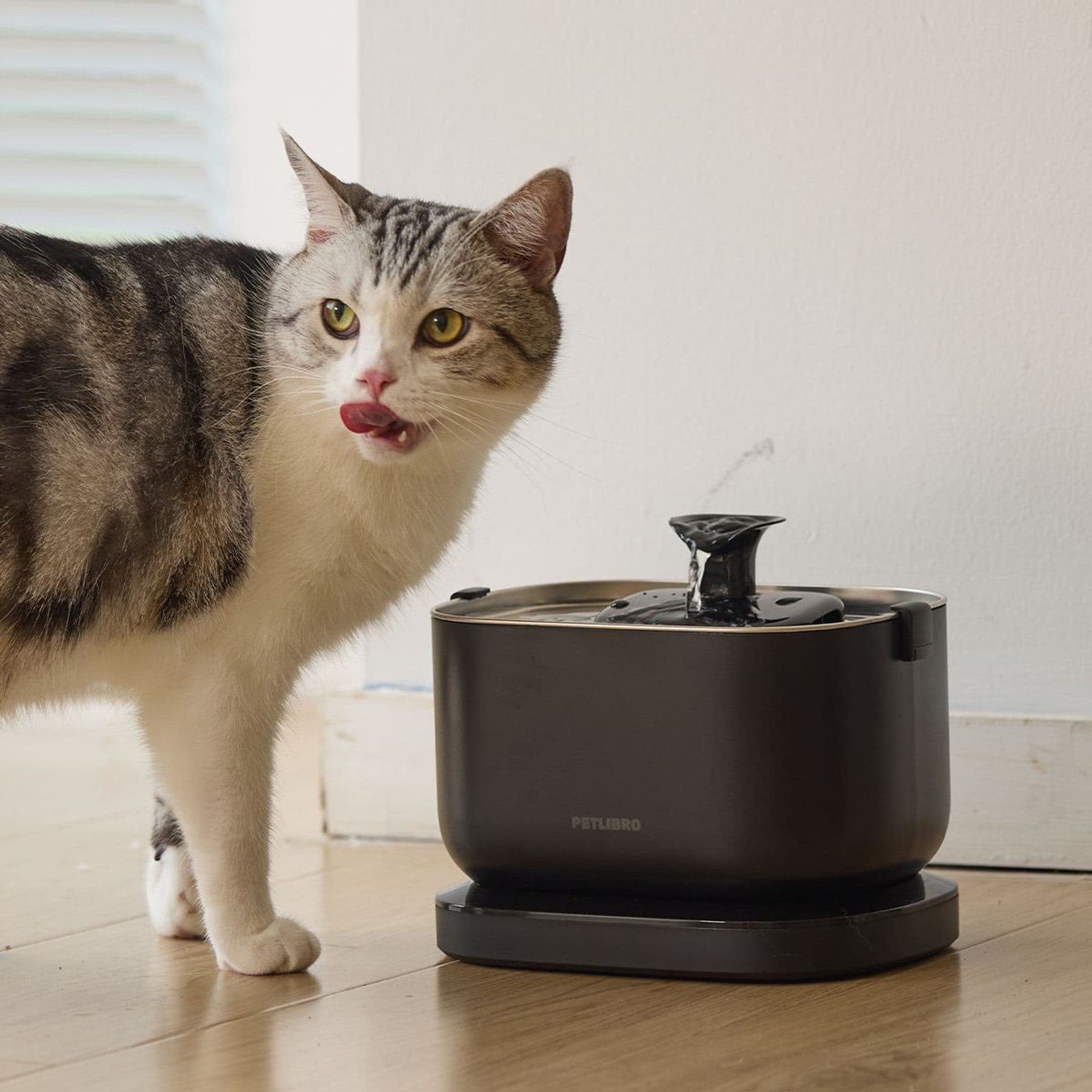
Best Overall: Petlibro Dockstream Cordless Water Fountain (PLWF115)
Webvet may earn a commission when you click through to Chewy, at no extra cost to you.
The Petlibro Dockstream PLWF115 is the best overall cat water fountain in this shortlist because it can function as either a cord-free station or a continuously running plug-in fountain. That flexibility solves a real placement problem. A cat's preferred drinking location is not always beside a convenient outlet, and placing every resource along one wall can create crowding in a multi-cat home.
The rechargeable base lets the fountain sit in a quieter, more useful location, while the plug-in option remains available when continuous flow is the priority.
Confirm the exact model
The exact model number is essential. Petlibro sells several products under the Dockstream name, including plug-in, app-connected, RFID, and second-generation versions. This recommendation applies to PLWF115, the 2.5-liter cordless model. It does not inherit the 3-liter capacity, app functions, dishwasher instructions, or other specifications of Dockstream 2 models.
Petlibro lists the PLWF115 at 8. 9 by 7. 4 by 6. 3 inches and 2. 18 pounds empty. The reservoir and body are BPA-free ABS plastic, while the broad drinking tray is stainless steel. That mix keeps the overall unit lighter than an all-ceramic fountain while giving the cat a smooth metal surface at the point of drinking.
The tray is relatively open, so a cat can approach without putting its face deep inside a narrow cup. That may suit cats that prefer more room around the muzzle, but it should not be sold as a proven cure for so-called whisker fatigue.
Power and noise
Power mode changes the experience. When the PLWF115 is connected to power, it can deliver continuous flow. When it is operating from its rechargeable base, the sensor activates water for about 42 seconds when a cat approaches within the stated range. If no approach is detected, the fountain also runs a short cycle about once per hour.
Sensor operation conserves battery power, but a cautious cat may prefer water that is already moving before it comes close. A household choosing this fountain specifically for continuous running water should plan to leave it plugged in.
What the 23 dB claim means
Petlibro describes the pump as operating at 23 dB. That is useful as a manufacturer rating, but it is not an independent WebVet measurement and should not be compared directly with another brand's quiet or whisper-quiet label. Pump sound also changes with the water level, mineral buildup, debris around the impeller, surface resonance, and whether a component is seated correctly.
A well-maintained pump on a stable mat can sound different from the same model running low on water against a hard countertop.
Maintenance and ownership
Maintenance is the Dockstream's main compromise. Petlibro recommends replacing the compatible four-layer filter every two weeks, with more frequent replacement possible in a multi-pet home. At the August 15, 2026 Chewy price of $22. 99 for eight filters, ongoing use works out to about 26 filters a year. Buying whole packs means four eight-packs, or $91.
96 before tax and shipping, although six filters carry into the next period. The annualized filter consumption is about $74. 92 per 365 days.
Hand-washing requirements
The PLWF115 is not dishwasher-safe. Petlibro says heat can deform the ABS components, so the reservoir, tray assembly, filter housing, and pump need careful hand cleaning. That is not a reason to reject it, but it is a real weekly or biweekly task that deserves more weight than a one-time purchase price.
Owners who reliably use a small brush on the pump and rinse the drinking surfaces will get more value from this design than owners looking for a fountain they can place in the dishwasher as one assembled unit.
Petlibro also advertises up to 30 days of battery operation, but that figure is based on its laboratory scenario of one cat and 48 sensor activations per day. More cats, a busy location, longer or more frequent activations, battery age, and charging habits can shorten it. Treat 30 days as a best-case manufacturer scenario rather than a schedule for refilling, cleaning, or checking the fountain.
Best fit and tradeoffs
Pros
- Cord-free sensor operation or continuous flow while plugged in.
- Open stainless steel drinking tray in a compact 2.5-liter format.
- The most flexible placement options among these four picks.
Cons
- Petlibro recommends replacing the filter every two weeks.
- The fountain is not dishwasher-safe and requires careful hand washing.
- Continuous flow requires an outlet; battery mode serves timed sensor cycles.
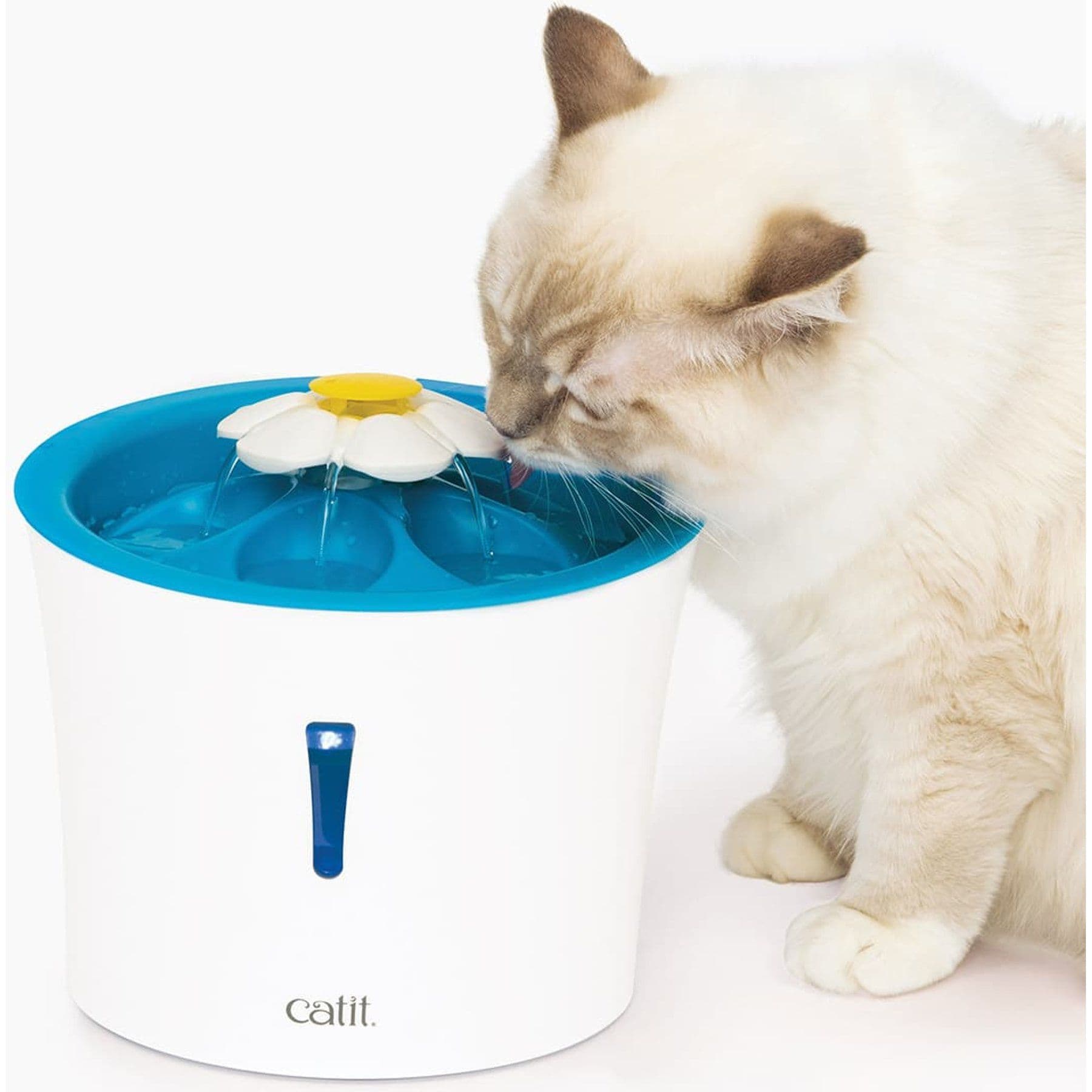
Best Budget: Catit LED Flower Fountain (#43747)
Webvet may earn a commission when you click through to Chewy, at no extra cost to you.
The Catit LED Flower Fountain #43747 is our budget pick because it combines a 3-liter, or 100-ounce, reservoir with three flow arrangements and replacement filters that are widely sold in larger packs. It is a straightforward plug-in fountain rather than a battery or app product. That simplicity can be an advantage for a household that wants moving water without paying for electronics it will not use.
Again, the model number prevents a common shopping mistake. Catit makes an original green Flower Fountain #43742, this blue-topped LED Flower Fountain #43747, and a Stainless Steel Flower Fountain #43725. They share some filters and design elements, but they are not the same fountain. The recommendation and dimensions here apply to the LED model, #43747.
The LED Flower Fountain measures 8. 3 by 8. 3 by 7. 3 inches and weighs 1. 32 pounds empty. Its 3-liter capacity is larger than the Petlibro and Creekside reservoirs while occupying a fairly compact circular footprint. A water-level window is illuminated by a blue LED, which makes it easier for a person to check the reservoir in low light.
The flower attachment can produce a gentle flow over the top, a bubbling center, or several narrow streams. Changing the arrangement is useful because cat preferences are individual. A cat that avoids falling streams may accept the lower bubbling setting, while another may seek the narrow streams.
Filtration and upkeep
The petal-shaped top retains small amounts of water after the pump stops. That means the fountain does not become instantly inaccessible during a brief outage, although the retained water is not a substitute for a separate backup bowl. The main reservoir is not automatically available to the cat if the assembled top is dry, and an outage can last longer than the amount held in the petals.
Catit's Triple Action filter combines a cotton-mesh outer layer, activated carbon, and ion-exchange resin. The mesh catches hair and visible debris. Carbon primarily addresses compounds associated with taste and odor. Ion exchange reduces some calcium and magnesium in tap water. Those are distinct functions, and none means the fountain sterilizes water or prevents urinary disease.
Catit recommends changing the filter about every 30 days, or sooner if it is visibly saturated or the flow is reduced.
Filter cost and cleaning
At the August 15, 2026 Chewy price of $44. 99 for a compatible 12-pack, the ordinary filter budget is about $44. 99 for roughly a year of 30-day changes. A household with several pets, hard water, heavy shedding, food debris, or rapid filter saturation may use more.
A lower replacement cadence than the Dockstream makes the Catit easier to budget, but the flower, top, reservoir seams, and pump still need physical cleaning. A filter cannot remove slime already attached to those surfaces.
Cleaning, noise, and fit
Catit advises cleaning the fountain with warm water, a soft sponge, and dish soap, followed by thorough rinsing. The pump should be removed and disassembled about every two weeks. The exact official LED model page does not state that the full unit is dishwasher-safe, so the safe plan is hand washing unless the current model manual expressly approves a specific part.
Do not transfer the stainless model's dishwasher instructions to the plastic LED fountain.
There is no official numerical sound rating for #43747. A flower fountain can also make more audible water sounds in a falling-stream configuration than in a low bubbling configuration. For a bedroom or noise-sensitive cat, the ability to remove or adjust the flower may matter more than a marketing adjective. Keep the reservoir filled above the pump's minimum line and clean the impeller if the motor becomes louder.
Best fit and tradeoffs
Pros
- A 3-liter reservoir at a budget-oriented upfront price.
- Three adjustable flow arrangements and widely available monthly filters.
- A compact circular footprint with an illuminated water-level window.
Cons
- The flower-shaped plastic top creates more seams and channels to clean.
- It is plug-in only and has no official numerical sound rating.
- The official LED model page does not confirm that the full unit is dishwasher-safe.
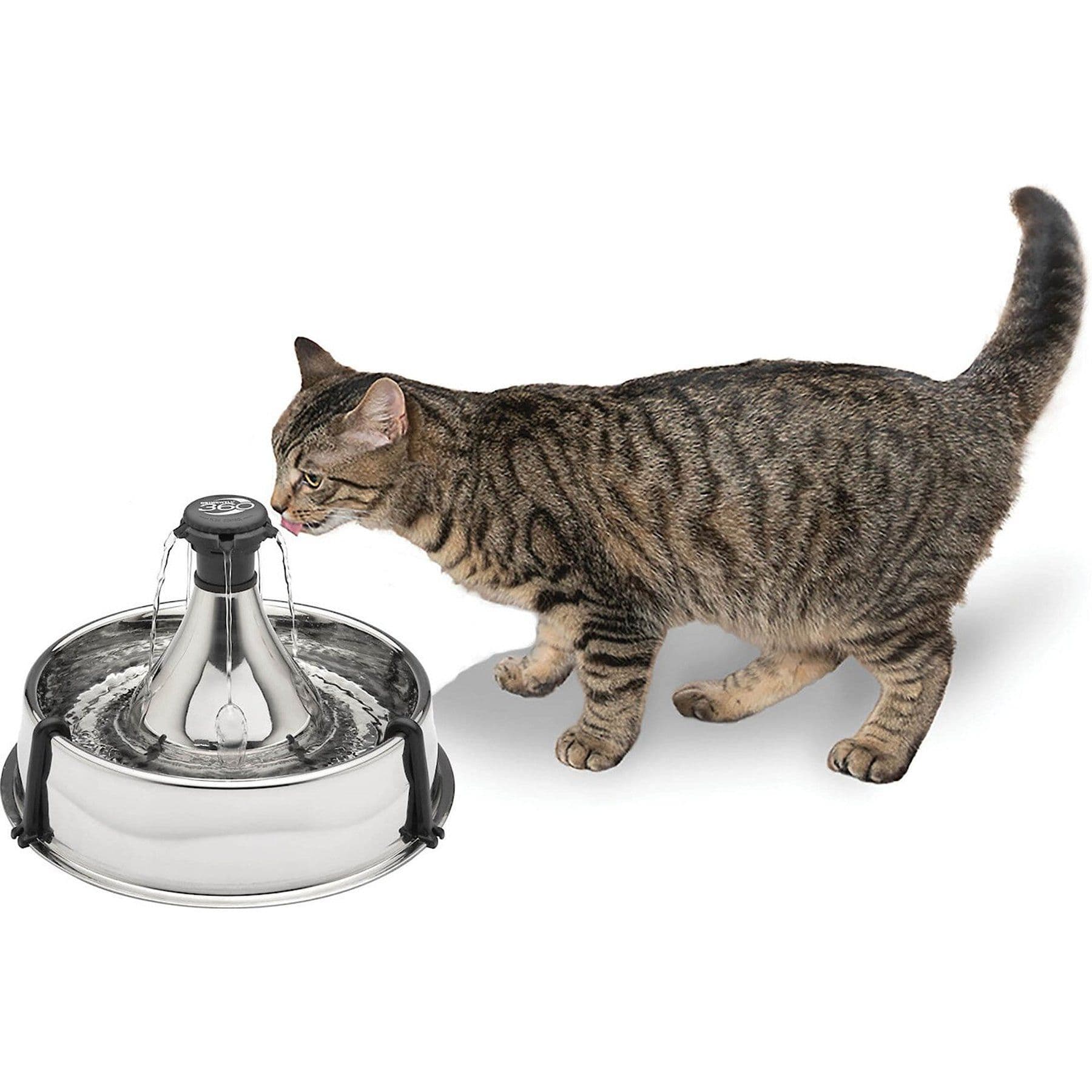
Best for Multi-Cat Homes: PetSafe Drinkwell Stainless Multi-Pet Fountain (PWW00-13705)
Webvet may earn a commission when you click through to Chewy, at no extra cost to you.
The PetSafe Drinkwell Stainless Multi-Pet Fountain PWW00-13705 is the best of these four for a multi-cat household because it pairs a 128-ounce, one-gallon reservoir with a circular drinking area and as many as five free-falling streams. Cats can approach from different sides instead of lining up at one small lip.
That does not guarantee peaceful sharing, but it gives the fountain a better physical layout for simultaneous access than the more compact picks.

The current official product name is Drinkwell Stainless Multi-Pet Fountain. Older listings may call it the Drinkwell 360 Stainless Steel fountain. The plastic Drinkwell 360 is a different product. Match model PWW00-13705 before using the dimensions, replacement filters, or cleaning instructions in this guide.
The fountain measures 14. 3 by 14. 3 by 9. 3 inches, so its capacity comes with the largest footprint in the shortlist. Measure the intended space before ordering, including clearance around the circular bowl. If the fountain is pushed tightly into a corner, the theoretical 360-degree access disappears.
In a multi-cat home, place it where a cat can approach and leave without being trapped by another cat, a dog, a wall, or a noisy appliance.
Flow and materials
Five interchangeable spout rings create different numbers of falling streams, and the flow strength is adjustable. This gives a household more ways to spread access around the tower. It also produces more water sound and more surfaces to disassemble than a soft-bubbling design. Start with a lower flow and fewer streams for a cautious cat, then adjust only after the cat is comfortable using the station.
The bowl and tower are stainless steel, a useful choice for a heavily used shared fountain because the surface is scratch-resistant and the main parts are top-rack dishwasher-safe. The pump must be removed and hand washed. Stainless steel does not prevent feline acne or eliminate microbes on contact.
Its advantage is practical: an intact metal surface tolerates routine washing well, and residue is easier to see than it may be on colored plastic.
Filters and daily use
The fountain uses two filter types. A cylindrical activated-carbon filter sits in the tower, while a foam prefilter catches hair and larger debris before it reaches the pump. PetSafe recommends replacing the carbon filter every two to four weeks and the foam filter every one to two months. At official prices checked August 15, 2026, 12 carbon filters cost $14. 99 and two foam filters cost $6. 99.
Depending on cadence, annual whole-pack purchases are approximately $50. 95 to $86. 91 before tax and shipping.
What one gallon does and does not mean
That wide range is honest because a multi-cat fountain is not used like a one-cat fountain. More mouths mean more saliva, loose hair, food particles, and paw contact. A busy fountain may need water refreshed, surfaces wiped, filters changed, and the pump cleaned sooner than the maximum interval. A one-gallon reservoir reduces refill frequency only if water remains above the pump minimum and stays acceptably clean.
It is not permission to leave the station unchecked for several days.
One useful outage feature is the open lower bowl. If power stops, water remains physically accessible there. You should still keep more than one water station in a multi-cat home, but the design is less dependent on an active stream than a fountain with no reachable basin.
Best fit and tradeoffs
Pros
- A one-gallon reservoir and approach points around the circular bowl.
- Five adjustable streams and top-rack dishwasher-safe stainless main parts.
- An open lower bowl keeps water accessible during a brief power loss.
Cons
- It has the largest footprint in this shortlist, and falling streams can be audible.
- Carbon and foam filters have separate replacement schedules.
- The pump still requires disassembly and hand washing.
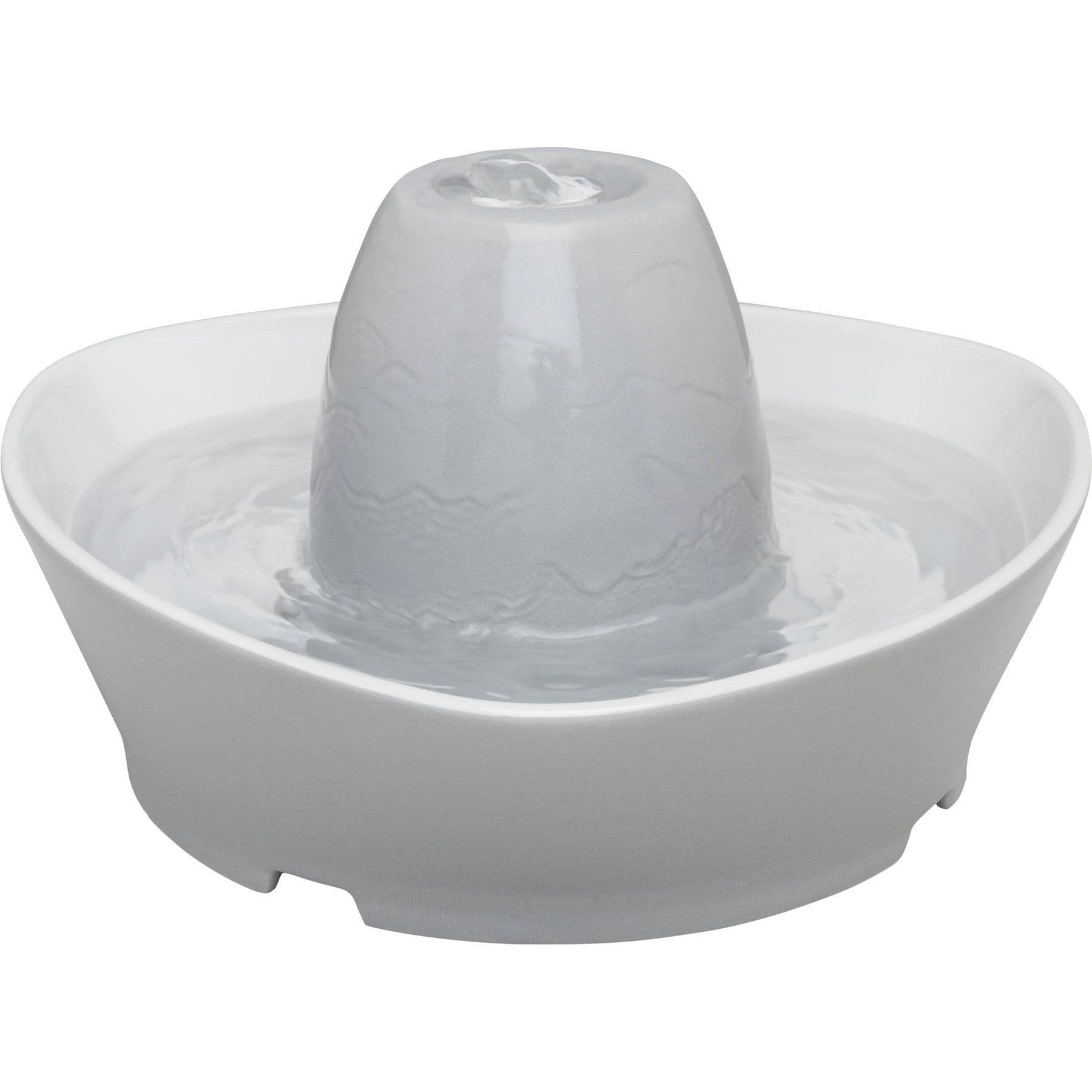
Best Ceramic: PetSafe Creekside Ceramic Pet Fountain (PWW00-17097)
Webvet may earn a commission when you click through to Chewy, at no extra cost to you.
The PetSafe Creekside Ceramic Pet Fountain PWW00-17097 is our ceramic pick for readers who want a compact, open drinking bowl and a softer bubbling presentation. It holds 60 ounces, less than half the Drinkwell Multi-Pet's capacity, and measures 10.2 by 10.2 by 5.4 inches. That makes it a better fit for one cat or a smaller space than for a busy group relying on one shared reservoir.
The Creekside's water bubbles over a low central tower rather than falling in several narrow streams. PetSafe calls the operation quiet or whisper-quiet, but it does not publish a numerical dB result for this model. The accurate description is a soft bubbling flow from a submersible pump. Whether it is quiet enough for a bedroom depends on the individual unit, water level, maintenance, surrounding surface, and the listener.
Weight, stability, and breakage
The glazed ceramic bowl gives the fountain more heft than a light plastic body and presents an open 360-degree drinking area. Greater empty weight and a broad footprint can make a fountain harder to shove, but no model is guaranteed to be unknockable. A determined cat can move water with a paw, catch the cord, or tip a station placed on an uneven surface.
Ceramic can also chip or break if dropped during cleaning.
Cleaning and filter costs
For routine care, the ceramic fountain body can go on the top rack of a dishwasher, while the pump needs hand washing. Inspect the glaze and edges after any impact. Retire a chipped or cracked part that creates a rough edge or a place that cannot be cleaned reliably. The plastic filter housing and other removable parts should follow the exact manual rather than a blanket dishwasher-safe label.
Filter cost
Like the stainless PetSafe model, Creekside uses both an activated-carbon filter and a foam prefilter. The carbon filter addresses taste and odor, while the foam catches larger debris and helps protect the pump. Using the current official pack prices and the manufacturer's general replacement intervals, whole-pack annual spending is approximately $60. 93 to $111. 87 before tax and shipping.
That estimate assumes four to seven four-packs of carbon filters at $9. 99 and three to six two-packs of foam filters at $6. 99. Actual use depends on water conditions and how quickly the filters load.
The 60-ounce capacity asks for more frequent level checks than the other three picks. That can be a positive habit because it keeps the owner engaged with water quality, but it is inconvenient for travel or a multi-cat household. Never allow the pump to run dry, and do not rely on the reservoir as the cat's only water source while you are away.
Best fit and tradeoffs
Pros
- A heavy ceramic body with an open, low-profile drinking area.
- Soft bubbling flow instead of several narrow falling streams.
- The ceramic body is top-rack dishwasher-safe.
Cons
- The 60-ounce reservoir needs more frequent checks than the other picks.
- Ceramic can chip or break, and the pump still needs hand washing.
- It is plug-in only and uses both carbon and foam replacement media.
How to Choose a Cat Water Fountain
Start with the cat and the cleaning routine, not the feature list. A technically elaborate fountain is a poor value if the cat avoids its flow or the owner postpones cleaning because the pump is difficult to reach. The best choice is the model your cat will use and your household can keep clean without resentment.

Choose the drinking presentation first
Some cats lap from a wide still basin. Others investigate a bubbling top or a narrow falling stream. The two controlled water-presentation studies cited in this guide found individual preferences but no consistent average advantage for circulating or free-falling water. That makes adjustable flow useful, not because a stronger stream is medically better, but because it gives you more than one presentation to try.
An open drinking area can be easier for a large cat, a flat-faced cat, or a cat that dislikes putting its head inside a narrow opening. It is reasonable to consider muzzle clearance and posture. It is not reasonable to promise that an open fountain prevents whisker fatigue.
A controlled whisker-friendly feeding-dish study did not find significant differences in food eaten, time spent eating, or food dropped, and it did not study fountains. Treat geometry as a preference question.
Then choose material by maintenance and handling
Stainless steel, ceramic, and plastic can all work when intact and cleaned correctly.
- Stainless steel is relatively scratch-resistant, easy to inspect, and often compatible with a dishwasher when the manufacturer says so. Thin metal parts can still dent, and pumps, gaskets, and plastic housings usually need separate care.
- Glazed ceramic adds weight and can provide a broad, smooth drinking surface. It can chip or break, and a damaged glaze may create an edge or a hard-to-clean area.
- Plastic keeps cost and weight down and allows more complex shapes. Scratches and seams deserve close inspection, and heat-sensitive parts may not be dishwasher-safe.
Published clinical work on feline acne does not establish that a plastic bowl causes the condition or that stainless steel or ceramic prevents it. If your cat develops blackheads, swelling, crusting, or painful chin lesions, clean the food and water surfaces and arrange a veterinary exam rather than trying to diagnose the material at home.
Measure capacity and footprint separately
Reservoir volume tells you how much water the unit can physically hold. It does not tell you how many days it can be ignored. Evaporation, flow setting, splashing, several pets, and the pump's minimum operating level all reduce usable time. A large fountain can also dominate a small feeding area or become difficult to place away from litter boxes and food.
For one cat, the PetSafe Creekside Ceramic PWW00-17097's 60 ounces may be enough when checked daily. The Petlibro Dockstream PLWF115's 2.5 liters and Catit LED Flower #43747's 3 liters offer more margin. The PetSafe Drinkwell Stainless Multi-Pet PWW00-13705's 128 ounces helps in a multi-pet home, but its 14.3-inch circular footprint needs open floor around it if you want cats to use more than one side.
Decide whether power flexibility matters
A plug-in fountain can run continuously but must stay near a safe outlet. A rechargeable fountain can sit farther from a wall, but its battery mode may use timed or motion-triggered flow. Smart features can send reminders or log activity on some products, but a recorded visit is not a medical assessment and an app does not make water cleaner. None of the four picks requires an app.
Place cords where a cat cannot chew, pull, or walk through them. Keep adapters and powered bases dry. A water-resistant mat protects the floor and can reduce vibration against a hard surface. Never use an indoor fountain outdoors unless its manufacturer expressly rates it for that environment.
Treat stability as risk reduction, not a guarantee
A wider base, greater empty weight, lower profile, and nonslip mat can make a fountain harder to move. Fill level changes the center of mass, while an exposed cord or tall tower can give a cat leverage. The most stable setup is level, away from traffic, with the cord secured and enough room for a cat to approach without jumping onto the unit.
Compare cleaning before comparing purchase price
Look at the path from bowl to pump. Can the impeller cover be removed without tools? Are there narrow channels that trap hair? Which exact parts can go in the dishwasher? Are filters sold in economical packs? A fountain that costs less initially but needs 26 filters a year may cost more to own than a model with monthly filters.
Finally, plan more than one water station
Multi-cat environmental guidance generally favors distributed resources so one cat cannot control every bowl, bed, litter box, or route through the home. A 360-degree fountain offers several approach points, but all those points still occupy one location. Keep at least one separate bowl elsewhere, and add more water stations when cats avoid one another, guard resources, or have different preferences.
Best Stainless Steel Cat Water Fountains

Stainless Steel by Household Size
Two of the four picks give the cat a stainless steel drinking surface, but they suit very different homes. The Petlibro Dockstream PLWF115 uses a stainless tray over a plastic reservoir and prioritizes flexible placement. The PetSafe Drinkwell Stainless Multi-Pet PWW00-13705 uses a much larger stainless bowl and tower and prioritizes capacity and access from several sides.
Reservoir capacity, multiple access points, and separated water stations matter in multi-cat households. One large circular fountain can improve approach options, but it cannot keep one cat from controlling the only water location in the home. Keep at least one additional bowl in another room so every cat has a route to water that does not pass the shared fountain.
Choosing for One Cat or Several
For one cat, the Dockstream is the more balanced stainless steel cat water fountain. It occupies less space, can operate away from an outlet, and presents a broad tray without a tall central tower. Its main costs are frequent filters and hand washing. The stainless tray does not make the entire unit dishwasher-safe because the surrounding ABS parts remain heat-sensitive.
For several cats, the Drinkwell's one-gallon reservoir and circular access are more useful. The five stream-ring options can distribute water around the tower, and the open bowl remains reachable when power is off. The main stainless parts are top-rack dishwasher-safe. Its disadvantages are the 14.3-inch footprint, two separate filter types, and the possibility that free-falling streams sound louder than a low bubbling surface.
What Stainless Steel Does and Does Not Do
Stainless steel is appealing because an intact surface is durable, comparatively scratch-resistant, and easy to inspect for residue. It is not self-sanitizing in ordinary fountain use. Hair, saliva, food particles, mineral film, and biofilm can still accumulate in the bowl, filter housing, tubing, and pump. The value of stainless steel comes from how well it tolerates regular cleaning, not from an assumption that bacteria cannot remain on it.
The best stainless steel choice therefore depends less on a material label than on the rest of the system. Pick the Petlibro Dockstream PLWF115 when outlet-free placement and a compact footprint matter most. Pick the PetSafe Drinkwell Stainless Multi-Pet PWW00-13705 when capacity and access from several directions justify the extra floor space. In either case, check the exact model number.
A product name that contains stainless steel does not mean every wetted part is metal or every part can go in a dishwasher.
 $65 · no membership
Worried about your cat's urinary or kidney symptoms?
A licensed vet can examine your cat over video and prescribe treatment online when it's appropriate.
 Talk to a vet
- Licensed vets
- All 50 states
- same-day Rx
Webvet may earn a commission if you book.
Quietest Cat Water Fountains
The most accurate shortlist is therefore the Petlibro Dockstream PLWF115 for a documented manufacturer dB claim and the PetSafe Creekside for a soft bubbling presentation without a numerical rating. The Dockstream's open tray avoids the sound of several long falling streams. The Creekside sends water over a low tower into an open bowl.
Either may be more comfortable in a quiet room than the Drinkwell configured with five free-falling streams, but that is a design inference, not a measured cross-brand result.
Pump condition often matters more than the marketing label. A fountain can become louder when:
- the water falls below the recommended level;
- hair or mineral scale reaches the impeller;
- air is trapped in the pump or tubing;
- the tower, lid, or filter housing is not seated correctly;
- the unit vibrates against a hard counter or hollow cabinet;
- the flow setting creates more falling-water sound than the household wants.
Before replacing a noisy fountain, unplug it, check the water level, clean the pump and impeller chamber, reseat every component, and place the unit on a stable water-resistant mat. Never reach into a powered fountain. If the pump remains unusually loud, hot, intermittent, or weak after cleaning, stop using it and follow the manufacturer's support process.
Sound preference belongs to the cat too. A timid cat may avoid a falling stream but accept a barely bubbling surface. Another cat may approach specifically because the stream is audible. Begin at the gentlest flow, keep the familiar bowl nearby, and let behavior determine the setting. Do not assume that the setting a person can barely hear is automatically the setting the cat prefers.
Best Ceramic Cat Water Fountain
The PetSafe Creekside PWW00-17097 is the only ceramic pick in this guide and the best fit for a reader who values an open, low-profile bowl more than maximum reservoir size. Its 60-ounce capacity and 10.2-inch footprint make it most practical for one cat, an apartment, or a second water station. The soft bubbling flow is less visually and acoustically active than several falling streams.
Ceramic changes both handling and maintenance. The weight can make the unit less easy for a cat to shove, and the glazed body can go on the top rack of a dishwasher. The same material can crack or chip if it is dropped into a sink or knocked against a counter.
Check the bowl and tower after cleaning, and replace damaged pieces rather than continuing to use a rough or difficult-to-clean surface.
What remains non-ceramic
The Creekside is not an all-ceramic machine. It still contains a pump, foam filter, carbon filter, filter housing, gasket, and power components that need their own care. Remove the pump before dishwashing the approved body parts and clean the impeller by hand. A ceramic label should never become permission to put an assembled powered fountain in the dishwasher.
When ceramic fits
If your household needs one gallon of shared capacity or cordless placement, ceramic is the wrong priority. If you want a compact open bowl, can check 60 ounces daily, and are willing to handle breakable parts carefully, the Creekside is the strongest match among the four exact picks.
Cat Fountain Filters and Filtration, Explained
A cat fountain filter is not one single technology. Most cartridges combine layers that solve different physical or chemical problems, and the filter only works while water can pass through it. Understanding each layer makes it easier to reject inflated claims and to notice when the system needs attention.

What is the best water filtration system for cats?
There is no single best water filtration system for every cat. Start with potable source water, then choose a compatible filter and fountain the household can maintain. Carbon, mesh, foam, and ion-exchange filtration have distinct roles and do not make unsafe source water potable. The best system is the one that controls the expected debris or taste issue without replacing regular water changes and cleaning.
Mesh and foam catch larger material
A mesh pad can collect hair, crumbs, and visible debris. A foam prefilter protects the pump from larger particles and helps maintain flow. These layers are mechanical barriers. They do not remove every dissolved substance, and they do not disinfect water.
Activated carbon addresses taste and odor
Carbon can adsorb some compounds that affect how water smells or tastes. That may make the water more acceptable to an individual cat, but a small pet-fountain cartridge is not a complete household water-treatment system. Carbon becomes less useful as sites fill, which is one reason manufacturers specify replacement intervals.
Ion-exchange resin changes some dissolved minerals
Catit's filter and Petlibro's multi-layer filter include ion-exchange media. In plain language, the resin exchanges certain ions and can reduce some calcium and magnesium associated with hard water. That may reduce mineral deposits in the fountain. It does not prove the fountain prevents urinary crystals or lower urinary tract disease. Urinary disorders have multiple causes and require diagnosis, not a filter advertisement.
The four picks use three practical arrangements:
- Petlibro PLWF115 uses a proprietary four-layer Dockstream cartridge and calls for replacement about every two weeks.
- Catit #43747 uses the round Triple Action Flower Fountain filter with mesh, carbon, and ion-exchange resin, usually replaced about every 30 days or sooner when saturated.
- PetSafe PWW00-13705 uses a cylindrical Drinkwell 360 carbon filter plus a foam prefilter.
- PetSafe PWW00-17097 uses a compatible Drinkwell carbon filter plus a foam prefilter.
A no-filter fountain can reduce consumable spending, but it transfers more debris control to cleaning and source-water quality. Circulation alone does not remove hair, saliva, food particles, minerals, or organisms. If you leave a filter out of a model designed to use one, debris may reach the pump sooner and the intended flow path may change. Follow the exact manual instead of improvising around the filter housing.
Some shoppers describe that choice as a filtered cat water fountain, a cat water fountain without a filter, or a no filter required stainless fountain. Those phrases describe consumable design, not water safety. A filter-free path still needs potable water, frequent cleaning, and pump inspection, while a filtered path still needs the reservoir and wetted surfaces washed.
UV-C claims need separate evidence
UV-C is another feature shoppers encounter, although none of the four locked picks depends on it. A percentage such as 99. 9 percent sterilization is not meaningful without model-specific information about UV dose, flow, exposure time, water clarity, lamp condition, and the validation method. General EPA water-treatment guidance is not certification of a pet fountain.
Even a validated UV stage would not remove hair from a pump or biofilm from an unwashed seam.
When to Replace a Filter
- the filter is visibly saturated or discolored beyond the expected initial rinse;
- flow remains weak after the pump and water level are checked;
- hair or food debris has loaded the outer layer;
- odor or taste returns;
- several pets use the fountain heavily;
- the manufacturer's instructions call for a shorter interval because of water conditions.
Do not wash a disposable carbon or ion-exchange cartridge with soap. Soap can remain in the porous media and enter the drinking water. Prepare a new filter exactly as directed, which may include tapping, rinsing, soaking, or pressing out trapped air. If black carbon dust appears during the first rinse, continue rinsing according to the manual before installing it.
Most importantly, begin with potable water. No cartridge in this roundup is represented as making contaminated water safe. If you would not drink the source water under local guidance, do not expect a cat fountain to correct it.
Cleaning, Maintenance, and Annual Filter Costs
The cleanest cat water fountain is the one an owner fully disassembles on schedule. If you want a cat water fountain that doesn't get slimy, cleaning frequency matters more than a self-cleaning label. A polished bowl can look fine while hair, slime, or mineral deposits collect inside the pump housing. Filters slow some debris, but they do not scrub wetted surfaces.

Use this repeatable routine, adjusted to the exact manual:
- Disconnect power. Unplug the adapter or remove the reservoir from its powered base. Keep connectors and electrical parts dry.
- Discard the old water. Do not top off indefinitely. Emptying the reservoir lets you inspect every surface.
- Remove the filter. Dispose of it when due. If it is still within its service period, set it aside without applying soap.
- Take apart the water path. Remove the top, tower, tray, filter housing, tubing, pump cover, and impeller when the manual permits.
- Wash approved hard parts. Use warm water, a soft sponge, and a mild dish detergent, or use the top rack of a dishwasher only for parts expressly approved by the manufacturer.
- Brush the pump. Clean the impeller chamber, intake, outlet, and narrow channels with a small dedicated brush.
- Rinse thoroughly. No visible soap, loosened residue, or cleaning odor should remain.
- Inspect before reassembly. Look for cracks, chipped glaze, deep scratches, damaged cords, worn gaskets, and a stiff or damaged impeller.
- Prepare the filter. Rinse or soak a new cartridge as its instructions require. Never use soap on it.
- Refill with potable water. Reassemble, fill above the pump minimum, dry the outside and connectors, then restore power and confirm normal flow.
How often should this happen? Refresh drinking water daily whenever practical and inspect the fountain every day for level, debris, and flow. For cats with lower urinary tract disease, the 2025 iCatCare consensus guidance advises cleaning or changing bowls and fountains at least every other day.
The manufacturer's longer interval usually refers to a deep clean, pump service, or filter replacement, not permission to leave the water untouched until that date.
The following cost comparison uses filter prices checked on August 15, 2026. Purchase price, replacement-filter interval, pump care, and annual maintenance cost affect long-term value, so this ownership comparison combines maintenance burden and replacement-filter spending as total ownership work. It excludes tax, shipping, promotional discounts, replacement pumps, brushes, electricity, and the value of cleaning time.
Prices can change, so the cadence and compatible SKU matter more than the exact total.
| Exact pick | Manufacturer filter cadence | Current pack basis | Estimated annual replacement-filter spending | Core cleaning work |
|---|---|---|---|---|
| Petlibro Dockstream PLWF115 | About every 2 weeks | 8 filters for $22.99 | 4 packs, about $91.96 | Hand wash all fountain parts; disassemble pump; no dishwasher |
| Catit LED Flower #43747 | About every 30 days or when saturated | 12 filters for $44.99 | 1 pack, about $44.99 in ordinary first-year use | Hand wash flower, top, reservoir, and channels; disassemble pump about every 2 weeks |
| PetSafe Drinkwell Stainless Multi-Pet PWW00-13705 | Carbon every 2 to 4 weeks; foam every 1 to 2 months | 12 carbon for $14.99; 2 foam for $6.99 | About $50.95 to $86.91 | Top-rack dishwasher for approved bowl and tower; hand wash pump; expect heavier multi-pet debris |
| PetSafe Creekside Ceramic PWW00-17097 | Carbon every 2 to 4 weeks; foam every 1 to 2 months | 4 carbon for $9.99; 2 foam for $6.99 | About $60.93 to $111.87 | Top-rack dishwasher for approved ceramic body; hand wash pump; inspect glaze for damage |
Whole-pack spending is intentionally different from prorated filter consumption. You cannot buy one quarter of a package, and unopened filters carry into the next year. The estimates also assume the current compatible packs remain available. Before buying any replacement, match the exact model and filter shape rather than relying on the word Dockstream, Drinkwell, or Flower alone.
Cost is only half the maintenance burden. The Petlibro Dockstream PLWF115 asks for the most frequent filter reminder and full hand washing. The Catit LED Flower #43747 has the least expensive ordinary annual filter figure here, but its flower and channels create more shapes to clean. The PetSafe Drinkwell Stainless Multi-Pet PWW00-13705 has dishwasher-friendly stainless parts but sees heavier shared use.
The PetSafe Creekside Ceramic PWW00-17097 has dishwasher-friendly ceramic parts but a smaller reservoir and breakage risk. The right choice is the routine you will continue after the novelty wears off.
Are Cat Water Fountains Worth It?
A cat water fountain is worth it when it adds a water station the cat chooses and the owner can keep clean. It is not worth it when the cat avoids the flow, the pump sound is disruptive, proprietary filters are hard to obtain, or cleaning gets postponed until the reservoir feels slimy. That individual cat preference is not the same as a clinically established hydration outcome.
The strongest reasons to buy are practical:
- your cat repeatedly seeks moving water from a faucet or shower;
- an adjustable stream gives the cat more presentation choices;
- a larger reservoir reduces the chance that a small bowl runs dry between daily checks;
- a circular design gives several cats more than one approach point;
- a water-level window or visible bowl makes daily checks easier;
- the fountain can be placed in a quiet location away from food, litter, and conflict.
The weakest reasons are medical promises. A fountain cannot guarantee more drinking, and it cannot correct an obstruction, infection, kidney disease, or a diet that does not meet the cat's needs. If total water intake is the concern, discuss wet food, adding water to food when accepted, and other individualized strategies with the veterinarian.
A controlled study of healthy cats found that higher dietary moisture increased total fluid intake and diluted urine more reliably than a change in water presentation alone, although that small study is not a prescription for every cat.

Introduce the fountain as an addition, not a sudden replacement. Put it in a calm location and keep the familiar bowl available several feet away or in another room. Begin with a gentle flow. Let the cat approach without being carried to the water or having a paw placed in it.
If the cat drinks reliably, keep both formats for at least several days before deciding whether to change the setup.
Do not remove every still bowl after the transition. A second station remains useful during cleaning, charging, pump failure, a power outage, or a disagreement between cats. It also gives the cat a genuine choice, which is the only way to learn whether moving water is preferred.
Do Vets Recommend Water Fountains for Cats?
Veterinarians may recommend trying a fountain as one way to offer water, especially when a cat seems attracted to moving water or when a broader care plan aims to increase water intake. That is a conditional recommendation for a water-station format, not an endorsement of one commercial model and not evidence that every cat drinks more from a fountain.
What the evidence shows
The 2025 International Cat Care consensus guidelines on feline lower urinary tract disease place fountains alongside several other options: provide water in multiple locations, try different bowl types, offer moving water when the cat prefers it, feed wet food, and add water to food when accepted. The list itself is the important point. Good hydration planning uses more than one route and adapts to the individual cat.
Controlled research supports that restraint. In one crossover study of healthy cats, a fountain produced only a slight increase in water consumption and did not significantly reduce urine osmolality. One cat refused the fountain. A later controlled comparison of still, circulating, and free-falling water found no significant average differences in water intake, urine volume, urine specific gravity, or urinary relative supersaturation, although individual cats showed preferences.
That evidence does not mean fountains are useless. It means the honest benefit is choice and access, not a guaranteed physiological result. A cat that prefers a stream may drink from it more readily. A cat that dislikes the pump may drink less until a still bowl returns. Watch the cat rather than treating the product category as the intervention.
For preventive context, the buying advice here connects to WebVet's feline urinary authority cluster with explicit treatment boundaries. WebVet's guide to feline urinary health and hydration explains how water access fits into a broader plan. If a veterinarian has mentioned crystals in cat urine, use that clinical explanation rather than relying on filter marketing. If you are seeing cat urinary symptoms, product selection can wait.
Kidney disease and changes in thirst
Kidney disease needs the same boundary. IRIS treatment recommendations for feline chronic kidney disease emphasize access to fresh water and individualized hydration management. They do not identify a best fountain or say that buying one slows disease. A cat with CKD may need dietary, medication, fluid, and monitoring decisions that only the treating veterinary team can tailor.
Also pay attention to change. A cat suddenly emptying the fountain, visiting it constantly, or drinking much more than usual is not proof that the new product is a success. New thirst can accompany kidney disease, diabetes, hyperthyroidism, medication effects, heat, or other conditions. WebVet's discussion of changes in a cat drinking water can help frame the observation, but a persistent or marked change deserves a veterinary call.
The practical recommendation
The most useful vet-informed buying advice is therefore modest: offer clean water in more than one location, choose surfaces and flows the cat accepts, keep the equipment clean, measure behavior rather than trusting a promise, and never let a consumer product delay medical care.
Cat Water Fountain Questions
Use these five answers as a final buying check. They cover the substantive reader questions that most affect the decision: stability, filter care, material choices, urinary limits, and maintenance. The right fountain must stay reasonably stable, accept the correct filter, suit your preferred material, respect medical boundaries, and fit the cleaning routine you can maintain.
Frequently Asked Questions
What is the best water fountain that cats can't knock over?
The best water fountain for cats that knock bowls over is still not unknockable. A wide base and higher empty weight can reduce tipping or shoving, but there is no unknockable guarantee. Of these four, the PetSafe Creekside Ceramic has a broad, low ceramic body, while the PetSafe Drinkwell Stainless Multi-Pet has a wide 14.3-inch circular footprint. Put any fountain on a level nonslip, water-resistant mat, secure the cord, keep it out of traffic, and leave a separate water bowl elsewhere. Do not use filled weight alone as proof, because the water level and center of mass change throughout the day.
How often should cat fountain filters be replaced?
Cat fountain filters should be replaced at the manufacturer's replacement interval, or sooner when visible saturation, reduced flow, debris loading, or odor appears. Petlibro recommends about every two weeks for the PLWF115. Catit recommends about every 30 days for the LED Flower #43747. PetSafe recommends carbon filters every two to four weeks and foam filters every one to two months for the two PetSafe picks. Multi-pet use, hard water, food debris, and heavy shedding can shorten those intervals. Filter replacement does not replace washing the reservoir and pump.
Is a stainless steel cat water fountain better than plastic?
A stainless steel cat water fountain is not automatically better than plastic. Compare scratch resistance and cleanability rather than assuming one material wins. Stainless steel is often easier to inspect, comparatively scratch-resistant, and dishwasher-friendly when the exact part is approved for the top rack. Plastic is lighter, usually less expensive, and allows more flow shapes, but scratches and heat-sensitive parts need careful attention. No material prevents feline acne, and good primary evidence does not establish that plastic bowls cause it. Choose by condition, weight, flow design, and the cat's preference.
Can a cat water fountain prevent urinary problems?
No. A fountain is one water option, not prevention or treatment. Some cats may prefer moving water, but controlled studies do not show a consistent intake or urine-dilution effect for every cat. It cannot prevent or treat infection, crystals, obstruction, feline lower urinary tract disease, or kidney disease. Urinary prevention and treatment depend on the diagnosis and may involve diet, environmental changes, medication, or other veterinary care. Straining with little or no urine is an emergency.
How much work is a cat water fountain to maintain?
How much work a cat water fountain takes to maintain depends on its design. Expect pump and reservoir cleaning, a brief daily check of water level, flow, and visible debris, frequent water replacement, and filter changes every two weeks to two months depending on the model and filter type. Dishwasher-safe parts reduce scrubbing but do not eliminate pump care. Include replacement-filter spending when you compare ownership work. Before buying, price the exact filters for a full year and confirm that you are willing to disassemble the pump. Stable fountain selection and filter care matter more than a long feature list; a simpler bowl is safer than a fountain that will not be maintained.
$65 · no membershipWorried about your cat's urinary or kidney symptoms?
A licensed vet can examine your cat over video and prescribe treatment online when it's appropriate.
Talk to a vet- Licensed vets
- All 50 states
- same-day Rx
Webvet may earn a commission if you book.

Editor
The Webvet Editorial Team is the in-house group of pet-care editors and writers behind Webvet, operated by Smart Pet Collective. The team researches, writes, and maintains Webvet's pet health, behavior, and medication content. Every article follows a defined editorial process: research from reputable veterinary and scientific sources, careful drafting, mandatory review of medical content by a credentialed veterinarian, and dated publication. Health and medication articles are medically reviewed by a licensed veterinary professional before they go live and are kept current over time.
Veterinarian · BVMS MRCVS
Dr. Pippa Elliott, BVMS, MRCVS, is a veterinarian with nearly 30 years of experience in companion animal practice. Dr. Elliott earned her Bachelor of Veterinary Medicine and Surgery from the University of Glasgow. She was also designated a Member of the Royal College of Veterinary Surgeons. Married with 2 grown-up kids, Dr. Elliott has a naughty Puggle named Poggle, 3 cats and a bearded dragon.
Related reading

Kidney Disease in Dogs: Why Tracking Water Intake Can Help Your Vet

Dog Bladder Stones: Symptoms, Treatment, and Surgery Costs

Dog Straining to Urinate: Is It a UTI, Blockage, or Emergency?
