Best Enzyme Cleaner for Cat Urine: Choosing by Surface
Compare four enzyme cleaners for cat urine by surface compatibility, exact application directions and price. Learn why contact time, drying and contamination in padding or underlay affect the result.

BVMS MRCVS
Medically reviewed by Dr. Pippa Elliott, BVMS MRCVS · Last reviewed

This article contains affiliate links. Webvet may earn a commission when you buy through them, at no extra cost to you.
The best enzyme cleaner for cat urine is one whose label matches the material you need to clean and whose directions let it reach the entire urine deposit. A spray that works on washable carpet may be unsuitable for wool, leather or an unsealed floor. Even a suitable product can disappoint when the urine has reached padding or underlay that the treatment never touches.
This guide compares four exact products by label instructions, surface fit and practical limitations. We did not conduct a hands-on stain-removal test, so there is no invented performance winner. The useful distinction is which product's application method fits the mess you actually have, including the time and access needed to complete the job.
Best enzyme cleaners for cat urine: match the surface
For ordinary water-safe carpet, Nature's Miracle Cat Urine Destroyer Plus and Simple Solution Extreme Cat offer explicit cat-urine directions. Urine Off provides detailed instructions for different substrates and older deposits. Rocco & Roxie Professional Strength is another stain-and-odor option, but its online instructions give differing contact times, so the purchased bottle's directions deserve particular attention.
An enzymatic cleaner is intended to break down components of organic messes rather than only cover the smell with fragrance. Some formulas also use bacteria that produce enzymes. The wording “enzyme cleaner” does not specify a universal concentration, disinfecting ability, surface permission or drying time. It also does not mean the liquid is intended for a cat's skin or fur.
- 1Choose the exact formula for the surface and follow its label directions.
- 2Spot test before treatment, and keep cats away from the wet area and cleaning supplies.
- 3Match application to urine penetration, including underlay when the material permits that treatment.
- 4Do not mix cleaners or substitute one brand's dwell time for another's.
- 5Repeated accidents need attention to the cat's health and litter-box situation as well as cleaning.
Before choosing a bottle, answer three questions:
- What is the material, including the hidden layer beneath the visible surface?
- Is the deposit fresh, dried or repeatedly soaked in the same place?
- Has another chemical or cleaning machine already been used there?
Those details help distinguish a straightforward surface cleanup from a job requiring access to padding or a professional assessment. A small visible spot on carpet is not a reliable measure of how far urine spread underneath. On a sofa, the cover and foam filling are different materials with potentially different care instructions. On a floor, an intact seal and an open seam create different routes for liquid.
Check the item's own care label as well as the cleaner label. Permission to use a cleaner on “water-safe upholstery” does not make every sofa water-safe. If the upholstery requires solvent-only or professional cleaning, stop and ask its manufacturer or a cleaner familiar with that fabric. A spot test checks a local reaction; it does not prove that deeply wetting the whole item is safe.
What counts as a useful product comparison?
A useful comparison identifies the exact variant, not just the brand. Nature's Miracle sells multiple formulas; Simple Solution Cat Extreme is not automatically the same as a general dog-and-cat product. Rocco & Roxie Professional Strength should not inherit instructions or surface promises from the brand's Extreme formula. The bottle size matters too: the Rocco & Roxie selection here is 24 fluid ounces, while the other three are 32 fluid ounces.
Price per fluid ounce helps compare purchase size, but it cannot establish cost per successful cleanup. That depends on how much liquid the material needs, whether the deposit extends into another layer and whether repeat treatment is allowed and necessary. A cheap bottle used as a light mist on a deep deposit may accomplish less than a properly applied treatment. Buying more liquid also does not solve an incompatible surface.

Four enzyme cleaners compared
The table compares the selected packages and their main application differences. Prices were captured October 2, 2026 and exclude tax, shipping and discounts. Treat them as a dated buying reference. None of the listed prices or manufacturer strength claims proves that one cleaner removes more urine than another in a controlled comparison.
| Product and package | Best-fit use | Format and application | Price reference | Main limitation |
|---|---|---|---|---|
| Nature's Miracle Cat Urine Destroyer Plus, 32 fl oz | Cat urine on label-compatible carpet, furniture and hard surfaces | Ready-to-use enzymatic liquid; soak 15 minutes, then blot; tough odors use reapplication and air drying | $12.72; about $0.40/fl oz | Not for untreated hardwood, leather, suede, silk or wool specialty fabrics |
| Rocco & Roxie Professional Strength, 24 fl oz | Compatible carpet or upholstery when exact-bottle instructions are available | Stain-and-odor liquid; manufacturer web contact times differ, so follow the purchased label | $17.94; about $0.75/fl oz | Do not transfer Extreme variant claims or assume safe saturation of wood |
| Simple Solution Extreme Cat, 32 fl oz | Water-safe carpet, upholstery and fabric with distinct stain or odor needs | Sprayer with foam, mist and stream; five-minute urine-stain step; 24–48-hour natural drying | $14.99; about $0.47/fl oz | Not for wool or leather; odor application differs from stain treatment |
| Urine Off Cat & Kitten Formula, 32 fl oz | Deposits needing substrate-specific saturation and drying instructions | Ready-to-use bio-enzymatic liquid; follow separate fresh, old and surface directions | $15.99; about $0.50/fl oz | Contact must reach the full deposit; cleaning cannot reverse all material damage |
Nature's Miracle Cat Urine Destroyer Plus: clear everyday cat-urine directions
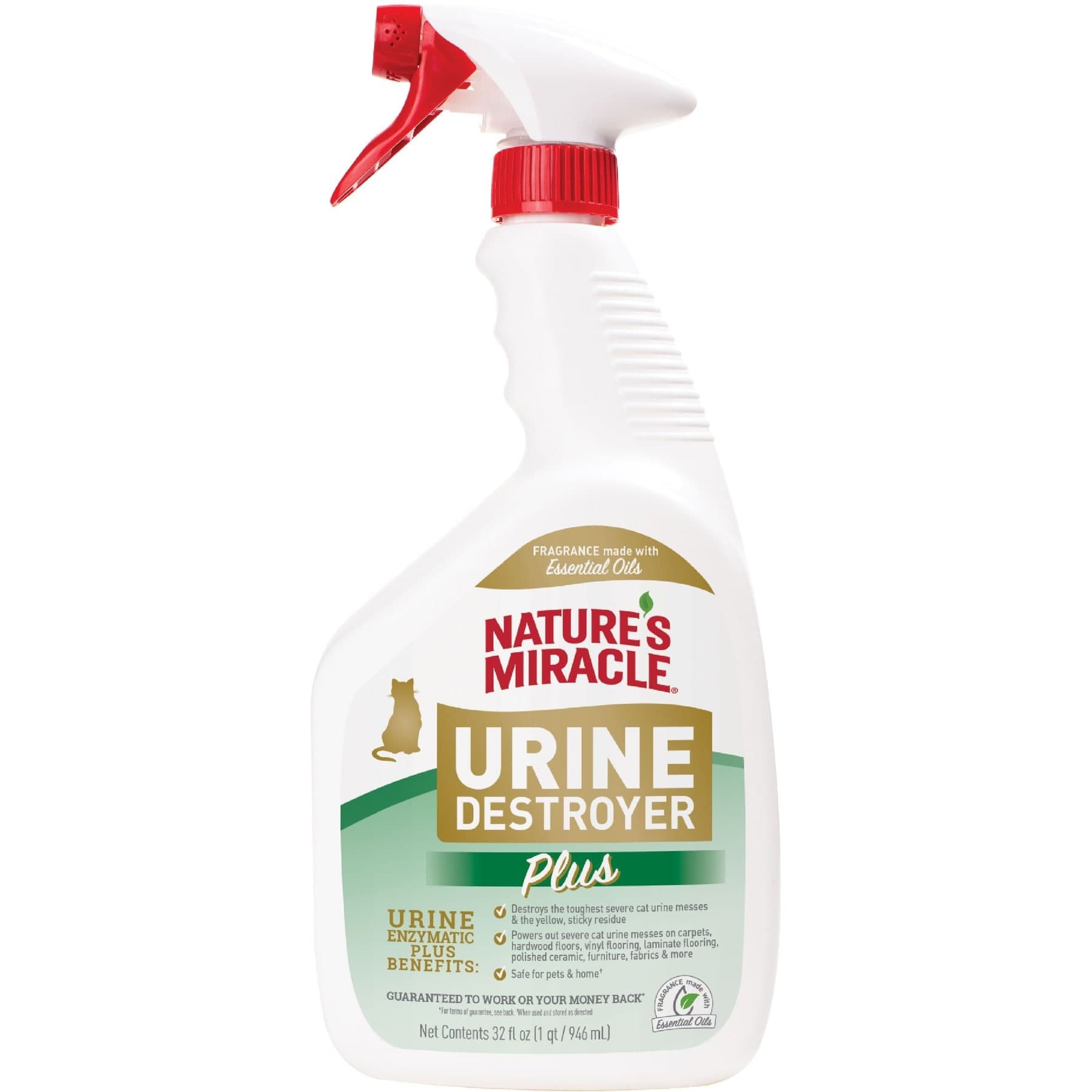
A 32-fluid-ounce cat-urine formula with a 15-minute contact step. Check material exclusions, including untreated wood, wool and leather, before use.
Webvet may earn a commission when you click through to Chewy, at no extra cost to you.
Nature's Miracle Cat Urine Destroyer Plus is a cat-specific bacteria-based enzymatic formula in the selected 32-fluid-ounce bottle. Its straightforward application makes it worth considering for a compatible household surface when you can wet the affected area as directed and allow adequate drying afterward.
The manufacturer's Cat Urine Destroyer Plus directions specify full-strength application, a 15-minute soak and blotting with a clean cloth. For difficult odors, the directions call for resoaking and air drying. A quick spray followed by immediate wiping does not follow that process.
The exclusions matter as much as the application:
- Do not use on untreated hardwood.
- Do not use on leather or suede.
- Do not use on silk or wool specialty fabrics.
- Test an inconspicuous area before treating the visible stain.
Those restrictions make it a poor first choice for an unidentified rug or an unfinished floor, even if the container says it works on many household messes. Check the actual bottle because formulas and packaging can change. The product's compatibility with one fabric does not imply permission to flood the cushion or furniture structure underneath it.
At the captured $12.72 price, the selected bottle costs about $0.40 per fluid ounce. That is the lowest unit purchase price of these four packages, not an efficacy ranking. A small compatible fresh spot and a repeatedly soaked carpet corner can require very different quantities, so there is no honest fixed “cost per accident” without knowing the job.
Rocco & Roxie Professional Strength: match the bottle to the instructions
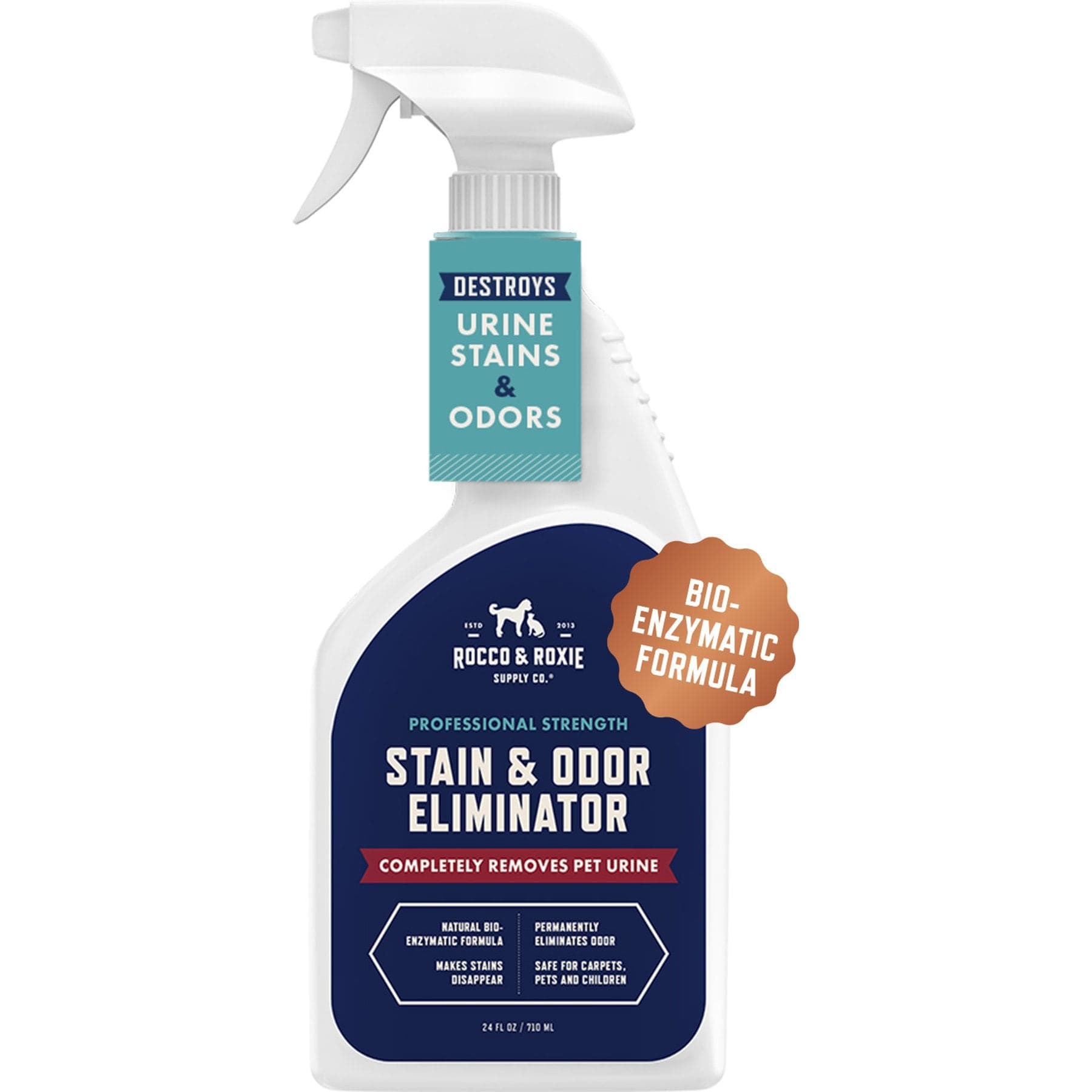
The 24-fluid-ounce Professional Strength formula for compatible stains and odors. Follow the exact bottle directions rather than transferring another variant’s instructions.
Webvet may earn a commission when you click through to Chewy, at no extra cost to you.
The selected Rocco & Roxie Professional Strength Stain & Odor Eliminator is the 24-fluid-ounce bottle. It is marketed for pet stains and odors on materials such as carpet and upholstery. The reason to consider it is the fit of the actual formula and its directions to your material, not the implication that “professional strength” guarantees a better outcome.
Its manufacturer instructions page presents more than one contact-time sequence:
- One section describes at least 10 minutes, with longer treatment for older spots.
- Another gives 30 minutes followed by a weighted-towel step.
We would not combine those into a new invented universal direction. Follow the exact bottle you receive, or ask the manufacturer to clarify before treating a valuable or sensitive item.
This distinction is especially important when searching online. Instructions for the brand's Extreme product do not automatically apply to Professional Strength. An apparently similar bottle name is not enough to transfer a claim about leather, silk, wool or another sensitive material. Confirm the product and the material together.
For a carpet deposit, think about removal and access as well as chemistry:
- If the instructions call for blotting or extracting liquid before application, do that step rather than spraying onto an already flooded area.
- On wood, prolonged saturation can itself be a problem. Permission to use a water-based cleaner should never be interpreted as unlimited soaking.
At $17.94 for 24 fluid ounces, this package is approximately $0.75 per fluid ounce. The smaller bottle can be convenient for limited use, but compare the quantity you actually need. Do not buy it on the assumption that a higher unit price establishes stronger biological performance; this guide did not test that claim.
Simple Solution Extreme Cat: separate stain and odor application
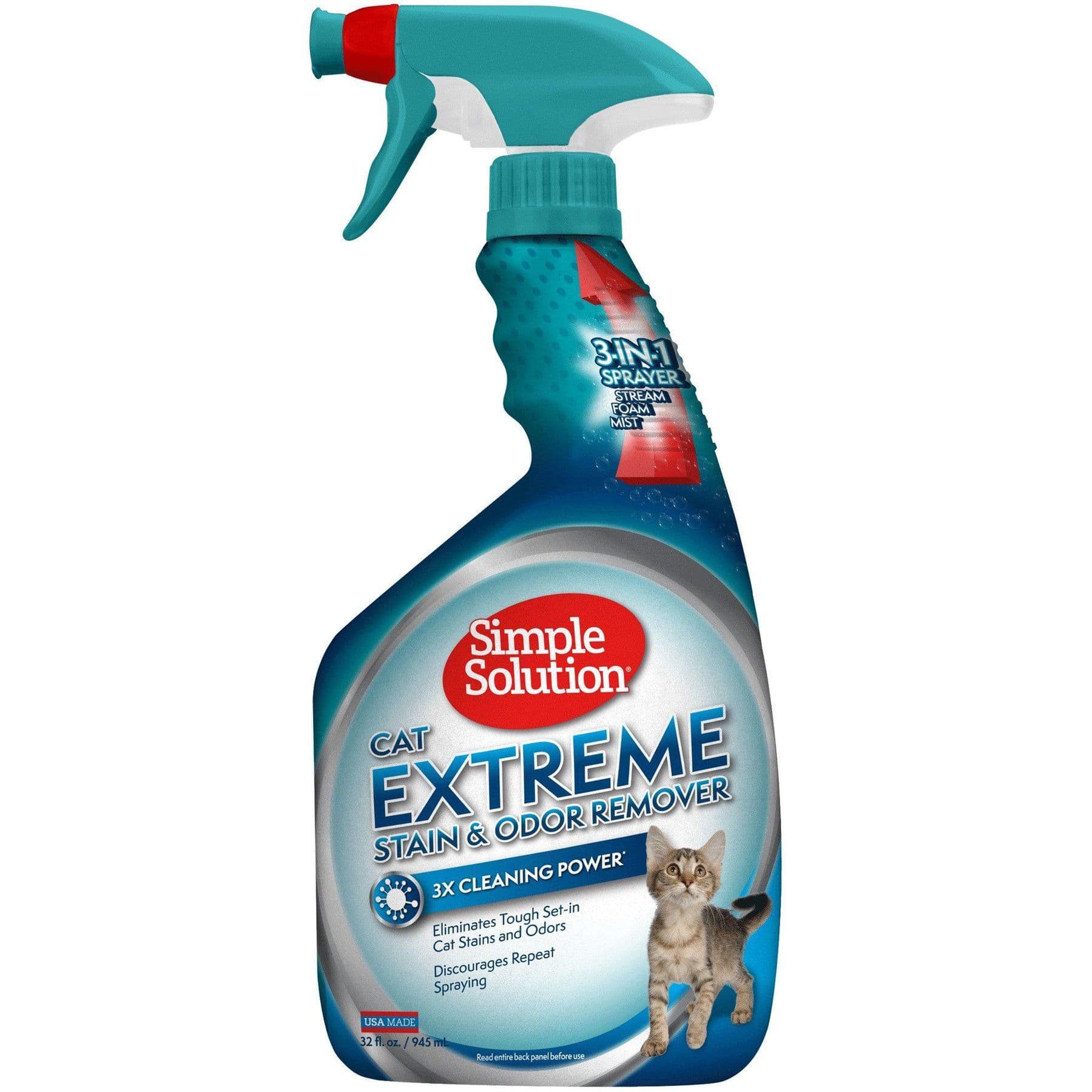
A 32-fluid-ounce Cat Extreme formula with separate stain and odor directions. Use on permitted water-safe materials and allow the stated drying time.
Webvet may earn a commission when you click through to Chewy, at no extra cost to you.
Simple Solution Extreme Cat Stain & Odor Remover provides separate procedures for visible urine stains and urine odor. That distinction is useful: a surface mark and an odor trapped deeper in fabric are not always the same cleaning task. The selected product is a 32-fluid-ounce bottle with foam, mist and stream settings.
The Cat Extreme manufacturer label says to remove excess waste and test for color change first. For urine stains, its foam application sits for five minutes before blotting. If the stain persists, the label allows another application. Natural drying takes 24–48 hours, followed by vacuuming when dry.
For urine odor, the label instead uses the stream setting over twice the area of the urine spot, with excess blotted and the same 24–48-hour natural drying period. That does not mean every material should be flooded indiscriminately. The permitted surface must still be water-safe, and the underlying construction must tolerate the treatment.
- The product excludes wool and leather.
- Use the urine directions, not the different timing given for blood or vomit.
- Keep the nozzle setting consistent with the task rather than assuming fine mist reaches deep contamination.
- Reserve the full drying period before judging the result or returning the area to normal use.
The captured price is $14.99, or about $0.47 per fluid ounce. A homeowner who can close off the affected room may find the drying period manageable. If the area is the only passage to food, water or litter, arrange an alternative route first. That is part of choosing a workable cleaner, not an afterthought once the floor is wet.
Urine Off Cat & Kitten: detailed directions for deeper deposits
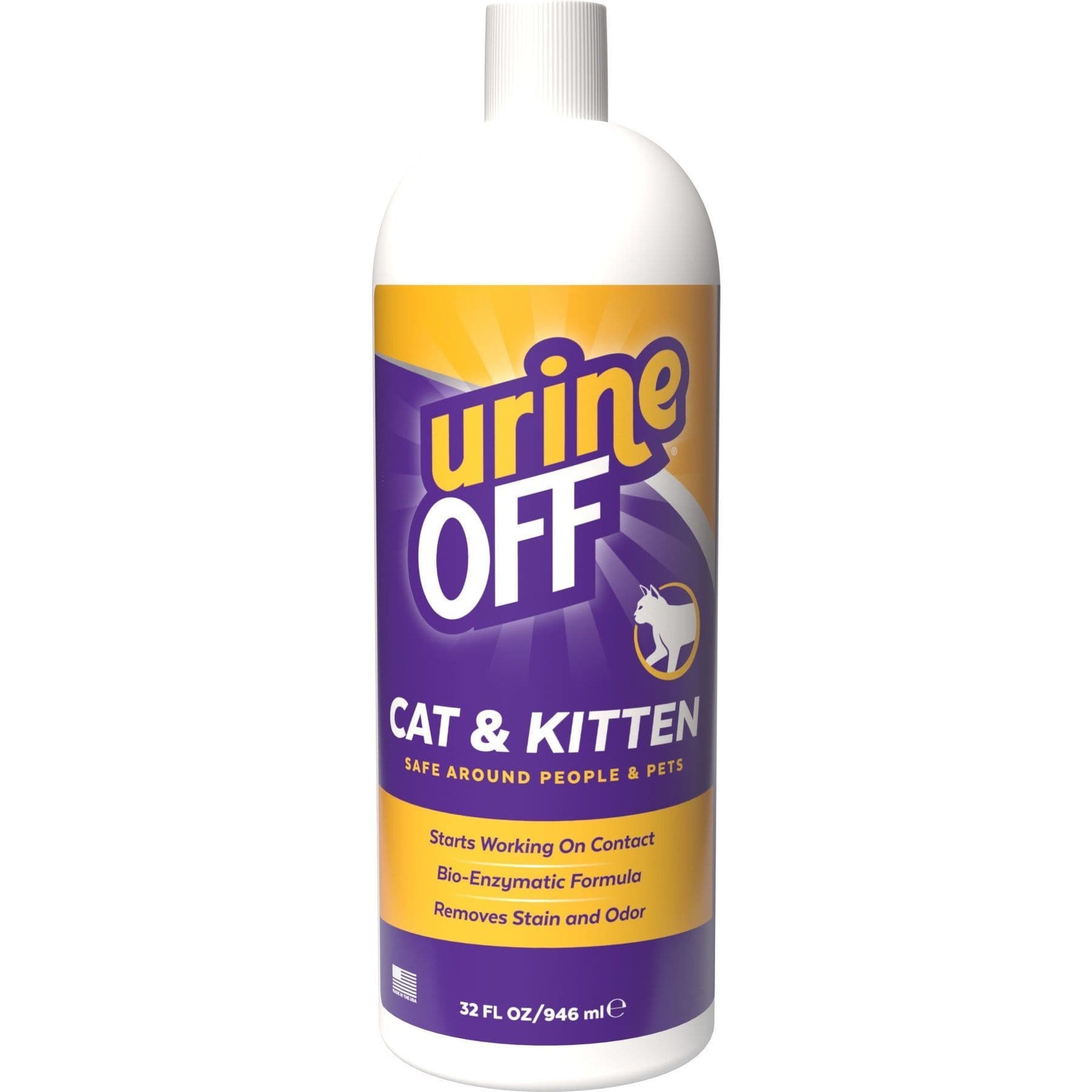
A 32-fluid-ounce Cat & Kitten formula with detailed substrate-specific guidance. Match treatment to the deposit’s depth and the material’s moisture limits.
Webvet may earn a commission when you click through to Chewy, at no extra cost to you.
Urine Off Cat & Kitten Formula is the selected 32-fluid-ounce ready-to-use option. Its main practical advantage in this comparison is the manufacturer's separate guidance for fresh and old deposits on different materials. That detail can help an owner recognize when a surface treatment is failing to reach the actual source.
The manufacturer's Cat & Kitten product information identifies the formula and says not to dilute it. The selected package size differs from the refill page, so use the directions on the actual bottle for the applicator and check the manufacturer's surface-specific instructions when needed.
This is a useful choice to consider when you can access the affected layer and follow the appropriate process. It is less useful when the contaminated foam, pad or subfloor is inaccessible or cannot safely be wetted. No enzyme formula solves a physical access problem merely by being sprayed on top.
- Fresh deposits need their own removal and drying process.
- Older carpet stains may require a different contact method.
- Laundry pretreatment timing is not carpet drying time.
- General old-porous-deposit instructions should not replace the more specific hardwood instructions.
At $15.99, the selected bottle costs about $0.50 per fluid ounce. Budget for the actual affected area and the possibility of permitted repeat treatment. Urine Off also notes that cleaning cannot reverse wood tannin damage. A floor that no longer smells may still need repair or refinishing for discoloration; that is a different outcome from removing the odor source.
Carpet, upholstery and sealed hard floors need different care
The first surface decision is whether water-based treatment is appropriate at all. The second is whether you can safely reach the depth of the deposit. Buying a cleaner before answering those questions can leave you with a bottle that is suitable for the visible face of the material but unsuitable for its backing, finish or filling.

Carpet and rugs: identify the fiber and backing
Read the rug or carpet care instructions before selecting an enzyme cleaner. Wool is an explicit exclusion for the selected Nature's Miracle and Simple Solution products. Silk and some specialty constructions need particular care too. A synthetic-looking surface does not prove the entire rug is washable, and an unknown fiber is a reason to identify it rather than experiment with a full application.
On compatible carpet, blot fresh urine first. Then use the chosen cleaner's instructions for the deposit. If urine has spread into backing or underlay, a light spray on the pile may miss most of the problem. You may need help determining whether the affected layers can be treated in place or whether the carpet edge needs lifting by someone who can do it without damaging the installation.
Think about the floor beneath a rug:
- Saturating a washable rug while it sits on a moisture-sensitive wood floor can create a second problem.
- If safe handling and care instructions permit it, separate the rug from that floor before treatment and drying.
- A waterproof sheet beneath it may protect a surface during a limited step, but it also changes drying. Do not improvise a permanently damp sandwich.
For valuable rugs, unknown dyes, glued backing or a large soaked area, ask a professional before adding more liquid. Give them the cleaner's exact name and a list of anything already used. That information is more actionable than saying “pet cleaner,” because the next treatment must account for residues and material compatibility.
Couches and chairs: the cover is only one layer
A couch may have removable covers, nonremovable upholstery, absorbent foam and a wooden frame. Check each accessible layer. A care code allowing water-based cleaning on the fabric does not guarantee that the whole cushion tolerates saturation, machine washing or prolonged dampness. Do not remove a cover just because it has a zipper unless the furniture maker permits removal and cleaning.
For an allowed treatment, spot test in a hidden area and let the test area dry so you can assess color and texture. Keep track of the stain's location relative to seams. If odor is strongest at a seam or underneath the cushion, urine may have followed a route that a top-only spray misses.
A practical inspection sequence is:
- Check the furniture care instructions and identify removable parts.
- Look at the top, sides and underside without forcing apart glued components.
- Identify which layers could have been exposed and which are accessible.
- Choose a product whose label and the furniture instructions both allow treatment.
- Plan drying before applying liquid, especially if the cushion is thick.
If the foam remains wet or the odor comes from an inaccessible internal area after appropriate treatment, seek professional advice. More fragrance on the cover will not repair contaminated filling. Replacement of a removable insert may be an option for some furniture, but that is a material-specific decision rather than a guaranteed requirement for every accident.
Mattresses: protect the filling and allow real drying time
For a mattress, start with the manufacturer's care instructions and whether the wet area involves only a removable protector or the mattress itself. Washable bedding can be treated separately. Do not assume an enzyme upholstery cleaner is approved for every foam, mattress coating or fire barrier.
If the mattress permits the selected water-based treatment, use its directions and avoid making the wet area larger than necessary. The difficulty is balancing contact with the urine deposit against the material's ability to dry. A thick mattress can feel dry at the cover while moisture remains inside, so immediate use under impermeable bedding is a poor way to evaluate the result.
Plan another sleeping surface if needed. If repeated contamination has reached the interior, or the care instructions prohibit the required application, consult the mattress manufacturer or a professional. A waterproof protector can help prevent future penetration after the underlying problem is resolved, but covering a still-soiled mattress does not remove the deposit.
Sealed hard floors: check seams and finish condition
On an intact compatible sealed floor, prompt removal of fresh urine can limit penetration. Wipe up the liquid and inspect edges, joints and the finish before applying cleaner. “Hard floor” is not one material: sealed tile, laminate, engineered wood and solid hardwood have different limits.
Nature's Miracle's selected formula excludes untreated hardwood. That is not permission to soak every treated wood floor. A worn finish, gap between boards or damaged edge may allow liquid underneath. Ask the flooring manufacturer about the exact cleaner and contact method, particularly if repeated wetting is being considered.
Avoid treating an entire floor when a small localized deposit is the problem. The cleaning method should follow the actual affected area and the floor's limitations. If odor returns near the baseboard or between planks, the source may be below the surface. A stronger cleaner on the finish will not necessarily reach it, and prolonged exposure may alter the finish before it solves the odor.
Concrete, grout, leather and outdoor materials
Concrete and unsealed grout are porous, while a coating or seal changes how liquid behaves. Identify that finish before choosing the application method. Urine Off publishes guidance for porous hard surfaces, but a concrete floor with an unknown coating still needs a compatibility check. Do not assume that what is suitable for bare concrete is suitable for painted or sealed concrete.
Leather, suede, silk and wool should not be treated by extrapolating from “upholstery.” The exclusions on the selected products rule out several of those uses. For delicate items, the manufacturer or a specialist is the appropriate starting point. A hidden spot test alone does not authorize a product that explicitly excludes the material.
Artificial turf is another separate system, with blades, infill, backing and drainage beneath. None of the four selected packages is established here as the best turf-specific treatment. Look for explicit turf directions and follow the installation maker's care guidance. Changing the cleaner without addressing where contaminated liquid drains may leave the same source in place.
 $65 · no membership
Have a health question about your cat?
A licensed vet can assess your cat over video and prescribe online when it's appropriate.
 Talk to a vet
- Licensed vets
- All 50 states
- same-day Rx
Webvet may earn a commission if you book.
How to treat an old or recurring urine smell
An old smell requires a source-finding plan before another application. Begin by identifying the affected area and what has already been tried. If there are multiple deposits, treat them as separate locations rather than assuming the most visible stain is the only one. Repeated accidents in one corner may reach deeper than a single fresh accident.

First, separate old contamination from a new accident
Note when the smell returns. Is it immediately after the cleaner dries, only when the room is closed up or after the cat has had access again? These observations cannot identify the chemistry, but they can change your next step. A newly wet patch calls for fresh-accident handling; a dry patch that never improved calls for reassessing contact and depth.
Use ordinary inspection and, if you already have one, a urine-finding light as aids rather than proof. Fluorescence can help locate areas to inspect, but it does not establish that every glowing mark is urine or that every deposit will be visible. Avoid treating large areas solely because of a light's appearance, especially on sensitive materials.
Keep a short cleanup record if the problem recurs:
- Location and approximate affected area.
- Whether the material was wet or dry when found.
- Exact product and application used.
- Contact and drying time completed.
- Whether the cat had access before the result was assessed.
That record helps distinguish incomplete cleaning from a new deposit and gives a professional a usable history. It also prevents accidentally alternating formulas because the previous bottle has been put away. The purpose is to solve the persistent spot, not to create an elaborate monitoring system for an ordinary isolated accident.
Follow one product's complete sequence
For a compatible fresh deposit, remove as much urine as the product's instructions direct before applying cleaner. Blot rather than vigorously spreading liquid across a wider area. Wear gloves if the label calls for them, dispose of used cloths or towels appropriately and wash your hands afterward. Keep cleaning tools separate from the cat's food and water equipment.
Then complete the chosen product's sequence. With Simple Solution Extreme Cat, the urine-stain foam step and the wider odor-treatment stream step have different purposes. With Nature's Miracle Cat Urine Destroyer Plus, immediate wiping skips the labeled 15-minute contact period. These are product-specific examples, not a shared recipe for all enzyme cleaners.
Do not add water to a ready-to-use product to make the bottle last unless the label calls for dilution. If you buy a concentrate in the future, use its stated dilution and measuring instructions; the concentration cannot be inferred from a brand name. Also check whether the product is permitted in a cleaning machine. A hand-applied carpet cleaner is not automatically a machine solution.
Old deposits may need a different process
Older contamination can require another permitted application or access to a deeper layer. Urine Off's directions distinguish old carpet and upholstery deposits from fresh ones: its covering step for those materials is removed after a few hours before blotting and air drying. That differs from the longer covering period described in its general old-porous-deposit guidance. Use the specific surface instructions rather than combining both.
If you cannot keep pets out of an area for the necessary contact and drying period, arrange another safe space before starting. Do not shorten the process by letting the cat walk through wet cleaner or by immediately covering the surface with normal bedding. Follow the label's reentry instructions and make sure the surface has dried as required.
After the full process, assess odor and material condition separately. A cleaner may reduce odor without restoring a stained finish, or lighten a mark without reaching all of the underlying source. Neither observation alone tells you whether another application is appropriate. Check whether the directions permit repeating and whether the material is tolerating the treatment.
Laundry and removable washable items
For clothing, washable pet bedding or a removable cover that is actually approved for washing, read both the textile care label and the cleaner's laundry directions. Not every surface spray is meant to be poured into a washing machine. Treat the affected textile with a product and process permitted for that use, then wash as directed.
Urine Off gives a 15–30-minute pretreatment period for appropriate fabrics before laundering. That is a laundry instruction, not a universal enzyme dwell time. Delicate materials require their own permission. Check the item after washing and before returning it to use; persistent odor may mean the deposit has not been fully addressed or that another layer, such as a cushion insert, remains contaminated.
Do not improvise mixtures of enzyme cleaner, bleach, vinegar and detergent in a bucket. Use a coordinated label-approved process. A normal detergent's cleaning role does not establish that adding more unrelated products makes urine removal better. If an item has been treated with another chemical, tell the cleaner manufacturer what it was before choosing the next step.
Keep the cat's needs in the plan
Cleaning removes a household consequence; it does not identify why the cat urinated there. New or repeated peeing outside the litter box can involve medical, environmental or litter-box factors. Changes in frequency, apparent discomfort or the amount of urine are reasons to contact your veterinarian.
If the cat is leaving small amounts on upright surfaces, learn about cat spraying rather than assuming every deposit is the same behavior. Odor removal can be useful in either case, but a cleaner is not a treatment for bladder pain, a conflict between cats or a poorly accessible litter box.
While a room dries, preserve safe access to food, water, resting places and an appropriate litter box elsewhere. Do not make the cat choose between crossing wet cleaner and reaching its toilet. Avoid punishment: it does not explain the preferred place to urinate and can make handling and observation more difficult. Work on the underlying cause while treating the affected material.
Why a cleaner may fail
A failed treatment does not automatically mean the enzymes are ineffective or the brand is weak. First separate product mismatch, inadequate contact, deeper contamination and a new deposit. Each calls for a different response. Repeating the same light spray indefinitely provides little information and may leave residues without reaching the source.

| What you notice | What may be going wrong | What to check next |
|---|---|---|
| Product was wiped away almost immediately | Insufficient contact compared with its directions | Exact formula's dwell time and permitted application sequence |
| Top looks clean but odor remains below it | Urine reached backing, foam or underlay | Whether deeper layers can be accessed and safely treated |
| Finish changes, dye transfers or texture stiffens | Product or moisture may not suit the material | Stop; check material and cleaner instructions before repeating |
| Smell returns after the cat reenters | A new deposit may be present | Fresh moisture, access pattern and medical or litter-box causes |
| Cleaner was added over several earlier products | Residues may interfere or obscure the result | Ask the manufacturer about removing prior product residues |
| Odor improves but a dark wood mark remains | Material damage may persist after cleaning | Whether repair or refinishing is needed rather than more cleaner |
Contact is both depth and time
Contact means the product reaches the deposit and stays there as directed. A long wait does not compensate for treating the wrong layer, and a large quantity does not compensate for wiping it up too soon. Consider both before declaring a cleaner ineffective.
For example, suppose a compatible carpet received repeated urine deposits near a wall. You treated only the visible central spot, followed the drying time and still notice odor at the edge. The next question is where the deposit spread, including underlay or the baseboard area. It is not automatically whether to buy a fifth brand. Ask for help if answering that question requires lifting flooring or opening furniture.
The reverse problem is excessive wetting of a material that cannot tolerate it. A label's instruction to saturate a suitable material does not override a flooring maker's restriction on moisture. When the cleaning method needed to reach the urine is incompatible with the item, a professional assessment is more useful than trying to solve the conflict by soaking longer.
Mixing and shortcuts make troubleshooting harder
Avoid switching between vinegar, disinfectant, enzyme spray and scented deodorizer on the same wet patch. The ingredients and residues may not be compatible, and the changing smell makes it harder to tell what remains. If something has already been applied, identify it and ask the next product's manufacturer about the appropriate preparation.
A home remedy for cat urine, including a “natural” recipe, is not a standardized enzyme cleaner. A fermented DIY mixture does not provide a verified concentration, storage life or material-safety profile. Vinegar may alter an odor temporarily, but it should not be presented as equivalent to a label-directed enzymatic treatment of a deep urine deposit. Neither an appealing scent nor a lack of fragrance establishes whether all contaminated layers are clean.
Know when to stop buying bottles
Get professional help when the material is valuable or delicate, when the deposit reaches inaccessible filling or subfloor, when the finish is being damaged or when repeated label-correct applications have not resolved the source. Give the professional the product history and ask what can be treated, what cannot and what outcome they can reasonably promise.
Other brands, including Bac-Out, Sunny & Honey, Bubba's, Biozyme, Resolve, Zep, Pine-Sol and OdoBan, have different product lines. A familiar brand name is not enough to identify an enzymatic formula or authorize cat-urine use on your surface. Read the exact product's active or ingredient description and application label. A disinfectant or general deodorizer should not be relabeled an enzyme cleaner because it mentions pet odors.
Will cat urine smell ever go away?
Often it can be substantially reduced or removed when the full deposit is accessible and the material tolerates correct treatment. There is no honest guarantee for every soaked item. Old urine in inaccessible padding or subfloor may require professional treatment or material replacement, and damaged finishes may remain discolored after odor control. If accidents continue, new deposits can also recreate the smell even when the previous spot was cleaned successfully.
Cleaner questions

Frequently Asked Questions
What is the best cleaner to get rid of cat urine smell?
Choose an enzyme cleaner whose exact label permits the affected surface and whose application can reach the entire deposit. Nature's Miracle Cat Urine Destroyer Plus and Simple Solution Extreme Cat provide clear cat-urine procedures for compatible materials; Urine Off offers detailed surface guidance. Rocco & Roxie is another option when the bottle instructions are clear. No product in this guide was proven best in a side-by-side test, and underlay contamination can defeat a surface-only application.
Which is better for cleaning cat urine, enzyme cleaner or vinegar?
For a compatible material with a urine deposit, a purpose-made enzyme cleaner with clear directions is the more useful starting point. Vinegar is not the same type of treatment and should not be assumed to remove deep contamination. Do not combine them to create a stronger mixture. First check the material, then follow one product's complete process, including contact time and drying, instead of judging success from a temporary change in smell.
Why isn't my enzyme cleaner working on cat pee?
Common possibilities include insufficient contact time, too little product reaching the deposit, urine in deeper padding or underlay, an incompatible surface or a new accident after cleaning. Prior products can also complicate treatment. Compare what you actually did with the exact label before buying another cleaner. If correct treatment repeatedly fails, investigate the source and material rather than simply increasing the concentration or mixing products.
How do professionals clean cat pee?
A professional should first identify the material, extent of contamination and products already used. Depending on the item, they may remove liquid, apply a compatible treatment, access underlying layers or recommend replacement of material that cannot be cleaned adequately. There is no single machine setting appropriate for every couch, carpet and wood floor. Ask what layers the quoted work covers and whether stain restoration is separate from odor removal.
What not to use when cleaning cat pee?
Avoid chemical mixtures, products the material excludes and household disinfectants used as though they were universal urine removers. Do not apply a surface cleaner to the cat or allow access to wet treatment. The selected Nature's Miracle formula excludes several delicate materials, and Simple Solution excludes wool and leather. Check both labels before use; an incompatible product can damage the item even if its packaging mentions pet messes.
How to clean cat pee so they don't pee there again?
Remove the deposit with a compatible label-directed cleaner, including deeper layers when that is safely possible, and keep the area inaccessible while it dries. Then address why the cat chose that location. Cleaning alone cannot resolve urinary pain, litter-box access problems or marking triggers. Repeated accidents or a change in urination warrant veterinary discussion and a review of the cat's environment, rather than punishment or repeated scented spraying.
What is the most powerful urine odor eliminator?
There is no comparable universal “power” rating that identifies the best product for every urine deposit and surface. Manufacturer words such as extreme or professional strength do not establish a head-to-head winner. The important test is whether the formula is compatible, can contact the whole deposit and is used correctly. A very concentrated product on the wrong material can cause damage without solving odor trapped underneath it.
Does Dawn dish soap clean cat urine?
Dish soap can help wash some removable surface soil on materials that tolerate it, but that does not establish it as a complete treatment for cat urine in carpet padding or upholstery filling. It is not interchangeable with the four enzymatic products compared here. Do not add it to their application process unless the relevant directions permit that sequence. Soap residue and excess water can create additional cleanup work without reaching the original source.
$65 · no membershipHave a health question about your cat?
A licensed vet can assess your cat over video and prescribe online when it's appropriate.
Talk to a vet- Licensed vets
- All 50 states
- same-day Rx
Webvet may earn a commission if you book.
Veterinarian · BVMS MRCVS
Dr. Pippa Elliott, BVMS, MRCVS, is a veterinarian with nearly 30 years of experience in companion animal practice. Dr. Elliott earned her Bachelor of Veterinary Medicine and Surgery from the University of Glasgow. She was also designated a Member of the Royal College of Veterinary Surgeons. Married with 2 grown-up kids, Dr. Elliott has a naughty Puggle named Poggle, 3 cats and a bearded dragon.


