Low Phosphorus Cat Food: Best Options for Cats With Kidney Disease
Phosphorus restriction is one of the few diet changes shown to help cats with chronic kidney disease, but the right food depends on the stage your vet assigns. How to read phosphorus on a label and choose between everyday and veterinary renal diets.

BVMS MRCVS
Medically reviewed by Dr. Pippa Elliott, BVMS MRCVS · Last reviewed

This article contains affiliate links. Webvet may earn a commission when you buy through them, at no extra cost to you.
Low phosphorus cat food: what it is, which cats need it, and why your vet decides
Low phosphorus cat food is mainly for cats with chronic kidney disease (CKD), because limiting dietary phosphorus appears to help delay the disease, according to VCA Animal Hospitals. Veterinary renal diets, sold on a vet's prescription, restrict phosphorus, and your vet matches the food to your cat's IRIS stage and blood work, not to the lowest number on a chart.
Phosphorus has to be compared on a dry matter or calorie basis, not as the as-fed figure printed on the can. A few over-the-counter foods are lower in phosphorus, but they are not a renal diet: their makers say they are for intermittent or supplemental feeding only.
| Food | Type | Form | Phosphorus, as the maker states it | Vet authorization |
|---|---|---|---|---|
| Weruva Wx Phos Focused Chicken Formula Grain-Free Puree Wet Cat Food, 3-oz can, case of 12 | Over-the-counter, supplemental feeding only | Wet puree | Up to 50% below the AAFCO minimum | Not needed |
| Dave's Pet Food Restricted Diet Phosphorus Chicken Liver & Chicken in Juice Pate Canned Wet Cat Food, 3-oz, case of 12 | Over-the-counter, supplemental feeding only | Wet pate | Label maximum stated as fed; maker says below the AAFCO minimum | Not needed |
| Hill's Prescription Diet k/d Feline Renal Health Dry Cat Food, 8.5-lb | Veterinary renal diet | Dry kibble | 0.54% dry matter | Required |
| Hill's Prescription Diet k/d Chicken Canned Cat Food, 5.5-oz, 24 ct | Veterinary renal diet | Wet | 0.5% dry matter (chicken pate) | Required |
| Royal Canin Veterinary Diet Adult Renal Support F Dry Cat Food, 6.6-lb bag | Veterinary renal diet for small appetites | Dry kibble | 0.62% maximum, as fed | Required |
| Purina Pro Plan Veterinary Diets NF Kidney Function Advanced Care Wet Cat Food, 5.5-oz, case of 24 | Veterinary kidney diet | Wet pate | On the veterinary label | Required |
| Royal Canin Veterinary Diet Adult Renal Support Early Consult Dry Cat Food, 8.8-lb bag | Early-stage veterinary renal diet | Dry kibble | 0.7% maximum, as fed (moderate) | Required |
- 1Understanding why vets restrict phosphorus in kidney disease starts with blood phosphate: high levels are linked with faster progression, and cats fed kidney diets have lived longer in studies.
- 2The rule for matching food to IRIS stage stays with your vet: IRIS says renal diets should be considered at Stage 2 and recommends them at Stages 3 and 4.
- 3Compare phosphorus on a dry matter or calorie basis, never by the as-fed label figure alone.
- 4Over-the-counter lower-phosphorus foods are supplemental foods, not a complete renal diet.
- 5A kidney cat that stops eating needs prompt veterinary attention, not another food swap.
Kidney disease is common in older cats. The Cornell Feline Health Center reports that CKD affects up to 40 percent of cats over 10 and 80 percent of cats over 15, which is why phosphorus questions usually arrive with a senior cat's first abnormal blood panel. The full disease picture is covered in our guide to kidney disease in cats.
Why phosphorus matters comes down to what failing kidneys can no longer clear. The Merck Veterinary Manual explains that with progressive kidney disease, excess phosphate in the blood leads to lower calcium levels, which drives the parathyroid changes vets watch for. A 2020 review in the Journal of Veterinary Internal Medicine links elevated serum phosphate with faster progression and a higher case fatality rate.

The survival evidence is the main reason vets reach for diet first. Cornell calls dietary change an important and proven part of CKD treatment and notes that, in some studies, cats eating a prescription kidney diet lived two to three times longer. The International Renal Interest Society (IRIS) summarizes three key studies:
- Elliott and colleagues (2000): cats on a kidney diet survived significantly longer, with a median of 633 days against 264 days on their usual food.
- Plantinga and colleagues (2005), a retrospective Dutch study: median survival of 16 months on kidney diets against 7 months on usual diets.
- Ross and colleagues (2006), a randomized, masked trial: no cats on the kidney diet had uremic crises or kidney-related deaths over two years, while some cats on a maintenance diet did.
A veterinary renal diet does more than cut phosphorus. IRIS describes renal diets as typically lower in phosphorus, with adjusted high-quality protein, higher calorie density, added B vitamins, more omega-3 fatty acids and antioxidants, potassium supplementation, and a neutral effect on acid-base balance. That bundle is what separates a renal diet from a food that is simply low in one mineral.
The cats who most often need a lower-phosphorus plan:
- Cats diagnosed with chronic kidney disease and staged by a vet, particularly at IRIS Stage 2 and above.
- Cats whose serum phosphorus sits above the IRIS target for their stage.
- Cats whose vet finds persistent protein loss in the urine, even at an early stage.
Cats who do not need it: healthy adults and seniors with normal blood work. Restricting phosphorus without a diagnosis carries its own risks: IRIS notes that even cats with kidney disease whose phosphate is in range can develop high blood calcium on a renal diet.
 Sponsored
Have questions about your cat's urinary health?
Talk to a licensed vet at Dutch over video, often the same day. They can recommend treatment and prescribe it when it's appropriate.
Use code Pets60
Plans start at $12/month · covers up to 5 pets
- Licensed vets in most states
- Rx for 150+ conditions
- 4.7 on Trustpilot
Our picks: the best low phosphorus cat food, over-the-counter and veterinary renal diets
The best low phosphorus cat food for a cat with kidney disease is a complete veterinary renal diet your vet chooses, with over-the-counter lower-phosphorus foods used only as supplements. Each pick is judged on its label and maker, never on taste: feeding statement, form, stated phosphorus, calories, and which cat it suits.
Shoppers often ask whether everyday lines such as Tiki Cat, Sheba, Blue Buffalo, Purina Pro Plan, or Weruva's Truluxe Steak Frites are low in phosphorus. These are maintenance foods rather than renal diets, and phosphorus varies by recipe. When Summers and colleagues analyzed 82 nonprescription cat foods, 27 contained at least 3.6 g of phosphorus per 1,000 kcal and 7 exceeded 4.8 g.
That spread is why a brand name tells you little. What actually makes a food right for a kidney cat:
- For a senior cat with kidney disease, the right low phosphorus food is the one your vet has matched to the IRIS stage and blood work.
- Protein quality, calories, and moisture matter alongside phosphorus, because a cat that loses muscle or stops eating is worse off.
- Carbohydrate limits matter only when another condition, such as diabetes, is also being managed; your vet sets which restriction comes first.
Over-the-counter lower-phosphorus foods. These need no prescription, but both makers say their formulas sit below the AAFCO phosphorus minimum and are meant for supplemental feeding, alongside a complete diet your vet approves.
Weruva Wx Phos Focused Chicken Formula Grain-Free Puree Wet Cat Food: best over-the-counter low phosphorus wet food
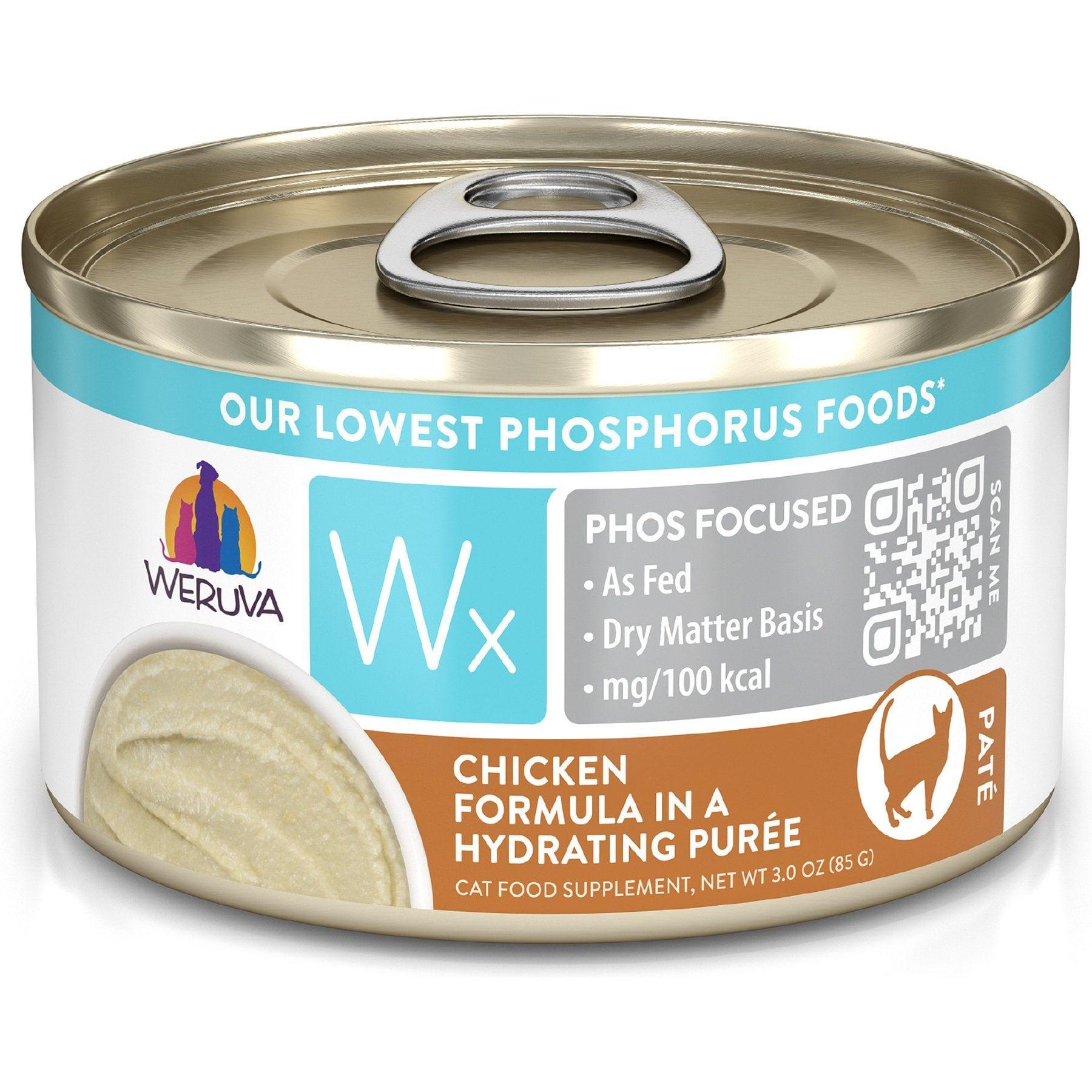
A lower-phosphorus chicken puree for supplemental feeding in a cat whose vet has confirmed kidney disease.
Webvet may earn a commission when you click through to Chewy, at no extra cost to you.
Weruva builds this puree on boneless, skinless white breast meat chicken and egg whites, proteins it describes as naturally low in phosphorus, according to Weruva's product page. It is listed at $26.28 on Chewy when checked in November 2026 for a case of twelve 3-oz cans.
The label fact that matters most: Weruva says Wx formulas have up to 50 percent less phosphorus than the AAFCO minimum and are intended for intermittent or supplemental feeding. Its Wx line page puts the gap at more than 20 percent below the minimum and states plainly that Wx foods are not complete and balanced because phosphorus is below adequate levels.
- Suits: a cat with diagnosed CKD whose vet wants extra moisture and a lower-phosphorus topper or partial meal alongside a complete renal diet.
- Skip it as the only food: a cat fed nothing else long term would fall short on phosphorus it still needs.
- Skip it entirely: for a healthy senior cat with normal blood work.
Dave's Pet Food Restricted Diet Phosphorus Chicken Liver & Chicken in Juice Pate Canned Wet Cat Food: best budget over-the-counter option
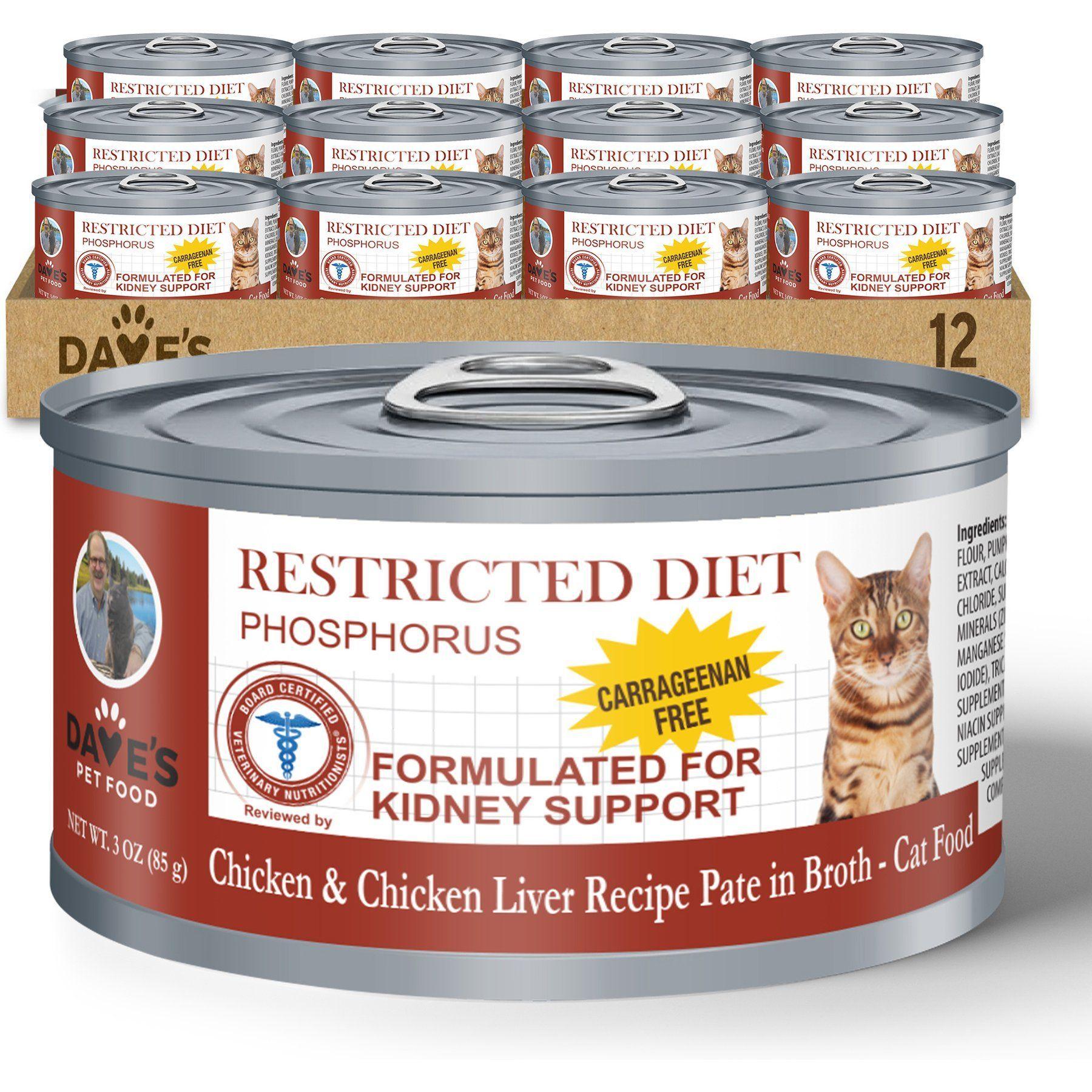
A budget lower-phosphorus pate for supplemental feeding when a vet has diagnosed kidney disease.
Webvet may earn a commission when you click through to Chewy, at no extra cost to you.
Dave's builds this pate on chicken broth, chicken, and chicken liver, per Dave's Pet Food, and guarantees its phosphorus as a label maximum on an as-fed basis. A label maximum is a ceiling, not the typical amount, so ask Dave's for the analyzed phosphorus on a dry matter basis before comparing it with a renal diet. It is listed at $22.99 on Chewy when checked in November 2026 for twelve 3-oz cans.
Dave's states that, because of the low phosphorus content, AAFCO requires it to label the food for supplemental feeding only, and that its magnesium and phosphorus levels do not meet AAFCO requirements for healthy adult maintenance. The maker says the recipe was reviewed with board-certified veterinary nutritionists and recommends speaking with your veterinarian about feeding guidelines.
- Suits: a cost-conscious owner adding a lower-phosphorus wet food to a vet-approved plan.
- Expect some refusals: Dave's itself notes that many cats dislike restricted foods because they cannot contain much meat, and meat is where the phosphorus is.
- Skip it: for any cat without a kidney diagnosis, and as a sole long-term diet.
Veterinary renal diets (vet authorization required). Hill's Prescription Diet, Royal Canin Veterinary Diet, and Purina Pro Plan Veterinary Diets kidney formulas are complete renal diets sold only with a veterinarian's authorization, which Chewy asks for at checkout. VCA names Hill's k/d, Royal Canin Renal Support, and Purina NF as the prescription kidney diets available through veterinary practices.
Hill's Prescription Diet k/d Feline Renal Health Dry Cat Food: best veterinary renal dry food
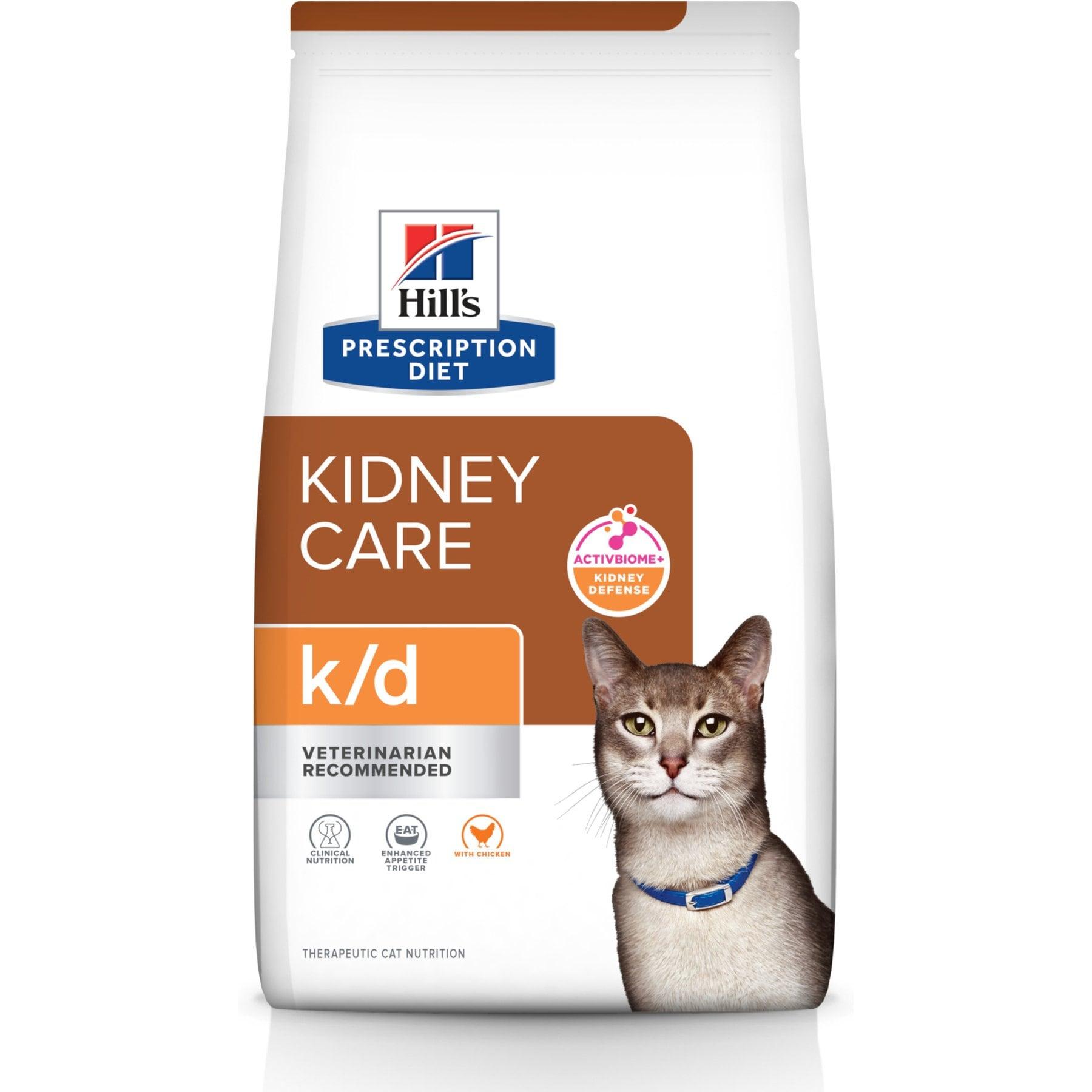
A complete veterinary renal kibble for a cat with diagnosed kidney disease, bought with your vet's authorization.
Webvet may earn a commission when you click through to Chewy, at no extra cost to you.
Hill's lists phosphorus at 0.54 percent and protein at 28.6 percent on a dry matter basis, with 408 kcal per cup. The first ingredients are chicken, brown rice, corn protein meal, chicken fat, and brewers rice, and Hill's describes a prebiotic blend it calls ActivBiome+ Kidney Defense.
It is listed at $78.99 on Chewy when checked in November 2026 for an 8.5-lb bag, and the purchase needs your vet's authorization. Hill's asks owners to get specific feeding instructions from the veterinarian and to have the cat's condition monitored.
- Suits: a staged CKD cat that reliably eats kibble.
- Watch: dry food brings little water, so the vet may pair it with wet meals or extra drinking opportunities.
- Skip it: for a cat that refuses kibble or whose vet prefers an all-wet plan.
Hill's Prescription Diet k/d Chicken Canned Cat Food: best veterinary renal wet food
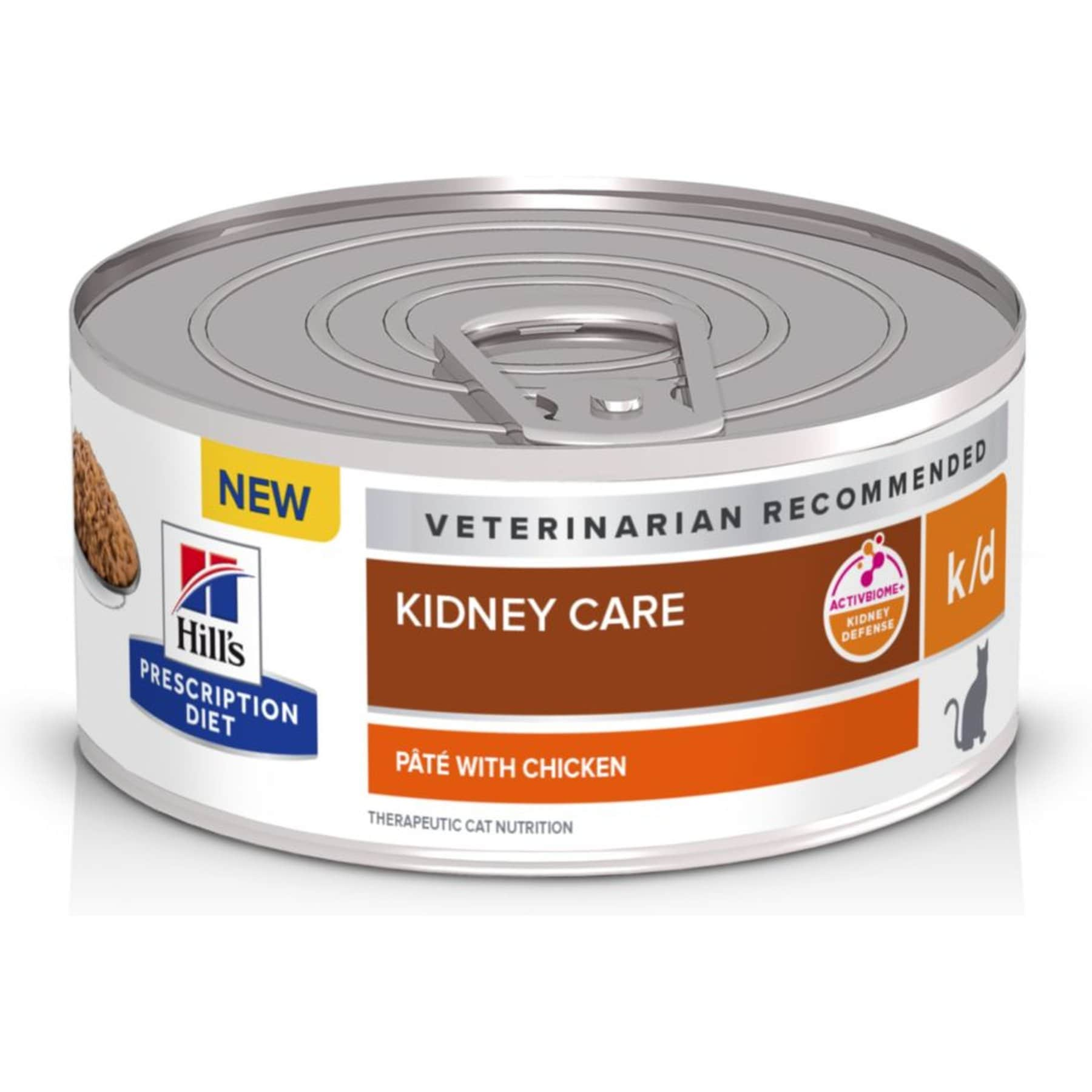
A complete veterinary renal wet food that adds moisture for a cat with diagnosed kidney disease.
Webvet may earn a commission when you click through to Chewy, at no extra cost to you.
For its k/d chicken pate, Hill's lists phosphorus at 0.5 percent and protein at 29 percent on a dry matter basis, with 181 kcal per 5.5-oz can. Water, pork liver, chicken, egg product, and brewers rice lead the ingredient list.
It is listed at $82.99 on Chewy when checked in November 2026 for 24 cans, with vet authorization required. Because the protein and phosphorus figures nearly match the dry k/d on a dry matter basis, a vet can combine the two forms to balance cost and moisture.
- Suits: a staged CKD cat that prefers pate, or one that needs more water from food.
- Skip it: for a cat whose vet has chosen a different renal line it already eats well.
Royal Canin Veterinary Diet Adult Renal Support F Dry Cat Food: best veterinary renal diet for picky eaters
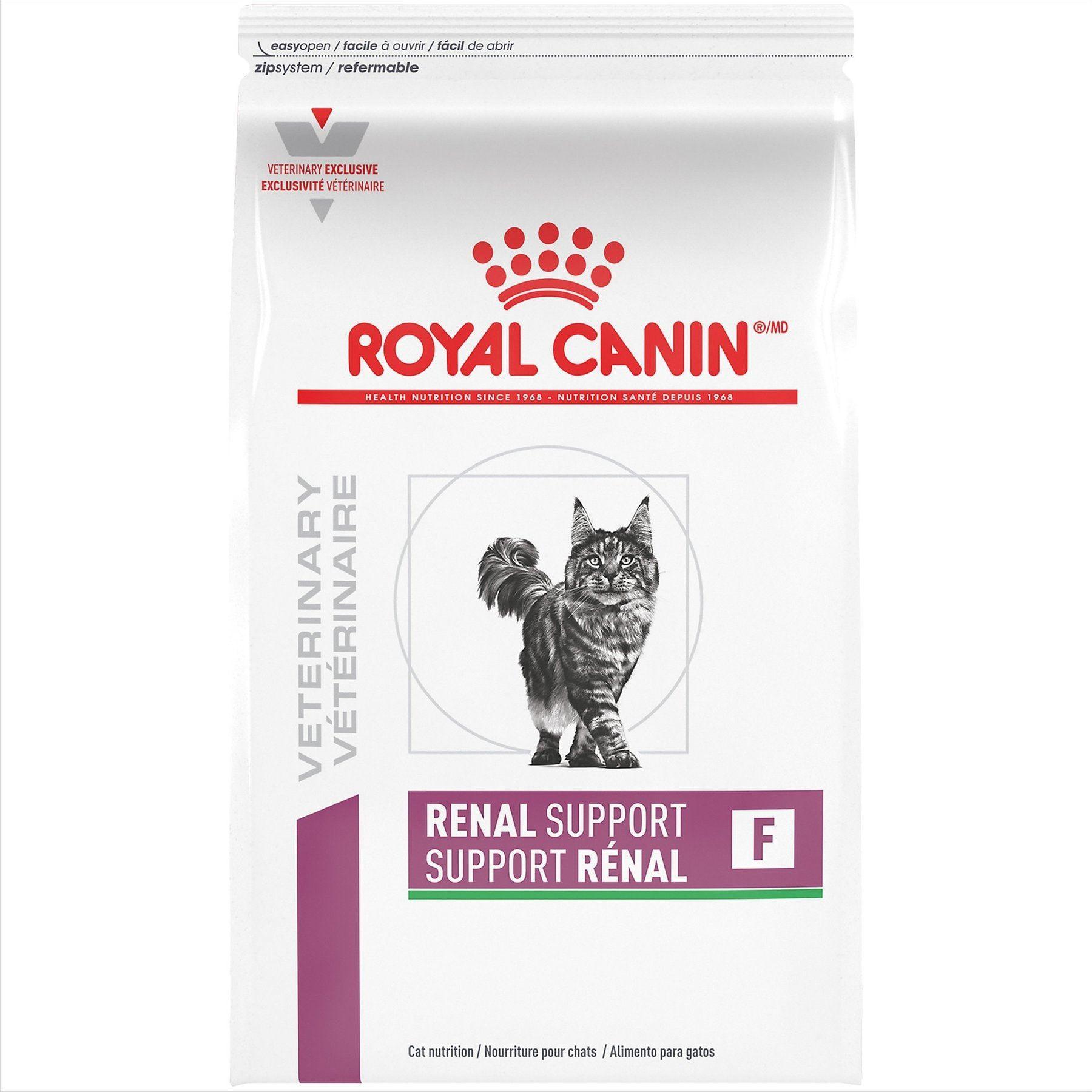
An energy-dense veterinary renal kibble for a kidney cat with a small appetite, used with vet authorization.
Webvet may earn a commission when you click through to Chewy, at no extra cost to you.
Royal Canin says this formula is energy-dense to reduce meal volume and uses triangle-shaped kibble to encourage eating. The guaranteed analysis lists crude protein of 24.0 to 28.0 percent, fat of at least 15.0 percent, phosphorus of no more than 0.62 percent, and moisture of no more than 8.0 percent, with 376 kcal per cup.
The first ingredients are brewers rice, corn, wheat gluten, chicken fat, and pork digest. Royal Canin's catalog notes the F stands for Flavorful and that the kibble can be mixed with other Renal Support formulas. It is listed at $62.99 on Chewy when checked in November 2026 for a 6.6-lb bag, with vet authorization required.
- Suits: a picky or low-appetite kidney cat that needs more calories in fewer bites.
- Skip it: for a cat that eats wet food well and needs the extra water.
Purina Pro Plan Veterinary Diets NF Kidney Function Advanced Care Wet Cat Food: best veterinary wet alternative
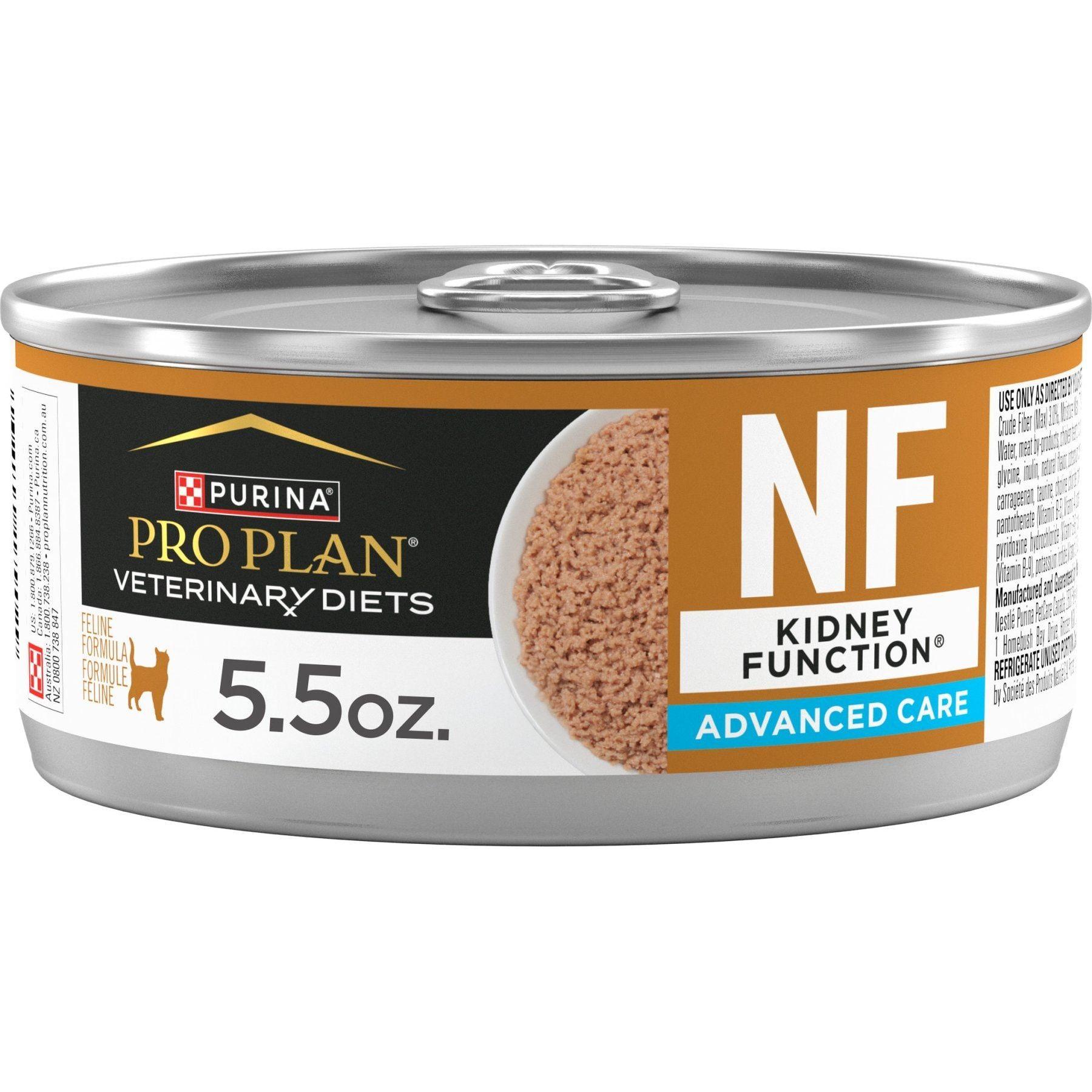
A complete veterinary kidney wet food from Purina's NF line, for a staged CKD cat on your vet's authorization.
Webvet may earn a commission when you click through to Chewy, at no extra cost to you.
Purina's catalog description opens by telling owners to talk with their veterinarian to see whether this NF pate could benefit their cat. It describes balanced nutrition to support kidney health, omega-3 fatty acids as a source of EPA and DHA, and fiber for the digestive tract.
It is listed at $74.99 on Chewy when checked in November 2026 for 24 cans of 5.5 oz, and it needs vet authorization. The "Advanced Care" name matters: VCA explains that kidney products for advanced disease restrict phosphorus a little more than early-disease products, so ask your vet whether this level fits your cat's stage.
- Suits: a cat that has turned down Hill's or Royal Canin wet foods and needs another complete renal pate.
- Skip it: for an early-stage cat whose vet wants a milder restriction.
Royal Canin Veterinary Diet Adult Renal Support Early Consult Dry Cat Food: best veterinary diet for early kidney disease
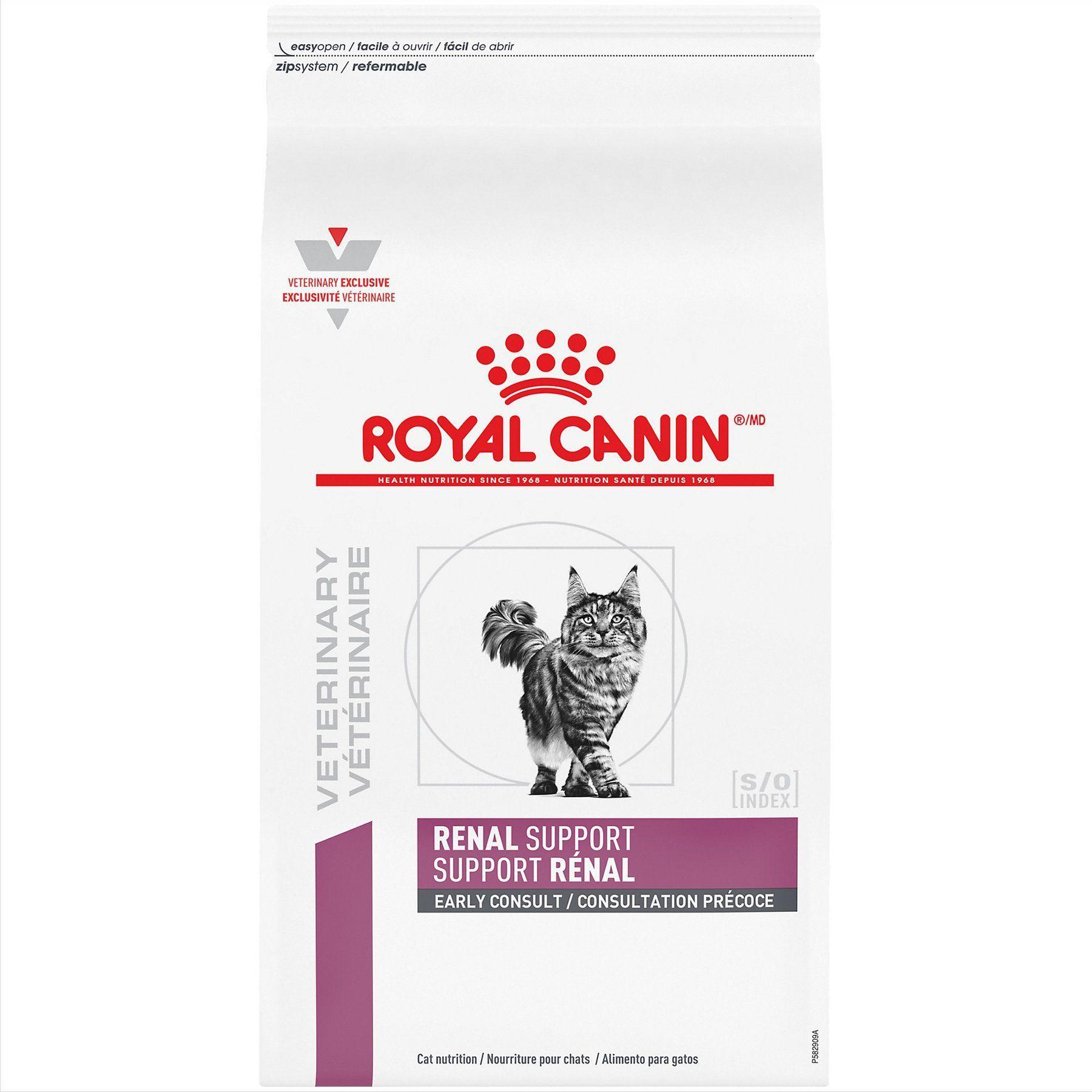
A moderate-phosphorus veterinary kibble for early kidney disease, chosen by your vet after staging.
Webvet may earn a commission when you click through to Chewy, at no extra cost to you.
Royal Canin describes this food as formulated with moderate phosphorus, EPA and DHA, and an antioxidant complex to support the kidneys at an early stage. The guaranteed analysis lists crude protein of at least 26.0 percent, fat of at least 12.0 percent, moisture of no more than 8.0 percent, and phosphorus of no more than 0.7 percent, at about 299 kcal per cup.
Corn, brewers rice, wheat gluten, and corn gluten meal lead the ingredients. It is listed at $77.99 on Chewy when checked in November 2026 for an 8.8-lb bag, and Royal Canin calls it veterinary-exclusive, so authorization is needed. The stage decision stays with your vet.
- Suits: an early-stage cat whose vet wants moderate, not maximal, phosphorus restriction.
- Skip it: for a Stage 3 or 4 cat whose phosphorus needs a stricter renal diet.
SponsoredVet care that's always there
Unlimited video calls and messaging with licensed vets for less than a typical vet visit. One membership covers up to five pets.
Use code Pets60
Plans start at $12/month · covers up to 5 pets
- Licensed vets in most states
- Rx for 150+ conditions
- 4.7 on Trustpilot
IRIS stage and phosphorus restriction: matching the food to your cat
| IRIS stage | What the vet monitors | Food tier | Wet or dry preference | Vet authorization |
|---|---|---|---|---|
| No CKD diagnosis (healthy senior) | Blood work and urine tests on the vet's schedule | Ordinary complete food for life stage | Either; wet adds water | Not needed |
| Stage 1 | Creatinine, SDMA, urine protein, blood pressure | Ordinary food; renal diet if persistent protein loss is found | Wet preferred for water intake | Needed only if a renal diet is chosen |
| Stage 2, phosphate within target | Phosphate, calcium, FGF23 where available | Early-care renal diet considered; senior diet or 50:50 mix if calcium rises | Wet preferred | Required for a renal diet |
| Stage 2, phosphate above target | Phosphate rechecked 4-6 weeks after the diet starts | Full veterinary renal diet | Wet preferred | Required |
| Stage 3 | Phosphate target under 5.0 mg/dl, appetite, weight, hydration | Full veterinary renal diet | Wet preferred; whichever the cat eats | Required |
| Stage 4 | Phosphate target under 6.0 mg/dl, appetite, hydration | Renal diet plus vet-prescribed phosphate binder if needed; feeding support | Whatever the cat will eat | Required |
| Any stage, phosphate still high on diet | Calcium and phosphate every 4-6 weeks until stable | Renal diet plus vet-prescribed phosphate binder | Unchanged | Required |
The right food for a kidney cat depends on its IRIS stage and blood phosphate. The IRIS staging system applies only to cats with stable chronic kidney disease, and a raised creatinine or SDMA reading alone does not diagnose CKD. Your vet confirms the disease, stages it, then chooses the renal diet.
Within those stages, serum phosphorus sets how hard the diet works. The IRIS treatment recommendations for cats say that keeping plasma phosphate below 4.6 mg/dl but above 2.7 mg/dl benefits cats with CKD, with more realistic targets of under 5.0 mg/dl at Stage 3 and under 6.0 mg/dl at Stage 4.
For reference, IRIS treats a creatinine of 1.6 to 2.8 mg/dl as Stage 2 and 2.9 to 5.0 mg/dl as Stage 3 in cats. Your vet reads these alongside SDMA, urine protein, and blood pressure.

How the recommendation changes by stage, in IRIS's own framing:
- Stage 1: IRIS calls the diet recommendation unclear. A clinical renal diet enters the plan when the vet finds persistent protein in the urine.
- Stage 2: a renal diet should be considered, and IRIS notes this is easier early, before appetite falls. Many Stage 2 cats have normal phosphate but raised parathyroid hormone.
- Stages 3 and 4: IRIS recommends feeding a renal diet, and the Merck Veterinary Manual recommends renal diets at stage 2 or higher.
- Outlook at Stage 3: how long a cat lives depends on blood pressure, protein loss, and response to treatment. VCA notes many cats have several years of quality life with treatment, and our kidney disease in cats guide covers prognosis by stage.
Stage 2 is where a vet's judgment matters most. IRIS warns that cats with phosphate already within target may develop high blood calcium when a renal diet is introduced. If total calcium passes 12 mg/dl, IRIS suggests switching to a senior diet or mixing the renal diet 50:50 by volume with standard food, and FGF23 testing can help show which cats benefit from restriction.
That is why an early-care food such as Royal Canin Veterinary Diet Adult Renal Support Early Consult Dry Cat Food, 8.8-lb bag exists as a separate tier from full renal diets. For ordinary feeding of an older cat with normal kidney values, our senior cat food guide is the better starting point.
Protein is the question owners ask most, and the sources line up on four points:
- VCA explains that dietary phosphorus is linked to protein, so renal diets usually trim protein as well, with early-disease products moderately reducing protein.
- VCA also warns that if protein intake drops too low, the cat breaks down its own lean muscle.
- IRIS calls it a common misconception that renal diets exist mainly to restrict protein; commercial kidney diets generally meet or exceed AAFCO protein minimums.
- Merck describes renal diets as low in phosphorus with modest amounts of high-quality protein.
So the best food for a cat with kidney disease is the renal diet that brings serum phosphorus into range while the cat keeps eating and holds muscle. For a wet renal food at Stage 3, a vet may choose Hill's Prescription Diet k/d Chicken Canned Cat Food, 5.5-oz, 24 ct or a Royal Canin Renal Support wet formula, depending on what the cat accepts.
Feeding extra protein as an everyday choice is a different goal; see our high protein cat food guide for cats without kidney disease.
If you are looking for a non-prescription wet food for a cat in kidney failure, know that Stages 3 and 4 are exactly where IRIS recommends a complete renal diet. Supplemental over-the-counter foods can add moisture or variety, but they are not built to be the whole diet.
How to lower phosphorus in cats naturally?
Diet is the most effective natural way to lower phosphorus: a vet-chosen renal diet reduces how much phosphorus the cat takes in, and IRIS lists dietary restriction as the first step at every stage. Feeding wet food raises water intake, and skipping high-phosphorus treats keeps the plan intact.
Ingredient choice matters too. A 2020 review in the Journal of Veterinary Internal Medicine notes that added inorganic phosphate salts are generally more bioavailable than the phosphorus naturally present in food ingredients. When diet alone falls short, the next step is a phosphate binder, which is a medicine your vet prescribes, not a supplement to add on your own.
Which cat food has the lowest phosphorus?
The lowest phosphorus figures belong to supplemental foods such as Weruva Wx Phos Focused Chicken Formula Grain-Free Puree Wet Cat Food, 3-oz can, case of 12 and Dave's Pet Food Restricted Diet Phosphorus Chicken Liver & Chicken in Juice Pate Canned Wet Cat Food, 3-oz, case of 12, which their makers say fall below the AAFCO minimum and are not complete diets.
Among complete renal diets, compare each maker's figure on a dry matter or per-calorie basis. The lowest number is not automatically the right food: IRIS warns that cats with phosphate already in range can develop high calcium when phosphorus is restricted too hard.
How to read phosphorus on a cat food label: dry matter, calories, and wet vs dry
The guaranteed analysis on a pet food label states nutrients on an as-fed basis, water included. The U.S. Food and Drug Administration notes that canned food is typically 75 to 78 percent moisture while dry food is 10 to 12 percent, so the raw label numbers for a wet food and a dry food cannot be compared directly.
The FDA's method puts both on the same footing, called the dry matter basis:
- Find the moisture percentage in the guaranteed analysis.
- Subtract it from 100 to get the percentage of dry matter.
- Divide the phosphorus percentage by the dry matter percentage.
- Multiply by 100 to get phosphorus on a dry matter basis.
A worked example: Royal Canin lists Renal Support F at 0.62 percent phosphorus maximum and 8.0 percent moisture maximum. Dry matter is 100 minus 8, or 92 percent, and 0.62 divided by 92, times 100, gives about 0.67 percent phosphorus on a dry matter basis.
Researchers and AAFCO also express phosphorus per 1,000 kcal, which accounts for differences in calorie density between foods. AAFCO's adult cat minimum is 1.25 g per 1,000 kcal, or 0.5 percent of dry matter, according to the 2020 Journal of Veterinary Internal Medicine review, which adds that no organization lists a maximum.
Three label pitfalls trip up owners:
- The guaranteed analysis may list only a minimum. Summers and colleagues found that declared phosphorus minimums were significantly lower than the amounts measured in the food.
- A label figure is not a lab result. For everyday foods, ask the maker for a typical analyzed phosphorus figure per 100 kcal or on a dry matter basis.
- Added phosphate salts change the picture. Ingredient lists that include phosphate salts can raise how much phosphorus the cat absorbs.
Wet or canned food is usually the better format for a kidney cat because of the water it carries. The ISFM consensus guidelines on feline CKD (Sparkes and colleagues) say feeding a wet rather than dry diet where possible is important because it increases water intake. For a staged kidney cat, the best wet choice is a complete renal pate such as Hill's k/d or Purina NF; Weruva Wx and Dave's are supplemental. For choosing everyday wet foods, see our best wet cat food roundup.
Dry food still has a place when a cat only eats kibble. On a dry matter basis, Hill's Prescription Diet k/d Feline Renal Health Dry Cat Food, 8.5-lb lists 0.54 percent phosphorus against 0.5 percent for the canned k/d chicken pate, so the restriction is similar and the real difference is water.
Non-prescription low phosphorus dry cat food is harder to find than wet. The over-the-counter foods that market low phosphorus are mostly wet and supplemental, which is one reason vets reach for a veterinary renal kibble when a cat will not eat wet food.

A printed list or chart of phosphorus figures can help you shortlist, but recipes change and a chart rarely says which basis it uses. Treat any chart as a starting point, confirm the current figure with the manufacturer, and let your vet decide what counts as low enough for your cat.
What is a low phosphorus level in cat food?
There is no official definition of low phosphorus in cat food. As a reference point, AAFCO's minimum for adult cats is 0.5 percent of dry matter, and veterinary renal diets such as Hill's k/d sit close to it, at 0.5 to 0.54 percent on a dry matter basis. Over-the-counter supplemental foods go below that minimum by design.
Everyday foods vary far more. In the Summers analysis, about a third of nonprescription foods (27 of 82) carried 3.6 g of phosphorus or more per 1,000 kcal. What counts as low for your cat depends on its IRIS stage and serum phosphorus, which is a decision for your vet.
Is Fancy Feast cat food low in phosphorus?
Fancy Feast is an everyday maintenance food line, not a veterinary renal diet, so it is not designed for phosphorus restriction. Phosphorus differs from recipe to recipe, and a label minimum can understate the real amount, as Summers and colleagues found across nonprescription foods.
To check a specific recipe, ask Purina for its typical phosphorus per 100 kcal or on a dry matter basis and share that number with your vet. For a cat with diagnosed kidney disease, the vet's renal diet comes first, and any favorite food becomes a small, agreed extra.
Over-the-counter low phosphorus food vs prescription kidney diets
The difference is completeness and supervision. A veterinary renal diet is a complete food designed to be fed alone for life, bought on a vet's authorization. A non-prescription low phosphorus cat food from Weruva or Dave's is supplemental: both makers state it falls below the AAFCO phosphorus minimum and is not meant to be the whole diet.
How the two compare in practice:
- Completeness: renal diets are complete and balanced for long-term feeding; the over-the-counter options are labeled for intermittent or supplemental feeding.
- What changes besides phosphorus: renal diets also adjust protein, calories, B vitamins, omega-3s, potassium, and acid-base balance, according to IRIS.
- Authorization: Hill's k/d, Royal Canin Renal Support, and Purina NF need a vet's approval; Chewy asks for it at checkout.
- Monitoring: a renal diet comes with scheduled blood work to check that phosphorus and calcium respond.
Hill's k/d is a good example of why the prescription matters. A vet who prescribes it also schedules the phosphorus recheck, watches calcium, and adds a binder if needed. Buying an over-the-counter food skips that loop, which is the real risk of a do-it-yourself kidney plan.
For a cat that refuses one prescription brand, the answer is usually another prescription brand rather than an over-the-counter food. Purina Pro Plan Veterinary Diets NF Kidney Function Advanced Care Wet Cat Food, 5.5-oz, case of 24 and Royal Canin Veterinary Diet Adult Renal Support F Dry Cat Food, 6.6-lb bag give a vet two different textures and flavor profiles to try.
A non-prescription lower-phosphorus food works best when used the way its maker intends: as a vet-approved supplement or topper, not a replacement. A cat that also has a suspected food allergy needs the vet to choose a single plan; our hydrolyzed protein cat food guide explains that side of the decision.
What foods are low in sodium and phosphorus?
Veterinary renal diets are the foods built to be low in both sodium and phosphorus. Cornell describes therapeutic kidney diets as restricted in protein, phosphorus, and sodium, and VCA notes that mild sodium restriction can reduce the workload on the kidneys.
Over-the-counter lower-phosphorus foods are designed around phosphorus, and their sodium is not necessarily reduced, so check the maker's figures. Avoid adding salty human foods or broths with added salt to a kidney cat's bowl without your vet's approval.
How to make low phosphorus cat food?
Making low phosphorus cat food at home is possible only with a recipe written by a board-certified veterinary nutritionist. The Merck Veterinary Manual warns that many homemade cat diets are deficient in minerals and fail to achieve a proper calcium-to-phosphorus ratio, and it recommends a high-quality commercial food or a diet designed by a credentialed veterinary nutritionist.
VCA likewise suggests consulting an experienced veterinary nutritionist when a homemade kidney diet is on the table. Internet recipes and simple meat-and-rice mixes are not a safe substitute, because getting phosphorus low while keeping protein, calcium, and vitamins adequate is exactly what is hard to do by hand.
When to see the vet: blood work, phosphate binders, and a kidney cat that stops eating
A diet change is the start of monitoring, not the end of it. IRIS advises rechecking serum phosphorus 4 to 6 weeks after a renal diet begins. If phosphate is still above target, a phosphate binder is added; once binders are in use, IRIS recommends checking calcium and phosphate every 4 to 6 weeks until stable, then every 12 weeks.
Sources differ on how long to give diet alone. IRIS suggests adding a binder if phosphate remains high at the 4-to-6-week recheck, while the Merck Veterinary Manual describes adding binders if diet does not normalize serum phosphorus within 2 to 3 months. Your vet chooses the timing based on how high the level is and how the cat is doing.
What to know about phosphate binders:
- They are medicines that reduce how much phosphorus the gut absorbs, as VCA explains for aluminum hydroxide.
- IRIS lists aluminum hydroxide, aluminum carbonate, calcium carbonate, calcium acetate, and lanthanum carbonate as options.
- They are mixed with each meal, so they work only when the cat is eating.
- The vet sets the product and dose and adjusts it from blood results; never start one on your own.

Hydration support is the other common vet visit. Cornell notes that maintaining good hydration is essential in CKD and that some cats need fluids given under the skin, which owners can often learn to do at home. VCA adds that subcutaneous fluids are well tolerated by cats and can improve their quality of life.
Signs that kidney values, including phosphorus, are climbing overlap with the signs of CKD itself. VCA lists drinking and urinating more and weight loss as early signs, with poor appetite and vomiting as advanced ones; our guide to kidney disease in cats covers these in detail.
Merck notes that in later stages cats are particularly vulnerable to poor appetite, weight loss, and muscle wasting, and that assisted feeding through a tube is appropriate in some cases. If your cat is refusing food for any reason, our guide to a cat not eating explains what to check and when to call.
How to lower phosphorus quickly?
There is no safe way to lower a cat's phosphorus quickly at home. Diet works over weeks, which is why IRIS rechecks at 4 to 6 weeks, and binders are prescription treatments the vet adjusts from blood results.
A kidney cat that is dehydrated, vomiting, or not eating needs an exam that day rather than a food change. IRIS directs vets to correct dehydration promptly with fluids given into a vein or under the skin.
How to switch a kidney cat to a renal diet, plus treats and hydration
Getting a kidney cat to eat the new food is the hardest practical step. The ISFM guidelines note that renal diets are generally less palatable than maintenance diets, and Cornell observes that many cats have difficulty accepting therapeutic diets. A slow, patient switch protects both the cat's appetite and the plan.
A switching plan built on the IRIS guidance:
- Start while the cat is still eating well. IRIS notes a renal diet is easier to introduce before appetite falls.
- Never introduce it during a hospital stay or while the cat is nauseous; IRIS says hospitalized patients should not be started on a kidney diet.
- Mix a small amount of the new food into the old, and increase it gradually over at least 3 weeks, as IRIS advises.
- Offer more than one texture or flavor. Cornell notes prescription kidney diets come in a variety of flavors and textures, so a cat that refuses one may accept another.
- If the cat was not eating its usual food before the switch, tell your vet; IRIS notes such cats are unlikely to accept a new diet.
Mixing within a brand can help. Royal Canin notes that Renal Support F kibble can be combined with other Renal Support formulas, which lets a vet blend a wet and a dry renal food the cat likes. If an older kidney cat is eating less during the transition, our guide to an old cat not eating explains which changes need a call.
Calories matter as much as phosphorus once appetite slips, and IRIS notes that renal diets are designed with higher calorie density. An energy-dense renal food helps a cat hold its weight on small portions; our guide on how much to feed a cat explains how to judge portions with your vet.
A lower-phosphorus topper can coax a reluctant eater. A spoonful of the Weruva Wx puree over the renal diet is one option, since the topper itself is low in phosphorus. Ask your vet how much topper fits the daily plan so the complete diet stays the main meal.

Treats count toward phosphorus too. If your vet approves treats, a lower-phosphorus option such as Weruva Wx Phos Focused Chicken Formula Grain-Free Lickable Cat Treats, 0.5-oz tube, 5 count fits better than ordinary treats, which are not formulated with phosphorus in mind. It is listed at $5.49 on Chewy when checked in November 2026.
Water is the other half of kidney care. IRIS advises keeping fresh water available at all times, and wet food adds more. Our guide on how much water a cat should drink shows what normal intake looks like, so you can spot a change worth reporting.
A filtered fountain is one way to keep water fresh and appealing. The PetSafe Outlast Pumpless Cat Water Fountain, White, 60-oz uses a pumpless design with a built-in filter and is listed at $54.99 on Chewy when checked in November 2026. Compare other designs in our roundup of the best cat water fountains.
Low phosphorus cat food questions
Frequently Asked Questions
Is there a non-prescription low phosphorus cat food?
Yes, but none of the non-prescription options are a renal diet. Weruva Wx and Dave's Restricted Diet are sold without a prescription and are lower in phosphorus, yet both makers label them for supplemental feeding because they fall below the AAFCO phosphorus minimum.
A complete renal diet that can be fed alone for life needs a veterinarian's authorization. Use the non-prescription foods only as part of a plan your vet has approved.
Is wet or dry low phosphorus cat food better?
Wet food is usually better for a cat with kidney disease, because its moisture raises daily water intake. The FDA puts canned food at 75 to 78 percent moisture against 10 to 12 percent for dry, and the ISFM guidelines recommend a wet diet where possible.
Dry renal diets restrict phosphorus to a similar degree, so a cat that only eats kibble can still be managed well. The best format is the one your cat reliably eats.
Can a cat with kidney disease eat a high protein food?
Usually not as its main diet once kidney disease is staged, because protein and phosphorus travel together in food. A high protein food tends to bring more phosphorus, which works against the restriction the vet is aiming for.
That does not mean starving the cat of protein. Renal diets keep moderate, high-quality protein to protect muscle, and your vet adjusts the balance from blood results and body condition.
Is low phosphorus cat food the same as low protein cat food?
No. Low phosphorus is the main goal of a renal diet, while low protein is not, and IRIS calls the belief that renal diets exist to restrict protein a common misconception. Commercial kidney diets generally meet or exceed AAFCO protein minimums.
Protein is moderated only as far as needed to bring phosphorus down. A food that is simply low protein, without the other renal diet adjustments, is not a substitute.
Should a senior cat eat low phosphorus food before a kidney diagnosis?
No. A senior cat should eat an ordinary complete diet until blood work and urine tests confirm kidney disease and the vet stages it. IRIS notes that even cats with kidney disease whose phosphate is in range can develop high blood calcium on a renal diet.
Regular senior blood work is the better safeguard. It catches kidney changes early, when a vet-chosen diet is easiest to start.
Veterinarian · BVMS MRCVS
Dr. Pippa Elliott, BVMS, MRCVS, is a veterinarian with nearly 30 years of experience in companion animal practice. Dr. Elliott earned her Bachelor of Veterinary Medicine and Surgery from the University of Glasgow. She was also designated a Member of the Royal College of Veterinary Surgeons. Married with 2 grown-up kids, Dr. Elliott has a naughty Puggle named Poggle, 3 cats and a bearded dragon.
Related reading

Best Cat Food for Urinary Health: Over-the-Counter and Prescription Options

Catit Flower Fountain Review: Why Cats Drink From It and What to Watch

Petlibro Water Fountain Review: Filters, Noise, and Cleaning Honestly Rated
