High Protein Cat Food: Best Picks and Which Cats Need It
Cats are obligate carnivores, so protein matters, but "high protein" on a bag means little until you read it on a dry matter basis. How to compare labels, which cats benefit, when a vet should weigh in first, and picks across wet and dry.

BVMS MRCVS

This article contains affiliate links. Webvet may earn a commission when you buy through them, at no extra cost to you.
High protein cat food: what it means, which cats benefit, and what makes a good one
Should cat food be high in protein? For most healthy adult cats, yes: a high protein cat food suits them because cats are obligate carnivores that rely on nutrients found only in animal products, according to the Cornell Feline Health Center. The catch is that the protein number on the bag means little until you read it on a dry matter basis.
Wet and dry labels are not comparable as printed, because canned food is mostly water. A good high protein cat food also carries an AAFCO complete-and-balanced statement for your cat's life stage. Cats with kidney disease, diabetes, or recent weight loss need their vet's input before any protein change.
| Pick | Form | Best for | Life stage on the maker's label |
|---|---|---|---|
| Purina Pro Plan High Protein Chicken & Rice Dry Cat Food, 5.5-lb bag | Dry kibble | Healthy adults and multi-cat homes | All ages, per the product listing |
| Tiki Cat Luau Succulent Chicken Pate Wet Cat Food, 2.8-oz can, case of 12 | Wet pate | Cats that need more water with their protein | Check the can's AAFCO statement |
| Dr. Elsey's cleanprotein Chicken Kibble Cat Dry Food, 6.6-lb bag | Dry kibble | Owners who want the most protein in a dry food | AAFCO all life stages |
| Purina Cat Chow Complete High Protein with Real Salmon Dry Cat Food, 15-lb bag | Dry kibble | Budget feeding for healthy cats | All life stages, per the product listing |
| ORIJEN Original Grain-Free High-Protein Premium Dry Cat Food, 7-lb bag | Dry kibble | Owners who want mostly animal ingredients | FEDIAF all life stages; check the bag |
| Purina ONE Indoor Advantage Senior 7+ High Protein Natural Dry Cat Food, 7-lb bag | Dry kibble | Healthy indoor cats aged 7 and up | Check the bag's AAFCO statement |
- 1This is why cats need animal protein: cats are obligate carnivores that use protein for energy and need taurine and other nutrients that plants do not supply.
- 2Start by converting label protein to dry matter, the only fair way to compare wet and dry food, since canned food is about three quarters water.
- 3Any food you choose should carry an AAFCO complete and balanced statement that matches your cat's life stage.
- 4Cats with kidney disease, diabetes, hyperthyroidism, or unexplained weight loss should see a veterinarian before a protein change.
Why cats need animal protein
Cats need much more protein than people or dogs because they use protein as an energy source, explains International Cat Care. Their bodies run on a steady supply of amino acids rather than switching to stored carbohydrate.
The Merck Veterinary Manual describes cats as being in continuous gluconeogenesis, making glucose from amino acids, and notes they cannot turn this down during fasting.
Animal protein also brings nutrients a cat cannot make or find in plants:
- Taurine: Merck states that plant proteins are devoid of taurine, and deficiency can cause dilated cardiomyopathy and central retinal degeneration. Our guides to taurine for cats and taurine deficiency in cats explain the signs.
- Arginine, methionine, and cysteine: International Cat Care lists these amino acids as essential for cats and absent from plants.
- Preformed vitamins: cats need vitamin A, vitamin D, and vitamin B3 supplied at the correct levels, according to the same source.

Which cats benefit, and what makes a good one
A cat's natural prey is high in protein, moderate in fat, and low in carbohydrate, the Cornell Feline Health Center notes. A food built along those lines suits most healthy adults, active cats, and many healthy seniors that are losing muscle.
A good high protein food does three things well:
- Names an animal protein source first in the ingredient list.
- Carries an AAFCO nutritional adequacy statement for growth, adult maintenance, or all life stages.
- Gives protein, moisture, and calorie figures you can convert and compare.
Kittens have their own targets: Merck gives a minimum of 30% protein on a dry matter basis for growth, and our best kitten food guide covers that stage.
Our picks: the best high protein cat food
These picks are judged on the label and the maker, not on taste. Each one is sold as an everyday food for healthy cats, and each suits a different kind of household. Confirm the AAFCO complete and balanced statement on the package before you buy. Prices are what Chewy listed when checked in November 2026 and change often.
Brand matters less than the label: an inexpensive bag and a premium one both have to pass the same dry matter and AAFCO checks.
For a cat with a history of urinary trouble, the wet pick below adds water along with its protein, and the vet should guide the choice.
Purina Pro Plan High Protein Chicken & Rice Dry Cat Food: best overall
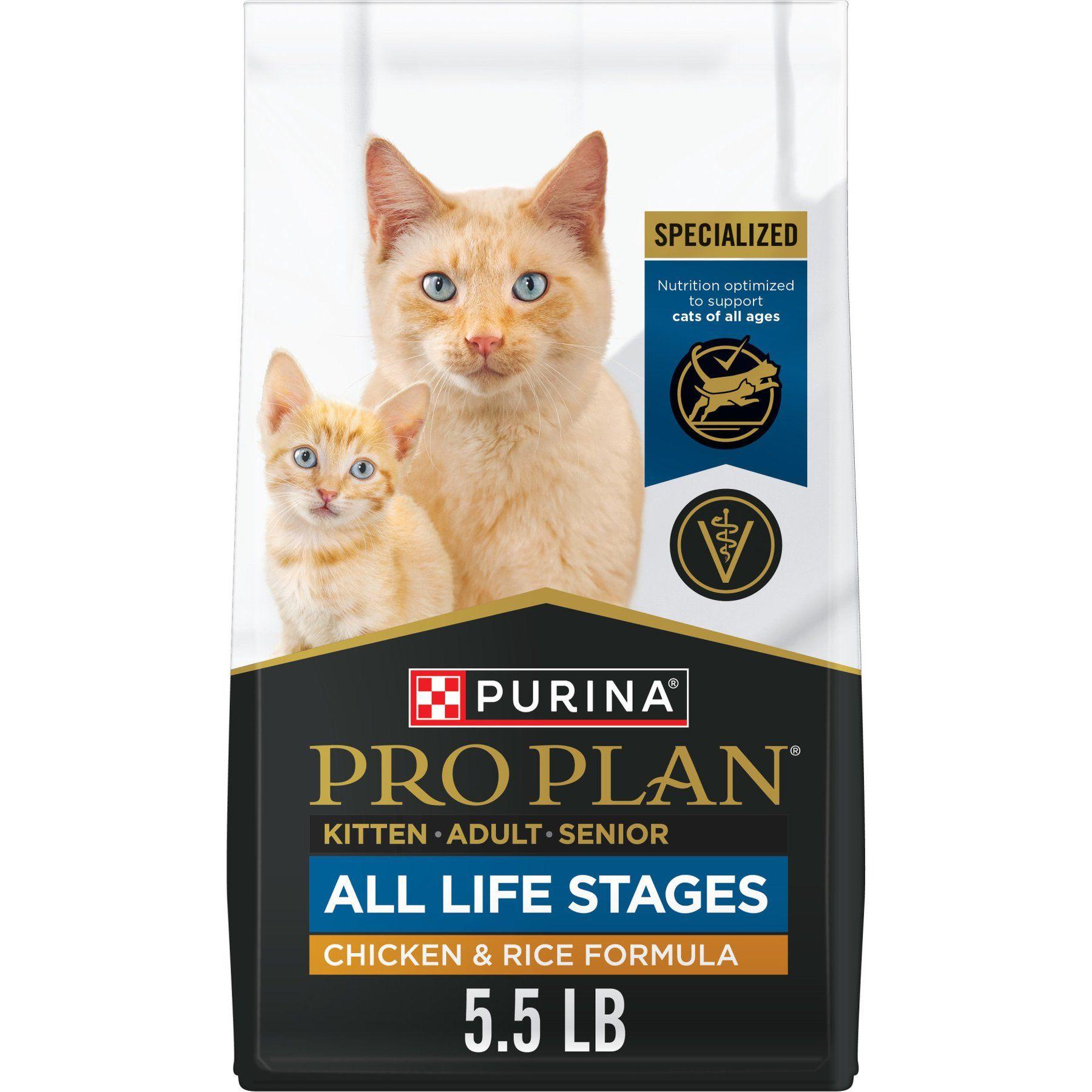
A widely sold high protein dry food with chicken first, labeled for cats of all ages.
Webvet may earn a commission when you click through to Chewy, at no extra cost to you.
Purina Pro Plan High Protein Chicken & Rice Dry Cat Food, 5.5-lb bag lists real chicken as the first ingredient and is described as supporting lean body mass. The listing says it provides 100% balanced nutrition for cats of all ages and sizes, which makes it an easy fit for multi-cat homes with different ages.
The formula adds DHA, live probiotics, natural fiber, omega-6 fatty acids, and antioxidants, according to the product listing. It is listed at $28.08 on Chewy when checked in November 2026.
- Suits: healthy adult cats, mixed-age households, and owners who want one food for every adult in the house.
- Skip or ask first: cats with kidney disease or any cat on a prescription diet.
- Before buying: read the guaranteed analysis on the bag and convert the protein to dry matter: subtract moisture from 100, then divide the protein by that figure.
Tiki Cat Luau Succulent Chicken Pate Wet Cat Food: best high protein wet food
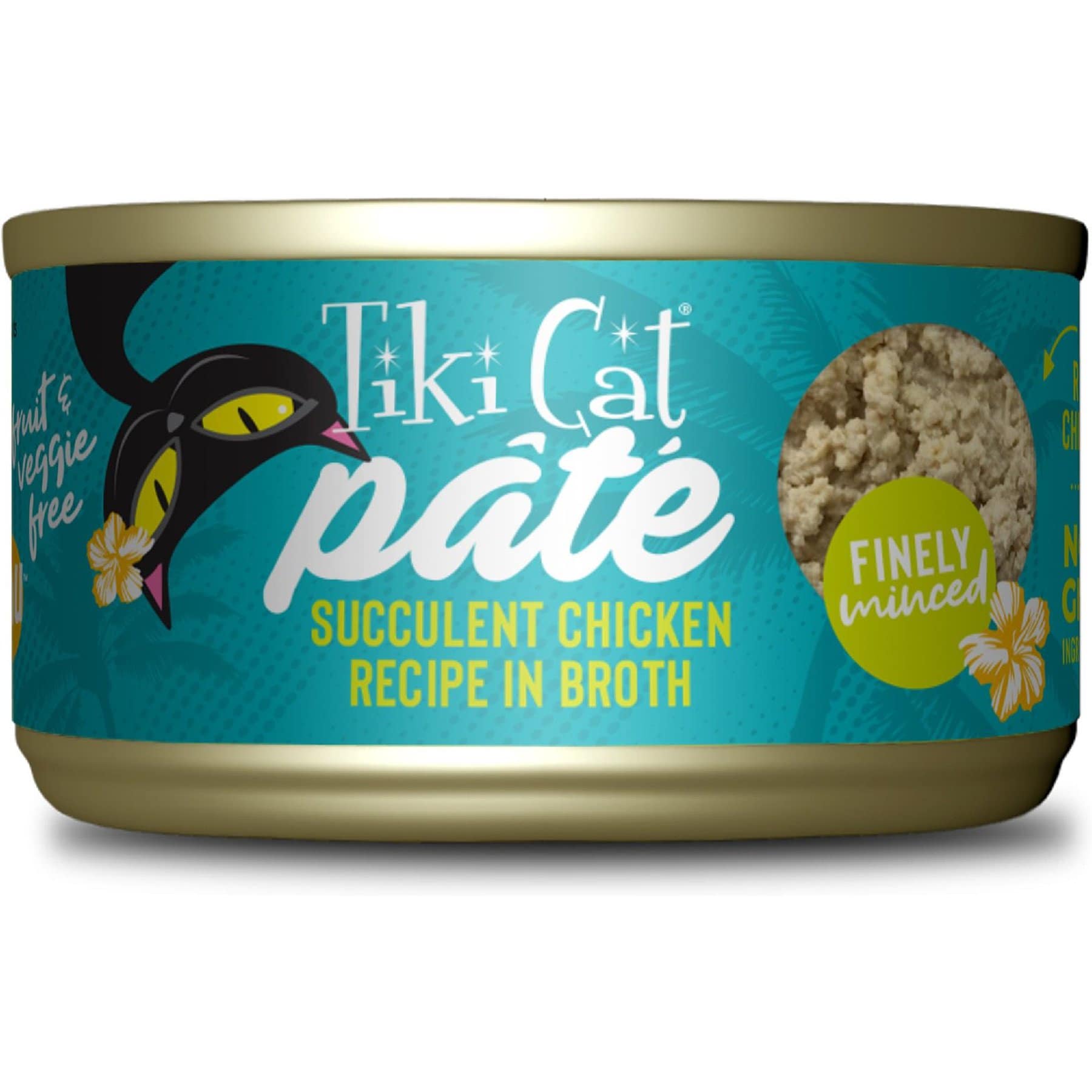
A chicken and broth pate for cats that do better with more water in their meals.
Webvet may earn a commission when you click through to Chewy, at no extra cost to you.
Tiki Cat Luau Succulent Chicken Pate Wet Cat Food, 2.8-oz can, case of 12 is a soft, finely ground pate. On the maker's page, the ingredient list starts with chicken, chicken broth, sunflower seed oil, and dried egg product, with no grains, fruit, or vegetables.
The Tiki Pets product page gives a minimum of 13% crude protein and a maximum of 81.5% moisture, with 77 kcal per 2.8-oz can. On a dry matter basis that works out to about 70% protein, the highest of the picks with a maker-published analysis. It is listed at $24.51 on Chewy when checked in November 2026.
- Suits: cats that drink little water, cats that prefer pate, and owners who want a high protein low carb wet meal.
- Skip or ask first: cats with kidney disease, and any cat that needs a measured calorie plan, since small cans add up.
- Before buying: the maker's page does not show the AAFCO statement, so confirm on the can that it says complete and balanced for your cat's life stage.
Dr. Elsey's cleanprotein Chicken Kibble Cat Dry Food: best highest protein dry food
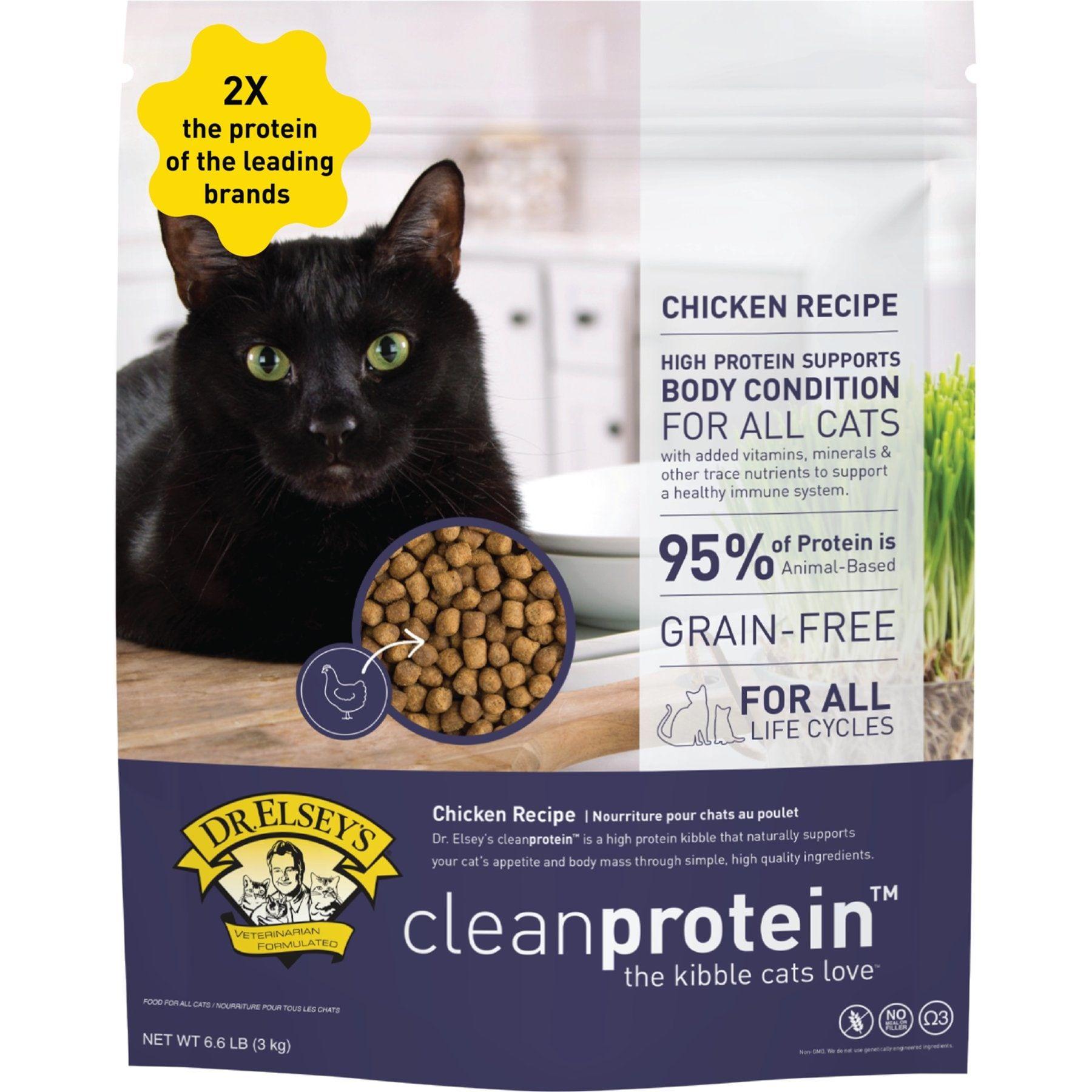
A very high protein chicken kibble for owners comparing the most protein in a dry food.
Webvet may earn a commission when you click through to Chewy, at no extra cost to you.
Dr. Elsey's cleanprotein Chicken Kibble Cat Dry Food, 6.6-lb bag is the highest protein cat food among the dry picks. The Dr. Elsey's product page lists a minimum of 59.0% crude protein, 17.0% fat, and a maximum of 12.0% moisture, which is about 67% protein on a dry matter basis.
The first ingredients are chicken, hydrolyzed pork, pork plasma, and gelatin. The maker states it is formulated to meet AAFCO Cat Food Nutrient Profiles for all life stages, and lists 3,953 kcal/kg and 523 kcal per cup. It is listed at $57.99 on Chewy when checked in November 2026.
- Suits: lean, active cats such as Bengals, and owners who want a dry food with very little room for carbohydrate.
- Skip or ask first: cats with kidney disease, and cats prone to weight gain, because a cup is calorie dense.
- Feeding note: the maker's guide suggests 0.5 to 0.7 cup daily for a 6- to 11-lb cat; adjust to body condition.
Purina Cat Chow Complete High Protein with Real Salmon Dry Cat Food: best budget
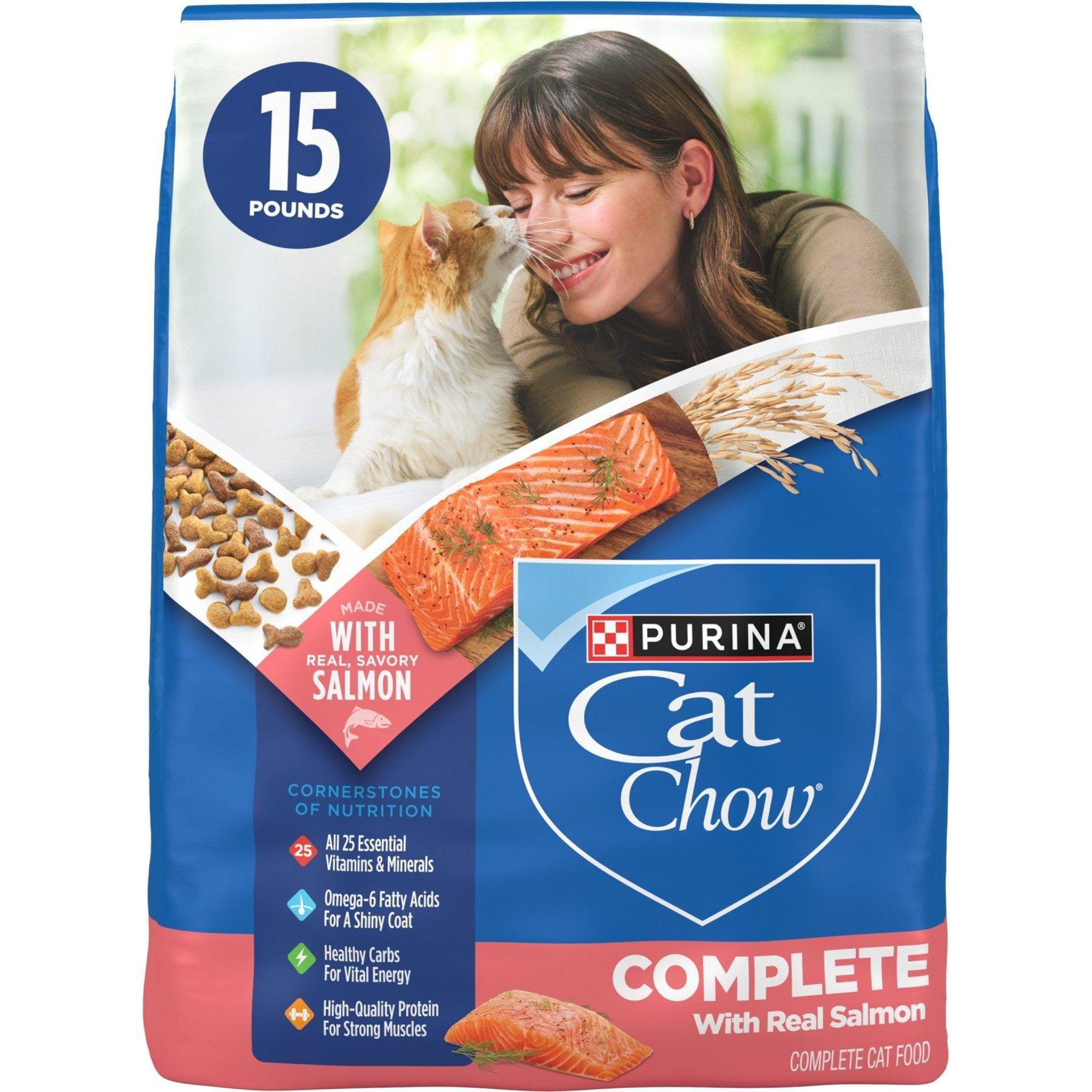
An affordable large bag of salmon kibble labeled complete and balanced for every life stage.
Webvet may earn a commission when you click through to Chewy, at no extra cost to you.
Purina Cat Chow Complete High Protein with Real Salmon Dry Cat Food, 15-lb bag is the most affordable high protein cat food here by bag size. The listing describes real salmon, 25 essential vitamins and minerals, and complete and balanced nutrition for cats at every life stage, from kittens to adults.
The listing is open about the formula also containing carbohydrates for energy, so expect more carbohydrate than the meat-heavy picks. It is listed at $18.28 on Chewy for a 15-lb bag when checked in November 2026.
- Suits: healthy cats in budget-conscious homes, shelters, and multi-cat households.
- Skip or ask first: cats on a vet-directed diet, and owners who specifically want a low carbohydrate food.
- Before buying: convert the bag's protein to dry matter and compare it with the pricier picks; the gap is often smaller than the front label suggests.
ORIJEN Original Grain-Free High-Protein Premium Dry Cat Food: best premium dry food
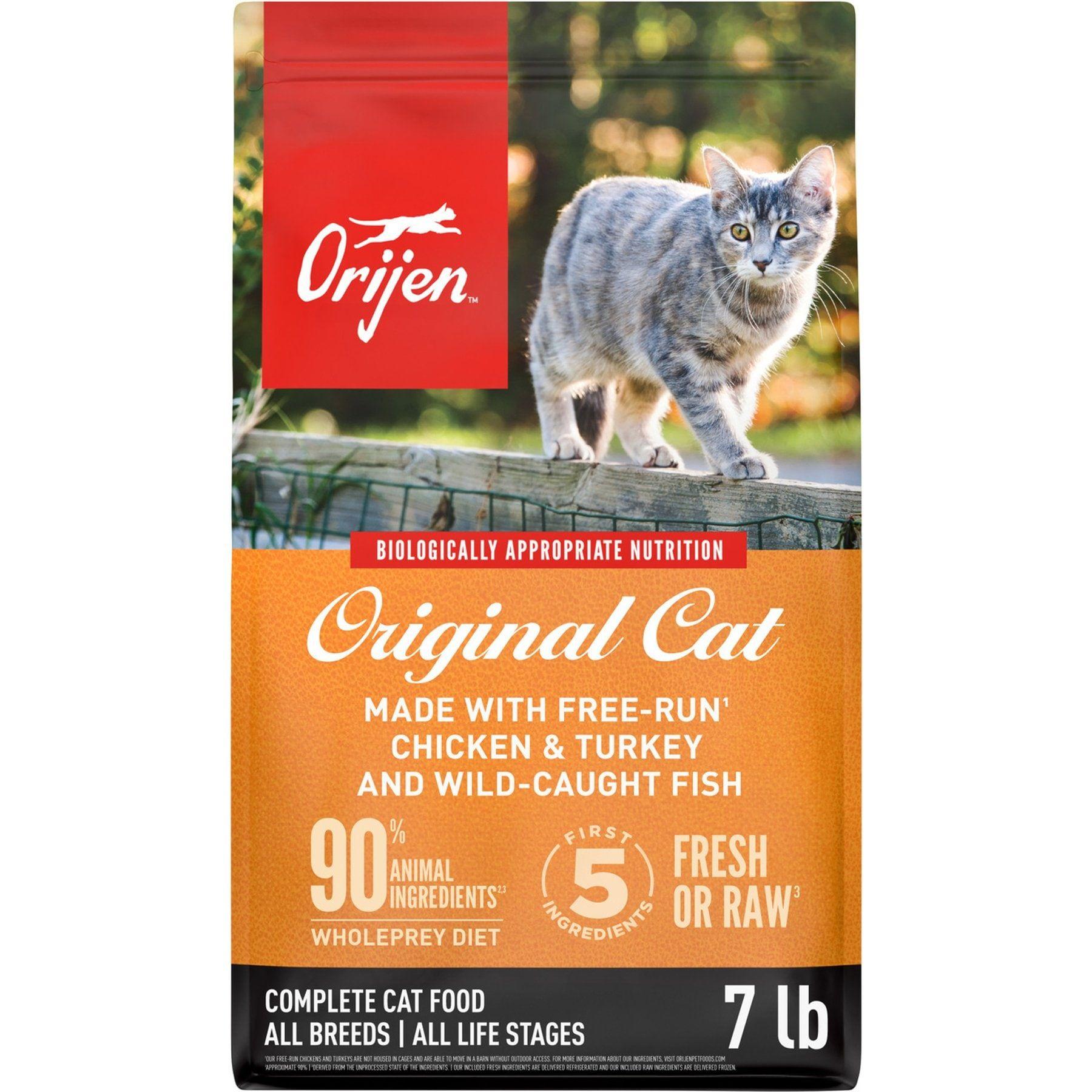
A dry food built mostly from animal ingredients, for owners who want fresh meat and fish first.
Webvet may earn a commission when you click through to Chewy, at no extra cost to you.
ORIJEN Original Grain-Free High-Protein Premium Dry Cat Food, 7-lb bag leads with fresh chicken, raw turkey, and raw whole herring on the ORIJEN product page. The maker lists 40% crude protein, 20% fat, 10% moisture, and 8% ash, which is about 44% protein and 21% carbohydrate on a dry matter basis.
ORIJEN states that 39% of calories come from protein, 18% from carbohydrates, and 43% from fat, at 541 kcal per 250 ml cup. Its page says the food is formulated to FEDIAF levels for all life stages; look for the AAFCO statement on the US bag. It is listed at $51.99 on Chewy when checked in November 2026.
- Suits: healthy, active adults and owners who want a mostly animal-ingredient kibble.
- Skip or ask first: cats with kidney disease, and cats that gain weight easily on a high fat food.
- Grain-free questions: our grain free cat food guide covers what grain-free does and does not mean for cats.
Purina ONE Indoor Advantage Senior 7+ High Protein Natural Dry Cat Food: best for healthy senior cats
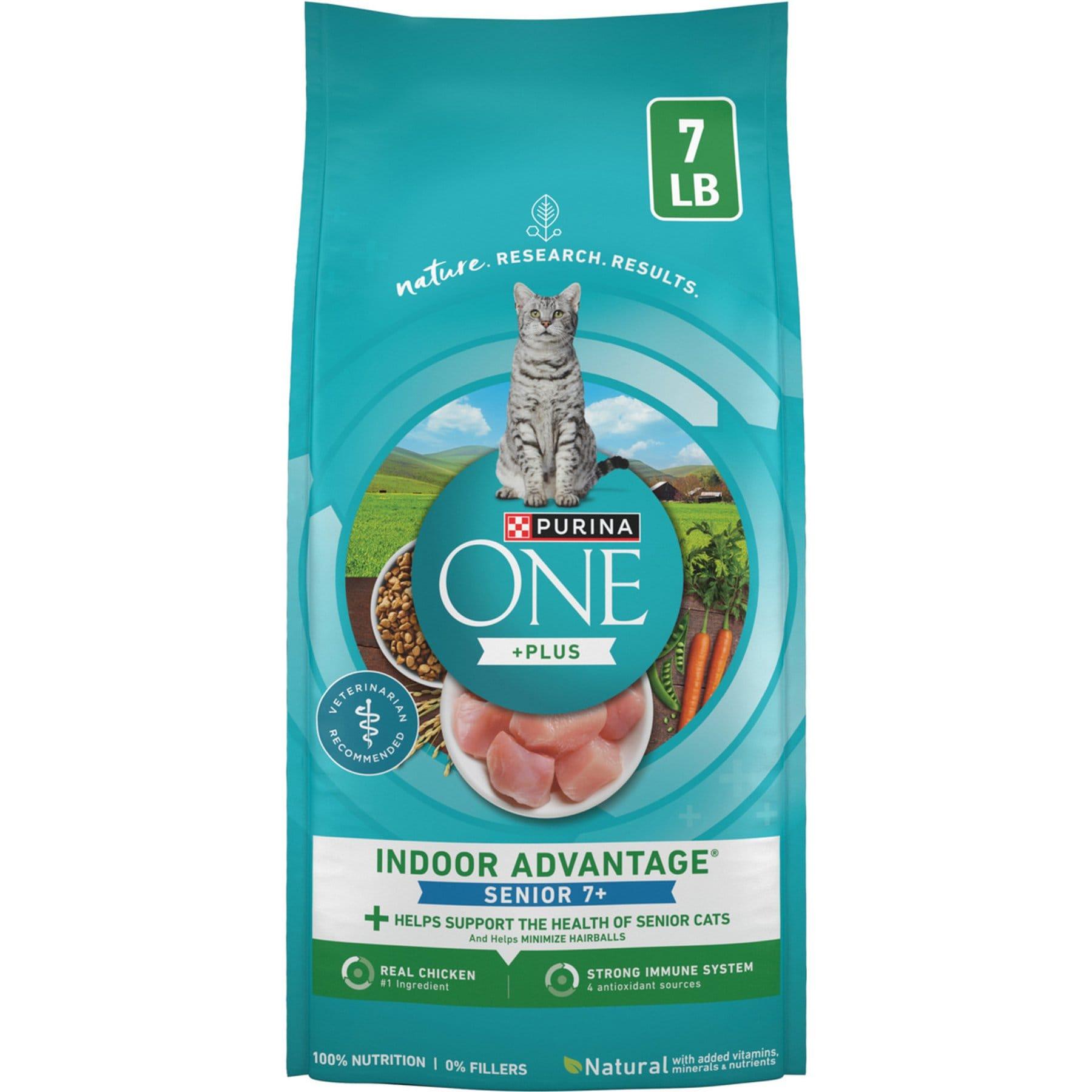
A reduced fat high protein kibble made for healthy indoor cats aged 7 and older.
Webvet may earn a commission when you click through to Chewy, at no extra cost to you.
Purina ONE Indoor Advantage Senior 7+ High Protein Natural Dry Cat Food, 7-lb bag is sold as the Purina ONE Plus Indoor Advantage senior formula. The listing describes real chicken first, 37 grams of protein per serving, reduced fat, glucosamine, and a fiber blend for hairballs.
This formula is aimed at indoor cats past age 7 that need fewer calories but still need to hold on to muscle. It is listed at $17.98 on Chewy when checked in November 2026.
- Suits: healthy indoor seniors with normal bloodwork and a good appetite.
- Skip or ask first: any senior that has not had recent kidney values checked; our senior cat food guide covers that visit.
- Before buying: there is no separate AAFCO senior profile, so check the bag for the adult maintenance or all life stages statement.
How to read protein on a cat food label: dry matter basis, protein quality, and the AAFCO statement
| Pick | Form | Label protein, as fed | Label moisture, max | Protein, dry matter | Carbohydrate, dry matter | Life stage | Suits which cat |
|---|---|---|---|---|---|---|---|
| Purina Pro Plan High Protein Chicken & Rice | Dry kibble | Read the bag | Read the bag | Convert from the bag | Needs ash from the bag | All ages, per listing | Healthy adults, mixed-age homes |
| Tiki Cat Luau Succulent Chicken Pate | Wet pate | 13% min | 81.5% | About 70% | No more than about 13% (ash not listed) | Confirm on the can | Low drinkers, pate lovers |
| Dr. Elsey's cleanprotein Chicken | Dry kibble | 59% min | 12% | About 67% | No more than about 9% (ash not listed) | AAFCO all life stages | Lean, active cats |
| Purina Cat Chow Complete High Protein Salmon | Dry kibble | Read the bag | Read the bag | Convert from the bag | Needs ash from the bag | All life stages, per listing | Healthy cats on a budget |
| ORIJEN Original Cat | Dry kibble | 40% | 10% | About 44% | About 21% | FEDIAF all life stages | Active adults |
| Purina ONE Indoor Advantage Senior 7+ | Dry kibble | Read the bag | Read the bag | Convert from the bag | Needs ash from the bag | Check the bag | Healthy indoor seniors |
The guaranteed analysis lists the minimum crude protein and fat and the maximum water and fiber, all on an as-fed basis, according to the Merck Veterinary Manual. As-fed numbers include the water, which is why a canned food looks low in protein next to a kibble.
Tufts Petfoodology puts it plainly: the guaranteed analysis cannot be used to compare foods as written, and moisture is one of the main reasons.
Converting label protein to dry matter
The math behind converting label protein to dry matter takes two steps and a phone calculator:
- Subtract the moisture percentage from 100 to get the dry matter.
- Divide the protein percentage by the dry matter, then multiply by 100.
For Tiki Cat's pate, 100 minus 81.5 leaves 18.5% dry matter, and 13 divided by 18.5 gives about 70% protein. For ORIJEN, 100 minus 10 leaves 90%, and 40 divided by 90 gives about 44%. The can that looked weaker is higher in protein once the water is removed.
Carbohydrate is not on most labels. It can be worked out by difference: subtract protein, fat, fiber, moisture, and ash from 100, then convert the remainder to dry matter. When a label leaves out ash, the result is only an upper limit.

Is 38% protein too much for a cat?
No. For a healthy adult cat, 38% protein is within the normal range: VCA Animal Hospitals says 30% to 40% protein on a dry matter basis is appropriate for most young adult cats, active or sedentary. If 38% is the as-fed figure on a kibble, the dry matter value is a little higher still.
For context, AAFCO's minimum for adult cats is 26% protein on a dry matter basis, or 65 grams per 1,000 kcal, according to Merck. Many complete foods sit well above that. The cats that need a different number are those with kidney disease, and that number comes from their vet.
Protein quality: what the ingredient list does and does not show
Ingredients are listed in descending order of weight on an as-fed basis, so a wet ingredient such as fresh chicken can lead the list while contributing less to the dry food than a meal further down, Merck explains. A food that is high in meat protein should still show animal ingredients near the top.
Protein quality also depends on digestibility, which no label shows. Merck classes protein digestibility below 80% as low and 80% to 85% as average. High-quality protein means digestible animal protein, not simply the highest number.
The WSAVA Global Nutrition Committee suggests asking these questions of any brand you are considering:
- Does the company employ a qualified nutritionist, with a PhD in animal nutrition or board certification in veterinary nutrition?
- Who formulates the diet, and what quality control checks the finished food?
- Can the company give an average or typical analysis for all essential nutrients, not just the guaranteed minimums?
- Has the company published research in peer-reviewed journals?
WSAVA also notes that unregulated terms such as holistic or premium are of little practical value.
Front-of-bag phrases such as high fiber or high quality animal protein still have to be judged on the numbers and the maker. Lower protein can be the right choice too: prescription kidney diets are deliberately lower in protein and are a vet decision.
The AAFCO statement and product names
AAFCO calls the nutritional adequacy statement perhaps the most important part of a label. The FDA explains that a complete and balanced food must contain every nutrient in its AAFCO nutrient profile at the recommended level, either by formulation or by passing a feeding trial.
Product names carry rules too. Under AAFCO labeling rules, "with" chicken can mean as little as 3% chicken, and a flavor name needs very little of the ingredient. When shopping, these checks matter more than the bag's color or claims:
- An AAFCO complete and balanced statement for your cat's life stage, not "intermittent or supplemental feeding."
- An animal protein named first, ideally more than once in the first few ingredients.
- A calorie figure per cup or can, so you can feed the right amount.
- A dry matter protein value you calculated yourself.
ORIJEN Original Grain-Free High-Protein Premium Dry Cat Food, 7-lb bag is a useful practice label: its maker publishes ash as well as protein, fat, fiber, and moisture, so the carbohydrate can be worked out fully.
What cat food has the highest amount of protein?
On a dry matter basis, wet foods made mostly of meat and broth usually have the most protein. Among these picks, Tiki Cat Luau Succulent Chicken Pate works out to about 70% protein and Dr. Elsey's cleanprotein Chicken to about 67%, from the makers' guaranteed analyses. The front label alone will not tell you that.
High protein wet vs dry cat food, and high protein low carb options
Wet versus dry protein comparisons only work after the water is removed. Merck states that comparisons across food types should be made on a dry matter or caloric basis. Canned foods contain 68% to 78% water and dry foods about 10%, so the printed protein figures start from very different places.
The Cornell Feline Health Center gives canned food a moisture content of at least 75% and calls it a good dietary source of water, while dry food holds between 6% and 10% water. VCA adds that cats eating dry kibble must drink more to meet their hydration needs.

High protein wet cat food
A high protein wet cat food gives protein and water in one meal. A canned meat-and-broth pate often has more protein on a dry matter basis than any kibble, because there is little room left for starch.
Tiki Cat Luau Succulent Chicken Pate Wet Cat Food, 2.8-oz can, case of 12 is an example: about 70% protein on a dry matter basis from a 13% as-fed label. Many owners use wet food for one meal a day and kibble for the rest.
High protein dry cat food
A high protein dry cat food is easier to store, measure, and leave out, and some cats simply prefer it. Among the dry picks with a maker-published analysis, protein on a dry matter basis runs from about 44% for ORIJEN to about 67% for Dr. Elsey's.
Tiki Cat Born Carnivore High Protein Deboned Chicken & Egg Dry Cat Food, 5.6-lb bag is another dry option; its listing describes more than 47% protein, with 80% from animal sources, in a baked grain-free kibble.
It is listed at $39.02 on Chewy when checked in November 2026. As with any kibble, check the bag for the AAFCO statement and convert the protein yourself.
High protein low carb cat food
High protein low carb cat food is food where protein and fat supply most of the calories and starch supplies little. Merck notes that cats are adapted to a moderate intake of complex carbohydrates and that carbohydrates are not essential for healthy adult cats.
Ways to find one:
- Canned pates made from meat and broth are usually the lowest in carbohydrates.
- Among dry foods, a very high protein kibble such as Dr. Elsey's cleanprotein Chicken Kibble Cat Dry Food, 6.6-lb bag leaves little room for starch: no more than about 9% carbohydrate on a dry matter basis from its label.
- Makers that publish ash, or a calorie split, let you calculate carbohydrate fully.
International Cat Care generally recommends feeding healthy cats a variety of both wet and dry food. That mix lets you add water and keep cost under control. Cats with diabetes are a separate decision made with the vet; our diabetic cat food guide explains why.
When high protein food is not the right choice: kidney disease and other reasons to see the vet first
High protein food is good for most healthy cats, but some cats need a vet's plan first. Here is who should not change diets without a vet:
- Cats diagnosed with chronic kidney disease, or seniors whose kidney values have not been checked.
- Cats being treated for diabetes, whose food is part of the treatment plan.
- Cats with hyperthyroidism, which may be treated with an iodine-restricted diet.
- Cats on any prescription or veterinary diet.
- Cats that have lost weight without explanation or are eating less.
Hyperthyroid cats are a special case. The Cornell Feline Health Center lists weight loss with increased appetite as a common sign, and an iodine-restricted diet is one treatment option. A cat with hyperthyroidism should stay on the plan its vet sets rather than a high protein food chosen off the shelf.
Can high protein cat food cause kidney problems?
There is no evidence in the sources reviewed here that a high protein food causes kidney disease in a healthy cat. Kidney disease is common in older cats whatever they eat. The Cornell Feline Health Center reports chronic kidney disease in up to 40% of cats over 10 and 80% of cats over 15, and names age as the only known risk factor.
Once a cat has kidney disease, diet matters a great deal. Cornell calls dietary modification an important and proven part of CKD treatment, and reports that some studies show cats with CKD eating a prescription kidney diet live 2 to 3 times longer than those on standard commercial food. These therapeutic diets are restricted in protein, phosphorus, and sodium.
The balance is delicate. VCA Animal Hospitals explains that limiting phosphorus appears to help delay progression and that phosphorus tracks with protein, but if protein intake is too low the cat breaks down its own lean muscle. That is why the choice belongs to the vet.

Vets stage kidney disease with the International Renal Interest Society (IRIS) system, based on blood creatinine and urine protein, VCA notes. Early signs such as weight loss and drinking and urinating more are often mistaken for normal aging. Our guide to kidney disease in cats covers the stages.
Is high-protein cat food bad for cats?
No, not for healthy cats. A complete and balanced high protein food fits how cats are built: they are obligate carnivores that use protein for energy. High protein food becomes the wrong choice for a cat with diagnosed kidney disease, where a vet-chosen diet with controlled protein and phosphorus may help the cat live longer.
The other limit is calories. A rich, calorie-dense high protein food can still cause weight gain in an indoor cat if portions are not measured, and that is a feeding problem rather than a protein problem.
Is high protein cat food good for urinary health?
Protein level is not a proven urinary treatment. The Cornell Feline Health Center lists drinking less water as a risk factor for lower urinary tract signs and says urinary health diets have not been shown to reduce those signs themselves. Fresh water at all times matters.
What matters most is recognizing an emergency. Cornell calls a urethral obstruction an absolute emergency: a blocked cat strains, makes frequent attempts, and passes little or no urine. Male and neutered male cats are at greater risk. That cat needs a vet immediately, not a food change.
Can cats survive on a meat-only diet?
Not safely on plain meat alone. Cats need animal protein, but they also need every nutrient in the AAFCO profile at the right level, the FDA explains. Taurine, vitamins A and D, and minerals must be present in balance, and a bowl of plain muscle meat is not a complete diet.
Home-made meat diets are hard to keep balanced. Tufts Petfoodology reports a 2015 study in which only 13% of owners were still feeding the original balanced recipe about a year later, and advises working with a board-certified veterinary nutritionist. A commercial complete food that is mostly meat is the practical route.
High protein food for indoor cats, seniors, and active or large-breed cats
Indoor adults, seniors, and active breeds each get something different from a high protein cat food. The goal for every cat is the same: enough protein to hold lean body mass, and the right number of calories for an ideal body condition.
Do indoor cats need high-protein?
Yes, indoor cats need the same high protein intake as any cat, but usually fewer calories. VCA notes that indoor cats face a greater risk of becoming overweight because they often lead more sedentary lives, and neutered cats share that risk. The aim is ample protein in measured portions.
For an indoor cat, pick a food with a clear calorie figure and feed by body condition rather than by the bag alone. Our how much to feed a cat guide walks through portions, and the cat weight chart helps you check where your cat sits.
For indoor cats past age 7, Purina ONE Indoor Advantage Senior 7+ High Protein Natural Dry Cat Food, 7-lb bag pairs reduced fat with chicken first. If your indoor cat already needs to lose weight, our weight management cat food guide is the better starting point.

Senior cats losing muscle
Muscle loss in older cats is a real, recognized problem, and many senior cats losing muscle still weigh about the same. The 2021 AAFP Feline Senior Care Guidelines define sarcopenia as age-related loss of muscle mass independent of illness, and recommend assessing muscle condition and body condition together, because body composition can change while weight stays the same.
A review in Topics in Companion Animal Medicine describes a progressive decline in fat and protein digestion in older cats, and notes that loss of lean body mass may be mitigated in part by feeding higher protein levels. The AAFP guidelines call for calorie-dense diets with highly digestible proteins for cats over 10.
Energy needs shift with age as well. The AAFP guidelines state that cats aged 7 to 11 need fewer calories, while cats 12 and older have increased daily energy requirements. The food should match that stage:
- Ages 7 to 11, healthy and indoor: a lower-fat high protein dry food, with portions measured.
- Ages 12 and up, losing weight or muscle: a vet visit first, then often a more calorie-dense, highly digestible food, such as a wet food in gravy or pate.
- Any age with abnormal kidney values: the vet's diet, not a high protein one.
"Senior" on a label is not a regulated standard. Merck notes that neither AAFCO nor NRC recognizes changed requirements in healthy older cats, and Tufts Petfoodology found no differences in protein, fat, or minerals between 31 senior and 59 adult cat diets. Judge a senior food by its numbers, not the age on the bag.
Active cats, weight gain, and high fat foods
Does high protein cat food cause weight gain? Weight changes with calories, not protein alone. High protein high fat cat food is calorie dense, which suits a lean, active cat or one that needs to regain condition, and can overfeed a quiet indoor cat. VCA notes body condition score matters more than the scale.
A high protein cat food for weight gain works by packing more calories into less volume, so a calorie-dense wet food or kibble can help a thin cat. Unexplained weight loss in a senior cat must be investigated first, the AAFP guidelines say, so a vet visit comes before the food change.
A food that is high in calories but lower in protein is a different product: it is usually a prescription kidney diet, chosen by the vet.
Maine Coons and other large cats
A Maine Coon does not need a special formula. AAFCO nutrient profiles are set by life stage, not breed, so a large adult needs a complete and balanced adult or all life stages food, fed for its own size and body condition. Maine Coon kittens need a growth-labeled food until they mature.
How to switch your cat to a high protein food
Take it slowly: switching foods gradually protects the gut and helps a cat accept the new food. Tufts Petfoodology recommends changing over at least one week, and notes that some pets need 4 to 6 weeks to avoid stomach upset.
A simple 7-day plan from Tufts:
- Day 1: 90% old food, 10% new.
- Day 2: 75% old, 25% new.
- Days 3 and 4: 50% old, 50% new.
- Day 5: 25% old, 75% new.
- Day 6: 10% old, 90% new.
- Day 7: 100% new food.
If you are adding a wet meal to a dry diet, a small can such as Purina ONE Natural Chicken in Gravy High Protein Wet Cat Food, 3-oz can, case of 4 is a low-cost way to start.
Its listing describes real chicken in gravy with complete nutrition for all life stages, and it is listed at $7.99 on Chewy when checked in November 2026.

How do I increase my cat's protein?
Switch to a complete and balanced food with more protein on a dry matter basis, rather than adding toppers. Compare labels by converting each one to dry matter, then change over gradually across at least a week. Adding a wet meal is another simple way to raise protein and water together.
Avoid building your own mix with plain cooked meat, because home-made diets easily go out of balance. Some kitchen foods are also toxic to cats; our guide to poison-proofing your cat's home lists the most dangerous ones to keep out of reach.
Signs the switch is going well, or not
Some soft stool can happen during a diet change, Tufts notes. Slow the switch for loose stool or mild gurgling. Call your vet for continued vomiting, liquid diarrhea, or a cat that seems painful or lethargic.
If your cat will not try the new food, Tufts suggests removing it after an hour, offering fresh food at each meal, and reducing the old food in 25% steps. Never let a cat go without eating to force a change.
A cat that stops eating is urgent. The Cornell Feline Health Center warns that hepatic lipidosis, or fatty liver, can follow and is likely to be fatal if not treated promptly. Tufts Petfoodology adds that overweight cats are at higher risk. If your cat stops eating, call your vet promptly rather than waiting it out.
High protein cat food questions
Frequently Asked Questions
Is high protein cat food good for senior cats?
For healthy senior cats with normal kidney values, yes. Older cats digest protein less efficiently and can lose muscle, so a highly digestible, protein-rich food helps many of them. A senior with kidney disease is different: its protein level should follow the vet's kidney plan, so get bloodwork before switching.
Is wet or dry food better for a high protein diet?
Either can work once you compare them on a dry matter basis. Wet food adds moisture, which helps cats that drink little, and meat-based pates are often the highest in protein after the water is removed. Dry food is easy to store and measure. Many owners feed both.
What is high protein low carb cat food?
It is a complete food in which protein and fat supply most calories and carbohydrate supplies little. Canned pates made mainly of meat and broth are usually lowest in carbohydrate. For kibble, calculate carbohydrate by difference from the label, and look for makers that publish ash so the figure is complete.
Do Maine Coons need a high protein cat food?
Maine Coons need the same thing as other cats: a complete and balanced food with plenty of animal protein, fed for their size and body condition. No separate Maine Coon nutrient standard exists. Because they are large, measure portions carefully so a big frame does not hide extra weight.
Can high protein cat food help a thin cat gain weight?
It can help once the cause is known. A calorie-dense high protein food packs more energy into each bite, which supports healthy weight gain. Weight loss in a cat can signal hyperthyroidism, kidney disease, or other illness, so have a veterinarian examine a thin cat before you change its food.
Veterinarian · BVMS MRCVS
Dr. Pippa Elliott, BVMS, MRCVS, is a veterinarian with nearly 30 years of experience in companion animal practice. Dr. Elliott earned her Bachelor of Veterinary Medicine and Surgery from the University of Glasgow. She was also designated a Member of the Royal College of Veterinary Surgeons. Married with 2 grown-up kids, Dr. Elliott has a naughty Puggle named Poggle, 3 cats and a bearded dragon.


