Grain Free Cat Food: Is It Better, and the Best Picks
Cats do not need a grain-free diet, and grain-free does not mean low-carb or allergy-proof. What grain-free actually changes, what the FDA heart disease investigation says about cats, how to read the label, and picks if you still prefer it.

BVMS MRCVS

This article contains affiliate links. Webvet may earn a commission when you buy through them, at no extra cost to you.
Grain free cat food: is it better, and what actually makes a good cat food
Grain free cat food is not better for most cats. Cats digest cooked grains well, feline food allergies are usually to an animal protein, and grain-free does not mean low in carbohydrate. VCA Animal Hospitals states there is no clear evidence that alternative diets, grain-free included, benefit most healthy cats more than appropriate conventional food.
What matters more than the grain free cat food label is whether the food is complete and balanced for your cat's life stage, how much moisture and protein it supplies, and whether the maker is open about how it is made. The FDA heart disease reports that made grain-free famous were almost all in dogs.
| Product | Form | Main protein named | Who it suits |
|---|---|---|---|
| Purina Pro Plan Sensitive Skin & Stomach Adult Grain-Free Chicken Pate Wet Cat Food, 3-oz, case of 24 | Wet pate | Chicken | Adult cats with occasional digestive or skin upsets |
| Fancy Feast Classic Pate Chicken Feast Grain-Free Pate Canned Cat Food, 3-oz can, case of 24 | Wet pate | Chicken | Adult cats on a budget who like pate |
| Iams Perfect Portions Healthy Adult Chicken Recipe Pate Grain-Free Wet Cat Food Trays, 2.6-oz tray, case of 24 twin packs | Wet pate in single-serve trays | Chicken | Households that want measured wet meals |
| Blue Buffalo Wilderness Indoor Chicken Grain-Free Dry Cat Food, 11-lb | Dry kibble | Chicken | Adult indoor cats fed some dry food |
| Hill's Science Diet Adult Sensitive Stomach & Skin Grain-Free Salmon & Yellow Pea Recipe Dry Cat Food, 13-lb Bag | Dry kibble | Salmon | Healthy adults prone to occasional digestive upsets |
| Instinct Original Real Chicken Recipe Grain-Free Dry Cat Food, 11-lb bag | Dry kibble | Chicken | Owners who want a high-protein dry recipe |
- 1Cats are obligate carnivores, but they digest cooked grains well: that is why cats do not need grain-free food.
- 2Remember that grain-free is not the same as low-carb: potatoes, peas, lentils, and tapioca often replace the grain.
- 3Food allergy in cats is usually to a protein such as beef, fish, or chicken, not to grain.
- 4The FDA heart disease reports were almost all dogs; only 9 of 524 involved cats.
- 5Check the AAFCO complete and balanced statement, moisture, and calories, and ask your vet before a diet change for a sick cat.
So why do so many owners buy grain-free? Usually for one of five reasons: a suspected allergy, a wish to cut carbohydrates, a sense that a grain-free recipe is more natural for a carnivore, a sensitive stomach, or worry about heart disease. Each has a clearer answer on the label than on the front of the bag.
VCA Animal Hospitals puts it simply: unless a cat has a food allergy, the nutrients the ingredients provide usually matter more than the ingredients themselves. A grain-free food can be a perfectly good food. It is just not good because it is grain-free.
What is the number one healthiest cat food?
No single cat food is the healthiest for every cat. The best food is the one that is complete and balanced for your cat's life stage and keeps that particular cat at a healthy weight with good muscle, formed stools, and a healthy coat. VCA lists those same checks as the way to judge whether a diet is working.
A cat with kidney disease, diabetes, or a urinary problem may need a very different food from a healthy young adult, and that choice belongs with your vet. For a healthy cat, the useful question is not which brand is number one but which maker can show its work.

The WSAVA Global Nutrition Committee suggests a short set of questions to put to any pet food company. These WSAVA nutrition guidelines work whether the food is grain-free or grain-inclusive:
- Does the company employ a nutritionist with a PhD in animal nutrition or board certification from the American College of Veterinary Nutrition (ACVN) or the European College of Veterinary Comparative Nutrition (ECVCN)?
- Who formulates the diet, and what are that person's qualifications?
- What is the quality control process for ingredients and finished products?
- What product research or nutrition studies has the company done, and are they published in peer-reviewed journals?
- Can the company give you the calorie content and a typical analysis for nutrients that are not on the label?
Picking a maker that answers WSAVA questions clearly and quickly is a better quality signal than any single ingredient claim. A phone number or email address on the bag is part of that test.
Our picks: the best grain free cat food
These picks are for owners who have weighed the evidence and still prefer a grain-free recipe, or whose cat simply eats one well. Each was chosen on what its Chewy catalog listing states: a named animal protein, an adult life stage, and a clear form (pate or kibble). None is a treatment for a medical condition.
The best grain free cat food for your cat is the one that matches its life stage and keeps it at a healthy weight. Words like premium or high quality on a bag do not settle that: the WSAVA Global Nutrition Committee notes that unregulated terms such as holistic or premium are of little practical value for judging nutrition.
Purina Pro Plan Sensitive Skin & Stomach Adult Grain-Free Chicken Pate Wet Cat Food: best overall grain free wet food
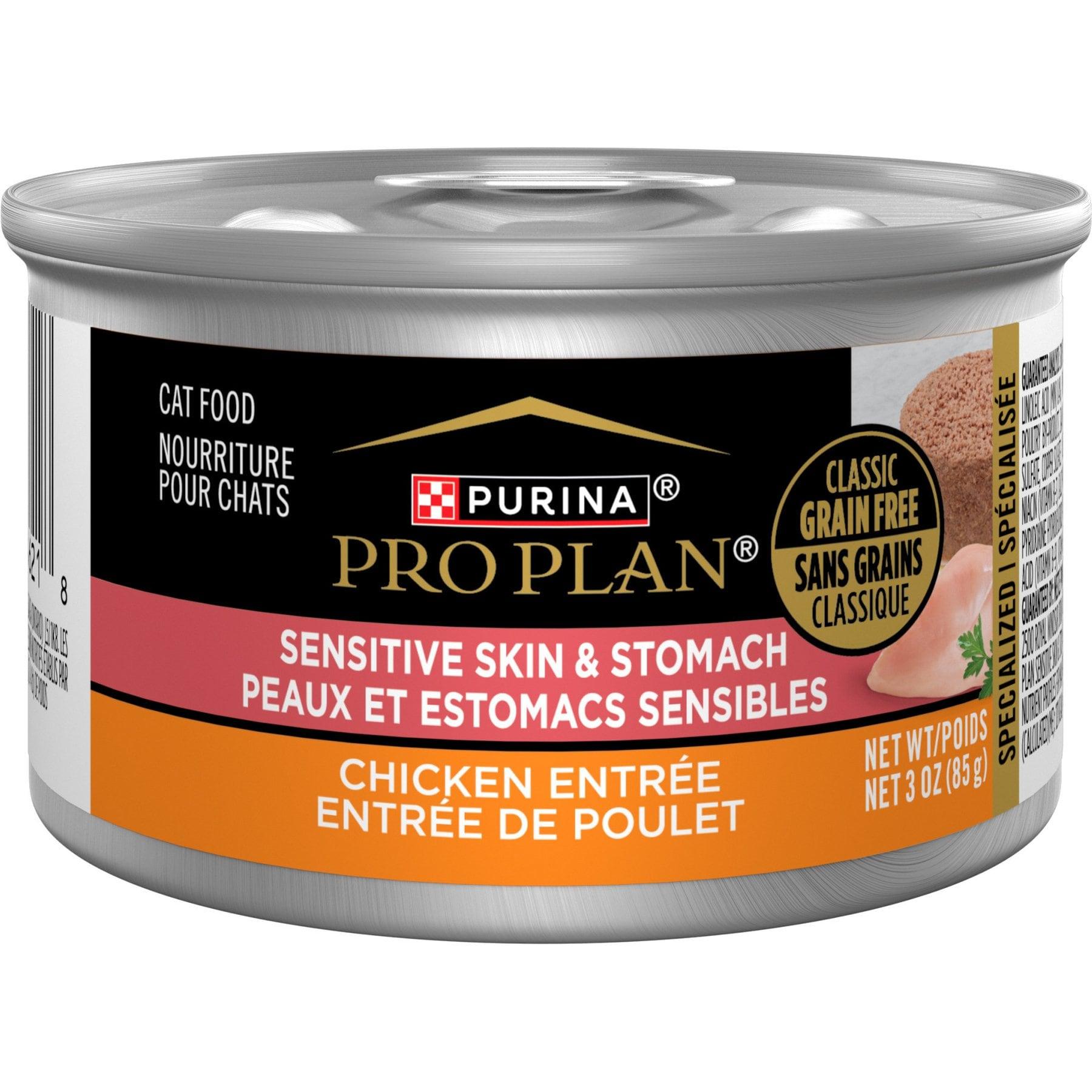
A grain-free chicken pate for adult cats with occasional tummy or skin upsets, with prebiotic fiber from chicory root.
Webvet may earn a commission when you click through to Chewy, at no extra cost to you.
Purina Pro Plan Sensitive Skin & Stomach Adult Grain-Free Chicken Pate Wet Cat Food is a chicken pate for adult cats. Its Chewy listing describes it as highly digestible and made with natural prebiotic fiber from chicory root to support digestive health, with a sensitive skin and stomach focus.
It suits a healthy adult cat that does best on wet food and has the occasional mildly upset stomach. As a pate in 3-oz cans, it is easy to measure into meals and adds moisture to the daily diet.
- Skip it for a kitten: the listing is for adults.
- Skip it as a test for a suspected food allergy: chicken is a common feline allergen, and an allergy trial needs a vet-chosen diet.
- Listed at $47.04 on Chewy when checked in November 2026 for a case of 24.
Fancy Feast Classic Pate Chicken Feast Grain-Free Pate Canned Cat Food: best budget grain free wet food
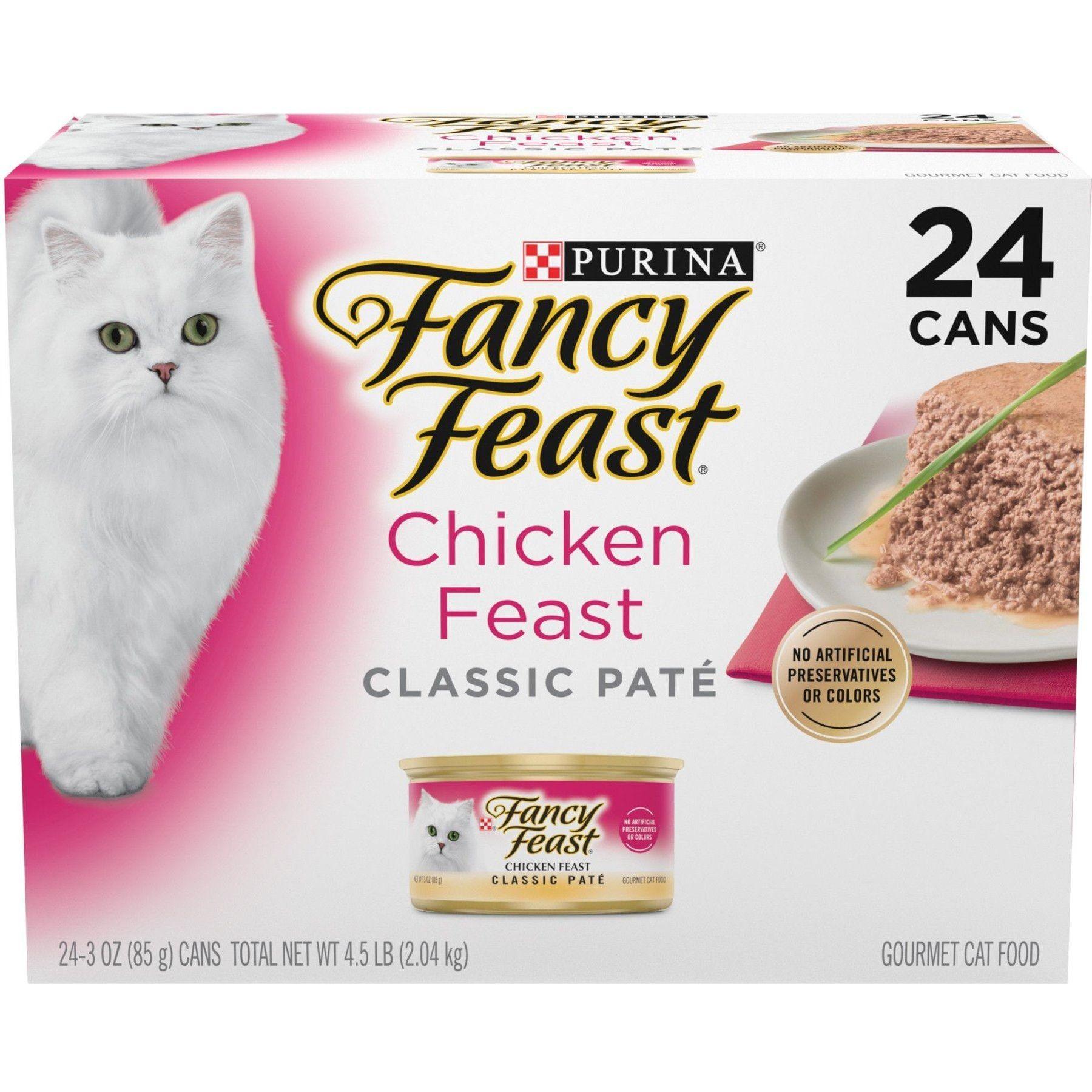
A low-cost grain-free chicken pate for adult cats, sold in 3-oz cans that are easy to portion.
Webvet may earn a commission when you click through to Chewy, at no extra cost to you.
Fancy Feast Classic Pate Chicken Feast Grain-Free Pate Canned Cat Food is a smooth chicken pate that the Chewy listing describes as a complete and balanced meal for adult cats. For owners who want wet food every day without a large bill, it is the lowest-priced pick here.
It suits adult cats that prefer a soft, uniform texture. Because a 3-oz can is small, it also works as one of several measured meals across the day rather than one large bowl.
- Skip it for kittens, and for any cat on a vet-prescribed diet.
- Check the calorie content on the can before working out how many cans a day your cat needs.
- Listed at $22.86 on Chewy when checked in November 2026 for a case of 24.
Iams Perfect Portions Healthy Adult Chicken Recipe Pate Grain-Free Wet Cat Food Trays: best portion-controlled grain free wet food
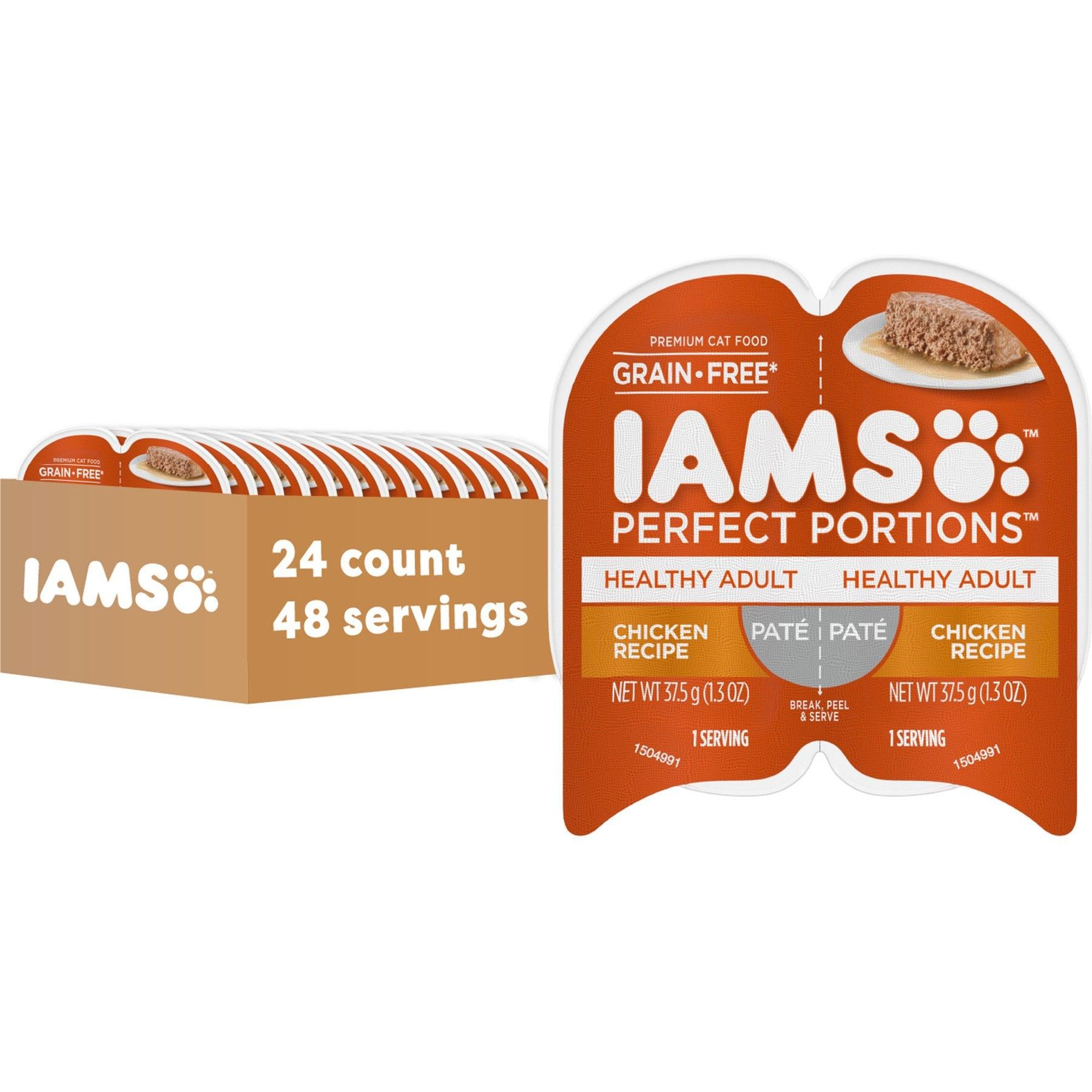
Single-serve grain-free chicken pate trays for adult cats, useful when you want each wet meal measured the same way.
Webvet may earn a commission when you click through to Chewy, at no extra cost to you.
Iams Perfect Portions Healthy Adult Chicken Recipe Pate Grain-Free Wet Cat Food Trays come as 2.6-oz twin-pack trays. The Chewy listing describes two individually wrapped meals in each twin pack and 100% complete and balanced nutrition for adult cats, made with real chicken.
The format is the selling point. Each wrapped meal is opened on its own, so there is no half-used can in the fridge and portions stay the same from day to day, which helps if several people feed the cat.
- Suits adult cats on a measured feeding plan and owners who dislike storing opened cans.
- Skip it if your cat eats a large volume at one sitting: more than one twin pack may be needed, so check the calories.
- Listed at $33.36 on Chewy when checked in November 2026 for 24 twin packs.
Blue Buffalo Wilderness Indoor Chicken Grain-Free Dry Cat Food: best grain free dry food for indoor cats
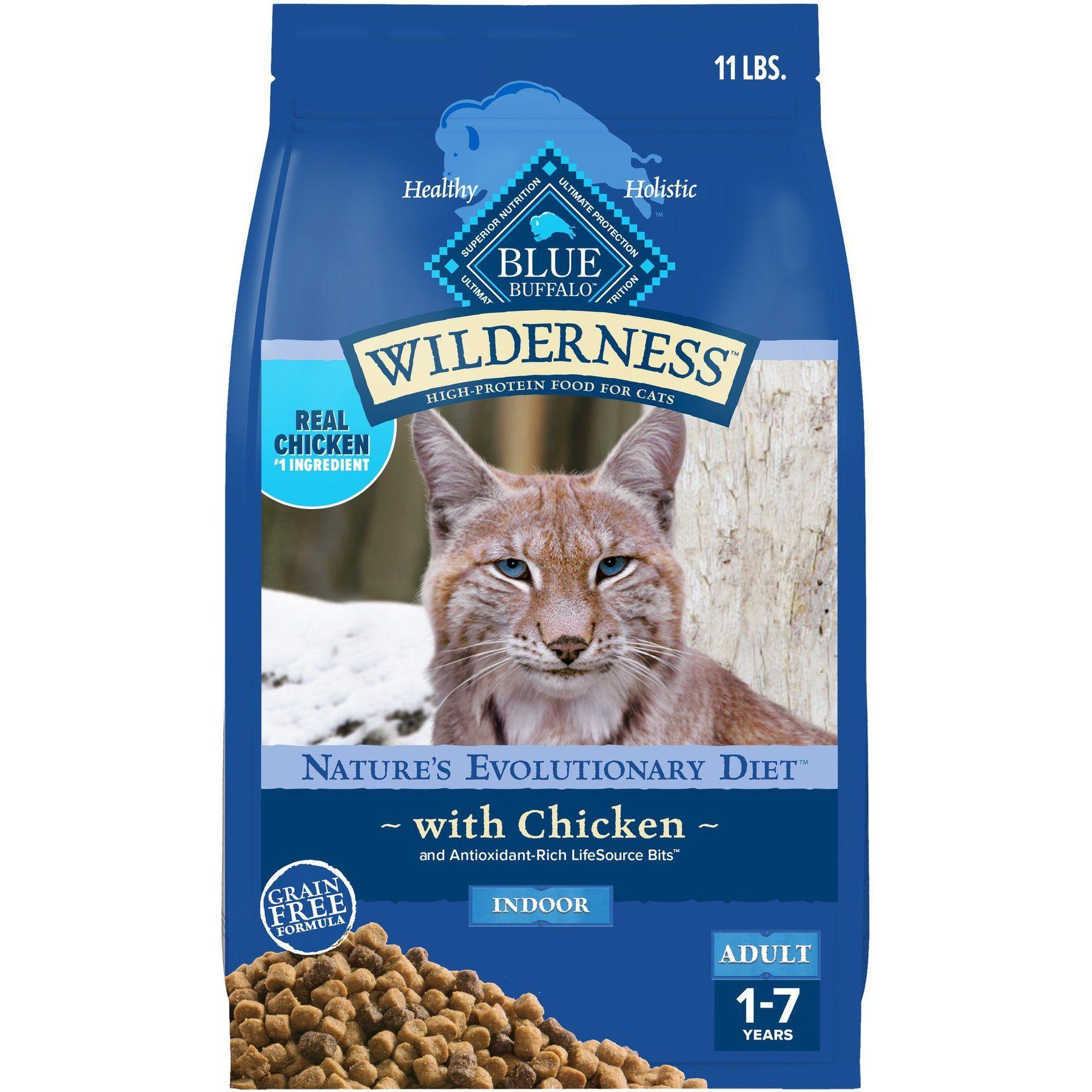
A grain-free chicken kibble for adult indoor cats for owners who feed some or all of the diet dry.
Webvet may earn a commission when you click through to Chewy, at no extra cost to you.
Blue Buffalo Wilderness Indoor Chicken Grain-Free Dry Cat Food is a dry recipe for adult indoor cats. Its Chewy listing describes it as high in protein, made with real chicken, formulated without chicken or poultry by-product meals, and free of corn and wheat.
It suits owners who leave some dry food out or use kibble in puzzle feeders. Indoor cats tend to be less active, so measuring the daily amount from the calorie content matters more than the indoor label.
- Skip it for kittens: the listing is for adult indoor cats.
- A by-product-free claim is a preference, not a quality guarantee: VCA notes byproducts can be rich in nutrients.
- Listed at $44.98 on Chewy when checked in November 2026 for an 11-lb bag.
Hill's Science Diet Adult Sensitive Stomach & Skin Grain-Free Salmon & Yellow Pea Recipe Dry Cat Food: best grain free dry food for sensitive cats
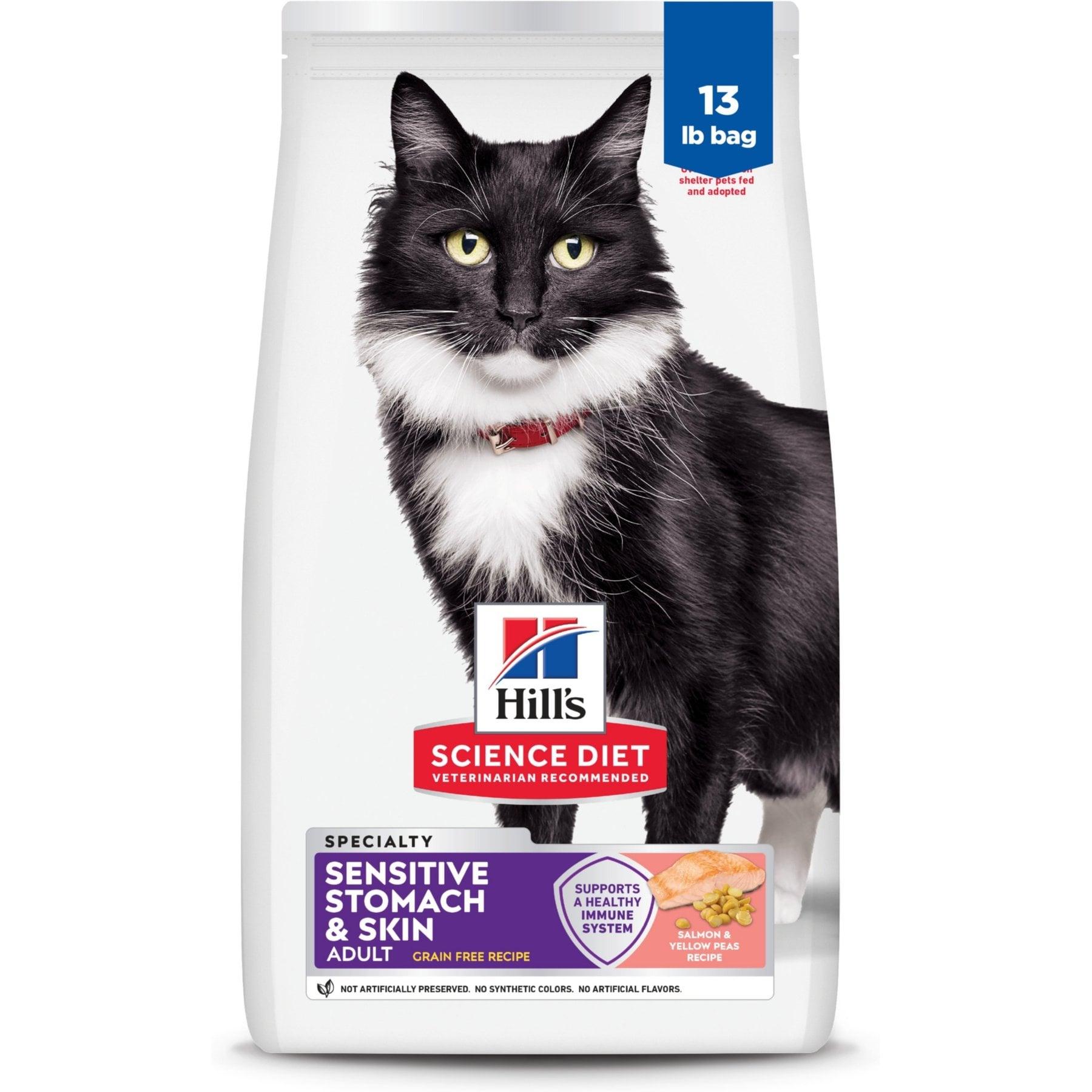
A grain-free salmon kibble for healthy adult cats prone to occasional digestive upsets or dull skin.
Webvet may earn a commission when you click through to Chewy, at no extra cost to you.
Hill's Science Diet Adult Sensitive Stomach & Skin Grain-Free Salmon & Yellow Pea Recipe Dry Cat Food is a salmon-based kibble. The Chewy listing describes a highly digestible formula with prebiotic fiber for healthy cats prone to occasional digestive upsets, plus support for healthy skin.
It is a Science Diet retail food, not a Hill's Prescription Diet, so no vet authorization is needed to buy it. It suits a healthy adult that eats dry food and has the odd loose stool. It is not a treatment for ongoing vomiting or diarrhea.
- Note the yellow pea in the name: this is a grain-free recipe that uses a pulse, not a low-carbohydrate one by default.
- Skip it for a cat with a diagnosed condition unless your vet agrees.
- Listed at $67.99 on Chewy when checked in November 2026 for a 13-lb bag.
Instinct Original Real Chicken Recipe Grain-Free Dry Cat Food: best high-protein grain free dry food
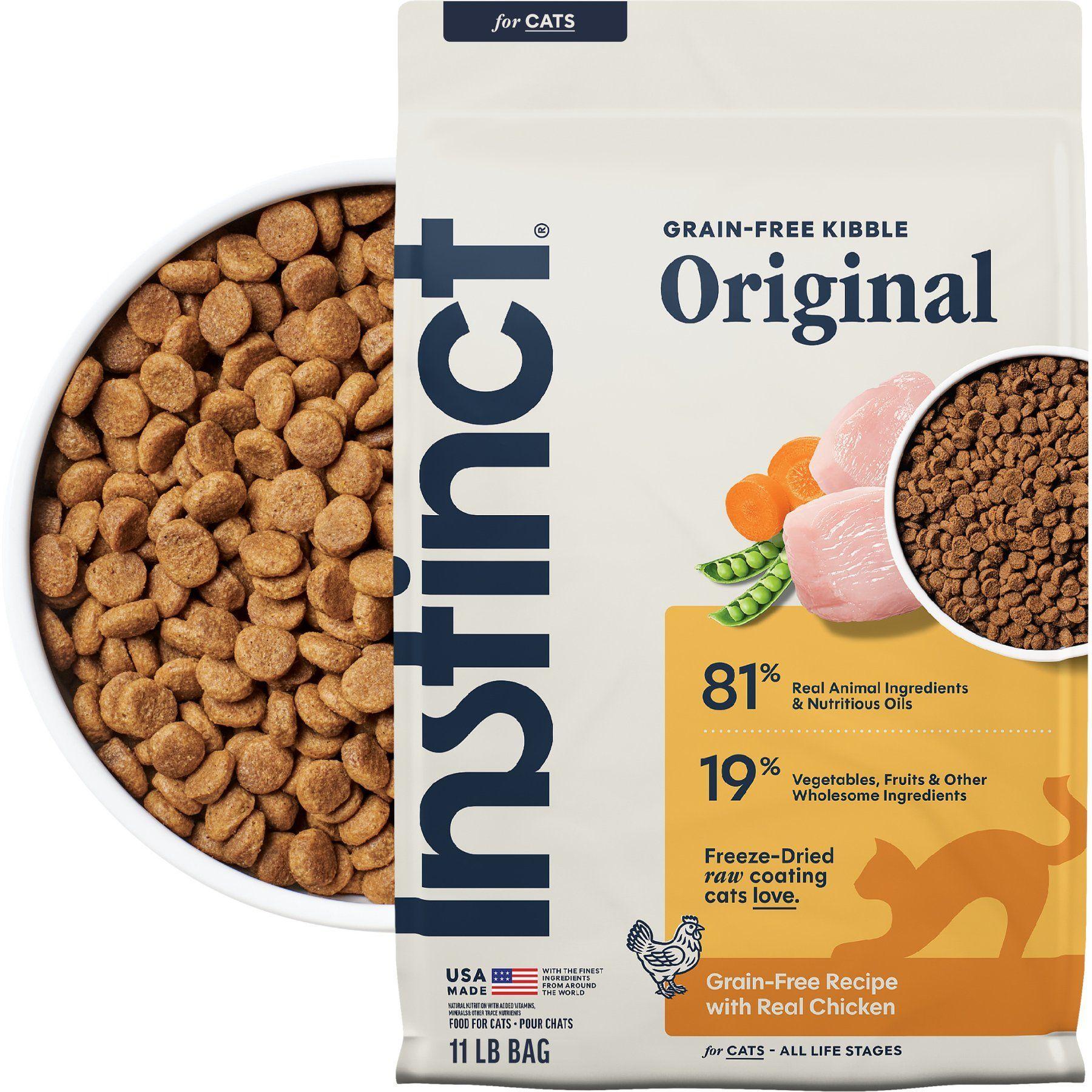
A high-protein grain-free chicken kibble for adult cats whose owners want animal ingredients to lead the recipe.
Webvet may earn a commission when you click through to Chewy, at no extra cost to you.
Instinct Original Real Chicken Recipe Grain-Free Dry Cat Food is the most animal-heavy dry recipe here by its own description. The Chewy listing states 81% real animal ingredients and nutritious oils with 19% vegetables, fruits, and other foods, with cage-free chicken as the first ingredient.
It suits owners who want protein to lead the recipe in a dry food. Higher-protein, higher-fat kibble can also be calorie-dense, so measure by calories, not by cup habit. For a wider look at this category, see the high protein cat food roundup.
- Skip it for cats with kidney disease unless your vet has set the protein level.
- Listed at $44.99 on Chewy when checked in November 2026 for an 11-lb bag.
Do cats need grain free food? Grains, carbohydrates, and allergies
| Reason owners give | What the evidence shows for cats | What to check on the label instead | When to ask the vet |
|---|---|---|---|
| My cat has allergies | Grain allergies are rare in cats; the common food allergens are beef, fish, and chicken | The animal proteins named in the ingredient list | Itching, skin sores, vomiting, or diarrhea that keep coming back |
| I want fewer carbohydrates | Grain-free diets average a little less carbohydrate, but many overlap with grain-inclusive diets | Starches such as potato, pea, lentil, and tapioca high in the ingredient list | Diabetes, weight loss plans, or a cat on insulin |
| Cats are carnivores, so grain-free is more natural | Cats need animal-sourced nutrients but digest cooked grains well | A named animal protein early in the list and a complete and balanced statement | Any plan to feed raw, homemade, or plant-based food |
| My cat has a sensitive stomach | Digestibility depends on the whole recipe, not on grain alone | Fiber source, fat level, and a gentle switch to any new food | Vomiting more than occasionally, diarrhea, weight loss, or blood in stool |
| I am worried about heart disease | FDA reports were nearly all dogs, with no causal link established | AAFCO statement and a maker that answers formulation questions | Breathing changes, lethargy, or fainting |
Cats do not need grain-free food. They are obligate carnivores, which the Cornell Feline Health Center defines as relying on nutrients found only in animal products. That is a reason to make sure animal protein leads the diet. It is not a reason to remove grain, which can sit alongside that protein without harm.

Do cats need grains in their diet? No, and they do not need to avoid them either. The Merck Veterinary Manual notes cats are adapted to a moderate intake of dietary complex carbohydrates. VCA Animal Hospitals adds that grains are not simply fillers and can supply iron, calcium, and B vitamins such as thiamine, riboflavin, and niacin.
Grain-free is not the same as low-carb
When grain comes out, another starch usually goes in. A study of 77 randomly selected dry cat diets in the Journal of Feline Medicine and Surgery (35 grain-free, 42 grain-containing) found the grain-free group averaged 64 g of carbohydrate per 1,000 kcal against 86 g for grain-containing diets.
That average gap hides the main finding. The authors reported considerable overlap between the groups, with individual diets' carbohydrate content varying widely. Some grain-free kibbles carry as much dietary carbohydrate as grain-inclusive ones, because chickpeas, lentils, peas, potato, sweet potato, and tapioca were more common in the grain-free recipes.
Tufts University nutritionists describe the same pattern: some grain-free diets simply substitute similar amounts of highly refined starches such as potato or tapioca, while others use peas, beans, or lentils instead of grains.
Food allergy is usually protein, not grain
Food allergy is a real reason to change a cat's diet, but grain is rarely the culprit. A critically appraised review in BMC Veterinary Research found the most common food allergens in cats are beef, fish, and chicken. VCA states that allergies or sensitivities to grains or gluten are rare in cats.
This is why a chicken-based grain-free food can leave an allergic cat just as itchy as before. If you suspect allergy, the allergies in cats guide explains how food allergy and flea allergy differ, and why a vet-run elimination trial is the test that confirms it.
Grain free cat food pros and cons
The honest list is short on both sides:
- Pro: some cats simply prefer a particular grain-free recipe, and a food the cat eats well has real value.
- Pro: some grain-free recipes are lower in carbohydrate, which may suit an owner's preference.
- Con: there is no proven health benefit for most cats, so any price premium buys a preference, not a result.
- Con: some lower-carbohydrate grain-free foods are higher in fat and calories, which can add weight.
- Con: the label can lead owners to skip the AAFCO statement and calorie checks that actually matter.
A grain-free recipe is not a proven fix for a sensitive stomach, because the evidence does not single out grain. A cat with mild, occasional upset may do well on a digestible recipe either way. As a grain-inclusive comparison, Hill's Science Diet Sensitive Stomach & Sensitive Skin Pollock Meal & Barley Recipe Adult Dry Cat Food, 3.5-lb bag uses barley and is listed at $31.99 on Chewy when checked in November 2026.
What brands of cat food are grain free?
Many major brands sell at least one grain-free recipe, including Purina Pro Plan, Fancy Feast, Iams, Blue Buffalo Wilderness, Hill's Science Diet, Instinct, and Merrick. Several, Hill's Science Diet among them, also sell grain-inclusive recipes, so a brand name alone does not tell you. Read the ingredient list of the exact recipe for corn, wheat, rice, barley, oats, or soy.
One grain-free recipe does not make a whole brand grain-free, wherever you shop. Check the recipe, then the AAFCO statement, then the calories.
What is the healthiest inexpensive dry cat food?
The healthiest inexpensive dry cat food is a complete and balanced adult food from a maker that answers the WSAVA questions, fed in the right amount. Price does not measure nutrition. An affordable grain-inclusive kibble can meet the same AAFCO nutrient profile as a costly grain-free one, and the grain-free label is not a proven benefit worth paying extra for.
To compare dry options side by side, including grain-inclusive ones, the best dry cat food roundup covers more choices. Cost per day, worked out from calories per cup and the amount your cat needs, is a fairer comparison than price per bag.
Grain free cat food and heart disease: what the FDA investigation does and does not say
There is no established evidence that grain-free food causes heart problems in cats. The FDA Center for Veterinary Medicine investigated reports of dilated cardiomyopathy (DCM) in animals eating certain diets. The investigation was about dogs, as its title says.

What the FDA heart investigation covered, in its own figures from the FDA Center for Veterinary Medicine:
- Between January 1, 2014 and April 30, 2019, FDA received 524 DCM reports: 515 in dogs and 9 in cats.
- More than 90 percent of reported products were grain-free, and 93 percent contained peas and/or lentils.
- FDA treated a product as grain-free if it did not contain corn, soy, wheat, rice, barley, or other grains.
- FDA said case reports alone do not supply sufficient data to establish a causal relationship.
- FDA described the issue as a complex scientific question that may involve multiple factors.
- In its December 23, 2022 update, FDA said it does not plan further public updates until there is meaningful new scientific information.
What it does not say matters just as much for cat owners. Nine feline reports over five years is far too few to draw conclusions about cats. FDA also notes that cats are generally more likely to develop a different heart disease, hypertrophic cardiomyopathy.
Where taurine fits
Cats have a long, well-documented link between diet and DCM, but it is taurine, not grain. The Merck Veterinary Manual states taurine deficiency can cause dilated cardiomyopathy and central retinal degeneration in cats, and that cats need animal-based protein because plant proteins are devoid of taurine.
Taurine comes from animal-based protein, which is one more reason a named animal protein should lead any cat food. The taurine for cats guide explains how much cats need and where it comes from, and the taurine deficiency in cats guide covers the signs and risks.
The practical takeaway: there is no evidence that the grain-free label itself adds heart risk for a cat eating a complete and balanced food. FDA urges owners to work with their veterinarians on diet questions, and that applies most to cats already diagnosed with heart disease.
How to read a grain free cat food label: wet vs dry, protein, and the AAFCO statement
To judge any grain free cat food, read the back of the label, not the front. The Cornell Feline Health Center calls the nutrition label the best way to compare cat foods. Four parts of it tell you far more than the words grain-free on the front.
Reading the AAFCO statement
The nutritional adequacy statement is the line to find first. The Merck Veterinary Manual notes there are four possible AAFCO statements and one must appear on every pet food label. According to the FDA, a complete and balanced food is intended to be fed as the sole diet.
What to look for in that statement:
- Complete and balanced, not intermittent or supplemental feeding.
- The life stage: adult maintenance, growth, or all life stages. The WSAVA guide notes all-life-stages diets are formulated for reproduction and growth.
- How it was substantiated: formulated to meet an AAFCO nutrient profile, or tested in AAFCO feeding trials. Both are allowed.
- That it says cat, not dog. Merck notes dog foods often lack assured taurine levels, so they are unsuitable for cats.
Grain free kitten food follows the same rule: a kitten needs a food labeled for growth or all life stages, and every pick above is labeled for adults only. The best kitten food guide covers growth-labeled picks.
Ingredients, guaranteed analysis, and calories
AAFCO requires ingredients to be listed in descending order by weight, so a named animal protein should appear early. In a grain-free food, watch for potato, pea, lentil, chickpea, or tapioca near the top: that is where the carbohydrate went.
The guaranteed analysis lists minimum crude protein and fat and maximum fiber and moisture. Because wet food is mostly water, compare protein between wet and dry foods only after accounting for moisture, or ask the maker for figures on a dry matter or per-calorie basis.
Calories sit under a heading titled Calorie Content. The WSAVA guide points out that accurate calorie figures help prevent overfeeding, and Tufts nutritionists note that some lower-carbohydrate grain-free foods are high in fat and calories. The how much to feed a cat guide turns those calorie figures into daily portions.
Wet vs dry grain free food
Wet grain-free food is the better choice for water intake, and dry is the more convenient one; the two differ mostly in water. Cornell states canned cat food has a moisture content of at least 75 percent, while dry food contains between six and 10 percent water. Canned, pate, and other soft grain-free foods therefore add water to a cat's day.
Dry grain-free kibble holds little water, so each bite packs in more food. It is convenient to leave out, which also makes overfeeding easier. Whether you are comparing a canned food with a kibble or two kibbles with each other, the same checks apply: AAFCO statement, life stage, named protein, calories.
Another grain-free dry option is Merrick Purrfect Bistro Grain-Free Chicken & Sweet Potato Recipe Dry Cat Food, 4-lb bag, listed at $17.99 on Chewy when checked in November 2026. Note the sweet potato in the name: it is a starch in place of grain. For wet options of every kind, the best wet cat food roundup compares more.
What is the least healthy cat food?
The least healthy cat food is one that is not complete and balanced for a cat. That includes a food with no AAFCO nutritional adequacy statement, a product labeled for intermittent or supplemental feeding used as the main diet, or dog food fed to a cat. A homemade diet without a veterinary nutritionist's recipe also often falls short, according to VCA.
Overfeeding any food is the other common problem. The WSAVA guide notes that accurate calorie information helps prevent unintended overfeeding, so measure portions from the Calorie Content line rather than by habit.
Which cat food brands should I avoid in 2026?
Avoid a brand that cannot answer the WSAVA questions, not a brand on a social media list. WSAVA advises that if a manufacturer cannot or will not share who formulates its food, its quality control, or its nutrient data, owners should be cautious about feeding that brand. Products recalled for safety reasons appear on the FDA recalls page.
Before you buy, check that the bag or can lists:
- An AAFCO complete and balanced statement for your cat's life stage.
- A calorie content figure.
- Contact details for the company, ideally a phone number or email.
- Who makes the food: made by the company itself, or made for or distributed by it through a third-party plant.
When a cat needs a vet instead of a food change
Owners often reach for a new food when the real problem is medical. A food change is reasonable for a healthy cat with a preference. It is the wrong first step when a cat is unwell, because a switch can hide the signs a vet needs to see, or delay treatment.

See your vet before changing food when you notice any of these:
- Itching, overgrooming, scabs, or hair loss that last for weeks. VCA describes chronic, year-round itching and skin inflammation as typical of food allergy in cats.
- Vomiting more than occasionally, diarrhea, or blood or mucus in the stool.
- Weight loss, or weight gain you cannot explain by portions.
- Straining in the litter box or frequent trips that produce little urine, which is an emergency.
- A cat already eating a prescription diet for kidney disease, diabetes, a urinary condition, or a food allergy.
If food allergy is suspected, the test is an elimination trial run with your vet. VCA Animal Hospitals says the elimination diet should be fed for at least eight weeks, and that the veterinary therapeutic diet chosen for your cat is better than an over-the-counter diet.
VCA also notes that over-the-counter foods may contact other proteins during manufacturing, even when one protein is listed. A store-bought grain-free or limited ingredient cat food can be a fine everyday choice, but it is not a diagnostic trial diet.
How to switch to grain free cat food, and where treats fit
If your cat is healthy and you have chosen a grain-free food, switch slowly. The Ohio State University Indoor Pet Initiative recommends starting only when the cat is feeling well and eating its usual diet normally.

The Ohio State approach, step by step:
- Put the new food in the cat's usual feeding container next to the usual diet.
- If needed, mix in a small amount of a flavor the cat likes, such as meat drippings or tuna juice, to make the new food more appealing at first.
- If the new food is not eaten within an hour, remove it and offer fresh food at the next meal.
- Once the new food is familiar, usually within a day or two, reduce the old food a little each day.
- Expect the full change to take 1 to 2 weeks.
When moving to a wet grain-free pate such as the Fancy Feast Classic Pate Chicken Feast Grain-Free Pate Canned Cat Food, the same side-by-side method works. Keep total calories steady as you shift the mix, since wet and dry foods differ widely per serving.
Grain free cat treats and toppers
Grain-free treats and toppers follow the same calorie rule as any treat. Cornell suggests treats should not exceed 10 to 15 percent of a cat's daily calories. The WSAVA guide puts foods labeled for intermittent or supplemental feeding at 10% or less of the diet.
A few points to keep treats and toppers in their place:
- The FDA notes treats, snacks, and supplements are typically not intended to be a pet's sole diet.
- A topper labeled for supplemental feeding does not make a meal complete.
- A wet grain-free food such as the Iams Perfect Portions Healthy Adult Chicken Recipe Pate Grain-Free Wet Cat Food Trays can serve as a measured topper over kibble if you reduce the kibble to match.
- During a vet-run elimination trial, no treats or toppers should be given unless your vet approves them.
Human food is a separate matter. Some foods are toxic to cats: the ASPCA Animal Poison Control Center lists onion, garlic, and chives, noting cats are more susceptible than dogs, along with chocolate, caffeine, and xylitol. The poison-proof your cat home guide covers the most toxic foods and how to store them.
Grain free cat food questions
Frequently Asked Questions
Is grain free food good for cats?
Grain-free food can be good for cats when it is complete and balanced, but it is not better than a good grain-inclusive food, and it is not bad for cats either. VCA finds no clear evidence that alternative diets help most healthy cats more than conventional ones. The quality comes from the whole recipe and the maker's standards, not from leaving grain out.
Why do some vets not recommend grain free cat food?
A veterinarian is usually not against grain-free food itself but against the idea that grain-free is healthier. The evidence does not show a benefit for most cats, and owners sometimes choose grain-free in place of a vet visit for itching or vomiting. Your vet would rather you judge food on its AAFCO statement and maker.
Does grain free cat food cause heart problems?
There is no proof that it does in cats. The FDA heart investigation focused on dogs, received only 9 feline reports between 2014 and April 2019, and did not establish a causal link. The known dietary cause of DCM in cats is taurine deficiency, according to the Merck Veterinary Manual, not grain.
Is grain free wet cat food better than dry?
Wet food is better for water intake whether or not it is grain-free. The Merck Veterinary Manual puts canned foods at 68%–78% water against about 10% moisture in dry food. Dry food holds far less water but is convenient. Many cats do well on a mix, and the grain content matters less than the moisture and calories.
Do cats need grains in their diet?
No. Cats are obligate carnivores and do not need grains, but they do not need to avoid them. Tufts nutritionists note that cats and dogs digest and use more than 90 percent of the nutrients from grains, and carbohydrates from cooked grain sit comfortably in a complete and balanced food.
Is grain free cat food good for a sensitive stomach?
Only if that particular recipe suits your cat. A sensitive stomach is not usually caused by grain, so look at the whole list of ingredients, the fat level, and the fiber source, and switch slowly. Repeated vomiting or diarrhea needs a vet, not another food change.
Veterinarian · BVMS MRCVS
Dr. Pippa Elliott, BVMS, MRCVS, is a veterinarian with nearly 30 years of experience in companion animal practice. Dr. Elliott earned her Bachelor of Veterinary Medicine and Surgery from the University of Glasgow. She was also designated a Member of the Royal College of Veterinary Surgeons. Married with 2 grown-up kids, Dr. Elliott has a naughty Puggle named Poggle, 3 cats and a bearded dragon.


