Best Cat Food for Urinary Health: Over-the-Counter and Prescription Options
Urinary cat foods come in two tiers: over-the-counter care formulas for healthy adult cats, and prescription diets a vet uses after a diagnosis. Which tier fits your cat, why wet food matters, and which signs need a vet first.

BVMS MRCVS
Medically reviewed by Dr. Pippa Elliott, BVMS MRCVS · Last reviewed

This article contains affiliate links. Webvet may earn a commission when you buy through them, at no extra cost to you.
Best cat food for urinary health: over-the-counter care foods vs prescription diets
The best cat food for urinary health depends on which of two tiers your cat belongs in. Over-the-counter urinary care foods suit a healthy adult cat as everyday maintenance. Prescription diets such as Hill's c/d, Royal Canin Urinary SO, and Purina Pro Plan Veterinary Diets UR are used after a veterinarian diagnoses a specific problem.
Moisture matters in both tiers, because wet food adds water and more water means more dilute urine. A cat already showing urinary signs needs a vet before any change of food, since the right diet depends on what is happening inside the bladder.
- 1Healthy adult cats with no urinary history can eat over-the-counter urinary care foods as a maintenance diet.
- 2Your veterinarian decides when a prescription diet is needed, usually after diagnosing struvite stones, calcium oxalate risk, or feline idiopathic cystitis.
- 3Wet food raises water intake and dilutes urine, which helps cats in either tier.
- 4A cat straining in the litter box needs a vet first, before any new food.
Six foods stand out across the two tiers: three over-the-counter formulas for healthy adults and three prescription diets that Chewy ships only with a veterinarian's authorization.
| Pick | Tier | Format | Best fit |
|---|---|---|---|
| Purina Pro Plan Focus Adult Urinary Tract Health Dry Cat Food, 7-lb | Over-the-counter | Dry | Healthy adult cats that eat mostly kibble |
| Royal Canin Feline Care Nutrition Urinary Care Thin Slices in Gravy Wet Cat Food, 3-oz can, case of 24 | Over-the-counter | Wet | Healthy adult cats that need more moisture |
| Hill's Science Diet Adult Urinary Hairball Control Dry Cat Food, 7-lb | Over-the-counter | Dry | Healthy adults that also struggle with hairballs |
| Hill's Prescription Diet c/d Multicare Bladder Health Cat Food, 8.5-lb | Prescription | Dry | Cats with a diagnosis, when the vet names c/d |
| Royal Canin Veterinary Diet Urinary SO Loaf Pate Adult Wet Cat Food, 5.1-oz can, pack of 12 | Prescription | Wet | Cats with a diagnosis, when the vet names Urinary SO |
| Purina Pro Plan Veterinary Diets UR Urinary St/Ox Wet Cat Food, 3-oz can, case of 24 | Prescription | Wet | Cats with a diagnosis, when the vet names UR |
"Urinary health" covers several different problems that share the same signs. Vets group them under feline lower urinary tract disease, a term for disorders of the bladder and urethra that range from mild to serious, according to the Cornell Feline Health Center.
The most common diagnosis in cats with lower urinary tract signs is feline idiopathic cystitis, a bladder inflammation with no single identifiable cause. Struvite crystals and stones and calcium oxalate stones are the other main problems. Each responds differently to diet, which is why one food cannot be right for every cat.
Cornell notes that these problems turn up most often in middle-aged, overweight cats that get little exercise. Its list of contributing factors also includes:
- Being male, which raises the risk of a urethral blockage.
- Using an indoor litter box and getting little activity.
- Stress, including life in a multi-cat household.
- Changes in routine, such as a move or a new pet.

The six foods cover both tiers and both formats, so nearly any cat has a match. Each one meets these criteria:
- The maker states a specific urinary purpose, such as lowering urine pH, limiting magnesium, or maintaining urine mineral balance.
- The food is a complete diet for adult cats, not a topper or supplement.
- The tier is clear: either sold openly for healthy cats or sold only with a veterinarian's authorization.
- Wet and dry options are both represented, because moisture is one of the strongest levers a food has.
What any urinary food can and cannot do:
- It can add water when it is wet, shift urine pH, and limit the minerals that build crystals.
- It can help keep urine dilute, which lowers the chance that crystals form.
- It cannot relieve a blockage, clear an infection, or dissolve a calcium oxalate stone.
- It cannot replace an exam when a cat is already showing urinary signs.
None of these foods replaces a diagnosis. A healthy cat can start on an over-the-counter formula today. A cat with symptoms or a past diagnosis should eat whatever the vet prescribes.
Price ranges also differ by tier. The over-the-counter picks were listed at $28.08 to $57.36 per bag or case on Chewy when checked in November 2026, and the prescription diets at $45.49 to $71.99, so budget can shape the choice within a tier but should never decide which tier a cat belongs in.
Age matters too. Most of these picks are made for adult cats, so a kitten with urinary signs needs a vet-chosen plan rather than an adult urinary bag picked off the shelf.
 Sponsored
Have questions about your cat's urinary health?
Talk to a licensed vet at Dutch over video, often the same day. They can recommend treatment and prescribe it when it's appropriate.
Use code Pets60
Plans start at $12/month · covers up to 5 pets
- Licensed vets in most states
- Rx for 150+ conditions
- 4.7 on Trustpilot
Our picks: the best cat food for urinary health
A good urinary cat food does one of three jobs. It adds water, it controls the minerals that form crystals, or it steers urine pH toward a range where those minerals stay dissolved.
The best food for cats with urinary issues is the one that does the job your cat actually needs, in a format your cat will eat every day. A food left in the bowl helps no one, however well it is formulated.

Choosing among the six comes down to a few questions:
- Has a vet diagnosed a urinary problem? If yes, choose only from the prescription group, and only the diet the vet names.
- Does your cat eat wet food? If so, a wet formula adds the most water.
- Is your cat kibble-only? A dry urinary formula plus water strategies is a sensible start.
- Does your cat also have hairballs? The Science Diet formula covers both jobs.
- Is budget tight? The over-the-counter picks cost less than the prescription diets.
Many familiar brands sell urinary cat food, and the names overlap in confusing ways:
- Purina: Purina ONE and Pro Plan sell urinary formulas for healthy cats, while Pro Plan Veterinary Diets is the line a vet prescribes, so the bag on the store shelf is not the clinic diet.
- Hill's: Science Diet urinary formulas are for healthy cats, and Prescription Diet formulas are for cats with a diagnosis.
- Royal Canin: the Feline Care Nutrition Urinary Care line is sold openly, while Veterinary Diet Urinary SO is prescription only.
- Others: Blue Buffalo and 9Lives also sell urinary formulas in the over-the-counter tier.
A premium label does not make a urinary food good. What counts is a clear urinary purpose, complete and balanced nutrition for an adult cat, and the right tier for the cat's history.
A maintenance urinary food bought for a healthy cat is a different product from a prescription diet chosen for a cat with stones. Once a vet has diagnosed a urinary problem, the food belongs in the prescription group, even when an over-the-counter bag uses similar words.
Over-the-counter tier: for healthy adult cats with no current urinary diagnosis. These three foods are sold openly and are designed for maintenance. They suit a cat that has never had urinary trouble, or a cat whose vet has said an over-the-counter urinary formula is fine.
Purina Pro Plan Focus Adult Urinary Tract Health Dry Cat Food: best over-the-counter dry food
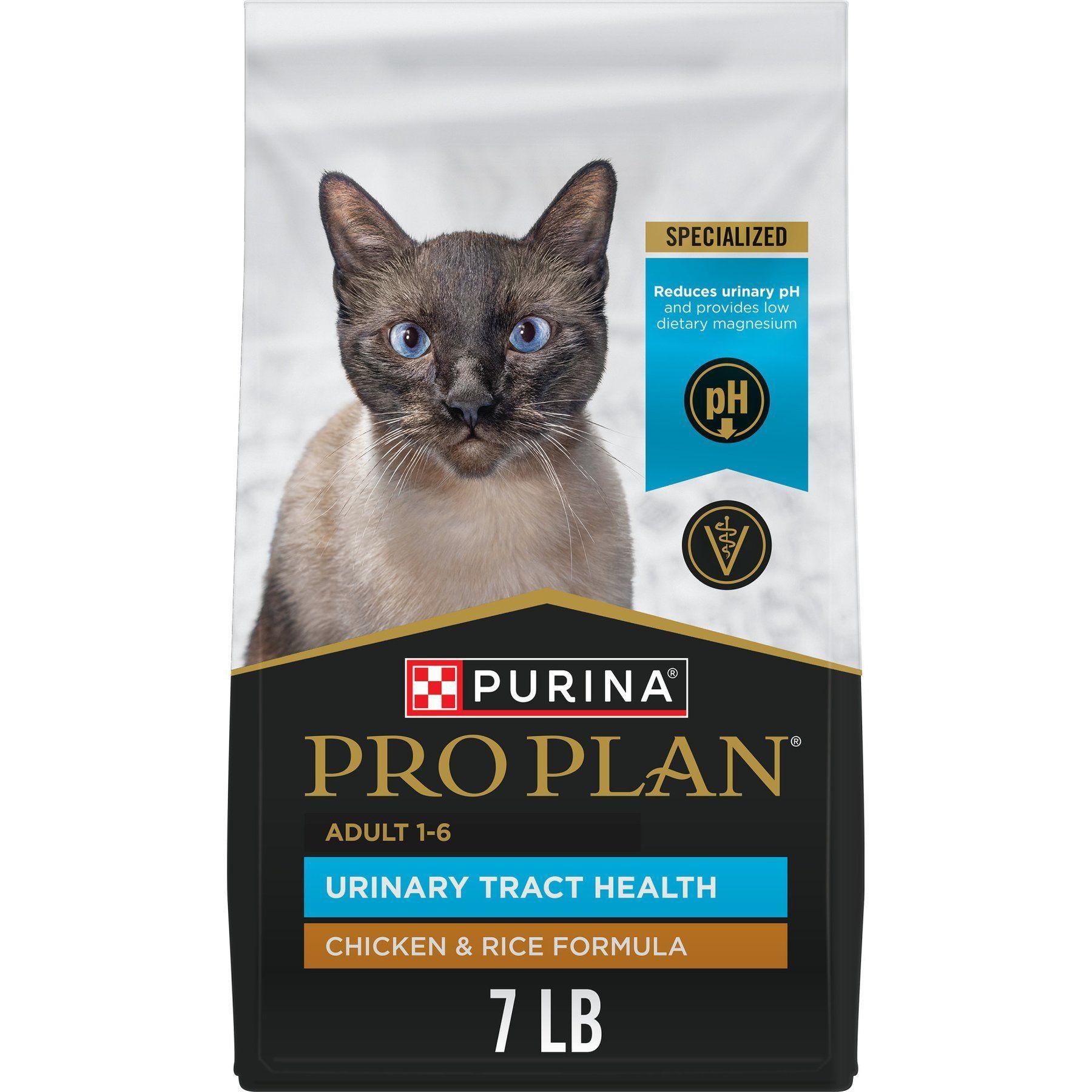
An over-the-counter dry food for healthy adult cats, made to lower urine pH and limit dietary magnesium.
Webvet may earn a commission when you click through to Chewy, at no extra cost to you.
Purina describes this Pro Plan urinary cat food as formulated to help maintain urinary tract health by reducing urinary pH and providing low dietary magnesium. It is a chicken and rice recipe with complete and balanced nutrition for the maintenance of adult cats.
That pairing of pH and magnesium targets struvite, a crystal type for which Merck lists alkaline urine as a contributing factor. For a healthy adult cat that already eats kibble happily, it keeps a urinary focus without a change of format.
It is listed at $28.08 on Chewy when checked in November 2026 for the 7-lb bag. For a cat that already eats kibble, it is the simplest place to start.
- Good fit if: your cat is a healthy adult, prefers dry food, and has no urinary diagnosis.
- Keep in mind: dry food holds little water, so add wet meals or a water fountain alongside it.
- Keep in mind: a cat with a calcium oxalate history should eat what the vet names instead, because ACVIM consensus links diets that push feline urine below pH 6.25 to calcium oxalate formation.
- Skip it if: your cat is a growing kitten, since the maker formulates it for adult maintenance.
- Feeding plan: pair dry meals with at least one wet meal a day, or set out extra water bowls, so the cat gets the moisture kibble lacks.
Royal Canin Feline Care Nutrition Urinary Care Thin Slices in Gravy Wet Cat Food: best over-the-counter wet food
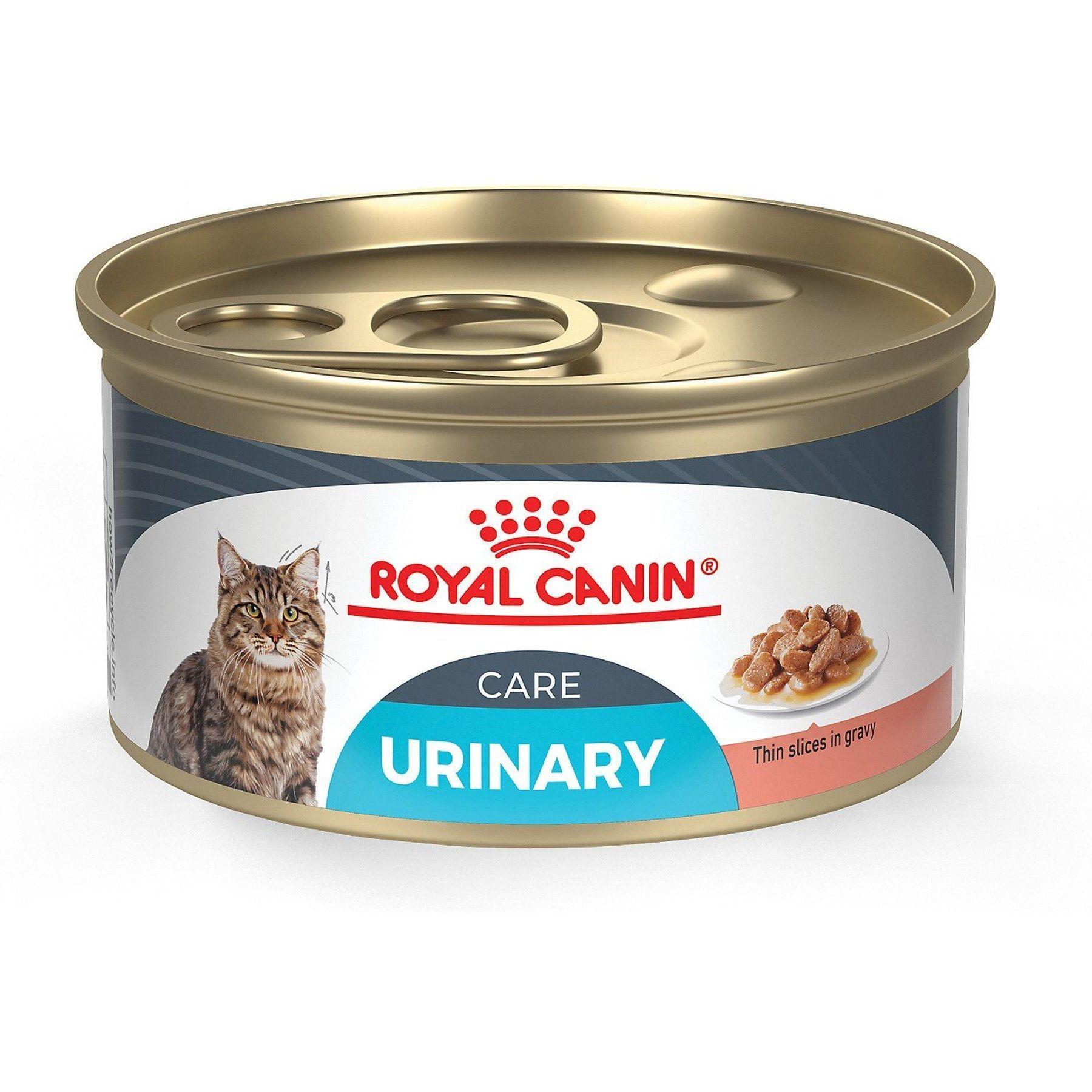
An over-the-counter wet food for healthy adult cats that adds moisture while supporting urine mineral balance.
Webvet may earn a commission when you click through to Chewy, at no extra cost to you.
Royal Canin describes its Urinary Care thin slices in gravy as a highly palatable wet food made to help maintain urinary tract health in healthy cats. The maker says it is complete and balanced and is balanced to support urinary health by maintaining the mineral balance in a cat's urine.
The wet format is the bigger story. Canned food carries far more water than kibble, and higher water intake produces more dilute urine. For a healthy adult that drinks little, a wet urinary formula covers both levers in one bowl.
It is listed at $57.36 on Chewy when checked in November 2026 for a case of 24 3-oz cans. Many owners use a few cans a week alongside a dry urinary food rather than feeding it as the only meal.
- Good fit if: your cat is a healthy adult that eats wet food and could use more water in the diet.
- Good fit if: you want to mix wet meals with an existing dry urinary food.
- Keep in mind: this is a maintenance food for healthy cats, not the prescription Urinary SO line.
- Skip it if: your vet has diagnosed stones or crystals and prescribed a therapeutic diet.
- Feeding plan: when a can replaces part of a dry meal, trim the dry portion so total daily calories stay steady, using the feeding guide on each label.
Hill's Science Diet Adult Urinary Hairball Control Dry Cat Food: best over-the-counter food for urinary and hairball care
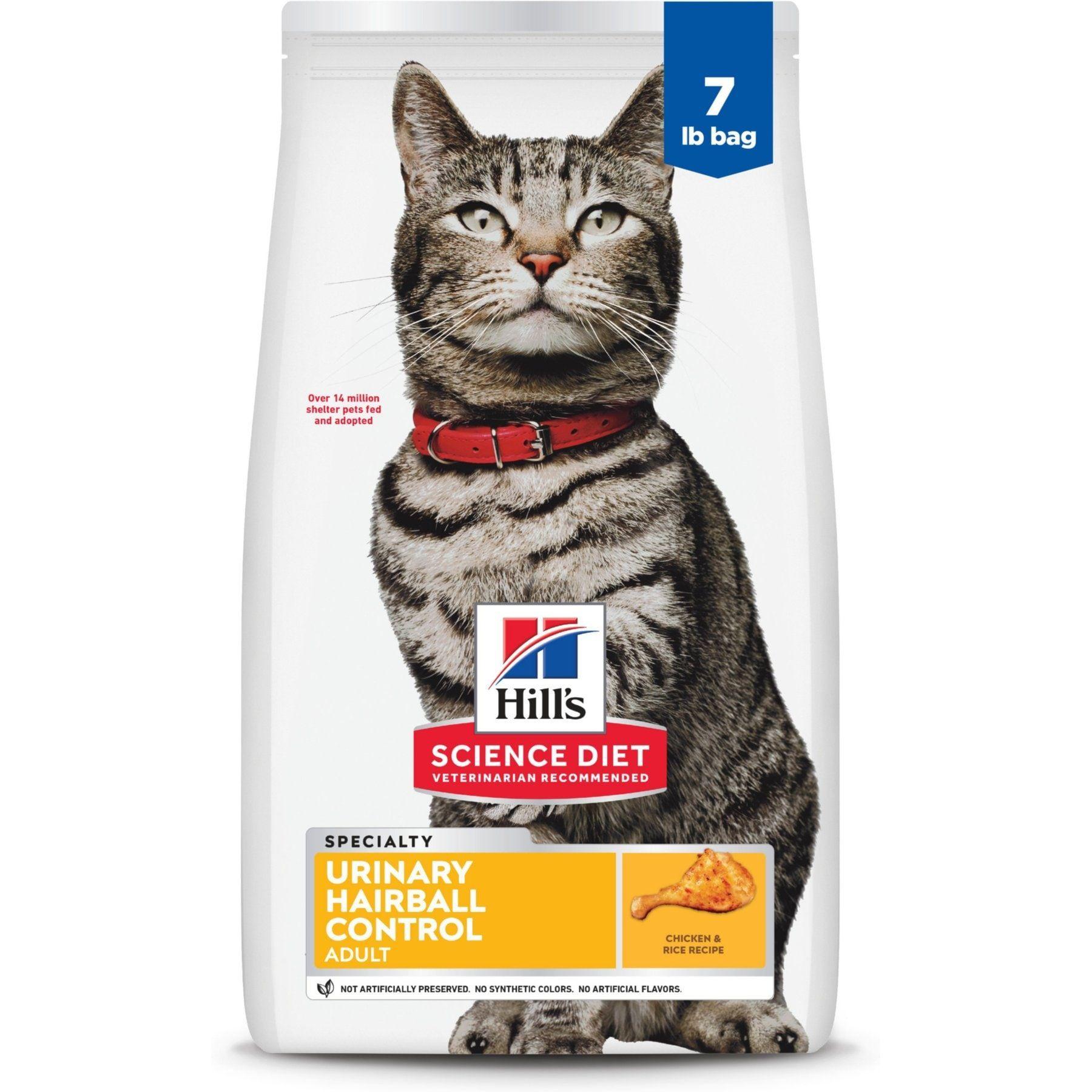
An over-the-counter dry food for healthy adult cats that pairs urinary support with fiber for hairball control.
Webvet may earn a commission when you click through to Chewy, at no extra cost to you.
Hill's says this Science Diet urinary cat food is formulated to promote urinary health by supporting a normal mineral content in the urine. It adds natural fiber to help reduce hairballs and aid healthy digestion, in a chicken and rice recipe for adult cats.
For a longhaired or heavily grooming adult, combining urinary and hairball care in one kibble keeps the routine simple.
It is listed at $39.99 on Chewy when checked in November 2026 for the 7-lb bag, which places it between the other two over-the-counter picks on price.
- Good fit if: your healthy adult cat eats dry food and coughs up hairballs.
- Good fit if: your cat already eats a Hill's dry food and you want to stay with a familiar brand.
- Skip it if: your cat has a current urinary diagnosis; a hairball formula is a maintenance food, not a therapeutic one.
- Keep in mind: the Merck Veterinary Manual notes longhaired cats are predisposed to calcium oxalate stones, so any past stone means a vet conversation before choosing a food.
- Keep in mind: like any kibble, it works best with extra water from wet meals or fountains.
- Feeding plan: measure portions rather than free-feeding, since Cornell links urinary problems to overweight cats.

Prescription tier: only after a veterinarian's diagnosis and authorization. The next three foods are therapeutic diets. A vet prescribes them for a diagnosed condition, such as struvite stones, calcium oxalate risk, or recurring cystitis, and Chewy requires vet authorization before it ships them. They are not upgrades for a healthy cat.
Hill's Prescription Diet c/d Multicare Bladder Health Cat Food: best prescription dry diet
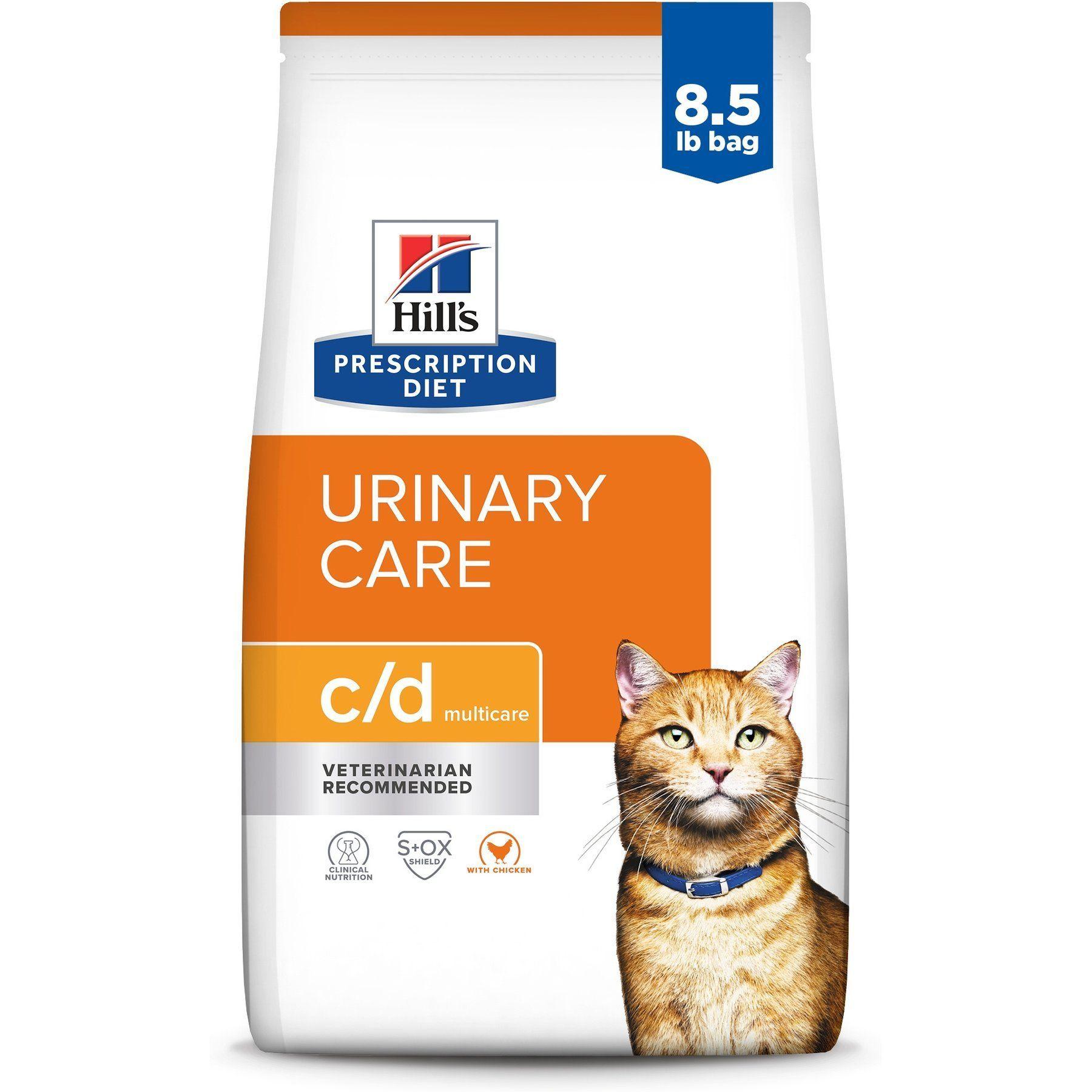
A vet-prescribed dry bladder diet for cats with a urinary diagnosis; Chewy needs your vet's authorization.
Webvet may earn a commission when you click through to Chewy, at no extra cost to you.
Hill's explains that excess minerals can encourage crystals in the urine, which may lead to bladder stones, and that c/d Multicare was developed by nutritionists and veterinarians. It is a prescription diet: your vet decides whether c/d fits the diagnosis.
Merck explains that sterile struvite stones are dissolved in cats by feeding a prescription dissolution diet. The same reference stresses that calcium oxalate stones cannot be dissolved this way, which is why the stone type comes first and the bag second.
It is listed at $71.99 on Chewy when checked in November 2026 for the 8.5-lb bag. Because it is dry, a vet may pair it with a wet prescription food or water strategies to raise moisture.
- Good fit if: your vet has diagnosed a urinary condition and names c/d Multicare.
- Keep in mind: a dry prescription food still benefits from extra water, so ask whether wet meals should be part of the plan.
- Keep in mind: VCA Animal Hospitals notes that some veterinary diets may not work properly with extra foods, so ask before mixing anything in.
- Feeding plan: feed the amount the vet prescribes, keep rechecks on schedule, and ask before adding treats or toppers.
- Skip it if: your cat has not been examined; a prescription diet is never a first step for an undiagnosed cat.
Royal Canin Veterinary Diet Urinary SO Loaf Pate Adult Wet Cat Food: best prescription wet diet
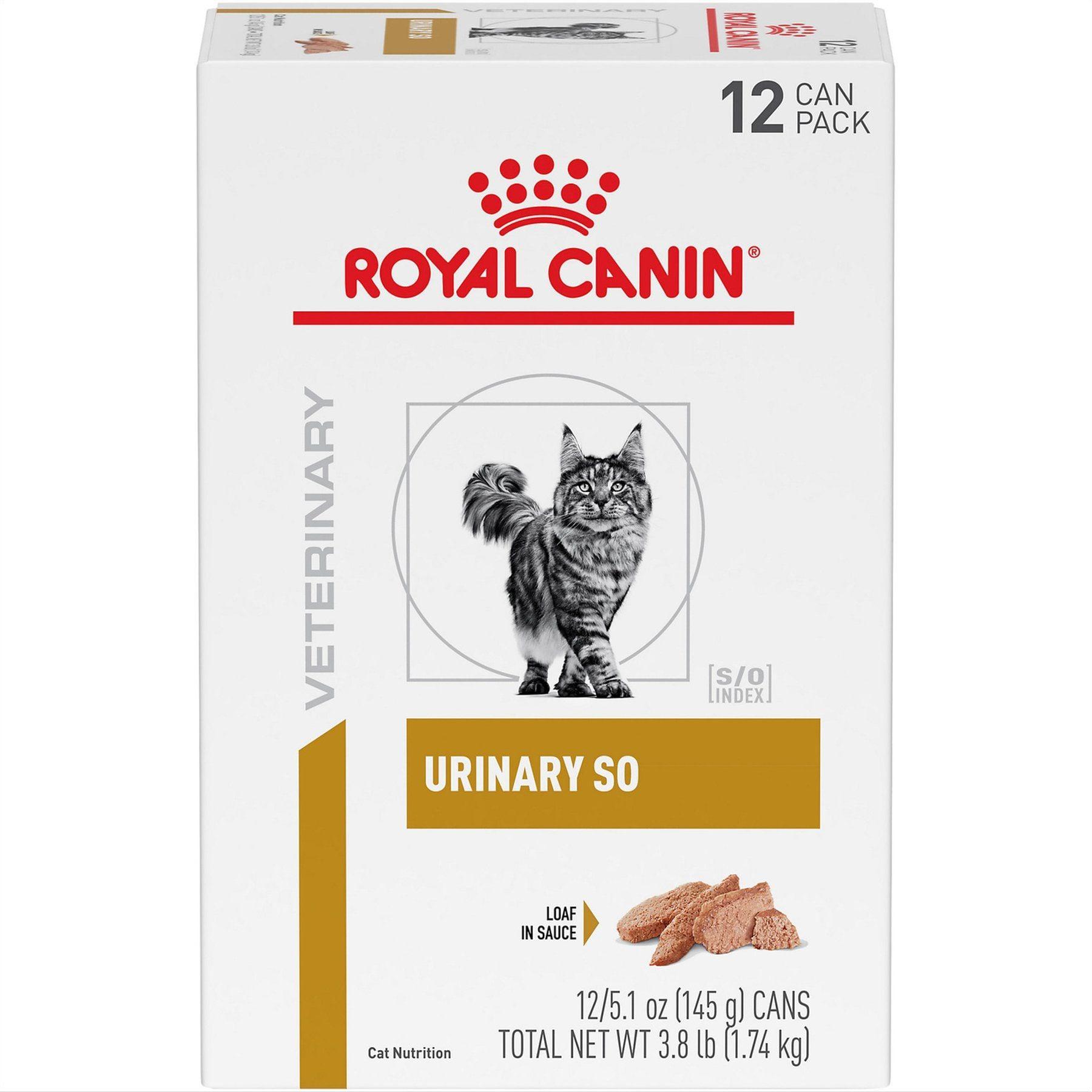
A vet-prescribed wet urinary diet for diagnosed cats; Chewy needs your vet's authorization.
Webvet may earn a commission when you click through to Chewy, at no extra cost to you.
Royal Canin calls Urinary SO a veterinary-exclusive food and says it helps promote a urinary environment unfavorable to both struvite and calcium oxalate crystals. On its product page for Royal Canin Feline Urinary SO, the company says the diet helps dissolve pure struvite stones and helps prevent calcium oxalate stones.
The same page notes the food is purchased with a prescription. The loaf format adds a lot of water, and Royal Canin says that by increasing the amount of urine a cat produces, the food helps dilute the minerals that form crystals.
It is listed at $45.49 on Chewy when checked in November 2026 for a pack of 12 5.1-oz cans. The canned Urinary SO line lists a maximum moisture of 82.5 percent on the Royal Canin canned Urinary SO page.
- Good fit if: your vet prescribes Urinary SO and your cat prefers pate.
- Good fit if: the plan calls for a wet prescription food to raise water intake.
- Skip it if: your cat is healthy; Royal Canin positions Urinary SO for cats with urinary health concerns, and a healthy cat belongs in the over-the-counter tier.
- Keep in mind: the dry and wet SO versions can be combined only as your vet directs.
- Feeding plan: Royal Canin lists the canned Urinary SO morsels at 65 kcal per can, so portions follow the vet's calorie target rather than a can count borrowed from another food.
Purina Pro Plan Veterinary Diets UR Urinary St/Ox Wet Cat Food: best prescription wet alternative
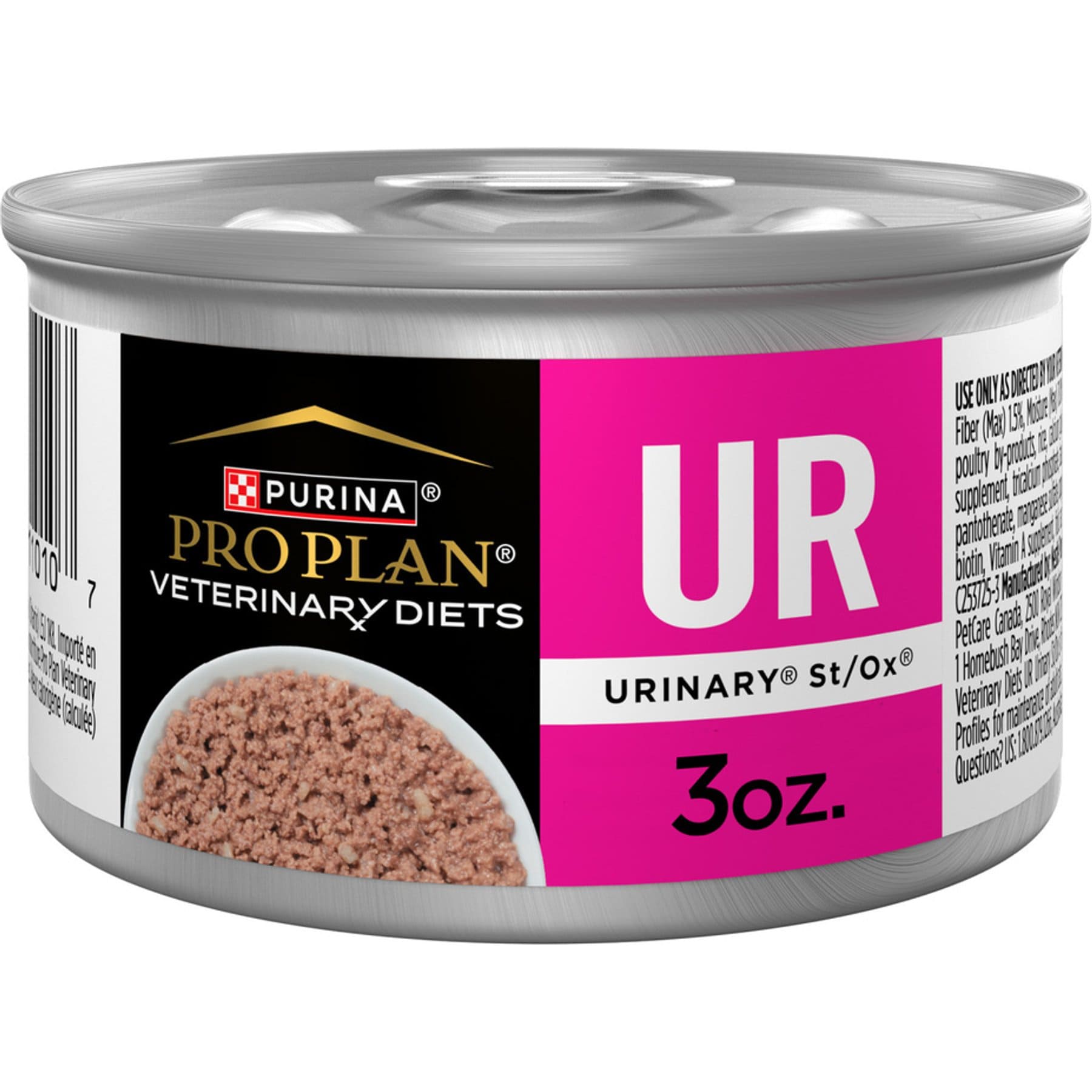
A vet-prescribed wet urinary diet that a vet may choose as an alternative; Chewy needs vet authorization.
Webvet may earn a commission when you click through to Chewy, at no extra cost to you.
Purina says the UR Urinary St/Ox feline formula is balanced to promote increased urine volume and water intake while delivering the nutrition adult cats need. The St/Ox in the name points to the two stone types the formula addresses, struvite and oxalate.
It gives a vet a third prescription brand to try when a cat refuses another. It is listed at $59.99 on Chewy when checked in November 2026 for a case of 24 3-oz cans.
- Good fit if: your vet names Pro Plan Veterinary Diets UR, or your cat will not eat another prescription brand.
- Keep in mind: switching between prescription brands is a decision for the vet, not a swap to make at the pet store.
- Skip it if: no vet has examined your cat; the formula is meant for a diagnosed condition.
- Keep in mind: as a wet food, it adds water with every meal, which supports the dilution goal.
- Feeding plan: follow the vet's portion and recheck schedule, and report any drop in appetite promptly, since a cat refusing food needs attention quickly.
SponsoredVet care that's always there
Unlimited video calls and messaging with licensed vets for less than a typical vet visit. One membership covers up to five pets.
Use code Pets60
Plans start at $12/month · covers up to 5 pets
- Licensed vets in most states
- Rx for 150+ conditions
- 4.7 on Trustpilot
Over-the-counter vs prescription urinary food: which tier fits your cat
| Cat situation | Food tier | Wet or dry | Prescription needed |
|---|---|---|---|
| Healthy adult, no urinary history | Tier 1: over-the-counter urinary care or a regular complete adult food | Wet or a wet and dry mix preferred; dry is acceptable | No |
| Healthy adult that drinks little or eats only kibble | Tier 1: over-the-counter urinary care | Add wet meals | No |
| Past struvite crystals or stones, now resolved | Tier 1 or Tier 2, as the vet decides | High-moisture preferred | Ask your vet |
| Past episodes of feline idiopathic cystitis | Tier 1 or Tier 2, as the vet decides | Wet preferred | Ask your vet |
| Struvite stones diagnosed now | Tier 2: prescription dissolution diet | Wet or dry as prescribed | Yes |
| Calcium oxalate stones diagnosed or removed | Tier 2: prescription prevention diet | High-moisture preferred | Yes |
| Urinary signs with no diagnosis yet | No food change yet | Not applicable | Vet exam first |
| Male cat straining with little or no urine | Emergency care, not a food decision | Not applicable | Emergency vet now |
The two tiers do different jobs. Tier 1 foods keep a healthy urinary tract healthy. Tier 2 foods are part of treating a diagnosed condition: a vet chooses the formula, sets how long the cat eats it, and checks whether it is working.
Over-the-counter urinary cat food usually aims for a moderate effect. Typical targets are a little less magnesium, a slightly lower urine pH, or a balanced mineral profile. That is reasonable for a healthy cat, but it is not designed to dissolve a stone.
Prescription urinary cat food is formulated around a specific therapeutic target, such as dissolving struvite or lowering calcium oxalate supersaturation. Foods marketed to treat or prevent disease are covered by a separate FDA compliance policy guide, U.S. Food and Drug Administration CPG Sec. 690.150, which sets them apart from ordinary cat food.

A prescription diet is needed when a veterinarian finds one of these situations:
- Struvite stones or a heavy load of struvite crystals that the vet wants to dissolve.
- Calcium oxalate stones, either removed or seen on imaging, that need a prevention plan.
- Repeated bouts of feline idiopathic cystitis despite good hydration and stress reduction.
- A past urethral blockage, where preventing a repeat is the top priority.
For a healthy adult, the best non-prescription choice is a complete over-the-counter urinary formula, ideally with plenty of wet meals. Wet or dry, look for a stated urinary purpose and an adult maintenance claim. A wet formula adds the moisture advantage, while a dry one needs water from somewhere else.
What over-the-counter food cannot do is stand in for a prescription diet:
- A cat with stones needs a food built around a dissolution or prevention target, which maintenance formulas are not designed to meet.
- Feeding a maintenance food to a cat with a diagnosis risks leaving a stone in place.
- A cat with a past blockage needs the vet's plan, since recurrence is common.
- A cat with calcium oxalate history may need a food that avoids over-acidifying the urine, while some maintenance urinary foods are designed to lower urine pH.
The reverse also holds: a healthy cat gains nothing from a prescription diet it does not need. These foods are built around targets for specific conditions, and the ACVIM consensus link between strongly acidic urine and calcium oxalate is a reminder that pushing urine chemistry without a reason carries its own risk.
The choice between tiers also has a time element. How long a cat stays in each tier varies:
- Healthy adults can stay on an over-the-counter urinary food long term, provided it is complete and balanced for adults.
- Struvite dissolution diets are courses with rechecks about every 2 weeks, according to Merck.
- After struvite clears, Merck says cats with a history of struvite stones should be kept on a high-moisture struvite-preventive diet when possible.
- Calcium oxalate prevention is long term, because no food dissolves these stones once they form.
Prescription options a vet may name include:
- Hill's Prescription Diet c/d Multicare, a common prescription dry option.
- Hill's Prescription Diet Metabolic + Urinary, another Hill's prescription formula; whether it fits a particular cat is the vet's call.
- Royal Canin Veterinary Diet Feline Urinary SO dry cat food, which lists a maximum moisture of 8.0 percent and maximum magnesium of 0.1 percent on its product page.
- Purina Pro Plan Veterinary Diets UR Urinary St/Ox, a wet option aimed at both stone types.
Every prescription urinary diet comes with a recheck schedule, and the plan changes as test results change. A cat may move from a dissolution diet to a prevention diet, or eventually back to maintenance, only on the vet's say-so.
In homes with several cats, tiers can collide at the food bowl. Guidance on monitoring urinary health in multi-cat households helps owners spot which cat is having trouble and keep prescription food with the cat it was prescribed for.
Questions worth asking your vet when choosing a tier:
- Which stone or crystal type did the tests show?
- Is the goal dissolution, prevention, or general maintenance?
- Should the food be wet, dry, or a mix of both?
- How long will my cat eat this diet, and when is the next recheck?
- Can the other cats in the home eat it, and which treats are allowed?
- Is there a wet version of the prescribed food my cat might accept more easily?
Is Royal Canin Urinary SO good for cats?
For the cats it is meant for, yes. Royal Canin says Urinary SO helps dissolve pure struvite stones and helps prevent calcium oxalate stones, using relative supersaturation, a lab measure of how likely urine is to form crystals.
It is a prescription diet, though, so it is good for a cat with a diagnosis, not as everyday food for a healthy cat.
What is the difference between Royal Canin Urinary Care and urinary S/O?
Royal Canin Feline Care Nutrition Urinary Care Thin Slices in Gravy Wet Cat Food, 3-oz can, case of 24 is an over-the-counter food for healthy adult cats, made to maintain urine mineral balance.
Urinary SO is a veterinary-exclusive prescription diet that Royal Canin says helps dissolve pure struvite stones and helps prevent calcium oxalate stones. Urinary Care maintains; Urinary SO manages a diagnosis.
Is there an alternative to Royal Canin Urinary SO?
Yes. Hill's Prescription Diet c/d Multicare and Purina Pro Plan Veterinary Diets UR Urinary St/Ox are the usual prescription alternatives. Your vet chooses among them based on the stone type, the cat's other health needs, and what your cat will eat. An over-the-counter urinary care food is not a replacement for a prescribed Urinary SO.
Which is better, Hill's or Royal Canin?
Neither brand is better for every cat. Both make prescription diets aimed at struvite dissolution and calcium oxalate prevention.
A randomized trial in the Journal of the American Veterinary Medical Association found two commercial dissolution foods worked at different speeds, so the specific formula matters more than the logo. The better choice is the one your vet names and your cat eats.
What urinary cat food changes: moisture, minerals, and urine pH
Urinary formulas work on three levers:
- Moisture sets how concentrated the urine is.
- Minerals such as magnesium, phosphorus, and calcium are the raw material for crystals.
- Urine pH decides which crystal type has the easier time forming.
Struvite is magnesium ammonium phosphate, one of the most common minerals in feline stones, according to a 2011 study in the British Journal of Nutrition.
Merck lists alkaline urine and decreased urine volume as contributing factors for struvite, which is why many urinary foods lower urine pH and limit magnesium. Calcium oxalate behaves the opposite way. The ACVIM consensus recommendations on uroliths note that diets producing acidic urine in cats, below pH 6.25, have been linked to calcium oxalate formation.
That tension explains why Merck suggests a near-neutral urine pH of 6.6 to 7.5 for cats prone to calcium oxalate stones. A food that over-acidifies to prevent struvite can raise the risk of the other stone, so pH targets are set for the individual cat.
| Problem | Urine factor linked to it | Can a diet dissolve it? | Usual food approach |
|---|---|---|---|
| Struvite stones | Alkaline urine and low urine volume (Merck) | Yes, a prescription dissolution diet, typically within 2 to 4 weeks | Dissolution diet, then a high-moisture struvite-preventive diet |
| Calcium oxalate stones | Acidic urine below pH 6.25 (ACVIM consensus) | No, stones are removed | High moisture and a near-neutral urine pH of 6.6 to 7.5 (Merck) |
| Feline idiopathic cystitis | No stones; stress is an important factor (Cornell) | Not applicable | More water, stress reduction, and sometimes a therapeutic diet |

Relative supersaturation, often shortened to RSS, is how nutritionists measure the balance. It estimates how likely the minerals in a cat's urine are to come out of solution and form crystals. Royal Canin describes RSS as the method it uses to develop diets that lower the ions behind struvite and calcium oxalate stones.
A study in the British Journal of Nutrition showed why RSS matters. Of 17 cats with naturally occurring bladder stones that completed the study on diets keeping struvite RSS below 1, stones dissolved in 13, in a median of 18 days with a range of 10 to 55 days. The 4 stones that did not dissolve were removed surgically and turned out to be calcium oxalate or calcium phosphate.
A randomized trial of 37 cats in JAVMA tested two low-magnesium, urine-acidifying dry foods. Here is what it found:
- Stones dissolved completely in 32 cats.
- Mean time to complete dissolution was 13.0 days on one food and 27.0 days on the other.
- The five stones that did not dissolve were ammonium urate or calcium oxalate, not struvite.
- No diet-related adverse events were seen, and the authors concluded dietary dissolution is safe and effective for sterile struvite.
Water ties all three levers together. The ACVIM consensus advises aiming for a urine specific gravity below 1.030 in cats prone to calcium oxalate, and it reports calcium oxalate RSS falling from 2.3 to 1.1 in short studies of healthy cats fed food with about 73 percent moisture.
Urine specific gravity is a measure of how concentrated urine is, and lower numbers mean more dilute urine. Because a vet checks it on a routine urinalysis, it offers a practical way to see whether extra moisture in the diet is working.
The type of crystal decides which food can help:
- Struvite stones: a prescription dissolution diet can dissolve them, typically within 2 to 4 weeks, according to Merck.
- Calcium oxalate stones: no diet dissolves them; they are removed, and a prescription prevention diet with high moisture helps slow recurrence.
- Crystals in urine without stones: these need interpretation by a vet before any food decision, because Merck notes struvite crystals turn up in healthy cats without stones or urinary signs.
- Idiopathic cystitis: there are no stones to dissolve, so moisture and stress management take the lead.
- Other stone types: calcium phosphate and ammonium urate stones did not dissolve on struvite diets in the British Journal of Nutrition and JAVMA studies, a reminder that stone analysis matters.
- How common each is: Cornell reports struvite stones are becoming less common in cats while the share of calcium oxalate stones has increased, and Merck says struvite tends to affect young to middle-aged adults.
WebVet's guide to crystals in cat urine covers what a urinalysis finding means and what a vet looks for next.
For a cat with diagnosed crystals, the right food is a prescription diet matched to the crystal type, so the choice starts at the vet's office. A non-prescription urinary food fits only a healthy cat with no current crystals, as maintenance. Format still counts in both cases:
- Wet and canned foods add water with every meal.
- Merck says cats with a history of struvite stones should be kept on a high-moisture struvite-preventive diet when possible.
- Dry food can work too, but it needs extra water from somewhere else.
People also ask what ingredient in cat food causes urinary problems. No single ingredient is the culprit. The bigger factors are concentrated urine from a low-moisture diet, mineral levels that favor crystals, and a urine pH that tips toward one stone type, along with weight, activity, and stress.
Questions about fish, such as whether tuna is high in phosphorus, matter most for cats with kidney disease, where IRIS treatment recommendations call for a clinical renal diet. WebVet's page on kidney disease in cats explains how phosphorus fits into that plan.
Reading a urinary claim on a label takes a few checks:
- Look for the purpose statement. Words such as "urinary tract health" or "supports urine mineral balance" signal a maintenance formula; dissolution or prevention language belongs to prescription diets.
- Check the AAFCO statement. Cornell explains that a food with an AAFCO nutritional guarantee is considered complete and balanced, and the label should name the life stage.
- Find the moisture and magnesium figures. The guaranteed analysis lists maximum moisture and, on urinary foods, often maximum magnesium.
- Note the life stage. Most urinary formulas are labeled for adult maintenance, not for growing kittens.
- Check the calorie statement. Calories per cup or per can help keep portions in line with the cat's weight goal, which matters because Cornell links urinary problems to overweight cats.
- Watch for treatment claims on an over-the-counter bag. A food sold openly should not promise to dissolve stones.
Comparing wet and dry labels takes one extra step. Percentages on a guaranteed analysis are as fed, so a canned food with 80 percent water will always show much lower mineral percentages than a kibble with 8 percent water.
Converting both to a dry matter basis, by dividing each nutrient by the share of the food that is not water, makes the comparison fair.
Wet vs dry food for urinary health
Water is the most useful thing a food can add to a cat's urinary routine. The Cornell Feline Health Center notes that canned food has a moisture content of at least 75 percent, while dry food contains only 6 to 10 percent water.
More water in the bowl means more water in the cat and more dilute urine. A 2024 study in PLoS One found that cats fed wet foods had lower urine density and higher urine volume, and that wet foods reduced relative supersaturation for both calcium oxalate and struvite.

The clinical evidence points the same way, with caveats:
- Canned vs dry in cystitis cats: in a prospective study in JAVMA, urinary signs did not recur over 12 months in 16 of 18 cats fed a canned diet, compared with 17 of 28 fed the dry version of the same urine-acidifying diet. The trial was not described as randomized and 8 cats were lost to follow-up, so the result is suggestive rather than definitive.
- An unexpected clue: in a 40-cat cystitis trial in the Journal of Feline Medicine and Surgery, most cats improved whether they got the test supplement or a placebo, and the authors credited the 90 percent of owners who started feeding more canned food.
- Format is not the whole story: a 2020 cohort in Veterinary Medicine and Science followed 31 cats with idiopathic cystitis whose owners chose the diet. Over 5 weeks, 5 of 17 cats on a therapeutic urinary stress diet had a recurrence, compared with 11 of 14 on other diets. Dry versus moist format was not significant, while the type of diet was, and its authors called for a prospective trial.
Taken together, the fair summary is that moisture helps and formulation matters too. Neither factor alone explains every cat's outcome.
| Factor | Wet urinary food | Dry urinary food |
|---|---|---|
| Water content | At least 75 percent (Cornell) | 6 to 10 percent (Cornell) |
| Effect on urine | Lower urine density and higher volume in the 2024 PLoS One study | More concentrated urine unless water comes from elsewhere |
| Calorie example | Royal Canin canned Urinary SO morsels: 65 kcal per can | Royal Canin dry Urinary SO: 315 kcal per cup |
| Practical upside | Appeals to many picky or older cats | Easy to store, measure, and leave out |
Wet urinary cat food has clear advantages:
- It delivers water with every meal, which matters for cats that drink little.
- It dilutes urine, which lowers mineral saturation.
- It comes in both tiers, from over-the-counter Urinary Care slices to prescription Urinary SO cans.
- It is often more appealing to picky or older cats.
Dry cat food for urinary health has its own strengths:
- It is easier to store, measure, and leave out for grazing cats.
- It usually costs less per day to feed.
- Purina, Hill's, and Royal Canin all make dry urinary formulas for cats that only eat kibble.
- It works well paired with wet meals rather than as the only source of food.
International Cat Care puts it plainly for cystitis cats: changing to a wet diet rather than a dry diet is important. For calcium oxalate, a review in the Journal of Feline Medicine and Surgery calls increasing moisture intake one of the key mechanisms for preventing recurrence.
Calorie density differs sharply between formats, which affects portions. Royal Canin lists the dry Urinary SO at 315 kcal per cup and the canned Urinary SO morsels at 65 kcal per can, so swapping one for the other is never a cup-for-can trade.
Two more over-the-counter options suit healthy adults on a budget or a wet-food plan:
- Purina ONE Urinary Tract Health Adult Premium Dry Cat Food, 7-lb bag is a lower-cost dry choice. Purina says it reduces urinary pH and provides low magnesium, and it is listed at $17.97 on Chewy when checked in November 2026. Like any kibble, it works best with deliberate water strategies alongside it.
- Blue Buffalo True Solutions Urinary Care Chicken Pate Wet Cat Food, 3-oz can, case of 24 is a wet choice. Blue Buffalo says it is designed to promote healthy mineral content in the urinary tract and includes taurine, and it is listed at $33.92 on Chewy when checked in November 2026.
Mixing formats is common and often sensible. Royal Canin notes on its Urinary SO page that combining wet and dry food can add palatability and hydration. For over-the-counter foods, any two complete adult formulas can share the bowl; for prescription diets, combine only the formats the vet approves.
For a healthy adult, the right format is less about the brand and more about the mix. Most cats do well when at least part of the daily ration is wet:
- Kibble-only cat: a dry food with a clear urinary purpose, paired with deliberate water strategies.
- Cat that eats wet food: whichever complete wet urinary formula it eats reliably.
- Mixed plan: a wet urinary food for one or two meals, with a dry urinary food filling in.
- Cat with a diagnosis: the wet prescription diet your vet names.
Cats raised on kibble may need time to accept wet food. A gradual approach tends to work better than a sudden swap:
- Start with a teaspoon of wet food beside the usual dry meal.
- Try different textures, such as pate, slices in gravy, or loaf.
- Warm canned food for a few seconds, which the AAFP handout suggests can make it more appealing.
- Keep the usual food available during the change so the cat never goes without eating.
- Stay within one brand's urinary line if your cat already likes its dry version, since flavor familiarity can ease the change.
Simple ways to raise water intake alongside any food:
- Offer at least one wet meal a day, or more if your cat accepts it.
- Add a spoonful of warm water to canned food.
- Place several water bowls around the home, away from the litter box.
- Try a cat water fountain, such as the Catit Flower LED Nightlight Cat Fountain, if your cat likes moving water.
- Refresh water daily, since Cornell recommends clean, fresh water at all times.
- Note roughly how much your cat drinks over a few days, so a sudden change stands out.
WebVet's guide to preventative care for feline urinary health covers hydration, litter box setup, and weight together.
Signs your cat needs a vet before any diet change
Food is a long-term tool. It cannot treat a blockage, clear an infection, or relieve pain, and switching foods during a flare-up can hide how serious the problem is. International Cat Care advises never changing a cat's diet during an episode of cystitis or other illness.
Cornell lists the signs of lower urinary tract disease that call for a vet visit:
- Straining or difficult urination.
- Painful urination, such as crying or vocalizing in the box.
- More frequent trips to the litter box.
- Blood in the urine.
- Little or no urine passed while the cat grows more distressed, especially in a male cat, which is an emergency.
Male cats face the highest risk. Today's Veterinary Practice explains that their relatively long, narrow urethra makes them much more likely than females to obstruct.
Merck likewise notes that stones occur with equal frequency in both sexes, but males are at increased risk of blockage. Female cats still develop cystitis and stones, so a straining female needs a prompt visit too.
In one 45-cat series reported by Today's Veterinary Practice, blockages had these causes:
- Idiopathic, with no identifiable cause: 53 percent.
- Stones: 29 percent.
- Urethral plugs: 18 percent.

Owners sometimes ask how to cure cat urinary blockage at home. There is no home cure: a vet has to relieve the obstruction and treat the electrolyte and acid-base imbalances that make a blockage life-threatening. WebVet's guide to cat UTI and urinary blockage explains what happens at the clinic.
Before recommending a food, a vet works out what is actually wrong. Typical steps include a physical exam, a urinalysis, and often X-rays or ultrasound to look for stones. WebVet's guide to how veterinarians diagnose urinary problems in cats walks through each test.
Diagnosis decides the diet, and each answer leads somewhere different:
- Struvite stones: a prescription dissolution diet, with rechecks.
- Calcium oxalate stones: removal, then a prevention diet with high moisture.
- Feline idiopathic cystitis: more water, stress reduction, and sometimes a therapeutic diet.
- No clear cause yet: further testing before any food change.
Details that help the vet at a non-emergency visit:
- When the signs started and whether they are getting worse.
- How often the cat visits the litter box and how much urine appears.
- What the cat eats now, including treats and any recent food change.
- Any recent stress, such as a move, a new pet, or a change in routine.
- Any past urinary trouble, and what the diagnosis was at the time.
The outlook with prompt care is good. Today's Veterinary Practice reports that survival to discharge is higher than 90 percent, though recurrence after treatment ranges from 11 to 43 percent. That recurrence risk is why vets often move a cat into the prescription tier after a blockage.
Once a blocked cat is stable, the vet looks for the cause, because idiopathic cystitis, stones, and urethral plugs each call for different follow-up. Food usually enters the plan at that stage, chosen to match the cause rather than picked before anyone knows it.
Stress deserves its own mention for cystitis cats:
- Cornell says stress seems to be an important factor in feline idiopathic cystitis, and that environmental enrichment can reduce the severity and frequency of episodes.
- An observational study of 46 indoor cats in the Journal of Feline Medicine and Surgery found that owners who made multimodal environmental changes saw significant reductions in urinary signs over 10 months, and the authors called the approach a promising add-on to usual care.
Switching to a urinary food and using urinary treats
Cats can be stubborn about new food, and a rushed switch can backfire. An American Association of Feline Practitioners client handout recommends making the change gradually over 7 to 10 days, and sometimes longer, up to 3 months, for reluctant cats.
That handout suggests offering the new food in a separate dish a few inches from the usual bowl rather than mixing the two, because some cats reject a mixed bowl. As the cat accepts the new food, the amount of new food goes up and the old food goes down over several days.
Switching foods gradually also protects the cat's liver. The Cornell Feline Health Center explains that hepatic lipidosis, a serious liver disease, is almost always accompanied or preceded by a cat refusing food, and that it can strike otherwise healthy cats. A cat should never be starved into accepting a new diet.

A practical transition plan for a healthy cat moving to an over-the-counter urinary food:
- Days 1 to 3: offer a small portion of the new food in its own dish beside the usual meal.
- Days 4 to 6: increase the new food and shrink the old portion if the cat is eating well.
- Days 7 to 10: serve mostly or only the new food.
- Slow down at any sign of refusal, vomiting, or diarrhea, and call the vet if the cat stops eating.
- Warm canned food for a few seconds if your cat seems hesitant, a tip the AAFP handout also offers.
Prescription diets follow the vet's timeline, not this generic plan, and your vet will say whether to transition gradually or switch directly. Once the new food is in place, Cornell's general advice still applies:
- Keep the diet and feeding schedule consistent.
- Feed small meals on a frequent basis.
- Provide clean, fresh water at all times.
- Watch the litter box for changes in urine amount or frequency during the first weeks.
Signs worth reporting to the vet after a switch:
- The cat eats noticeably less or stops eating.
- Vomiting or diarrhea that does not settle as the change slows.
- Any return of straining, frequent small urinations, or blood in the urine.
- Urine clumps in the litter box that look much smaller or fewer than usual.
- Signs of pain, such as crying in the litter box or straining.
If a cat refuses a prescription food, the fix is a call to the vet, not a return to the old diet. Three major brands make urinary prescription diets in different textures, so the vet often has another option, and Cornell's warning about hepatic lipidosis means a long refusal should never be waited out.
Multi-cat homes need a plan so the right cat gets the right food:
- Feed cats in separate rooms at set mealtimes.
- Pick up uneaten prescription food after the meal instead of leaving it out.
- Store the prescribed cat's food apart so refills do not get mixed up.
- Ask the vet whether the other cats can safely eat the same food.
Portion size matters as much as the formula, since Cornell links urinary problems to overweight cats. WebVet's guide to how much to feed a cat helps set a daily calorie target before treats enter the picture.
Urinary cat treats are where many good plans quietly slip. The World Small Animal Veterinary Association advises that treats make up less than 10 percent of a cat's daily calorie intake. It also warns that conventional treats may not suit a cat on a veterinary-prescribed diet.
Treat rules that protect a urinary plan:
- Keep all treats under 10 percent of daily calories; WSAVA estimates about 25 treat calories a day for an average 5 kg healthy adult cat.
- Ask the vet before giving any treat to a cat on a prescription diet.
- Use a few pieces of the cat's own urinary kibble as a reward.
- Skip table scraps and dairy, which WSAVA flags as unhealthy treat choices for cats.
- Choose treats that state their calories, or ask the manufacturer, as WSAVA suggests for commercial treats.
Owners of cats on Urinary SO or another prescription food often look for treats that match it. VCA notes that a vet may recommend a prescription treat designed to go with the prescription food, which keeps the mineral and pH targets intact.
How long does Royal Canin Urinary SO take to work?
It depends on the problem. For sterile struvite stones, Merck says prescription dissolution diets typically work within 2 to 4 weeks, and the ACVIM consensus says these stones usually dissolve in less than 2 to 5 weeks. Merck recommends rechecks about every 2 weeks. If nothing changes, the stone may not be struvite, so the vet reassesses.
Cat food for urinary health questions
Frequently Asked Questions
Can a cat eat urinary food without a prescription?
Yes, if the food is an over-the-counter urinary care formula and the cat is healthy. Those foods are sold openly for maintenance.
Prescription urinary diets are meant for a diagnosed condition, and Chewy asks for a veterinarian's authorization before shipping them. If your cat has ever had stones, crystals, or a blockage, ask your veterinarian which tier fits. A cat showing urinary signs today should be examined before eating either kind.
Is wet food better than dry food for urinary health?
For most cats, wet food has the edge because of moisture. Canned food is at least 75 percent water, compared with 6 to 10 percent for kibble, per Cornell, and higher water intake produces more dilute urine.
Dry food can still work for a healthy cat if you add water through wet meals, fountains, or extra bowls. Many owners settle on a mix: wet food for water intake and dry food for convenience.
Can healthy cats eat urinary cat food?
A healthy adult cat can eat an over-the-counter urinary formula as its maintenance diet, as long as the label says complete and balanced for adult cats.
Prescription urinary diets are another matter. They are formulated for specific conditions, so a healthy cat should not share a housemate's therapeutic food without a vet's approval. For a healthy adult, a urinary formula is one reasonable maintenance choice among many complete foods.
Are urinary cat treats worth it?
They can be, if they fit the plan. Treats should stay under 10 percent of daily calories, according to WSAVA, so even the right treats should stay small.
For a cat on a prescription diet, ordinary treats may work against the food's targets, so a vet-recommended urinary treat or a few pieces of the cat's own food is the safer reward. Count every treat toward the cat's daily calories, not on top of them.
Can a cat with urinary problems eat a homemade diet?
Only with expert help. Cats need a precise nutrient balance, and a homemade diet for urinary problems also has to hit mineral, moisture, and pH targets.
A board-certified veterinary nutritionist can design a complete, balanced recipe for a specific diagnosis. Without that expert balancing, a homemade diet can miss the urinary goal entirely. Your veterinarian can refer you to a nutritionist if a commercial diet is not an option.
What is the difference between prescription and non-prescription urinary cat food?
Non-prescription urinary food supports a healthy urinary tract in cats with no current problem.
Prescription urinary food is a therapeutic diet chosen after a diagnosis, such as struvite stones, calcium oxalate stones, or recurring cystitis.
It targets specific outcomes like dissolving struvite, and the vet monitors progress. One maintains health; the other is part of treatment. Your veterinarian also decides when a cat can move from a prescription diet back to maintenance food.
Can urinary cat food help with crystals?
It depends on the crystal. Struvite stones can be dissolved with a prescription dissolution diet.
In a British Journal of Nutrition study, diets with a struvite relative supersaturation below 1 dissolved struvite stones in a median of 18 days; the stones that did not dissolve were calcium oxalate or calcium phosphate.
Calcium oxalate stones cannot be dissolved by any food. A veterinarian has to identify the crystal type before choosing the diet. For a healthy cat with no crystals, an over-the-counter urinary food is maintenance, not treatment.

Editor
The Webvet Editorial Team is the in-house group of pet-care editors and writers behind Webvet, operated by Smart Pet Collective. The team researches, writes, and maintains Webvet's pet health, behavior, and medication content. Every article follows a defined editorial process: research from reputable veterinary and scientific sources, careful drafting, mandatory review of medical content by a credentialed veterinarian, and dated publication. Health and medication articles are medically reviewed by a licensed veterinary professional before they go live and are kept current over time.
Veterinarian · BVMS MRCVS
Dr. Pippa Elliott, BVMS, MRCVS, is a veterinarian with nearly 30 years of experience in companion animal practice. Dr. Elliott earned her Bachelor of Veterinary Medicine and Surgery from the University of Glasgow. She was also designated a Member of the Royal College of Veterinary Surgeons. Married with 2 grown-up kids, Dr. Elliott has a naughty Puggle named Poggle, 3 cats and a bearded dragon.
Related reading

Catit Flower Fountain Review: Why Cats Drink From It and What to Watch

Petlibro Water Fountain Review: Filters, Noise, and Cleaning Honestly Rated

Vaginitis in Dogs: Symptoms, Causes, and Treatment
