Are Orchids Toxic to Cats? What a Vet Wants You to Know
True orchids are non-toxic to cats: the ASPCA lists the moth orchid, Phalaenopsis, as safe for cats, dogs, and horses. The bark, moss, wire stake, and fertilizer in the pot are the real hazard. Here is what to watch for and when to call a vet.

BVMS MRCVS
Medically reviewed by Dr. Pippa Elliott, BVMS MRCVS · Last reviewed

This article contains affiliate links. Webvet may earn a commission when you buy through them, at no extra cost to you.
Are orchids toxic to cats? Common moth orchids are not poisonous to cats. The ASPCA Animal Poison Control plant database lists the moth orchid, Phalaenopsis sp., as non-toxic to cats, dogs, and horses, and ASPCA also identifies Cymbidium, Dendrobium and Oncidium as pet-safe orchid choices.
That is the answer, and it is worth having in the first ten seconds. It is also not the whole answer. Non-toxic describes the plant. It does not describe the bark chips, the sphagnum moss, the wire stake, or the fertilizer crust your cat reaches first.
So this guide gives the verdict, then the part the verdict does not cover: what to watch for after a cat chews an orchid, how long to watch, which plants sold under an orchid name are not orchids at all, and when watching stops and a phone call starts.
Are orchids toxic to cats?

The named orchids below are not poisonous to cats. The ASPCA plant database is the reference veterinarians and poison control staff send owners to, and its orchid entries are unusually consistent. Moth orchid (Phalaenopsis sp.), jewel orchid (Ludisia discolor, listed there as Haemaria discolor), dancing doll orchid (Oncidium flexuosum), and leopard orchid (Dendrobium gracilicaule) are all listed non-toxic to cats.
Cattleya, Miltonia, Odontoglossum, Epidendrum, Masdevallia, and Sophronitis appear with the same verdict. Those listings support the named plants; the database is not an exhaustive assessment of every orchid species.
What matters more than the verdict is what non-toxic means in that database. The ASPCA states it plainly on the list itself:
- Plants listed as non-toxic are not expected to be life threatening to cats or dogs.
- Consumption of any plant material may still cause vomiting and gastrointestinal upset.
- The list is a compilation of the most frequently encountered plants, not an all-inclusive reference.
So the honest reading is this. An identified orchid covered by a non-toxic listing is not expected to cause systemic poisoning. An orchid can still make your cat sick in the ordinary way any mouthful of leaf or stem can, and the pot it lives in can do considerably worse than that.
There is also no number here, and no reputable source publishes one. The cited Phalaenopsis entry provides no lethal dose, milligram-per-kilogram figure or fatality rate. A non-toxic listing does not establish a safe amount to eat.
- 1The named common orchids discussed here have non-toxic listings. The ASPCA lists Phalaenopsis and other specifically listed orchid genera as non-toxic to cats, dogs, and horses.
- 2The pot is the risk, not the petals. Bark chips, sphagnum moss, wire stakes, clips, and fertilizer residue are the parts of a shop-bought orchid that put a cat in an emergency room.
- 3Non-toxic is not the same as harmless. Any plant material can cause vomiting, drooling, or an obstruction.
- 4A cat that stays unwell needs a veterinarian regardless of the plant being safe. The orchid does not explain ongoing vomiting, lost appetite, or lethargy.
What happens if your cat eats an orchid

If your cat chewed an orchid, confirm the species and check what else was in the pot. A non-toxic orchid can still cause a plant-material upset when eaten. Tell your veterinarian the amount eaten, the potting material, any treatment products and the signs you have seen.

A window perch gives your cat a dedicated resting spot. Install it as directed and keep it away from accessible plants.
Webvet may earn a commission when you click through to Chewy, at no extra cost to you.
Gastrointestinal irritation is possible after a cat eats plant material, even when the plant is listed non-toxic. Do not assume the plant alone explains continuing illness; tell the veterinarian about potting material and any treatment products as well.
Signs that fit an ordinary plant-material upset:
- Drooling, lip-smacking, or pawing at the mouth
- Vomiting, with or without visible plant fragments
- Loose stool or diarrhea
- A reduced appetite, which should be reported to your veterinarian
The table below separates signs to report from problems that need prompt care. The ASPCA orchid entry does not establish an hour-by-hour recovery schedule.
| Situation | What to report | What means call your veterinarian |
|---|---|---|
| After a chew | Any mouth irritation or vomiting; identify both the plant and anything added to its pot. | Repeated retching that brings nothing up, swelling around the mouth or face, or any change in breathing |
| While following veterinary advice | Appetite, water intake, activity, and any further signs. | Repeated vomiting, refusal of water, drooling that has not stopped, or obvious lethargy |
| Persistent or recurrent signs | Do not assume a non-toxic plant explains ongoing illness. | Persistent vomiting, no stool at all, straining, a hunched posture, or a cat that will not eat |
| Later concerns | New signs still warrant assessment. | Tell the veterinarian about the plant, potting medium and treatments. |
Two things end the watching early. The first is any sign on that list arriving repeatedly rather than once. The second is a cat that seems uncomfortable rather than unbothered: hiding, hunched, straining in the litter box, or turning away from water.
Vomiting and diarrhea are what most owners actually end up watching, and our guide to cat vomiting and diarrhea carries the escalation thresholds in more detail than a plant article needs to.
Ask your veterinarian whether home observation is appropriate and, if so, how long to continue it and when to call back. The ASPCA moth-orchid entry gives no hour-by-hour recovery schedule. Record vomiting, appetite, drinking and activity while following that advice; persistent or worsening signs need reassessment.
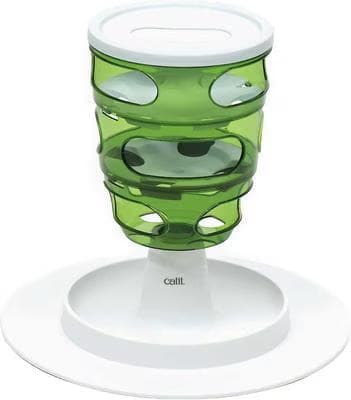
A food-tree puzzle adds an activity to everyday feeding. Introduce it gradually using part of your cat’s usual food allowance.
Webvet may earn a commission when you click through to Chewy, at no extra cost to you.
What to do if your cat ate an orchid

Take the plant away from the cat rather than the cat away from the plant, and do it without a chase. Then work through a short list. None of this is treatment. All of it is the information a veterinarian or a poison control expert will ask you for.
- Gently clear any plant material still in the mouth, and offer a small drink of water if your cat will take it.
- Photograph the plant, including its label if it still has one, and keep the chewed piece.
- Work out roughly how much is missing. A nibbled petal edge is a different conversation from a stripped stem or an emptied pot.
- Note the time it happened, and write down anything you have already seen.
- Call your veterinarian or a poison control line, and describe all of it.
That instruction is worth repeating on its own. Do not induce vomiting at home. Whether vomiting should be brought on at all is a decision for a veterinarian, and the home methods that circulate online are not safe in cats.
If the call ends with a request to bring your cat in, the next question is usually cost. Our guide to what an emergency vet visit costs sets that expectation in advance, and pet insurance is one way owners cover an unplanned bill like it.
Whatever you decide, the see-a-vet message is the part of this article that does not soften. A non-toxic plant does not explain a cat that keeps vomiting, stops eating, or turns quiet and still. Something else is going on, and it needs an examination.
Which parts of an orchid are safe, and what about the potting mix

The ASPCA Phalaenopsis entry gives a whole-plant non-toxic listing. It does not publish separate toxicity assessments for petals, leaves, stems, aerial roots, sap or pollen; identify the plant before applying that verdict.
The pot is a different object entirely. A supermarket orchid is not planted in soil. It sits in a loose mix of chunky orchid bark and sphagnum moss, held upright by a wire stake and a plastic clip, and often finished with a crust of dried fertilizer.
What actually poses a risk in an orchid pot:
- Bark chips large enough to swallow whole, which is a choking and obstruction risk rather than a poisoning one
- Long strands of sphagnum moss, which behave like the string and yarn cats are known to swallow
- Wire stakes and plastic clips, which are sharp, swallowable, and not food-shaped enough for a cat to reject
- Fertilizer crust, bloom booster granules, and leaf shine, none of which is meant to be eaten
- Systemic insecticide, which sits inside the leaf tissue where rinsing the plant does not reach it
That combination is what a cat gets to first, because it sits at paw height and it moves. The Merck Veterinary Manual describes indigestible material as the most common cause of gastrointestinal obstruction in cats and dogs, and orchid bark is indigestible material.
Systemic insecticide deserves its own sentence. It is applied to the roots or the growing medium, drawn up into the plant, and carried in the tissue itself, so a shop-bought orchid can hold residue that no amount of wiping the leaves removes. If you do not know how a plant was treated, assume it was.
| Part of the orchid | What it does to a cat | What to do about it |
|---|---|---|
| Flowers and petals | No known feline toxin. A large mouthful can cause ordinary stomach upset. | Nothing beyond watching for vomiting. |
| Leaves and stems | No known feline toxin. Fibrous, so more likely to come back up than go down. | Move the plant if chewing becomes a habit. |
| Aerial roots | No known feline toxin. Tough and stringy, and a favorite target. | Leave them alone and raise the plant out of reach. |
| Sap | The ASPCA lists no toxic principle for the orchid genera in its database. | Rinse the mouth with water if your cat allows it. |
| Pollen | The named orchid has a non-toxic listing; that is not an assessment of every substance on its surface. | Tell the veterinarian if exposure is uncertain or symptoms occur. |
| Orchid bark chips | Not toxic. A genuine choking and obstruction risk if swallowed. | Cover the pot surface or switch to a closed cache pot. |
| Sphagnum moss | Not toxic. Behaves like linear material such as string if swallowed. | Never leave loose strands within reach. |
| Wire stake and plastic clip | Not toxic. Sharp, swallowable foreign objects. | Remove both once the flower spike has finished. |
| Fertilizer residue and leaf shine | Chemical residue rather than plant matter. Can irritate the mouth and stomach. | Rinse the pot rim, and call poison control if a cat licked it. |
| Systemic insecticide | Sits inside the leaf tissue. Rinsing the plant does not remove it. | Ask the retailer, and keep treated plants fully out of reach. |
The practical version is short. Top the pot with something a cat cannot pull out, such as a flat layer of larger stones or a fitted cover, and put the spare bark and moss in the bin rather than on the windowsill.
A cat that repeatedly mouths things that are not food is showing a behavior vets call pica, and it is worth understanding on its own terms. Our guide to why cats chew things that are not food covers that behavior properly.
A blue orchid flower does not establish what plant or product a cat encountered. If it is a dyed Phalaenopsis, the plant’s non-toxic listing does not establish the safety of its dye or other treatments. Save the label and ask the seller what was used so your veterinarian can assess the actual exposure.
Which orchid types are safe, and which orchids are not orchids at all

Purple, white, pink, mini and other retail labels describe an orchid without necessarily identifying its species. Check the botanical name before applying a non-toxic listing, and ask the seller about dyes or other treatments separately.
Moth orchids, dendrobiums, oncidiums, cymbidiums, cattleyas, and jewel orchids all sit inside Orchidaceae, and all of them carry non-toxic listings. Check the plant against its own entry rather than extending those named listings to an unidentified orchid.
The name is where it goes wrong. Several popular houseplants and garden trees carry the word orchid in their common name while sitting in a completely different botanical family:
- Hong Kong orchid tree (Bauhinia) is a legume, family Fabaceae
- Poor man's orchid, also sold as butterfly flower (Schizanthus), is in the nightshade family, Solanaceae
- Orchid cactus (Epiphyllum) is a cactus, family Cactaceae
The Hong Kong orchid tree is not a true orchid, and neither is poor man’s orchid or the orchid cactus. The moth-orchid listing does not establish a feline verdict for these plants; check the botanical name against a veterinary source.

Grow a small tray of oat grass for your cat. Follow the kit instructions and keep ornamental plants out of reach.
Webvet may earn a commission when you click through to Chewy, at no extra cost to you.
That is not the same as safe, and it is not the same as toxic. It means the orchid answer does not transfer, and the plant in front of you needs checking under its own botanical name.
The same trap runs in reverse elsewhere in the house. Peace lily is not a lily, and the ASPCA lists it as toxic to cats through insoluble calcium oxalates. Pencil cactus is not the harmless Christmas cactus on the same shelf, and it is listed toxic to cats, dogs, and horses.
| Plant | Family | A true orchid? | ASPCA verdict for cats |
|---|---|---|---|
| Moth orchid (Phalaenopsis sp.) | Orchidaceae | Yes | Non-toxic to cats, dogs, and horses |
| Jewel orchid (Ludisia discolor, listed as Haemaria discolor) | Orchidaceae | Yes | Non-toxic to cats, dogs, and horses |
| Dancing doll orchid (Oncidium flexuosum) | Orchidaceae | Yes | Non-toxic to cats, dogs, and horses |
| Leopard orchid (Dendrobium gracilicaule) | Orchidaceae | Yes | Non-toxic to cats, dogs, and horses |
| Christmas orchid (Cattleya trianaei) | Orchidaceae | Yes | Non-toxic to cats, dogs, and horses |
| Pansy orchid (Miltonia roezlii) | Orchidaceae | Yes | Non-toxic to cats, dogs, and horses |
| Ghost orchid (Polyrrhiza lindenii) | Orchidaceae | Yes | Non-toxic to cats, dogs, and horses |
| Hong Kong orchid tree (Bauhinia) | Fabaceae | No | No entry under this name. The orchid verdict does not apply. |
| Poor man's orchid (Schizanthus) | Solanaceae | No | No entry under this name. The orchid verdict does not apply. |
| Orchid cactus (Epiphyllum) | Cactaceae | No | No entry under this name. The orchid verdict does not apply. |
If you are holding a plant and cannot tell which column it belongs in, the botanical name on the label is worth more than the marketing name on the front. If there is no label at all, treat the plant as unidentified and call poison control rather than guess.
Just Add Ice identifies its orchids as Phalaenopsis hybrids, so the moth-orchid plant listing is the relevant starting point; it does not certify dyes, fertilizer or pesticides. A ballerina orchid is a different botanical identity, Caladenia melanema. Yellow orchid vine is different again: the University of North Florida identifies it as Mascagnia macroptera. The Phalaenopsis listing does not say whether these two plants are poisonous to cats. Keep them inaccessible until their own species-specific verdict is verified, and seek advice after suspected ingestion.
Labels such as Mystique, waterfall, or blue orchid are not enough to establish a toxicity verdict. Check the botanical name and ask the seller about dyes and treatments. If the label confirms Phalaenopsis, the ASPCA moth-orchid listing applies to the plant; it does not certify an added dye or pesticide.
A blue orchid is not automatically poisonous because of its color. The useful distinction is whether it is an identified non-toxic Phalaenopsis and whether any dye or other product has been added. A blue bloom with no botanical label needs identification before you apply that verdict.
Can you keep orchids in a house with cats?

Yes. An orchid is one of the few flowering houseplants you can keep in a house with cats without running a risk calculation every time it blooms, and there is no reason to give one away because you adopted a cat.
The decision actually worth making is about placement. Keep the orchid, and keep the pot out of jumping range, because everything that can genuinely hurt a cat here lives at the surface of the growing medium rather than in the flower.
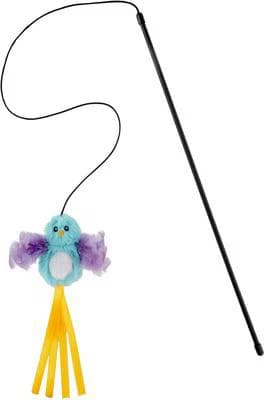
Make time for supervised play with a feathered wand. Put the toy away after each session.
Webvet may earn a commission when you click through to Chewy, at no extra cost to you.
Placement that works:
- A hanging bracket, or a high shelf with nothing beside it to launch from
- A closed cache pot or a fitted cover so bark and moss cannot be dug out
- Spent flower spikes, wire stakes, and clips cleared away as soon as blooming finishes
- Fallen petals swept up rather than left on the floor as a free toy
- 1Keep the orchid. There is no safety reason to rehome a Phalaenopsis because a cat lives in the house.
- 2Put the pot out of jumping range, on a bracket or a high shelf with no launch pad beside it.
- 3Cover the growing medium so the bark and moss stop being reachable, because that is the part that causes real trouble.
- 4Clear the stake, the clip, and the spent spike once flowering ends.
If your cat is a determined climber rather than an opportunist, a pot topper or a plant-safe deterrent spray on the shelf edge is the sensible next step. Neither one replaces moving the plant, and neither is a reason to skip the placement work above.
Orchids are one plant on one shelf. For the whole-house version of this exercise, cupboards and cleaning products included, our guide to poison-proofing your home for a cat covers the rest of it.
How to keep your cat out of your orchids

Cats chew plants for reasons that have very little to do with hunger. Movement, texture, boredom, and the plain fact that a flower spike swings when you bat it all rank well above taste.
Which is why deterrence on its own tends to fail. Take away the interesting object and give nothing back, and most cats simply find the next interesting object. The version that holds pairs a barrier with a replacement.
- Move the pot first. Height with no launch pad beside it beats every spray on the market.
- Cover the growing medium so digging stops being rewarding.
- Offer cat grass in a wide, shallow tray, placed somewhere your cat already likes to sit.
- Try a second chewable target if the first is ignored, because cats are individual about texture.
- Use supervised play to redirect your cat, then put interactive toys away where your cat cannot reach them.
Cat grass is usually oat, wheat, or barley grass, and it is the honest answer to a plant chewer: something better to chew, somewhere they are allowed to reach. A tray takes about a week from seed, and kits such as the Imperial Cat Easy Grow Cat Oat Grass Kit make that easy enough to keep one always coming on.
Can cats be allergic to orchids?
A non-toxic plant listing does not diagnose an allergy or explain symptoms after contact. Tell your veterinarian what your cat touched and whether the plant carried fertilizer or pesticide.
Do not assume a sneeze, watery eye or skin irritation is caused by the orchid merely because the plant was nearby.
What an orchid reaction looks like, and what it does not:
- Report sneezing, a watery eye, or face rubbing and when it began.
- Report drooling and any possible contact with plant-care chemicals.
- Persistent itching, hair loss, or scabbing needs assessment rather than a diagnosis from the plant label.
- Coughing, wheezing, or open-mouth breathing needs prompt veterinary attention.
Smelling a flower and swallowing plant material are different events. A toxicity database cannot determine the cause of symptoms in a scented room.
Ask your veterinarian about ongoing signs; seek prompt care for breathing difficulty.
Are orchids toxic to dogs and other pets?
The ASPCA lists Phalaenopsis orchids as non-toxic to dogs as well as cats and horses. That is a whole-plant listing, rather than a separate warning for its flowers or leaves. Confirm the species before extending the answer to an orchid-named plant.
The qualifiers carry over unchanged, and in a couple of ways they matter more for a dog. Dogs eat more in one go, they swallow bark chips whole more readily, and a dog that empties an orchid pot has taken in a volume of indigestible material a cat rarely would.
If a dog raids an orchid:
- For a confirmed non-toxic orchid, report both the plant material and anything swallowed from the pot: bark, moss, stake, clip, fertilizer or other treatments.
- An emptied pot raises concerns about swallowed objects as well as any chemicals. Tell the veterinarian what was in the pot rather than assuming which hazard explains the signs.
- The same two poison control numbers apply, and so does the instruction never to induce vomiting at home.
Small pets are a shorter answer in a different lane. Rabbits, guinea pigs, birds, and reptiles have their own plant tolerances, the ASPCA list is written for dogs, cats, and horses, and nothing on it should be read across to a rabbit or a parrot without checking that species specifically.
A Hong Kong orchid tree needs its own botanical identification and dog-specific assessment; the Phalaenopsis listing does not cover a Bauhinia tree. Keep an unidentified plant away from the dog while you obtain that advice.
The one flower in the vase that is a real emergency

Almost everything above this line is reassuring. This section is not, and it is the reason to look at the whole vase rather than the one stem you searched for.
Orchid stems arrive in mixed arrangements constantly, and so do lilies. If there is a lily in the same vase as the orchid, the orchid stops being the story.
The ASPCA lists true lilies (Lilium species) and daylilies (Hemerocallis) as toxic to cats, with kidney failure among the clinical signs and cats the only species known to be affected. What counts as exposure is wider than most owners expect:
- Any amount of leaf, stem, flower, or rhizome
- Pollen groomed off the face, the coat, or the paws
- Water from the vase the lilies were standing in
Pet Poison Helpline lists vomiting, abdominal pain, dehydration, and acute kidney failure among the results of that exposure, and states that early treatment is vital for cats after any contact with these lilies. So a lily in the arrangement needs immediate veterinary advice; do not wait to see what happens.
Peace lily and calla lily are not true lilies and do not carry that kidney risk. Peace lily is still listed toxic to cats through insoluble calcium oxalates, which causes mouth and throat irritation rather than kidney injury. The names are unhelpful in both directions, which is exactly why the botanical name matters.
Every plant named here, and the rest of the ASPCA toxic list, is ranked by how urgently a cat needs a veterinarian in our full guide to plants toxic to cats.
Other cat-safe plants worth keeping
Once the orchid clears, the next question is usually what else on the windowsill is fine. Several common houseplants carry the same non-toxic listing in the ASPCA database, and the spider plant (Chlorophytum comosum) is the easiest one to point at.
The qualifier follows every one of them. Non-toxic means no known systemic poison. It does not mean a cat can graze without consequence, and any plant material can still produce vomiting, drooling, or an obstruction.
Worth knowing before you restock the shelf:
- Check the botanical name rather than the common name, because the name traps run through the whole plant aisle
- Assume a shop-bought plant carries fertilizer or pesticide residue unless the retailer tells you otherwise
- Cover loose growing medium on anything kept at cat height
- Give your cat a legitimate chewing target so the plants stop being the only option
Two related questions sit right beside this one and neither is answered by an orchid verdict: which cut flowers are genuinely dangerous to a cat, and which houseplants are safe to keep in a home with one. Both are bigger than a single plant, and both deserve a full list rather than a paragraph here.
The whole-home version of this work, cupboards and cleaning products included, is in our guide to poison-proofing your home for a cat. If a plant question ever does turn into a clinic visit, what an emergency vet visit costs is worth reading before you need it.
For the complete vet-checked list across houseplants, flowers, herbs, and garden beds, see our guide to plants safe for cats.
Orchid and cat questions owners still ask
Frequently Asked Questions
Are orchids poisonous to cats if they only smell them?
The cited Phalaenopsis listing does not identify a poisoning risk from smelling the flower. A cat that pushes its face into a bloom may pick up pollen on the muzzle, and your veterinarian can advise about contact or possible ingestion.
Smelling the flower is not an exposure. The listing does not establish an expected symptom duration after contact. If a cat that has only been near the plant develops coughing, wheezing, or any change in breathing, that needs a veterinary appointment regardless of the orchid.
Can I let my cat chew orchid flowers on purpose?
No. A non-toxic listing is a statement about poison, and it is not a cat food label. The ASPCA notes that consumption of any plant material may cause vomiting and gastrointestinal upset, so deliberate grazing buys your cat nothing and risks a stomach upset for no reason.
There is a second problem with permission. A cat that is allowed at the flowers is also learning that the pot is fair game, and the pot is where the bark, moss, stake, and fertilizer are. Offer cat grass instead. It is grown to be eaten and it satisfies the same urge.
My cat chewed an orchid a few days ago and seems fine. Should I still worry?
Not about the orchid. A cat that remains well is reassuring, but a non-toxic plant listing does not clear every possible exposure to the pot or its treatments.
Ongoing vomiting, a lost appetite, straining or lethargy warrants a veterinary examination. That deserves an examination rather than more waiting, and it is worth mentioning the plant to your vet anyway so it can be ruled out properly.
The verdict at the top of this page applies to an identified orchid with a non-toxic listing, such as Phalaenopsis. A chewed petal from that plant is different from an unidentified orchid-named plant or exposure to a dye, pesticide or potting product. Tell your veterinarian which plant and materials your cat encountered.
The part worth carrying away is the second half of it. Watch the pot rather than the petals, and let a cat that stays unwell be seen by a veterinarian rather than explained away by a plant.

Editor
The Webvet Editorial Team is the in-house group of pet-care editors and writers behind Webvet, operated by Smart Pet Collective. The team researches, writes, and maintains Webvet's pet health, behavior, and medication content. Every article follows a defined editorial process: research from reputable veterinary and scientific sources, careful drafting, mandatory review of medical content by a credentialed veterinarian, and dated publication. Health and medication articles are medically reviewed by a licensed veterinary professional before they go live and are kept current over time.
Veterinarian · BVMS MRCVS
Dr. Pippa Elliott, BVMS, MRCVS, is a veterinarian with nearly 30 years of experience in companion animal practice. Dr. Elliott earned her Bachelor of Veterinary Medicine and Surgery from the University of Glasgow. She was also designated a Member of the Royal College of Veterinary Surgeons. Married with 2 grown-up kids, Dr. Elliott has a naughty Puggle named Poggle, 3 cats and a bearded dragon.
Related reading

Is Pothos Toxic to Cats? Yes, and So Is Philodendron

Is Monstera Toxic to Cats? Symptoms and What to Do

Is Aloe Vera Toxic to Cats and Dogs? What to Do Now
