Flea Collar for Cats: Do They Work, Are They Safe, and Which to Choose
A vet-reviewed guide to flea collars for cats: which ingredients actually kill and repel fleas, what the EPA found about Seresto, kitten age minimums, breakaway safety, and five collars compared.

BVMS MRCVS
Medically reviewed by Dr. Pippa Elliott, BVMS MRCVS · Last reviewed

This article contains affiliate links. Webvet may earn a commission when you buy through them, at no extra cost to you.
A flea collar for cats can work well, but only one kind reliably does. Collars that release imidacloprid and flumethrin through the skin oils, such as Seresto and PetArmor Extend, kill and repel fleas and ticks over the whole body for about 8 months. Older collars built on tetrachlorvinphos, an organophosphate, protect mainly around the neck for up to 7 months and are a budget stopgap rather than a plan.
This guide explains how the two collar technologies differ, what the EPA concluded when it reviewed Seresto, which collars kittens can wear and at what age, and how a collar compares with topical drops and oral tablets. It closes with five collars compared on the facts their labels bury. WebVet compared manufacturer labels, EPA and FDA guidance and the Merck Veterinary Manual; we did not test these collars on cats.
Do flea collars work on cats?
Yes, if you buy a modern sustained-release collar and fit it correctly. The active ingredients spread from the collar into the lipid layer of the skin and coat, so fleas die on contact across the whole cat, not only near the neck. Budget tetrachlorvinphos collars do kill fleas close to the collar, and their labels claim head-to-tail coverage, but they release pesticide mostly as dust and vapor, so coverage thins toward the rump where fleas gather.
- 1Imidacloprid plus flumethrin collars (Seresto, PetArmor Extend) kill and repel fleas and ticks for 8 months and are the collars veterinarians most often accept as real prevention.
- 2Tetrachlorvinphos collars (Hartz UltraGuard ProMax, Adams Plus, Zodiac) cost far less, last up to 7 months and are legal EPA-registered products, but they suit a low-risk cat or a short gap, not a heavy infestation.
- 3Every collar here has a breakaway design or release feature; never put a dog flea collar or any permethrin product on a cat.
- 4Check the active ingredients and the kitten age minimum before price: PetArmor Extend 7 weeks, Seresto 10 weeks, the tetrachlorvinphos collars 12 weeks and 5 pounds.
- 5A collar prevents; it does not clear a home. If your cat already has fleas, pair it with a fast-acting treatment and vacuuming.
| Pick | Active ingredients | Lasts | Kitten minimum | Best fit | Main tradeoff |
|---|---|---|---|---|---|
| Seresto Flea and Tick Collar for Cats | Imidacloprid, flumethrin | 8 months | 10 weeks | Year-round prevention for indoor and outdoor cats | Highest price; counterfeits sold on marketplaces |
| PetArmor Extend Flea and Tick Collar for Cats | Imidacloprid, flumethrin | 8 months | 7 weeks | Seresto-style coverage at a lower price; youngest kittens | Newer product with a shorter track record |
| Hartz UltraGuard ProMax Flea and Tick Collar for Cats | Tetrachlorvinphos, methoprene | 7 months per collar, 2-pack | 12 weeks and 5 lb | Low-risk indoor cats, multi-cat homes on a budget | Neck-focused organophosphate coverage |
| Adams Plus Flea and Tick Breakaway Collar for Cats | Tetrachlorvinphos, (S)-methoprene | 7 months | 12 weeks and 5 lb | Budget collar with egg and larva control | Same organophosphate limits as Hartz |
| Zodiac Flea and Tick Collar for Cats | Tetrachlorvinphos | 7 months | 12 weeks and 5 lb | Cheapest stopgap while a stronger plan is arranged | No insect growth regulator; adult fleas only |
The links go to the current Chewy listing for each collar. Check the exact species and age statement on the package you receive; dog and cat collars from the same brand look alike.
The best flea collars for cats
The five collars below are ranked by how much protection they deliver, then by price. Read the kitten minimum before anything else if your cat is under a year old.
Best overall: Seresto Flea and Tick Collar for Cats
Webvet may earn a commission when you click through to Chewy, at no extra cost to you.
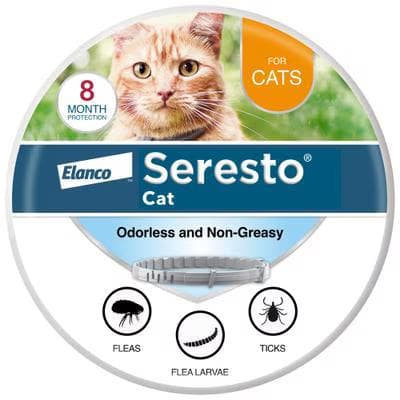
Seresto is the reference collar every other one is measured against. Elanco's polymer matrix releases imidacloprid and flumethrin slowly over 8 continuous months, killing and repelling fleas and ticks through contact so they do not need to bite. The cat version has a two-way release mechanism that lets the collar open if it snags, and the manufacturer says the collar stays effective through bathing and swimming. It is labeled for cats and kittens 10 weeks and older.
It is also the collar the EPA reviewed in depth. The agency allowed it to stay on the market in 2023 with new label warnings, annual incident reporting and a five-year registration limit; the safety section below covers what that means. Buy it from a veterinary clinic or an authorized retailer, because counterfeit Seresto collars are a documented marketplace problem.
Seresto for Cats: strengths and tradeoffs
Pros
- Kills and repels fleas and ticks across the whole body for 8 months.
- Two-way release mechanism and water-resistant design suit indoor and outdoor cats.
- The most vet-familiar collar, with a formal EPA review behind its current label.
Cons
- The highest price in this slate, and counterfeits are common on third-party marketplaces.
- Not for kittens under 10 weeks.
- Skip it if your cat has reacted to a collar before or if you already use a monthly topical or oral preventive; do not stack products.
Best long-lasting alternative: PetArmor Extend Flea and Tick Collar for Cats
Webvet may earn a commission when you click through to Chewy, at no extra cost to you.
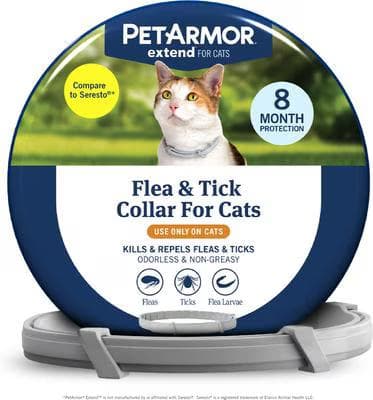
PetArmor Extend uses the same two active ingredients as Seresto, imidacloprid and flumethrin, in its own polymer matrix, and is labeled for 8 months of protection. PetArmor states plainly that it is not manufactured by or affiliated with Elanco. The cat collar is labeled for kittens as young as 7 weeks, the youngest minimum in this group, and the maker says water exposure under normal conditions does not shorten its effective life.
The tradeoff is track record. Extend launched years after Seresto, so it has less incident history behind it, for better or worse. For an owner who wants Seresto-style coverage at a lower price, or who has a kitten between 7 and 10 weeks, it is the sensible second choice.

PetArmor Extend for Cats: strengths and tradeoffs
Pros
- Same two active ingredients and 8-month duration as Seresto, usually at a lower price.
- Labeled for kittens from 7 weeks.
- Odorless, non-greasy and rated for normal water exposure.
Cons
- A newer product with a shorter safety and efficacy record than Seresto.
- Availability and price move more than the established brand.
- Skip it if your veterinarian specifically wants the Seresto label data or if your cat weighs under the label minimum on the package you receive.
Best mid-price collar: Hartz UltraGuard ProMax Flea and Tick Collar for Cats
Webvet may earn a commission when you click through to Chewy, at no extra cost to you.
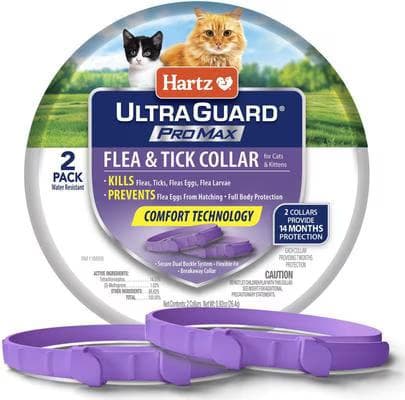
Hartz's ProMax collar combines tetrachlorvinphos with methoprene, an insect growth regulator that stops flea eggs from hatching. Hartz says each collar gives up to 7 months of protection against fleas, ticks, flea eggs and flea larvae, and the tin holds two collars for 14 consecutive months. It has a pre-determined breakaway point, is water resistant, and is labeled for cats and kittens at least 12 weeks old and 5 pounds.
The egg and larva control is what separates this from a plain tetrachlorvinphos collar. It still relies on organophosphate chemistry concentrated near the neck, so we place it as the mid-price option for a lower-risk indoor cat rather than a substitute for Seresto in a flea-heavy yard.
Hartz UltraGuard ProMax for Cats: strengths and tradeoffs
Pros
- Two collars per tin cover 14 months for one cat or 7 months for two.
- Methoprene targets eggs and larvae, not only adult fleas.
- Breakaway point and water resistance suit everyday indoor cats.
Cons
- Tetrachlorvinphos coverage is strongest near the collar and weaker toward the tail.
- Organophosphate residue on the coat is a consideration in homes with small children.
- Skip it for a cat with an active infestation or heavy outdoor exposure; the 8-month collars above cover the whole body.
Best budget breakaway: Adams Plus Flea and Tick Breakaway Collar for Cats
Webvet may earn a commission when you click through to Chewy, at no extra cost to you.
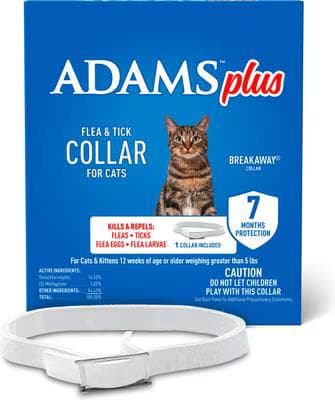
Adams Plus lists tetrachlorvinphos 14.55 percent and (S)-methoprene 1.02 percent, kills fleas, flea eggs, flea larvae and ticks including deer ticks, and is labeled for up to 7 months. The breakaway snap releases if the collar catches, the formula stays effective through rain and wetting, and the label restricts it to cats 12 weeks and older weighing at least 5 pounds.
At its price it is the best of the budget collars because the growth regulator adds egg control. Adams notes that in a severe infestation the collar should not be replaced earlier than 5 months, which is a reminder that a collar alone is not an infestation cure.
Adams Plus Breakaway Collar: strengths and tradeoffs
Pros
- Growth regulator plus adulticide at a budget price.
- Breakaway snap and water-resistant formula.
- Labeled tick coverage including deer ticks.
Cons
- Same neck-focused organophosphate limits as the other tetrachlorvinphos collars.
- Not for kittens under 12 weeks or under 5 pounds.
- Skip it if anyone in the home is sensitive to pesticide residue on the cat's coat or if your cat has had a skin reaction to a collar.
Cheapest stopgap: Zodiac Flea and Tick Collar for Cats
Webvet may earn a commission when you click through to Chewy, at no extra cost to you.
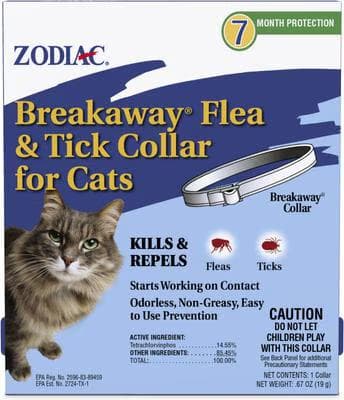
Zodiac's collar contains tetrachlorvinphos 14.55 percent as its only active ingredient, kills fleas and ticks for up to 7 months, starts working within about 24 hours according to the manufacturer, and keeps working after temporary wetting. Like the other budget collars it is labeled for cats 12 weeks and older weighing at least 5 pounds, and it has an easy-release design.
Without a growth regulator it kills adult fleas only, so eggs already in the home keep hatching. That makes it a fair choice for a low-risk cat while you arrange a stronger plan, and a poor choice for an active infestation.
Zodiac Cat Collar: strengths and tradeoffs
Pros
- The lowest price in this comparison.
- Begins killing fleas within about a day of fitting.
- Easy-release design and tolerance for temporary wetting.
Cons
- Adult fleas only; no egg or larva control.
- Neck-focused organophosphate coverage.
- Skip it if fleas are already established in your home or if your cat goes outdoors in a flea-heavy area.
 $65 · no membership
Need flea, tick, or heartworm prevention for your cat?
A licensed vet can recommend and prescribe the right preventive for your cat online when it's appropriate.
 Talk to a vet
- Licensed vets
- All 50 states
- same-day Rx

Webvet may earn a commission if you book.
How cat flea collars work

A flea collar is a slow-release pesticide reservoir. What separates one collar from another is which pesticide it holds and how that pesticide reaches the rest of the cat. The product-by-product table below lets readers compare the five collars on the facts the labels bury: active ingredients, months of protection, kitten age minimums and how each spreads. The breakaway design of each collar and the EPA findings are explained without alarm in the safety section that follows.
| Collar | Active ingredients | How it spreads | Kills or repels | Duration | Kitten minimum |
|---|---|---|---|---|---|
| Seresto | Imidacloprid, flumethrin | Into skin oils, whole body | Kills and repels fleas and ticks on contact | 8 months | 10 weeks |
| PetArmor Extend | Imidacloprid, flumethrin | Into skin oils, whole body | Kills and repels fleas and ticks on contact | 8 months | 7 weeks |
| Hartz UltraGuard ProMax | Tetrachlorvinphos, methoprene | Dust and vapor from the collar | Kills fleas, ticks, eggs, larvae | 7 months | 12 weeks, 5 lb |
| Adams Plus | Tetrachlorvinphos, (S)-methoprene | Dust and vapor from the collar | Kills fleas, ticks, eggs, larvae | 7 months | 12 weeks, 5 lb |
| Zodiac | Tetrachlorvinphos | Dust and vapor from the collar | Kills fleas and ticks | 7 months | 12 weeks, 5 lb |
Imidacloprid and flumethrin collars
Imidacloprid kills adult fleas and larvae by disrupting the insect nervous system. Flumethrin, a synthetic pyrethroid, repels and kills ticks and adds flea repellency. Both are held in a polymer matrix and migrate continuously into the lipid layer of the skin, which carries them from the neck to the tail base. Because fleas die on contact, they do not need to bite, which is why these collars also reduce flea allergy flare-ups.
Flumethrin is a pyrethroid, and cats are famously sensitive to pyrethroids. The distinction is dose and chemistry: the low, controlled release from a cat-labeled collar is registered for cats, while permethrin, the pyrethroid in many dog spot-ons and collars, is toxic to cats at the concentrations used for dogs. Our guide to permethrin for dogs explains why the dog products must never touch a cat.
Tetrachlorvinphos collars
Tetrachlorvinphos, often shortened to TCVP, is an organophosphate insecticide. Collars built on it release pesticide mainly as fine dust and vapor around the neck, so they knock down fleas near the collar and offer thinner protection toward the rump. Adding methoprene, an insect growth regulator, lets the Hartz and Adams collars stop eggs and larvae from developing, which matters more than most owners realize because adults are a small fraction of a flea population.
TCVP collars are EPA-registered and legal. They have also been the subject of long-running petitions to the EPA over residue exposure for children who handle treated pets, which is why the label directions about wash-your-hands and keeping collars away from children are not boilerplate.
How long does a flea collar take to work?
The imidacloprid collars begin killing fleas within hours and reach full distribution across the coat over the first day or two. Zodiac states its collar starts working within about 24 hours. Neither type clears the home: the Merck Veterinary Manual notes that fleas may live and feed on a pet for 6 to 24 hours before being killed, and the eggs, larvae and pupae in carpets keep producing new fleas for weeks.
Are flea collars safe for cats?

For a healthy adult cat wearing a cat-labeled collar fitted correctly, the most common problems are local: redness, itching or hair thinning under the collar. Serious reactions are uncommon but real, which is why the EPA reviewed the most popular collar in detail.
What the EPA concluded about Seresto
After a multi-year review of incident reports, the EPA decided in 2023 that Seresto collars "continue to meet EPA's standards" and did not cancel the product. The agency reported about 1,400 pet deaths reported to it from 2016 through 2020, which it described as 2 percent of all Seresto incidents, and found the rate similar to other pet products it has reviewed. It linked strangulation deaths to mechanical collar failure rather than the pesticide.
The registration continued with conditions: label descriptions of common adverse effects with instructions to remove the collar if they occur, annual incident and sales reporting by Elanco, separate registrations for the cat and dog collars, an evaluation of the emergency release mechanism, and a five-year limit on the current approval. The EPA's own summary is on its Seresto pet collar review page. The takeaway for a cat owner is neither "Seresto is dangerous" nor "Seresto is proven harmless"; it is that the collar stays registered under closer watch, and that a reaction should be reported.
Signs of a flea collar reaction
The FDA's guidance for safe use of flea and tick products adds three rules that prevent most collar problems: read the label before use, match the product to the cat's species, life stage and weight, and wash your hands after handling it. It states directly: if the product is for use on dogs, don't use it on cats.
Breakaway collars and outdoor cats
A cat that climbs, squeezes through fences or hangs a collar on a branch needs a collar that gives way. The breakaway design differs by collar: Seresto has a two-way release mechanism, Hartz a pre-determined breakaway point, Adams a breakaway snap and Zodiac an easy-release design. None of these is a guarantee, so check the collar's release yourself when you fit it and keep the two-finger fit described later. Overtight fitting is a common cause of both skin irritation and failed releases.
Never use a dog flea collar on a cat
Dog collars and spot-ons often contain permethrin or higher doses of other pyrethroids that cats cannot metabolize. Signs of pyrethroid toxicity in cats include tremors, twitching, drooling and seizures, and the exposure can be fatal. If you also own a dog, read our guide to the flea collar for dogs and keep the two collars in separate, labeled places. Cats that groom a collared dog can also be exposed, so ask your veterinarian which dog product is safest in a mixed home.
Counterfeit collars
Fake Seresto collars are sold through third-party marketplace listings at prices that look like a bargain. A counterfeit may contain no active ingredient, the wrong one, or an uncontrolled dose. Elanco's advice is to buy from veterinary clinics and trusted retailers, and the same rule applies to every collar here. If the packaging, the collar's texture or the price looks wrong, do not put it on your cat.
Flea collar vs topical vs oral flea treatment for cats
A collar is one of three delivery routes, and the right one depends on your cat and your household. The table below is the quick comparison; our guide to the best flea treatment for cats covers the individual topical and oral products in depth.
| Route | Examples | Lasts | Prescription | Strengths | Limits |
|---|---|---|---|---|---|
| Collar | Seresto, PetArmor Extend, TCVP collars | 7 to 8 months | No | Long duration, no monthly reminder, repels ticks | Collar reactions, release failures, counterfeits, slower start than pills |
| Topical spot-on | Revolution Plus, Bravecto Plus, Frontline Plus, Advantage II | 1 to 3 months | Some | Whole-body coverage; some also cover heartworm, mites or worms | Monthly application, greasy spot, cannot bathe right away |
| Oral tablet | Capstar (nitenpyram), Comfortis, Credelio for cats | Hours to 1 month | Most | Fastest kill; nothing on the coat for children to touch | Prescription and pill-giving; short-acting options do not prevent |
What is the best thing to keep fleas off of cats? The product they will actually receive on schedule, which is why the most effective flea prevention differs by household:
- A collar wins for an owner who forgets monthly doses.
- A prescription topical wins when heartworm, ear mites or intestinal worms also need covering.
- An oral tablet wins for the fastest kill in an active infestation.
Which is better, a collar or drops? For a healthy indoor cat with no other parasite risk, the two are comparable and the collar is cheaper per month; for an outdoor cat or a multi-parasite risk, veterinarians usually recommend the broader prescription products.
What do vets recommend for fleas? Most recommend year-round prevention with a product whose label matches the cat, chosen with the cat's age, weight, outdoor access and other parasite risks in mind, and they generally favor prescription-strength options over bargain collars for cats with real exposure.
Flea collars for kittens

Can kittens wear flea collars? Only from the age and weight printed on the label, and those differ by product. PetArmor Extend is labeled from 7 weeks, Seresto from 10 weeks, and the Hartz, Adams and Zodiac collars from 12 weeks and 5 pounds. Below the minimum, a kitten's size makes dosing unreliable and the collar itself is a strangulation risk on a tiny neck.
For a flea-infested kitten under the minimum, the safe tools are a flea comb, a warm bath with a mild kitten-safe shampoo, washing bedding, and a veterinary visit for a product labeled for the kitten's exact age. Kittens can become anemic from fleas faster than adult cats, so do not wait out an infestation on a young kitten.
Weigh the kitten rather than guessing. A collar that is right at 12 weeks can still be wrong for a small 12-week-old under 5 pounds.
Do flea collars work if your cat already has fleas?

A modern collar will start killing the fleas on your cat, but it is not the fastest tool, and it does nothing for the eggs, larvae and pupae already seeded through the home. Those immature stages are most of an infestation, and Merck notes a second environmental treatment may be needed 7 to 10 days after the first in severe cases.
The realistic plan for an infested cat
Treating an existing infestation alongside a collar means three things at once: a fast kill on the cat, the collar for prevention, and the house. Start with a fast-acting kill. Our guide to flea pills for cats covers nitenpyram tablets that kill adult fleas within hours and the prescription monthly tablets. Fit the collar the same day for ongoing prevention if you are not using a monthly product. Then treat the house: vacuum daily for two weeks, wash bedding hot, and use a home spray with an insect growth regulator, as covered in our guide to the best flea spray for home and the step-by-step how to get rid of fleas on cats.
What is the best thing to kill fleas on a cat right now? A veterinary oral adulticide, because it works in hours and nothing sits on the coat. The collar is what keeps them from coming back.
Why is Frontline not killing the fleas on my cat?
Usually because the home is reinfesting the cat faster than a monthly topical can keep up, not because the product has failed. Live fleas on a treated cat within the first weeks of an infestation are expected as pupae keep hatching. Check that the topical was applied to skin rather than fur, that the cat was not bathed right after, and that every pet in the home is treated. Persistent live fleas after two months of correct use is the point to ask your veterinarian about a different active ingredient.
Not sure whether what you are seeing is fleas at all? Our guide to fleas on cats and how to spot them covers flea dirt, comb checks and the bite pattern.
How to fit and use a cat flea collar
- Unroll the collar and, for tetrachlorvinphos collars, stretch it as the label directs to activate release.
- Place it around the neck and adjust to the two-finger fit: you can fit two fingers comfortably between the collar and the neck. Looser than that and the collar swings and rubs; tighter and it irritates skin and may not release.
- Trim the excess to no more than about an inch beyond the loop, and test the breakaway or release by pulling gently.
- Wash your hands. Keep the packaging so you have the lot number if you ever need to report a reaction.
- Note the fitting date for replacement timing. Replace Seresto and PetArmor Extend at 8 months and the tetrachlorvinphos collars at 7 months, sooner if the label says so for heavy infestations.
Do indoor cats need a flea collar?
Indoor cats get fleas less often, but fleas ride in on dogs, shoes and used furniture, and one pregnant flea is an infestation. Our guide to whether indoor cats can get fleas and worms walks through the real risk. For a strictly indoor cat with no dog in the home, a collar is optional; for an indoor cat that shares a home with a dog that goes outside, year-round prevention on both animals is the standard advice.
Bathing and swimming
The imidacloprid and flumethrin collars are designed to tolerate bathing and water exposure, and Hartz, Adams and Zodiac all describe their collars as effective after rain or temporary wetting. Frequent shampooing with a degreasing shampoo can still shorten the effective life of any collar because it strips the skin oils that carry the active ingredient.
Frequently asked questions
Do vets recommend flea collars?
Many veterinarians accept the imidacloprid and flumethrin collars as one option among several for cats, particularly for owners who struggle with monthly dosing. Fewer recommend the older tetrachlorvinphos collars, which they view as a budget stopgap with neck-focused coverage. Most prefer prescription topical or oral products for cats with outdoor exposure or additional parasite risks.
What flea collar do vets recommend?
When a veterinarian recommends a collar for a cat, it is usually Seresto, because of its 8-month duration, whole-body coverage and formal EPA review. PetArmor Extend uses the same two active ingredients. Buy either from veterinary clinics or an authorized retailer to avoid counterfeits.
How long does it take for a flea collar to work on cats?
Imidacloprid collars begin killing fleas within hours and have spread through the coat within about 24 hours; Zodiac states its collar works within about 24 hours. Existing fleas in the home keep hatching for weeks, so expect to see some live fleas early on even when the collar is working.
Is there a flea collar that actually works?
Yes. Collars that kill and repel on contact using imidacloprid and flumethrin, such as Seresto and PetArmor Extend, deliver head-to-tail protection for 8 months. Tetrachlorvinphos collars also work, but their coverage is strongest near the neck and weaker toward the tail.
Which is better, Frontline or a Seresto collar?
They solve different problems. Frontline Plus is a monthly topical with fipronil that covers fleas and ticks across the body; Seresto is an 8-month collar that also repels. For an owner who applies drops reliably, the two protect similarly; for an owner who forgets, the collar wins. Neither covers heartworm or internal worms, which prescription topicals such as Revolution Plus do.
Is there a better flea collar than Seresto?
Not by duration or coverage. PetArmor Extend matches Seresto's same two active ingredients and 8-month label at a lower price and a younger kitten minimum, so it is the closest rival. The tetrachlorvinphos collars are cheaper but do not match the whole-body coverage.
What's the worst month for fleas?
In most of the United States flea numbers peak in late summer, August and September, when warmth and humidity speed the life cycle. Southern and coastal regions see fleas nearly year-round, and heated homes keep fleas breeding through winter indoors.
What time of year is worst for cat fleas?
Late summer into early fall is worst outdoors, but for an indoor cat the danger season is whenever fleas come inside on a dog or visitor, because indoor heating lets the flea life cycle continue all year. That is why veterinarians recommend year-round prevention rather than seasonal use.
What smell do fleas absolutely hate?
No scent repels fleas reliably enough to protect a cat. Products and folk remedies built on essential oils such as citrus, eucalyptus or tea tree are unproven against fleas and several of those oils are toxic to cats. Use a proven product and a flea comb instead.
Is it true that Dawn dish soap kills fleas?
A bath with dish soap drowns adult fleas on the cat at that moment, which is why shelters use it on tiny kittens. It has no lasting protection and does nothing to eggs and larvae in the home, so it is a first step, not a treatment plan.
What do holistic vets recommend for flea and tick prevention?
Holistic practitioners often emphasize flea combing, frequent vacuuming and washing bedding, all of which help. Essential oil sprays and collars are a different matter: many oils are toxic to cats, and none has evidence comparable to registered products. If you prefer a lower-chemical approach, combine mechanical control with a veterinarian-approved product rather than replacing it.
$65 · no membershipNeed flea, tick, or heartworm prevention for your cat?
A licensed vet can recommend and prescribe the right preventive for your cat online when it's appropriate.
Talk to a vet- Licensed vets
- All 50 states
- same-day Rx
Webvet may earn a commission if you book.

Editor
The Webvet Editorial Team is the in-house group of pet-care editors and writers behind Webvet, operated by Smart Pet Collective. The team researches, writes, and maintains Webvet's pet health, behavior, and medication content. Every article follows a defined editorial process: research from reputable veterinary and scientific sources, careful drafting, mandatory review of medical content by a credentialed veterinarian, and dated publication. Health and medication articles are medically reviewed by a licensed veterinary professional before they go live and are kept current over time.
Veterinarian · BVMS MRCVS
Dr. Pippa Elliott, BVMS, MRCVS, is a veterinarian with nearly 30 years of experience in companion animal practice. Dr. Elliott earned her Bachelor of Veterinary Medicine and Surgery from the University of Glasgow. She was also designated a Member of the Royal College of Veterinary Surgeons. Married with 2 grown-up kids, Dr. Elliott has a naughty Puggle named Poggle, 3 cats and a bearded dragon.


