Best Cat Collars: Breakaway, Reflective, and Flea Picks a Vet Would Choose
The right cat collar breaks away if it snags, fits two fingers snug, and carries your phone number. Here is how a vet thinks about breakaway buckles, bells, reflective trim, kittens, and flea collars, plus the Chewy collars we would buy.

BVMS MRCVS
Medically reviewed by Dr. Pippa Elliott, BVMS MRCVS · Last reviewed

This article contains affiliate links. Webvet may earn a commission when you buy through them, at no extra cost to you.
A cat collar has one job that matters more than the rest: carrying your phone number so anyone who finds your cat can call you. Chosen badly, the same strap can snag on a fence or catch a front leg, which is why shelter guidance focuses on the buckle, not the color.
The short answer: a collar is optional, but if your cat wears one, it needs a breakaway buckle, room for two fingers underneath, and your phone number. The six Chewy picks below run from a breakaway collar listed at $7.49 in October 2026 to reflective, kitten, personalized, and flea collars.
| Collar | Best fit | Material or format | Key spec | Main tradeoff |
|---|---|---|---|---|
| Safe Cat Snag-Proof Polyester Breakaway Cat Collar with Bell, Purple | Most indoor and indoor-outdoor cats, on a budget | Snag-proof nylon, breakaway buckle, bell | 3/8 inch wide, adjusts 8 to 12 inches, listed at $7.49 on Chewy in October 2026 | Release force not published |
| LupinePet Reflective Breakaway Buckle Safety Cat Collar with Bell, Blue Paws | Cats outside at dusk or after dark | Woven nylon with reflective threads, breakaway buckle, bell | 1/2 inch wide, buckle releases at about 5 lbs, listed at $15.30 on Chewy in October 2026 | Not for leash or tie-out use |
| Kittyrama Breakaway Adjustable with Bell Cat Collar, Jungle | Cats that fight stiff nylon or have sensitive skin | Silicone strap, breakaway, adjustable, bell | Listed as hypoallergenic and waterproof, listed at $16.99 on Chewy in October 2026 | Size range and release force not published |
| Kittyrama Kitten Breakaway Adjustable with Bell Cat Collar, Fern | Kittens with small, growing necks | Kitten-size silicone strap, breakaway, bell | Lightweight soft strap, listed at $14.99 on Chewy in October 2026 | A very light kitten may not trigger some breakaway buckles |
| GoTags Nylon Personalized Reflective Tag with Bell Breakaway Cat Collar, Black | Door-dashers and any cat that needs ID on the collar | Nylon collar with personalized reflective tag, breakaway buckle, bell | Precision-engraved personalized ID, listed at $15.95 on Chewy in October 2026 | Neck range not published by the maker |
| Seresto Flea & Tick Collar for Cats | Cats that need flea and tick control | Medicated collar | Elanco says it works for 8 continuous months | Ingredients and kitten age limit not on Elanco's consumer page; ask your vet |
Should cats wear collars? What vets and shelters say
A collar is optional, but if your cat wears one, three things make it safe and useful. It needs a breakaway buckle, a fit with room for two fingers underneath, and an ID tag with your phone number. One rule sits above all three: never put a fixed buckle collar on a cat.
If you plan to walk your cat on a leash, clip it to a harness, not a collar. Our best cat harness guide covers the options.

The guidance behind each part:
- Breakaway buckle: the RSPCA Australia Knowledge Base recommends a quick-release breakaway clip that opens when pulled with force, and advises against non-stretch collars with fixed buckles.
- Two-finger fit: RSPCA Australia says one large or two small fingers should fit between the collar and the hair.
- ID with a phone number: the same guidance says the tag should carry your cat's name and one or two phone numbers.
- Microchip as backup: Cats Protection calls an implanted microchip the preferred ID because it is permanent and safe, while a collar can come off.
- 1A collar is optional for a cat. If yours wears one, choose a breakaway collar with an ID tag, and keep a microchip as backup.
- 2Before the first wear, pull the buckle apart by hand and make sure it opens.
- 3Leave room for two small fingers under the collar, snug enough that a paw swipe cannot pull it off.
- 4Put your cat's name and one or two phone numbers on the tag, and keep microchip registry details current.
- 5Never use a fixed buckle collar, and keep flea collars, cones, and trackers for the jobs they were made for.
Why so much attention on one strap? RSPCA Australia says collar injuries are rare but can be serious, and they are usually linked to a collar that is too loose or too tight. The encircling shape means a cat can catch a leg or its teeth in the collar.
Petplan UK, a pet insurer, makes the same point more bluntly: cats can entangle themselves in their own collars. A jaw or leg stuck in a collar is the failure a breakaway buckle and a good fit are meant to prevent.
The upside is identification that anyone can read. Humane World for Animals notes that a finder can read a collar tag on the spot, and the ASPCA says personalized ID tags are likely the fastest way to get a pet home.
Is it good for cats to wear collars?
For most cats, yes, provided the collar is a breakaway type that fits well. In a JAVMA study summarized by Faunalytics, 73% of 538 cats were still wearing their collars after six months. The authors still called microchips important backup ID, because some cats lose collars often.
Do vets recommend cat collars?
Veterinary and shelter guidance treats a collar as one layer of ID, not a requirement. RSPCA Australia recommends a breakaway clip plus an ID tag, and Cats Protection prefers a microchip as the permanent method. None of the sources we reviewed says every cat must wear one; the common advice is all three together.
Collar, microchip, or both
The two kinds of ID solve different problems, which is why the sources recommend pairing them:
- A collar and tag are visible. A neighbor who finds your cat can read the number and call without a trip to a vet or shelter, which is why the ASPCA calls ID tags likely the fastest route home.
- A microchip is permanent. It cannot fall off, but someone has to scan it, and it only works if your registry details are current.
- Both together cover each other's weak spot. The JAVMA study authors called microchips important backup ID precisely because some cats lose collars often.
If your cat refuses a collar, or keeps losing one despite a good fit, a microchip alone is a recognized choice. Cats Protection describes it as the preferred method in its own right.
Indoor cats, outdoor cats, and escape artists
Do cats need collars if they never go outside? The ASPCA notes a collar can come off and leave a pet with no ID, which is why the microchip matters. Still, an indoor cat that slips out a door is a lost cat with no visible sign of a home unless it wears a tag.
If your cat already bolts for the door, our guide on what to do when my cat is trying to escape covers the behavior side. For the collar side, here is how lifestyle changes the priorities:
- Indoor cats: the collar is for the day a door is left open. A simple tag with your phone number does most of the work.
- Indoor-outdoor cats: visibility matters more. Reflective trim helps at dusk, and a bell may reduce wildlife catches if you want to protect birds and small mammals.
- Escape artists: fit matters most, because a loose collar that slides off at the first paw swipe leaves no ID behind.
Style, materials, and comfort
An everyday ID collar is a different tool from a flea collar, a collar key for a feeder or door, or a recovery cone.
Wherever you buy, and whatever the style, run the same three checks:
- Does it have a breakaway or quick-release buckle that opens when pulled?
- Does it adjust to a snug two-finger fit on your cat's neck?
- Is there a way to attach or print your name and phone number?
A print, a color, or a premium label says nothing about the buckle. A chain, studded, or spiked collar without a breakaway release fails the first check.
For a cat with sensitive skin, Chewy lists the silicone Kittyrama Breakaway Adjustable with Bell Cat Collar, Jungle as hypoallergenic, lightweight, and soft enough not to rub on fur.
Our picks: the best cat collars
Every ID collar in this list has a breakaway buckle, because that is the one feature shelters agree on. Elanco's consumer page does not state the release design of the Seresto flea collar. An indoor-only cat, a cat out at dusk, a growing kitten, and a door-dasher need different features.
| Cat's lifestyle | Breakaway buckle | Fit | Reflective trim | Bell | ID | Where to start |
|---|---|---|---|---|---|---|
| Indoor only | Yes, for the day a door is left open | Two-finger fit, checked weekly | Optional | Optional | Name and phone number tag plus microchip | Safe Cat breakaway collar |
| Indoor-outdoor | Yes | Two-finger fit, checked weekly | Yes, for dusk and dark | Worth considering for wildlife | Tag plus microchip | LupinePet reflective breakaway collar |
| Kitten | Yes, and confirm a light kitten can trigger it | Two-finger fit, rechecked often as it grows | Optional | Optional | Tag plus microchip | Kittyrama Kitten breakaway collar |
| Escape artist | Yes | Snug two-finger fit so a paw cannot pull it off | Yes, if it gets outside | Optional, helps you hear it | Personalized collar with phone number | GoTags personalized breakaway collar |
| Senior | Yes | Two-finger fit, checked weekly | Optional | Optional, remove if it bothers the cat | Tag plus microchip, chip checked at the annual exam | Kittyrama soft silicone collar |
| Needs flea control | Ask your vet about the medicated collar's release design | Two-finger fit | Not applicable | Not applicable | Keep a separate ID collar or microchip | Seresto, after a vet conversation |
Before the first wear, test any breakaway buckle by hand:
- Fasten the collar off the cat, then pull both sides apart firmly. It should pop open.
- If it will not come apart at all, do not use it. Petplan UK says a quick-release collar that will not open can be dangerous.
- Check whether the listing publishes a release force, such as LupinePet's buckle that releases at about 5 lbs.
- For a small kitten, compare that force with the kitten's weight, because a buckle built for an adult may not open under a light kitten.
- Refasten, fit it with the two-finger check, and repeat the pull test at every weekly collar check.
Safe Cat Snag-Proof Polyester Breakaway Cat Collar with Bell: best overall and best budget
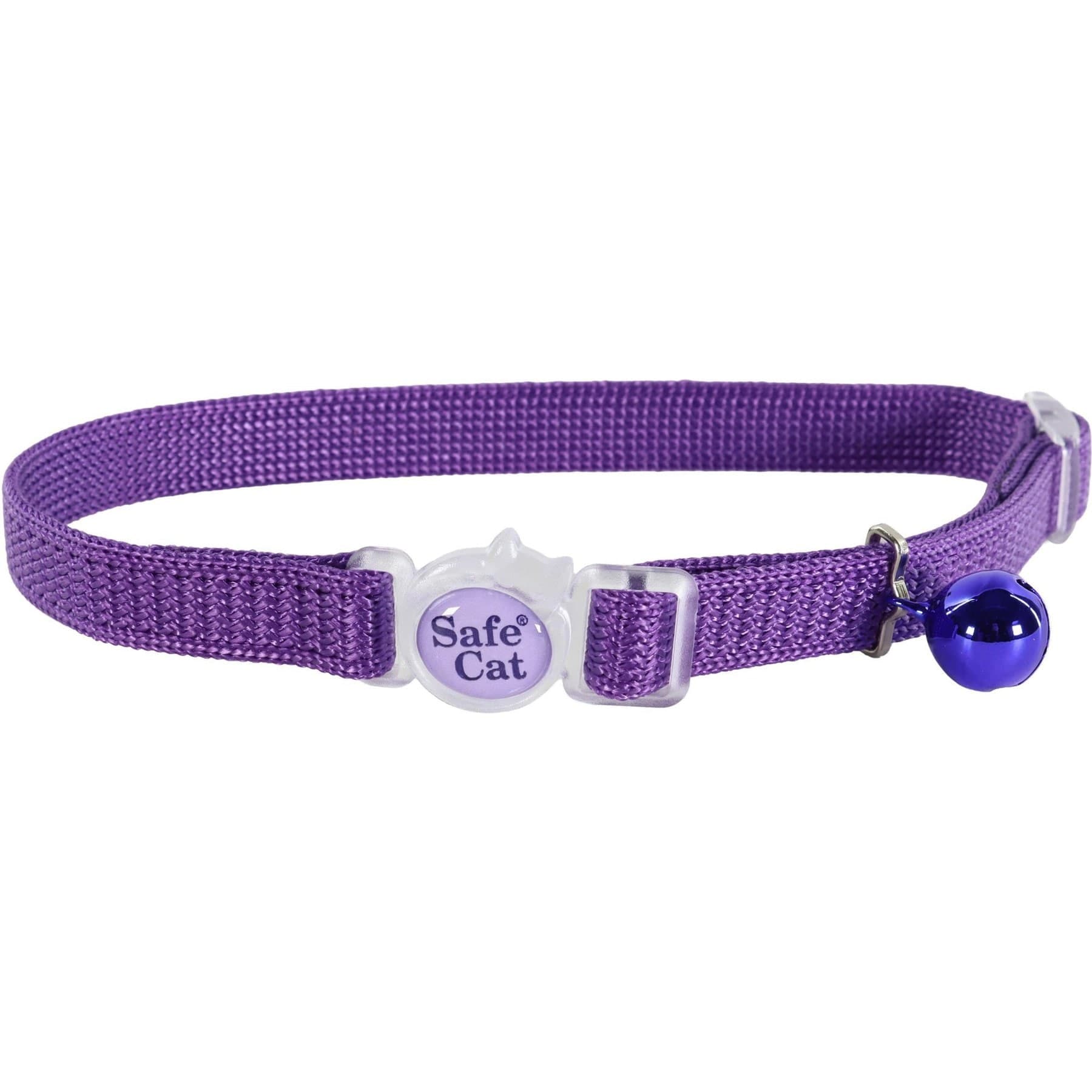
Snag-proof breakaway collar with a bell that adjusts from 8 to 12 inches.
Webvet may earn a commission when you click through to Chewy, at no extra cost to you.
This is the simple, safe default. Coastal Pet, the maker, describes the Safe Cat collar as snag-proof nylon with a breakaway buckle, 3/8 inch wide and adjustable from 8 to 12 inches. Chewy's listing says the buckle is designed to release when appropriate pressure is applied.
It suits indoor and indoor-outdoor cats whose necks fall within that range. Coastal Pet's fit guide uses the same two-finger rule as the shelters: two fingers between the collar and the cat's neck. The listing describes the collar as lightweight and comfortable for daily wear, with a bell already attached.
The tradeoffs to know:
- Release force: neither the Chewy listing nor Coastal Pet's product page gives how much pull opens the buckle, so do the hand test before the first wear.
- Size range: 8 to 12 inches covers many adult cats, but measure first, since a small kitten or a very large cat may fall outside it.
- Price: Chewy listed it at $7.49 in October 2026, the least expensive pick, which makes a spare easy to keep for the day a breakaway collar comes off outdoors.
- Skip it if: your cat is out after dark and needs reflective trim, or wants a softer strap than nylon.
LupinePet Reflective Breakaway Buckle Safety Cat Collar with Bell: best reflective collar
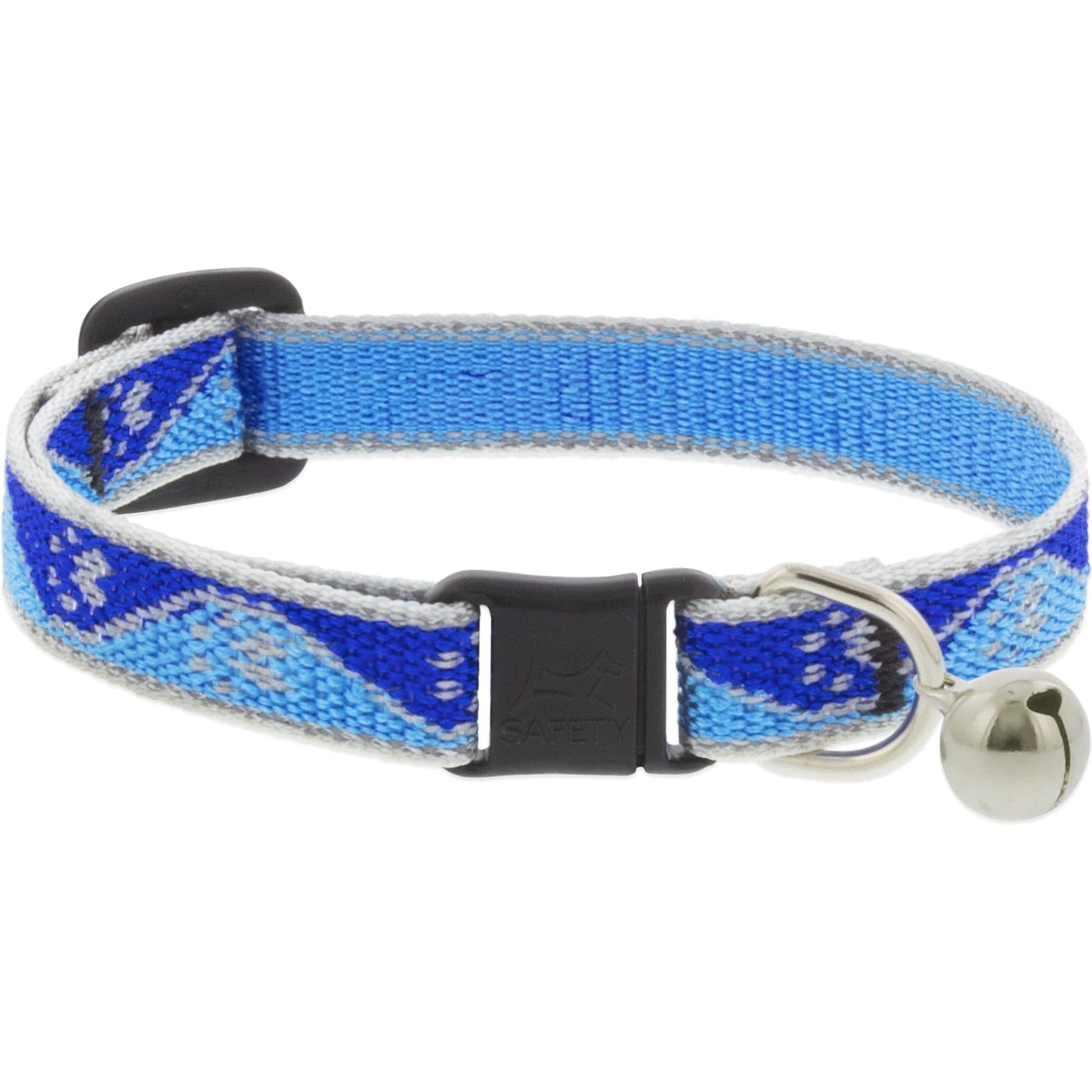
Reflective threads woven into soft nylon, with a breakaway buckle that releases at about 5 lbs.
Webvet may earn a commission when you click through to Chewy, at no extra cost to you.
Choose this one for a cat that is outside at dusk or after dark. Chewy's listing says reflective threads are woven into the front, back, and edges for visibility in low light. LupinePet says the reflective threads are never printed, so they will not scratch or peel off.
The details:
- Material and width: soft woven nylon, 1/2 inch wide.
- Buckle: LupinePet says the breakaway buckle releases at about 5 lbs, one of the few published release figures among these picks.
- Bell: included, so you hear the cat coming, and a bell may help with wildlife.
- Price: Chewy listed it at $15.30 in October 2026, the same as LupinePet's regular price.
- Skip it if: your cat is a small kitten, since a buckle that needs about 5 lbs of pull may not open under a small kitten.
The tradeoff is that this is a safety collar only. LupinePet says it is not intended for use with a leash or tie-out, which is the right design, since a breakaway buckle is supposed to open under pull. For walks, clip the leash to a harness instead; our best cat harness guide covers the options.
Kittyrama Breakaway Adjustable with Bell Cat Collar: best silicone collar for comfort
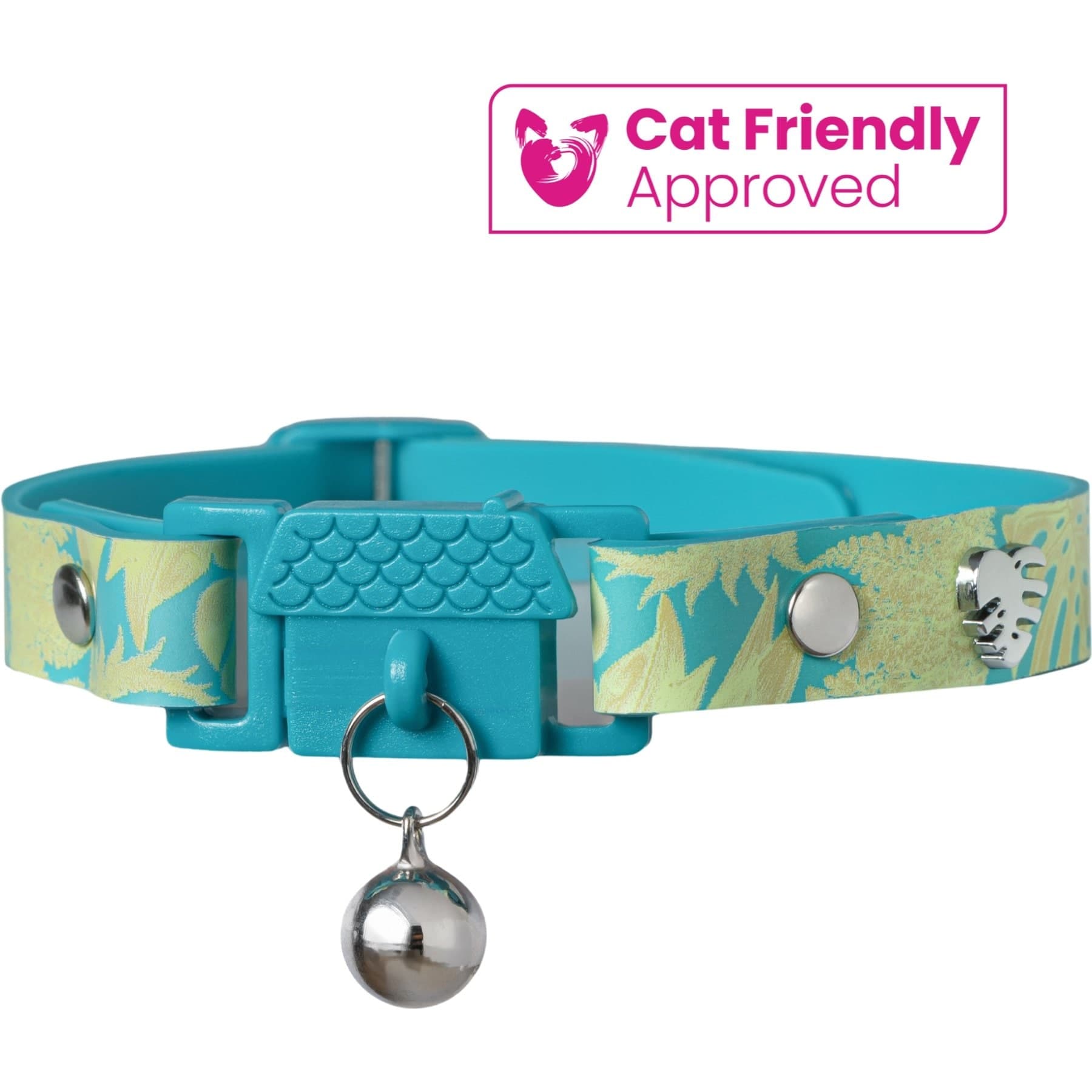
Soft silicone breakaway collar with a bell, listed as hypoallergenic and waterproof, for cats that fight stiff nylon.
Webvet may earn a commission when you click through to Chewy, at no extra cost to you.
This is the pick for a cat that scratches at nylon or has sensitive skin. Chewy's listing describes a high-quality silicone strap that is naturally hypoallergenic and waterproof and can help prevent irritation along the neck. It also calls the collar lightweight, with a smooth, soft strap that will not rub on fur.
The product name lists a breakaway buckle, an adjustable strap, and a bell. That combination matters: a soft collar should still release, not rely on give alone. RSPCA Australia notes that stretch collars can lose their elasticity as they age, which is one reason to keep checking any soft collar at the weekly fit check.
The gaps are in the published specs:
- Size range: not stated in the Chewy listing, so measure your cat's neck and confirm the range at checkout.
- Release force: not published, so the hand test matters more here.
- Price: Chewy listed it at $16.99 in October 2026, the highest of the ID collars here.
- Skip it if: you want a published release figure or reflective trim; the LupinePet covers both.
Kittyrama Kitten Breakaway Adjustable with Bell Cat Collar: best kitten collar
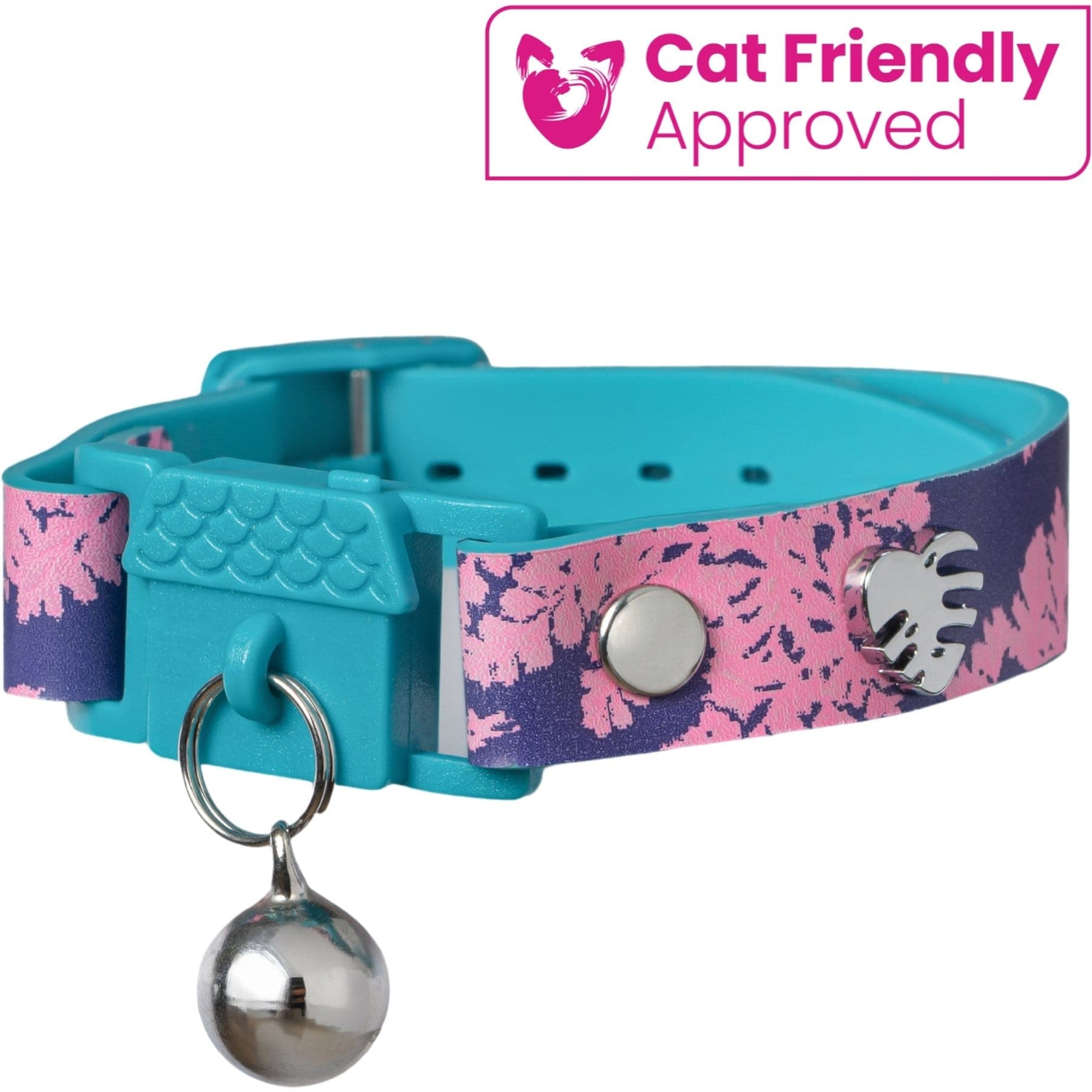
Kitten-size silicone breakaway collar with a bell, made for a small, growing neck.
Webvet may earn a commission when you click through to Chewy, at no extra cost to you.
This is the kitten version of the silicone collar above, listed on Chewy at $14.99 in October 2026. Chewy's listing uses the same description: lightweight silicone, a smooth soft strap, and a material sold as hypoallergenic and waterproof. The name lists a breakaway buckle, an adjustable strap, and a bell, in a kitten size.
It suits a kitten that is old and large enough for a collar and that you can check often. RSPCA South Australia says collars on any animal must be checked often, especially on young animals, and Coastal Pet's kitten collar guide notes that kittens grow quickly, so fit needs checking periodically.
The tradeoffs to plan around:
- Release weight: Coastal Pet says its own Li'l Pals breakaway collar is designed to release on cats or kittens of 6 to 8 pounds, so a lighter kitten may not trigger some buckles.
- No published release force: the Chewy listing gives none, so pull-test the buckle and watch your kitten closely for the first days of wear.
- Short service life: plan to move up to an adult collar as the neck outgrows the kitten size.
GoTags Nylon Personalized Reflective Tag with Bell Breakaway Cat Collar: best personalized ID collar
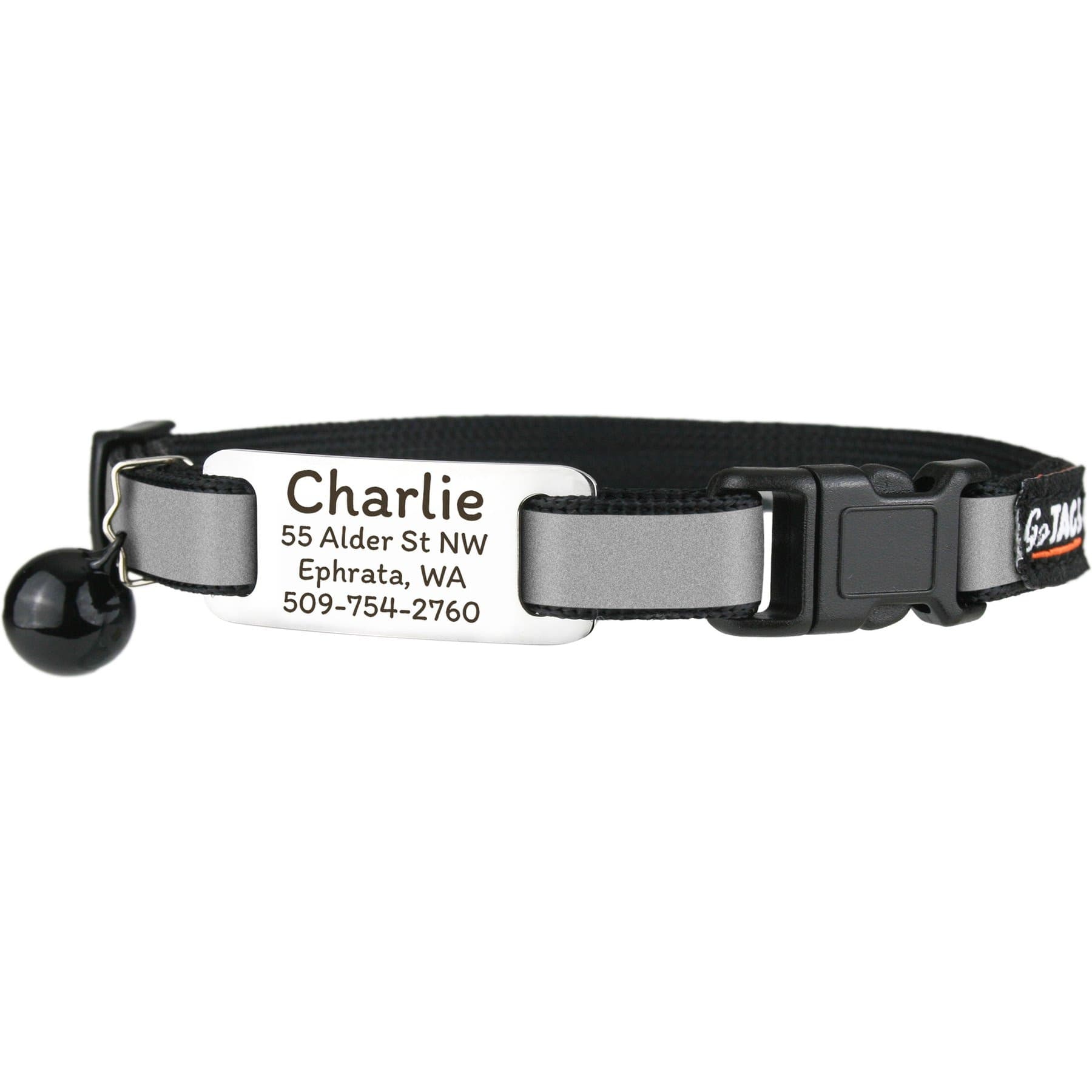
Breakaway collar with a personalized reflective tag for your cat's name and phone number, plus a bell.
Webvet may earn a commission when you click through to Chewy, at no extra cost to you.
This is the collar for a cat that must carry ID every day, especially a door-dasher. Chewy's listing says it has a breakaway safety buckle and a precision-engraved ID, so the details you choose, such as your phone number, travel with the collar. A bell is included.
RSPCA Australia's advice on what to engrave applies directly: your cat's name and one or two phone numbers. The microchip still covers the day the whole collar comes off.
What the listings do not tell you:
- Neck range: GoTags listed a Reflective Cat Collar with Breakaway Buckle at $8.50 in four colors on its own site in October 2026, but that page gives no neck range or reflective detail.
- This version: the tag-and-bell model Chewy listed at $15.95 does not appear on the GoTags site, so measure before you order a personalized item.
- Skip it if: your cat is still growing, since a personalized collar you outgrow in weeks is an expensive way to carry a phone number.
Seresto Flea & Tick Collar for Cats: best flea collar to pair with an ID collar
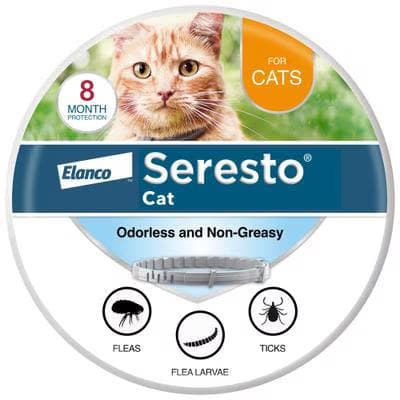
Medicated collar that Elanco says kills and repels fleas and ticks on contact for 8 continuous months.
Webvet may earn a commission when you click through to Chewy, at no extra cost to you.
This is a parasite-control collar, not an ID collar. Elanco, the maker, says Seresto works for 8 continuous months and kills and repels fleas and ticks through contact.
Elanco's consumer page does not list the active ingredients, the minimum kitten age, or the release design. Read all three on the package before fitting it, and fit it with the same two-finger check as any other collar.
The Merck Veterinary Manual says the most effective flea products are sold by veterinarians and recommends discussing flea control with your vet. That conversation is the right first step before buying this pick, especially for a kitten or a cat on other medication.
Breakaway buckles: why they matter and how to test one
A breakaway buckle is the feature that matters most on a cat collar. Humane World for Animals explains that breakaway collars use plastic fasteners designed to open automatically when the collar is pulled. If the collar catches on a branch, a fence, or the cat's own jaw, the buckle gives way.
Shelter guidance is consistent on this. RSPCA Australia recommends a quick-release breakaway clip that opens when pulled with force. RSPCA South Australia goes further and says it is vital that a collar has a break-away, safety release buckle.
What is the safest type of cat collar?
The safest type of cat collar is a lightweight collar with a breakaway buckle that opens under pull, fitted with two fingers of room. RSPCA Australia recommends a breakaway clip with an ID tag. Cats Protection prefers a quick-release or snap-opening collar over an elasticated one, because the cat is less likely to be trapped.
Breakaway, elastic insert, or fixed buckle
Cat collars use three main closure designs, and the sources treat them very differently:
- Breakaway or quick-release buckle: a plastic clip that opens when the collar is pulled hard. This is the design RSPCA Australia, RSPCA South Australia, and Cats Protection recommend.
- Elastic insert (stretch) collar: a section of elastic lets the cat slip a collar off. Cats Protection says a leg or jaw can get caught in an elasticated or ill-fitting collar, and RSPCA Australia notes stretch collars can lose their elasticity as they age.
- Fixed buckle: a standard belt-style or snap buckle that does not release. RSPCA Australia advises against non-stretch collars with fixed buckles.
There is one honest disagreement in the evidence. In the 538-cat study, as written up by the Animal Medical Center blog, the plastic buckle collar stayed on best, and no collar-related injuries were identified during the study.
That result is reassuring about collars in general, but it is one six-month study. The shelters' position rests on injuries being rare but serious, and a buckle that releases removes the worst case. Our read: a breakaway buckle plus a good fit gives most of the staying power with far less risk.
Breakaway cat collars that stay on
Some cats lose breakaway collars often, in the yard or every few days. Start with the fit before looking for a stronger buckle:
- Tighten to the two-finger fit. Humane World for Animals says a proper fit keeps the collar from sliding off at the swipe of a paw.
- Check the buckle itself. One that opens with a light tug may be worn or faulty, and RSPCA Australia's weekly condition check is the time to catch it.
- Keep a spare. Breakaway collars are cheap enough to replace, and a spare means your cat is not left without ID while you shop.
- Rely on the chip. The JAVMA study authors called microchips important backup ID because some cats lose collars often, which is exactly this situation.
A collar that never comes off is not the goal. A collar that stays on during normal life and opens when the cat is stuck or caught is.
Release force and why it matters
A breakaway buckle only helps if your cat can generate enough pull to open it. Few makers publish that number. Two do:
- LupinePet: the LupinePet Reflective Breakaway Buckle Safety Cat Collar with Bell, Blue Paws buckle releases at about 5 lbs.
- Coastal Pet: its Li'l Pals breakaway collar is designed to release on cats or kittens of 6 to 8 pounds.
The practical point is for kittens and very small cats. A buckle tuned for an adult may stay shut when a light kitten is caught, so the hand test and close supervision matter more early on.
When to recheck or replace a breakaway collar
RSPCA Australia advises checking the condition and fit of a collar weekly. At that check, replace or adjust the collar when:
- The buckle no longer opens with a firm pull, or opens far too easily and the collar keeps falling off.
- The strap is frayed, cracked, or stretched, especially on a stretch collar that has lost elasticity.
- Two fingers no longer slide under the collar, or the collar now slides over the cat's head.
- The bell or tag ring is bent or catching on the strap.
Fitting a cat collar: the two-finger rule, kittens, and growth
The two-finger rule runs through shelter, insurer, and maker guidance alike. RSPCA Australia says you should be able to fit one large or two small fingers between the collar and the hair. Petplan UK says a cat collar needs to be firmly fitted, with only 1 to 2 fingers fitting underneath.

The rule is about balance in both directions. RSPCA South Australia describes the target as not so tight that it inhibits breathing but not so loose that the cat can get a front leg through it. Humane World for Animals adds that a proper fit also prevents snagging.
Note that RSPCA Australia measures the gap between the collar and the hair, not the skin. On a long-haired cat, press your fingers through the coat to the neck so a thick ruff does not hide a collar that is actually loose.
How to know if a cat collar is too tight or too loose
Use these checks every time you fit or adjust a collar:
- Too tight: you cannot slide two small fingers flat under the collar, or the strap presses into the fur and skin.
- Too loose: the collar slides forward over the ears with gentle pressure, or there is enough room for a front leg to slip through.
- Right: two fingers slide under with light resistance, and the collar sits still when the cat shakes or scratches.
Measuring and using a size chart
There is no single cat collar size chart that works across brands. Each maker publishes its own length range and width.
Chewy's listings for the Safe Cat Snag-Proof Polyester Breakaway Cat Collar with Bell, Purple and the LupinePet Reflective Breakaway Buckle Safety Cat Collar with Bell, Blue Paws both open with a reminder to measure for the perfect fit.
To size an adjustable cat collar, follow these steps:
- Measure around the middle of your cat's neck with a soft tape, then add room for two fingers.
- Compare that number with the collar's length range. The Safe Cat collar, for example, adjusts from 8 to 12 inches.
- Pick a range where your cat's size falls near the middle, so there is room to tighten or loosen.
- Check the width. The Safe Cat is 3/8 inch wide and the LupinePet is 1/2 inch wide.
- Fit the collar, do the two-finger check, and recheck after a day of wear.
Kitten collars: when to start and how often to check
Can kittens wear collars? Yes, once they are old enough. Petplan UK says it is inadvisable to place collars on young kittens, and none of the primary sources we reviewed gives a minimum age in weeks, so ask your vet when yours is ready.
Once a kitten does wear one, growth changes the fit quickly. Coastal Pet says kittens grow fast, so fit should be checked periodically to make sure the collar is not too tight. RSPCA South Australia says collars on young animals must be checked often, and RSPCA Australia's weekly check is the minimum.
When you shop for a kitten collar, look for these features:
- A breakaway buckle a small kitten can open: check the release force where it is published.
- A short, adjustable range: a tiny kitten collar should still leave room to grow.
- Light weight: the Kittyrama Kitten Breakaway Adjustable with Bell Cat Collar, Fern is a soft silicone option sized for kittens.
- Somewhere for ID: a tag, or a collar carrying your phone number, so a lost kitten can be returned.
Color and decoration are a matter of taste once those checks pass.
A practical kitten routine, built from the sources above:
- Every week: do the two-finger check and the buckle pull test, as RSPCA Australia advises for any collar.
- After a growth spurt: loosen the collar a notch if two fingers no longer slide under it, since Coastal Pet notes kittens grow quickly.
- When the adjuster runs out: move to an adult collar rather than leaving a kitten collar at its last hole.
- At each vet visit: ask whether the chip has been registered and scanned, so ID does not depend on the collar alone.
Bells, reflective trim, and ID tags: what each is for
Each add-on on a cat collar does a specific job. A bell is mainly about wildlife, reflective trim is about being seen in low light, and an ID tag is about getting your cat home. None of them changes the need for a breakaway buckle.
Bells: what the evidence shows
Why put a bell on a cat collar? Mostly to cut down how much wildlife a hunting cat catches. The best-known study, a Glasgow trial of 41 cats (Ruxton and colleagues, 2002), found cats wearing bells brought home 82 mammals, compared with 167 when not wearing bells.
The Cornell Feline Health Center summarizes that work as bell-equipped cats killing about half as many mammals and birds, while noting earlier studies had questioned whether bells help.

The evidence for birds is mixed. A second study (Nelson and colleagues, 2005) found a 41% reduction in birds brought home by cats with a collar and bell in 2002, but no significant effect on birds in 2003. A cat collar with a bell is a reasonable step for a hunter, not a guarantee.
Are collars with bells bad for cats? None of the primary veterinary sources we reviewed states that a bell harms a cat's hearing. Humane World for Animals addresses noise only for tags: if jingling tags bother you or your cat, stick them together with Velcro or double-sided tape.
If you want a bell, the options look like this:
- Bell included: all five ID collars in our picks come with one.
- Add your own: a separate bell clips onto the collar ring, which lets you remove it for an indoor-only cat.
- No bell: reasonable for an indoor cat that does not hunt, or for a cat that seems bothered by the sound.
Reflective trim and light-up collars
Reflective trim works by bouncing back headlights and flashlights. On the LupinePet Reflective Breakaway Buckle Safety Cat Collar with Bell, Blue Paws, the reflective threads are woven into the front, back, and edges rather than printed on, which LupinePet says keeps them from scratching or peeling off.
Reflective trim suits an indoor-outdoor cat that is out at dusk. Light-up collars are another option, but we found no independent data comparing them with reflective trim. Whichever you choose, the buckle should still break away.

ID tags, names, and microchips
An ID tag is the part of the collar that actually reunites cats with owners. RSPCA Australia says the tag should include your cat's name and one or two phone numbers. RSPCA Australia also lists ID options from cheap engraved tags through to newer GPS trackers.
Ways to put a name and number on a cat collar:
- Engraved ID tag: a classic tag for a cat collar on the ring. Cheap and easy to replace.
- Name plate or slide-on tag: sits flatter against the collar than a hanging tag.
- Personalized collar: a collar sold with your details engraved, such as the GoTags Nylon Personalized Reflective Tag with Bell Breakaway Cat Collar, Black, which Chewy lists with a precision-engraved ID.
- Microchip: permanent ID under the skin, readable at a vet clinic or shelter with a scanner.
The microchip is the backup for the day the collar comes off. The ASPCA says implanted microchips are an important security measure, and that reunions depend on keeping your contact details current with the microchip registry. In the 538-cat study, 477 of 478 scanned microchips still worked at the end of six months.
The same study's write-up recommends having your cat's microchip function confirmed during the annual exam. If you are budgeting for the procedure, our guide to dog microchip cost explains how clinics price microchipping.
A short ID checklist that covers both layers:
- Tag: your cat's name and one or two phone numbers, per RSPCA Australia, readable without removing the collar.
- Registry: your current address and phone number on file with the microchip registry, which the ASPCA says reunions depend on.
- Annual scan: ask the vet to confirm the chip still reads at the yearly exam.
- After a move or new number: update the tag and the registry the same week.
Trackers and collar keys
A tracker clipped to the collar is one more device on the strap. Treat it as an extra layer on a breakaway collar, never a replacement for the microchip.
The same goes for a collar tag that works as a key for a feeder or cat door. The key hangs from the collar, so the collar still needs a breakaway buckle and a two-finger fit.
Decorative and personalized collars
Looks are where cat collars vary most, and that is fine, as long as the style passes the same safety checks:
- Breakaway buckle: a bow tie or patterned collar should open under pull like any plain one.
- Attachments: a bow, charm, or holiday piece should not add enough weight or loops to snag.
- Name and number: a personalized collar works well, as long as the phone number is readable.
- Fit: a collar with few adjustment holes may not allow a two-finger fit, so check before buying.
Flea collars, GPS trackers, and cones: when a cat wears a different collar
Several products go around a cat's neck without being ID collars. Flea collars, calming collars, trackers, and cones each have a job, and none of them replaces a breakaway ID collar and a microchip.

Flea collars for cats
A flea collar for cats is a medicated collar, and the active ingredient matters. The Merck Veterinary Manual says the most effective flea products are sold by veterinarians. Its veterinary drug tables list a flumethrin collar, a pyrethroid, as lasting 8 months, or less if the animal is bathed frequently.
Ingredient choice is a safety issue for cats. The Merck Veterinary Manual's ectoparasiticide section warns that some pyrethroids, such as permethrin, can be highly toxic to cats. Read the label of any flea collar and talk to your vet before you buy.
Questions worth bringing to that vet conversation:
- What is the active ingredient, and is it labeled for cats? Merck's permethrin warning is the reason this comes first.
- How long does it last for my cat? Merck notes a collar's interval can be shorter if the animal is bathed frequently.
- Is my cat old and large enough? Check the package for a minimum age before fitting a flea collar on a kitten.
- Does it replace or add to other flea products my cat already uses?
- Should it share the neck with an ID collar, or should ID rely on the microchip while the flea collar is on?
For a deeper look at flea collar options and how they compare with other flea products, see our guide to the flea collar for cats. We found no veterinary guidance on wearing a flea collar and an ID collar at the same time, so ask your vet how to handle two collars.
Calming and pheromone collars
Calming collars, often sold as pheromone collars, are marketed to ease stress. None of the sources we reviewed tested them or published side effects.
If you are considering one for a stressed cat, ask your vet first. A calming collar still sits on the neck, so it needs a breakaway release and a two-finger fit like any other collar.
GPS trackers
RSPCA Australia lists GPS trackers among cat ID options, from engraved tags up to trackers. No veterinary body source we reviewed gave data on GPS collar safety or accuracy, so we do not rank trackers here. If you use one, mount it on a breakaway collar and keep the microchip registered.
Cones and recovery collars
A cone, or Elizabethan collar, is a medical device. VCA Animal Hospitals says it stops a cat from directly traumatizing a surgical site or injured area. VCA also says you should always be able to fit two fingers comfortably between the cone and the cat's neck.
Soft, inflatable, and donut-style recovery collars are alternatives to a hard cone. Our cat cone guide covers fitting, types, and keeping one on. Any post-surgery collar should be fitted and managed under your vet's direction.
Is there an alternative to a cat collar?
Yes. For ID, the alternative is a microchip, which RSPCA South Australia calls the best identification method. For walks, clip the leash to a harness; LupinePet says its breakaway collar is not intended for leash use. For wound protection, VCA notes a T-shirt may cover some sites, but ask your vet first.
Getting a cat used to wearing a collar
Most cats accept a collar with time, but the first few days set the tone. Humane World for Animals suggests getting cats used to a new collar and tags gradually. Coastal Pet says the sooner you introduce a kitten to a collar, the easier it will be.

How to get a cat used to a collar, step by step:
- Let your cat sniff the collar first, and leave it near a favorite sleeping spot so it smells familiar.
- Fit the collar with the two-finger check during a calm moment, such as just before a meal or play session.
- Keep the first sessions short and stay nearby, then remove the collar before your cat gets frustrated.
- Lengthen the time worn over several days as your cat stops scratching at it.
- Add the tag or bell once the collar itself is accepted. If the jingle bothers your cat, tape tags together as Humane World suggests.
- Recheck the fit and pull-test the buckle at the end of the first week.
Do cats like wearing collars? In the 538-cat study, 73% were still wearing them after six months. A cat that keeps fighting the collar after the first days may do better in a lighter, softer one, such as the silicone Kittyrama Breakaway Adjustable with Bell Cat Collar, Jungle.
If your cat seems stressed well beyond the collar, such as distress whenever you leave the house, that is a separate issue worth reading about in our guide to cat separation anxiety. Watch for these signs that the collar itself needs attention:
- Redness, hair loss, or a bald patch under the collar.
- A collar that keeps ending up in the cat's mouth or behind a front leg, which means it is too loose.
- A buckle that opens many times a day, which may mean a poor fit or a buckle that releases too easily.
If your cat fights the collar
Some cats keep scratching, rolling, or backing out of a new collar. Before giving up, work through the likely causes:
- The fit is off. A collar that is too loose shifts and rubs, and one that is too tight presses. Redo the two-finger check.
- The material bothers the cat. Switching from stiff nylon to a soft silicone strap is the simplest change to try.
- The noise bothers the cat. Remove the bell, or tape tags together as Humane World for Animals suggests.
- The pace was too fast. Go back to short, supervised sessions and build up again gradually.
If none of that works, a microchip alone still gives your cat permanent ID. Shelters recommend a collar as one option, not as something to force on a cat that will not accept it.
Cat collar questions
Frequently Asked Questions
When should a cat not wear a collar?
A very young kitten should not, since Petplan UK calls collaring young kittens inadvisable, and no cat should wear a fixed buckle collar. A cat that keeps getting a leg or jaw through a collar despite a good fit is better served by a microchip alone.
Do indoor cats need a collar?
Not strictly, but a collar with a tag helps if your cat ever gets out. An indoor cat that makes an escape through an open door has no visible ID without a tag. The ASPCA notes collars can come off, so a registered microchip should back up any collar.
Do bells on cat collars bother cats?
No primary veterinary source we reviewed says a bell damages a cat's hearing. Some cats may still dislike the jingle, and Humane World for Animals suggests taping jingling tags together. Bells have some evidence for reducing wildlife catches, with the strongest results for small mammals and mixed results for birds.
How tight should a cat collar be?
Snug, with room for two fingers. RSPCA Australia says one large or two small fingers should slide between the collar and the hair. If more fits, the collar may slide off or let a leg through. If less fits, it is too tight, so loosen it and check again after a day.
Should a kitten wear a collar?
Once it is large enough, yes, but no primary source we found gives a minimum age, so we could not confirm the often-repeated figure of eight weeks. Ask your vet when your kitten is ready. After that, check weekly at minimum, because kittens grow quickly.
Can a cat wear a flea collar and a regular collar at the same time?
No primary source we found addresses wearing two collars at once. The Merck Veterinary Manual advises discussing flea control products with your veterinarian, which is the right step here. If your vet agrees to two collars, each one should have a breakaway release and its own two-finger fit.

Editor
The Webvet Editorial Team is the in-house group of pet-care editors and writers behind Webvet, operated by Smart Pet Collective. The team researches, writes, and maintains Webvet's pet health, behavior, and medication content. Every article follows a defined editorial process: research from reputable veterinary and scientific sources, careful drafting, mandatory review of medical content by a credentialed veterinarian, and dated publication. Health and medication articles are medically reviewed by a licensed veterinary professional before they go live and are kept current over time.
Veterinarian · BVMS MRCVS
Dr. Pippa Elliott, BVMS, MRCVS, is a veterinarian with nearly 30 years of experience in companion animal practice. Dr. Elliott earned her Bachelor of Veterinary Medicine and Surgery from the University of Glasgow. She was also designated a Member of the Royal College of Veterinary Surgeons. Married with 2 grown-up kids, Dr. Elliott has a naughty Puggle named Poggle, 3 cats and a bearded dragon.
Related reading

Dog Safe Chew Toys: What Vets Recommend and What to Avoid

Cat Proof Christmas Tree: Vet-Reviewed Safety Steps, Deterrents, and Cat-Safe Tree Options

Dog Ate Grapes or Raisins? Signs of Poisoning and What to Do
