Best Flea Spray for Home and Furniture: Vet-Reviewed Picks
Compare six household flea treatments by surface, application format, safety requirements, and role in a complete flea-control plan for dogs and cats.

BVMS MRCVS
Medically reviewed by Dr. Pippa Elliott, BVMS MRCVS · Last reviewed

This article contains affiliate links. Webvet may earn a commission when you buy through them, at no extra cost to you.
The best flea spray for home use matches the infested surface and combines adult-flea control with a way to interrupt developing fleas. Compare the four indoor sprays below by their active ingredients, growth regulator, coverage and application restrictions. Two additional options, a laundry additive and a fogger, serve different jobs and are discussed separately. Compare the labels for Adams Home Spray, Virbac Knockout E.S., Adams Carpet Spray and Zodiac Carpet & Upholstery Spray.
These are label-based comparisons, not results from a hands-on efficacy test. Treat every pet appropriately and combine any household pesticide with vacuuming and laundry. A long residual claim does not mean an infestation disappears immediately or that a treated room is safe to enter while wet. Check the current package before each application, especially when a retailer’s bottle size or formulation differs.
How to choose a flea spray for carpet and furniture
- 1The surface label determines fit. Choose by the permitted material and treatment site, not by the word “natural,” a familiar brand, or the largest coverage claim.
- 2Keep pets and people out during application and return only when the current label's ventilation, drying, and re-entry conditions are met.
- 3Never put a premise product on a pet unless that exact label explicitly permits use on that species, age, and weight.
- 4Treat every pet with veterinarian-selected flea control because a home spray cannot stop an untreated animal from producing more eggs.
| Product | Format and formulation | Best-fit job |
|---|---|---|
| Adams Home | Trigger; etofenprox + methoprene | Targeted labeled indoor fabric areas |
| Knockout E.S. | Aerosol; permethrin/pyrethrins + pyriproxyfen | Labeled carpet and cloth upholstery |
| Adams Carpet | Aerosol; etofenprox/prallethrin + methoprene | Broad eligible carpet areas; avoid wood |
| Zodiac Pump | Pump; permethrin + (S)-methoprene | Smaller eligible upholstery areas |
| TropiClean Laundry | Laundry additive; not a surface spray | Washable fabrics only; optional adjunct |
| Zodiac Fogger | Whole-room release; not a targeted spray | Only where all evacuation and ignition precautions can be met |
The best flea spray for your house is one labeled for the surfaces you need to treat. Name the surface first: carpet, upholstery, washable bedding or a floor crack. Check which rooms can be closed to pets and people. A targeted spray is useful only if its label permits that material and the household can follow every exclusion, ventilation and re-entry instruction.
| Surface | Format to consider | Surface label and re-entry condition to verify | Main limitation |
|---|---|---|---|
| Carpet edges, rugs, baseboards, and cracks | Targeted room or carpet spray | Surface label, stain test, ventilation, drying, and re-entry | Cannot reach every pupa or replace treatment on pets |
| Sofa seams and upholstered furniture | Upholstery-labeled pump spray | Fabric compatibility and whether cushions or sleeping surfaces may be treated | Overspray and damp fabric increase exposure and damage risk |
| Washable pet bedding and blankets | Hot wash and dryer, with a labeled laundry additive if desired | Fabric care and product directions | Only treats washable items, not floors or pets |
| Multiple inaccessible areas in a closed room | Fogger only when the label and room layout support it | Evacuation, ignition sources, food, dishes, aquariums, ventilation, and exact room volume | Poor placement and clutter can leave untreated hiding places while increasing exposure |
| Severe, recurring, or hard-to-access infestation | Licensed pest-control professional | Treatment plan, product registration, pet instructions, and follow-up | Higher cost, but safer than improvising with repeated pesticides |

A phrase such as “pet friendly” does not mean a dog can walk through wet residue or a cat can lie on a freshly treated sofa. The product label determines whether animals must leave, how long the area must dry or ventilate, which surfaces are permitted, and what protective steps are required. The EPA's pet pesticide guidance explains that pesticide products work safely only when the label directions and precautions are followed.
Webvet may earn a commission when you click through to Chewy, at no extra cost to you.
Plan extra precautions for cats, fish, birds, children and anyone with respiratory disease. Remove or protect them exactly as the label requires before application. If a room cannot be isolated safely, choose another control method or get professional advice.
If a cat lives in the home, check the label and ask a veterinarian or pest-control professional when anything is unclear. Cats groom treated surfaces from their feet and coats, and some pesticide exposures that a dog tolerates can be dangerous to a cat. Fish and birds can also be vulnerable to airborne products or contaminated water. Covering an aquarium may not be enough if the label requires removing or sealing it in a specific way.
The best flea sprays for home and furniture
The four sprays use different adulticides and insect growth regulators. An adulticide kills adult fleas; an IGR such as methoprene or pyriproxyfen interrupts immature development. These are complementary roles. Follow the specific label rather than adding another product because a newly emerged flea is still visible.
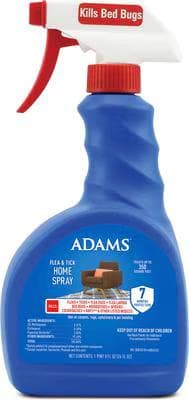
1. Adams Flea & Tick Home Spray: Targeted trigger application
Adams Flea & Tick Home Spray is the closest match to a reader who wants one trigger bottle for labeled household surfaces. The 24-fluid-ounce format is easier to aim along carpet edges, baseboards, pet-resting zones, and approved fabric areas than a whole-room fogger. That control makes it a practical starting point for a limited indoor infestation.
The manufacturer lists etofenprox 0.50%, (S)-methoprene 0.01% and piperonyl butoxide 2.00%. Methoprene is the growth regulator; the advertised up-to-seven-month claim concerns preventing reinfestation. The current online directions require vacating treated areas for at least one hour. Check the 24-ounce package for its complete drying, ventilation and return conditions; elapsed time alone is not permission to contact wet residue.
Choose Adams Home Spray when you need a broad labeled household format and can empty the treatment zone, ventilate it, and keep every pet away through the full re-entry period. Skip it when the material is not listed, a resident cannot safely leave the room, or the infestation is severe enough to need professional assessment.
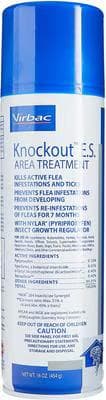
2. Virbac Knockout E.S.: Aerosol with pyriproxyfen
Knockout E.S. combines pyriproxyfen 0.10%, pyrethrins 0.05%, permethrin 0.40% and an insecticide synergist. Pyriproxyfen is its growth regulator. The E.S. product differs from plain Knockout Area Treatment, which has a different formula; check the complete name on the can.
An aerosol can help distribute product across a defined area, but mist also raises the importance of ventilation, respiratory precautions, ignition warnings, and removing animals from the room. Do not assume that a fine spray is appropriate for mattresses, pet beds, toys, or every fabric. Confirm each surface on the current label and test a hidden area when the label allows fabric use.
The Virbac E.S. product information supports an up-to-seven-month reinfestation claim. Follow the can’s room preparation, drying and re-entry directions, and use it only on permitted surfaces. It is an environmental product, not a treatment to spray on a dog or cat.
3. Adams Plus Carpet Spray: Carpet and upholstery aerosol
Webvet may earn a commission when you click through to Chewy, at no extra cost to you.
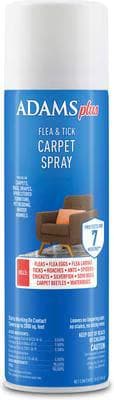
The current manufacturer formula lists etofenprox 0.500%, prallethrin 0.300%, (S)-methoprene 0.045% and a synergist. Methoprene supplies the growth-regulator role. Adams advertises up to 2,000 square feet and seven months of reinfestation protection for the carpet aerosol. The bottle size and formula differ from the home trigger spray.
The product name does not authorize every soft surface. Carpet, rugs, upholstery, pet bedding, and mattresses can have different instructions, so verify the precise material before applying. Vacuum first when the label and cleaning plan support it, move furniture enough to reach edges, and avoid creating a soaked walking surface. Remove people and pets before treatment rather than trying to keep them in one corner of the room.
The Adams carpet spray directions cover carpets, drapes, rugs and upholstered furniture, require a hidden-fabric test and warn against spraying wood furniture, floors or trim. Keep the room closed until the package’s full return conditions are met.
4. Zodiac Carpet & Upholstery: Smaller-area pump spray
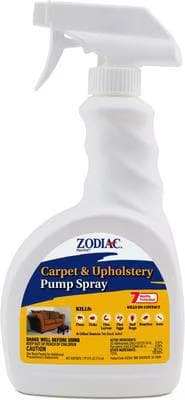
Zodiac’s pump spray targets carpet and upholstery and covers up to 300 square feet. Its seven-month claim concerns control of developing fleas, not seven months of instant adult-flea killing. It is a different delivery format from Zodiac’s aerosol and room fogger. A smaller pump bottle can be easier to aim at a limited eligible fabric area, but the label still controls which surfaces may be treated.
Furniture treatment deserves caution. Cushions can hold moisture, people and pets contact them for long periods, and dyes or finishes may react. Read the surface directions, test a hidden location when permitted, remove loose covers for laundry when possible, and keep the item unavailable until it meets the label's return conditions. Never treat a cat tree, dog bed, or human sleeping surface merely because it is fabric.
The registered Zodiac Fleatrol carpet and upholstery pump formula (EPA registration 2724-401) contains permethrin 0.28% and (S)-methoprene 0.01%, as listed in the California pesticide registration record. Methoprene interrupts developing fleas. The manufacturer’s back label requires keeping people and pets out until treated areas have dried. Match the registration and instructions on the bottle supplied; do not borrow directions from Zodiac’s aerosol, fogger or on-pet spray.

5. TropiClean Flea + Tick Laundry Additive: Best Washable-Fabric Adjunct
TropiClean Flea + Tick Laundry Additive is an optional washable-fabric adjunct. It is not one of the four surface sprays. Ordinary laundering and drying according to the textile’s care label remain useful without an additive.
Laundry is valuable because it physically removes flea debris and exposes suitable fabric to washing and drying. The additive should be used only as its own label directs, and it does not make a delicate item safe for hot water or high heat. Follow the textile care label too. Never pour a laundry product into a carpet machine, spray bottle, pet bath, or yard applicator.
Choose this option when a large share of the flea habitat is washable and the item instructions are compatible. It remains an adjunct. Floor edges, furniture frames, the pet, and other animals in the home still require their own appropriate parts of the plan.
6. Zodiac Room Fogger: An option with substantial setup restrictions
Zodiac Flea & Tick Room Fogger is the most specialized and highest-burden option in this group. A fogger releases product through a closed room, so correct room volume, placement, evacuation, ignition-source control, food and dish protection, aquarium precautions, ventilation, and re-entry are central to the decision.
Foggers are not automatically more thorough. Product may settle on exposed horizontal surfaces while failing to penetrate under clutter, into carpet backing, or behind furniture. Using too many foggers increases exposure and fire risk without fixing those gaps. Never estimate can count from memory or use a fogger in a smaller room than the label permits.
Choose a fogger only when its current label clearly fits the room and every evacuation step is practical. A licensed pest-control professional is the safer path when the structure is complex, someone cannot leave, an aquarium cannot be protected as required, or repeated consumer treatment has failed.
Webvet may earn a commission when you click through to Chewy, at no extra cost to you.
What each product type can and cannot treat
A spray can reduce adults and immature stages in labeled locations, but no can treats the animal, every protected pupa, and every room at once. The cat flea, Ctenocephalides felis, is the usual household flea on both dogs and cats in North America. Female fleas begin producing eggs soon after feeding, and those eggs drop into the places where a dog or cat rests. That is why premise treatment works best when every pet is on an effective veterinary plan at the same time.
Some registered household products use an insect growth regulator such as pyriproxyfen or methoprene to disrupt immature flea development. That feature is not permission to extend a product to an unlisted surface. Confirm the exact active ingredients, the EPA registration number, and the approved treatment sites on the package that arrives. A room spray, carpet spray, laundry additive, and fogger are not interchangeable, even when several labels mention the same pest.
Hot laundry and vacuuming are not optional busywork. Washing removes loose eggs and larvae from fabric, while a dryer adds heat when the textile permits. Vacuuming lifts debris, eggs, larvae, and some adults from accessible areas. It also creates vibration that can encourage pupae to emerge, allowing the new adults to encounter treated pets and labeled surfaces.
- A veterinarian-selected pet product stops adult fleas from feeding and reproducing on the host.
- A flea comb finds adult fleas and flea dirt and removes loose debris from the coat.
- Hot laundry handles washable bedding, blankets, and covers.
- Vacuuming reaches carpet pile, baseboards, furniture edges, and floor gaps.
- A labeled premise product treats only the listed surfaces and pests.
- A professional can access structural zones and plan treatment when the home is difficult to isolate.

 $65 · no membership
Need flea, tick, or heartworm prevention for your dog?
A licensed vet can recommend and prescribe the right preventive for your dog online when it's appropriate.
 Talk to a vet
- Licensed vets
- All 50 states
- same-day Rx

Webvet may earn a commission if you book.
How to use a home flea spray safely
Webvet may earn a commission when you click through to Chewy, at no extra cost to you.
Read the entire current label before opening the container. The FDA's guidance on flea and tick products emphasizes matching products to species, life stage, and weight when they are used on animals. The same discipline applies to premise products: match the product to its listed site and do not borrow directions from another container or an old online listing.
Before spraying, make a written setup list:
- Confirm the EPA registration information and product identity on the package.
- Read approved sites, prohibited surfaces, mixing directions, amount, ventilation, and re-entry.
- Remove every pet, person, bowl, toy, exposed food, and item the label names.
- Plan for aquariums, air pumps, bird cages, terrariums, and ventilation rather than improvising mid-application.
- Vacuum and clear clutter so treatment can reach the intended edges.
- Test a hidden fabric area if the label permits and the manufacturer recommends it.
- Apply only the stated amount, then leave the room for the full period.
- Ventilate and clean only as directed, and store the package in case a reaction occurs.
Document the application before anyone re-enters. Photograph the front label and EPA registration number, then write down the rooms, exact surfaces, start time, amount used, ventilation start, and earliest permitted return. This record prevents a second household member from treating the same area again and gives a veterinarian, poison-control service, or pest professional useful facts if an exposure or treatment failure is suspected.
Keep treated and untreated household zones separate. Close doors or use a clear gate notice so a child, pet sitter, or returning family member does not enter early. Do not carry a wet applicator across clean pet areas, and do not put bowls, toys, bedding, or removable covers back merely because the odor has faded. Odor is not a drying or re-entry test. The current label's stated conditions remain the decision point.
If a pet contacts wet treatment, licks residue, develops vomiting, drooling, wobbliness, tremors, breathing trouble, weakness, or unusual behavior, move the animal away from exposure and contact a veterinarian or animal poison-control service promptly. Keep the package available so the ingredient list and registration details can be shared. Do not induce vomiting or apply a home antidote unless a veterinary professional directs it.
Why spray alone does not clear a flea infestation
The adult fleas you see are only one stage. Eggs fall from the animal, larvae develop in protected debris, pupae sit inside resistant cocoons, and adults emerge when a host is nearby. A one-day spray may kill exposed insects while later-emerging adults restart the visible problem.
The Companion Animal Parasite Council flea guidance recommends year-round control for dogs and emphasizes a comprehensive program that treats pets, existing environmental infestation, and reinfestation risk. Follow your veterinarian's advice for each animal rather than selecting an on-pet product from a household spray list.
| Part of the plan | What it accomplishes | What happens if it is skipped |
|---|---|---|
| Treat every pet | Stops hosts from feeding the next adult generation | Untreated animals continue egg production |
| Comb and inspect | Confirms adult activity and removes live fleas or debris | You lose a simple way to track whether activity is changing |
| Wash and dry bedding | Removes and exposes fabric stages to cleaning and heat | Favorite resting zones keep reseeding floors and furniture |
| Vacuum target zones | Removes accessible stages and stimulates some pupae to emerge | Carpet edges and protected debris remain active reservoirs |
| Apply a labeled premise product | Adds control in approved non-washable locations | Exposed adults and larvae may survive in target zones |
| Repeat label-directed cleaning and treatment | Covers stages that emerge after the first treatment without inventing an interval | A late wave can look like product failure and restart reproduction |
For the complete sequence, use WebVet's guide to getting rid of fleas in the house and yard. Petful's room-by-room guide to getting rid of fleas in the house adds a practical cleaning and follow-up checklist that complements this product comparison. If you are trying to identify pale specks before treating, the visual guide to flea eggs on dogs explains eggs, dandruff, and flea dirt. Outdoor products belong in the separate flea and tick yard treatment guide, not in an indoor spray plan.

When a fogger or pest-control professional may be appropriate
A flea fogger for house use can be considered when its label fits a closed, measurable room and every resident can leave safely. It is not a shortcut for clutter, inaccessible voids, untreated pets, or repeat work. Follow the exact can-to-volume direction and never use additional cans to make the treatment stronger. A fogger also should not be treated as the best flea killer for home use merely because it fills a room. Poorly placed aerosol may miss protected harborages while leaving residue on exposed surfaces.
A professional flea treatment for house infestations becomes more useful when the problem spans inaccessible voids, multiple units, complex ventilation, or residents who cannot complete a consumer label's evacuation plan. The professional advantage is not a secret chemical. It is accurate pest identification, access to the actual harborages, selection of registered methods, controlled placement, and scheduled follow-up. Professional treatment may be appropriate before repeated consumer applications overlap or create an exposure problem.
Call a licensed pest-control professional when:
- Fleas remain after every pet has received correctly timed veterinary control and environmental work has been consistent.
- The infestation involves multiple units, crawl spaces, voids, or inaccessible areas.
- A resident cannot safely leave or has a health condition affected by aerosol exposure.
- Birds, fish, reptiles, or other sensitive animals make product choice complicated.
- Previous pesticide use may have overlapped, and you cannot reconstruct what was applied.
- The problem may not be fleas and accurate pest identification is needed.
A professional should explain the active ingredients, registration, treatment sites, pet-removal plan, ventilation, re-entry, and follow-up. Ask what preparation is essential and what is unnecessary. More chemical is not a substitute for correct identification and access.
Home flea spray questions
Frequently Asked Questions
What kills fleas in the house fast?
What kills fleas in the house fast is coordinated work, not one stronger can. Immediate control requires treating pets plus vacuuming, laundry, and a labeled premise product. Put every dog and cat on veterinarian-selected control, hot-wash and dry compatible bedding, vacuum resting zones and edges, and apply a registered household product only to its listed surfaces. A spray may kill exposed adults quickly, but protected pupae can release new fleas later. Follow every label-directed removal, ventilation, drying, and re-entry step while continuing the complete plan.
Pupae can emerge after quick adult knockdown, so a fast first-day result is not the endpoint.
Professional treatment may be appropriate when consumer products cannot reach the harborages, residents cannot complete evacuation and re-entry safely, or repeated label-directed work is not reducing flea activity.
What is the most effective flea treatment for the house?
The most effective flea treatment for the house matches the method to the surface and interrupts more than the adult stage. Use pet medication on pets, hot laundry on washable fabric, vacuuming along edges and resting zones, and a registered premise product only where its surface label permits. An insect growth regulator may add immature-stage control when the current product includes one. Effectiveness depends on stopping new eggs while clearing environmental stages over time, with pets kept away through all label-directed re-entry conditions.
A lawfully labeled product must match each permitted surface rather than being extended from carpet to furniture, bedding, or pet-contact areas by assumption.
What will 100% get rid of fleas?
Nothing can truthfully promise to 100% get rid of fleas in one application. No product guarantees complete eradication because protected pupae may survive early treatment and release adults later. The best chance of clearance comes from treating every animal, cleaning the environment, using labeled products correctly, and repeating label-directed cleaning and treatment for as long as the veterinary and product plan requires. If activity does not trend down, confirm identification and timing with a veterinarian or licensed pest-control professional instead of stacking pesticides.
No single spray offers a 100 percent guarantee because pupae can survive and emerge later.
Coordinated treatment must cover later-emerging adults without shortening a medication or pesticide interval.
What do exterminators use to spray for fleas?
What exterminators use to spray for fleas depends on the building, infestation, state requirements, and lawfully labeled product labels. Licensed pest-control professionals may select an adulticide, an insect growth regulator, targeted crack-and-crevice work, or another approved method. The exact product is less important than correct identification, placement, dose, access, pet precautions, and follow-up. Ask for the active ingredients, EPA registration information, treatment map, preparation steps, and re-entry plan before work begins. Never assume a professional application lets pets return before the stated conditions are met.
Registration, placement, pet re-entry, and follow-up matter more than copying a product name from another home.
What is the most effective home flea spray?
The best flea spray you can buy is the one you can use safely and correctly in your home. There is no absolute best flea killer for every household. There is no universal most effective home flea spray. The surface label determines fit: a broad home spray may suit targeted carpet edges, a carpet aerosol may suit listed floor coverings, an upholstery pump may suit approved furniture, and a fogger carries a much higher evacuation burden. The best spray depends on surface label, pets, ventilation, and lifecycle coverage, including whether an insect growth regulator is present. Choose only after confirming the material, resident vulnerabilities, preparation, drying, ventilation, and pet re-entry requirements.
Is my house dirty if I have fleas?
No. A house is not dirty simply because it has fleas. A flea infestation reflects host access and lifecycle biology, not a moral judgment about housekeeping. Fleas can arrive on pets, wildlife, people, or objects, and their life cycle can continue in a clean, heated home. Clutter and missed vacuuming may make harborages harder to reach, but blame does not clear them. Focus on every pet, favorite resting zones, washable bedding, labeled surface treatment, and consistent follow-up instead.
Clean heated homes can sustain the flea lifecycle when a host and protected environmental stages are present.
What is the strongest over the counter flea treatment?
For household flea control, the strongest over-the-counter product is not automatically the best treatment. Choose a spray labeled for the actual surface, with the appropriate adult-flea and immature-stage coverage. A higher concentration or stronger smell does not make off-label use effective or safe. Treat pets with their own species-appropriate products and continue cleaning; a household spray cannot substitute for an on-pet prevention plan.
Sources
$65 · no membershipNeed flea, tick, or heartworm prevention for your dog?
A licensed vet can recommend and prescribe the right preventive for your dog online when it's appropriate.
Talk to a vet- Licensed vets
- All 50 states
- same-day Rx
Webvet may earn a commission if you book.

Editor
The Webvet Editorial Team is the in-house group of pet-care editors and writers behind Webvet, operated by Smart Pet Collective. The team researches, writes, and maintains Webvet's pet health, behavior, and medication content. Every article follows a defined editorial process: research from reputable veterinary and scientific sources, careful drafting, mandatory review of medical content by a credentialed veterinarian, and dated publication. Health and medication articles are medically reviewed by a licensed veterinary professional before they go live and are kept current over time.
Veterinarian · BVMS MRCVS
Dr. Pippa Elliott, BVMS, MRCVS, is a veterinarian with nearly 30 years of experience in companion animal practice. Dr. Elliott earned her Bachelor of Veterinary Medicine and Surgery from the University of Glasgow. She was also designated a Member of the Royal College of Veterinary Surgeons. Married with 2 grown-up kids, Dr. Elliott has a naughty Puggle named Poggle, 3 cats and a bearded dragon.


