Dog Skin Tags: Pictures, and How to Tell Them From Warts and Tumors
Dog skin tags are soft, dangly, and almost always harmless, but they can mimic warts, ticks, and tumors. See labeled pictures by location, the comparison chart, and which changes mean a vet visit.

BVMS MRCVS
Medically reviewed by Dr. Pippa Elliott, BVMS MRCVS · Last reviewed

This article contains affiliate links. Webvet may earn a commission when you buy through them, at no extra cost to you.
Dog skin tags are small, soft, dangly growths that hang from the skin on a narrow stalk, and in most dogs they are completely harmless. Finding one while petting your dog can be alarming, though, because a skin tag can look a lot like a wart, an attached tick, or in the worst case a tumor. This guide shows you what skin tags look like at each common body location, walks you through a labeled skin tag vs. wart vs. tumor comparison, and explains which changes in a tag mean it is time for a vet visit.
One rule sits above everything else in this article: never remove a skin tag at home. Tying it off with a band, snipping it with clippers, or using a freezing kit risks pain, bleeding, and infection, and it destroys tissue a veterinarian might have needed to test. Removal, when it matters at all, is a vet decision.
 Sponsored
Want a vet's take on your dog's skin or coat?
Talk to a licensed vet at Dutch over video, often the same day. They can recommend treatment and prescribe it when it's appropriate.
Use code Pets30
Plans start at $11/month · covers up to 5 pets
- Licensed vets in most states
- Rx for 150+ conditions
- 4.7 on Trustpilot
What Are Skin Tags on Dogs? (And Which Dogs Get Them)
- 1Skin tags are almost always harmless fibrovascular growths, and a vet check is the only way to confirm one, because looks alone cannot rule out a tumor.
- 2A tag that turns black, bleeds, or grows fast needs a vet visit.
- 3Never band, clip, or freeze a skin tag at home. Removal is a veterinary procedure.
A skin tag, known medically as a fibrovascular papilloma, is a benign overgrowth of collagen and small blood vessels covered by normal skin. Unlike a tumor, it is not an uncontrolled mass of abnormal cells. It is closer to a small flap of extra skin. Tags usually feel soft and floppy, stay flesh colored, and hang from a narrow stalk that lets them wiggle when touched. According to the Merck Veterinary Manual, benign skin growths like these are extremely common in dogs, especially as they age.

Sponsored Lemonade pet insurance link. Webvet may earn a commission.
Nobody knows exactly why individual dogs grow skin tags, but several patterns are consistent:
- Age. Middle-aged and senior dogs grow far more tags than young dogs.
- Friction. Tags cluster at rub points such as the armpits, chest, belly, and elbows, and around collar and harness contact areas.
- Breed. Larger breeds and short-coated breeds are overrepresented. Boxers, Labrador Retrievers, Bulldogs, Great Danes, and Cocker Spaniels are frequently mentioned by veterinary dermatologists as tag-prone breeds.
- Genetics. Some dogs simply grow dozens of tags over a lifetime while a housemate never grows one.
What breed of dog is prone to skin tags? Any breed can develop them, but large and giant breeds such as Boxers, Labradors, Great Danes, and Bulldogs, along with Cocker Spaniels, seem predisposed, and short-coated dogs make tags easier to spot. Age matters more than breed: most tags show up in dogs past middle age, often at friction sites like the chest, armpits, and belly. If your dog grows one tag, expect more over the years. That is normal, and each new growth still deserves a quick vet confirmation at the next visit.
What Do Dog Skin Tags Look Like? Pictures and Appearance
The classic dog skin tag is a soft, skin-colored stalk of tissue a few millimeters long that dangles and moves freely when you touch it. But tags vary more than most owners expect, which is why so many searches are for specific looks: large skin tags, long skinny tags, white, pink, or red tags, and hard tags.
Here is the normal range of appearance:
- Size. Most tags are 1 to 5 millimeters, but old tags can slowly reach a centimeter or more. A large skin tag that took years to get there is usually still benign.
- Shape. Long and skinny, teardrop, or flattened flaps. The defining feature is the narrow stalk connecting the growth to the skin.
- Color. Flesh colored, pink, or slightly darker than surrounding skin. A white or pale tag is common on light-skinned dogs. A red, angry-looking tag usually means irritation from licking or rubbing.
- Texture. Soft and pliable. A tag that feels hard or firm breaks the pattern and deserves a vet look, because firmness is a tumor feature, not a tag feature.
Multiple tags are common, and dogs that grow one often grow several over time. What should stay consistent is the behavior: true skin tags grow very slowly or not at all, do not bother the dog, and look the same month after month. Any growth that breaks those rules gets evaluated. Photograph each tag with a coin or ruler for scale when you first find it. That baseline photo makes every future judgment call easier for you and your veterinarian.

A collar-mounted sensor and app for activity, rest, sleep, respiratory rate, heart-rate trends, itch behaviors, and more.
- Builds a personalized baseline over time
- Tracks trends between veterinary visits
- Generates a month-long shareable report
Health monitoring for dogs and cats
Webvet may earn a commission when you click through to Maven Pet, at no extra cost to you.
Skin Tags by Location: Eyelid, Face, Belly, and Legs
Location changes both what a skin tag looks like and whether removal is ever justified, and it is the first thing owners want to check against dog skin tags pictures. So here is that identification set organized by body location: a labeled photograph of a skin tag on the eyelid margin, the face, the belly, and the legs, one for each of the four places tags show up most.

The eyelid margin photo above is the highest-stakes match; the face, belly, and leg photographs follow.

Belly and chest tags are the friction classics on older dogs.

And legs, elbows, and paws round out the set.

Eyelid and Eye Area
The eyelid margin is the one location where an otherwise harmless skin tag most often earns removal. A tag on the eyelid or eye rim can rub the cornea with every blink, causing squinting, tearing, and eventually a painful corneal ulcer. Eyelid growths in dogs are also frequently meibomian gland tumors rather than true skin tags, and only a vet exam can tell them apart. If your dog has a growth on the eyelid margin, book a vet visit rather than watching and waiting, and mention any squinting or discharge. Readers checking a dog's eye area closely may also find our guide to dog eye ulcer pictures useful for the rubbing damage an eyelid growth can cause.
Face, Muzzle, and Lips
Facial tags show up on the cheeks, muzzle, and lip margins. On the face the main look-alike is a viral wart, especially in young dogs, because papilloma warts favor the mouth and lips. A smooth dangling stalk points to a tag; a rough cauliflower surface points to a wart. Face and lip tags rarely need removal unless the dog catches them while chewing or scratching, but growths inside the mouth or on the lip margin should always be checked, since the mouth is a common site for more serious growths.
Belly, Chest, and Armpits
The belly, chest, and armpits are classic friction territory, and this is where older dogs accumulate the most tags. Tags here are usually the textbook soft dangly type and almost never need removal. The practical problems are mechanical: harness straps can rub belly and chest tags raw, and grooming clippers can nick them and cause dramatic-looking bleeding. Note where each belly tag sits and tell your groomer, and consider harness padding if a strap crosses a tag directly.
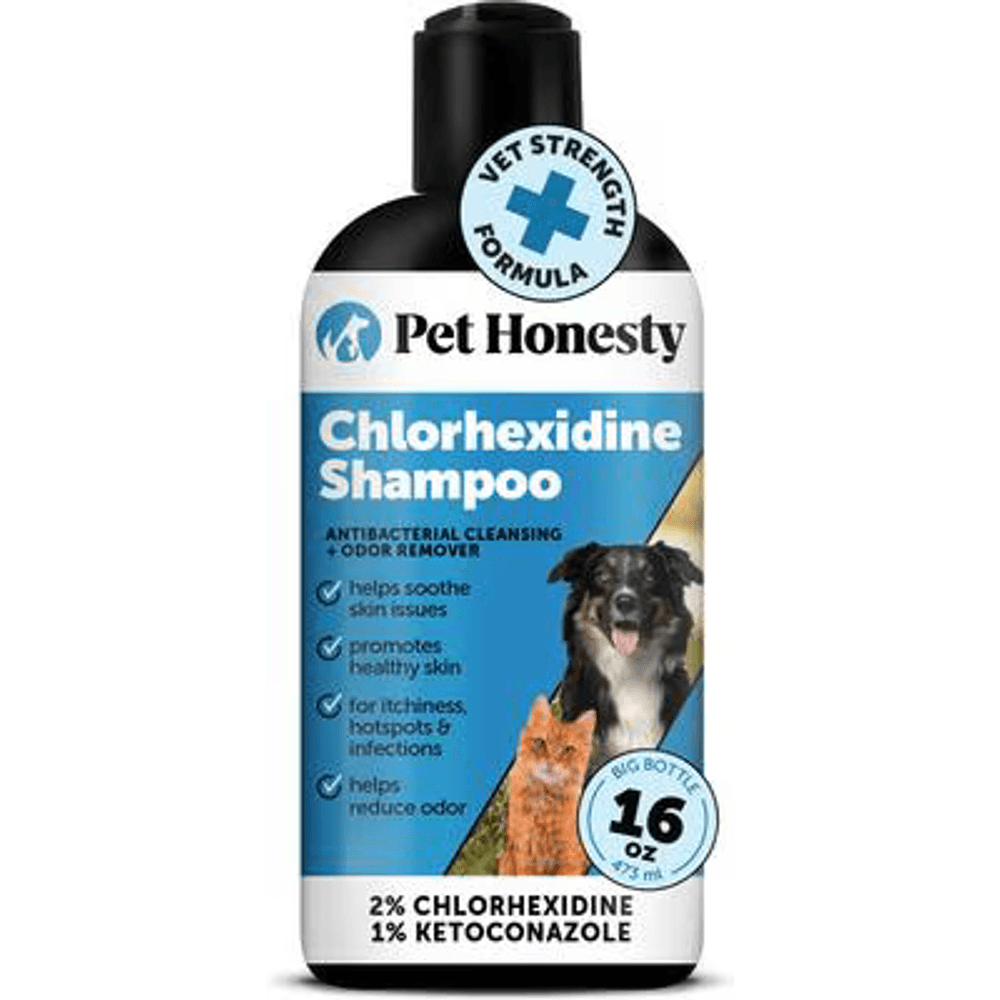
A vet-strength medicated shampoo with 2% chlorhexidine and 1% ketoconazole, the antifungal and antibacterial combination vets use to help clear ringworm and skin infections and to cut fungal spore shedding during treatment.
Webvet may earn a commission when you click through to Chewy, at no extra cost to you.
Legs, Elbows, and Paws
Leg and elbow tags form over pressure points, especially in heavy dogs that lie on hard floors. Paw tags are less common and are more often confused with other growths, since interdigital cysts, viral warts, and even tumors also favor the feet. A growth between the toes or on a paw pad deserves a vet exam rather than a skin-tag assumption, particularly if the dog licks it or limps. Tags higher on the leg follow the usual rules: soft, slow, and dangling means monitor; firm, fast, or fixed means examine. Padding hard resting spots with an orthopedic bed reduces the friction that seeds both calluses and tags.
 Sponsored
Vet care that's always there
Unlimited video calls and messaging with licensed vets for less than a typical vet visit. One membership covers up to five pets.
Use code Pets30
Plans start at $11/month · covers up to 5 pets
- Licensed vets in most states
- Rx for 150+ conditions
- 4.7 on Trustpilot
Skin Tag vs. Wart vs. Tumor vs. Tick: Telling Them Apart
This is the decision most owners actually need to make, and it is easier with the growths side by side. The labeled comparison below shows a skin tag with its narrow stalk, a wart with its cauliflower texture, and a tumor presenting as a firm raised mass.

Descriptions alone force you to hold three pictures in your head at once, which is why this section pairs labeled skin tag, wart, and tumor photos with one comparison table. The labeled photo comparison above and the table below put a skin tag, a wart, and a tumor side by side with the distinguishing features under each: a skin tag hangs from a narrow stalk, a wart shows a cauliflower texture, and a tumor sits as a firm raised mass.
| Feature | Skin tag | Wart (papilloma) | Tumor | Attached tick |
|---|---|---|---|---|
| Attachment | Narrow stalk, dangles | Broad base, sits on skin | Broad base, may feel fixed in or under skin | Mouthparts embedded in skin |
| Surface | Smooth, normal skin | Rough, cauliflower texture | Variable, may ulcerate | Smooth, shiny body |
| Feel | Soft, floppy | Firm but rubbery | Often firm or hard | Firm, swells as it feeds |
| Change over time | Grows very slowly or not at all | Can multiply, often regresses in young dogs | May grow steadily or quickly | Grows over days, then drops off |
| Legs visible | No | No | No | Yes, look for legs at skin level |
| Typical dog | Middle-aged and senior | Young or immunosuppressed | Any age, risk rises with age | Any dog after outdoor exposure |
The tick confusion deserves special attention because roughly the same number of owners search for it as for warts. A feeding tick looks shockingly like a new gray or brown skin tag. The test is simple: look at the base with good light or a phone photo zoomed in. A tick has eight tiny legs where it meets the skin and its body sits against the skin rather than hanging from a stalk, and it appeared suddenly where nothing existed last week. If you are still unsure, compare against our photo guide to what tick bites look like on dogs before you pull anything. Yanking a skin tag you mistook for a tick is painful and causes real bleeding.
Warts have their own deep dive too. If your dog's growth has that rough cauliflower texture, especially around the mouth of a young dog, read our full guide to dog warts (papillomas) for the virus, contagion, and immune timeline.
Black or Changing Skin Tags: Warning Signs
A stable skin tag is boring, and boring is good. The tags that matter are the ones that change. When should you worry about a skin tag on a dog? Worry when an existing tag changes character: it turns black or darkens quickly, it becomes a bleeding tag without an obvious injury, it starts growing fast after months of staying the same, it becomes firm, or the skin around it gets red, swollen, or sore. Any one of those changes means a vet visit, not because most changed tags are cancer, but because change is exactly how a malignant growth announces itself, and only testing can tell the difference.

An owner asking when to worry about a skin tag on a dog should not have to reassemble the answer from scattered paragraphs. Here it is as one scannable checklist: a tag turning black, a bleeding tag, or one growing fast leads the list, and any single item is a vet visit trigger, not a wait-and-see note:
- Turning black or darkening noticeably over days to weeks
- Bleeding tag with no grooming or scratching injury to explain it
- Growing fast, meaning visible size change within a few weeks
- Becoming firm or hard when it used to be soft
- Red, swollen, or painful skin at the base of the tag
- Discharge or odor from the tag or surrounding skin
- Your dog suddenly licking or chewing at a tag they always ignored

Third-party-tested omega-3 softgels (EPA and DHA) that support skin, coat, and joint health in dogs. Fish oil is one of the first things many vets suggest for a dull, dry, or flaky coat.
Webvet may earn a commission when you click through to Chewy, at no extra cost to you.
One nuance keeps owners up at night: some skin tags darken slowly and harmlessly with age, the way skin moles do in people. A gradually pigmented tag that stays soft, small, and comfortable is usually fine to raise at the next routine visit. A rapidly blackening tag is different, because melanoma and mast cell tumors can both masquerade as small dark skin growths. Speed of change is the signal. When in doubt, a same-week vet appointment settles it cheaply, often with a simple fine needle aspiration.
Is It Something More Serious? When to Suspect a Tumor
Every rule in this article reduces to one honest limitation: nobody, including your veterinarian, can certify a growth as benign by looking at it. Mast cell tumors are notorious shape-shifters that can present as small, innocent, tag-like skin bumps, which is why our mast cell tumors in dogs guide exists. If your dog's growth is firm, broad-based, fast-growing, or just does not match the skin tag pattern on this page, start with our lump on dog triage guide, which walks through all eight common lump types and how vets tell them apart with fine needle aspiration and biopsy. Growths that appear alongside other skin problems, like the raw sores covered in our hot spots on dogs guide or the scratching covered in why your dog is so itchy, also deserve a vet exam rather than home diagnosis.
When Does a Skin Tag Need Removal? (And What It Costs)
When removal matters, how vets remove skin tags, and the typical cost all come down to the same short answer. How do you get rid of skin tags on dogs, or how to remove a skin tag on a dog safely? You have a veterinarian do it, and only when there is a reason. Vets remove skin tags surgically, usually with a scalpel, electrocautery, or cryosurgery, under local anesthetic for small accessible tags or brief general anesthesia for eyelid tags, mouth tags, or wriggly patients. The removed tissue can then go to pathology, which is the hidden benefit of professional removal: you find out for certain what the growth was. Most skin tags never need removal at all, and vets generally recommend leaving stable, comfortable tags alone.
Removal is justified when:
- The tag sits on the eyelid margin and rubs the eye
- The tag gets repeatedly caught by grooming clippers, collars, harnesses, or scratching
- The tag is in a spot the dog licks or chews constantly
- The tag has changed, is a repeatedly bleeding skin tag, looks like a blood filled skin tag, or has become an infected skin tag, and the vet wants it off and tested
- Your dog is already under anesthesia for a dental or another procedure, making removal nearly free to add
Cost depends mostly on anesthesia. A small tag removed with local anesthetic during a regular appointment often runs $100 to $300 including the visit. Removal under general anesthesia typically runs $300 to $800, and adding pathology (histopathology) usually adds $100 to $250. Bundling a tag removal into an already scheduled dental is the classic money-saver, so mention bothersome tags when booking any anesthetic procedure. For context on exam pricing, see our guide to how much a vet visit costs.
Never Remove a Skin Tag at Home
The banding trick circulates endlessly online because it sometimes appears to work: the tag loses blood supply, dies, and falls off. What the posts leave out is that dogs feel every hour of that process, that the dying tissue is an open door for bacteria, and that the entire approach assumes the growth was a harmless tag. That assumption is the whole problem. A mast cell tumor treated with a rubber band does not go away. It stays in the skin, untested and untreated, while the visible portion sloughs off and the owner relaxes. Human over-the-counter wart and tag products are equally bad bets, since they are formulated for human skin and routinely burn dog skin around the target. There is no safe home version of this procedure.
How to Monitor Your Dog's Skin Tags
Can a dog's skin tag fall off on its own? Occasionally, yes. A tag with a very thin stalk can twist, lose its blood supply, and drop off, or get scraped off by scratching and grooming. That is not dangerous by itself, but the spot may bleed briefly and should be kept clean while it heals, and a tag that falls off and then regrows as something firmer or faster-growing needs a vet exam. Do not take spontaneous fall-off as an invitation to help the others along. Monitoring, not removal, is the owner's job.
A simple monthly routine keeps you ahead of every tag:
- Map them. During a calm petting session, run your hands over the whole dog and note each tag's location.
- Photograph with scale. Take a phone photo of each tag next to a coin. Date the photos or keep them in one album.
- Compare monthly. Check each tag against its baseline photo for size, color, and texture changes.
- Log new growths. Add any new lump to the map and photo album, and show the list at every vet visit.
- Protect known tags. Tell your groomer where tags are, and check harness and collar contact points for rubbing. Keep styptic powder in the grooming kit too: a nicked tag bleeds impressively for its size, and styptic stops it while you call the vet.
This five-minute habit is exactly what your vet wishes every owner did, and it turns the scary question of "is this new?" into a photo comparison with a date on it.
Dog Skin Tag FAQs
Frequently Asked Questions
Can I remove my dog's skin tag at home with a band or nail clippers?
No. Never band or clip a skin tag at home. Banding slowly strangles living tissue, which causes hours to days of pain, and cutting causes immediate pain, bleeding, and infection risk. Worse, home removal destroys the tissue a vet would test, so if the growth was actually a tumor you have hidden the evidence while leaving cancer cells behind. Veterinary removal is quick and inexpensive.
My dog's skin tag is bleeding or got torn. What should I do?
Apply gentle pressure with clean gauze for five minutes. Torn tags bleed impressively because of their blood vessels, but most stop with steady pressure. Once bleeding stops, keep the area clean and stop your dog from licking it. See a vet the same day if bleeding continues past ten minutes, keeps restarting, or the area looks swollen, and book a routine visit either way so the tag can be checked.

Editor
The Webvet Editorial Team is the in-house group of pet-care editors and writers behind Webvet, operated by Smart Pet Collective. The team researches, writes, and maintains Webvet's pet health, behavior, and medication content. Every article follows a defined editorial process: research from reputable veterinary and scientific sources, careful drafting, mandatory review of medical content by a credentialed veterinarian, and dated publication. Health and medication articles are medically reviewed by a licensed veterinary professional before they go live and are kept current over time.
Veterinarian · BVMS MRCVS
Dr. Pippa Elliott, BVMS, MRCVS, is a veterinarian with nearly 30 years of experience in companion animal practice. Dr. Elliott earned her Bachelor of Veterinary Medicine and Surgery from the University of Glasgow. She was also designated a Member of the Royal College of Veterinary Surgeons. Married with 2 grown-up kids, Dr. Elliott has a naughty Puggle named Poggle, 3 cats and a bearded dragon.


