Cat Breathing Fast: Normal, Serious, and Emergency Causes
A cat breathing fast can be a harmless reaction to heat or play, or an early sign of heart failure, asthma, or fluid around the lungs. Learn how to count the rate, tell normal from dangerous, and know exactly when it is an emergency.

BVMS MRCVS
Medically reviewed by Dr. Pippa Elliott, BVMS MRCVS · Last reviewed

This article contains affiliate links. Webvet may earn a commission when you buy through them, at no extra cost to you.
A cat breathing fast is sometimes harmless and sometimes a medical emergency, and the difference comes down to what your cat is doing at the time. A cat that just played hard, got too warm, or is frightened may breathe quickly for a few minutes and then settle. A cat breathing fast while resting or sleeping is not normal and needs a vet, because in cats rapid resting breathing is an early warning sign of heart failure, fluid around the lungs, or asthma.
Cats are also very good at hiding illness, so a faster resting breathing rate is often the first clue that something is wrong, well before a cat looks obviously sick. This guide explains what normal looks like, how to count the rate yourself, the benign and serious causes with their companion signs, what your vet will actually do, and the exact signs that mean you should not wait until morning.
- 1Normal resting breathing for a cat is about 15 to 30 breaths per minute. A consistent sleeping or resting rate over 30 is an early red flag, and over 40 warrants a same-day vet visit.
- 2Fast breathing after play, in heat, or during stress that settles within 10 to 15 minutes of rest is usually benign.
- 3Open-mouth breathing, panting, or belly (abdominal) breathing in a cat is a high-acuity emergency, far more urgent than in a dog.
- 4Cats are obligate nasal breathers and rarely pant, so mouth-breathing almost always means the cat is struggling to get enough oxygen.
- 5Blue, gray, or pale gums plus fast breathing means go to an emergency vet immediately.
What counts as fast breathing in a cat?
Fast breathing in a cat means a resting or sleeping respiratory rate consistently above roughly 30 breaths per minute. A healthy cat at rest takes slow, smooth, almost invisible breaths, usually 15 to 30 breaths per minute. Cornell University's Feline Health Center lists a normal range near this band, and notes that a rising resting rate is one of the earliest measurable signs of heart trouble.
The medical term for abnormally fast breathing is tachypnea. It is different from labored breathing (dyspnea), where the cat works hard to move air. A cat can have one, the other, or both at once, and the combination tells your vet a lot. You can learn the resting baseline for your own cat using the simple count below, and the Cornell Feline Health Center recommends tracking that resting rate over time so you notice a change early.
The reason rate matters so much in cats comes down to anatomy. Cats are obligate nasal breathers, meaning they are built to move air through the nose, not the mouth. A dog will happily pant to cool down or recover from a run, but a healthy cat almost never does. So a fast rate that holds at rest, or any shift toward open-mouth breathing, is a much louder alarm in a cat than the same change would be in a dog.
| Breathing state | Breaths per minute | What it usually means |
|---|---|---|
| Asleep or deeply resting | 15 to 30 | Normal |
| Resting, consistently 30 to 40 | 30 to 40 | Early warning, call your vet |
| Resting, over 40 | 40+ | Same-day vet visit needed |
| Just after play or in heat | up to 40, brief | Likely benign if it settles in 10 to 15 minutes |
| Open-mouth, panting, or belly breathing at rest | any rate | Emergency, go now |
How to count your cat's breathing rate
Counting your cat's resting respiratory rate takes 30 seconds and is the single most useful thing you can do at home. Wait until your cat is asleep or lying still and calm, never just after play, purring, or grooming, and watch the chest or belly move.
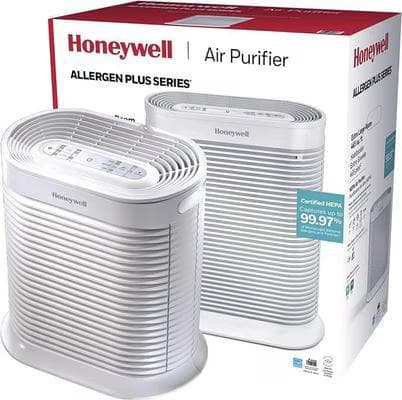
Certified True HEPA air purifier that captures 99.97% of airborne dust, dander, pollen, and smoke, reducing the airborne triggers behind feline asthma and respiratory irritation.
Webvet may earn a commission when you click through to Chewy, at no extra cost to you.
- Watch the chest and belly. One full rise and fall counts as a single breath.
- Count the breaths for 30 seconds using a phone timer.
- Multiply by two to get breaths per minute.
- Repeat on a few calm days to learn your cat's normal resting number.
Two cautions make the count reliable. First, count true sleep or quiet rest, not light dozing, because a dreaming cat can twitch and breathe irregularly for a few seconds. Second, do not count while your cat is purring. Purring moves the chest and inflates the number, so wait for a silent, settled moment. If you cannot see the chest move clearly, rest a hand lightly on the side and feel each breath instead.
A sleeping rate that creeps up over days, or any reading consistently above 40, is worth a call. The trend matters more than a single number, so a baseline of 22 climbing to 34 over a week is meaningful even though 34 alone might not sound alarming. For the full method and what a healthy baseline looks like, see our guide to the normal cat breathing rate. Knowing your cat's resting number means you can tell a real change from a one-off.

Benign causes: when fast breathing is usually okay
Fast breathing is usually harmless when there is a clear trigger and your cat returns to a normal rate within about 10 to 15 minutes of resting. In these cases the body is simply moving more air for a short, understandable reason, and the gums stay a healthy pink the whole time.
Heat
Cats cannot cool themselves the way we do, since they only sweat a little through their paw pads. On a hot day a cat may briefly breathe faster to shed heat. Learn how feline cooling works in our explainer on whether cats sweat. The key companion sign here is the setting: a warm room or car. If the fast breathing or any panting does not stop within minutes in a cool room, treat it as an emergency, because heatstroke is life-threatening and is covered in the serious section below.
Play and exertion
A hard play session or a sprint up the stairs raises the breathing rate the same way exercise does in people. A fit cat recovers within minutes, the rate drops smoothly, and the cat goes back to grooming or napping. If your cat gets winded easily from gentle cat exercises, or has to stop and rest mid-play, that low exercise tolerance can itself signal heart or lung disease and is worth mentioning to your vet.
Stress and anxiety
A car ride, a vet visit, a new pet, or a thunderstorm can spike the breathing rate. Stress breathing usually comes with other tense body cues like flattened ears, a tucked posture, dilated pupils, or a swishing tail. Reading your cat's body language helps you separate fear from a medical problem. Stress breathing should ease once the trigger is gone. The catch is that a sick cat is also a stressed cat, so if you cannot pin the fast breathing to a clear scare, do not assume it is only nerves.
 $65 · no membership
Have a health question about your cat?
A licensed vet can assess your cat over video and prescribe online when it's appropriate.
 Talk to a vet
- Licensed vets
- All 50 states
- same-day Rx
Webvet may earn a commission if you book.
When a cat breathing fast means disease
Fast breathing means disease when there is no obvious trigger, when it happens at rest or during sleep, or when it does not settle. Because cats hide illness so well, these conditions are often silent until breathing changes. Each one below has its own companion signs, and learning them helps you describe what you are seeing when you call the clinic.
Heart failure and HCM
Heart disease, especially hypertrophic cardiomyopathy (HCM), is the leading reason cats develop a fast resting rate. In HCM the heart muscle thickens, the heart cannot relax and fill properly, and fluid backs up into or around the lungs, so breathing speeds up. The Merck Veterinary Manual notes that many cats show no signs until they are in crisis, which is why a rising sleeping respiratory rate is such a valuable early warning.
Companion signs to watch for include a fast sleeping rate, low energy or hiding, reduced appetite, and sometimes a sudden cry with dragging or cold hind legs, which signals a blood clot lodging in the back legs and is a stark emergency. Many affected cats never cough, unlike dogs in heart failure, so do not wait for a cough to take the breathing seriously.
Pleural effusion (fluid around the lungs)
When fluid collects in the chest cavity, the lungs cannot fully expand, so the cat breathes fast and shallow and often shifts to belly breathing. This is a true emergency. Companion signs include a reluctance to lie down flat, sitting upright with the elbows held out, and quiet but rapid effort. The fluid can come from heart failure, infection (pyothorax), cancer such as lymphoma, or chest trauma, and it must be drained by a vet before the cause can be treated.
Feline asthma
Asthma causes the lower airways to narrow and become inflamed, leading to fast breathing, wheezing, and a hunched, open-mouth cough that owners often mistake for trying to bring up a hairball. The giveaway is the posture: the cat crouches low with the neck and head extended forward and the elbows out, then coughs in dry, repeated bouts. A severe asthma attack can tip into a breathing emergency within minutes and needs immediate care, oxygen, and fast-acting airway medication.
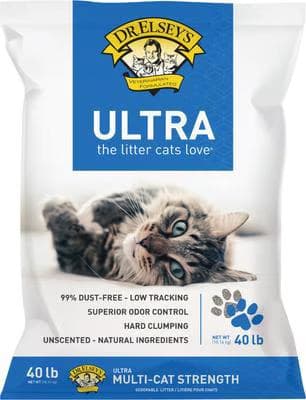
99% dust-free, low-tracking clumping clay litter with superior odor control and hard clumping. Unscented, natural ingredients, multi-cat strength.
Webvet may earn a commission when you click through to Chewy, at no extra cost to you.
Anemia
Anemia means too few red blood cells to carry oxygen, so the cat breathes faster to compensate for thinner blood. Pale, white, or yellow-tinged gums are the classic companion sign, along with weakness and a faster heartbeat. Causes include blood loss, chronic kidney disease, immune disease, and heavy parasite infections such as fleas in a small cat or kitten, where the blood loss adds up fast.
Pain and fever
Pain and a high fever both push the breathing rate up. Cats mask pain instinctively, so fast breathing may be one of the only outward clues that something hurts. Our guide on how to tell if a cat is in pain covers the subtle posture and facial signs to watch for, such as a hunched body, squinted eyes, and a tucked-away cat that no longer wants to be touched. Fever often rides alongside, leaving the cat warm to the touch, off its food, and lethargic.
Hyperthyroidism
An overactive thyroid revs the whole body, raising the heart and breathing rates. It is common in middle-aged and senior cats. The hallmark companion signs are weight loss despite a big appetite, restlessness, increased thirst, and sometimes a poor, unkempt coat. Untreated, the strain can also damage the heart, so a fast-breathing senior cat that is eating well yet losing weight should be tested.
Heatstroke
When a cat overheats beyond what brief fast breathing can cool, heatstroke sets in. This is the dangerous end of the heat trigger above. Companion signs include heavy open-mouth panting, drooling, bright red gums, restlessness then collapse, and vomiting. Move the cat to a cool place, offer water, and head straight to a vet, because heatstroke damages organs and can be fatal even after the cat appears to cool down.
After anesthesia or sedation
A cat coming home from a dental or surgery may breathe a little faster for a few hours as it clears the drugs, fluids, and pain. Mild, steadily improving fast breathing with pink gums is usually expected recovery. But fast breathing that worsens, comes with pale or bluish gums, or appears alongside heavy effort is not normal post-anesthesia and means you should call the clinic that performed the procedure right away.
| Sign you notice | Likely cause | Urgency |
|---|---|---|
| Fast breathing after play, settles fast | Normal exertion | Monitor |
| Fast breathing at rest, otherwise acting fine | Heart disease, early illness | Vet within 24 hours |
| Fast shallow breathing plus belly effort | Pleural effusion, heart failure | Emergency now |
| Open-mouth breathing or panting | Severe distress, low oxygen | Emergency now |
| Wheezing, hunched cough | Feline asthma | Same day, sooner if severe |
| Weight loss with big appetite, fast breathing | Hyperthyroidism | Vet within days |
| Pale or white gums | Anemia | Emergency now |
| Blue or gray gums | Critically low oxygen | Emergency now |


Which cats are most at risk?
Any cat can develop fast breathing, but a few groups deserve extra vigilance. Knowing your cat sits in a higher-risk group is a good reason to learn the resting rate now, while your cat is healthy, so you have a baseline to compare against later.
- Senior cats face higher rates of heart disease, hyperthyroidism, kidney disease, and cancer, any of which can raise the breathing rate before other signs appear.
- At-risk breeds such as Maine Coons, Ragdolls, and Persians carry a higher inherited risk of hypertrophic cardiomyopathy, the top cause of feline heart failure.
- Overweight and flat-faced cats tire and overheat more easily, and brachycephalic faces add airway resistance that makes any breathing problem worse.
- Cats with a known diagnosis of asthma, a heart murmur, or past heart disease should have their sleeping rate logged regularly, because a climbing number is often the first sign of a flare.
A heart murmur heard at a routine checkup does not always mean disease, but in a cat it earns closer watching, since feline murmurs and silent HCM do not always line up. If your vet has ever mentioned a murmur, ask whether home rate monitoring makes sense for your cat.
Cat breathing heavy: how it differs from fast breathing
A cat breathing heavy means each breath looks like hard work, while fast breathing means many breaths per minute. The two often appear together, but heavy or labored breathing is the more alarming of the two. A cat that has to use its whole body, extend its neck, or open its mouth to breathe is showing dyspnea and needs urgent care regardless of the exact rate.
Watch for visible effort: heaving sides, a rocking belly, flared nostrils, or noisy breathing. Quiet, smooth, fast breathing is concerning, but loud, strained, heavy breathing is an emergency. It also helps to note where the effort comes from. Effort centered in the belly often points to fluid or air around the lungs, while a wheezing, whistling sound on the out-breath leans toward asthma. Different breathing patterns point to different problems, which is why the cluster of guides below breaks each one down so you can match what you see to the most likely cause.
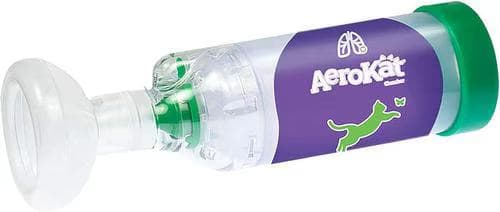
The vet-standard aerosol chamber (spacer) for giving asthma inhaler medication to cats, making daily inhaled treatment far easier and more effective.
Webvet may earn a commission when you click through to Chewy, at no extra cost to you.
Match your cat's breathing pattern to the right guide
The specific way your cat is breathing narrows down the likely cause. Use the deeper guides below for the exact pattern you are seeing, then bring what you observe to your vet.
- Cat open-mouth breathing: why mouth-breathing is a feline emergency.
- Cat labored breathing: when each breath is visibly hard work.
- Cat belly breathing: what abdominal effort signals about the lungs.
- Cat shallow breathing: small, quick breaths and what causes them.

What the vet will do
The vet's first job is to stabilize breathing, usually by placing your cat in an oxygen cage and minimizing handling. Only once your cat is stable will the team run tests. Pushing a struggling cat through diagnostics too soon can be dangerous, so expect oxygen and a quiet rest period first, before anyone reaches for X-rays.
- Oxygen therapy in a cage or by flow-by mask to relieve distress right away.
- Chest X-rays or ultrasound to look for fluid, an enlarged heart, or lung disease. A quick cage-side ultrasound can spot chest fluid without stressing the cat.
- Tapping the chest (thoracocentesis) to drain fluid if pleural effusion is present. This both relieves the breathing fast and provides a fluid sample to test.
- Blood work and an NT-proBNP test to check for anemia, infection, and thyroid disease, and to flag heart strain. NT-proBNP is a blood marker that rises when the heart muscle is stretched, helping separate a heart cause from a lung cause.
Treatment then targets the cause, whether that is heart medication and a diuretic to clear fluid, an asthma inhaler or steroids, draining the chest, treating an infection, or regulating the thyroid. Many cats with a treated underlying condition go on to live comfortably for a long time, especially when the problem is caught early from a rising resting rate rather than at the point of crisis.
Cost and prognosis vary with the cause, so ask your vet to walk you through what each test and treatment is for and what the realistic outlook is. The single biggest factor in a good outcome is timing: a cat brought in at the first sign of a fast resting rate has far more options than one that arrives already in open-mouth distress. That is why the home count is worth the habit. It buys time, and with breathing problems, time is everything.

Soft-sided travel safety carrier that keeps a stressed cat secure and well-ventilated on the way to the vet, with mesh panels for airflow and a seat-belt loop.
Webvet may earn a commission when you click through to Chewy, at no extra cost to you.
Frequently Asked Questions
Should I be worried if my cat is breathing fast?
Be worried if your cat is breathing fast while resting or asleep, if there is no obvious trigger like heat or play, or if the fast breathing does not settle within 10 to 15 minutes. Fast breathing right after exertion that quickly returns to normal is usually fine. A consistent resting rate over 30 breaths per minute, and certainly over 40, warrants a vet visit because it can be an early sign of heart or lung disease. Pair the rate with a gum check: pink gums are reassuring, while pale, white, or bluish gums alongside fast breathing mean go to an emergency vet right away.
What does rapid breathing in a cat look like?
Rapid breathing in a cat looks like quick, shallow breaths where the sides and belly move fast but only slightly, as if the cat cannot get a full, satisfying breath. The chest rises and falls more than 30 to 40 times a minute. In more serious cases the cat extends its neck, breathes with its mouth open, or pushes hard with its abdominal muscles so the belly visibly heaves with each breath. A cat in trouble may also sit upright with its elbows held away from the body and refuse to lie down flat. Any of these added signs turns a worrying picture into an emergency.
How can I calm down a cat that is breathing fast?
If the fast breathing is clearly from stress or heat, move your cat to a quiet, cool, dim room, remove the trigger, and let it settle without handling or fussing. Lower the lights, reduce noise, and give the cat space rather than picking it up, since restraint can make a frightened cat breathe harder. Do not try to medicate or treat fast breathing at home, and never give human medicines. There is no safe home remedy for a cat that is genuinely struggling to breathe. If the rate does not drop within about 15 minutes of calm rest, or you see any open-mouth or belly breathing or a color change in the gums, go to the vet right away.
What are the signs that a cat is about to pass away?
Common end-of-life signs in cats include loss of appetite, marked weakness or constant hiding, abnormal or labored breathing, a drop in body temperature with cold paws and ears, incontinence, and withdrawal from family and favorite spots. Abnormal breathing, including open-mouth or heavily labored breathing, is one of the most distressing of these and is itself a sign that a cat is suffering and needs help now. None of these signs alone confirms that a cat is dying, since many are also treatable when caught in time. If your cat shows them, contact your vet promptly to discuss whether the cause can be treated and, if not, what comfort care and humane options look like.
What is the silent killer in cats?
The phrase silent killer is most often used for chronic kidney disease in cats, which can progress with few outward signs until much of kidney function is already lost. Heart disease such as hypertrophic cardiomyopathy is another quiet threat, and it frequently shows up first as a faster resting breathing rate rather than any dramatic symptom. Hyperthyroidism and high blood pressure can hide in much the same way in older cats. All of these are reasons to take an unexplained rise in breathing rate seriously, even when your cat is still eating, grooming, and otherwise seems fine. Counting the resting rate at home is one of the simplest ways to catch a silent problem early.
Why is my cat breathing fast while sleeping?
A cat breathing fast while genuinely asleep, not just napping lightly or dreaming, is one of the most reliable early warning signs of heart failure or fluid around the lungs. A sleeping cat should breathe slowly and smoothly, usually under 30 breaths per minute, and the breaths should be barely noticeable. Count the rate during true, still sleep, not during a dream when the paws twitch and the breathing flutters for a few seconds. If the sleeping rate is consistently above 30, call your vet. If it is above 40, or your cat opens its mouth to breathe or heaves with its belly, treat it as an emergency and go in now.
Why is my cat breathing fast but otherwise acting normal?
A cat breathing fast but otherwise eating, playing, and acting normal can still have an underlying problem, because cats hide illness extremely well and instinctively mask weakness from predators. Mild, brief fast breathing tied to heat, stress, or play is usually benign and fades on its own. But a fast resting rate that persists, even in a cat that seems happy and is behaving normally, is worth a same-day or next-day vet check. Normal behavior does not rule out early heart or lung disease, which is exactly why the rising resting rate is so useful: it can be the only clue you get before a cat becomes visibly unwell.
When in doubt, count the resting rate and trust it. A calm cat breathing fast at rest is giving you an early, actionable warning, and acting on it can be the difference between a manageable diagnosis and a crisis.
$65 · no membershipHave a health question about your cat?
A licensed vet can assess your cat over video and prescribe online when it's appropriate.
Talk to a vet- Licensed vets
- All 50 states
- same-day Rx
Webvet may earn a commission if you book.

Editor
The Webvet Editorial Team is the in-house group of pet-care editors and writers behind Webvet, operated by Smart Pet Collective. The team researches, writes, and maintains Webvet's pet health, behavior, and medication content. Every article follows a defined editorial process: research from reputable veterinary and scientific sources, careful drafting, mandatory review of medical content by a credentialed veterinarian, and dated publication. Health and medication articles are medically reviewed by a licensed veterinary professional before they go live and are kept current over time.
Veterinarian · BVMS MRCVS
Dr. Pippa Elliott, BVMS, MRCVS, is a veterinarian with nearly 30 years of experience in companion animal practice. Dr. Elliott earned her Bachelor of Veterinary Medicine and Surgery from the University of Glasgow. She was also designated a Member of the Royal College of Veterinary Surgeons. Married with 2 grown-up kids, Dr. Elliott has a naughty Puggle named Poggle, 3 cats and a bearded dragon.


