Posatex for Dogs: Uses, How to Apply It, and Side Effects
Posatex is a prescription ear suspension vets use for yeast and bacterial ear infections in dogs. This guide covers label dosing by weight, how to apply it, how long it takes to work, side effects, and rechecks.

BVMS MRCVS
Medically reviewed by Dr. Pippa Elliott, BVMS MRCVS · Last reviewed

Drug facts
Posatex (orbifloxacin, mometasone furoate, posaconazole) Otic Suspension· Posatex
Posatex is an FDA-approved prescription ear suspension for dogs (NADA 141-266) that treats otitis externa associated with Malassezia pachydermatis yeast and susceptible bacteria. The label dose is 4 drops once daily for dogs under 30 lbs and 8 drops once daily for dogs 30 lbs or more, for 7 consecutive days.
 Sponsored
Is Posatex (orbifloxacin, mometasone furoate, posaconazole) Otic Suspension right for your dog?
A licensed vet at Dutch can assess your dog over video and prescribe treatment when it's appropriate, delivered to your door.
Use code Pets60
Plans start at $12/month · covers up to 5 pets
- Licensed vets in most states
- Rx for 150+ conditions
- 4.7 on Trustpilot
Posatex for dogs: what it treats, prescription status, and whether today is a vet day
Posatex for dogs is a prescription ear suspension that combines an antifungal (posaconazole), an antibiotic (orbifloxacin), and a steroid (mometasone furoate) to treat outer ear infections. The Posatex label on DailyMed restricts it to use by or on the order of a licensed veterinarian, so it starts with an ear exam, not a shopping cart.
If your dog is shaking its head, scratching its ears, or has ear discharge and nobody has looked inside yet, today is a vet day. Posatex should only go into a dog's ear after a veterinarian has confirmed the eardrum is intact, and the label says that check comes before the first drop.
- 1Posatex treats otitis externa in dogs linked to Malassezia yeast and certain bacteria.
- 2It is FDA-approved for dogs only and is dispensed only with a veterinarian's prescription.
- 3The label dosing by dog weight is 4 drops under 30 lbs and 8 drops at 30 lbs or more, once daily for 7 days.
- 4A vet must confirm the eardrum is intact before use; stop and call if hearing or balance changes.
- 5Plan a recheck after the course so the vet can confirm the infection has cleared.

The label names the target: otitis externa in dogs associated with susceptible strains of the yeast Malassezia pachydermatis and the bacteria coagulase positive staphylococci, Pseudomonas aeruginosa, and Enterococcus faecalis.
The middle bottle size is the Posatex 15-g Otic Suspension for Dogs, which Chewy Pharmacy fills only with a veterinarian's prescription after the ear exam.
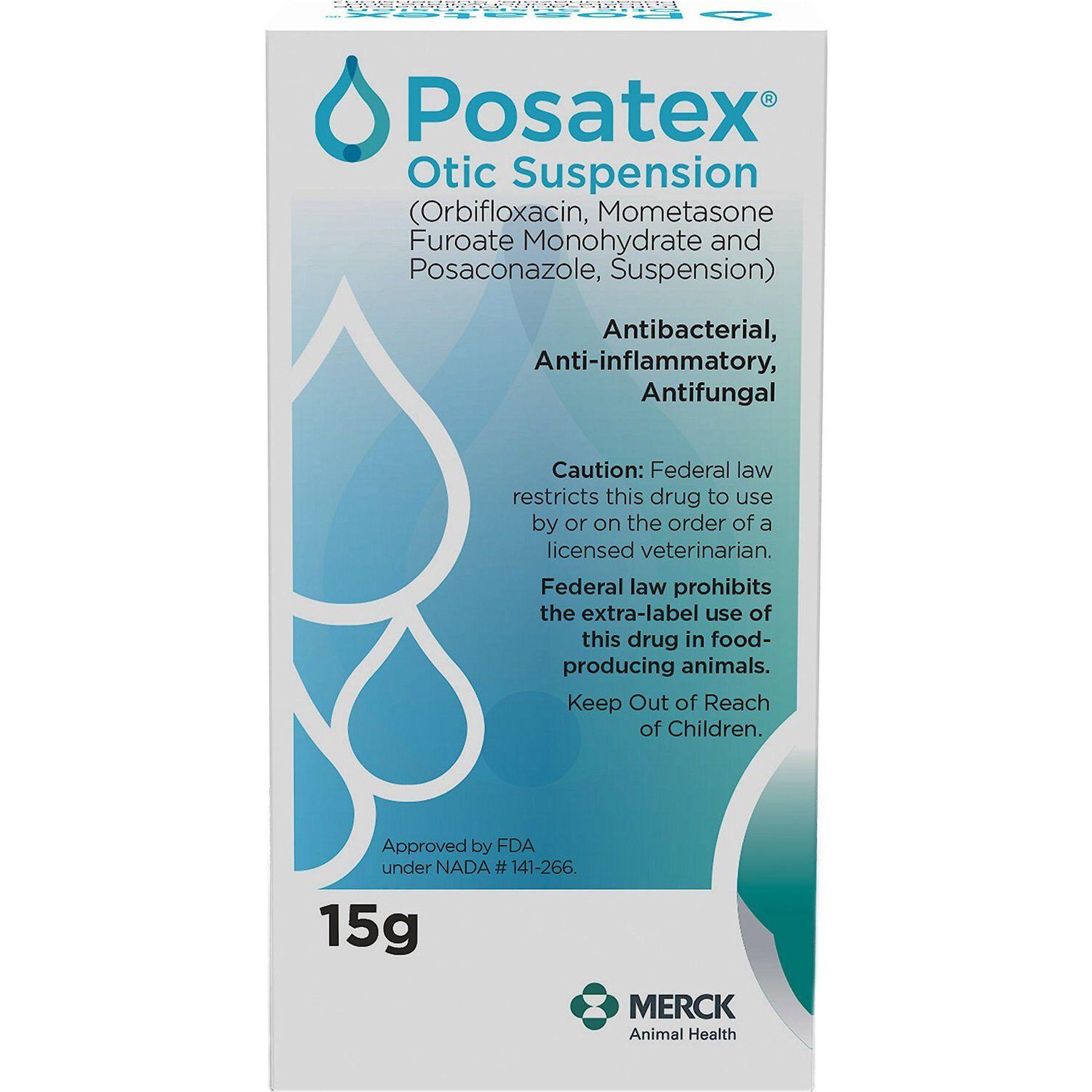
The 15 g bottle of the prescription ear suspension your vet may prescribe for a yeast and bacterial ear infection.
Webvet may earn a commission when you click through to Chewy, at no extra cost to you.
The Merck Veterinary Manual describes otitis externa as inflammation of the external ear canal and a common problem in dogs. Posatex is FDA-approved under NADA 141-266, and the bottle carries the Merck Animal Health name.
Posatex cannot be bought over the counter or without a prescription in the United States, because federal law limits the drug to use by or on the order of a licensed veterinarian. The reason is practical too: VCA Animal Hospitals says microscopic examination is essential to choose the right medication, and the wrong drug can miss the real cause.
Book a vet visit if you see any of the ear infection signs VCA lists, or if a problem keeps returning:
- head shaking and scratching at the ears
- a black or yellowish discharge
- a dog ear infection that has returned after an earlier course of drops
Posatex dosage for dogs by weight
| Label weight band | What the label states | Form and timing | Recheck |
|---|---|---|---|
| Dogs weighing less than 30 lbs | Instill 4 drops once daily into the ear canal | Otic suspension, shake well, 7 consecutive days | Vet recheck after the course; the label study re-evaluated dogs 2-7 days after the last dose |
| Dogs weighing 30 lbs or more | Instill 8 drops once daily into the ear canal | Otic suspension, shake well, 7 consecutive days | Vet recheck after the course; the label study re-evaluated dogs 2-7 days after the last dose |
| Any weight band, eardrum not yet checked | The label says eardrum integrity should be confirmed before use | No drops until the vet has examined the ear | Ear exam first, then the prescribed course |
The Posatex dosage for dogs on the DailyMed label is 4 drops once daily into the ear canal for dogs under 30 lbs and 8 drops for dogs 30 lbs or more, for 7 consecutive days. Your vet decides which ears need treatment and writes the exact number of drops on the prescription, so give exactly the number of drops the vet prescribed and do not change the drop count or cut the course short without checking with the vet first. The one exception is hearing loss or balance changes, such as a new head tilt: the label says to stop immediately if hearing loss is observed, so stop the drops and call the vet the same day.

The label states the strength in each drop as well. Each gram of the otic suspension contains 10 mg of orbifloxacin, mometasone furoate monohydrate equivalent to 1 mg of mometasone furoate, and 1 mg of posaconazole in a mineral oil based system. Four drops deliver approximately 1.0 mg orbifloxacin, 0.1 mg mometasone furoate monohydrate, and 0.1 mg posaconazole.
Posatex ear drops come in three bottle sizes: 7.5 g, 15 g, and 30 g. Every bottle size holds the same product, so the size only changes how many drops are available, not the strength. The Posatex 15-g Otic Suspension for Dogs is listed at $68.99 on Chewy when checked in November 2026, and it still needs a prescription.
For comparison, the Mometamax label uses the same 30 lb cutoff, with 4 drops under 30 lbs and 8 drops at 30 lbs or more from its 7.5 g, 15 g, and 30 g bottles. The 15-g Mometamax Otic Suspension for Dogs is another prescription product, filled by Chewy Pharmacy or the vet only with a veterinarian's prescription.
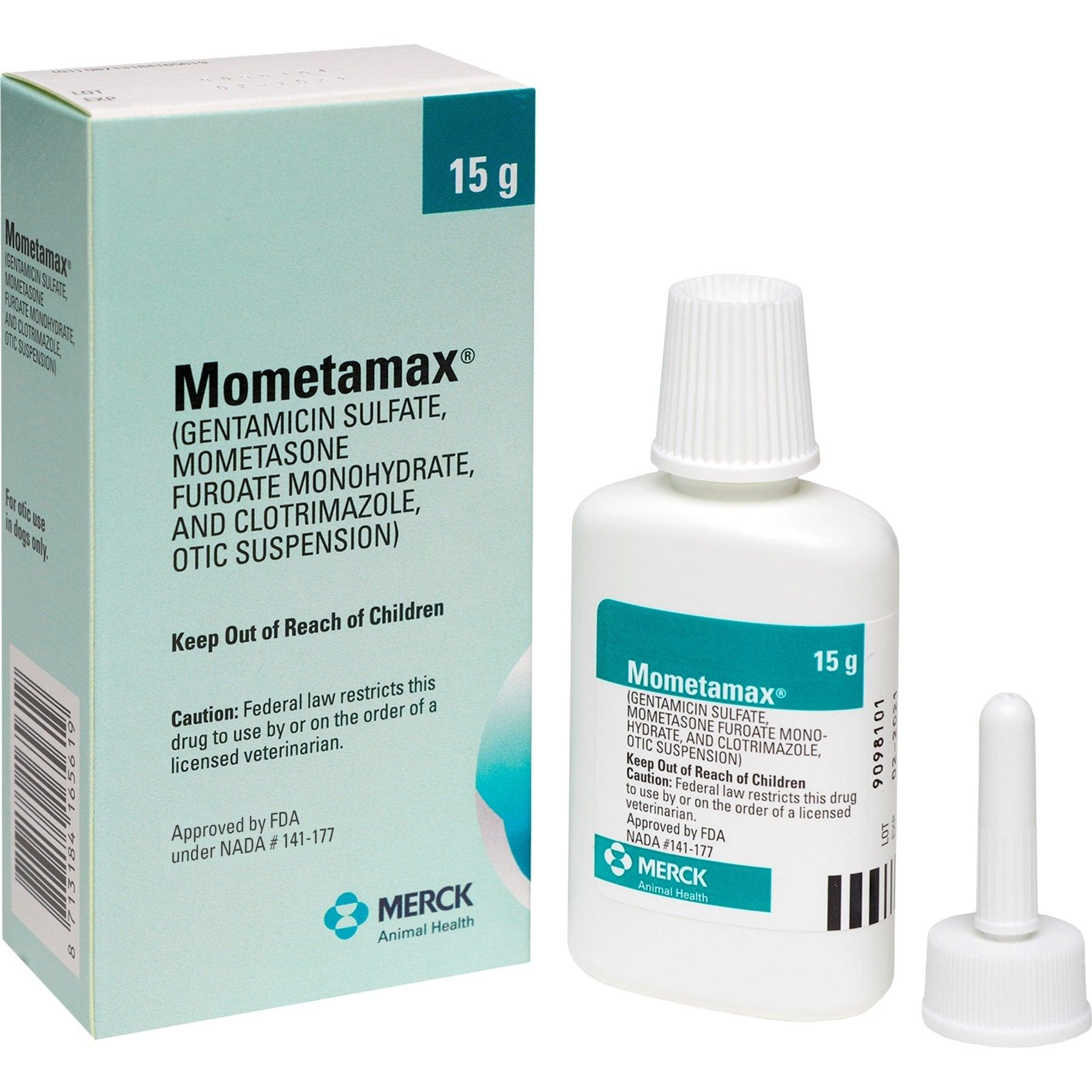
A prescription ear suspension with a different antibiotic and antifungal that vets sometimes choose instead of Posatex.
Webvet may earn a commission when you click through to Chewy, at no extra cost to you.
How often should I use Posatex for my dog?
Once a day. The Posatex label directs once-daily dosing into the ear canal for 7 consecutive days, and VCA's monograph agrees it is usually given for 7 consecutive days. Give it at roughly the same time each day, finish the full week unless your vet says otherwise, and do not extend the course on your own.
Storage is simple. The label says to store the bottle between 2-30°C (35.6-86°F) and to shake well before use. VCA adds to keep it in the original, tightly sealed container, out of reach of children and pets.
What Posatex treats and how it compares with Mometamax, Otomax, and other ear drops
Posatex is used in dogs for otitis externa caused by a mix of yeast and bacteria. The label explains the three Posatex ingredients:
- Orbifloxacin: a synthetic fluoroquinolone antibacterial that disrupts bacterial DNA replication.
- Mometasone furoate: a topical corticosteroid, the steroid part of the mix.
- Posaconazole: a broad-spectrum triazole antifungal that blocks ergosterol production in yeast.
Many ear infections have an underlying cause. The Merck Veterinary Manual separates primary causes, such as allergy, adverse food reactions, and atopic dermatitis, from secondary invaders such as Malassezia yeast, which lives in low numbers in healthy ears. VCA says allergies are involved in as many as 43% of ear infection cases. Treating the yeast without the trigger can mean the ear flares again.
Questions about what kills ear yeast, and how long an ear yeast infection takes to clear, are covered in WebVet's guide to dog ear yeast infection; in short, a prescribed antifungal after a vet exam, over a timeline the vet tracks with cytology. Triggers and diet questions, including which foods matter, sit in the broader guide to yeast infection in dogs.
What is similar to Posatex for dogs?
Several FDA-approved prescription ear products treat the same kind of mixed infection with a different antibiotic, antifungal, or steroid. The closest are Mometamax, Otomax, and Surolan, which are applied at home, and Claro, which a vet gives in the clinic. None is sold over the counter; each still needs an ear exam and a veterinarian's prescription.
The difference between Posatex and Mometamax comes down to the antibiotic and antifungal: both use mometasone furoate once daily, but Mometamax pairs gentamicin with clotrimazole. The labels compare like this:
- Mometamax: gentamicin, mometasone furoate, and clotrimazole; 4 or 8 drops by the same 30 lb cutoff, once daily for 7 days, per its FDA label. It shares Posatex's steroid but swaps in a different antibiotic and antifungal.
- Otomax: gentamicin, betamethasone valerate, and clotrimazole ointment, given twice daily for 7 days, per its FDA label.
- Surolan: miconazole, polymyxin B, and prednisolone; 5 drops twice daily for 7 days, per its FDA label.
- Claro: a single dose per affected ear that its FDA label says should be administered by veterinary personnel.
- Osurnia: another ear medication a vet may weigh, covered in WebVet's separate guide.
Read side by side, the labels show where Posatex differs. Among these home-use products, it is the one that pairs posaconazole as its antifungal with orbifloxacin as its antibiotic. Mometamax, Otomax, and Surolan rely on clotrimazole or miconazole against yeast and on gentamicin or polymyxin B against bacteria. Posatex and Mometamax share the same steroid, mometasone furoate, at 1 mg per gram.
Every one of these labels takes the eardrum and hearing seriously. Mometamax says to discontinue use if hearing or vestibular dysfunction is noted, and Otomax notes deafness or partial hearing loss in a small number of sensitive dogs. Mometamax also says not to use it with a known perforated eardrum, as Posatex does, and the eardrum check applies whichever product the vet chooses.
Questions worth asking your vet when an ear product is chosen:
- Has the eardrum been checked, and is it intact?
- What did the ear cytology show: yeast, bacteria, or both?
- How many drops, how many times a day, and for how many days?
- Which bottle size covers the full course for both ears if both are treated?
- When is the recheck, and what should the ear look like by then?
- Is there an underlying cause, such as allergy, that needs its own plan?
Your vet chooses between them based on what the ear cytology shows, whether the eardrum is intact, past responses, and how easily your dog tolerates daily drops. Posatex and Mometamax both run once a day, while Otomax and Surolan run twice a day, which matters for a busy household or a dog that dislikes handling. The full menu of dog ear infection treatment options is wider than any single brand.
The Surolan 15-mL Otic Suspension for Dogs is listed at $40.19 on Chewy when checked in November 2026. Like Posatex, it is filled by Chewy Pharmacy or your vet only with a veterinarian's prescription.
A twice-daily prescription ear suspension with miconazole, polymyxin B, and prednisolone that a vet may choose.
Webvet may earn a commission when you click through to Chewy, at no extra cost to you.
Posatex is dispensed by the clinic or by an online pharmacy that confirms the prescription with your vet. Which of the two is the cheap route for Posatex varies, so compare both prices for the same bottle size. The Posatex 15 g bottle is listed at $68.99, the 15-g Mometamax bottle at $53.99, and the Otomax 15-g Otic Ointment for Dogs at $49.99, each on Chewy when checked in November 2026.
Price per bottle is only part of the cost. A large dog on 8 drops in both ears uses more product per day than a small dog with one sore ear. Because Posatex comes in 7.5 g, 15 g, and 30 g bottles, ask your vet which size covers the full 7-day course for your dog's weight band and the number of ears being treated.
For a broader look at prescription and nonprescription dog ear drops, including when each type fits, see WebVet's overview. The practical difference is simple: Posatex, Mometamax, Otomax, and Surolan are each labeled to treat a diagnosed otitis externa, and each carries the federal caution restricting it to use by or on the order of a licensed veterinarian. The Otomax ointment is one of those prescription-only options.
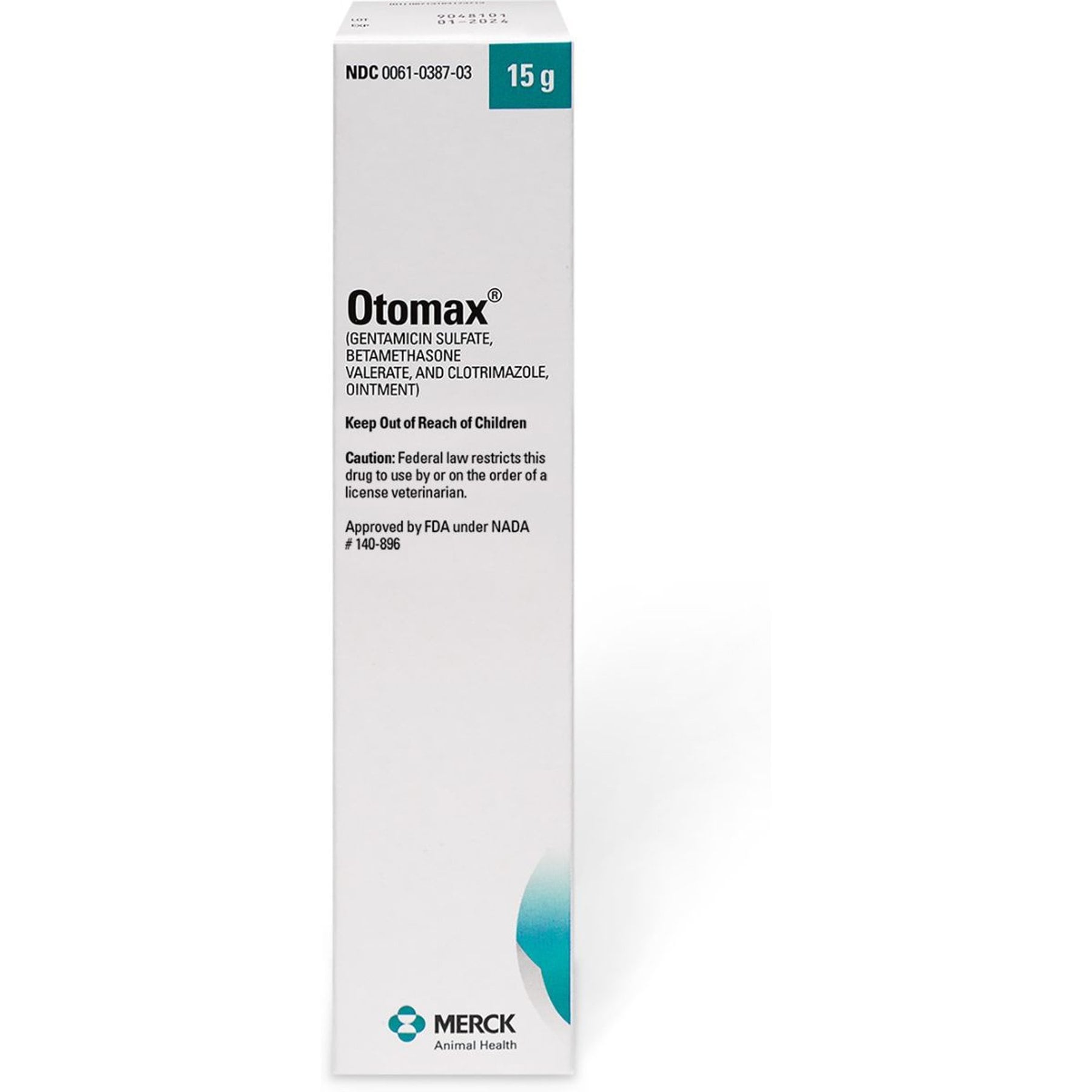
A twice-daily prescription ear ointment with gentamicin, betamethasone, and clotrimazole that a vet may prescribe.
Webvet may earn a commission when you click through to Chewy, at no extra cost to you.
Posatex side effects in dogs
Is Posatex safe for dogs? For most dogs with an intact eardrum, the label data are reassuring. In the field study, 143 dogs were treated with Posatex, and 1 dog with bilateral otitis externa developed hearing loss; treatment was stopped and the condition resolved after one week, according to the Posatex label.

VCA groups the side effects of Posatex into common and rare:
- Common: redness or discomfort at the site of application.
- Rare, call your vet: an infection that does not respond, does not appear to be healing, or is getting worse.
- Rare, call your vet: sudden hearing loss, or a head tilt or walking in circles.
The label safety study gave Posatex at 1, 3, and 5 times the recommended dose for 21 consecutive days. Redness was noted in all groups. In the 5 times group, there was a slight decrease in serum cortisol after ACTH stimulation, and aural pain, swelling, or heat were each noted in 3 dogs.
That cortisol finding is why the label says to avoid prolonged or repeated use. Long-term use of topical otic corticosteroids has been associated with adrenocortical suppression and iatrogenic hyperadrenocorticism (a drug-induced form of Cushing's) in dogs. VCA adds that drug sensitivities can develop over time with repeated exposure.
In the label data, side effects were mostly confined to the ear. The bigger risks come from using it without an ear exam, in an ear with a damaged eardrum, or for weeks without a recheck.
 Sponsored
Vet care that's always there
Unlimited video calls and messaging with licensed vets for less than a typical vet visit. One membership covers up to five pets.
Use code Pets60
Plans start at $12/month · covers up to 5 pets
- Licensed vets in most states
- Rx for 150+ conditions
- 4.7 on Trustpilot
When to stop Posatex and call the vet now, including hearing or balance changes
The Posatex label gives one direct stop instruction: immediately discontinue use if hearing loss is observed during treatment. It also says the product is not to be given by mouth.
Stop and call your veterinary office immediately for any of these:
- sudden hearing loss or deafness during the course
- head tilt, walking in circles, or loss of balance
- signs of a suspected allergic or adverse reaction
- an infection that is not healing or is getting worse
VCA advises calling your veterinary office immediately for a suspected overdose or adverse reaction, with the product name, your dog's weight, and the symptoms ready. Hearing loss was rare in the label study and the one affected dog recovered after stopping, but deafness during treatment still needs a same-day call.
If your dog ate Posatex or chewed open the bottle, the label offers no ingestion data beyond "do not administer orally." Call your veterinarian or a pet poison control service with the bottle in hand. Suspected adverse reactions can also be reported to the manufacturer at 1-800-224-5318, the number printed on the label.
Ruptured eardrums, interactions, and dogs that should not get Posatex
The eardrum is the single biggest reason Posatex needs an ear exam. The label says not to use it in dogs with known tympanic perforation, notes that use in dogs with perforated eardrums has not been evaluated, and states that eardrum integrity should be confirmed before administering the product.

VCA explains why this matters: if the eardrum is ruptured, certain medications can result in loss of hearing, and deep ear infections can themselves damage or rupture the eardrum. The Merck Veterinary Manual says it is important to verify the tympanic membrane is intact before applying topical treatments, and that many agents can be toxic to the inner ear.
According to the label and VCA, Posatex should not be used in dogs that:
- have known or suspected hypersensitivity to quinolones, mometasone furoate, or posaconazole
- have a known or suspected ruptured eardrum
- are receiving other medications that are potentially toxic to the ears
VCA says to use it with caution in dogs that:
- are pregnant, nursing, or used for breeding (the label says safe use in these dogs has not been evaluated)
- have liver or kidney disease
- are geriatric, frail, or sick
The label also notes that quinolones given systemically have produced cartilage erosions of weight bearing joints in immature animals of various species. Posatex is an ear product, not a tablet, but tell your vet if your dog is a young, growing puppy.
Mention every other ear product, steroid, or medicine your dog receives so the vet can check for overlap. The label adds human warnings: it is not for use in humans, and it should be kept out of reach of children.
How to apply Posatex, how long it takes to work, and when to recheck
The label directions are short: shake well, then instill the prescribed drops once daily into the ear canal for 7 consecutive days. The label gives no cleaning step of its own, so follow your vet's instructions on whether and when to clean before each dose.

The Merck Veterinary Manual suggests that, if possible, the first ear cleaning be done at the clinic with the owner watching, which is a good moment to ask about technique. If your vet orders cleaning at home, a product such as Virbac Epi-Otic Neutral-pH Advanced Dogs & Cats Ear Cleaner, 8-fl oz bottle, listed at $21.99 on Chewy when checked in November 2026, is used only as the vet directs; a cleaner does not replace the prescribed drops or the exam. WebVet's guide to choosing a dog ear cleaner covers the options.
How do you use ear drops for dogs?
Hold the ear flap straight up, place the bottle tip into the canal, give the prescribed drops, and massage the base of the ear for about 30 seconds. VCA's ear drop guide sets out the technique for ear drops:
- Read the label and make sure you understand the prescription instructions before you begin.
- Choose a quiet area away from other pets; a sore ear may make a muzzle necessary.
- Shake the Posatex bottle well.
- Pull the ear flap straight up to expose the ear and straighten the ear canal.
- Ask your vet whether the tip can go in the ear; if so, place it gently down into the canal and give the amount prescribed.
- Gently massage the base of the ear below the opening for about 30 seconds.
- Let your dog shake, then wipe debris from the ear flap.
- Wipe the bottle tip with a cotton ball soaked in alcohol and offer a treat.
Wiping the ear flap after each dose is easier with something like Petkin Fingertip Ear Wipes Dog & Cat Grooming Wipes, 100 count, listed at $16.50 on Chewy when checked in November 2026. A dog that keeps scratching at the treated ear may need a recovery collar such as the Supet Inflatable Dog Recovery Cone Collar, Green, Medium, listed at $26.99 on Chewy when checked in November 2026. Neither replaces the prescribed treatment or the vet exam.
How long does it take for Posatex to work?
VCA says the medication should take effect within 1 to 2 hours, with improvement in clinical signs to follow. The label measures results differently: in its study, dogs got 7 days of drops and were re-evaluated 2-7 days after the last dose.
Discomfort improved in 88% of Posatex dogs versus 45% on placebo, redness in 81% versus 39%, and swelling in 83% versus 49%. The Merck Veterinary Manual adds that treatment can run from 7-10 days to several months depending on the diagnosis.
Use this recheck checklist during and after the course:
- First few days: scratching and head shaking should begin to ease; call sooner if pain or redness worsens.
- Any day: stop and call the same day for hearing loss, head tilt, or walking in circles.
- End of day 7: finish the course as prescribed; do not extend it without the vet.
- After the course: keep the recheck your vet sets (the label study re-evaluated dogs 2-7 days after the last dose); Merck advises repeat cytology weekly to every other week until no infection remains.
- If signs return: a primary cause, such as allergy, may still need work, and VCA notes several rechecks may be needed.
Posatex questions
Frequently Asked Questions
Is Posatex safe for dogs?
Yes, for dogs with an intact eardrum and no allergy to its ingredients, when used as prescribed. It is FDA-approved for dogs, and the main side effect in label data was one case of temporary hearing loss among 143 treated dogs. The key safety step is the ear exam that confirms the eardrum is intact before treatment begins.
Can Posatex cause hearing loss in dogs?
It can, rarely. One dog in the label field study developed hearing loss that resolved a week after stopping. The risk rises if drops reach the middle ear through a damaged eardrum, which is why the vet checks the eardrum first and why any hearing change means stopping and calling.
What should I do if my dog ate Posatex?
Take the bottle away, note how much may be missing, and call your veterinarian. The label offers no data on swallowing the product. You can also call the ASPCA Animal Poison Control Center at (888) 426-4435; the ASPCA says a consultation fee may apply.
Can you buy Posatex without a vet prescription?
No. Federal law restricts Posatex to use by or on the order of a licensed veterinarian, so any legitimate seller needs a prescription. That prescription follows an ear exam, which confirms the cause of the infection and that the eardrum is intact. Left untreated or mistreated, VCA warns an ear infection can lead to an aural hematoma.
What are the ingredients in Posatex?
Each gram contains 10 mg of orbifloxacin (an antibiotic), 1 mg of mometasone furoate (a steroid, as the monohydrate), and 1 mg of posaconazole (an antifungal), in a mineral oil based system. It is made under the Merck Animal Health name.
Veterinarian · BVMS MRCVS
Dr. Pippa Elliott, BVMS, MRCVS, is a veterinarian with nearly 30 years of experience in companion animal practice. Dr. Elliott earned her Bachelor of Veterinary Medicine and Surgery from the University of Glasgow. She was also designated a Member of the Royal College of Veterinary Surgeons. Married with 2 grown-up kids, Dr. Elliott has a naughty Puggle named Poggle, 3 cats and a bearded dragon.


