Mometamax for Dogs: How to Use It, Side Effects, and Cost
Mometamax is a prescription ear medicine that vets use for yeast and bacterial ear infections in dogs. This guide covers label dosing by weight, how to apply it, side effects, when to stop, and when to recheck.

BVMS MRCVS
Medically reviewed by Dr. Pippa Elliott, BVMS MRCVS · Last reviewed

Drug facts
Mometamax· Gentamicin, mometasone furoate, and clotrimazole otic suspension
Mometamax is an FDA-approved prescription ear suspension for dogs that combines gentamicin, mometasone furoate, and clotrimazole to treat otitis externa caused by susceptible yeast and bacteria. The label dose is 4 or 8 drops once daily by weight band for 7 days, after a vet confirms the eardrum is intact.
Treats

 Sponsored
Is Mometamax right for your dog?
A licensed vet at Dutch can assess your dog over video and prescribe treatment when it's appropriate, delivered to your door.
Use code Pets60
Plans start at $12/month · covers up to 5 pets
- Licensed vets in most states
- Rx for 150+ conditions
- 4.7 on Trustpilot
Mometamax for dogs: what it treats, prescription status, and whether today is a vet day
Mometamax for dogs is a prescription ear medicine from Merck Animal Health that combines an antibiotic, a steroid, and an antifungal. The FDA approved it to treat otitis externa, an infection of the outer ear canal caused by yeast, bacteria, or both. It is not sold over the counter.
A red, smelly, itchy, or painful ear is a vet day before it is a Mometamax day. Using Mometamax for a dog's ears follows a vet exam that identifies the germs and confirms the eardrum is intact, because the label forbids it in a perforated eardrum. Mometamax Single is a separate one-dose version that the clinic gives.
- 1On what Mometamax treats: outer ear infections (otitis externa) in dogs caused by susceptible yeast and bacteria.
- 2On label dosing by dog weight: 4 drops for dogs under 30 lbs or 8 drops for dogs 30 lbs or more, once daily for 7 days, from the 7.5 g, 15 g, and 30 g bottles.
- 3Status: prescription only, and the vet checks the eardrum before the first dose.
- 4Stop and call the vet for hearing loss, a head tilt, loss of balance, or an ear that is getting worse.
- 5Mometamax Single is one 0.8 mL dose per ear, given only by clinic staff.

Mometamax otic for dogs is a suspension of three active ingredients. According to the Mometamax label on DailyMed, each gram contains gentamicin (3 mg), mometasone furoate (1 mg), and clotrimazole (10 mg) in a mineral oil-based gel. The label restricts it to otic use in dogs only.
How does Mometamax work for dogs?
Mometamax works by attacking an ear infection three ways at once. The label explains that gentamicin is an antibiotic that kills susceptible bacteria by blocking their protein synthesis, mometasone furoate is a steroid that calms inflammation, and clotrimazole is an antifungal active against Malassezia yeast. In field trials it reduced discomfort, redness, swelling, discharge, and odor.
VCA Animal Hospitals says the combination should take effect within 1 to 2 hours, with improvement in clinical signs following.
The 15-g Mometamax Otic Suspension for Dogs is one of the four bottle sizes on the label, and the vet chooses the size for each dog. Like every size, it is filled by Chewy Pharmacy or the clinic only with a veterinarian's prescription after an ear exam.
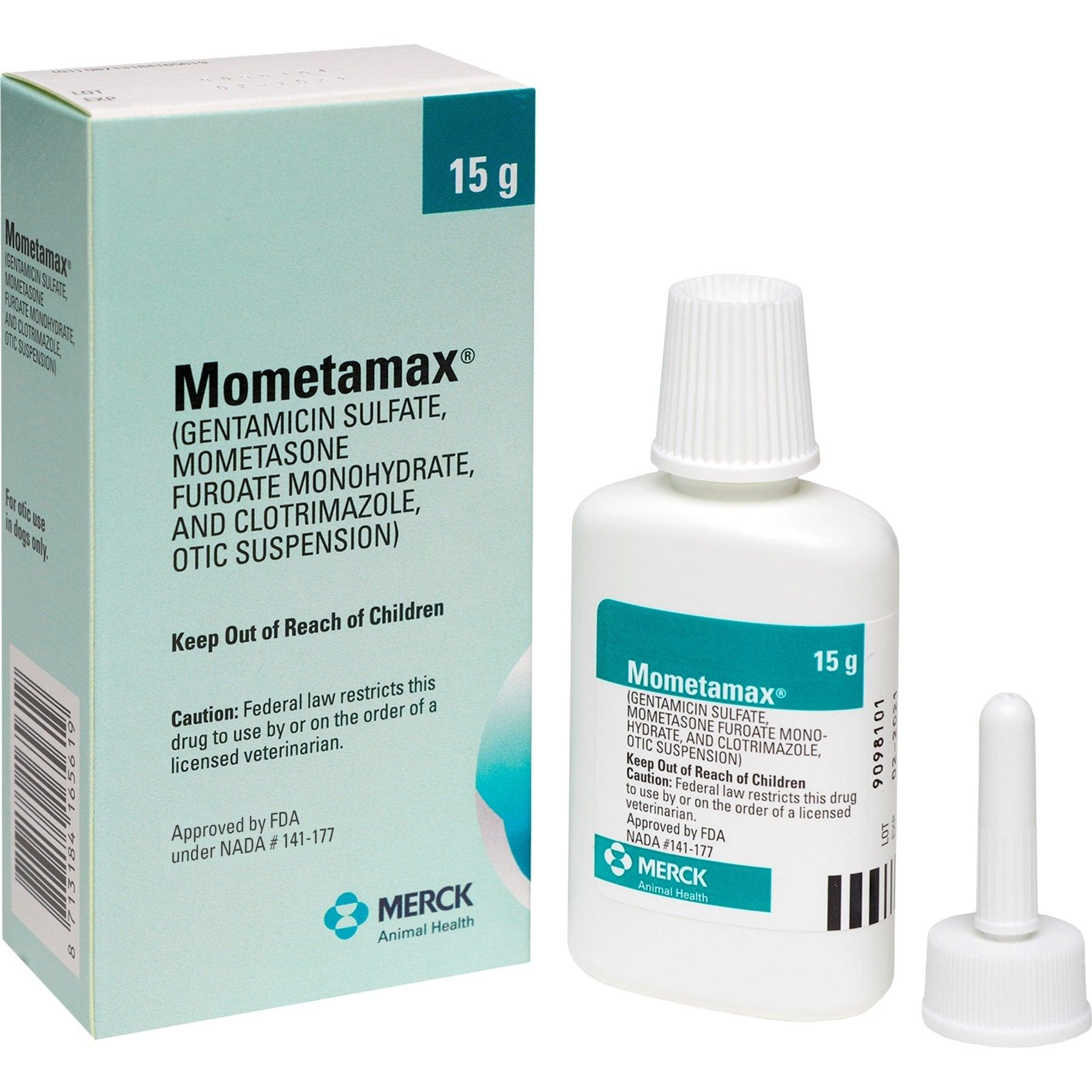
The standard 15 g bottle of Mometamax, dispensed only on a veterinarian's prescription after an ear exam.
Webvet may earn a commission when you click through to Chewy, at no extra cost to you.
What ear infection medicine can I buy for my dog without a vet's prescription?
Only over-the-counter ear products such as Zymox, not Mometamax or any other antibiotic-steroid ear drop. The Mometamax label states that federal law restricts it to use by or on the order of a licensed veterinarian. Over-the-counter solutions exist, but none replaces the exam that confirms the eardrum is intact and identifies the germ.
There is no non-prescription version of Mometamax, and no legitimate seller offers it without a vet's prescription. A seller that skips the prescription is also skipping the eardrum check the label requires before the first drop.
Two other questions come up before the first bottle:
- Malmetazone: no label under that name appears in the DailyMed database, so compare the FDA approval number and active ingredients on its box with the three in Mometamax before assuming it is the same drug.
- Pregnant dogs: Merck Animal Health's product page says not to use Mometamax in pregnant dogs, and the label warns that steroids given during pregnancy have caused birth defects in puppies.
Today is a vet day, rather than a wait-and-see day, when a dog shows any of these:
- Head shaking, scratching, or rubbing at one or both ears
- A bad smell, discharge, or redness inside the ear
- Pain when the ear is touched, or a dog that pulls away from handling
- A head tilt, loss of balance, or sudden hearing loss
- An ear infection that has come back after a previous course
The Merck Veterinary Manual lists head shaking, itching, pain, odor, redness, and swelling as signs of otitis externa, and says diagnosis rests on the history, an ear exam with an otoscope, and cytology. VCA adds that looking at ear debris under a microscope is essential to choosing the right medication.
That microscope test is how the vet tells a bacterial infection from a yeast infection, and the dog ear infection guide explains both in more depth.
Mometamax dosage for dogs by weight, and Mometamax Single
The label sets the Mometamax dose by weight band and bottle size, and the vet confirms the exact number of drops for each dog. Give exactly what the vet prescribed, and never change, stretch, or stop the course without the vet.
Generic Mometavet carries the same weight-band dosing as Mometamax, because its FDA approval names Mometamax as the reference drug with the same ingredients at the same strength. The Mometavet Otic Suspension for Dogs, 15 g is that generic in the 15 g size, and Chewy Pharmacy fills it only with a veterinarian's prescription.
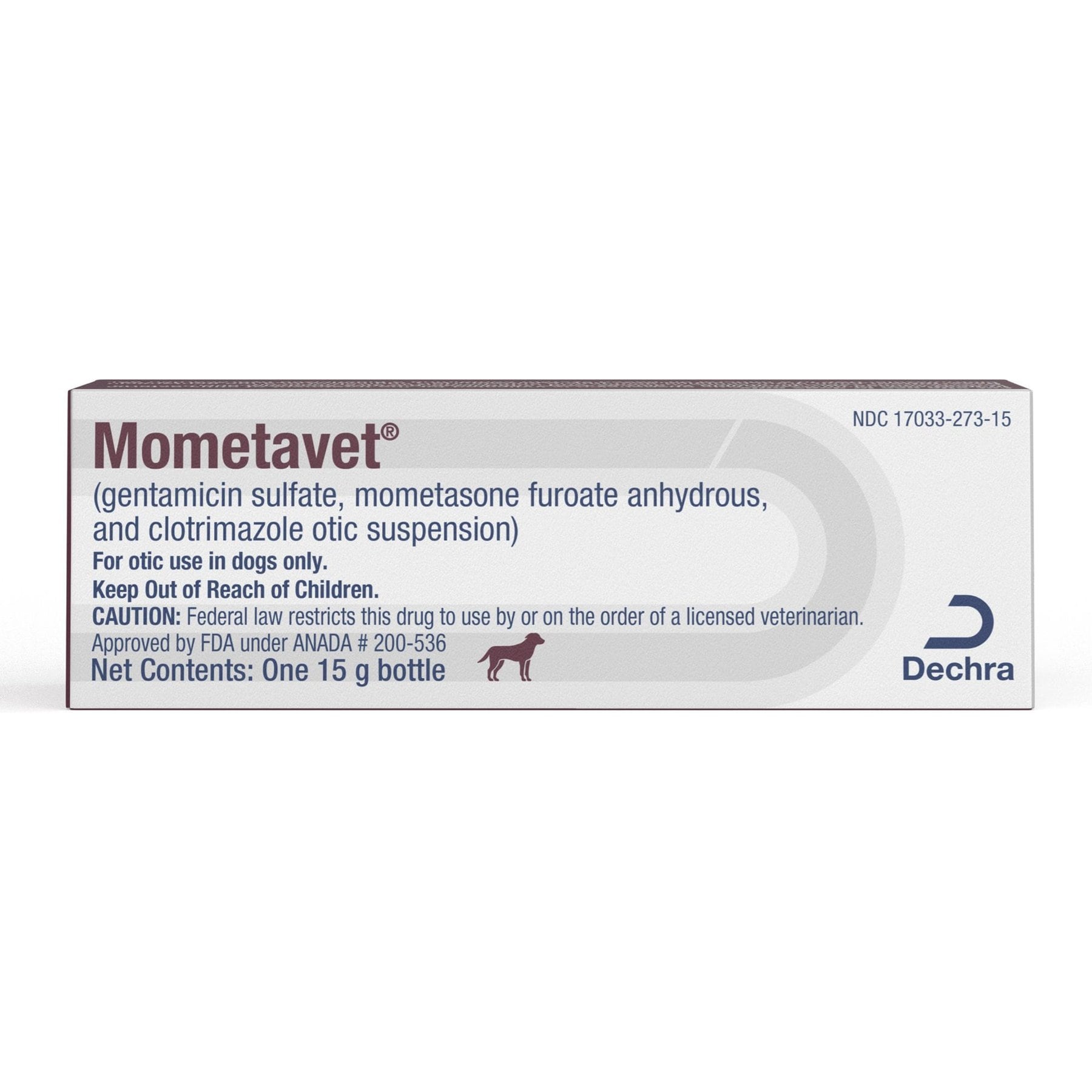
The FDA-approved generic of Mometamax in a 15 g bottle, filled only with a veterinarian's prescription.
Webvet may earn a commission when you click through to Chewy, at no extra cost to you.
| Weight band | Product form | What the label states |
|---|---|---|
| Under 30 lbs | Mometamax otic suspension, 7.5 g, 15 g, or 30 g bottle | 4 drops once daily into the ear canal, for 7 consecutive days |
| Under 30 lbs | Mometamax otic suspension, 215 g bottle | 2 drops once daily into the ear canal, for 7 consecutive days |
| 30 lbs or more | Mometamax otic suspension, 7.5 g, 15 g, or 30 g bottle | 8 drops once daily into the ear canal, for 7 consecutive days |
| 30 lbs or more | Mometamax otic suspension, 215 g bottle | 4 drops once daily into the ear canal, for 7 consecutive days |
| No weight band on the label | Mometamax Single, drawn up by syringe at the clinic | 0.8 mL once per affected ear, given by veterinary personnel; the effect should last 33 days |
| Recheck | Either product | The vet sets the recheck; the Merck Veterinary Manual describes repeat ear cytology weekly to every other week until no infection is seen |

The label's 4-drop and 8-drop counts apply to the 7.5 g, 15 g, and 30 g bottles, therapy should continue for 7 consecutive days, and the bottle should be shaken well before use.
Mometamax ear drops come as one gentamicin, mometasone, and clotrimazole otic suspension in four bottle sizes, and every size needs a veterinarian's prescription. The 15-g Mometamax Otic Suspension for Dogs and the 30 g bottle share the same label drop count, so a dog gets the same number of drops from either size; the 215 g bottle has its own, lower count on the label.
Some owners ask about a Mometamax ointment, a Mometamax otic solution, or a Mometamax Ultra. The DailyMed label search lists only two Mometamax products: the otic suspension and Mometamax Single. Mometamax is a suspension in a gel base rather than an ear ointment; Otomax is the related ointment.
Mometamax Single for dogs
Mometamax Single is a different drug, not a stronger Mometamax. The FDA Freedom of Information Summary for Mometamax Single lists gentamicin, posaconazole, and mometasone furoate, approved in April 2025 as a prescription single-dose treatment that veterinary personnel give at 0.8 mL per affected ear.
The Mometamax Single label on DailyMed tells the clinic to clean and dry the ear first, then restrain the dog afterward to limit head shaking and splatter. The effect should last 33 days, and cleaning the ear after dosing may reduce how well it works, so owners skip home cleaning unless the vet says otherwise.
The label marks it for otic use in dogs only and says not to use it in cats. The FDA summary of its approval study records:
- 80.5% of treated dogs were treatment successes, compared with 19.6% of dogs given the inactive vehicle
- 372 dogs were in the safety analysis, 245 of them treated with Mometamax Single
- Enrolled dogs had to be at least 12 weeks old, and pregnant or lactating females were excluded
- In a separate safety study, puppies given up to 5 times the label dose kept normal hearing
What Mometamax treats and how it compares with Otomax, Posatex, and generic Mometavet
Mometamax is used in dogs for outer ear infections. The label lists the germs it covers: Malassezia yeast and the bacteria Pseudomonas (including P. aeruginosa), coagulase-positive staphylococci, Enterococcus faecalis, Proteus mirabilis, and beta-hemolytic streptococci. It is labeled for ears only, not for skin problems such as hot spots.
Does Mometamax treat rods? The Merck Veterinary Manual says rod-shaped bacteria seen on ear cytology are usually Pseudomonas aeruginosa, E. coli, Proteus mirabilis, or Corynebacterium. Pseudomonas and Proteus are on the Mometamax label, while E. coli and Corynebacterium are not, so the cytology result guides whether the vet reaches for Mometamax or something else.

The Mometamax ingredients set it apart from look-alike ear drops. Here is how the main options line up on their labels:
- Mometamax: gentamicin, mometasone furoate, and clotrimazole; once daily for 7 days at home
- Otomax: gentamicin, betamethasone valerate, and clotrimazole; twice daily for 7 days at home
- Mometavet: an FDA-approved generic of Mometamax with the same ingredients and dose
- Posatex: orbifloxacin, mometasone furoate, and posaconazole; once daily for 7 days at home, so Posatex shares the steroid and schedule with Mometamax but not the antibiotic or antifungal
- Mometamax Single and Osurnia: clinic treatments given by vet staff rather than daily drops at home
Mometavet, from Med-Pharmex, is the generic Mometamax. The FDA Freedom of Information Summary for Mometavet shows approval on May 17, 2016, with Mometamax as the reference drug and a waiver from bioequivalence testing because it has the same active ingredients at the same concentration and dosage form.
What are some alternatives to Otomax for dogs?
Mometamax, Posatex, and the clinic-applied products Mometamax Single and Osurnia are the main prescription alternatives to Otomax. Each label covers otitis externa in dogs, but the steroid, antibiotic, antifungal, and schedule differ. The Posatex label is once daily for 7 days, and the Osurnia label is given by a veterinary professional.
The full monographs for Posatex for dogs and Osurnia for dogs cover their own label details. Vets most often prescribe combination drops like these, which pair a steroid with an antibiotic and an antifungal; the dog ear drops guide covers what vets give and why.
For the generic, the price differs more than the medicine, and none of these is available without a vet prescription:
- The Mometavet Otic Suspension for Dogs, 15 g is listed at $37.18 on Chewy when checked in November 2026.
- The Otomax 15-g Otic Ointment for Dogs is listed at $49.99 on Chewy when checked in November 2026.
- The 15-g Mometamax Otic Suspension for Dogs is listed at $53.99 on Chewy when checked in November 2026.
The practical difference between Otomax and Mometamax is the steroid and the schedule. The Otomax label uses betamethasone valerate and calls for drops twice daily, while Mometamax uses mometasone furoate once daily. Once-daily dosing means one ear treatment a day instead of two, a practical point to raise with the vet.
The Otomax for dogs monograph covers that drug in depth. Otomax is a twice-daily ointment for acute and chronic ear infections in dogs, and Chewy Pharmacy fills the 15 g size only with a veterinarian's prescription.
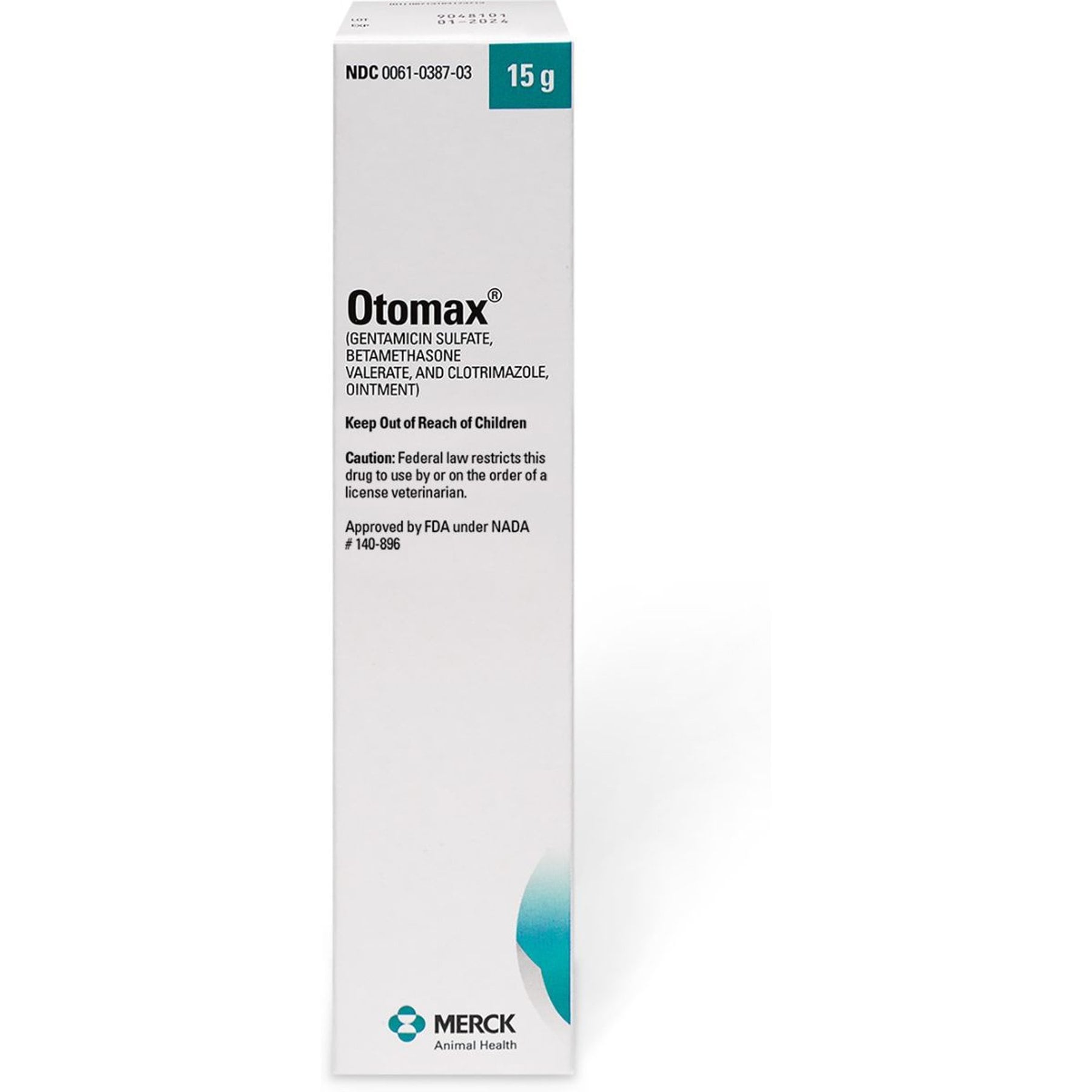
Otomax ointment in the 15 g size, the twice-daily alternative a vet may prescribe instead of Mometamax.
Webvet may earn a commission when you click through to Chewy, at no extra cost to you.
Buying Mometamax comes down to the clinic or a pharmacy that receives the vet's prescription. For the price of the 30 g bottle, ask the clinic or pharmacy for a quote. A site offering to sell Mometamax online without a vet prescription is selling a drug the label restricts to veterinary order.
 Sponsored
Vet care that's always there
Unlimited video calls and messaging with licensed vets for less than a typical vet visit. One membership covers up to five pets.
Use code Pets60
Plans start at $12/month · covers up to 5 pets
- Licensed vets in most states
- Rx for 150+ conditions
- 4.7 on Trustpilot
Can you buy over-the-counter ear drops for a dog?
Yes, but only non-prescription products such as Zymox, and they are not an over the counter version of Mometamax. VCA describes Zymox Enzymatic Ear Solution as an over-the-counter ear solution for bacterial and yeast ear infections, sold with or without hydrocortisone. Unlike Mometamax, it is applied to an uncleaned ear.
Zymox is not a like-for-like swap for Mometamax. VCA says to contact the vet if the ear does not improve or gets worse on Zymox, and notes that the manufacturer advises using no other ear products alongside it. The Zymox for dogs monograph covers it fully.
Before choosing an over-the-counter equivalent, or something to use instead of Mometamax, owners should know:
- No home product can confirm that the eardrum is intact or identify the germ.
- The Merck Veterinary Manual says irritating treatments such as home remedies and vinegar dilutions should be avoided.
- The dog ear infection home remedies guide explains why most ear infections still need a vet visit to clear.
Zymox Otic Dog & Cat Ear Infection Treatment without Hydrocortisone, 1.25-fl oz bottle is the hydrocortisone-free version of Zymox for dogs and cats. It is sold without a prescription, and it does not replace the prescribed treatment or the vet exam.
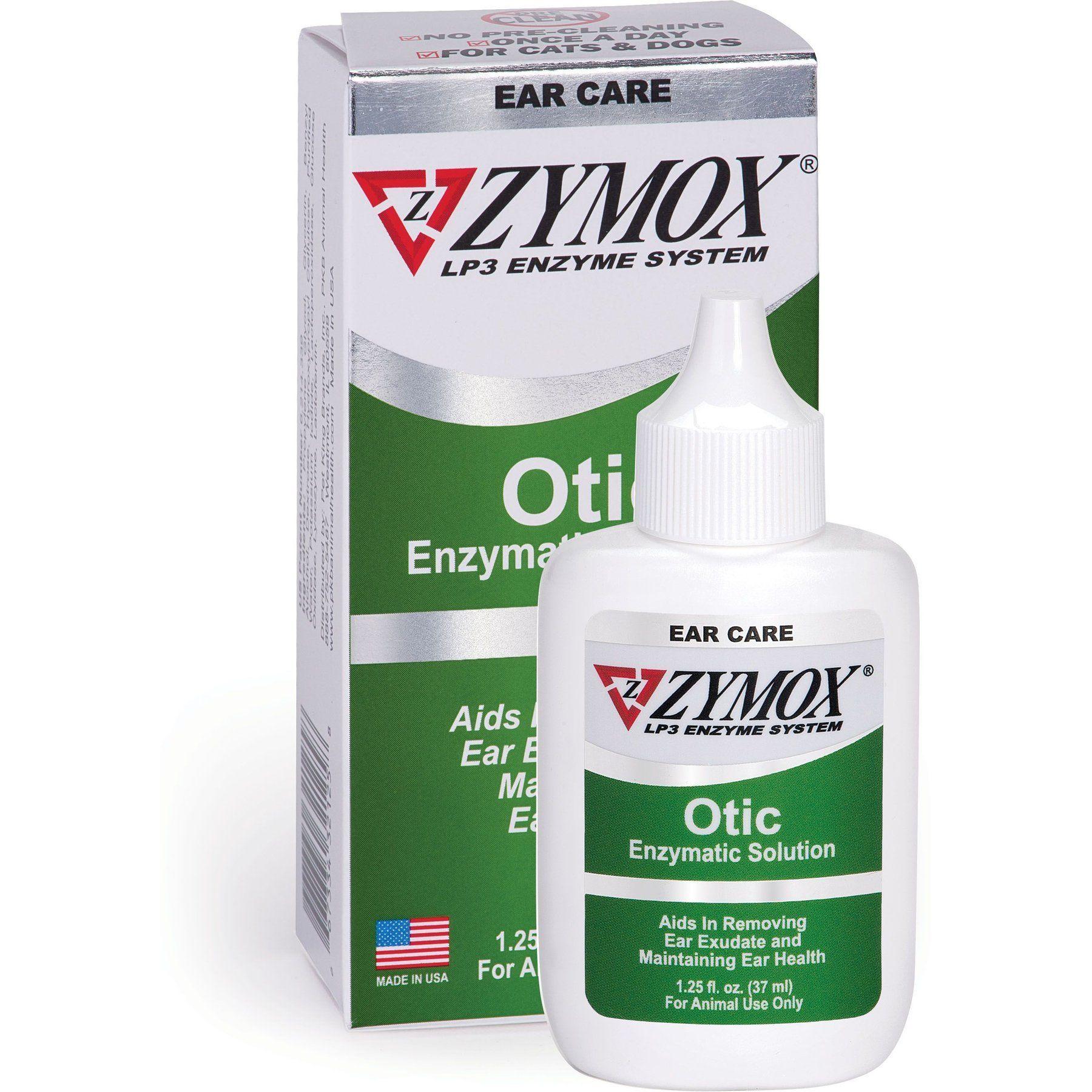
Hydrocortisone-free Zymox, an over-the-counter ear solution that does not replace a vet exam or prescribed drops.
Webvet may earn a commission when you click through to Chewy, at no extra cost to you.
Mometamax side effects in dogs
Mometamax is generally safe for dogs when used as labeled for the full week. The label reports a wide safety margin at the recommended dose in field and safety studies, and the side effects it records in treated dogs were uncommon.
The label lists these Mometamax otic suspension side effects from its field studies:
- Unsteady walking (ataxia), poor awareness of limb position, and increased water consumption, each in less than 1% of 164 dogs given once-daily treatment
- Inflammation of the ear flap (pinna) and diarrhea, in less than 1% of 141 dogs given twice-daily treatment
- Deafness or partial hearing loss in a small number of sensitive dogs, such as older dogs, which is usually temporary
VCA adds redness or discomfort where the drops go in. The label lists steroid overdose signs such as increased thirst and urination, fluid retention, and weight gain, and notes Cushing's syndrome after prolonged or repeated steroid therapy. Side effects are the same for the 15 g bottle as for every other size, because the suspension is identical.
Can Mometamax cause diarrhea? Yes, rarely. The twice-daily field study recorded it in less than 1% of 141 dogs, and VCA lists vomiting or diarrhea among the signs that mean stop and call the vet.
Mometamax Single side effects come from its own FDA field study of 245 treated dogs. The FOI Summary lists:
- Vomiting in 21 dogs (8.6%), compared with 3.1% of control dogs
- Decreased appetite in 3.7%
- Itching (pruritus) in 3.3% and ear itching in 2.9%
- Disorientation in 1.2%
When to stop Mometamax and call the vet now, including hearing changes
Of all Mometamax side effects, deafness is the one owners ask about most. The label links these ingredients to deafness or partial hearing loss in a small number of sensitive dogs, such as geriatric dogs, and says the deficit is usually temporary. If hearing or balance problems appear, the label directs stopping Mometamax immediately and flushing the ear canal thoroughly with a non-ototoxic solution.
That flush is a clinic job, so any hearing change during treatment is a same-day call, even though the label says the loss is usually temporary. The Merck Veterinary Manual names decreased hearing, head tilt, and vertigo as the signs of ear-drug toxicity, and says the medication should be stopped until the pet is evaluated.

VCA lists these signs that mean stop giving the medication and contact the veterinarian immediately:
- Sudden hearing loss, a head tilt, or walking in circles
- Worsening ear pain
- An infection that is not responding, not healing, or getting worse
- Loss of appetite, vomiting, or diarrhea
- Weight loss, sores around the mouth, or increased thirst
A Mometamax allergic reaction is also a stop sign. The label says that if hypersensitivity to any of the components occurs, treatment should be discontinued and appropriate therapy started. VCA's advice for a suspected overdose or reaction is to call the veterinary office immediately, or an emergency clinic if the usual practice is closed.
For Mometamax Single, which stays in the ear once given, the label tells the vet to reevaluate the dog if hearing loss or signs of balance trouble appear during treatment.
Ruptured eardrums, interactions, and dogs that should not get Mometamax
Mometamax should not go into an ear with a ruptured eardrum, which is why it is never a leftover-bottle drug. The label says not to use it in dogs with known eardrum perforation, and directs an ear canal exam first so the drug cannot carry infection into the middle ear or damage the cochlea or balance organ.
The Merck Veterinary Manual explains the risk: gentamicin belongs to the aminoglycosides, which can damage hearing, and that risk is greater when the eardrum is not intact. The label also states that all aminoglycosides can cause reversible and irreversible damage to balance, hearing, and the kidneys, mainly with prolonged use on large wounds or broken skin.
VCA says a dog should not get Mometamax if any of these apply:
- A known allergy to any of the ingredients
- A confirmed or suspected ruptured eardrum
VCA also advises caution in dogs with recurring ear infections, where an underlying cause such as allergy needs its own workup.
Merck Animal Health says not to use Mometamax in pregnant dogs. The label explains why: corticosteroids given during pregnancy have caused cleft palate and other defects in puppies, and in late pregnancy they can trigger early labor. The Mometamax Single label adds that its safety in breeding, pregnant, or lactating dogs has not been evaluated.
The label says to avoid other drugs known to damage hearing, and VCA lists these interactions:
- Other medications containing gentamicin, which may raise the risk of hearing loss
- Other corticosteroids, unless the vet instructs otherwise
- Vitamins, supplements, and herbal products, which the vet should know about before starting
The label also warns against ingestion, noting that some topical steroids have caused body-wide reactions when swallowed. The Mometamax Single label advises caution in dogs with impaired kidney function, since gentamicin can affect the kidneys.
How to apply Mometamax, rechecks, and what to do if the ear is not improving
How to use Mometamax for dogs starts with a clean, dry ear and ends with a recheck. The label directs cleaning and drying the canal thoroughly and confirming the eardrum is intact; VCA adds trimming excess ear hair. The how to clean dog ears guide covers the technique.
Use only the cleaner the vet approves. The Virbac Epi-Otic Neutral-pH Advanced Dogs & Cats Ear Cleaner, 4-fl oz bottle, listed at $13.59 on Chewy when checked in November 2026, is a routine cleanser for sensitive ears; it does not replace the prescribed drops or the vet exam.

Mometamax for dogs directions, step by step:
- Shake the bottle well, as the label directs.
- Lift the ear flap and hold the tip of the bottle at the opening of the ear canal.
- Instill the exact number of drops the vet prescribed into the canal.
- Massage the base of the ear gently so the medicine spreads down the canal, as VCA advises.
- Wipe away any excess from the ear flap. VCA advises wearing gloves and washing hands afterward.
- Give the next dose at the same time the next day for the number of days prescribed.
How many drops of Mometamax for dogs depends on weight band and bottle size, confirmed by the vet. The label schedule is once a day, not twice a day, for 7 days. A 14-day course goes beyond the label, which warns that doses beyond 7 days may delay wound healing.
For wiping the ear flap once the course is finished, and only if the vet approves, Veterinary Formula Clinical Care Ear Therapy Dog & Cat Ear Wipes, 100 count are listed at $12.94 on Chewy when checked in November 2026. For a scratcher, a dog cone such as the Barpor Protective Recovery Cone Dog Collar, Medium is listed at $19.99 on Chewy when checked in November 2026. Neither replaces the prescribed medication or the vet exam.
The label says to store Mometamax between 2° and 25°C (36° and 77°F), which VCA calls room temperature, so it does not need to be refrigerated. Once opened, Mometamax has a short shelf life: the label says to use it within 28 days of first use, so any suspension left after 28 days goes back to the clinic for disposal advice.
What a recheck should look like
The Merck Veterinary Manual describes rechecking ears with cytology weekly to every other week until no infection is seen, and says most acute cases take 2–4 weeks. It also warns that many owners stop treatment when the ear looks better but before the infection is resolved. VCA notes that several recheck examinations may be needed.
The label describes what Mometamax did in its field trials, which is what improvement should resemble at the recheck:
- Less discomfort, redness, and swelling in the ear
- Less discharge and odor from the canal
- A dog that shakes its head and scratches less than before the course
If the ear is not improving
Call the vet rather than starting a second bottle if any of these apply:
- The ear looks the same or worse after the prescribed course
- The infection returns within weeks of finishing
- The dog becomes more painful, develops a head tilt, or seems to hear less
- The ear needs a culture, a different drug, or a workup for allergies or another underlying cause
The dog ear infection treatment guide covers what comes next for stubborn ears, and the dog ear yeast infection guide covers recurring yeast. VCA explains that if an underlying disease is not diagnosed and treated, the dog will continue to have ear problems.
Mometamax questions
Frequently Asked Questions
Can Mometamax cause deafness in dogs?
Yes, in a small number of sensitive dogs, such as older dogs, and the label says the hearing loss is usually temporary. The risk is greater with a ruptured eardrum, so the vet checks the eardrum before the first dose, and any change in hearing means stopping and calling the vet.
Does Mometamax need to be refrigerated?
No. The label's storage instruction is between 2° and 25°C (36° and 77°F), which VCA describes as room temperature. Keep it in the original, tightly sealed bottle, shake it before each dose, and keep it out of reach of children and pets.
What is the difference between Mometamax and Mometamax Single?
Mometamax is drops the owner gives once daily for 7 days at home. Mometamax Single is a single dose of a different formula (gentamicin, posaconazole, and mometasone furoate) that clinic staff give once per affected ear, and its label says the effect should last 33 days.
Does Mometamax expire?
Yes. The expiration rule that matters at home starts once the bottle is opened: the label says to use it within 28 days of first use, so note the date it was opened. For Mometamax Single, the label says to discard the bottle 3 months after opening or after 20 doses, whichever comes first.
Can Mometamax cause diarrhea?
Rarely. The label reports diarrhea in less than 1% of 141 dogs in a twice-daily field study. Licking or swallowing the medicine is a separate concern: the label says to avoid ingestion, so wipe excess off the ear flap and keep other pets from licking a treated ear.
Can Mometamax be used on hot spots?
Not as labeled. The label reads for otic use in dogs only, so it is approved for ear infections, not hot spots or other skin sores. VCA notes off-label use for other infections is possible, but only the vet makes that call after examining the skin; leftover drops are never a hot spot treatment.
Is Malmetazone the same as Mometamax?
Not confirmed. No Malmetazone label appears in the DailyMed database, so its match to Mometamax cannot be confirmed from a public FDA label. A true FDA-approved generic, such as Mometavet, lists gentamicin, mometasone furoate, and clotrimazole at the same strengths as Mometamax and names Mometamax as its reference drug.
Veterinarian · BVMS MRCVS
Dr. Pippa Elliott, BVMS, MRCVS, is a veterinarian with nearly 30 years of experience in companion animal practice. Dr. Elliott earned her Bachelor of Veterinary Medicine and Surgery from the University of Glasgow. She was also designated a Member of the Royal College of Veterinary Surgeons. Married with 2 grown-up kids, Dr. Elliott has a naughty Puggle named Poggle, 3 cats and a bearded dragon.


