Zonisamide for Dogs: Seizure Dosage, Side Effects, and Monitoring
Zonisamide is a prescription anticonvulsant vets use extra-label to control epilepsy in dogs. This guide covers dosing by weight, side effects to watch, drug cautions, blood monitoring, and why it must never be stopped suddenly.

BVMS MRCVS
Medically reviewed by Dr. Pippa Elliott, BVMS MRCVS · Last reviewed

Drug facts
Zonisamide (Zonegran)· zonisamide
Zonisamide is a human anti-seizure capsule (brand Zonegran) that veterinarians prescribe extra-label for dogs with epilepsy, either alone or added to phenobarbital or potassium bromide. It is given by mouth every 12 hours, is usually well tolerated, and must never be stopped suddenly.
Treats
 Sponsored
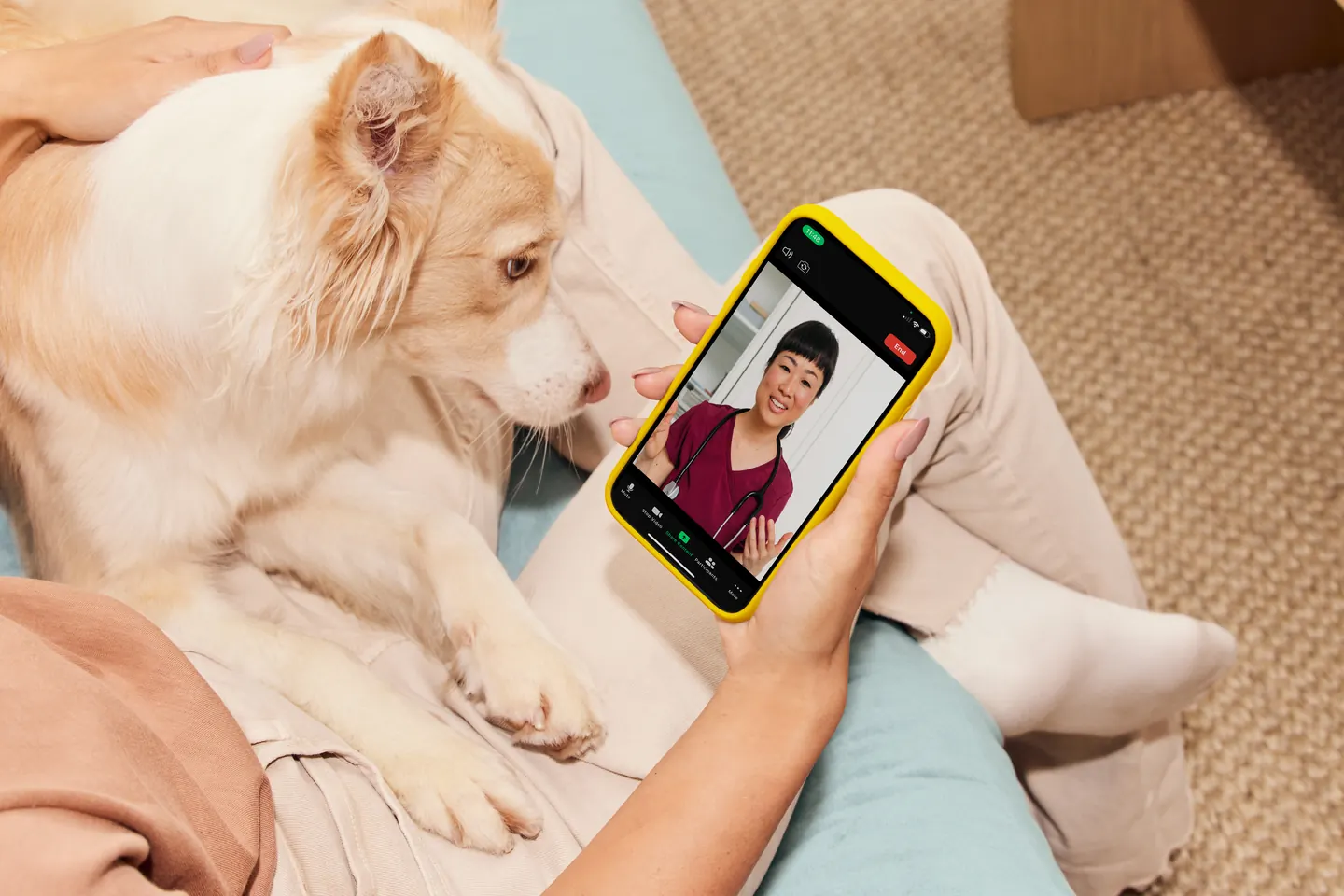
Is Zonisamide (Zonegran) right for your dog?
A licensed vet at Dutch can assess your dog over video and prescribe treatment when it's appropriate, delivered to your door.
Use code Pets60
Plans start at $12/month · covers up to 5 pets
- Licensed vets in most states
- Rx for 150+ conditions
- 4.7 on Trustpilot
Zonisamide for dogs is a prescription anticonvulsant that veterinarians use extra-label to control epilepsy, most often idiopathic epilepsy, either alone or added to phenobarbital or potassium bromide. It is a human drug sold as Zonegran and as generic capsules, and there is no FDA-approved veterinary version.
Your vet sets the zonisamide dose by body weight, it is given by mouth every 12 hours, and it must never be stopped suddenly. A seizure lasting more than 5 minutes, or more than 2 seizures in 24 hours, makes today a vet day, not a wait-and-see day.
What zonisamide is, what it treats in dogs, and why it needs a prescription
VCA Animal Hospitals describes zonisamide as an antiseizure medication used either as a first therapy for epilepsy or as an add-on drug for seizures that are difficult to control. VCA notes that its use in dogs and cats is off label, also called extra-label.
That is why zonisamide is extra-label in dogs: the only FDA label is the human Zonegran label on DailyMed, which covers add-on treatment of partial seizures in adults and has no canine indication. VCA tells owners to follow the veterinarian's directions carefully, because they may differ from the human label.
Is zonisamide a controlled substance? No. The generic zonisamide capsule label on DailyMed lists no DEA schedule, so it is not a controlled drug, but it is a prescription drug. Chewy Pharmacy or your vet clinic fills generic zonisamide capsules only with a veterinarian's prescription.
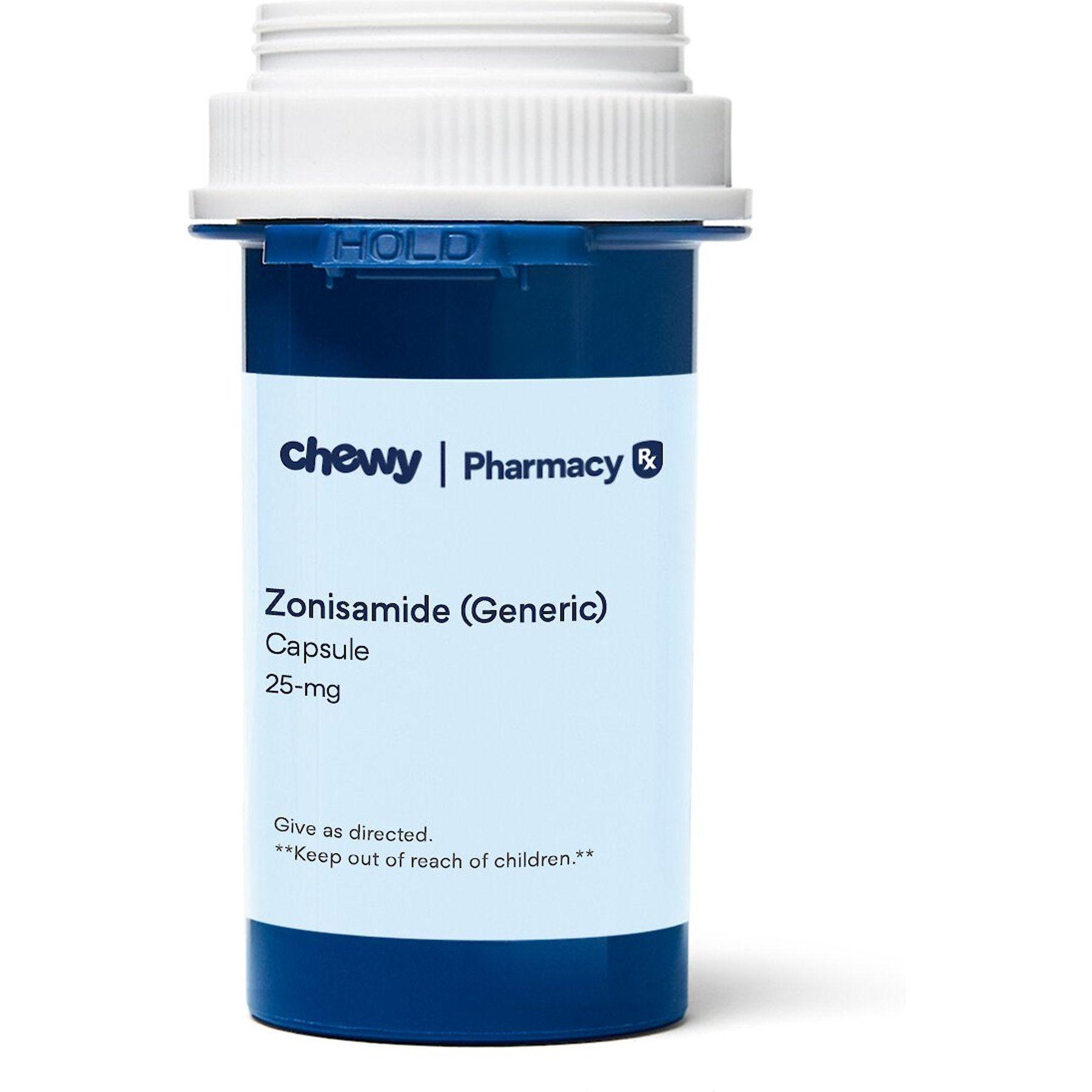
Generic zonisamide 25 mg capsules for seizure control, filled only with your veterinarian's prescription.
Webvet may earn a commission when you click through to Chewy, at no extra cost to you.
- 1Zonisamide is a human anticonvulsant, brand name Zonegran, prescribed for dogs with epilepsy.
- 2Its only FDA label is for people, so vets prescribe it extra-label; there is no veterinary label.
- 3Your vet prescribes a dose set by body weight, given by mouth every 12 hours.
- 4It is a prescription drug but not a controlled substance.
- 5Never stop it suddenly, because seizures can return.
The Merck Veterinary Manual defines epilepsy as two or more unprovoked seizures more than 24 hours apart and describes idiopathic epilepsy as typically genetic. Merck says vets often start an anti-seizure medication after the second or third seizure, after any cluster, or after status epilepticus.
Zonisamide dosage for dogs by weight
Zonisamide dosing is set by body weight in milligrams per kilogram (mg/kg), and your veterinarian calculates the exact dose for your dog. The veterinary references give mg/kg ranges rather than a weight-band dosage chart, and they do not fully agree on the starting dose.

| Situation (source) | Range vets work within | How often | Form |
|---|---|---|---|
| Idiopathic epilepsy, zonisamide alone (2015 ACVIM consensus) | 5 mg/kg of body weight, initial dose | Every 12 hours by mouth | Oral capsule |
| Zonisamide alone, starting (Clinician's Brief) | 3-5 mg/kg of body weight | Every 12 hours by mouth | Oral capsule |
| Newly diagnosed idiopathic epilepsy, monotherapy (2024 JVIM trial authors) | 2.5-5 mg/kg of body weight, proposed starting dose | Every 12 hours by mouth | Oral capsule |
| Dogs and cats, general (Merck Veterinary Manual) | 5-10 mg/kg of body weight | Every 12 hours by mouth | Oral capsule |
| With phenobarbital (2015 ACVIM consensus) | 7-10 mg/kg of body weight | Every 12 hours by mouth | Oral capsule |
| With phenobarbital, starting (Clinician's Brief) | 10 mg/kg of body weight | Every 12 hours by mouth | Oral capsule |
| Target trough blood level (2015 ACVIM consensus, 2024 trial) | 10-40 µg/mL, extrapolated from human medicine | Checked by blood test | Blood sample |
The zonisamide starting dose depends on whether your dog also takes phenobarbital. Merck's anticonvulsant chapter says dogs on an enzyme inducer such as phenobarbital need nearly twice the zonisamide dosage to reach the same blood levels as dogs on zonisamide alone.
Zonisamide titration means building up to the maintenance dose gradually. The 2015 ACVIM consensus statement says gradual titration may reduce sedation, wobbliness, vomiting, and poor appetite. Three facts frame the upper end of the range:
- No source sets a single maximum daily dose for dogs.
- The 2024 JVIM monotherapy trial saw notably more side effects at 10 mg/kg every 12 hours or higher.
- Dogs that responded in that trial took a mean of 4.8 mg/kg every 12 hours (range 2.7-8.6).
Small dogs follow the same mg/kg approach, so the total amount is smaller. Ask your vet whether Zonisamide (Generic) Capsules, 25-mg or a compounded liquid fits your dog's dose.
Give exactly what your vet prescribed. Never raise, lower, or stop the dose on your own.
Zonisamide capsule strengths, brand names, and liquid options
The zonisamide brand name is Zonegran, and the Zonegran label lists only 25 mg and 100 mg hard gelatin capsules. Zonisamide is also generic: the generic label lists 25 mg, 50 mg, and 100 mg capsules. A 50 mg zonisamide product is therefore always a generic capsule.
Both labels list capsules only, with no tablet, and neither lists a 250mg capsule, so your vet decides how to reach a dose that falls between strengths. The 25 mg capsule covers small doses, while the 100 mg capsule covers dogs on a larger total dose.
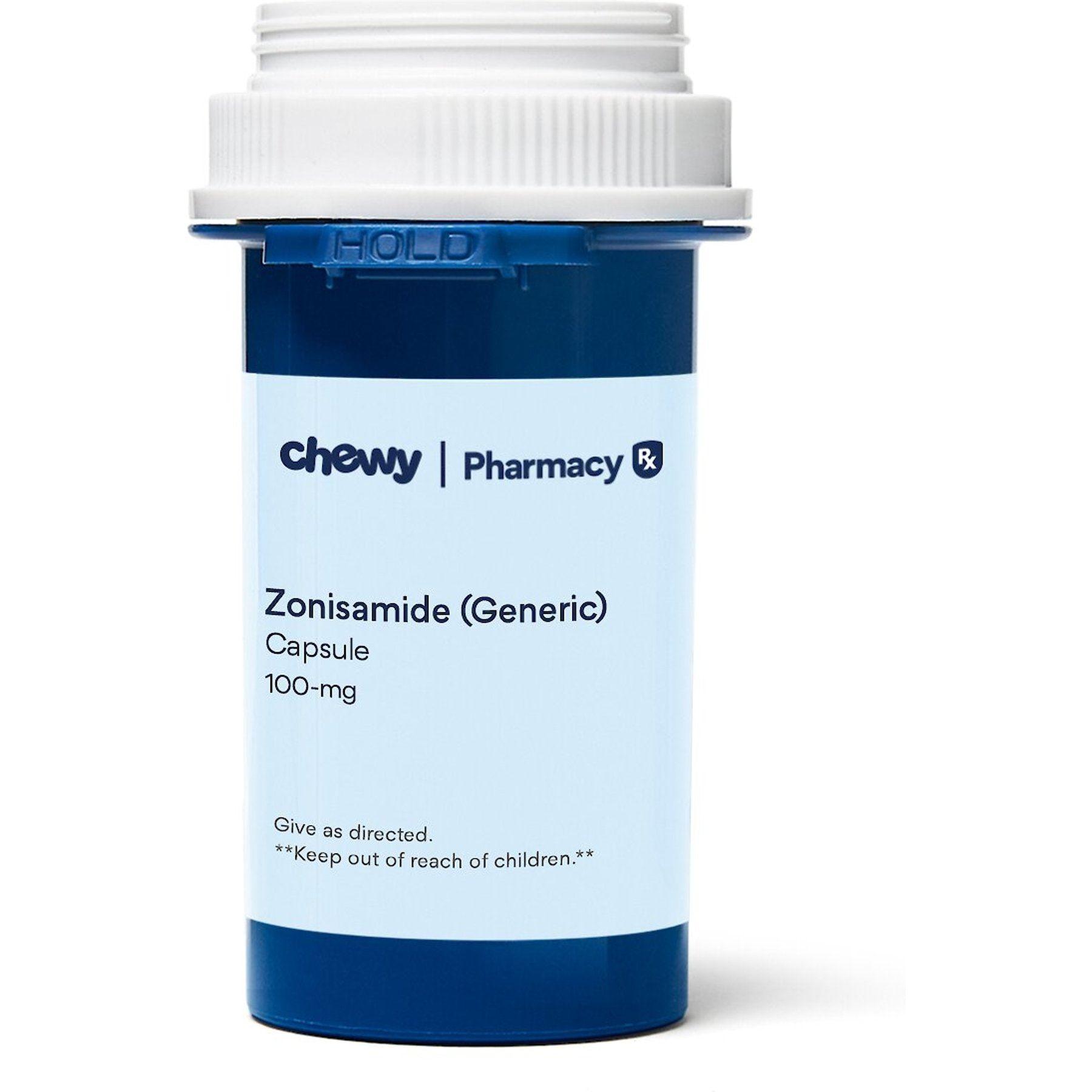
Generic zonisamide 100 mg capsules for dogs on a larger seizure-control dose, filled with a vet prescription.
Webvet may earn a commission when you click through to Chewy, at no extra cost to you.
Does zonisamide come in liquid form? VCA says it can be given as an oral capsule or compounded into an oral liquid, with or without food. A compounding pharmacy prepares the liquid or suspension to your vet's order, which can help for very small dogs. Clinician's Brief notes that no IV form is commercially available.
Chewy lists generic zonisamide in 25 mg, 50 mg, and 100 mg capsule strengths, and its listing notes that customers may receive the drug under the name Zonegran.
How well zonisamide controls seizures and how long it takes to work
What is zonisamide used for in dogs? Mainly seizure control in epilepsy; in animals, VCA describes its use as an antiseizure medication for dogs and cats. Clinician's Brief says it blocks sodium channels, suppresses calcium currents, enhances neuronal inhibition, and weakly inhibits carbonic anhydrase, making it a mild carbonic anhydrase inhibitor. In the brain, Merck explains, this helps stabilize nerve cells and restrict the spread of seizures.
The strongest evidence for its benefits comes from the 2024 JVIM trial of 56 client-owned dogs newly diagnosed with idiopathic epilepsy. On zonisamide alone, 76% had at least a 50% drop in seizure frequency and 55% became seizure free. The study was open-label without a control group, so the result is encouraging rather than final.
As an add-on, the 2015 ACVIM consensus reports that 58-80% of 23 dogs had at least a 50% drop in seizures, while noting the evidence came from small uncontrolled studies. Merck says zonisamide is increasingly used as a first-choice anti-seizure medication in dogs and cats.

How long zonisamide takes to work
VCA says zonisamide should begin working within 1-2 days. Steady blood levels take longer: Clinician's Brief gives 3 to 4 days with a half-life near 15 hours, while Merck gives about 1 week and a half-life of 18-28 hours.
Success is measured in seizures: VCA advises tracking every seizure to show your vet how well the medication works for your dog.
Zonisamide side effects in dogs
VCA lists the common zonisamide side effects in dogs as sedation, incoordination while walking, vomiting, and lack of appetite, with sedation first on the list. Merck calls these usually mild and describes the wobbliness as transient. That is why sedation in the first weeks is expected and usually not an emergency.
The usual timeline keeps expected early signs separate from the ones that need a same-day call:
- First days and weeks: sleepiness, wobbly walking, occasional vomiting, or a smaller appetite. These are expected and usually ease; call your vet if they are severe.
- Call your vet immediately: your dog stops eating, becomes dramatically lethargic, or develops yellow skin, gums, or whites of the eyes, according to VCA.
- Long-term watch items: urinary stones, liver changes, thyroid hormone changes, dry eye, or a change in behavior, which your vet tracks with checkups and bloodwork.
VCA lists liver disease, urinary stones, and aggression as rare long-term side effects of zonisamide in dogs. The veterinary sources do not name nephrolithiasis (kidney stones) specifically. Clinician's Brief notes case reports of acute liver failure, renal tubular acidosis, and a severe skin reaction called erythema multiforme in individual dogs, some potentially fatal.
Because of its sulfonamide base, Merck warns that these could occur:
- Dry eye (keratoconjunctivitis sicca)
- Bone marrow problems
- Liver disease
- Vasculitis
- Metabolic acidosis
- Thyroid hormone changes after long-term use
Hair loss is not on the veterinary lists, though the human Zonegran label lists it as infrequent in people. A 2021 case report in Frontiers in Veterinary Science described three dogs with rage, aggression, and restlessness that almost completely resolved within 5 days after zonisamide was discontinued.

Side effects of zonisamide often go away. In the 2024 trial, 7 of 56 dogs (13%) had reduced activity, decreased appetite, vomiting, hindlimb weakness, soft stools, or constipation, and the authors described these as mild and temporary. For nausea and vomiting after a dose, VCA suggests giving it with food or a small treat.
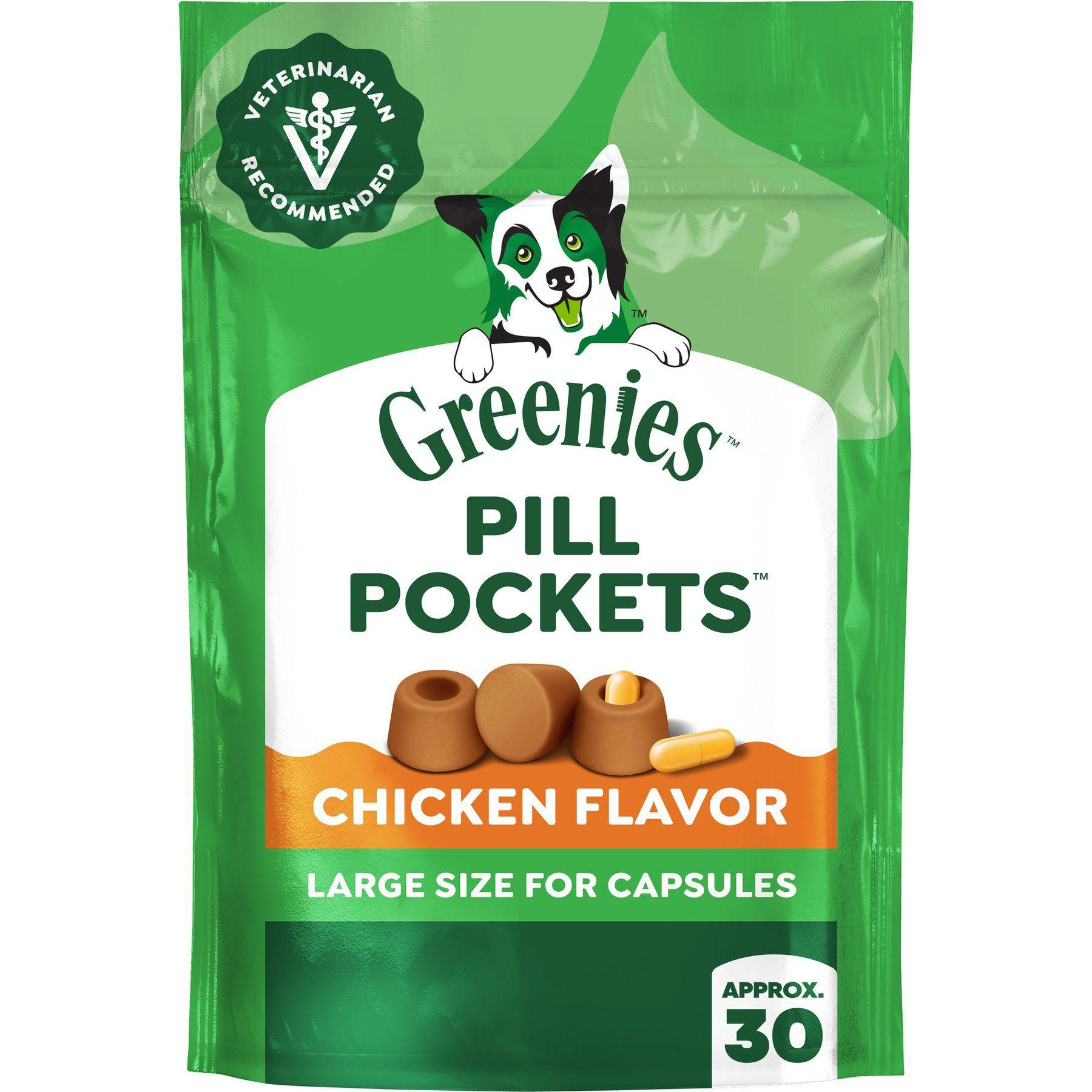
Chicken treats with a built-in pouch that holds most large capsules, for giving a dose with a small treat.
Webvet may earn a commission when you click through to Chewy, at no extra cost to you.
The veterinary sources do not list weight gain as something zonisamide can cause; the listed effect runs the other way, reduced appetite. Because the dose depends on body weight, tell your vet about any big change on the scale.
Overdose signs and seizure emergencies that need a vet now
Can my dog overdose on zonisamide? Yes, for example through an accidental double dose. VCA says never give two doses at once, and if you suspect an overdose or a reaction, call your veterinary office immediately or follow its directions to an emergency facility.
No veterinary source lists specific zonisamide overdose symptoms in dogs. The human label describes one person who became comatose with a slow heart rate, low blood pressure, and slowed breathing, and the 2024 trial saw more side effects at higher doses. After a double dose, call your vet even if your dog seems fine.
A seizure becomes an emergency when it does not stop on its own. The 2024 ACVIM consensus on status epilepticus and cluster seizures defines status epilepticus as a seizure lasting more than 5 minutes and cluster seizures as more than 2 seizures within 24 hours. Go to a vet now if:
- A seizure lasts more than 5 minutes
- Your dog has more than 2 seizures in 24 hours
- Two seizures happen without your dog fully waking up in between, which Merck also counts as status epilepticus
- Your dog got a double dose or you suspect an overdose
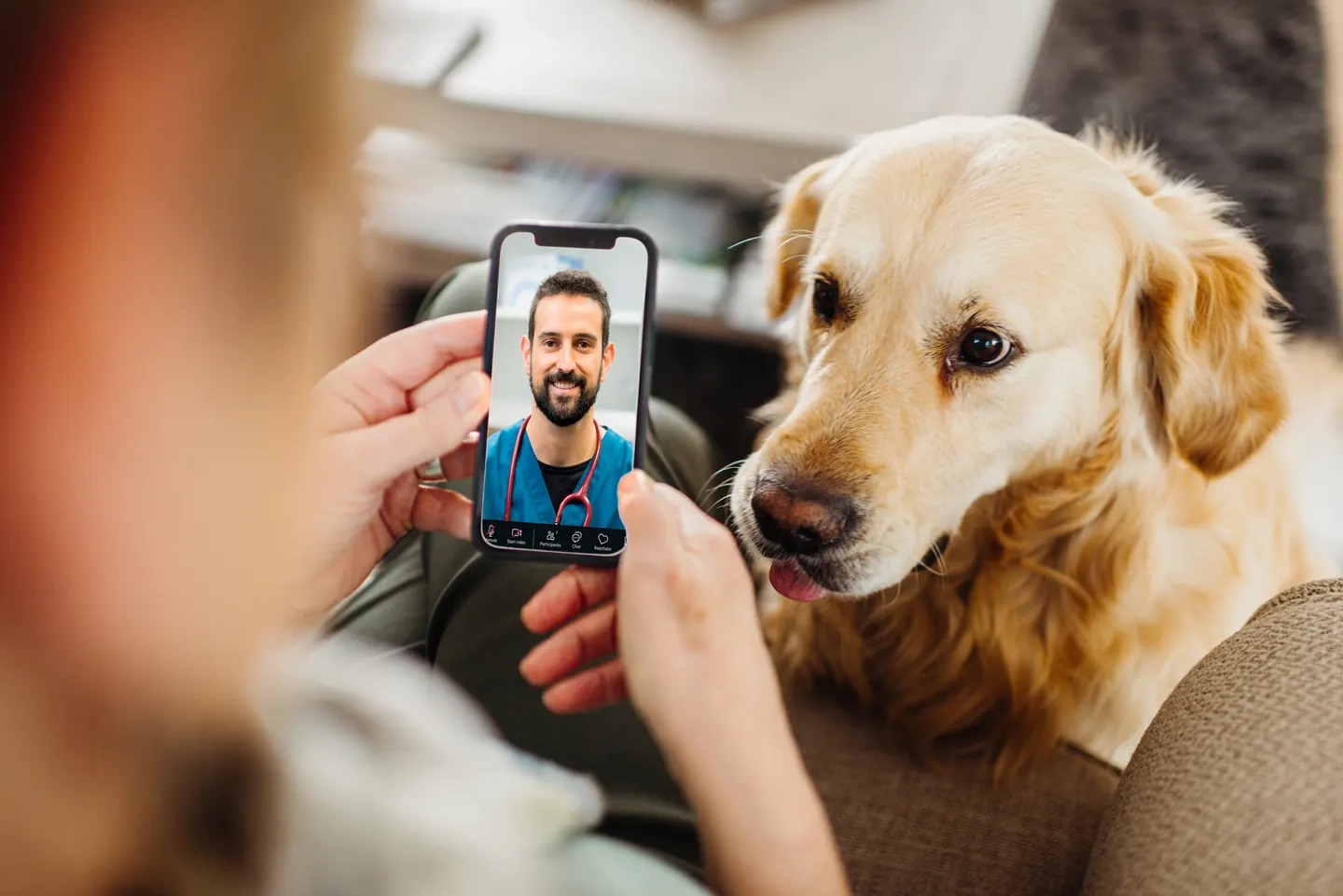 Sponsored
Vet care that's always there
Unlimited video calls and messaging with licensed vets for less than a typical vet visit. One membership covers up to five pets.
Use code Pets60
Plans start at $12/month · covers up to 5 pets
- Licensed vets in most states
- Rx for 150+ conditions
- 4.7 on Trustpilot
How can I manage cluster seizures in my dog?
Agree on a written plan with your vet before a cluster happens. Keep giving the daily anti-seizure medication on schedule, record the time and length of each seizure, and keep any prescribed at-home rescue medicine ready. More than 2 seizures in 24 hours still means calling the vet, even with a plan.
What medication can be used to stop cluster seizures in dogs?
For at-home treatment, the 2024 ACVIM consensus recommends intranasal midazolam or rectal diazepam and lists an oral levetiracetam pulse as another option. In the clinic, Merck says vets may inject levetiracetam. Clinician's Brief says rectal zonisamide is not recommended for status epilepticus. Your vet prescribes and doses each one.
For what triggers cluster seizures, whether a dog survives them and is the same afterward, life expectancy, seizures in senior dogs near the end of life, and what not to give a dog with seizures, see our guide to seizures in dogs.
Sudden wobbling or falling can also come from vestibular disease in dogs or a stroke in dogs, which a vet can tell apart.
Drugs, sulfa sensitivity, and dogs that should not take zonisamide
For most dogs zonisamide is well tolerated: Merck calls it usually safe, and the 2024 trial authors found it well tolerated on its own. The safe amount for a given dog is the dose the vet sets and checks with bloodwork.
The prescription also names the capsule strength; generic 50 mg capsules sit between the 25 mg and 100 mg options, filled only with a veterinarian's prescription.
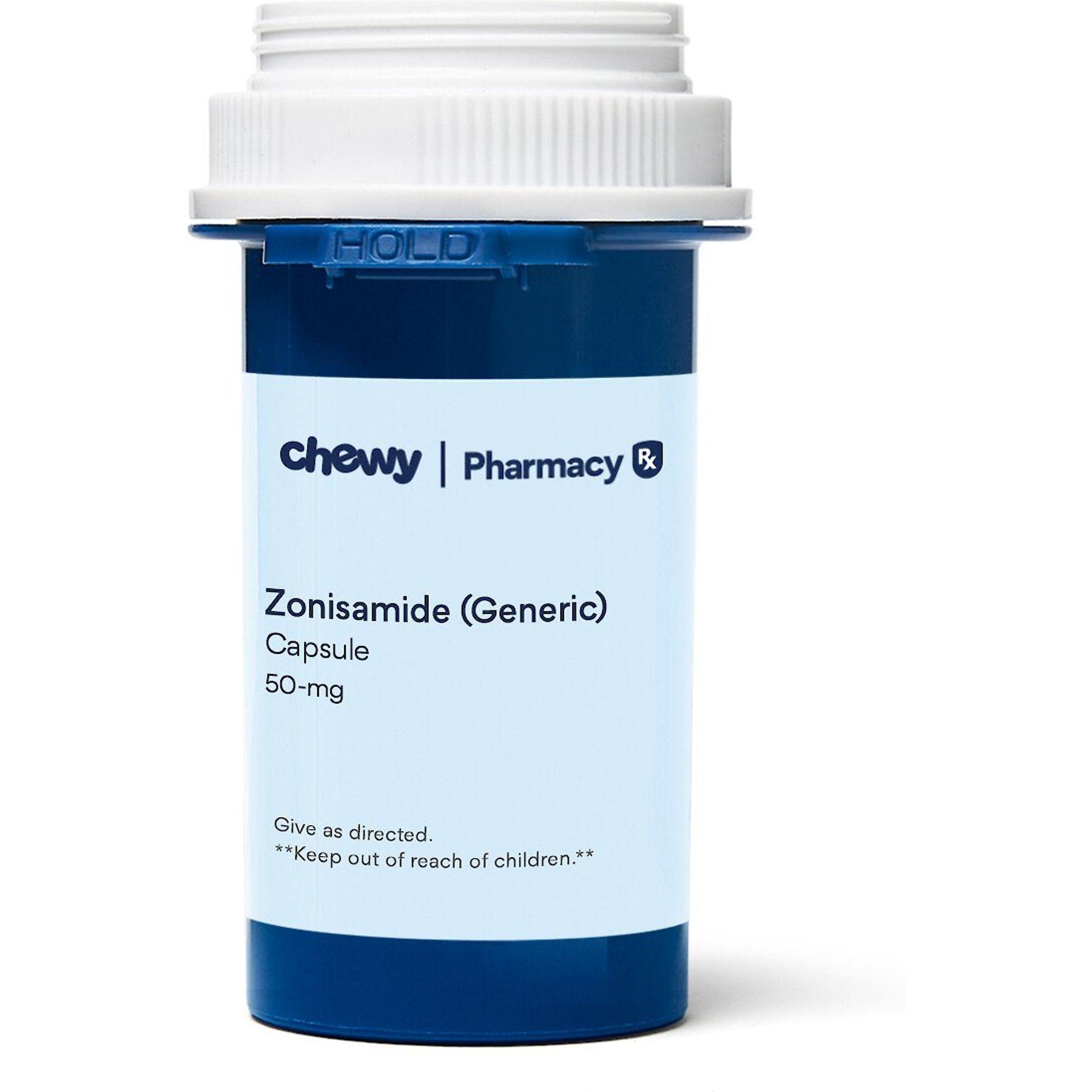
Generic zonisamide 50 mg capsules, the middle strength between 25 and 100 mg, filled with a vet prescription.
Webvet may earn a commission when you click through to Chewy, at no extra cost to you.
Interactions the sources name:
- Phenobarbital: speeds zonisamide clearance, so higher zonisamide doses may be needed. VCA says the effect can last up to 10 weeks after phenobarbital stops; ACVIM reports 12 weeks.
- Other carbonic anhydrase inhibitors: ACVIM advises caution when they are given together.
- Liver enzyme inducers: the human label says drugs that induce the liver enzyme CYP3A4 increase zonisamide clearance.
Is zonisamide a sulfa drug? Yes, it is sulfonamide-based, and the sources differ on how strict to be about sulfa sensitivity. Merck says dogs with a history of sulfa drug hypersensitivity should not be prescribed zonisamide, and the human label lists sulfonamide hypersensitivity as a contraindication. VCA lists sulfa allergy as a reason for caution instead.

The 2015 ACVIM consensus adds that patients with a past allergic reaction to sulfonamide medicines are at higher risk. If your dog ever reacted to a sulfa medicine, tell your vet before the first dose. Merck also says people with sulfa allergies should handle zonisamide with caution, if at all.
VCA says zonisamide should not be used in dogs that:
- Are allergic to zonisamide
- Have liver disease
- Are breeding or pregnant
VCA also advises caution in nursing dogs, and the 2024 trial authors advise caution in animals at risk of metabolic acidosis, such as those with impaired breathing or kidney function. Bloodwork showing elevated liver enzymes in dogs is worth discussing first.
For other common pairings, the references name no specific interaction: levetiracetam (Keppra) and zonisamide together, gabapentin and zonisamide, an antihistamine such as Benadryl, or CBD. That is not proof of safety. VCA asks owners to tell the vet about every medication, vitamin, supplement, or herbal therapy. Our guide to gabapentin for dogs and cats covers that drug.
Giving zonisamide on schedule: missed doses, blood monitoring, and never stopping suddenly
Give zonisamide by mouth every 12 hours, with or without food, per VCA. No source names a best time of day. What matters is the same two times daily, so tying doses to a fixed morning and night routine makes them easier to remember.
Wear gloves when handling it, since VCA calls zonisamide a hazardous drug and says pregnant or nursing people should not handle it. The human label says capsules should be swallowed whole, not crushed or opened, unless your vet says otherwise. A compounded oral liquid is the alternative your vet can order.
Getting a capsule into your dog
A capsule can be hidden in a paste such as Pet MD Wrap-A-Pill Peanut Butter Pill Paste, listed at $14.99 on Chewy when we checked in November 2026. Our best pill pockets for dogs guide compares more options.

For dogs that eat around treats, a Vet Worthy Pill Gun for Dogs is a reusable plastic dispenser for capsules and tablets, listed at $5.49 on Chewy when we checked in November 2026.
What if a dose is missed, and how is zonisamide monitored and stopped safely?
If a dose is forgotten, VCA's missed-dose rule applies:
- Give the missed dose when you remember.
- If it is close to the next dose, skip the missed one and return to the regular schedule.
- Never give two doses at once or extra doses to catch up.
The 2015 ACVIM consensus recommends checking liver enzymes, electrolytes, blood gases, and a blood count before starting and periodically afterward. The Clinician's Brief author suggests zonisamide levels, CBC, and chemistry at 2 weeks and 3 months, then every 6 to 12 months, plus baseline thyroid testing. Our dog bloodwork cost guide explains typical charges.
ACVIM and the 2024 trial give a therapeutic trough level of 10-40 µg/mL, the lowest point before the next dose. ACVIM says to recheck the zonisamide level 1-2 weeks after starting or any dose change, and whenever seizures become more frequent.
Stopping or tapering is a plan only your vet can set, and no source gives a home taper schedule. VCA says to store the capsules at 25°C (76°F), dry and protected from light, so zonisamide does not need to be refrigerated. The sources do not say how long capsules take to expire, so ask the pharmacy before giving any past the date on their label.
Zonisamide vs phenobarbital, Keppra, and potassium bromide, and what it costs
Merck calls phenobarbital and bromide the first-line maintenance anticonvulsants in dogs, with levetiracetam and zonisamide often used as well. Each choice trades something:
- Zonisamide vs phenobarbital for dogs: Merck lists phenobarbital at 2-5 mg/kg every 12 hours as first-line, and ACVIM lists liver toxicity, blood disorders, and skin disease among its risks. Phenobarbital also speeds zonisamide clearance when both are used.
- Potassium bromide vs zonisamide: Merck gives the labeled bromide dose as 11-30 mg/kg once every 24 hours, but bromide can take up to 4 months to reach steady state. Our guide to potassium bromide for dogs covers it in depth.
- Zonisamide vs Keppra for dogs: Merck says immediate-release levetiracetam must be given every 8 hours, and tolerance with long-term use has been reported in dogs.
- Zonisamide vs Zonegran: the same active ingredient; Zonegran is the brand, and generics are labeled separately.
- Zonisamide vs gabapentin: gabapentin is a different drug, not the same as zonisamide.
- Zonisamide vs lacosamide: the veterinary references give no dog data comparing them, so choosing between them is a decision for your vet or a veterinary neurologist.

Switching from Keppra to zonisamide, or adding zonisamide, follows Merck's rule that previous anti-seizure drugs should not be stopped or reduced until seizure control is achieved. Whether zonisamide is used with Keppra long term is your vet's call; the references name no interaction between them.
Zonisamide cost for dogs is modest because it is generic, and Clinician's Brief notes generic availability made it more affordable than when first introduced. Monitoring bloodwork adds to the yearly cost.
Chewy Pharmacy fills each generic strength with a veterinarian's prescription:
- Zonisamide (Generic) Capsules, 25-mg, 30 capsules: listed at $7.50 on Chewy when we checked in November 2026
- Zonisamide (Generic) Capsules, 50-mg, 30 capsules: listed at $8.40 on Chewy when we checked in November 2026
- Zonisamide (Generic) Capsules, 100-mg, 30 capsules: listed at $7.80 on Chewy when we checked in November 2026
What is veterinary levetiracetam used for?
Levetiracetam, sold for people as Keppra, controls seizures. Merck says it has been used as an add-on anticonvulsant in dogs with refractory epilepsy and in cats, appears very safe with rare side effects, and is given every 8 hours as immediate-release or every 12 hours as extended-release. Vets may also inject it for status epilepticus or cluster seizures.
Zonisamide for dogs questions
Frequently Asked Questions
Is zonisamide a controlled substance?
No. The human labels list no DEA schedule, and the Zonegran label says animal studies did not show abuse liability. It still requires a prescription, so a veterinarian must authorize every fill for a dog.
Can zonisamide capsules be opened for a dog?
Only if your vet says so. The human label directs swallowing each capsule whole, and VCA classes the drug as hazardous, so opening one releases powder you should not handle bare-handed. For a dog that cannot take a capsule, the vet can order zonisamide compounded into an oral liquid.
Does zonisamide cause hair loss in dogs?
Hair loss is not among the dog side effects listed by VCA, Merck, the ACVIM consensus, or the 2024 trial. People taking Zonegran occasionally report it. If your dog's coat thins or a rash appears, show your veterinarian, and keep giving doses until they advise otherwise.
Is zonisamide the same as Zonegran?
Zonegran is the brand name, and generic zonisamide capsules contain the same active ingredient under their own FDA labels. Zonegran comes in 25 mg and 100 mg capsules, while the generic also comes in a 50 mg strength.
Can my dog take zonisamide with Benadryl?
There is no published veterinary guidance on Benadryl (diphenhydramine) with zonisamide specifically. Zonisamide itself can cause sedation, so ask your vet before adding Benadryl or any other medicine, and report any extra sleepiness after combining them.
Veterinarian · BVMS MRCVS
Dr. Pippa Elliott, BVMS, MRCVS, is a veterinarian with nearly 30 years of experience in companion animal practice. Dr. Elliott earned her Bachelor of Veterinary Medicine and Surgery from the University of Glasgow. She was also designated a Member of the Royal College of Veterinary Surgeons. Married with 2 grown-up kids, Dr. Elliott has a naughty Puggle named Poggle, 3 cats and a bearded dragon.
Related reading

Potassium Bromide for Dogs: Epilepsy Dosage, Side Effects, and Blood Monitoring

Diphenoxylate for Dogs (Lomotil): Dosage, Safety, and Why Vets Use Caution

Budesonide for Dogs: IBD Dosage, Side Effects, and How It Compares With Prednisone
