Potassium Bromide for Dogs: Epilepsy Dosage, Side Effects, and Blood Monitoring
Potassium bromide is a prescription anticonvulsant for dogs with epilepsy, now FDA approved as KBroVet chewables. This guide covers how vets dose it, side effects, why diet salt matters, toxicity signs, and blood level checks.

BVMS MRCVS
Medically reviewed by Dr. Pippa Elliott, BVMS MRCVS · Last reviewed

Drug facts
KBroVet (potassium bromide chewable tablets)· potassium bromide
Potassium bromide is an anticonvulsant for dogs with idiopathic epilepsy, given by mouth once or twice daily alone or with phenobarbital. KBroVet chewable tablets are FDA approved and prescription only; liquids and capsules are compounded. It takes months to reach steady blood levels, needs regular blood tests, and is not for use in cats.

 Sponsored
Is KBroVet (potassium bromide chewable tablets) right for your dog?
A licensed vet at Dutch can assess your dog over video and prescribe treatment when it's appropriate, delivered to your door.
Use code Pets60
Plans start at $12/month · covers up to 5 pets
- Licensed vets in most states
- Rx for 150+ conditions
- 4.7 on Trustpilot
Potassium bromide for dogs is a prescription anticonvulsant used to control seizures caused by idiopathic epilepsy. In the US it is sold as KBroVet chewable tablets, which the U.S. FDA Center for Veterinary Medicine fully approved on January 21, 2026.
Your vet decides whether potassium bromide fits your pet, sets the dose, and schedules blood checks. If your dog is having a seizure right now, is wobbly and dazed, or has had several seizures in a day, today is a vet day.
What potassium bromide is, how it controls seizures in dogs, and why it is prescription only
Potassium bromide is a halide salt. The KBroVet label on DailyMed explains that it is thought to pass through chloride channels in nerve cells, making them less excitable and raising the seizure threshold. The Merck Veterinary Manual calls bromide the oldest anticonvulsant.
It can be used alone or alongside phenobarbital. The liver does not break it down, and it leaves the body so slowly that steady blood levels take weeks to months, so improvement builds gradually.
- 1Potassium bromide controls seizures in dogs with idiopathic epilepsy, alone or with phenobarbital.
- 2KBroVet chewable tablets are the FDA-approved form; liquids and capsules are compounded.
- 3It is prescription only because a vet must diagnose epilepsy and monitor safe use.
- 4A loading dose is optional and vet-supervised; the maintenance dose is daily and lifelong.
- 5Steady blood levels take months, so regular blood tests guide every dose change.

Why prescription only? The FDA says KBroVet needs a prescription because a veterinarian must diagnose idiopathic epilepsy and monitor safe use, including treating any adverse reactions. The label carries the federal caution restricting it to use by or on the order of a licensed veterinarian.
Owner reviews vary, so the label's field results are a steadier guide: in one study, 18 of 27 dogs (67%) counted as treatment successes.
The FDA first granted conditional approval in January 2021 under the name KBroVet-CA1, and the Chewy listing still uses that name. The KBroVet-CA1 250 mg chewable tablets are filled by Chewy Pharmacy only with a veterinarian's prescription.
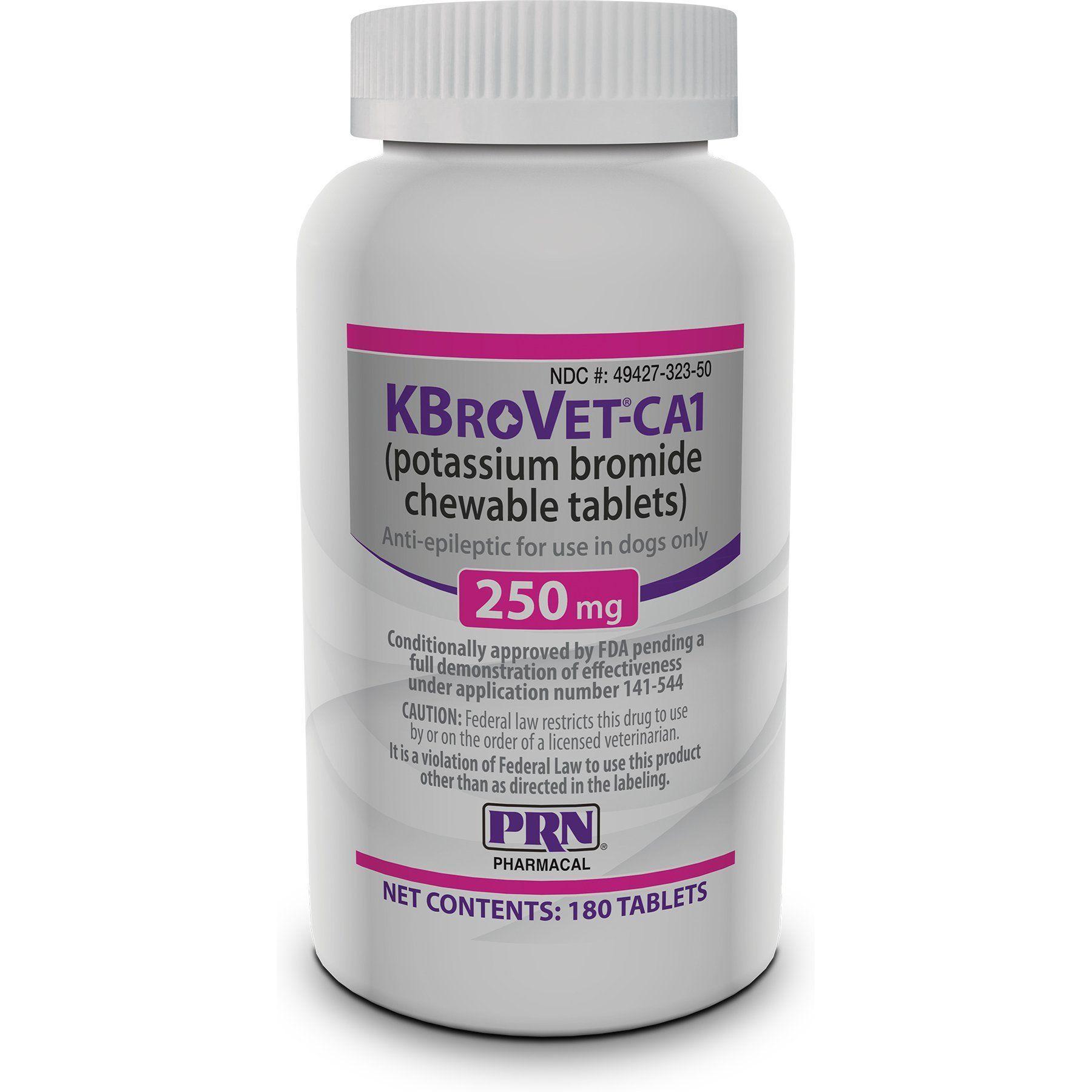
FDA-approved potassium bromide chewable tablets for dogs with idiopathic epilepsy, dispensed with your vet's prescription.
Webvet may earn a commission when you click through to Chewy, at no extra cost to you.
Potassium bromide dosage for dogs by weight, including the loading dose
| Weight band | Phase and source | Dose range vets work within | Form |
|---|---|---|---|
| Any weight, dose set per kg | Maintenance (FDA label) | 25 - 68 mg/kg (11-31 mg/lb) total daily oral dose, adjusted by clinical response | KBroVet chewable tablets, 250 mg or 500 mg, not split |
| Any weight | Loading dose (FDA label) | Optional and decided per dog; the label gives no loading dose figure | KBroVet chewable tablets |
| Any weight | Loading dose (Merck Veterinary Manual) | 100 mg/kg by mouth every 24 hours for 4-6 days; not recommended unless another seizure drug must be stopped abruptly | Tablet or compounded liquid |
| Any weight | Loading dose, alternative (Merck Veterinary Manual) | 120 mg/kg every 24 hours plus 20-30 mg/kg maintenance for the 5 loading days, then maintenance alone | Oral |
| Any weight | Loading dose (IVETF consensus) | 625 mg/kg over 48 h in eight or more doses in hospital, or 125 mg/kg/day split 3-4 times daily for 5 days | Oral |
| Any weight | Maintenance, bromide alone (IVETF consensus) | 20 mg/kg twice daily starting dose; target serum about 2000-3000 mg/l | Oral |
| Any weight | Maintenance with phenobarbital (IVETF, Merck) | IVETF 15 mg/kg twice daily starting dose; Merck 15-30 mg/kg every 24 hours; target serum 1-2 mg/mL | Oral |
The label gives one total daily range by body weight rather than a weight chart, so there is no official dosing chart by weight to print. Your vet calculates the exact dose per kg from your dog's weight, seizure history, and other medicines, and adjusts it from blood results.
How much potassium bromide your dog takes is always the vet's decision. Give exactly what was prescribed, at the times prescribed, and never change, skip, or stop the dose without talking to your vet. Stopping suddenly can put a dog at risk of more severe seizures.

The KBroVet label sets the canine dose at 25 - 68 mg/kg (11-31 mg/lb) of body weight per day, given with or without food. The chewables come in 250 mg and 500 mg strengths and are not split, so the vet builds the daily dose from whole tablets.

The 500 mg KBroVet chewable strength, for dogs whose vet-prescribed potassium bromide dose calls for larger tablets.
Webvet may earn a commission when you click through to Chewy, at no extra cost to you.
Does a dog need a loading dose of potassium bromide?
The label lets the vet consider a loading dose for an individual dog, balancing a faster response against side effects, but gives no loading figure. Loading dose versus maintenance, in short:
- Loading dose: a short burst of higher doses that fills the body's bromide stores quickly. The Merck Veterinary Manual epilepsy chapter cautions against routine loading because of sedation, stomach upset, and aspiration risk, and reserves it for dogs that must come off another seizure drug abruptly.
- Hospital loading: the International Veterinary Epilepsy Task Force (IVETF) consensus advises hospitalizing a dog loaded over 48 hours.
- Maintenance: the steady daily dose that follows, often given once a day in the evening because of the long half-life.
Whatever the form, the vet doses by mg/kg. In the US, the larger strength is the KBroVet-CA1 500 mg chewable tablets, listed in a 120-tablet bottle and dispensed only against a veterinary prescription.
KBroVet chewable tablets vs compounded capsules and liquid
VCA Animal Hospitals lists three forms: chewable tablets, capsules, and liquid solution. Only one is the FDA-approved product. The others are made to order by compounding pharmacies, and VCA notes some bromide use in dogs is off label or extra label.
KBroVet potassium bromide chewable tablets for dogs, still listed on Chewy as KBroVet-CA1, come as flavored, non-scored 250 mg or 500 mg tablets, and the label says not to split them. The manufacturer, on the KBroVet site, describes them as French vanilla flavored and sells 60- and 180-count bottles.

Merck notes that liquid formulations, sometimes called potassium bromide syrup or solution, must come from a compounding pharmacy. Compounded capsules and liquids are not the approved product, so strength and flavor depend on the pharmacy's preparation.
- Chewable tablets (KBroVet): FDA approved, fixed 250 mg or 500 mg strengths, flavored, not to be split.
- Compounded capsules: made in custom strengths; VCA advises making sure the capsule is fully swallowed and followed by food or water to avoid mouth or throat irritation.
- Compounded liquid: allows small, precise doses; VCA says to measure each dose with an accurate syringe and store it per the pharmacy label.
If a bottle carries a different product name, ask your vet what is in it. In the US, the approved product is KBroVet, and other potassium bromide tablets, capsules, or liquid your vet prescribes are compounded.
Capsules are harder to hide than a flavored chewable. Our guide to the best pill pockets for dogs covers treat-style wraps, and simple tools such as the Vet Worthy Pill Gun for Dogs or Pet MD Wrap-A-Pill Peanut Butter pill paste can help with a dog that spits out capsules.
What potassium bromide is used for in dogs and how long it takes to work
The label indication is control of seizures associated with idiopathic epilepsy in dogs, a form of canine epilepsy with no known cause. The FDA says idiopathic epilepsy affects roughly 5% of dogs. Merck lists potassium bromide and phenobarbital as first-line maintenance drugs for dogs with seizures.
Potassium bromide works slowly. The usual timeline:
- Days: side effects can start right away, VCA notes.
- Weeks: gradual improvement is usually seen, and full effects can take up to a few weeks (VCA).
- Months: with a half-life of 25-46 days, steady blood levels can take up to 4 months (Merck).
The goal is fewer seizures, not none. The manufacturer says medication is unlikely to eliminate seizures and that treatment is lifelong once started. For what epilepsy looks like, its causes and triggers, whether any food stops seizures, and whether a dog can die during one, see our guide to seizures in dogs.
Because levels build over months, a form your dog takes reliably every day matters. When the chewable is refused or a custom strength fits better, a vet can prescribe the Potassium Bromide Compounded Capsule, 400 mg, listed at $55.80 for 90 capsules on Chewy when we checked in November 2026.
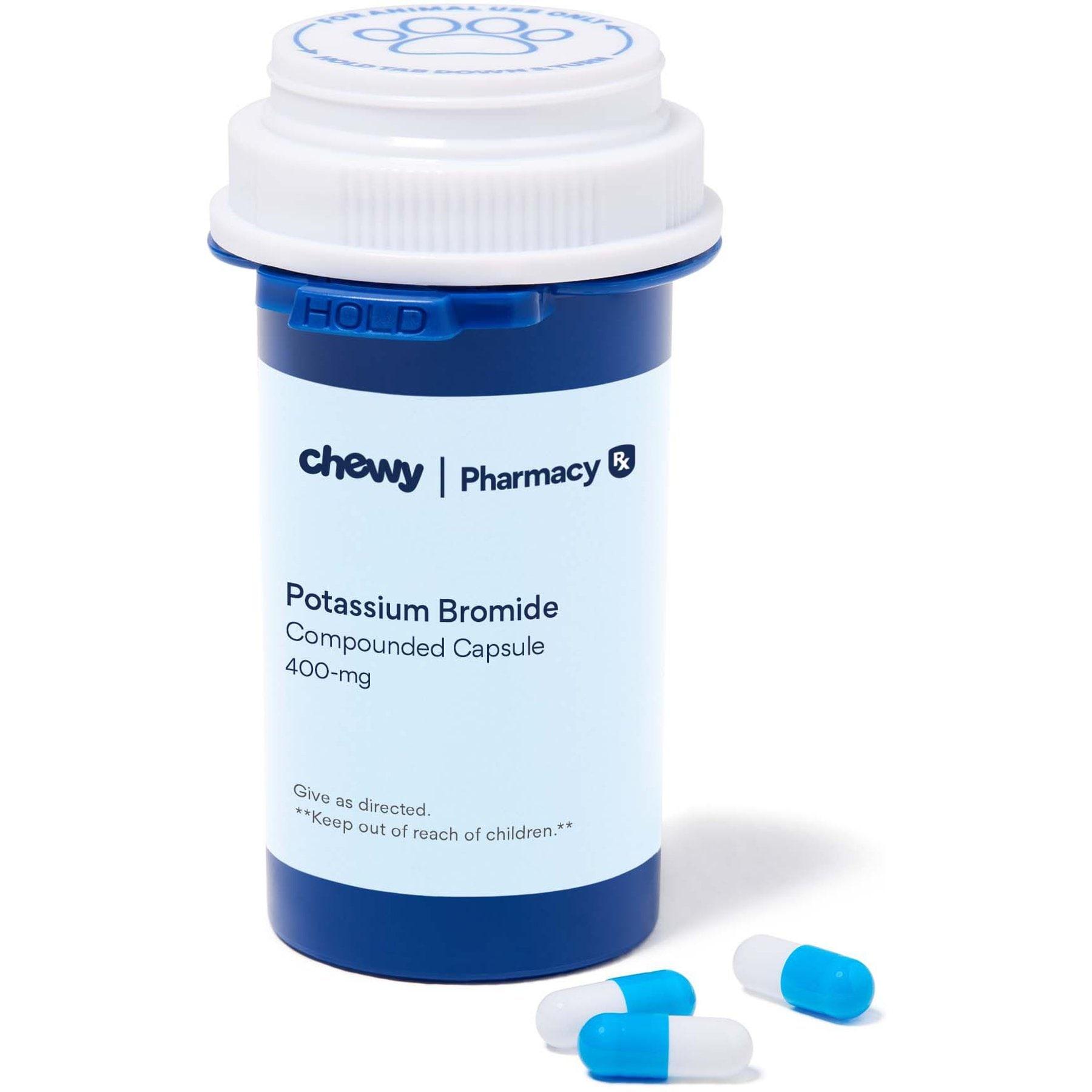
A compounded 400 mg potassium bromide capsule your vet can prescribe when a custom strength suits your dog better.
Webvet may earn a commission when you click through to Chewy, at no extra cost to you.
What are the uses of bromide?
In veterinary medicine, bromide is an anticonvulsant. Merck says it can be a single-drug treatment for epilepsy in dogs or an add-on for dogs whose seizures resist other drugs. In one monotherapy study, about 74% of dogs had more than a 50% drop in seizures. It is no longer recommended for cats.
Potassium bromide side effects in dogs: wobbliness, thirst, hunger, and pacing
The label reports increased appetite, weight gain, vomiting or regurgitation, and sedation as the most common problems in the first 60 days. Merck adds wobbliness (ataxia), increased thirst and urination, and stomach irritation.
The most common side effects include:
- Increased hunger and weight gain
- Sleepiness and sedation
- Wobbliness and hind-limb weakness
- Increased thirst and urination
- Vomiting, regurgitation, or diarrhea
- Restlessness or irritability, which some owners notice as pacing

Early wobbliness with sedation is expected for many dogs. The IVETF consensus says sedation, ataxia, hind-limb weakness, thirst, and hunger appear in the first weeks, may be stronger alongside phenobarbital, and partly or fully subside once steady state is reached. Merck says marked sedation during loading should improve within a couple of weeks.
Long-term side effects reported at steady state on the label include weight gain, weakness, ataxia, and increased appetite. The IVETF lists uncommon reactions: personality changes such as aggression or hyperactivity, persistent cough, a higher pancreatitis risk, and megaesophagus. See our guide to pancreatitis in dogs.
Food helps the stomach. The IVETF advises giving bromide with food and splitting the daily dose into two or more portions to reduce stomach irritation. A soft treat such as Greenies Pill Pockets can make a meal-time dose easier for dogs on capsules.

Chicken-flavored treats with a built-in pouch that hides a capsule or tablet at dose time.
Webvet may earn a commission when you click through to Chewy, at no extra cost to you.
Thirst and hunger can be hard to separate from other causes, especially in older dogs. If a senior dog suddenly drinks far more, our guide to a senior dog drinking a lot of water explains other reasons worth ruling out with your vet.
 Sponsored
Vet care that's always there
Unlimited video calls and messaging with licensed vets for less than a typical vet visit. One membership covers up to five pets.
Use code Pets60
Plans start at $12/month · covers up to 5 pets
- Licensed vets in most states
- Rx for 150+ conditions
- 4.7 on Trustpilot
Bromide toxicity and seizure emergencies that need a vet now
Bromide toxicity, or bromism, happens when bromide builds too high for that dog. Merck notes it can occur at any blood level in an unusually sensitive dog. Because bromide clears so slowly, it usually develops over weeks rather than hours.
Call your vet or an emergency clinic now if a dog on potassium bromide shows these signs, which the FDA and VCA list for severe intoxication or serious reactions:
- Marked wobbliness, poor coordination, or hind-limb weakness or partial paralysis
- Stupor, a dazed state, depression, or behavior changes
- Dilated pupils, shaking, or twitching
- Continuous vomiting or diarrhea, or persistent loss of appetite
- Yellowing of the skin or eyes
- Coma or unresponsiveness
Severe wobbliness on bromide is not something to wait out at home. It has other causes too, such as vestibular disease in dogs, which a vet can rule out.
If a dog dies while on bromide, owners often want to know whether the drug was to blame. In overdose, the label reports stupor progressing to coma and death at 200 to 500 mg/kg a day for 4 to 26 weeks, far above the approved range.
A case in BMC Veterinary Research describes a dog with a month of worsening ataxia after an unprescribed diet change. Merck says severe bromism is treated with IV saline, with improvement expected within 48 hours.
What are bad signs after a dog has a seizure?
Merck says most seizures last seconds to a few minutes. A seizure that keeps going, a second seizure within 24 to 48 hours (a cluster), or continuous seizure activity (status epilepticus) needs emergency care. On bromide, stupor, deep wobbliness, hind-limb weakness, or dilated pupils also warrant an immediate call.
Diet salt, other drugs, and dogs that should not take potassium bromide
The kidney handles bromide and chloride together. The label explains that more dietary chloride (salt) pushes bromide out in the urine and lowers blood levels, while less chloride lets bromide build up. Merck says keeping dietary chloride consistent is crucial, and the FDA advises avoiding abrupt diet changes.

Drugs and situations that interact with potassium bromide include:
- Phenobarbital, which adds to sedation and wobbliness
- Loop diuretics such as furosemide, which speed bromide loss (IVETF)
- Chloride-containing IV fluids and high- or low-salt diets
- Other sedating drugs and drugs that lower the seizure threshold (VCA)
- Lab chloride tests, which may read falsely high (Merck)
Dogs that should not take potassium bromide, or need extra caution:
- Cats: the label says not for use in cats, and Merck links bromide to a potentially fatal lung disease in cats
- Dogs with a history of bromide hypersensitivity
- Dogs with reduced kidney function, which the label says may predispose them to toxicity
- Breeding, pregnant, or nursing dogs and puppies, where safety has not been established
Bromide blood levels, missed doses, and never stopping suddenly
Potassium bromide levels in dogs are checked with a blood test. Merck's target is 1-3 mg/mL when bromide is used alone and 1-2 mg/mL alongside phenobarbital. The half-life is long: Merck gives 25-46 days, while one study on the label found a median of 15.2 days.

That slow build is why vets recheck blood on a schedule:
- After a loading dose: Merck suggests a sample within 2 weeks; the IVETF suggests 1 month after loading.
- 1 month after starting maintenance: an early check per Merck.
- 3 months after starting or changing the dose: the IVETF timing, when steady state is best assessed.
- 4 months: Merck's second check, when steady state is usually reached.
- Long term: every 6 months (IVETF) or 6-12 months (Merck), plus a blood count and biochemistry every 6 months (IVETF).
Each recheck shows whether the maintenance dose is reaching the target. Our guide to dog bloodwork cost explains what these tests involve.
For a missed dose, VCA advises giving it when remembered unless the next dose is close, then skipping it; never give two doses at once. The manufacturer says one missed dose is unlikely to cause a big drop in levels.
Stopping potassium bromide in dogs should only happen under a vet's direction; VCA says never stop abruptly, and the manufacturer warns it can raise the risk of more severe seizures. Weaning a dog off potassium bromide, or reducing the dose, is considered only after at least 1-2 years without seizures, per the IVETF.
Potassium bromide vs phenobarbital, and what it costs
Choosing between phenobarbital and potassium bromide comes down to speed, liver health, and side effects. Merck says phenobarbital reaches steady state in about 2-3 weeks, versus months for bromide.
- Speed: phenobarbital works faster; bromide takes months to reach steady levels.
- Liver: phenobarbital is processed by the liver and avoided in liver disease; the IVETF calls bromide a good alternative for those dogs.
- Combination: for phenobarbital and potassium bromide dosage together, Merck gives phenobarbital 2-5 mg/kg every 12 hours with bromide 15-30 mg/kg every 24 hours.
Zonisamide is another option vets use; see our guide to zonisamide for dogs.
On price, the IVETF credits low cost as one reason both drugs stayed popular. Cost depends on dose and form. On Chewy, the KBroVet-CA1 250 mg, 60 tablets was listed at $34.65 and the KBroVet-CA1 500 mg, 120 tablets at $135.40 when we checked in November 2026.
Buying it online, including from Chewy, requires a prescription the pharmacy confirms with your vet; your clinic is the other place to buy it.
Why is potassium bromide not used anymore?
It still is. Merck lists bromide as a first-line maintenance drug in dogs, and the FDA fully approved KBroVet in 2026. It is no longer recommended in cats, and one study cited by the IVETF found it less effective and less tolerable than phenobarbital as a first choice.
Potassium bromide for dogs questions
Frequently Asked Questions
Is potassium bromide FDA approved for dogs?
Yes. The FDA granted full approval to KBroVet chewable tablets on January 21, 2026 (NADA 141-615), after conditional approval in 2021. The Merck Veterinary Manual still describes the tablets as conditionally approved, but the FDA action is current. Compounded liquids and capsules are not FDA approved.
Can potassium bromide be used alone or only with phenobarbital?
Both. Bromide can be given alone or as an add-on, and the IVETF gives separate starting doses for each. The label cautions that some dogs do not respond to bromide alone, so your vet may add phenobarbital or another drug.
Is liquid potassium bromide better than chewable tablets?
Neither is better for every dog. Chewable tablets are the approved form in fixed strengths, while a compounded liquid allows small custom doses. Liquid must be measured carefully with an accurate syringe.
Can potassium bromide cause pancreatitis in dogs?
It can, though it is uncommon. Merck reports pancreatitis when bromide is given with phenobarbital. Call your vet if your dog has repeated vomiting or refuses food.
Do dogs on potassium bromide need regular blood tests?
Yes. Because bromide takes months to reach steady state, a blood test confirms the level after starting, after any dose change, and then on a regular schedule for life.
Veterinarian · BVMS MRCVS
Dr. Pippa Elliott, BVMS, MRCVS, is a veterinarian with nearly 30 years of experience in companion animal practice. Dr. Elliott earned her Bachelor of Veterinary Medicine and Surgery from the University of Glasgow. She was also designated a Member of the Royal College of Veterinary Surgeons. Married with 2 grown-up kids, Dr. Elliott has a naughty Puggle named Poggle, 3 cats and a bearded dragon.
Related reading

Zonisamide for Dogs: Seizure Dosage, Side Effects, and Monitoring

Diphenoxylate for Dogs (Lomotil): Dosage, Safety, and Why Vets Use Caution

Budesonide for Dogs: IBD Dosage, Side Effects, and How It Compares With Prednisone
