Vetsulin for Dogs and Cats: Dosing, Storage, Side Effects, and Cost
Vetsulin is a prescription U-40 insulin vets use to manage diabetes in dogs and cats. This guide covers how the dose is set and adjusted, mixing and storage, matching syringes, low blood sugar warning signs, cost, and home monitoring.

BVMS MRCVS
Medically reviewed by Dr. Pippa Elliott, BVMS MRCVS · Last reviewed

Drug facts
Vetsulin (porcine insulin zinc suspension)· vetsulin
Vetsulin is an FDA-approved prescription U-40 porcine insulin zinc suspension from Merck Animal Health that lowers high blood sugar and its signs in dogs and cats with diabetes mellitus. The veterinarian sets and adjusts each dose from glucose curves and clinical signs.

 Sponsored
Is Vetsulin (porcine insulin zinc suspension) right for your pet?
A licensed vet at Dutch can assess your pet over video and prescribe treatment when it's appropriate, delivered to your door.
Use code Pets60
Plans start at $12/month · covers up to 5 pets
- Licensed vets in most states
- Rx for 150+ conditions
- 4.7 on Trustpilot
Vetsulin is a prescription U-40 insulin, a porcine insulin zinc suspension made by Merck Animal Health, that the FDA approved to lower high blood sugar in dogs and cats with diabetes mellitus. Only a veterinarian can prescribe it, and the vet sets and adjusts every dose from glucose readings.
If your pet already has a Vetsulin prescription, most days are routine: shake the vial, draw the dose with a U-40 syringe, and inject after a meal. Today is a vet day if your pet is weak, wobbly, not eating, or vomiting, because low blood sugar is the emergency every owner needs to recognize.
Vetsulin for dogs and cats: what it treats, prescription status, and whether today is a vet day
- 1In short, what Vetsulin treats is diabetes mellitus in dogs and cats: it lowers high blood sugar and the thirst, urination, and weight loss that come with it.
- 2The label explains how the vet sets the starting dose: by body weight for dogs and as a small fixed amount per injection for cats, then adjusted from glucose curves.
- 3Use only U-40 syringes or the VetPen with Vetsulin; a U-100 syringe gives the wrong dose.
- 4Weakness, wobbling, twitching, or a seizure after an injection can mean low blood sugar and needs action now.
Vetsulin dog insulin and Vetsulin feline use are the same product, sold as Caninsulin outside the United States according to Merck Animal Health. The FDA-approved label on DailyMed describes a sterile zinc suspension of purified porcine insulin, 40 International Units per mL.

Federal law restricts Vetsulin insulin for dogs and cats to use by or on the order of a licensed veterinarian. The Vetsulin (porcine insulin zinc suspension) U-40 Injectable for Dogs & Cats, 10-mL is the vial most pets use, and Chewy Pharmacy fills it only with a veterinarian's prescription.
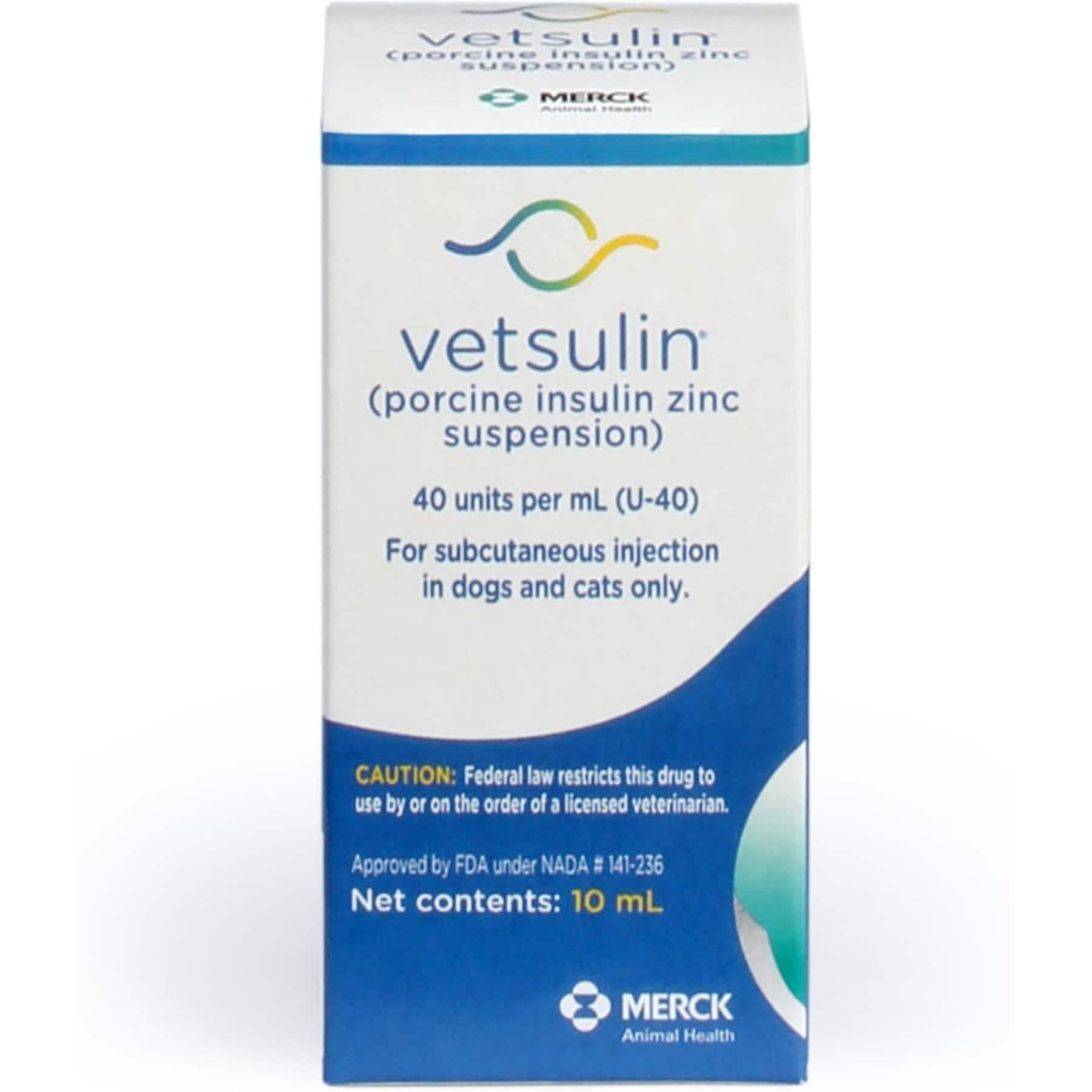
The 10 mL U-40 Vetsulin vial your vet prescribes, filled by pharmacy only with a valid veterinary prescription.
Webvet may earn a commission when you click through to Chewy, at no extra cost to you.
The owner sheet in the label says Vetsulin is not a cure, but most pets improve within a few days, and some cats go into remission and no longer need injections. Stopping or skipping it lets the signs return.
The Merck Veterinary Manual says diabetes in both species is treated with insulin plus diet changes, and that in dogs it is generally lifelong. WebVet's guide to diabetes in dogs explains that treatment plan, and diabetes in cats covers remission.
Call the vet the same day, according to the label's owner sheet, if your pet on Vetsulin has:
- Excessive water drinking for more than 3 days, or new accidents in the house (see cat drinking a lot of water for why thirst matters)
- Reduced or lost appetite, vomiting, diarrhea, or constipation
- Small, frequent urinations, straining, or blood in the urine
- Swelling of the head or neck
- A vial that was left out overnight, frozen, or shows clumps that will not shake out; ask the vet or pharmacy before using it
Vetsulin dosage for dogs and cats: starting dose and how the vet adjusts it
The Vetsulin dose is always set by the vet, who works from body weight, signs such as water drinking, and laboratory results. The figures below are what the label directs as a starting point and the range vets work within, not a dosing chart for home use.
| Species | What the reference states for the starting dose | How the vet adjusts it | Monitoring check after each change |
|---|---|---|---|
| Dogs (Vetsulin label) | 0.5 International Units per kg body weight, once daily with or right after a meal | Moves to twice daily if the effect does not last; each of the two doses is 25% less than the once-daily dose | Clinical signs, urinalysis, and a glucose curve until control is adequate |
| Dogs (Merck Veterinary Manual) | 0.25–0.5 U/kg every 12 hours for lente or NPH insulin | Most dogs need two doses a day | Clinical signs and serial blood glucose readings after 5–7 days of stabilization at home |
| Cats (Vetsulin label) | 1 to 2 International Units per injection, twice daily about 12 hours apart | Dose changed from clinical signs, urinalysis, and glucose curve values | Clinical signs, urinalysis, and a glucose curve until control is adequate |
| Cats (Merck Veterinary Manual) | Starting doses conservative, not exceeding 2 U per cat | Reevaluate 5–7 days after starting; increases no more often than every 1–2 weeks | Glucose curve or home glucose readings before any increase |
The two references differ for dogs. The Vetsulin label starts Vetsulin dosing for dogs once daily, while the Merck Veterinary Manual gives a twice-daily starting range and says most dogs need two injections a day. Your vet picks the plan, and you give exactly what was prescribed.

Is Vetsulin U40 or U100? It is U-40 insulin, not U-100: every mL holds 40 units, so a 10 mL bottle holds 400 units. The label also offers 2.7 mL cartridges for the VetPen, and it warns in capitals that any syringe other than a U-40 syringe will result in incorrect dosing.
The U-40 syringe is the measuring tool, so matching U-40 syringes to U-40 insulin is essential. The UltiCare VetRx Insulin Syringes U-40 12.7mm x 29G, 0.5-cc, 100 syringes and the Monoject Insulin Syringes U-40 0.5-in x 29G, 0.5-cc, 100 syringes are both marked for 40-unit insulin. Your vet chooses the syringe size, and syringes never replace the prescription.
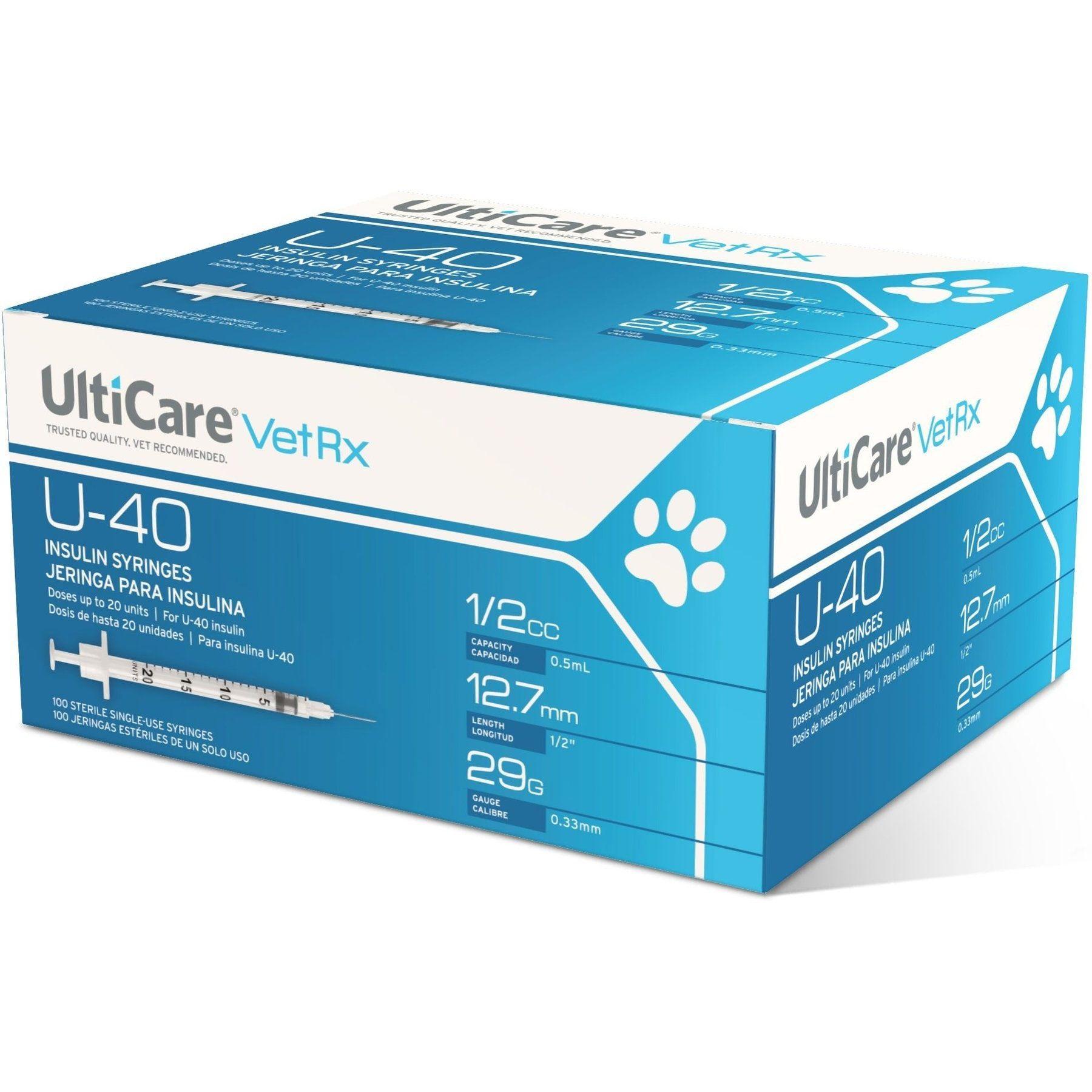
U-40 insulin syringes sized for 40-unit insulin such as Vetsulin, used at the dose your vet prescribes.
Webvet may earn a commission when you click through to Chewy, at no extra cost to you.
Is 5 units of Vetsulin a lot for a cat? It is above the label's 1 to 2 unit starting dose, yet within the range cats reached in the US study behind the approval.
In that study, Merck Animal Health reports a mean final dose of 3.3 units twice daily and a maximum of 8 units twice daily. Whether 5 units suits one cat depends on its glucose curve, and only the vet makes that call.
What Vetsulin is used for, how fast it works, and how it compares with ProZinc and Novolin
Vetsulin is used for diabetes mellitus in dogs and cats, and it is a lente insulin, which Merck Animal Health classifies as intermediate-acting, so it is not fast acting. Caninsulin, its name outside the US, is the same type of insulin.
It mixes a quicker amorphous fraction with a slower crystalline fraction. Merck adds that porcine insulin has the same amino acid sequence as canine insulin, making dogs less likely to form anti-insulin antibodies.
How long does Vetsulin take to work? The label gives an onset of 0.5 to 2 hours, plus the peak and how long Vetsulin lasts, and calls these initial guidelines because they vary between pets and from day to day:
- Onset: 0.5 to 2 hours in healthy laboratory dogs and cats
- Diabetic dogs: two peaks, the first at 2 to 6 hours and the second at 8 to 14 hours, with activity lasting 14 to 24 hours
- Diabetic cats: one peak between 1.5 and 8 hours, with activity lasting 8 to 12 hours

VCA Animal Hospitals gives a shorter figure, describing lente insulin as lasting 10 to 14 hours. The label's numbers come from its own studies, so the vet times doses from your pet's own readings rather than from either figure.
The main difference between Vetsulin, ProZinc, and Novolin is strength, source, and mixing:
- Vetsulin: porcine lente insulin, U40 (40 units/mL), FDA-approved for dogs and cats, shaken before use
- ProZinc: protamine zinc recombinant human insulin, U-40, FDA-approved for dogs and for cats according to the ProZinc label, mixed by gently rolling the vial
- Novolin N and Humulin N: human NPH insulins at 100 units/mL (U100), approved for people; VCA notes NPH is used off label in pets with U-100 syringes and is rolled, not shaken
- Levemir: insulin detemir, a long-acting human insulin at U-100; the Merck Veterinary Manual says vets may consider detemir for dogs poorly controlled on NPH or lente, and that it is potent
The Merck Veterinary Manual calls lente the insulin of choice for dogs. For cats it prefers long-acting insulins such as glargine or PZI and does not recommend lente as a first insulin, although Vetsulin is FDA-approved for cats. That is why some cats start on ProZinc or glargine instead.
Are Vetsulin and lantus the same thing?
No. Lantus is insulin glargine, a long-acting human insulin analog sold at 100 units/mL, according to the Lantus prescribing information. Vetsulin is a porcine lente insulin at 40 units/mL. VCA notes glargine is used off label in pets with U-100 syringes or its pen, so the two are never swapped unit for unit.
What is a substitute for Vetsulin?
There is no exact equivalent or generic replacement, but the closest veterinary alternative is ProZinc, the other U-40 insulin FDA-approved for dogs and cats. Vets may also use human insulins such as NPH, glargine, or detemir off label. The label names no generic Vetsulin; its generic name is simply U-40 purified porcine insulin zinc suspension. Any change of insulin type is a vet decision.
Whichever insulin a pet ends up on, a glucose curve, a series of blood glucose readings across the day, shows the vet where the peak and low point fall. The Merck Veterinary Manual says this testing is best done at home, where the pet's routine stays normal.
The AlphaTRAK 3 Starter Kit Diabetic Blood Glucose Test Kit for Cats, Dogs & Horses is one pet-calibrated meter kit for those readings. A home meter supports the vet's plan; it does not replace vet visits or let owners change the dose alone.
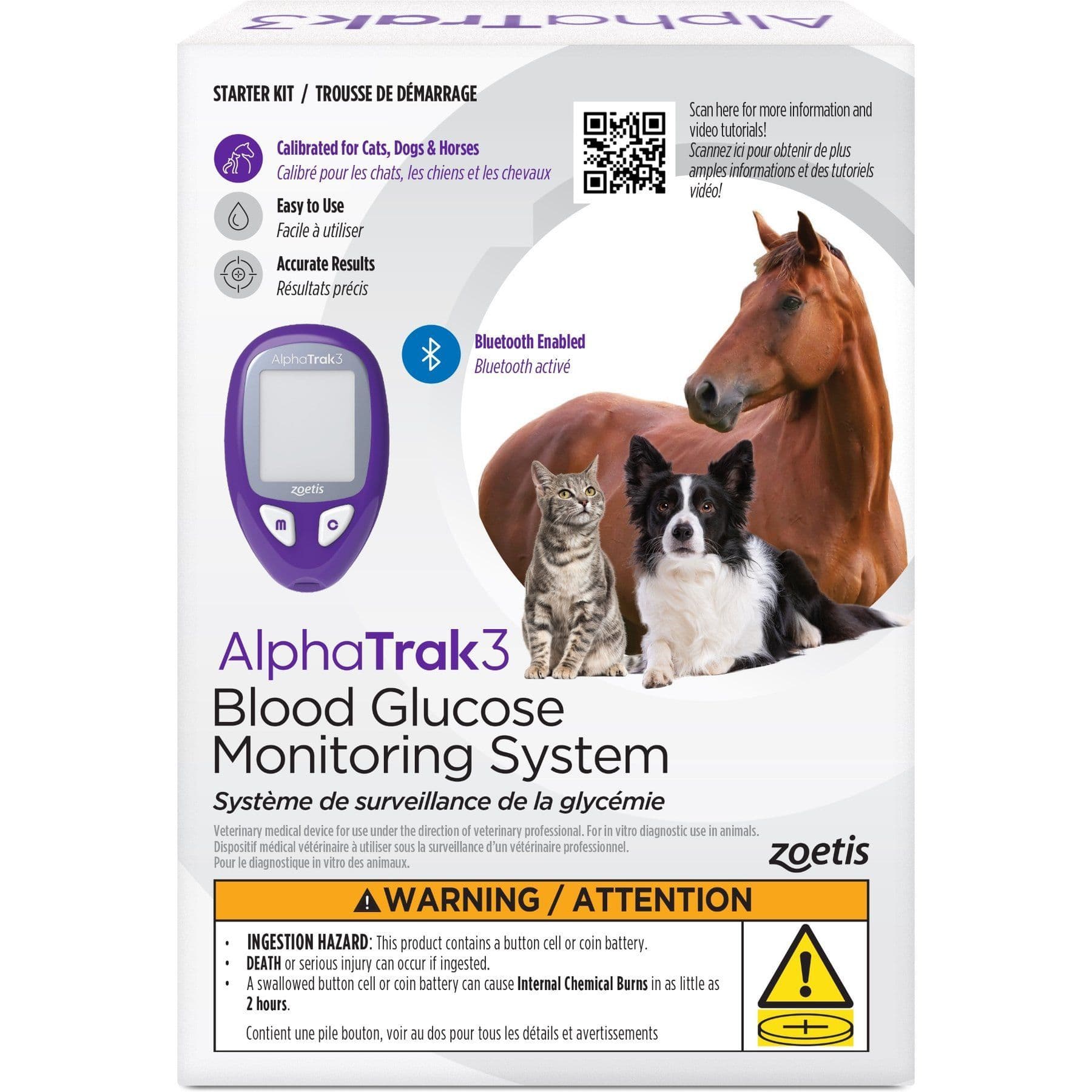
A pet-calibrated glucose meter kit for the home readings your vet uses to build a glucose curve.
Webvet may earn a commission when you click through to Chewy, at no extra cost to you.
Vetsulin side effects in dogs and cats
On the label, Vetsulin side effects in dogs and cats fall into two groups: low blood sugar, and findings that may come from diabetes itself.
In the label's dog field study, blood glucose dropped below 50 mg/dL in 35.5% (22/62) of dogs, usually with mild signs such as weakness or stumbling. Disorientation and collapse occurred in 16.1% (10/62); two dogs had a seizure, and one died.

In the label's study of 78 cats, low blood sugar was reported in 61 cats (88 incidences), but only 15 occurrences, in 13 cats, came with signs. Four cats had polyneuropathy. Other side effects of Vetsulin listed on the label include:
- Injection-site swelling, soreness, a bleb under the skin, mild bruising, or thickened tissue
- Vomiting, diarrhea, and pancreatitis
- Urinary tract infections and blood in the urine
- Development of cataracts in dogs
- Loss of effect, and local or whole-body allergic reactions
Does Vetsulin cause blindness in dogs? The Merck Veterinary Manual says cataracts develop frequently in dogs with poorly controlled diabetes, so steady control is the protection, not stopping insulin.
VCA says to stop the insulin and call the vet immediately for an allergic reaction: irregular breathing, rash, fever, or puffiness and swelling around the face.
 Sponsored
Vet care that's always there
Unlimited video calls and messaging with licensed vets for less than a typical vet visit. One membership covers up to five pets.
Use code Pets60
Plans start at $12/month · covers up to 5 pets
- Licensed vets in most states
- Rx for 150+ conditions
- 4.7 on Trustpilot
Low blood sugar after Vetsulin: emergency signs and what to do now
Once you spot low blood sugar signs and your pet is conscious, the owner sheet says to rub approximately 1 tablespoon of corn syrup or honey on the gums. Once your pet can swallow, give corn syrup or honey by mouth until it is alert enough to eat, feed its usual meal, and contact your vet.
The label lists what tips a pet into low blood sugar:
- Giving too much insulin
- Missing or delaying food, or changing the food or amount fed
- More exercise than usual
- Infection, illness, or a change in the body's need for insulin
- Adrenal, pituitary, thyroid, liver, or kidney disease
- Drugs such as progestogens or glucocorticoids
If your pet got more than the prescribed amount, the label warns that severe, life-threatening hypoglycemia can follow. Contact your vet immediately, or other veterinary help at once if your vet is unavailable.
The safer decisions on an ordinary day:
- Did not eat: VCA says not to give the insulin and to call the vet
- Missed a dose: the label says this is not life-threatening; call the vet, and if you cannot reach them and your pet is eating and acting normally, give the usual dose at the next scheduled time
- Never double up: VCA warns that two doses at once cause an overdose
- Needle stick to a person: the label says to seek medical attention immediately
Drug interactions, illness, and pets that need a different insulin plan
Food and insulin work as a pair, so the label asks for a consistent diet. Some vets choose Hill's Prescription Diet w/d Glucose Management Dry Dog Food, 8.5-lb, a prescription diet that needs a vet's authorization. A diet supports insulin; it never replaces it.
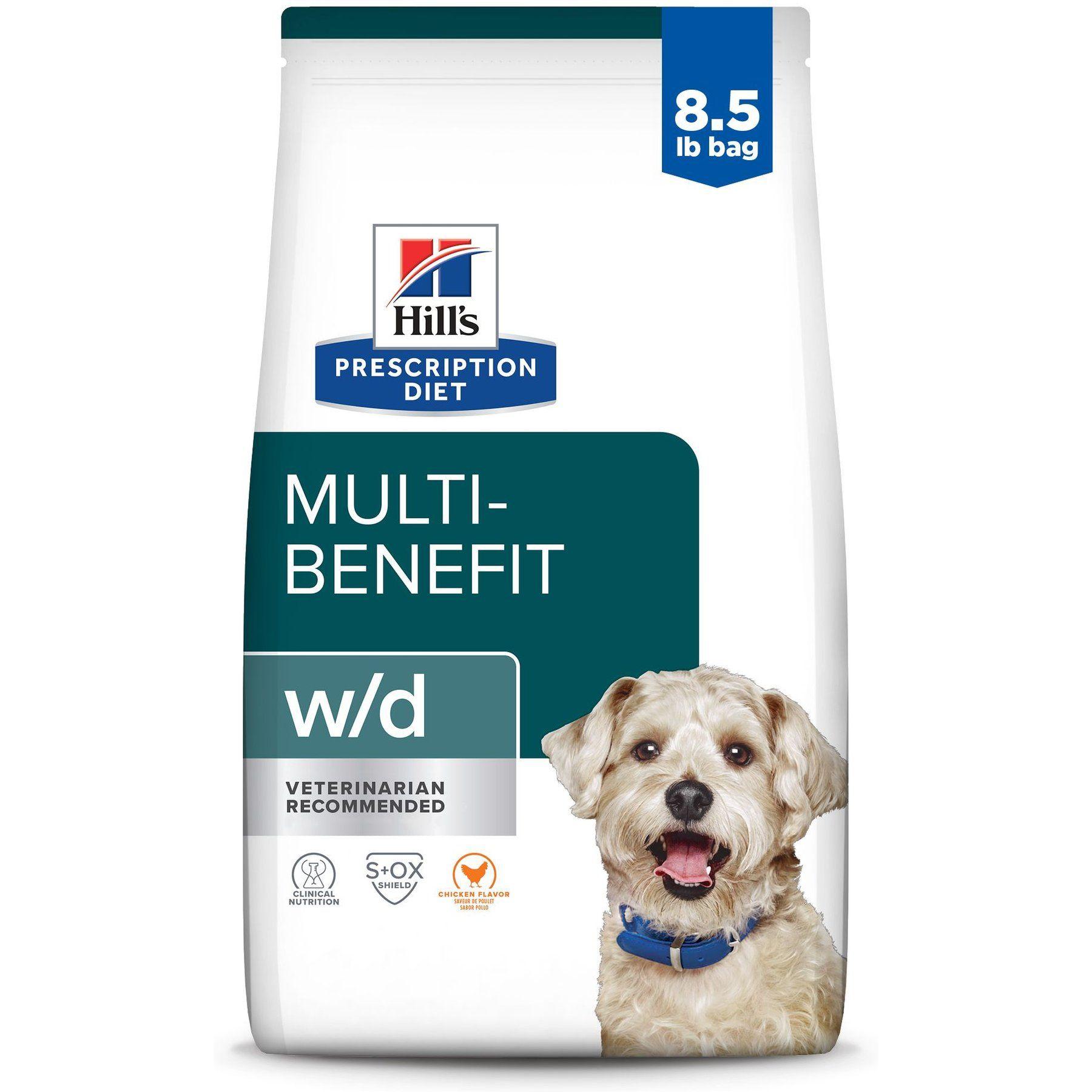
A prescription dry dog food some vets choose for steady meals timed with each insulin injection.
Webvet may earn a commission when you click through to Chewy, at no extra cost to you.
When Vetsulin is not working for a dog or a cat is not responding to Vetsulin, the label tells vets to look for hidden hormone disease, such as Cushing's disease in dogs or hyperthyroidism in cats. It also advises spaying intact female dogs, since progesterone opposes insulin.
The label says Vetsulin should not be given to pets with a systemic allergy to pork, or during low blood sugar. Pets with severe ketoacidosis, no appetite, lethargy, or vomiting are first stabilized with short-acting insulin. Its safety in puppies, kittens, and breeding, pregnant, or nursing animals has not been evaluated.
Never change the dose or the food without the vet: the label says diet, body weight, other medicines, infection, or another illness can all change how much insulin a pet needs. Medicines that can blunt Vetsulin or change blood sugar, per the label and VCA:
- Progestogens such as megestrol, and glucocorticoids such as prednisone, dexamethasone, or triamcinolone, which the label says to avoid
- Sedatives such as acepromazine, dexmedetomidine, and xylazine
- Some antibiotics (sulfonamides, fluoroquinolones)
- Heart and blood pressure drugs, including beta blockers, ACE inhibitors, and diuretics
Switching from Vetsulin to Novolin N or Humulin N, from Novolin to Vetsulin, or from ProZinc to Vetsulin has no conversion chart on any label, and no safe way to convert units at home. Novolin N and Humulin N are U-100, so the syringe changes too.
The Vetsulin label says changes in insulin strength, manufacturer, type, or species may change the dose and should be made only under a vet's supervision. The ProZinc label shows the caution involved: a dog moving from another insulin starts ProZinc once daily regardless of its previous schedule, with close glucose monitoring.
How to give and store Vetsulin, monitor glucose at home, and what it costs
Vetsulin is given as a shot under the skin with a U-40 syringe or the VetPen; for dogs the label times it with or right after a meal. How to give Vetsulin to a dog or a cat, including Vetsulin shots for dogs and safe handling of the vial, follows the label's instructions. Your vet shows you the administration technique first; these steps cover technique only, including mixing the vial before each dose, and the amount is always the one on your prescription.

- Wash your hands and take the vial from the refrigerator.
- Shake the vial thoroughly (Vetsulin should be shaken, not rolled) until the suspension is uniformly milky, and let any foam settle. Do not use it if clumps or white particles remain after shaking.
- Using a U-40 syringe, draw in air equal to the dose, inject the air into the vial, turn the vial upside down, and withdraw the prescribed dose.
- Tap out air bubbles and recheck the dose before removing the needle.
- For injection sites, pinch a fold of skin 3/4 to 2 inches from the midline of the back, between just behind the shoulder blade and just in front of the hipbone, and inject under the skin.
- Alternate left and right sides, and drop the used syringe in a sharps container.
Merck Animal Health advises never reusing syringes or pen needles because of infection risk and contamination of the insulin. The UltiCare VetRx Insulin Syringes U-40 12.7mm x 29G, 0.5-cc, 100 syringes are listed at $24.79 on Chewy when checked in November 2026.
For the Vetsulin pen, the label pairs 2.7 mL cartridges with the VetPen and 29G/12 mm pen needles. In a 21-day study, all 36 cat owners said they could learn to use the pen, and Vetsulin syringes for cats are the same U-40 syringes used for dogs.
Does Vetsulin need to be refrigerated?
Yes. Vetsulin storage, per the label: keep the vial upright under refrigeration at 2°C to 8°C (36°F to 46°F), protect it from light, and never freeze it; Merck says freezing denatures the insulin.
The label gives no room temperature allowance, so it does not say how long Vetsulin stays good without refrigeration or what happens if it is not refrigerated. If you forgot to refrigerate the vial, or it was frozen or left out overnight, ask the vet or pharmacy before using it.
How many days does Vetsulin last?
The Vetsulin shelf life after opening is 42 days: the label says to use the vial within 42 days of the first puncture. VCA reports a different view: veterinary internal medicine specialists indicate lente insulin can be used for 3 to 6 months after opening if stored properly. Follow your own vet's discard date.
Write the opening date on the vial. A silicone sleeve such as the Vial Safe for Pets Insulin Vial Protector for Vetsulin, Clear, 2 Pack helps guard the glass against drops; it protects the bottle and replaces nothing your vet prescribed.
Home glucose monitoring shows the vet how Vetsulin is working between visits. Vetsulin.com sets out the basics:
- A stable diabetic dog should have blood glucose of 100–250 mg/dL for most of a 24-hour period
- Blood can be taken from the ear flap, alternating sides
- Readings taken across the day form the glucose curve; record each one in a log or curve chart and share it with the vet
Owners already testing can restock with AlphaTRAK 3 Test Strips for Blood Glucose Monitoring System for Cats, Dogs, & Horses, 50 strips. Strips support the vet's plan rather than replace it; readings go to the vet, who makes every dose change.
What is the cost of Vetsulin for dogs?
The Vetsulin 10mL vial (U-40) is listed at $79.99 on Chewy when checked in November 2026, with U-40 syringes as an added cost. The same vial is used for cats, so Vetsulin for cats costs the same.
How long one vial lasts depends on the prescribed dose, and the 42-day limit after opening caps it even for small pets on low doses.
How to get Vetsulin cheaply?
Ask your vet for a written prescription so you can compare the clinic's price with an online pharmacy, ask both whether any discount is offered, and ask whether the vial or the VetPen cartridges cost less for your pet's dose.
Do not switch to a cheap human insulin on your own; the label warns that changing insulin type can change the dose needed.
Where's the cheapest place to buy insulin for dogs?
Prices vary by pharmacy and change often, so compare your vet clinic with online pharmacies that fill veterinary prescriptions, where you can order or purchase Vetsulin online once the vet approves it. Chewy listed the Vetsulin (porcine insulin zinc suspension) U-40 Injectable for Dogs & Cats, 10-mL at $79.99 when checked in November 2026.
Whatever you buy, the insulin and syringes must match the prescription. Keep meals steady too: the label asks owners to avoid treats and diet changes unless the vet recommends them, and WebVet's guides to diabetic dog treats and diabetic cat food cover choices to discuss with your vet.
Vetsulin questions
Frequently Asked Questions
Should you shake or roll Vetsulin?
Shake it. The Vetsulin label says to shake the vial thoroughly until the suspension is uniformly milky and let foam settle. Merck explains that the active insulin sits in both the cloudy part and the clear liquid, so it must be fully mixed. ProZinc and NPH insulins, by contrast, are gently rolled.
How long can Vetsulin be out of the fridge?
The label gives no room temperature allowance; it says to store Vetsulin upright in the refrigerator at 36°F to 46°F and never freeze it. If a vial sat at room temperature for hours or was left out overnight, ask your vet, or call Merck Animal Health customer service at 1-800-521-5767, before using it.
Is Vetsulin U-40 or U-100?
Vetsulin is U-40, meaning 40 units per mL. It must be drawn up with a U-40 syringe or given with the VetPen. A U-100 syringe, made for human insulin, is marked for a different strength and would deliver the wrong amount, which the label warns causes incorrect dosing.
When does Vetsulin peak in dogs?
In diabetic dogs the label describes two peaks, the first at 2 to 6 hours and the second at 8 to 14 hours after the injection. Because timing varies between dogs and even day to day, the vet confirms your dog's own peak and low point with a glucose curve.
Does Vetsulin cause blindness in dogs?
Vetsulin is not shown to cause blindness on its own. Cataracts appeared during the label's dog study, but the label says such findings may come from diabetes itself, and the Merck Veterinary Manual links cataracts in dogs to poorly controlled diabetes. Good glucose control is what helps protect the eyes.
Veterinarian · BVMS MRCVS
Dr. Pippa Elliott, BVMS, MRCVS, is a veterinarian with nearly 30 years of experience in companion animal practice. Dr. Elliott earned her Bachelor of Veterinary Medicine and Surgery from the University of Glasgow. She was also designated a Member of the Royal College of Veterinary Surgeons. Married with 2 grown-up kids, Dr. Elliott has a naughty Puggle named Poggle, 3 cats and a bearded dragon.


