Denamarin for Dogs: Uses, Side Effects, Cost, and How to Give It
Denamarin supports liver health, but its formulas are not interchangeable. Learn how to check the right product, give it around meals, recognize side effects and compare daily costs.

BVMS MRCVS
Medically reviewed by Dr. Pippa Elliott, BVMS MRCVS · Last reviewed

This article contains affiliate links. Webvet may earn a commission when you buy through them, at no extra cost to you.
Denamarin for dogs is a liver-support supplement containing S-adenosylmethionine, usually called SAMe, and silybin, a compound from milk thistle. Your veterinarian may recommend it after abnormal liver blood tests or alongside treatment for a diagnosed condition. The right formulation, daily amount and follow-up plan matter more than choosing a bottle by dog size alone.
Original coated tablets, original chewable tablets and Denamarin Advanced have different strengths and instructions. Before starting, confirm three things:
- The full product name and strength on the package.
- The number of tablets your dog should receive each day.
- When the veterinarian wants to repeat blood work or reassess treatment.
What is Denamarin for dogs used for?
Denamarin supports liver antioxidant defenses; it does not diagnose the cause of an abnormal test or replace treatment for liver disease. Its mechanism of action includes SAMe helping the body produce glutathione. Silybin is a specific component of milk thistle extract, rather than another name for the whole herb. Nutramax combines the two in formulations designed for veterinary use. It is a supplement, not an FDA-approved medication for curing liver disease, as PetMD's veterinary overview explains.
The evidence is strongest when described in its actual setting. A randomized study of dogs receiving lomustine chemotherapy found that concurrent Denamarin reduced the severity of liver-enzyme increases and made treatment interruption less likely. That finding does not establish that every dog with elevated enzymes will benefit equally, or that the supplement cures liver damage.
- A dog with a liver shunt needs a plan for the shunt, not supplementation alone.
- Cushing's disease and medicines can affect liver-test results; those results still need interpretation in context.
- SAMe has also been studied for cognitive support, but Denamarin should not become a self-prescribed treatment for canine cognitive dysfunction or dementia.
Owner reviews of original Denamarin or Advanced can describe whether a dog accepts a chewable or how easy a package is to use. They cannot show that a supplement corrected the underlying disease. Ask what the veterinarian expects Denamarin to accomplish in your dog's case and which result would change the plan.
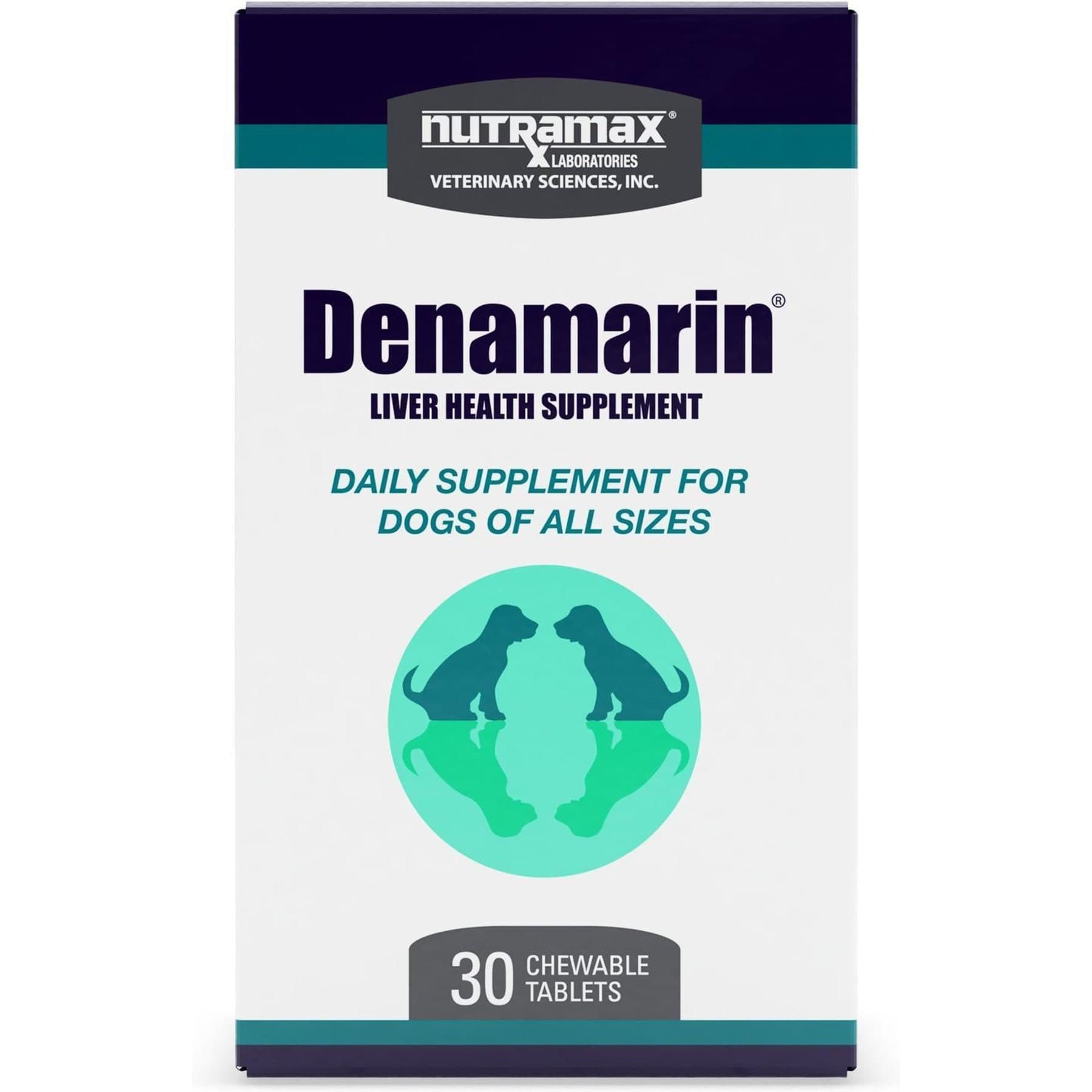
Chewable Denamarin for dogs whose veterinarian recommends this formulation. Follow its own label rather than substituting a coated-tablet schedule.
Webvet may earn a commission when you click through to Chewy, at no extra cost to you.
Original Denamarin, chewables, and Advanced
The manufacturer's formulation guide identifies four forms of Nutramax's Denamarin liver health supplement. Each combines SAMe and silybin, but the delivery system and amount per tablet differ. A lower SAMe number on an Advanced package does not mean that you should multiply the dose to match an original product.

| Formulation | What distinguishes it | Practical consideration |
|---|---|---|
| Original coated tablets | Small (90 mg), medium (225 mg), and large (425 mg); enteric-coated tablets | Match the strength to the prescribed dog weight band; give whole |
| Original chewable tablets | One 225 mg SAMe strength; scored chewable tablets for dogs | The daily tablet quantity changes with weight |
| Advanced hard tablets | Different SAMe strengths and smaller tablets | Veterinary-exclusive; use its own directions |
| Advanced chewable tablets | Small/medium and large strengths; scored | Veterinary-exclusive; its weight bands differ from original chewables |
Original coated strengths contain 90mg, 225mg or 425mg of SAMe, paired with 9, 24 or 35 mg of silybin respectively. The original chewable contains 225 mg SAMe and 24 mg silybin, but that matching ingredient amount does not make every instruction interchangeable. Whether a seller calls them pills or chews, use the full formulation name and strength to identify the product. Original chewables come in 30- and 75-count packages; package count tells you how many tablets you are buying, not the daily amount.
A blue or brown pill cannot establish the formulation or strength. Match the packaging, label and veterinary instructions rather than choosing Denamarin by tablet color.
The small original coated package may say “cats and small dogs.” That shared label does not mean the cat directions apply to a small dog. For dogs up to 12 pounds, confirm the small-dog instructions and your veterinarian's recommendation. The 30-count small-dog coated tablets are the corresponding original product, not an Advanced chewable.
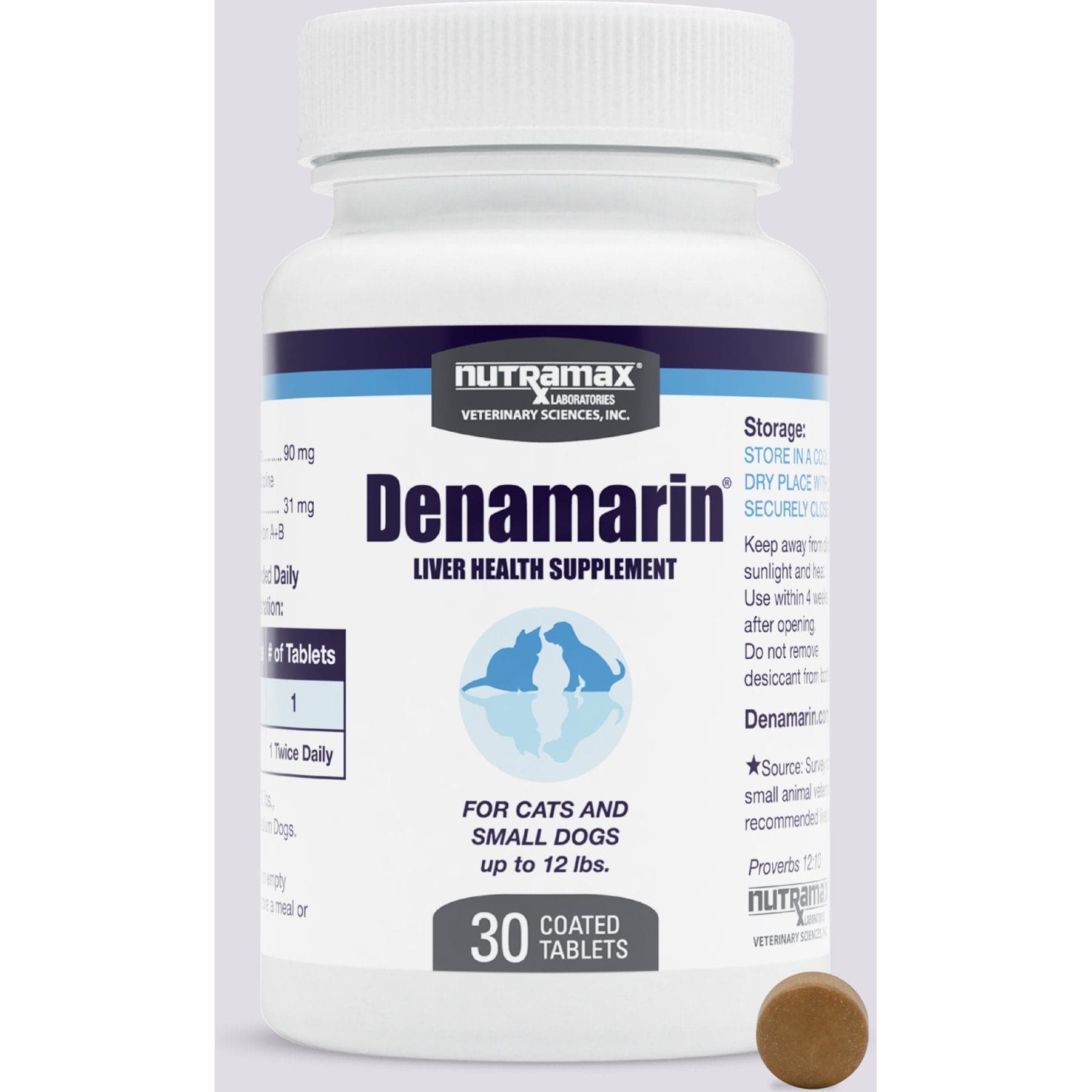
Denamarin tablets labeled for cats and small dogs. Confirm the correct strength and amount with your veterinarian.
Webvet may earn a commission when you click through to Chewy, at no extra cost to you.
Buying Denamarin: prescription and veterinary access
Original Denamarin is sold over the counter, so you do not need a prescription to buy it. Denamarin Advanced is available exclusively through veterinarians: arrange it with your clinic rather than assuming a retail prescription will provide access. This sales-channel difference does not tell you which formulation your dog needs. Ask the veterinarian to specify the exact product, amount and recheck plan before purchasing.
Denamarin dosage depends on the exact formula
Your veterinarian should set the dose. The following original coated-tablet label information helps you check that the bottle and instructions agree; it is not a personalized prescription. The manufacturer allows the daily amount to be adjusted under veterinary direction as the dog's needs change.
| Dog's weight | Original coated tablet | Label tablets per day |
|---|---|---|
| Up to 12 pounds | Small: 90 mg SAMe | 1 |
| 13–34 lbs | Medium: 225 mg SAMe | 1 |
| 35 to 65 pounds | Large: 425 mg SAMe | 1 |
| 66 to 120 pounds | Large: 425 mg SAMe | 2 |
| Over 120 pounds | Large: 425 mg SAMe | 3 |
A medium dog weighing 13–34 lbs therefore has a different original coated-tablet product from a dog weighing 35 to 65 pounds. Read both the strength and daily quantity. “Large dog” by itself is incomplete: the original large-tablet label spans dogs taking one, two or three tablets daily.
Original chewables follow a separate schedule. For example, their label lists half a tablet for dogs weighing 7 to 15 pounds, one for 16 to 30 pounds, and one-and-a-half for 31 to 45 pounds. A 30-count bottle can consequently last very different lengths of time. Use the complete chewable weight chart together with the veterinary instructions.
- Advanced small/medium chewables contain 120 mg SAMe and 35 mg silybin; Advanced large chewables contain 215 mg and 70 mg respectively.
- Advanced hard tablets use another set of strengths. Do not carry a coated or chewable schedule across to them.
- If your dog's weight is near a label boundary, or the written instructions differ from the box, clarify the intended product and amount before changing anything.
The current Advanced hard-tablet page has an overlapping 12-pound boundary between small and medium products. Your veterinarian and the exact package directions should resolve that ambiguity. Guessing which tablet the manufacturer intended is not a safe dosing method.
 $65 · no membership
Need a prescription or refill for your dog?
A licensed vet can assess your dog over video and prescribe online when it's appropriate.
 Talk to a vet
- Licensed vets
- All 50 states
- same-day Rx
Webvet may earn a commission if you book.
How to give Denamarin with meals and other medicines
For optimal absorption, give original Denamarin on an empty stomach, then wait at least one hour before your dog eats a meal, following the manufacturer's directions. Giving it with food can reduce SAMe absorption; it does not justify giving an extra tablet afterward. If your dog already received a dose with breakfast, ask the veterinary team how to handle the next scheduled dose.
Morning is often convenient because you can give the tablet before breakfast. Night or bedtime can work if the prescribed schedule and meal interval are still met. Consistent timing matters more than the clock hour. If you need an after-meal schedule, ask the team to specify it rather than assuming that an hour after eating is equivalent to an hour before.
- Check the exact product before preparing the dose. To administer a coated tablet, give it whole. Do not crush it or dissolve it in water; the tablet must remain intact. If a tablet is crushed or broken, ask the clinic what to do instead of estimating a replacement dose.
- Follow its food instructions and the veterinarian's schedule.
- Use the prescribed quantity; do not compensate for an uncertain dose by repeating it.
- Tell the team if your dog will not take it, repeatedly spits it out or vomits afterward.
The Advanced chewable instructions also prefer an empty stomach at least one hour before a meal, but allow a small amount of food if pilling is not possible. Advanced hard tablets have a similar stated exception. That is not permission to mix every formulation into a full meal. Ask before using a pill pocket or food coating with original coated tablets, especially if this is the only way your dog will accept them.

Keep the medication list with your dosing instructions. A veterinarian may intentionally combine liver support with other treatment, but you should not create spacing rules, stop another medicine or add supplements on your own. A practical routine should account for meals and all prescribed medicines together.
For a dog prescribed the original medium coated strength, the medium-dog 30-count product keeps that identity explicit when replacing a bottle. Check that a reorder has not switched you to chewables or Advanced.
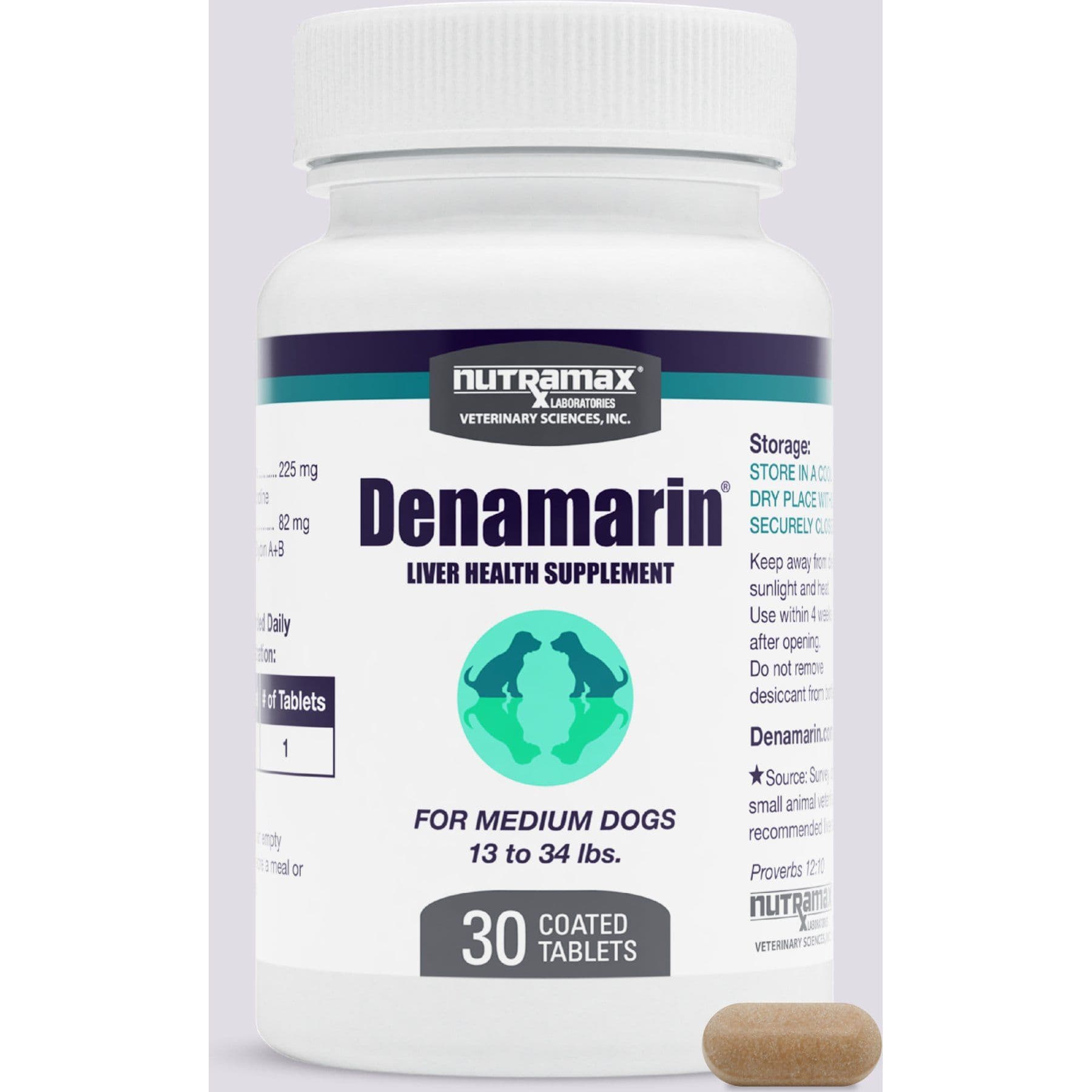
Medium-dog Denamarin tablets in a 30-count bottle. Match the package strength to your veterinarian's instructions.
Webvet may earn a commission when you click through to Chewy, at no extra cost to you.
What does Denamarin cost?
The best price comparison is cost per day at the veterinarian's prescribed amount. The cheapest bottle can cost more per day if it contains fewer usable daily doses. The following 30-count catalog prices for original, over-the-counter Denamarin were checked October 4, 2026; shipping, tax and later promotions can change the total.
- Original small-dog coated tablets: $33.99, or about $1.13 per tablet.
- Original medium-dog coated tablets: $44.99, or about $1.50 per tablet.
- Original large-dog coated tablets: $74.99, or about $2.50 per tablet.
- Original chewable tablets: $44.99, or about $1.50 per whole tablet.
For example, a dog prescribed two original large coated tablets daily would use a 30-count bottle in 15 days. At $74.99, that is approximately $5 per day, or $149.98 for 30 days. At one tablet daily, the same bottle lasts 30 days and costs about $2.50 per day. These are arithmetic examples, not a recommendation to use either amount for your dog.
To compare a proposed replacement, write down the formulation, pack count, daily tablet quantity and resulting days per pack. Then divide the package price by those days. Do not compare an original chewable with an Advanced tablet by milligrams or bottle price alone. Ask the clinic for an Advanced quote and its prescribed daily quantity before deciding whether it is less expensive.
The large-dog original coated tablets are the 425 mg SAMe product used in the example. Confirm the prescribed amount before ordering a larger supply. A supplement purchase also does not replace the budget for follow-up testing; our dog blood work cost guide explains common testing expenses.
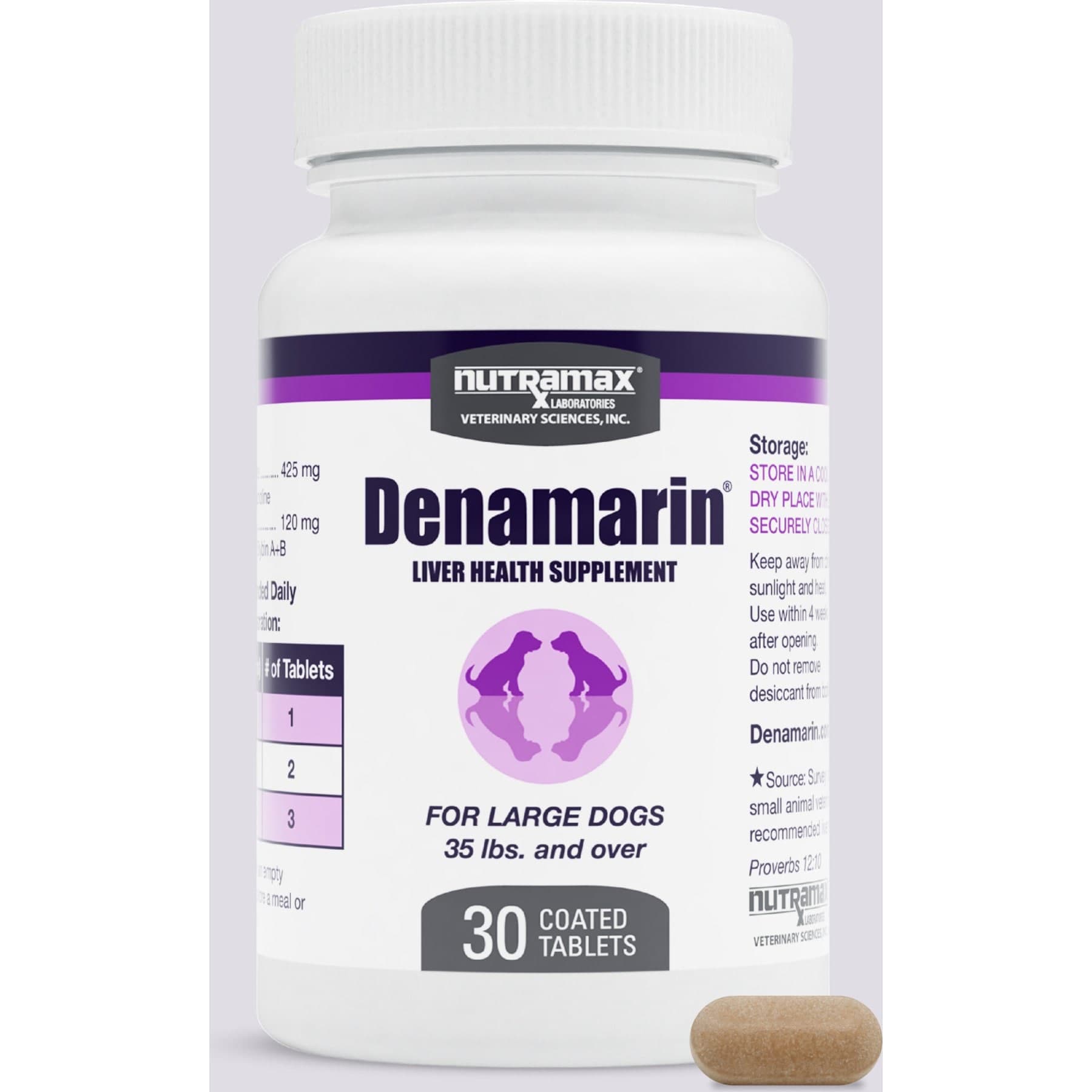
Large-dog Denamarin tablets in a 30-count bottle. Compare cost per prescribed daily amount rather than bottle price alone.
Webvet may earn a commission when you click through to Chewy, at no extra cost to you.
Denamarin side effects and when to call your vet
Denamarin is generally well tolerated, but gastrointestinal side effects can occur and warrant veterinary contact. VCA's clinical guidance identifies reduced appetite, vomiting and diarrhea as potential problems and advises stopping the supplement and contacting the veterinarian if they occur. Report when the symptoms began, the product, amount and other medicines given.
If your dog seems sleepy after a dose, do not assume the supplement is simply “working.” If your dog will not eat, has a loss of appetite, becomes unusually lethargic or seems much more thirsty, contact the veterinarian. Excessive thirst needs assessment rather than being assumed to be a normal Denamarin effect. These changes may require reassessment for the underlying illness, another medicine or an adverse reaction. Describe the change to the veterinary team rather than increasing the supplement in an attempt to treat it.
- Call promptly after an accidental double dose or an uncertain overdose; have the packaging available.
- Seek urgent care for collapse, breathing difficulty, seizures or severe worsening illness.
- Do not wait for the next routine blood test when your dog is repeatedly vomiting or cannot keep water down.
What if my dog has pancreatitis?
Denamarin provides liver support; it is not an established treatment for pancreatitis. AAHA describes pancreatitis care as veterinary treatment that may include fluids, pain relief, anti-nausea medication and dietary management. If your veterinarian recommends Denamarin for a dog with pancreatitis, ask which liver concern it is intended to address.
The available sources do not establish Denamarin as a cause of pancreatitis. That does not rule out an individual adverse event, and vomiting alone cannot distinguish a supplement reaction from pancreatic disease. Repeated vomiting, abdominal pain or a marked appetite change needs prompt veterinary assessment, particularly in a dog with a pancreatitis history.
Other diagnoses and medicines
VCA notes that its effects may last longer in dogs with kidney or liver disease. Tell the veterinarian about either diagnosis before starting or adjusting Denamarin; kidney disease is not itself a reason to select a liver supplement.
Claims that Denamarin “killed my dog” cannot establish causation without the medical history and an investigation. They also should not be dismissed when an owner reports a serious change. Have the veterinarian assess the event and document the timing. For dogs also taking prednisone, provide the full medication history rather than assuming that either product alone explains the symptoms.
How long Denamarin takes to work and how vets monitor it

Denamarin does not have one reliable countdown to a normal liver panel. Some effects develop over days to weeks, while the time needed to see a meaningful blood-test change depends on the diagnosis and other treatment. To judge whether it is effective, consider the veterinarian's planned measurements rather than a single good day. An improvement in appetite or activity is useful information, but it does not prove that liver function has normalized.
The manufacturer's monitoring advice centers on follow-up examinations and laboratory testing. Ask for a specific recheck date and which values are being followed. A simple home record can help the appointment:
- Product, daily quantity and any missed doses.
- Appetite, vomiting, diarrhea and energy changes.
- New medicines, supplements or diet changes.
Treatment duration varies: some dogs take Denamarin briefly; others remain on it long term. Blood work helps the veterinarian decide whether the plan should continue. How long your dog should stay on it depends on what is being treated and the response, not a universal six-week or lifetime rule. Stopping, tapering or switching to every-other-day dosing needs veterinary direction; a nearly empty bottle or a dog that looks better is not sufficient reason.
A dog can sometimes feel and behave normally despite elevated liver enzymes. Enzyme results alone cannot predict lifespan or establish how much working liver tissue remains. The veterinarian may recommend additional testing to distinguish a reversible change from an ongoing liver problem. Continue the agreed meal-and-dose routine while that assessment proceeds; changing timing to try to speed the blood-test response will not substitute for it.
Can you replace Denamarin with another liver supplement?
Milk thistle or human SAMe is not an automatic substitute for Denamarin. Do not assume that products described as milk thistle, silymarin, SAMe or “generic Denamarin” are equivalent. The manufacturer explains that Denamarin uses stabilized SAMe and a bioavailable silybin formulation. A cheaper or “natural” alternative may differ in active ingredients, amounts, formulation and supporting evidence. Ask the veterinarian to approve the exact substitute before changing products.
The important comparison depends on what you are changing:
- The difference between Denosyl and Denamarin is an ingredient-choice question: Denosyl supplies SAMe (also written SAM-e), while Denamarin combines SAMe with silybin. Ask why the combination was selected.
- Marin Plus is a different blend. Nutramax's product-program description hosted by UC Davis lists silybin complex with vitamin E, zinc, MCT oil and curcumin for Marin Plus; its Denamarin listing pairs silybin with SAMe. That ingredient difference does not establish that one works better. Do not substitute or combine them without checking the exact products with your veterinarian.
- Original Denamarin versus Denamarin Advanced is a formulation and dosing question. Switching products does not establish that the disease needs more or less support.
- Milk thistle alone does not supply the SAMe component. Adding it to Denamarin can also duplicate ingredients your veterinarian is already accounting for.
- Ursodiol is a different medicine with a different role. A veterinarian may prescribe ursodiol and Denamarin together when both fit the treatment plan; ursodiol is not a generic version of Denamarin.
The verified manufacturer products are tablets, including coated and chewable forms. If you need a liquid or compounded preparation because pilling is impossible, ask the veterinarian and pharmacist about an appropriate option. Do not dissolve coated tablets into a homemade liquid or calculate a liquid conversion from another product's label.
Likewise, elevated liver enzymes do not create one universal list of forbidden meats or one suitable “liver diet.” Avoid adding unapproved supplements or making drastic protein changes while the cause is being investigated. Ask whether your dog's specific diagnosis calls for a therapeutic diet and what treats are compatible with it.
Denamarin questions from dog owners
Frequently Asked Questions
What should I do if I miss a Denamarin dose?
Skip the missed dose and resume the next scheduled dose unless your veterinarian has given different instructions. Do not double the amount to catch up. Record repeated missed doses so the team can judge the blood-test results in light of what your dog actually received.
Can I crush a Denamarin tablet?
Do not crush or split an original enteric-coated tablet. A scored chewable is designed for the portions on its own label, which is a different situation. If swallowing is difficult, ask for a suitable formulation rather than modifying a coated tablet at home.
Can I give my dog human SAMe?
Ask your veterinarian before substituting human supplements. Products can have different strengths, delivery systems and additional ingredients, and human SAMe does not necessarily supply silybin. Matching one number on the label is not enough to show that it replaces the prescribed veterinary product.
How should I store Denamarin?
Use the storage instructions on your package. Keep it in a dry place away from heat and pets. If supplied in a blister pack, leave each tablet sealed until needed; close a bottle tightly. Do not keep loose doses somewhere damp simply to make the morning routine easier.
$65 · no membershipNeed a prescription or refill for your dog?
A licensed vet can assess your dog over video and prescribe online when it's appropriate.
Talk to a vet- Licensed vets
- All 50 states
- same-day Rx
Webvet may earn a commission if you book.
Veterinarian · BVMS MRCVS
Dr. Pippa Elliott, BVMS, MRCVS, is a veterinarian with nearly 30 years of experience in companion animal practice. Dr. Elliott earned her Bachelor of Veterinary Medicine and Surgery from the University of Glasgow. She was also designated a Member of the Royal College of Veterinary Surgeons. Married with 2 grown-up kids, Dr. Elliott has a naughty Puggle named Poggle, 3 cats and a bearded dragon.


