Denamarin vs Denamarin Advanced: What Changes?
Original Denamarin and Advanced differ in formula, tablet strengths, weight bands and food instructions. Compare the four U.S. options, veterinary availability and daily cost before discussing a switch.

BVMS MRCVS
Medically reviewed by Dr. Pippa Elliott, BVMS MRCVS · Last reviewed

This article contains affiliate links. Webvet may earn a commission when you buy through them, at no extra cost to you.
Comparing Denamarin vs Denamarin Advanced starts with the full product name on the package. Both Nutramax liver-health supplement lines combine SAMe and silybin, but their tablet strengths, formats and administration instructions differ. A smaller milligram number on Advanced does not tell you how to replace your dog’s existing tablets.
The useful choice is the formulation your veterinarian recommends and your dog can take consistently. This guide compares the current U.S. products, explains what the manufacturer’s absorption claims mean, and shows how to compare the amount supplied before judging bottle prices.
Denamarin vs. Denamarin Advanced at a glance
The difference between Denamarin and Denamarin Advanced depends on the exact formulation. There are four formulations to distinguish: original coated tablets, original chewable tablets, Advanced hard tablets and Advanced chewable tablets. These U.S. labels describe different products, even when an online listing shortens the name to “Denamarin tablets.” The manufacturer’s FAQ confirms all four options.
For example, the original coated product for small dogs and cats contains 90 mg SAMe per tablet. The similarly named Advanced hard product contains 30 mg. Both are real small-pet products; selecting one requires the full name and your veterinarian’s directions, not matching the front-label milligram number.
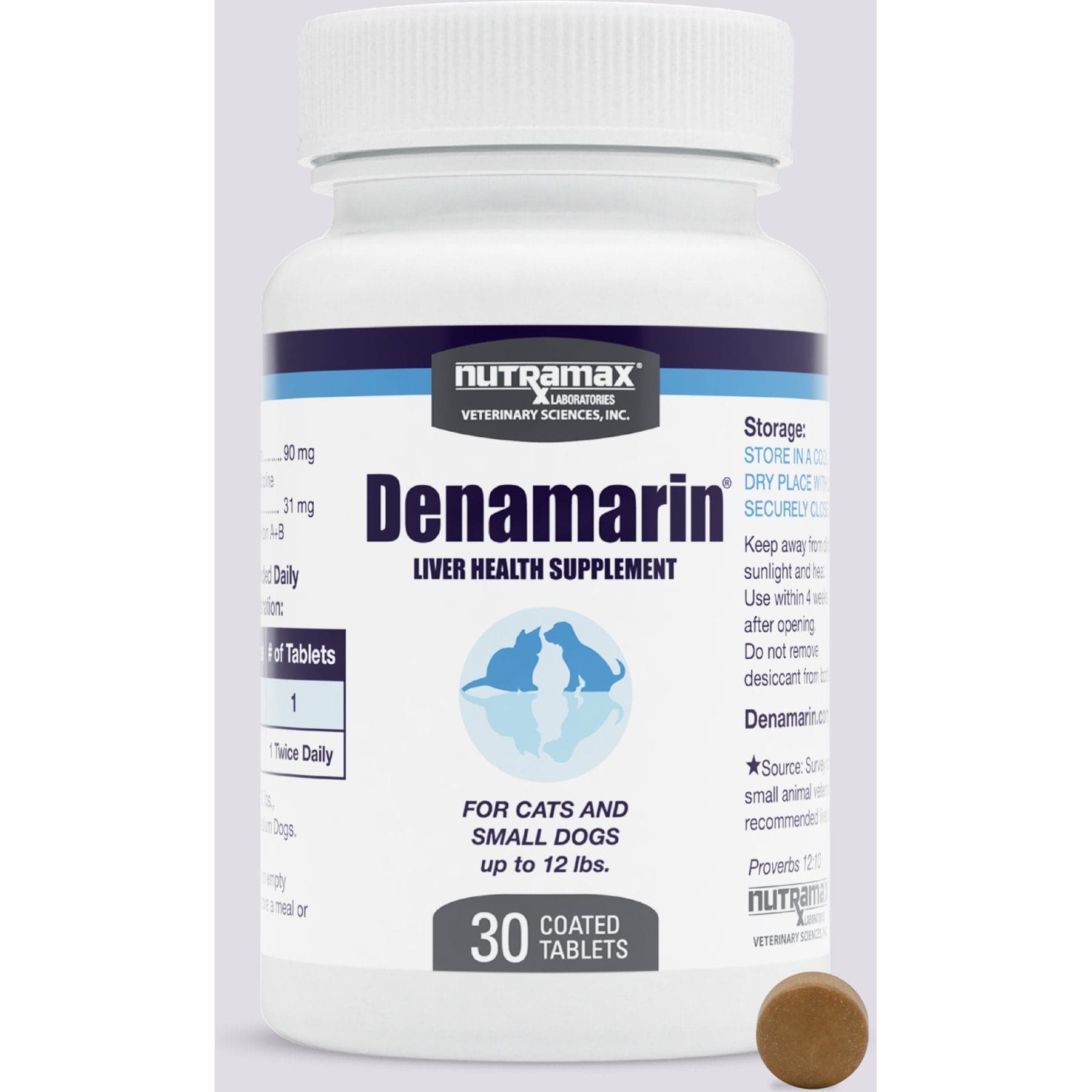
Denamarin tablets labeled for cats and small dogs. Confirm the correct strength and amount with your veterinarian.
Webvet may earn a commission when you click through to Chewy, at no extra cost to you.
- 1Choose the exact formulation with veterinary guidance; original and Advanced tablets are not interchangeable by tablet count or milligrams.
- 2Advanced changes formulation, tablet size and labeled administration options. Greater absorption is not a guarantee of better clinical results for an individual dog.
- 3Compare the daily amount and days supplied, then the price. Both product lines belong within the dog’s broader liver-care plan.
| U.S. product | SAMe per whole tablet | Silybin A+B per whole tablet | Format and labeled species |
|---|---|---|---|
| Original coated: small | 90 mg | 9 mg | Whole coated tablet; cats and small dogs |
| Original coated: medium | 225 mg | 24 mg | Whole coated tablet; medium dogs |
| Original coated: large | 425 mg | 35 mg | Whole coated tablet; large dogs |
| Original chewable | 225 mg | 24 mg | Scored chewable; dogs |
| Advanced hard: small | 30 mg | 9 mg | Hard tablet; cats and small dogs |
| Advanced hard: medium | 82 mg | 24 mg | Hard tablet; medium dogs |
| Advanced hard: large | 172 mg | 35 mg | Hard tablet; large dogs |
| Advanced chewable: small/medium | 120 mg | 35 mg | Scored chewable; dogs |
| Advanced chewable: large | 215 mg | 70 mg | Scored chewable; dogs |
Strengths above come from the U.S. original coated, original chewable, Advanced hard and Advanced chewable product pages. The table compares whole tablets, not equal treatment doses. Cats appear on some package names because those particular products serve both species; the dosing discussion here is for dogs.

Which Denamarin is best for dogs? There is no single best choice for every dog. Your veterinarian can weigh the reason for liver support, the exact formulation, whether your dog will chew or swallow it, and what the treatment costs over time. An existing plan that is practical and being monitored does not automatically need changing because another package says Advanced.
What changes in the ingredients and absorption?
The main ingredients remain SAMe, or S-adenosylmethionine, and silybin, a component of milk thistle. Nutramax uses a silybin-phosphatidylcholine complex in these products. Read the ingredient columns carefully: the weight of that whole complex is different from the amount of silybin A+B it provides. Comparing one label’s complex weight with another label’s silybin amount gives a misleading result.
The original medium-dog coated tablets contain 225 mg SAMe and 24 mg silybin. The manufacturer’s dog label assigns one medium tablet daily at 13–34 pounds. An original chewable happens to contain the same stated amounts per whole tablet, but its weight bands differ. Similar ingredient numbers do not remove the need to follow the exact product directions.
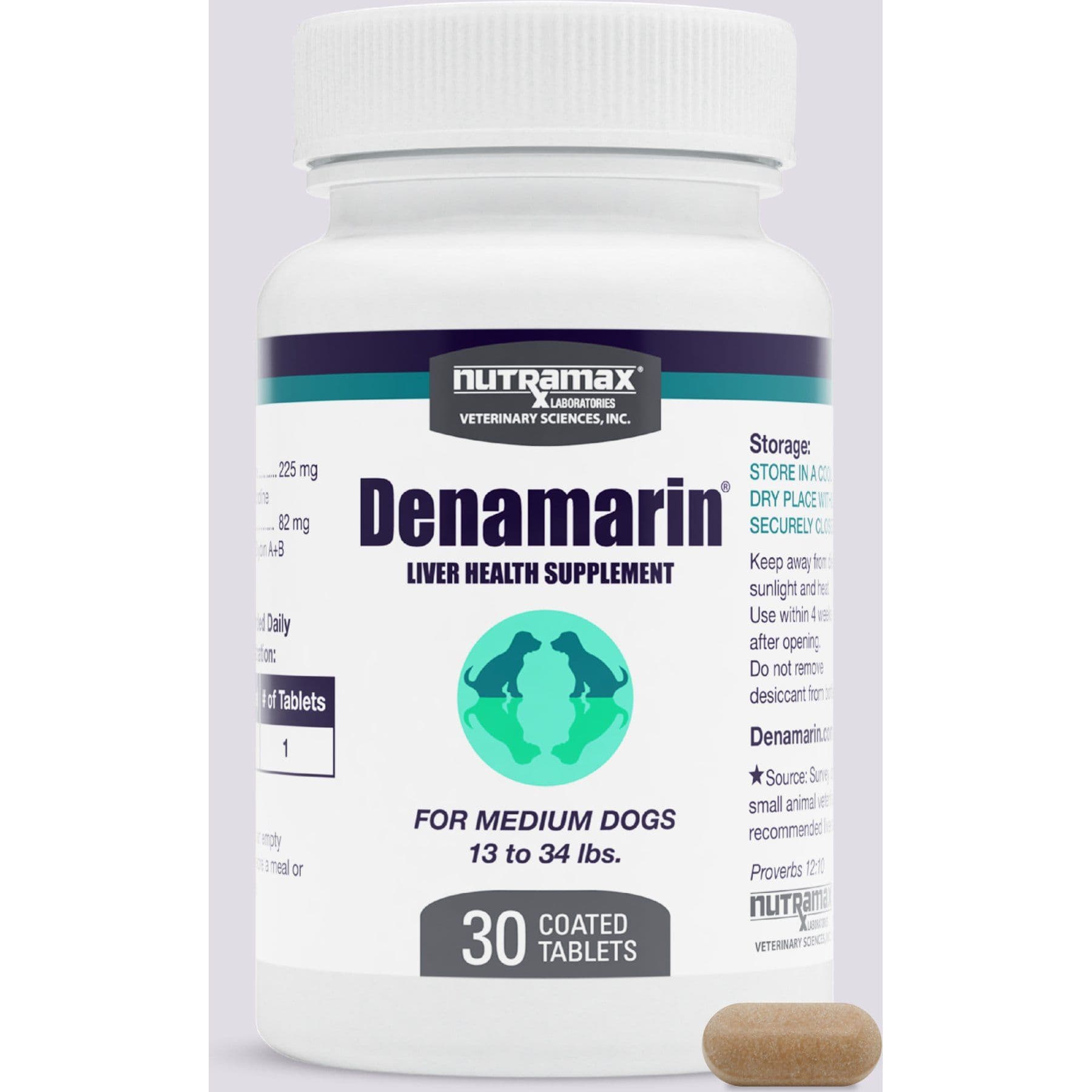
Medium-dog Denamarin tablets in a 30-count bottle. Match the package strength to your veterinarian's instructions.
Webvet may earn a commission when you click through to Chewy, at no extra cost to you.
The Advanced hard-tablet page identifies its SAMe specification as NMXSS75A. Nutramax describes formulation and bioavailability improvements for the Advanced line; its Advanced chewable page also describes greater bioavailability than original Denamarin. Bioavailability concerns how an ingredient becomes available to the body after administration. It does not establish that every dog’s liver values or symptoms will improve more.
- For small, medium and large hard tablets, the SAMe amount changes between original and Advanced while the stated silybin A+B amount remains 9, 24 and 35 mg respectively.
- Chewables have a different comparison: original provides 225 mg SAMe and 24 mg silybin; Advanced small/medium provides 120 mg and 35 mg, and Advanced large provides 215 mg and 70 mg.
- A lower SAMe milligram number therefore cannot be used as a home conversion rule, and “Advanced” does not mean every ingredient is simply increased.
Is Denamarin Advanced really better than Denamarin? It offers practical differences that may matter, including smaller tablets and different chewable weight bands. The manufacturer’s absorption claims alone do not prove superior clinical outcomes, fewer side effects or longer survival. Ask what a switch is intended to improve for your dog: administration, the prescribed formulation, daily cost or a specific monitored treatment goal.
Original coated tablets and chewables: choosing the exact product
For original Denamarin, the chewable-versus-tablet decision changes both handling and daily tablet count. Coated tablets come in three strengths and should be swallowed whole. Original chewable tablets come in one scored strength for dogs of different sizes, with the label using fractions or multiple tablets according to weight. A chewable is not simply the coated tablet with flavor added.

Both original forms are directed on an empty stomach, at least one hour before a meal. If that schedule or swallowing a whole tablet is difficult, describe the problem to your veterinarian before changing the preparation. The Advanced labels have a specific food exception discussed below; it should not be assumed from a retailer’s abbreviated description of original Denamarin.
 $65 · no membership
Need a prescription or refill for your dog?
A licensed vet can assess your dog over video and prescribe online when it's appropriate.
 Talk to a vet
- Licensed vets
- All 50 states
- same-day Rx
Webvet may earn a commission if you book.
Advanced hard tablets and chewables: strengths and weight bands
Nutramax Denamarin Advanced hard tablets retain separate small-, medium- and large-pet strengths. Advanced liver health supplement chewable tablets instead come in small/medium-dog and large-dog strengths. The U.S. hard-tablet label includes cats and small dogs; the Advanced chewables are labeled for dogs. Check the dosage form as well as “small” or “large” before using a dosing chart.

The chart below transcribes the manufacturer’s dog weight bands and daily amounts. It helps you check a package and a veterinary instruction; it is not an individual prescription. The large-dog Advanced chewable is the product labeled for 51 pounds and over, with the daily amount increasing in heavier bands. The 30-tablet package count is separate from the daily dose.
| Advanced formulation | Body weight on U.S. label | Daily amount on label |
|---|---|---|
| Hard tablets: small-pet strength | Up to 12 lb | 1 tablet |
| Hard tablets: medium-dog strength | 12–34 lb | 1 tablet |
| Hard tablets: large-dog strength | 35–65 lb | 1 tablet |
| Hard tablets: large-dog strength | 66–120 lb | 2 tablets |
| Hard tablets: large-dog strength | Over 120 lb | 3 tablets |
| Chewable tablets: small/medium strength | 7–14 lb | ¼ tablet |
| Chewable tablets: small/medium strength | 15–25 lb | ½ tablet |
| Chewable tablets: small/medium strength | 26–50 lb | 1 tablet |
| Chewable tablets: large-dog strength | 51–85 lb | 1 tablet |
| Chewable tablets: large-dog strength | 86–130 lb | 1½ tablets |
| Chewable tablets: large-dog strength | Over 130 lb | 2 tablets |
For comparison, original large-dog coated tablets contain 425 mg SAMe and 35 mg silybin. Their label lists one daily at 35–65 pounds, two at 66–120 pounds and three above 120 pounds. A “large dog” package is a strength choice, not a promise that every large dog needs one tablet. Confirm the daily amount before estimating how long a bottle will last.
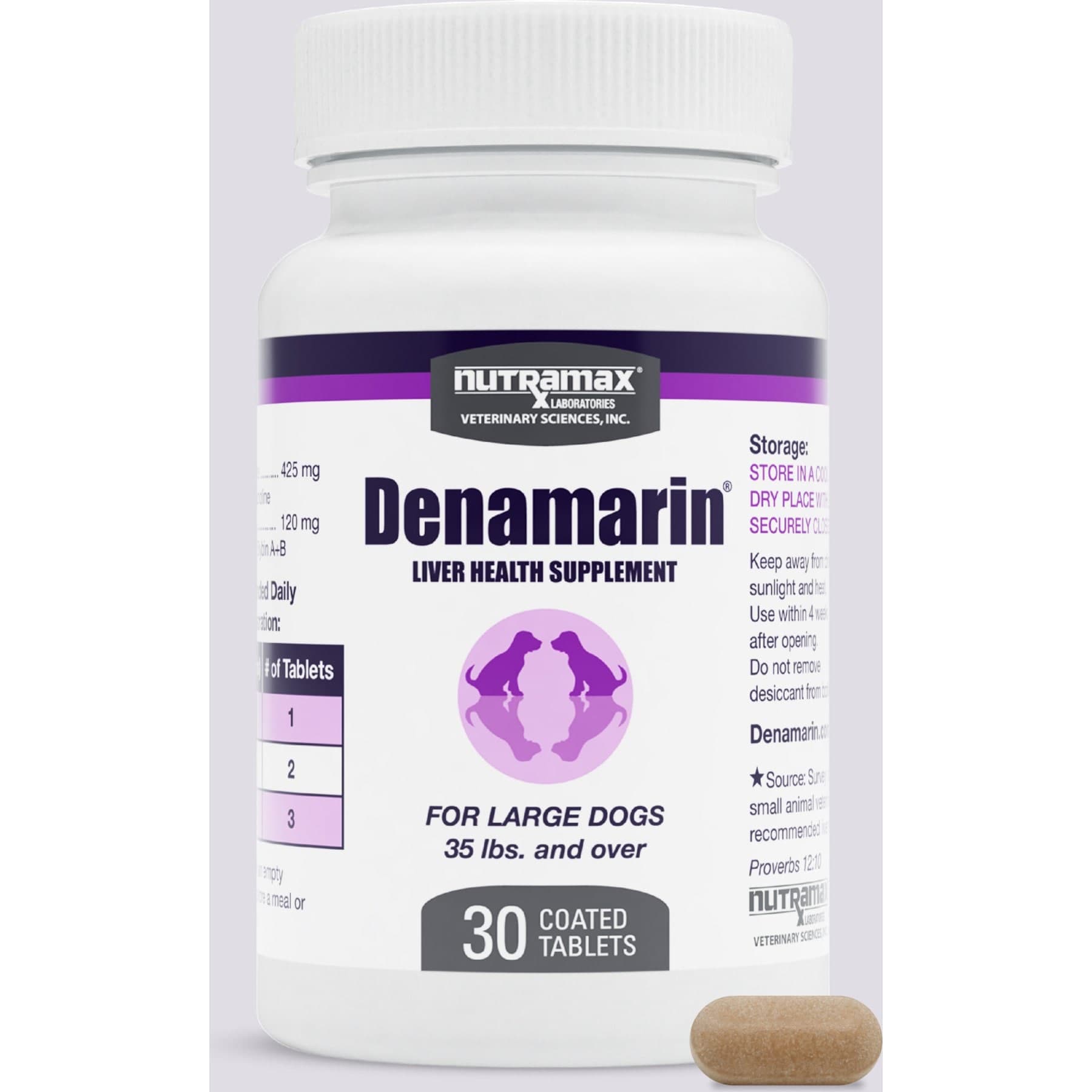
Large-dog Denamarin tablets in a 30-count bottle. Compare cost per prescribed daily amount rather than bottle price alone.
Webvet may earn a commission when you click through to Chewy, at no extra cost to you.
Two label details need clarification rather than guesswork. The Advanced hard-tablet page places 12 pounds in both its small and medium ranges. Ask your veterinarian which strength to use for a dog at that boundary. The Advanced chewable chart starts at 7 pounds; do not invent a smaller fraction for a dog below that weight.
If your dog’s weight has changed, report the current measured weight when confirming a refill. For Advanced small dogs, medium dogs and large dogs alike, the correct amount depends on the exact product and veterinary plan. Taking a photograph of the front label and ingredient panel is a simple way to prevent a mix-up when the clinic and an online shop use slightly different product titles.
Food, splitting and switching instructions

Original coated tablets should not be split or crushed, because doing so compromises the enteric coating. Scored chewable tablets have labeled fractional amounts. Do not carry a chewable’s splitting instructions over to an unscored hard tablet, or assume that all products bearing the Denamarin name handle the same way.
For Advanced hard and chewable tablets, the U.S. manufacturer recommends an empty stomach at least one hour before a meal for optimal absorption. Both Advanced pages allow a small amount of food if pilling is not possible. This is a limited administration option, not an instruction to routinely mix the supplement into a full meal. If your dog refuses the product or becomes unwell after taking it, ask the clinic how to proceed.
- Show the clinic the current package and the proposed replacement, including whether each is coated, hard or chewable.
- Confirm when the first replacement dose should be given and whether the daily amount changes.
- Keep the agreed recheck schedule so the change can be assessed alongside appetite, behavior and bloodwork.
If your veterinarian chooses original chewables, a 16–30-pound dog falls in the one-tablet band, while a 46–60-pound dog falls in the two-tablet band. The product comes in 30- and 75-count packages. If your veterinarian recommends it, decide whether the scored chewable makes the daily routine easier and which package count suits that routine. Keep the package directions available rather than carrying forward instructions from a coated-tablet bottle.
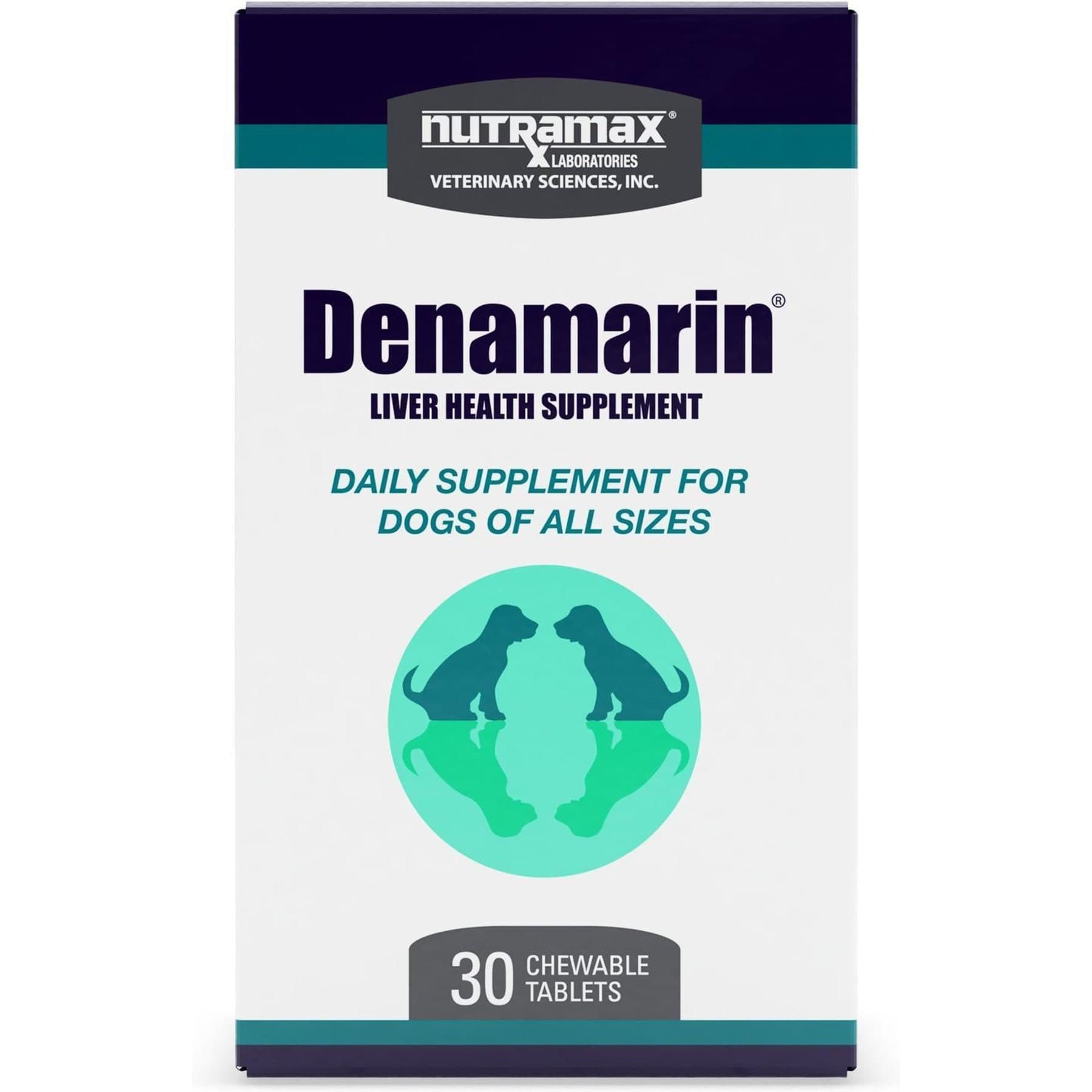
Chewable Denamarin for dogs whose veterinarian recommends this formulation. Follow its own label rather than substituting a coated-tablet schedule.
Webvet may earn a commission when you click through to Chewy, at no extra cost to you.
Where can you buy Denamarin Advanced?
Start with your veterinarian. Nutramax describes Denamarin Advanced as available exclusively through veterinarians. Ask the clinic which Advanced formulation it recommends and whether it supplies that product directly or through its veterinary online pharmacy. That is especially useful when you need a particular hard-tablet strength or a small/medium versus large-dog chewable.
Do you need a prescription for Denamarin Advanced? The manufacturer’s veterinary-exclusive policy tells you how it is distributed. It does not, by itself, establish that this liver-health supplement is a prescription drug. Ask the supplying practice what authorization or patient relationship it requires instead of assuming ordinary over-the-counter checkout will apply.
When searching Chewy, Amazon or a VCA online pharmacy, check the actual product page rather than the search-result wording. An original Denamarin listing is not an Advanced listing, and a retailer name does not confirm which formulation is supplied. Match all of the following before ordering:
- The word Advanced, plus hard tablets or chewable tablets.
- The small/medium or large-dog strength and the active-ingredient amounts.
- The package count, seller and the veterinary purchase route required for that product.
If the clinic cannot supply the intended product, ask it to choose a suitable replacement and give new instructions. A similarly named item in stock elsewhere is not enough evidence to switch. The original-product links in this guide identify original Denamarin only.
Compare cost per day, not bottle price

Denamarin Advanced’s price matters only alongside the exact formulation, package count and veterinarian-directed daily amount. The following 50-pound dog example illustrates why. The original chewable label uses two tablets a day in the 46–60-pound band; the Advanced small/medium chewable label uses one a day in the 26–50-pound band.
| Example for a 50-pound dog | Tablets per day on that label | Tablet count per bottle | Days per bottle |
|---|---|---|---|
| Original chewable | 2 | 30 | 15 |
| Advanced chewable (small/medium) | 1 | 30 | 30 |
These are days of supply calculated from two labels, not proof of equivalent treatment response or permission to switch. Divide the bottle price by days per bottle to compare daily cost. If your veterinarian directs a different amount, redo the calculation with that amount rather than the example.
For a concrete original-product example, the 30-count original chewable was listed at $44.99 in the Chewy offer checked October 4, 2026. At two tablets daily, that is about $3.00 per day before shipping or tax. An Advanced 30-count quote would need its own price; at one tablet daily, divide that quote by 30. Without both current prices, the longer-lasting bottle alone does not establish a dollar saving.
For large dogs, repeat the calculation using the large-dog strength and your dog’s weight band. Compare like-for-like package counts when checking Costco, clinic or online listings; first establish whether the item is original or Advanced. A discount on the wrong formulation does not make it a suitable substitution.
- Use the current checkout or clinic quote, including delivery charges and any minimum order.
- If a Denamarin Advanced rebate is advertised, verify the eligible product, purchase dates and submission requirements before counting it as a saving. An old rebate page does not establish a current offer.
- Budget for the agreed monitoring plan separately. Our dog blood work cost guide explains the testing side of that discussion.
Do benefits, side effects or monitoring change?
Both lines provide liver-support ingredients, and neither choice identifies or treats every cause of abnormal liver tests. Your veterinarian should define what response to look for and when to reassess. Changing the supplement formula does not replace investigating elevated liver enzymes in dogs or treating the underlying condition.
What are the potential side effects of taking Denamarin Advanced for your dog? VCA’s SAMe and silybin guidance describes side effects as rare but identifies reduced appetite, vomiting and diarrhea as reasons to stop giving the supplement and contact your veterinarian immediately. That ingredient-level guidance does not provide a measured original-versus-Advanced side-effect rate.
- Report new vomiting, diarrhea or reduced appetite, including when it started relative to a dose or formulation change.
- Tell the veterinarian about all medicines and supplements your dog receives, including any other liver-support product.
- Seek urgent veterinary help for a dog who is collapsing, struggling to breathe or severely unwell, regardless of which product was most recently given.
There is no basis here to promise that Advanced is safer for small dogs, large dogs or any particular diagnosis. Likewise, owner reviews cannot establish that one version caused improvement or deterioration. A review may tell you about one dog’s acceptance of a tablet, but it usually cannot separate the supplement’s effect from the disease, other treatment and timing.
Use the manufacturer’s suggested monitoring discussion: recheck bloodwork as your veterinarian recommends, along with appetite, attitude and activity at home. If a change was made mainly to improve administration, record whether doses are now being taken consistently. If the aim was a clinical change, ask the veterinarian which findings would support continuing or revising the plan.
When you need the broader Denamarin guide
Questions about whether Denamarin works for a particular liver condition or how long a dog can remain on it need more than a formulation comparison. Duration and response depend on the diagnosis and veterinary monitoring; there is no universal course length for every dog. Our Denamarin for dogs guide covers the broader uses, evidence, side effects and recheck decisions.
If you are worried after reading a report that Denamarin harmed a dog, discuss the actual timeline and symptoms with your veterinarian. A serious event occurring after a supplement was given does not by itself show causation. For your own unwell dog, seek care rather than treating a switch to Advanced as a solution or waiting for online accounts to resolve the concern.
Frequently asked questions
Can I give original Denamarin and Advanced together?
Both products contain the same active ingredients, SAMe and silybin, in different formulations and amounts. Do not combine them unless your veterinarian specifically includes both in the veterinary plan. When a new product replaces the old one, clarify the start date and daily amount so a change does not accidentally become duplicate supplementation.
Why do some websites say Advanced is only for dogs?
Overseas descriptions and different dosage forms can describe a different product from the one you have. Current U.S. hard tablets in the Advanced line include a product for dogs and cats; the U.S. Advanced chewables are labeled for dogs. Use the exact U.S. package and manufacturer page rather than transferring a species statement from another country or formulation.
Is either formulation the same as plain milk thistle?
No. Both original Denamarin and Advanced combine SAMe and silybin, with silybin supplied in a phosphatidylcholine complex. Plain milk thistle is not the same combination, and its label may describe extract or silymarin amounts that cannot be substituted for these tablets. Our milk thistle for dogs guide explains that separate supplement decision.
$65 · no membershipNeed a prescription or refill for your dog?
A licensed vet can assess your dog over video and prescribe online when it's appropriate.
Talk to a vet- Licensed vets
- All 50 states
- same-day Rx
Webvet may earn a commission if you book.
Veterinarian · BVMS MRCVS
Dr. Pippa Elliott, BVMS, MRCVS, is a veterinarian with nearly 30 years of experience in companion animal practice. Dr. Elliott earned her Bachelor of Veterinary Medicine and Surgery from the University of Glasgow. She was also designated a Member of the Royal College of Veterinary Surgeons. Married with 2 grown-up kids, Dr. Elliott has a naughty Puggle named Poggle, 3 cats and a bearded dragon.


