Cat Sleeping on Back: Why Cats Sleep Belly-Up
Is your cat sleeping on its back with its legs in the air? Learn what the belly-up pose really means, the six reasons cats do it, and when it signals a problem.

This article contains affiliate links. Webvet may earn a commission when you buy through them, at no extra cost to you.
There is almost nothing more disarming than catching your cat sleeping on its back, legs splayed in the air and soft belly on full display. It looks goofy, vulnerable, and completely unbothered all at once. So what does it actually mean? In the wild, the belly is a cat's most defenseless spot, guarding vital organs, so a cat sleeping on back and exposing it is making a quiet but powerful statement: it feels safe. This vet-informed guide breaks down the six real reasons cats sleep belly-up, whether that pose is really an invitation for a belly rub, and the rare cases where a change in sleeping position is worth a closer look.
- 1A cat sleeping on its back with its belly exposed is usually a strong sign of trust, safety, and deep relaxation.
- 2The six most common reasons are trust, temperature regulation, deep relaxation, comfort and flexibility, a playful invitation, and scent marking.
- 3An exposed belly is often a trust display, not a request for a belly rub, so touch it with caution.
- 4Belly-up is a vulnerable position, so cats only sleep this way when they feel secure in their environment.
- 5Watch for a sudden change in sleeping posture paired with lethargy, hiding, or labored breathing, which can signal a health problem worth a vet visit.

What Does It Mean When a Cat Sleeps on Its Back?
When a cat sleeps on its back, it is exposing the one part of its body it instinctively protects: the belly. That soft underside shields the stomach, intestines, and other vital organs, and a cat has almost no way to defend it quickly from that position. In the language of feline body posture, choosing to sleep this way says, I am completely comfortable and I do not expect to be attacked here. It is one of the clearest signs of a relaxed, secure cat.
That is why you almost never see a nervous or newly rehomed cat sleeping belly-up in the open. A cat that flops onto its back in the middle of the room is telling you it trusts its surroundings, the people in them, and any other pets sharing the space. The pose is context-rich: the same cat may guard its belly in a stressful setting and bare it entirely once it settles in and feels at home.
Belly-up sleeping is just one entry in a much larger catalogue of feline snooze styles, each with its own meaning. For the full tour, see our guide to

An orthopedic sofa bed with three bolstered sides for dogs who like to rest their head and joints against a cushion. The supportive foam base cradles hips and elbows, a comforting spot for an older or shaky dog to settle.
Webvet may earn a commission when you click through to Chewy, at no extra cost to you.
cat sleeping positions and what they mean. This article zooms in on the belly-up pose specifically.
Why Do Cats Sleep on Their Back with Their Legs in the Air?
The full legs-in-the-air version of belly-up sleeping takes the trust signal one step further. When a cat is stretched out on its back with all four paws floating loosely toward the ceiling, its muscles are almost completely relaxed. Cats hold this floppy, boneless-looking posture only during their deepest, most restorative sleep, when they feel entirely unthreatened.
There is a practical side, too. Splaying the legs opens up the thinly furred belly and inner thighs to the air, which helps a warm cat shed heat. So the legs-in-the-air pose often combines two things at once: a cat so relaxed it has gone fully limp, and a cat cooling itself on a warm day. The result is that irresistible, slightly ridiculous sprawl that makes owners reach for their phones.

The 6 Real Reasons Cats Sleep Belly-Up
There is rarely just one reason a cat rolls over to snooze. Most belly-up naps come down to some blend of the following six drivers, from the emotional to the purely physical.
1. Deep trust and a sense of safety
The number one reason is trust. Exposing the belly means dropping every defense, and a cat only does that when it feels genuinely secure. If your cat sleeps belly-up near you or out in the open, take it as a compliment: you have created a home where your cat feels no need to stay on guard.

2. Temperature regulation
The fur on a cat's belly is thinner than the fur on its back, so baring the belly is an efficient way to release body heat. On a hot day, or on a cool tile floor, a cat may flip onto its back specifically to cool down. If your cat only sleeps belly-up in summer or in warm rooms, temperature is likely a big part of the story.
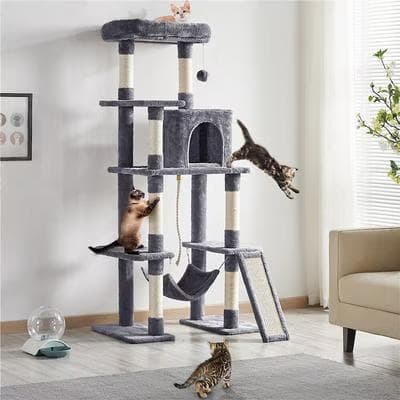
63-inch multi-level cat tree with plush perches, a condo, a hammock, sisal scratching posts, and a dangling toy. Dark gray.
Webvet may earn a commission when you click through to Chewy, at no extra cost to you.
3. Maximum relaxation and deep sleep
Cats cycle between light dozing and deep sleep. The belly-up sprawl, with slack whiskers and limp paws, tends to show up during that deep, dream-heavy stage. A cat has to feel safe to let itself sink that far under, which is why the pose so often overlaps with trust.

4. Comfort and flexibility
Cats are remarkably supple, and lying on the back lets the spine and limbs stretch out in ways a curled position cannot. Some cats simply find it comfortable to unspool their whole body, especially right after a satisfying full-body stretch. For an older or achy cat, sprawling can take pressure off stiff joints.

5. A playful invitation
Not every belly-up cat is asleep. A cat that rolls onto its back while awake, batting at the air or a toy, is often inviting play. Kittens and young cats do this constantly. The rolling flop is part come-play-with-me and part show of confidence, since a cat would never expose its belly to something it perceived as a real threat.
6. Marking scent and territory
Cats have scent glands across their bodies, and rolling onto the back and wriggling can deposit their scent onto a favorite spot. When a cat flops and rolls on a particular blanket, sunny patch, or your lap, it may be marking that territory as comfortably, reassuringly its own.

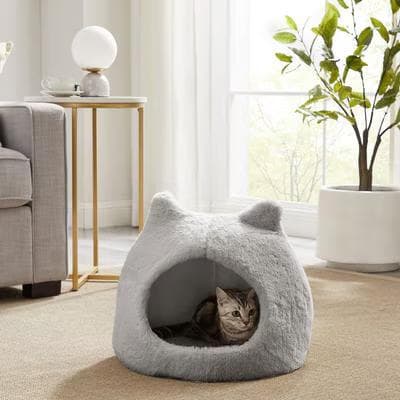
Covered, igloo-style cat bed in soft plush with a water-resistant bottom, giving cats a cozy enclosed spot to curl up. Grey.
Webvet may earn a commission when you click through to Chewy, at no extra cost to you.
Is a Belly-Up Cat Actually Asking for a Belly Rub?
Here is where a lot of loving owners get gently ambushed. A cat rolling over to show its belly looks exactly like a dog asking for a belly rub, so the instinct is to reach right in. But for many cats, an exposed belly is a display of trust, not a request to be touched there. Rub the belly and you may trigger the famous belly-trap: paws grab your hand, back legs kick, and teeth come out, all in a flash.

This is not your cat being deceptive or mean. The belly is a highly protected, sensitive area, and many cats reflexively defend it the instant it is touched, even when they trust you deeply. A few cats genuinely enjoy belly rubs, but they are the exception. When in doubt, admire the belly, do not pet it, and let your cat come to you for affection on its own terms.
Belly-Up vs Other Sleeping Positions: What Each One Signals
Belly-up is only one pose in a cat's repertoire, and each position carries its own message about how safe and comfortable your cat feels. Comparing them side by side makes the belly-up signal much easier to read.
| Sleeping position | What it usually signals | Comfort and trust level |
|---|---|---|
| Belly-up (on the back) | Total relaxation, deep trust, sometimes cooling off | Highest |
| Side sprawl | Relaxed and content, deep sleep, some belly exposed | High |
| Loaf (paws tucked under) | Resting but ready to move, mildly guarded | Moderate |
| Curled in a ball | Conserving heat and protecting the belly | Moderate |
| Crouched and tense (hunched) | On alert, cold, or possibly unwell | Low |
The compact cat loaf position with all four paws tucked underneath is a middle ground: your cat is relaxed enough to rest but keeps its paws and belly protected, ready to spring up if needed.
By contrast, a cat curled up in a ball with its tail over its nose is conserving warmth and shielding its vital organs. It is a cozy, self-protective pose, and it is the opposite of the wide-open vulnerability of belly-up.
Belly-up sleeping at a glance
Pros
- A strong sign your cat trusts you and feels safe at home
- Often means your cat is in deep, restorative sleep
- Can help a warm cat cool down comfortably
- Usually a reassuring, healthy behavior in a settled cat
Cons
- The exposed belly is often a trust display, not an invitation to touch
- Petting the belly can trigger the grab-and-kick belly-trap reflex
- A sudden, out-of-character change in posture can occasionally hint at illness
When Sleeping on the Back Could Signal a Health Problem

Probiotic supplement formulated to help cats maintain calm behavior, with the BL999 strain. 30 daily sachets.
Webvet may earn a commission when you click through to Chewy, at no extra cost to you.
In the vast majority of cases, belly-up sleeping is a happy, healthy sign. The behavior itself is not a symptom of anything wrong. What matters is context and change. A cat that has always napped on its back is simply being a relaxed cat. A cat that suddenly adopts a strange new posture, or abandons its usual comfy poses, is the one to watch.
Occasionally a cat in pain will lie in an unusual position to relieve pressure. A cat with abdominal discomfort, breathing trouble, or generalized pain may hold itself oddly, or may seem to sprawl but actually be tense and reluctant to move. The pose is not the alarm; the accompanying signs are.
Because posture can occasionally reflect how a cat feels, it is worth knowing the difference between a happy sprawl and a worrying one. Our guide to cat sleeping positions when sick walks through the postures that tend to accompany illness, so you can tell a contented belly-up nap from a red flag.
Kittens vs Senior Cats: Does Age Change Belly-Up Sleeping?
Age plays a real role in how often, and why, a cat sleeps on its back. Kittens are the belly-up champions. They have not yet learned to be wary of the world, they sleep enormously as they grow, and they tumble into deep sleep in a puppy-pile of exposed bellies without a second thought. A belly-up kitten is often just being a carefree kitten.
Senior cats can go either way. A comfortable, secure older cat may still love a good belly-up sprawl, and lying on the back can ease pressure on arthritic joints. But older cats also feel the cold more and may favor warm, curled positions to stay cozy. If a senior cat that always slept belly-up suddenly stops, or picks stiff, guarded postures instead, mention it to your vet, since arthritis and other age-related issues can quietly change how a cat rests.
Both kittens and seniors sleep more than cats in their prime, so a lot of belly-up napping at either end of life is normal. To understand what is typical, see how much sleep is healthy in our guide to how much cats sleep. A sudden, dramatic jump in sleep at any age, though, is worth watching.
If your cat has started sleeping far more than usual on top of any posture changes, our partners at Petful explain the common reasons behind a cat sleeping so much and when it points to something more than a lazy afternoon.
How to Tell If Your Cat Trusts (or Has Imprinted On) You
Belly-up sleeping is one of the loudest trust signals a cat can send, but it rarely travels alone. A cat that has bonded closely with you, sometimes described as imprinting, tends to show a whole cluster of affectionate behaviors. Look for these alongside the belly-up sprawl:
- Slow blinking at you, the feline equivalent of a warm, relaxed smile.
- Following you around from room to room and settling wherever you are.
- Kneading your lap or a blanket, a contented behavior carried over from kittenhood.
- Head-butting and cheek-rubbing, which mark you with your cat's scent as one of its own.
- Sleeping on or near you, choosing your body or your side over any other spot in the house.
That last one is a big one. If your cat regularly chooses your chest, lap, or feet as its bed, it is a profound sign of attachment. We dig into the reasons in why does my cat sleep on me, which pairs naturally with belly-up trust behavior.
How to Say 'I Love You' Back in Cat Language
If your cat is bonding with you through belly-up trust and slow blinks, you can absolutely answer in kind. Cats communicate love through calm, predictable, low-pressure signals, and you can speak the same dialect.
- Return the slow blink. Catch your cat's eye, then slowly close and open your eyes. It is the closest thing cats have to a spoken I love you, and many cats slow-blink right back.
- Respect the belly. When your cat shows its belly, admire it rather than grabbing it. Honoring that boundary tells your cat its trust was well placed.
- Let your cat set the pace. Offer affection and let your cat opt in. A cat that can always walk away is a cat that keeps coming back.
- Keep the environment calm and safe. A quiet, predictable home with cozy spots and few threats is the foundation that makes belly-up sleeping possible in the first place.
Where and how your cat chooses to sleep in relation to you says a great deal about your bond. For more on decoding those choices, see what your cat's sleeping position with you means. The more secure your cat feels, the more often you will catch it belly-up and blissful.
A cat that feels safe enough to sleep belly-up even around other pets or a busy household has landed exactly where every cat owner hopes: fully at home, fully at ease, and completely, adorably unguarded.
- A playful cat may also flop belly-up while wide awake, batting at a toy as an invitation to play rather than a request for sleep.
Frequently Asked Questions
Why does my cat sleep on his back with his legs in the air?
Your cat sleeps on his back with his legs in the air because he feels completely safe and relaxed. The belly is a cat's most vulnerable area, protecting vital organs, so exposing it means he does not expect any threat. The floppy, legs-up sprawl also appears during his deepest, most restorative sleep, when his muscles go fully slack. There is often a practical bonus, too: splaying the legs opens the thinly furred belly and inner thighs to the air, which helps a warm cat cool down. So the pose usually means a blend of deep trust, deep relaxation, and sometimes temperature regulation. It is one of the most reassuring positions a cat can choose.
What does it mean when a cat sleeps on the back?
When a cat sleeps on its back, it most often means the cat feels safe, secure, and deeply relaxed. Because the belly guards vital organs and cannot be defended quickly, a cat only exposes it when it trusts its surroundings and the people or pets nearby. Belly-up sleeping can also help a warm cat shed heat, since the belly fur is thinner, and it tends to accompany the deepest stage of sleep. In most cases it is a healthy, happy sign rather than a cause for concern. The main thing to watch is change: a sudden, out-of-character posture shift paired with lethargy, hiding, appetite loss, or labored breathing is worth a vet visit, even though the belly-up pose itself is not a symptom.
How to tell if a cat is imprinted on you?
A cat that has imprinted on, or closely bonded with, you shows a cluster of trusting, affectionate behaviors rather than any single sign. Classic signals include sleeping on or right next to you, exposing its belly in your presence, slow blinking at you, following you from room to room, kneading your lap or a blanket, head-butting and cheek-rubbing to mark you with its scent, and greeting you with an upright tail and a chirp or trill. A cat that seeks you out for comfort, relaxes fully around you, and chooses your company over hiding is telling you it feels genuinely attached. The more of these behaviors you see together, and the more relaxed your cat is around you, the stronger the bond.
How do you say "I love you" in cat language?
The clearest way to say I love you in cat language is the slow blink. Catch your cat's gaze, then slowly close and reopen your eyes; this relaxed, unthreatening gesture is how cats signal trust and affection, and many will slow-blink back. Beyond that, you can speak your cat's language by respecting its boundaries, admiring an exposed belly instead of grabbing it, letting your cat set the pace of affection so it can always walk away, and keeping the home calm, predictable, and full of cozy safe spots. Gentle head-to-cheek contact, quiet talking, and consistent routines all reinforce the bond. In short, cats feel loved through calm, patient, low-pressure attention rather than forced cuddles.

Editor
The Webvet Editorial Team is the in-house group of pet-care editors and writers behind Webvet, operated by Smart Pet Collective. The team researches, writes, and maintains Webvet's pet health, behavior, and medication content. Every article follows a defined editorial process: research from reputable veterinary and scientific sources, careful drafting, mandatory review of medical content by a credentialed veterinarian, and dated publication. Health and medication articles are medically reviewed by a licensed veterinary professional before they go live and are kept current over time.


