Cat Sleeping Positions With Owner: What Each Pose Means
On your chest, by your head, at your feet, or between your legs? Decode what every cat sleeping position with its owner really means about trust, warmth, and your bond.

This article contains affiliate links. Webvet may earn a commission when you buy through them, at no extra cost to you.
Where and how your cat chooses to sleep in relation to you is one of the most honest messages it will ever send. Understanding cat sleeping positions with owner meaning turns a nightly habit into a readable map of trust, warmth, and love. A cat that sleeps on your chest is bonding with your heartbeat; one at your feet keeps an escape route; one between your legs has simply found the best radiator in the house. This vet-informed guide decodes every owner-relative position, one by one, plus what a sudden change in where your cat sleeps can quietly tell you.
- 1Where your cat sleeps relative to you signals its trust level, from arm's-length companionship to belly-up total surrender.
- 2Sleeping on your chest or by your head is scent bonding and peak trust; at your feet is affection with an escape route.
- 3Between your legs or in your just-vacated warm spot is usually about heat as much as love.
- 4Cats bed-share with their owners for warmth, scent, security, and social bonding, all at once.
- 5A sudden change in where or how your cat sleeps, especially withdrawal plus lethargy or hiding, is worth a vet visit.

What Your Cat's Sleeping Position Really Tells You About Your Bond
Cats are hardwired to be cautious about where they rest. In the wild, a sleeping cat is a defenseless cat, so a cat chooses its sleeping spot based on how safe it feels and who it trusts. When your cat picks a spot on, near, or touching you, it is making a deliberate decision: you are safe, warm, and part of its inner circle.
The exact position layers on more meaning. Closeness usually maps to trust, and vulnerability, like an exposed belly, maps to even deeper security. But warmth, personality, and simple comfort matter too. A cat at your feet is not loving you less than a cat on your chest; it may just prefer a little space or a quick exit. Read the position as one clue among several, alongside your cat's overall body language and daytime affection.
This guide focuses on how your cat sleeps in relation to you. For the wider catalogue of solo poses like the loaf, the crescent curl, and the belly-up sprawl, see our full guide to cat sleeping positions and what they mean.
Cat Sleeping Positions With Their Owner: The Complete Meaning Chart
Here is the quick-scan version. Use this chart to find your cat's favorite spot, then read the full section below for the nuance behind each one.
| Where your cat sleeps | What it usually means | Trust level |
|---|---|---|
| On your chest or stomach | Deep attachment; bonding with your heartbeat and warmth | Very high |
| By your head or on the pillow | Scent bonding and peak trust; you smell like home | Very high |
| Belly-up beside you | Ultimate trust; fully relaxed and undefended | Highest |
| Between your legs | You are a warm, secure den; comfort and heat | High |
| Spooning or against your back | You are part of the colony; shared warmth and safety | High |
| At your feet or foot of the bed | Affection with an escape route; guarding with space | Moderate to high |
| Butt facing you | Trust and comfort; back turned means it feels safe | High |
| Beside but not touching | Companionship with independence; likes closeness and space | Moderate to high |
| In your just-vacated warm spot | Claiming your heat and scent; comfort-seeking | Moderate to high |
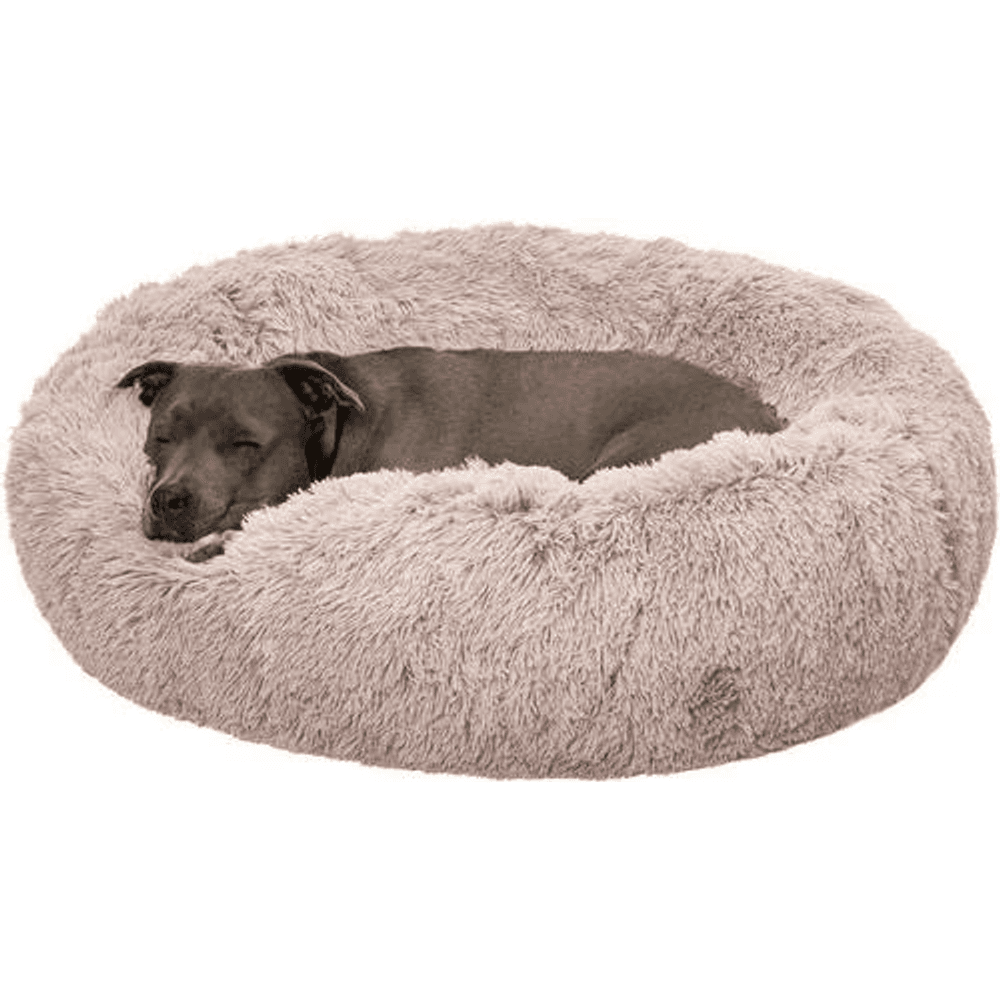
A plush, long-fur donut bolster bed with a raised rim that gives a recovering pet a secure, cushioned place to curl up during the crucial 10 to 14 days after surgery.
Webvet may earn a commission when you click through to Chewy, at no extra cost to you.
On Your Chest or Stomach: Heartbeat, Warmth, and Deep Attachment
A cat that sleeps on your chest or stomach is choosing one of the most intimate spots available. Your torso is warm, it rises and falls with your breathing, and it carries the steady thump of your heartbeat, a rhythm that many cats find deeply soothing, echoing the closeness they knew as kittens curled against their mother.

This position is a strong signal of deep attachment and trust. Your cat is not just near you; it is on you, using your body as both mattress and safe zone. It is also practical: your chest is one of the warmest surfaces in the house, and your scent is concentrated there, which reassures your cat that it is exactly where it belongs.
There is a comforting rhythm at work here, as well. The rise and fall of your breathing and the muffled beat of your heart create a slow, predictable cadence that helps a cat settle and drift into deeper sleep. Kittens spend their first weeks pressed against a warm, breathing, purring mother, so an adult cat that seeks out your chest is returning to one of the most primal reassurances it knows. This is often why chest-sleepers knead, purr, and dribble happily before they finally nod off.
If your cat only claims your chest occasionally, do not read too much into the off nights. Cats rotate their sleeping spots for warmth, light, and comfort, and a cat that snoozes elsewhere one evening has not withdrawn its love. What matters is the overall pattern: a cat that returns to your chest or stomach again and again has clearly decided that you are its safest, coziest place in the whole house.
If your cat regularly picks your chest, lap, or stomach over any other spot in the home, that is a profound compliment. We unpack the full range of reasons in our guide to why does my cat sleep on me, from warmth and scent to genuine emotional bonding.
By Your Head or On the Pillow: Scent Bonding and Peak Trust
When your cat curls up by your head or claims a corner of your pillow, scent is doing most of the talking. Your head and hair carry your most concentrated personal smell, and cats bond through scent. Sleeping there lets your cat both soak up your scent and layer its own onto you, mingling the two into one shared family smell.

The head is also a relatively still, protected spot. Unlike your restless legs, your head stays put, so a cat that wants closeness without being jostled often gravitates upward. Choosing to sleep this close to your face, one of the most vulnerable positions for both of you, reflects peak trust. Your cat is confident you will not startle, roll, or threaten it in the night.
Some cats take this a step further and sleep wrapped around the top of your head or nestled in your hair. Beyond scent, there is a temperature bonus: you lose a lot of body heat through your head, so the pillow zone stays pleasantly warm all night. A cat that combines your warmest, most scent-rich real estate with a low-traffic spot has essentially found the penthouse suite of your bed.
It is worth noting that a head-sleeper can occasionally interrupt your rest, batting at your hair or waking you at dawn. If that becomes a problem, you can gently redirect your cat to a warm bed placed near your pillow rather than banishing it from the room. The behavior itself, though, is pure affection: your cat wants to be as close to the essence of you as it can get.
At Your Feet or the Foot of the Bed: Affection With an Escape Route
A cat at your feet or curled at the foot of the bed still wants to be with you, just on slightly more independent terms. This spot offers closeness plus a clear escape route: from the edge of the bed, your cat can slip away instantly if something startles it, without having to climb over you.

There is a protective reading, too. From the foot of the bed, a cat has a wide view of the room and the door, so it can keep a light, instinctive watch over you while you sleep. Many cats treat this as a guarding post. So do not read the distance as coolness; a cat at your feet is often blending affection, a good vantage point, and its natural preference for a ready exit.
This spot is especially common with cats that are still building their confidence, or with restless sleepers who do not want to be jostled by a shifting human. It is also a favorite of cats in multi-pet homes, where the foot of the bed offers closeness to you plus a quick line of retreat if another animal wanders in. In other words, the position often reflects a cat's temperament as much as its feelings toward you.

Lickable cat treats with real chicken, made to support comfort and tranquility. 12 single-serve 0.5-oz tubes.
Webvet may earn a commission when you click through to Chewy, at no extra cost to you.
If your cat has always slept at your feet, take it as a comfortable, healthy sign of an independent but affectionate bond. If a cat that used to sleep on your chest has recently retreated to the foot of the bed, that is a change worth noting, though it is far more often about a warm night or a new mattress than anything medical.
Between Your Legs: You're Their Personal Heater
The gap between your legs is prime feline real estate. It is a warm, enclosed pocket bordered on both sides by your body, which recreates the snug, den-like security cats instinctively seek. A cat wedged between your legs has essentially built itself a cave out of you, complete with central heating.

Cats run warmer than we do and actively seek out heat, so much of this position is about warmth and physical comfort. But it is still a trust behavior: your cat is boxing itself into a spot it cannot bolt from quickly, which it would never do near someone it did not feel safe with. Consider yourself both a heater and a bodyguard your cat has vetted and approved.
You will often see this position peak in colder months, when your body heat is at a premium, and fade a little in summer, when your cat may prefer a cool tile floor. Small and slender cats tend to favor the between-the-legs pocket most, since they fit neatly into the gap, while larger cats may drape across your shins instead. Either way, the message is the same: your cat has decided your body is the best bed in the house.
Spooning or Curled Against Your Back: You're Part of Their Colony
When your cat presses itself along your back or curls into the small of your spine to spoon, it is treating you the way it would treat a trusted fellow cat. Free-living cats that get along sleep piled together for warmth and safety, so a spooning cat has folded you into its social group. You are colony.

Some behaviorists note that a cat curled against your back, facing outward, may also be taking the sentry position, keeping watch on the room while you rest facing the other way. Whether it is guarding you or simply borrowing your warmth, spooning is a high-trust, high-affection choice. Your cat is sharing body heat and lowering its guard right against you.
This colony instinct is deeply rooted. Domestic cats descend from largely solitary ancestors, but they are far more social than their reputation suggests, and cats that live together and trust each other routinely pile up to sleep. When your cat spoons you, it is applying that same social logic to you: you are not a threat or a stranger, you are a member of the group worth cuddling up to. Few positions capture the sheer companionship of the human-cat bond quite so clearly.
Belly-Up / Full Sprawl Next to You: The Ultimate Trust Signal
If your cat flops onto its back beside you, legs splayed and soft belly on full display, you are witnessing the loudest trust signal a cat can send. The belly guards a cat's vital organs and is nearly impossible to defend quickly, so exposing it means your cat feels it has nothing to fear from you or its surroundings.
Doing this right next to you dials the trust up even higher. Your cat is not just relaxed in the room; it is relaxed enough to be utterly defenseless within paw's reach of you. Cats reserve this kind of full surrender for the people and places they trust most, which is why you may notice a newly adopted cat takes weeks or months before it will sprawl belly-up in your company. When it finally does, it is a milestone in your relationship.

A belly-up sprawl is one part total relaxation, one part cooling off, since the thin-furred belly sheds heat. Just remember that an exposed belly is usually a trust display, not a request for a belly rub. We cover the full meaning, and the famous belly-trap, in our guide to a cat sleeping on its back.
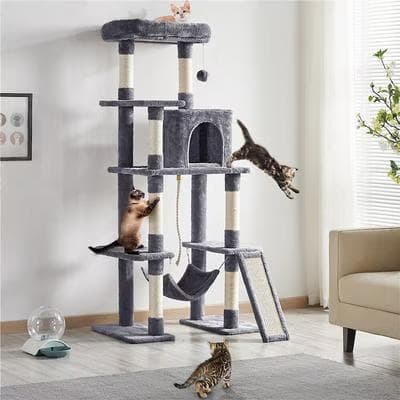
63-inch multi-level cat tree with plush perches, a condo, a hammock, sisal scratching posts, and a dangling toy. Dark gray.
Webvet may earn a commission when you click through to Chewy, at no extra cost to you.
Butt Facing You / Beside-Not-Touching: What It Actually Means
Two of the most misread owner positions are the rear-toward-your-face sleeper and the close-but-not-touching sleeper. Both look standoffish and are actually the opposite.
When your cat sleeps with its back or rear turned toward you, it is not an insult. Turning its back on you means your cat trusts you to watch its blind side; it feels safe enough to point its defenses outward, at the room, rather than at you. It is a quiet vote of confidence, sometimes paired with a bit of scent-sharing from the tail base.
The beside-but-not-touching sleeper wants your company without the contact. This is classic independent-cat affection: close enough to share your presence and warmth, with just enough space to feel autonomous. Plenty of deeply bonded cats prefer this. Proximity, not contact, is their love language, and it is every bit as sincere as a lap snuggler.
The Guardian and the Warm-Spot Claimer: Protective and Comfort Positions
A couple of owner positions are less about touching you and more about your cat's relationship to your space. The guardian perches slightly above or beside you, upright and watchful, keeping a light eye on the room while you sleep. Cats are protective of their territory and their people, and a guardian cat has appointed itself lookout. Some behaviorists link this to the way mother cats and colony members keep watch over sleeping kittens.
The warm-spot claimer is the opportunist who slides into the cozy dent you just left, still radiating your body heat and soaked in your scent. It is a two-for-one: your cat gets a pre-warmed bed and a comforting hit of your smell. Far from rejecting you, the warm-spot claimer is chasing the next best thing to sleeping on you directly.
The Spiritual Meaning and Male-Cat Angle Owners Ask About
A lot of owners search for the spiritual meaning behind where their cat sleeps, particularly when a cat settles on their legs or chest. In folklore and various spiritual traditions, a cat choosing to sleep on you is often read as a sign of protection, healing energy, or a strong soul bond, with the idea that cats sense and soothe stress or illness. These interpretations are cultural and symbolic rather than scientific, and they are lovely to enjoy as long as they do not replace real veterinary care when something seems off.
From a behavioral standpoint, the grounded explanation is the more reassuring one: your cat sleeps on your legs because they are warm, stable, and carry your scent, and because it feels safe there. As for whether male cats sleep differently, sex is far less important than personality, neutering status, and upbringing. A well-socialized, neutered male can be just as cuddly and bonded a bed-sharer as any female, so a male cat sleeping tightly against you carries the same trust-and-warmth meaning as it would for any cat.
Why Do Cats Choose to Sleep With Their Owner?
Zoom out from the specific pose and the same handful of drivers explain nearly every owner-adjacent sleep spot. Whether your cat is on your chest, at your feet, or curled in your just-vacated warm spot, it is almost always answering the same set of instincts. Cats bed-share with their people for a blend of the following reasons:
- Warmth. Cats seek out heat, and a sleeping human is a large, reliable radiator.
- Scent and security. Your smell signals safety, and sleeping in it lowers your cat's guard so it can sleep more deeply.
- Social bonding. Cats that trust each other sleep together, and your cat has folded you into its social circle.
- Safety in numbers. A vulnerable sleeping cat feels safer beside a trusted companion who can help watch for threats.

360-degree Wi-Fi pet camera so you can watch your cat's resting breathing rate and behavior from your phone and catch worrying changes early.
Webvet may earn a commission when you click through to Chewy, at no extra cost to you.
Because cats sleep so much of the day, you will get plenty of chances to observe these positions. To understand what a normal amount of sleep looks like, and when a change matters, see our guide to how much cats sleep.
And if you have ever watched your cat twitch, paddle, or chirp while curled against you, it may be dreaming. We explore what is likely going on in our guide to what cats dream about.
How to Tell If Your Cat Has Truly Bonded With (Chosen) You
Sleeping on or near you is one of the clearest signs a cat has chosen you, but it rarely arrives alone. A cat that has genuinely bonded with you shows a whole cluster of affectionate behaviors. Look for these alongside the shared sleep:
- Slow blinking at you, the feline equivalent of a relaxed, affectionate smile.
- Following you from room to room and settling wherever you happen to land.
- Head-butting and cheek-rubbing you, which marks you with your cat's scent as one of its own.
- Kneading your lap or a blanket, a contented behavior carried over from kittenhood.
- Greeting you with an upright, quivering tail and a chirp or trill when you come home.
The more of these you see together, and the more relaxed your cat is in your presence, the more confident you can be that your cat has truly chosen you. A cat that seeks you out for comfort and sleeps against you is telling you, in the plainest cat terms, that you are its person.
It helps to remember that bonding looks different from cat to cat. A confident, outgoing cat may broadcast its affection loudly, sprawling on your keyboard and demanding laps, while a shy or formerly stray cat may show its trust quietly, sleeping just within sight or slipping onto the bed only after the lights go out. Neither cat loves you more than the other; they simply express it on their own terms. If your once-aloof cat has started choosing to sleep near you, that quiet shift is a genuine sign the bond is deepening.
Is It Safe and Healthy to Let Your Cat Sleep in Your Bed?
For most healthy adults and healthy cats, sharing a bed is perfectly fine and can be genuinely comforting for both of you. The bond and reassurance a cat gets from sleeping near its person are real, and many owners sleep better with a warm, purring companion nearby.
There are a few sensible caveats. Cats are crepuscular, so a cat that wakes and plays at dawn can disrupt your sleep. People with allergies, asthma, or weakened immune systems, and homes with very young infants, may want to keep the cat out of the bedroom. And an outdoor cat should be reliably parasite-protected before it shares your pillow. None of these are reasons to feel guilty; they are just worth weighing for your household.
If bed-sharing does not suit your household, you can still honor your cat's desire to sleep near you. A heated or plush cat bed placed on your nightstand or at the foot of your bed gives your cat the closeness and warmth it craves without it actually being under the covers. Many cats happily accept this compromise, especially if the bed carries a blanket that smells like you. The goal is not to reject your cat but to give it a cozy, safe alternative within your orbit.
Letting your cat sleep in your bed, at a glance
Pros
- Strengthens the bond and reassures an already-trusting cat
- Shared warmth and a calming, purring presence can help you sleep
- Lets you notice changes in your cat's habits and comfort more easily
- Perfectly safe for most healthy people and healthy, parasite-protected cats
Cons
- A dawn-active cat can interrupt your sleep
- Not ideal for people with allergies, asthma, or weakened immunity
- Outdoor cats should be reliably flea, tick, and worm protected first
- Very young infants generally should not share a bed with pets
When a Change in Sleeping Position Signals Something Is Wrong
The position itself is almost never the problem; a change from your cat's normal pattern is the thing to watch. A cat that has always slept curled against your chest and suddenly retreats to sleep alone, hidden under the bed or in a closet, is worth paying attention to, especially if the change is sudden and out of character.
Cats instinctively hide when they feel unwell, so withdrawal from your bed can be an early clue that something is off. A cat in pain may also adopt a tense, hunched posture instead of its usual relaxed sprawl, or seem unable to get comfortable. As always, it is the surrounding signs, not the pose alone, that raise the alarm.
The reverse can also happen. A cat that suddenly becomes much clingier, insisting on being pressed against you day and night when it never used to, is occasionally seeking comfort because it feels off. Older cats in particular may cling more as arthritis, cognitive changes, or failing senses make the world feel less secure. Any abrupt, sustained change in your cat's normal sleeping habits, in either direction, is worth a mental note and, if it persists or comes with other symptoms, a conversation with your vet.
Because posture and sleep spot can reflect how a cat feels, it helps to know the difference between a happy snuggle and a worrying retreat. Our guide to cat sleeping positions when sick walks through the postures that tend to accompany illness so you can tell them apart.
Not every change is medical, though. Cats also rotate their sleeping spots for seasonal, comfort, and territorial reasons. Our partners at Petful explain the common, harmless reasons behind why a cat always changes where it sleeps, which can help you tell a normal shuffle from a red flag.
Which Cat Breeds Are the Most Clingy Bed-Sharers?
Personality varies from cat to cat, but some breeds are famous for being especially affectionate, people-oriented, and prone to sleeping right on top of you. If you want a guaranteed bed buddy, these breeds skew clingy in the best way:
- Ragdoll, named for going limp and cuddly in your arms, and one of the most affectionate lap breeds.
- Siamese, intensely people-focused, vocal, and known to shadow their owner everywhere.
- Sphynx, hairless and heat-seeking, so they burrow under the covers and cling to your warmth.
- Burmese and Bombay, velcro cats that love laps, attention, and sleeping pressed against their person.
That said, breed is only a tendency. Plenty of mixed-breed and rescue cats are devoted bed-sharers, while some pedigree cats prefer their own space. How a cat is raised, socialized, and treated matters just as much as its breed. A secure, well-loved cat of any background can become your most loyal sleeping companion.
Age matters here, too. Kittens are the ultimate cuddlers, sleeping in trusting heaps and burrowing against any warm body, while some cats grow a little more independent as they mature and then circle back to being cuddly in their calm senior years. If you specifically want a bed-sharing cat, spending relaxed, low-pressure time together, offering warmth, and never forcing contact will encourage the behavior far more reliably than breed alone. Trust, patience, and consistency turn almost any cat into a willing sleeping partner.
How to Say 'I Love You' Back in Cat Language
If your cat is telling you it loves you by choosing to sleep against you, you can answer in kind. Cats communicate affection through calm, patient, low-pressure signals, and you can speak the same dialect back.
- Return the slow blink. Catch your cat's eye, then slowly close and reopen your eyes. It is the closest thing to a spoken I love you in cat, and many cats blink right back.
- Respect its chosen sleep spot. Let your cat sleep where it feels safest without moving or disturbing it. Honoring that choice tells your cat its trust was well placed.
- Let your cat set the pace. Offer affection and let your cat opt in. A cat that can always walk away is a cat that keeps coming back to your side.
- Keep the home calm and predictable. A quiet, low-stress environment with cozy safe spots is the foundation that makes trusting, close-contact sleep possible in the first place.
Do these consistently and you reinforce the exact bond that has your cat curling up on your chest each night. The more secure your cat feels, the more often it will choose you as its favorite place to sleep.
Ultimately, every one of these positions, from the chest snuggler to the foot-of-the-bed guardian to the arm's-length companion, is your cat telling you the same thing in slightly different accents: it feels safe with you. Learn to read the accent and you will never again wonder whether your cat loves you. The proof curls up beside you every single night.
Frequently Asked Questions
How do you say "I love you" in a cat?
The clearest way to say I love you to a cat is the slow blink. Meet your cat's gaze, then slowly close and reopen your eyes; this relaxed, unthreatening gesture is how cats signal trust and affection, and many will slow-blink back. You can reinforce it by respecting your cat's boundaries, letting it choose where to sleep and when to be touched, offering gentle head-to-cheek contact if it invites it, and keeping the home calm, predictable, and full of cozy safe spots. Cats feel loved through calm, patient, low-pressure attention rather than forced cuddles, so speaking their language mostly means slowing down and letting your cat come to you.
What does it mean when a cat sleeps with its owner?
When a cat sleeps with its owner, it most often means the cat trusts and feels bonded to that person. A sleeping cat is vulnerable, so choosing to rest on, against, or near you shows it feels safe in your presence. The behavior also blends practical motives: your body is warm, your scent signals security and helps your cat relax into deeper sleep, and sleeping beside a trusted companion satisfies a cat's instinct for safety in numbers. The exact spot adds nuance, with on-your-chest or by-your-head signaling especially deep attachment and at-your-feet blending affection with a preferred escape route. In nearly all cases it is a genuine sign of love and security.
How to tell if a cat has chosen you?
A cat that has chosen you shows a cluster of trusting, affectionate behaviors rather than any single sign. Classic signals include sleeping on or right next to you, exposing its belly in your presence, slow blinking at you, following you from room to room, kneading your lap or a blanket, head-butting and cheek-rubbing to mark you with its scent, and greeting you with an upright, quivering tail and a chirp or trill. A cat that seeks you out for comfort, relaxes fully around you, and picks your company over hiding is telling you it feels genuinely attached. The more of these behaviors you see together, and the more relaxed your cat is with you, the stronger the bond.
Are cats happier if they sleep with you?
Many cats are genuinely happier and more secure when allowed to sleep with a trusted person, because it satisfies their need for warmth, scent-based reassurance, and safe companionship. A cat that chooses to sleep with you is showing it feels calm and bonded, and that closeness can strengthen your relationship. That said, happiness depends on choice: a cat should be free to join you or sleep elsewhere, never forced. Some independent cats are perfectly content sleeping nearby or alone in a favorite cozy spot, and that is not a sign of unhappiness. As long as your cat has safe, warm resting options and the freedom to pick, it can be equally happy sleeping with you or on its own.
What smell do cats absolutely hate?
Cats have a far more sensitive sense of smell than we do and tend to strongly dislike citrus (orange, lemon, and lime), which is why many will avoid citrus-scented areas. Other smells cats commonly hate include strong menthol and eucalyptus, most essential oils, mint, pine and other harsh cleaners, vinegar, coffee grounds, and pungent spices. Because these odors can be off-putting, a cat is much less likely to relax and sleep somewhere that reeks of them. If your cat suddenly avoids a favorite sleeping spot near you, check whether a new detergent, air freshener, essential oil diffuser, or cleaner has introduced a scent it finds unpleasant. Note that many essential oils are also toxic to cats, so keep diffusers and undiluted oils well away from them.
Which cat breed is most clingy?
The Siamese is often crowned the most clingy cat breed. Siamese cats are intensely people-oriented, highly vocal, and known to follow their owner from room to room and demand to be involved in everything, including sleep. Other famously clingy, affectionate breeds include the Ragdoll, which goes limp and cuddly in your arms, the heat-seeking Sphynx that burrows under the covers, and the devoted Burmese and Bombay. Keep in mind that clinginess is an individual trait as much as a breed one; upbringing, socialization, and personality shape how attached a cat becomes, so plenty of mixed-breed and rescue cats are just as devoted as any pedigree.
How do you say "I love you" in cat language?
In cat language, the most reliable way to say I love you is the slow blink: hold your cat's gaze, then slowly close and reopen your eyes to signal calm and trust, and many cats will return it. Beyond that, you can speak your cat's dialect by respecting its space, admiring an exposed belly rather than grabbing it, letting your cat set the pace of affection so it can always walk away, offering gentle cheek and head contact when it invites you, and keeping the home quiet, predictable, and full of safe cozy spots. Consistent routines, soft talk, and honoring your cat's chosen sleeping places all reinforce the bond. Cats feel loved through patient, low-pressure attention far more than through forced cuddling.
What breed of cat is the most clingy?
The Siamese is widely considered the most clingy cat breed, prized (and occasionally exhausting) for how intensely it bonds with its humans, vocalizes for attention, and insists on being wherever you are, including your bed. Close behind are other velcro breeds: the affectionate Ragdoll that loves to be held, the hairless Sphynx that craves body heat and snuggles under blankets, and the loyal Burmese and Bombay that adore laps and constant company. Breed is only a tendency, though. How a cat is raised and socialized influences clinginess just as much, so a well-loved cat of any breed or mix can grow into an intensely devoted, always-underfoot companion.

Editor
The Webvet Editorial Team is the in-house group of pet-care editors and writers behind Webvet, operated by Smart Pet Collective. The team researches, writes, and maintains Webvet's pet health, behavior, and medication content. Every article follows a defined editorial process: research from reputable veterinary and scientific sources, careful drafting, mandatory review of medical content by a credentialed veterinarian, and dated publication. Health and medication articles are medically reviewed by a licensed veterinary professional before they go live and are kept current over time.


