Best Hairball Remedy for Cats: Vet-Reviewed Picks
Six vet-reviewed hairball remedies for cats compared by how each one actually works, what the published feeding studies really measured, and the point at which buying another product is the wrong move.

BVMS MRCVS
Medically reviewed by Dr. Pippa Elliott, BVMS MRCVS · Last reviewed

This article contains affiliate links. Webvet may earn a commission when you buy through them, at no extra cost to you.
The best hairball remedy for cats is the one your cat will actually accept, matched to the reason the hairballs are happening in the first place.
Almost everything on the shelf is designed to do one of two jobs: lubricate swallowed hair so it keeps moving, or add fiber so more hair leaves in the stool. Nothing dissolves hair. Hair is keratin, and no product sold in a pet store breaks it down.
Below are six picks covering gels, chews, fiber tablets, food, lickable treats, grooming, and grass, plus what the peer-reviewed veterinary literature actually found when researchers tested these approaches. Some of it is less flattering than the packaging.
- 1Before you buy anything, rule out the two problems a hairball remedy cannot fix: an obstruction, and a cough that only looks like a hairball retch.
- 2A cat that retches repeatedly without producing anything, refuses food, or stops passing stool needs a veterinarian, not a gel.
 Sponsored
Have a health question about your cat?
Talk to a licensed vet at Dutch over video or message, including nights and weekends.
Use code Pets30
Plans start at $11/month · covers up to 5 pets
- Licensed vets in most states
- Rx for 150+ conditions
- 4.7 on Trustpilot
Before You Buy: When a Hairball Is Not Just a Hairball
A hairball remedy is the wrong purchase for a cat that may be obstructed. VCA Animal Hospitals lists three signs of an obstruction:
- Vomiting
- Abdominal pain
- A lack of bowel movements
VCA also states that a cat which cannot keep down food or water needs veterinary treatment. The detail that catches owners out: with an obstructing trichobezoar, you may not see any hair in the vomit at all.
That last point is worth sitting with. Plenty of people watch a cat vomit clear fluid or undigested food, see no hair, and conclude the hairballs have stopped. The hair may simply be stuck.
The Cornell Feline Health Center draws the line at two patterns. Contact a veterinarian without delay if you see either of these:
- Lethargy plus food refusal lasting more than a day or so
- Repeated episodes of unproductive retching
That is a phone call, not a trip to the pet store.
The second thing to rule out is a cough. VCA Animal Hospitals notes that a cough is often confused with bringing up a hairball, with one decisive difference: no hairball is produced. Coughing points to lower respiratory disease, usually bronchitis.
Cornell is blunter about the stakes, warning that frequent hacking may be a serious respiratory problem such as asthma that requires emergency treatment.
| Hairball retch | Cough | |
|---|---|---|
| Does something come up? | Yes, a mass of hair, or food and fluid | No, nothing is produced (VCA) |
| Most likely cause | Swallowed hair from normal grooming | Lower respiratory disease, usually bronchitis (VCA) |
| Emergency potential | Concerning when retching is repeated and unproductive (Cornell) | Frequent hacking may be asthma needing emergency treatment (Cornell) |
| Right next step | Hairball management, once obstruction is ruled out | Veterinary respiratory work-up |
If any obstruction sign above matches your cat, read the warning signs of a hairball blockage before buying anything. And if you are not certain what you found on the floor was a hairball, our guide to telling a hairball apart from vomit shows what each one looks like.

How Many Hairballs Are Actually Normal?
Webvet may earn a commission when you click through to Chewy, at no extra cost to you.
Far fewer than most owners assume. The Cornell Feline Health Center calls a hairball once every week or two nothing to worry about, which works out to roughly 26 to 52 a year.
Peer-reviewed owner survey data lands somewhere very different. In a poll published in the Journal of Feline Medicine and Surgery, 48 apparently healthy shorthaired cats split like this:
- 35 of the 48 (73%) had never been known to bring up a hairball at all
- 8 of the 48 (17%) produced about one a year
- 5 of the 48 (10%) produced two or more
A larger poll in the same review split the results by coat:
- Shorthaired cats. 26% of 87 cats brought up more than two hairballs a year, and 43% had never produced one.
- Longhaired cats. 55% of 38 cats brought up more than two a year, and 24% had never produced one.
Put together, roughly 10% of otherwise healthy shorthaired cats regularly bring up hairballs, defined as two or more a year, with longhaired incidence around twice that. A separate commentary in the Journal of Feline Medicine and Surgery puts the figure for healthy cats generally at about 10%.
So which number should you use? Neither alone. The rule that commentary lands on is not a raw count but a change in pattern or frequency, especially alongside weight loss or a change in appetite.
Veterinary Partner describes the normal route plainly: in a healthy cat, swallowed hair passes through the stomach and intestines and leaves in the feces. Vomiting hair is the backup plan, not the design.
When one does come up, Cornell describes the typical hairball as cigar or sausage shaped and about an inch long, though some reach five inches long and an inch thick. For the mechanism behind why cats get hairballs in the first place, start with our full guide.

Our Top Hairball Remedy Picks
The remedies veterinarians reach for fall into four groups:
- Petrolatum-based lubricant gels
- Psyllium fiber supplements
- Hairball-control diets
- Grooming tools
Only the last group removes hair before the cat swallows it, and grooming occupies a real share of a cat's day. The often-quoted 3.6 hours a day, about 25% of waking hours, comes from a small observational study of five cats cited in the Journal of Feline Medicine and Surgery.
| Pick | Format | Working ingredient | Where it fits | Best for |
|---|---|---|---|---|
| Vetoquinol Laxatone Tuna Hairball Control Gel for Cats | Lickable gel | White petrolatum and light mineral oil | The lubricant route, delivered by hand | Cats that will lick a gel from a finger |
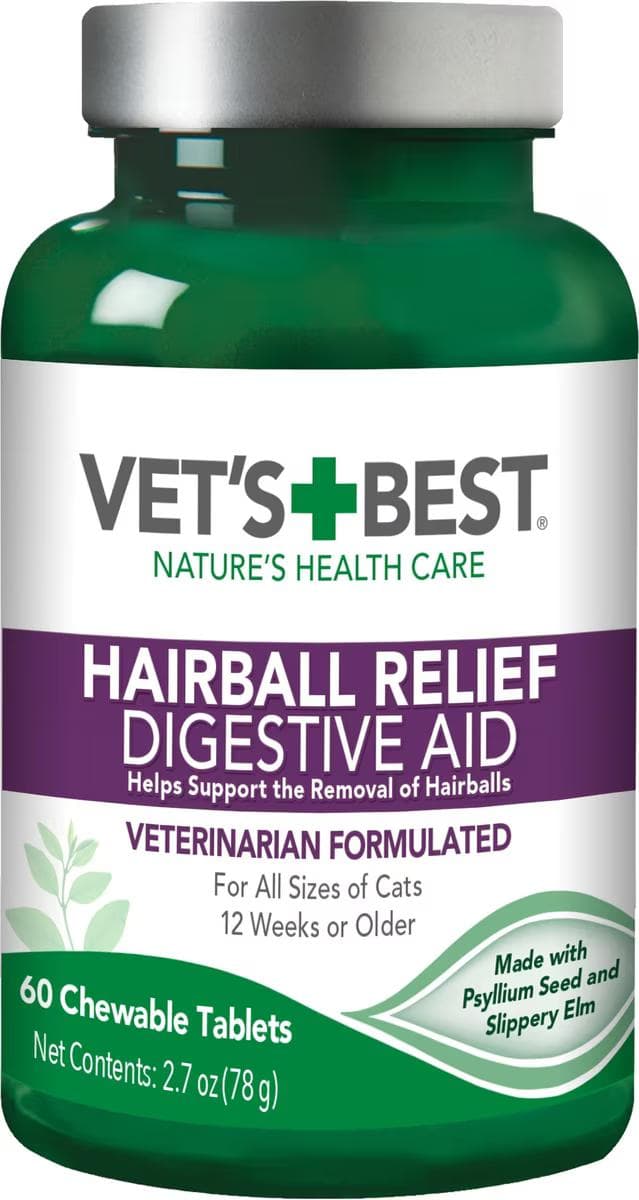
| Vet's Best Hairball Relief Digestive Aid Chewable Tablets | Chewable tablet | Psyllium fiber | The fiber route, and the one feeding studies actually tested | Longhaired cats, and owners who prefer fiber to oil |
| Hill's Science Diet Adult Hairball Control Chicken Recipe Dry Cat Food | Dry complete diet | Powdered cellulose | Fiber built into the whole diet, with no separate step | Cats that refuse supplements entirely |
| Inaba Churu Hairball Control Chicken Recipe | Lickable puree tube | Added fiber in a broth-style puree | The fiber route in the format picky cats accept | Picky cats and pill-averse households |
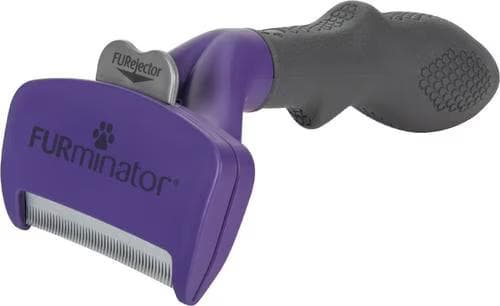
| FURminator Long Hair Cat Deshedding Tool | Deshedding tool | None, purely mechanical | Removes hair before the cat swallows it | Longhaired cats and heavy shedders |
| Frisco Natural Cat Grass Growing Kit | Live grass kit | None, live grass to chew | An enrichment outlet for plant chewers, not a hairball treatment | Cats that already chew houseplants |
Webvet may earn a commission when you click through to Chewy, at no extra cost to you.
Shop the matching products: Vetoquinol Laxatone, Vet's Best Hairball Relief, Hill's Science Diet Adult Hairball Control, Inaba Churu Hairball Control, FURminator Long Hair Cat Deshedding Tool, and Frisco Natural Cat Grass Growing Kit.
How much to offer and how often depends on the product and your cat's weight, so check the label and our guide to dosing a hairball gel safely and what never to give your cat.
Best Overall Lubricant Gel: Vetoquinol Laxatone Tuna Hairball Control Gel for Cats
Laxatone is the gel most clinics keep in a drawer. It is a white petrolatum and light mineral oil base in a tuna-flavored paste, and the design intent is mechanical rather than chemical.

The oil is meant to coat swallowed hair so the mass keeps moving toward the litter box instead of collecting in the stomach. That is the rationale behind the format, not a demonstrated effect.
The tuna flavor exists because acceptance decides everything with gels. A cat that licks it off a fingertip gets all of it. A cat that flicks it away wears it, and you have delivered nothing.
The gel dissolves nothing, whatever the shelf talker implies.
Best Fiber Supplement: Vet's Best Hairball Relief Digestive Aid Chewable Tablets
This is the fiber route rather than the oil route. The tablets are built on psyllium, a soluble fiber. In controlled feeding studies, added fiber raised the amount of hair recovered in the feces, and those studies did not measure whether the cats vomited less.

Fiber is where the closest thing to real evidence lives, and it comes with a catch about coat length. In Veterinary Medicine and Science, psyllium diets at 11% and 15% total dietary fiber raised fecal hair excretion by 81% and 113% in longhaired cats, but produced no effect at all in shorthaired cats.
A separate two-week trial of a psyllium and slippery elm chew, run by Dann and colleagues in 2004 and reported in Cannon's Journal of Feline Medicine and Surgery review, found a 29% reduction in hairball-associated clinical signs such as coughing and retching, but no significant reduction in actual vomiting.

Best Hairball Control Food: Hill's Science Diet Adult Hairball Control Chicken Recipe Dry Cat Food
A hairball-control diet is the option with no daily ritual attached. Hill's ingredient panel names powdered cellulose as the working fiber, so every meal does the work, which suits cats that will not take a gel, a chew, or a tablet from anybody.
Cellulose is also the fiber with the most contradictory evidence behind it. It moved nothing in the sugarcane comparison, yet the double-blind Beynen trial found a cellulose-enriched diet reduced vomiting, retching and coughing. Encouraging, not settled.

Choosing a food deserves a proper comparison, including wet against dry and what to do for a cat with a sensitive stomach. We cover that in our guide to the best cat food for hairballs.
Best Lickable Treat for Picky Cats: Inaba Churu Hairball Control Chicken Recipe
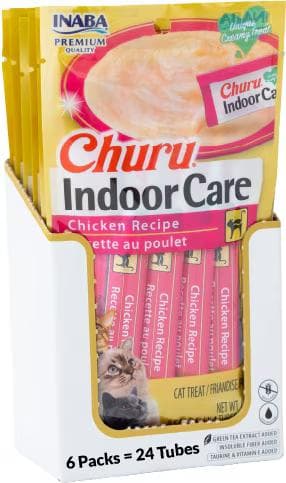
Churu is a broth-style puree in a squeeze tube, and it reaches cats that every other format bounces off. The hairball version adds fiber to the same puree most cats will lick straight from the tube while making direct eye contact with you.

The practical advantage is acceptance. Offering it becomes a social event rather than a wrestling match, which is often the difference between a remedy that stays in the routine and one that gets abandoned.
Best Prevention Tool: FURminator Long Hair Cat Deshedding Tool
The only item on this list that stops hair reaching the stomach has no active ingredient at all. A deshedding tool lifts loose undercoat the cat would otherwise swallow while grooming, and the long-hair version has longer teeth to reach through a dense topcoat.

Coat length is the sharpest signal in the obstruction data. Among 44 cats operated on for obstructive trichobezoars in a 2023 Journal of Feline Medicine and Surgery study, 20 (45.5%) were domestic longhairs and 9 (20.5%) were Maine Coons, against 7 (15.9%) domestic shorthairs.
If you own a long coat, the brush is the main event, not the optional extra.
Technique by coat type lives in our guide to a brushing routine matched to your cat's coat.
Prefer a lubricant gel? Vetoquinol Laxatone is the dedicated gel option from the picks above.
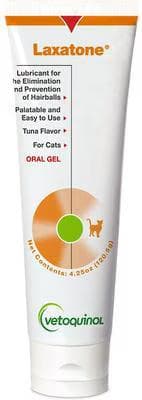
A palatable tuna-flavored oral gel that gently lubricates the digestive tract to ease hairballs and mild constipation in cats.
Webvet may earn a commission when you click through to Chewy, at no extra cost to you.
Best Enrichment Outlet for Plant Chewers: Frisco Natural Cat Grass Growing Kit
Start with the caveat, because the packaging will never carry it. Barrs and colleagues, writing in the Journal of Feline Medicine and Surgery in 2001, list four documented factors that predispose cats to obstructive trichobezoars:
- A long-hair coat
- Flea allergy dermatitis
- Inflammatory bowel disease
- Ingestion of non-digestible plant material
So treat this as an enrichment item, not a hairball treatment. No study has shown that cat grass reduces hairballs, and the one published mention of plant material in this literature is a risk factor rather than a benefit.

What a tray of live grass does is give an indoor cat that already chews greenery a target that is not your pothos. That is the honest argument for it: redirecting an existing habit, for households where the habit is happening anyway.
SponsoredVet care that's always there
Unlimited video calls and messaging with licensed vets for less than a typical vet visit. One membership covers up to five pets.
Use code Pets30
Plans start at $11/month · covers up to 5 pets
- Licensed vets in most states
- Rx for 150+ conditions
- 4.7 on Trustpilot
What the Evidence Actually Says About Hairball Remedies
Nothing dissolves a hairball. Hair is keratin, and no retail product breaks it down. The nearest thing in the literature is a research diet pairing fiber with keratinolytic enzymes, and even that measured how much hairball material the cats excreted, not hair being dissolved. It was a study formulation, not a product on a shelf.
Most of what the controlled studies measured was not vomiting but fecal hair excretion, meaning how much hair left the body in the stool.
Cannon's review in the Journal of Feline Medicine and Surgery documented that the entire peer-reviewed literature on feline hairballs up to 2013 amounted to one five-case series and 13 single case reports published between 1946 and 2010.
Which Fiber, and Does the Type Matter?
The studies that exist point to the type of fiber mattering more than the amount, though they do not all point the same way.
Cellulose is where that shows up most sharply. Two trials tested it and reached different conclusions:
- Sugarcane fibre worked on excretion, cellulose did not. In a controlled 42-day study of 32 cats in the Journal of Nutritional Science, added sugarcane fibre linearly reduced excretion of small and medium trichobezoars (P=0.004) and reduced trichobezoar mass (P<0.01). Added cellulose produced no effect on any measured trait.
- Cellulose worked on what owners saw. A double-blind, placebo-controlled trial in 24 owned cats by Beynen and colleagues found that a diet enriched with cellulose reduced vomiting, retching and coughing.
The two trials measured different things. One counted hairball material the cats excreted and saw nothing from cellulose. The other counted what owners saw at home and found a benefit. Neither result cancels the other, so cellulose is best read as unproven on one measure and promising on another.
Webvet may earn a commission when you click through to Chewy, at no extra cost to you.
The same pattern shows up when researchers test fiber against enzymes. In the Journal of Animal Physiology and Animal Nutrition, insoluble fibre alone did not reduce hairball excretion (p=0.5947), and an enzyme complex alone had no effect either (p=0.3633). Only fibre combined with keratinolytic enzymes produced a significant reduction (p=0.0344).
What the Trials Actually Counted
Now read those endpoints closely, because this is where marketing and evidence part company. The fiber and enzyme excretion trials counted hair and hairball material recovered in feces. They did not measure whether the cat in your living room vomits less often.
The other work that tracked owner-observed signs was Dann and colleagues' two-week psyllium and slippery elm chew study from 2004, as reported in Cannon's review. It found a 29% reduction in hairball-associated signs but no significant reduction in actual vomiting. The cats coughed and retched less, and threw up about the same.
The practical translation comes down to four points:
- Fiber has the best claim to doing something measurable
- Coat length decides whether it does anything at all
- Gels have plausible mechanics and no trial support
- Brushing is the only approach that removes hair before the cat swallows it
Be skeptical of any label promising to dissolve or break down a hairball.
Lubricant Gel Safety: What the Label Does Not Tell You
Commercial hairball gels are petrolatum-based products designed to be licked voluntarily, and that design is itself the safety feature. The danger case is a different one.
The distinction matters and it gets blurred constantly online. A flavored gel a cat chooses to lick is simply not the same act as forcing an oily liquid into the mouth with a syringe, and the published warning is specific to the second one.
That is a distinction about route, not substance. It is the syringing that creates the inhalation risk, which is exactly why commercial gels are formulated to be flavored and licked voluntarily rather than forced.
That still leaves commercial flavored gels as the sensible consumer choice, because they are formulated to be licked and take the syringe out of the picture. Three substitutes people reach for are a separate matter, and none of them belong in a hairball plan:
- Olive oil
- Butter
- Human laxatives
The same review makes a broader point worth holding onto. Lifelong medication to control hairballs should not be necessary, and a diligent search for underlying disease should come first. If you find yourself buying gel every month for years, that is information, not a routine.
How much to offer and how often sit with the treatment protocol, so we keep them in one place: how to help a cat pass a hairball safely.
Natural Add-Ons Worth Trying
Brushing is the only approach here that removes hair before a cat can swallow it. The reasoning is mechanical rather than experimental: hair caught on a comb is hair that never reaches the stomach. No study has tested whether that lowers hairball frequency.
Even so, the volume involved is hard to ignore, and a cat that grooms for hours a day is swallowing hair the whole time.
Coat-specific technique lives in our guide to hairball prevention for cats.
Keep the exit route in mind. Veterinary Partner describes the normal path for swallowed hair as straight through the stomach and intestines and out in the feces, which is the system every fiber product is trying to work with.

Finally, deal with the reason for over-grooming. Barrs and colleagues list flea allergy dermatitis in the Journal of Feline Medicine and Surgery among the documented factors predisposing cats to obstructive trichobezoars, and a cat grooming itself raw over fleas swallows far more hair than a comfortable one.
How to Choose a Hairball Remedy for Your Cat
Choosing well comes down to two questions: what will your cat actually accept, and what does the evidence support for your cat's coat?
Coat length is the sharpest dividing line in the research. Psyllium fiber raised fecal hair excretion by 81% and 113% in longhaired cats in Veterinary Medicine and Science, and did nothing measurable in shorthaired cats.
Here is how that plays out, cat by cat:
- Longhaired cats. Start with the brush and add fiber. This is the group the psyllium data supports, and the group that dominates the obstruction surgeries: domestic longhairs (45.5%) and Maine Coons (20.5%) were the two largest shares of the 44 trichobezoar cases in the 2023 Journal of Feline Medicine and Surgery series.
- Shorthaired cats. Expect less from fiber, since that same Veterinary Medicine and Science trial found no effect in shorthaired cats. More importantly, Cannon's review describes frequent hairball elimination in most shorthaired cats as an indicator of underlying chronic disease. A shorthaired cat producing regular hairballs is a diagnostic question first and a shopping question second.
- Senior cats. In a five-cat series reported by Barrs and colleagues in the Journal of Feline Medicine and Surgery in 2001, three cats were 10 or older and abdominal neoplasia was wrongly suspected, delaying or preventing investigation in two. Age is not a diagnosis, and our guide to senior cat digestive problems covers what else to rule out.
- Picky eaters. Go for the lickable puree or the food route. A remedy refused has zero efficacy, however good the formula looks.
- Multi-cat households. Food and treat formats are easier to deliver but harder to control, because you cannot guarantee who ate what. If only one cat needs the supplement, use a format you can give individually and feed it separately.
- Cats with existing medical conditions. Talk to your veterinarian before adding oil or fiber, particularly for a cat on oral medication or a prescription diet. VCA Animal Hospitals is explicit that the single most important prevention strategy is addressing underlying intestinal disease, ranked above diet.
When Hairballs Mean Stop Buying Products
Frequent hairballs in a cat with a chronic history are a diagnostic sign, not a shopping prompt.
Among 44 cats operated on for obstructive trichobezoars in the 2023 Journal of Feline Medicine and Surgery series, alimentary small cell lymphoma was diagnosed in 10 (22.7%), and every one of those ten had a chronic history of gastrointestinal signs.

The chronic-history pattern is the part to notice. In that same series, 24 of the 44 cats (54.5%) had chronic clinical signs before surgery. Within that chronic group:
- 95.8% had been vomiting
- 20.8% had lost weight
- 20.8% had already had a previous trichobezoar obstruction
"Chronic" has a specific meaning here. Pawenski and colleagues, in that 2023 Journal of Feline Medicine and Surgery series, apply the ACVIM consensus definition: gastrointestinal signs lasting longer than three weeks. Three weeks of vomiting is not a hairball phase.
Obstructive trichobezoars are uncommon, but they are well documented. The 2023 series drew its 44 surgical cases from six specialty hospitals between January 2016 and July 2022: not a common surgery, and not a theoretical one either.
The reassuring half is that the underlying problem is usually treatable. Cannon's review notes that frequent hairball vomiting in shorthaired cats is common in chronic gastrointestinal disease such as dietary intolerance or inflammatory bowel disease, and that managing the primary disease frequently reduces hairball vomiting significantly.
Stop buying and book an appointment when you see any of these:
- A change in how often your cat produces hairballs, especially alongside weight loss or a change in appetite
- Vomiting or retching that has continued for more than three weeks
- Repeated unproductive retching, or lethargy with food refusal lasting more than a day or so
- A previous hairball obstruction in this cat's history
- Any vomiting, abdominal pain, or absence of bowel movements that suggests a blockage
The Merck Veterinary Manual gives the same advice in one line: see a veterinarian for frequent hairballs or repeated vomiting, because something more serious could be to blame.
Cannon's bottom line bears repeating: lifelong medication to control hairballs should not be necessary, and a diligent search for underlying disease comes first.
Frequently Asked Questions
In the Journal of Nutritional Science, a 42-day study of 32 cats found added sugarcane fibre reduced trichobezoar excretion and mass, with no effect from cellulose on that measure. A double-blind trial by Beynen and colleagues, using owner-observed signs instead, found a cellulose-enriched diet reduced vomiting, retching and coughing.
One boundary applies to every gel: no lubricant is safe for a cat that may be obstructed. VCA Animal Hospitals lists vomiting, abdominal pain, and an absence of bowel movements as obstruction signs, and a cat that cannot keep down food or water needs a veterinarian rather than a gel.
Frequently Asked Questions
What is the fastest-acting hairball remedy for cats?
There is no fast-acting hairball remedy, and any product promising one is overselling. Hair is keratin and nothing dissolves it. Gels and fiber work by helping hair move through the digestive tract on the gut's own timetable. Cornell Feline Health Center says repeated unproductive retching is a reason to contact a veterinarian without delay.
How long does hairball gel take to work?
No published trial has measured how quickly a petrolatum gel moves a hairball. Cannon's review in the Journal of Feline Medicine and Surgery reports that commonly recommended preventive strategies have never been evaluated in studies. Gels work by lubrication, and in a healthy cat swallowed hair normally exits in the feces.
What helps break up hairballs in cats?
Nothing breaks up a hairball, because hair is keratin and no consumer product digests it. What research has changed is how hair leaves the body.
Is hairball gel safe for cats?
Commercial hairball gels are made to be licked voluntarily, and that is the safe way to give them. The serious risk sits elsewhere: the Journal of Feline Medicine and Surgery warns that liquid paraffin or mineral oil must never be syringed into a cat's mouth, because inhalation can cause severe lipid-induced pneumonia.
How often is it normal for a cat to have hairballs?
Less often than most owners think. Cornell Feline Health Center calls one every week or two nothing to worry about, but owner-survey data in the Journal of Feline Medicine and Surgery found 73% of 48 healthy shorthaired cats had never produced one. A change in your cat's own pattern matters more than any average.
What should I do if my cat is gagging but not throwing up?
Treat it as a veterinary question, not a hairball. VCA Animal Hospitals notes that a cough is routinely mistaken for bringing up a hairball, the difference being that nothing is produced, and that coughing signals lower respiratory disease. Cornell adds that frequent hacking may be asthma requiring emergency treatment.
Can hairballs be dangerous?
Yes. VCA Animal Hospitals describes obstructing trichobezoars presenting with vomiting, abdominal pain, and no bowel movements, and warns you may see no hair in the vomit. The Journal of Feline Medicine and Surgery adds two routes of harm: oesophageal entrapment risking oesophagitis and stricture, and vomition into the nasopharynx causing sneezing and nasal discharge.
The Bottom Line
If your cat is otherwise healthy and you want one product, Vetoquinol Laxatone is the pragmatic choice for cats that will lick a gel. If your cat is longhaired, fiber and the FURminator are where the evidence actually points.
Just keep the order of operations straight. Brushing removes hair before it is swallowed, which no gel can do. Fiber has real feeding-study support, but only in longhaired cats, and what those studies counted was hair in the feces. Gels have plausible mechanics and no trial behind them. And nothing dissolves hair.
Above all, treat a change in your cat's hairball pattern as a diagnostic clue. When small cell lymphoma turned up in 22.7% of the cats operated on for obstructive trichobezoars in that surgical series, the lesson is not to shop harder. It is to stop shopping and start investigating.

Editor
The Webvet Editorial Team is the in-house group of pet-care editors and writers behind Webvet, operated by Smart Pet Collective. The team researches, writes, and maintains Webvet's pet health, behavior, and medication content. Every article follows a defined editorial process: research from reputable veterinary and scientific sources, careful drafting, mandatory review of medical content by a credentialed veterinarian, and dated publication. Health and medication articles are medically reviewed by a licensed veterinary professional before they go live and are kept current over time.
Veterinarian · BVMS MRCVS
Dr. Pippa Elliott, BVMS, MRCVS, is a veterinarian with nearly 30 years of experience in companion animal practice. Dr. Elliott earned her Bachelor of Veterinary Medicine and Surgery from the University of Glasgow. She was also designated a Member of the Royal College of Veterinary Surgeons. Married with 2 grown-up kids, Dr. Elliott has a naughty Puggle named Poggle, 3 cats and a bearded dragon.
Related reading

In Home Pet Euthanasia: Cost, What Happens, and How to Choose a Provider

Dog Dementia: Signs, Stages, Treatment, and When to Say Goodbye

Dog Cold Symptoms: Treatment and How to Tell It From Kennel Cough
