Best Cat Food for Hairballs: Vet-Reviewed Picks
Five hairball control cat foods compared, with an honest look at what the controlled feeding trials actually found, why coat length changes the answer, and when a food change is the wrong move.

BVMS MRCVS
Medically reviewed by Dr. Pippa Elliott, BVMS MRCVS · Last reviewed

This article contains affiliate links. Webvet may earn a commission when you buy through them, at no extra cost to you.
If your cat brings up a slick, cigar-shaped clump every few weeks, the best cat food for hairballs is the one that adds the right kind of fiber, matches your cat's coat length, and actually gets eaten. That last condition decides more outcomes than anything printed on the front of the bag.
Here is the part the category rarely admits. The published evidence behind hairball diets is thin, the controlled trials that exist measured hair leaving in the stool rather than hairballs landing on your rug, and coat length changes the answer entirely.
Below are five formulas worth considering, what each genuinely brings, where each is weak, and when a food change is the wrong move.
- 1Hairball control food is a reasonable, low-risk experiment for a healthy longhaired cat.
- 2It is not a treatment, it does not dissolve anything, and in the one trial that split results by coat length, it did nothing measurable for shorthaired cats.
 Sponsored
Have a health question about your cat?
Talk to a licensed vet at Dutch over video or message, including nights and weekends.
Use code Pets30
Plans start at $11/month · covers up to 5 pets
- Licensed vets in most states
- Rx for 150+ conditions
- 4.7 on Trustpilot
Does Hairball Control Cat Food Actually Work?
Hairball control cat food rests on a far thinner evidence base than its packaging suggests. A review in the Journal of Feline Medicine and Surgery states there is no objective information in the public domain on the efficacy of hairball-control diets.
The same review notes that no studies have evaluated the other preventive strategies vets routinely recommend. And the controlled trials that do exist measured something different from what owners actually complain about.
A handful of controlled feeding studies have tested specific fibers, and they disagree with each other in ways no bag mentions.
- Psyllium plus slippery elm, two weeks. Dann et al. (2004) tested a psyllium and slippery elm chew over two weeks. As reported in the Journal of Feline Medicine and Surgery review, it produced a 29% reduction in hairball-associated clinical signs such as coughing, retching and vomiting. It produced no significant reduction in actual vomiting.
- Sugarcane fibre versus cellulose, 42 days. In a controlled 42-day study of 32 cats published in the Journal of Nutritional Science, added sugarcane fibre linearly reduced excretion of small and medium trichobezoars (P=0.004) and their mass (P<0.01). Added cellulose produced no effect on any trait that study measured.
- Cellulose, double-blind and placebo-controlled. A trial in 24 owned cats by Beynen and colleagues found a diet enriched with cellulose reduced vomiting, retching and coughing. That points the opposite way to the sugarcane study, and the reason is the endpoint: this one counted what owners saw at home.
- Psyllium, split by coat length. Diets at 11% and 15% total dietary fibre raised faecal hair excretion by 81% and 113% in longhaired cats (P<0.001) in a trial published in Veterinary Medicine and Science. In shorthaired cats, the same diets had no effect at all.

Webvet may earn a commission when you click through to Chewy, at no extra cost to you.
- Fiber alone versus fiber plus enzymes. Work in the Journal of Animal Physiology and Animal Nutrition found insoluble fibre alone did not reduce hairball excretion (p=0.5947) and an enzyme complex alone had no effect (p=0.3633). Only fibre combined with keratinolytic enzymes produced a significant reduction (p=0.0344).

Read together, three conclusions follow.
- Fiber type matters, and no single fiber has cleanly won. Cellulose did nothing for trichobezoar excretion in one trial and reduced owner-observed signs in another.
- Coat length matters. The clearest hair-transit benefit belonged to longhaired cats.
- The endpoint decided the finding. The measure a study picked largely decided what it found.
So is it worth buying? For a healthy longhaired cat with a predictable hairball pattern, yes: it is low-risk and the mechanism is plausible. For a shorthaired cat that has recently started vomiting more, a food change is the wrong first move.
How Hairball Control Cat Food Works
Hairball control cat food works by raising dietary fiber so swallowed hair keeps moving through the digestive tract and leaves in the stool instead of collecting in the stomach.
Veterinary Partner describes the normal route plainly: in a healthy cat, swallowed hair passes through the stomach and intestines and exits in the feces. Hairball formulas aim to make that ordinary route more reliable.
For how a swallowed mat of hair turns into a trichobezoar in the first place, our guide to why cats get hairballs walks through the formation process.

Not all fiber does the same job, and the label will not tell you which one you are buying. Guaranteed analysis compresses every fiber in the bag into a single crude fiber figure. Only the ingredient panel names the actual source, and the trials say the source is what decides whether anything happens.
- Cellulose. Two trials, pointing opposite ways. It produced no measurable effect in the 42-day Journal of Nutritional Science comparison, while sugarcane fibre in the same study did. But the double-blind, placebo-controlled Beynen trial in 24 owned cats found a cellulose-enriched diet reduced vomiting, retching and coughing.
- Psyllium. The fiber behind the longhaired-cat result in Veterinary Medicine and Science, and the one with no measurable effect in shorthaired cats in that same trial.
- Beet pulp, pea fiber and other plant fibers. Common in mainstream and grain-free formulas, and untested for hairballs in the published trials above.
The practical lesson is that a named fiber is not a promise. In the Journal of Animal Physiology and Animal Nutrition study, insoluble fibre alone changed nothing and only worked when paired with keratinolytic enzymes, which break down keratin, the protein hair is made from.
One expectation to reset: a hairball diet is a management food, fed continuously, that changes how hair moves over weeks. It does nothing for a hairball sitting in the stomach tonight.
For that situation, see our guide to helping a cat pass a hairball, which covers the products vets actually reach for and how they are given.
Our Top Hairball Control Cat Food Picks
The best hairball control cat food for your cat comes down to coat length, calorie needs, and whether your cat will eat it without a fight. All five below are widely available adult dry or wet diets sold for hairball control, and each entry names who it fits and the limitation worth knowing.

Webvet may earn a commission when you click through to Chewy, at no extra cost to you.
One instruction applies to every pick. Manufacturers reformulate between production runs, so the ingredient panel on the bag in front of you is the only reliable source for which fiber it contains. Read it before you buy, and read it again when you rebuy.
If you want to compare the current options first, start with Hill's Science Diet Adult Hairball Control, Royal Canin Hairball Care Thin Slices in Gravy, Purina Pro Plan Adult Indoor Hairball Management, or Iams ProActive Health Indoor Weight and Hairball Care; each is reviewed in detail below.
Best Overall Dry Food: Hill's Science Diet Adult Hairball Control Chicken Recipe Dry Cat Food
Hill's Science Diet Adult Hairball Control Chicken Recipe is a mainstream adult dry food sold for hairball control, built on a chicken recipe. It is widely stocked, which matters more than it sounds for a food you plan to feed for years.
Availability is underrated in a food you feed for years. A hairball diet only does anything if it is fed continuously, and continuity is easier with a bag you can always find.
It suits a particular cat and a particular owner:
- an adult cat already eating dry food
- a cat with no diagnosed digestive disease
- an owner who wants a low-friction starting point rather than a science project
The working fiber is powdered cellulose, per Hill's ingredient panel, retrieved August 15, 2026. That is the fiber the two cellulose trials disagree about: no effect on trichobezoar excretion in one, fewer episodes of vomiting, retching and coughing in the double-blind Beynen trial.
The honest limitation is that neither of those trials was run on this bag, and panels change between production runs. Confirm cellulose is still listed on the one you pick up.

Best for Longhaired Cats: Royal Canin Feline Care Nutrition Hairball Care Adult Dry Cat Food
Royal Canin Feline Care Nutrition Hairball Care Adult Dry Cat Food is an adult dry diet sold specifically for cats that bring up hairballs. Coat length is the reason it appears on this list, and the fiber inside matches the coat-length research.
The research is unambiguous about who benefits. In the Veterinary Medicine and Science trial, psyllium diets raised faecal hair excretion by 81% and 113% in longhaired cats and did nothing measurable in shorthaired cats.
That is the finding with your cat's name on it if you share a home with one of these:
- a Maine Coon
- a Persian
- a Ragdoll
- a Norwegian Forest Cat
- a domestic longhair
Royal Canin's ingredient panel lists psyllium seed husk in the fiber blend, retrieved August 15, 2026. That is the same fiber the longhaired-cat trial used, which is why this bag rather than another one heads the section. Confirm it is still listed when you rebuy.
The honest limitation is that the trial diets were experimental formulas at defined total dietary fibre levels of 11% and 15%. A retail bag is not the study diet and should not be assumed to match it or to reproduce its results.
Best Wet Food: Royal Canin Feline Care Nutrition Hairball Care Thin Slices in Gravy
Royal Canin Feline Care Nutrition Hairball Care Thin Slices in Gravy is the wet counterpart to the dry formula above, served as thin slices in gravy and sold for the same adult hairball-prone cat.
Its real job here is palatability and format. A cat who flatly refuses dry food cannot benefit from a dry hairball formula, and the best food for that cat is the one that gets eaten.
It suits three situations in particular:
- cats who reject kibble outright
- cats recovering their appetite after an illness
- households where a larger, softer portion is easier to serve on schedule
The honest limitation is that crude fiber on a wet label looks tiny beside a dry food, because the as-fed figure is diluted by moisture. Compare on a dry-matter basis for a fair read. Wet food also cannot be left down safely between meals.
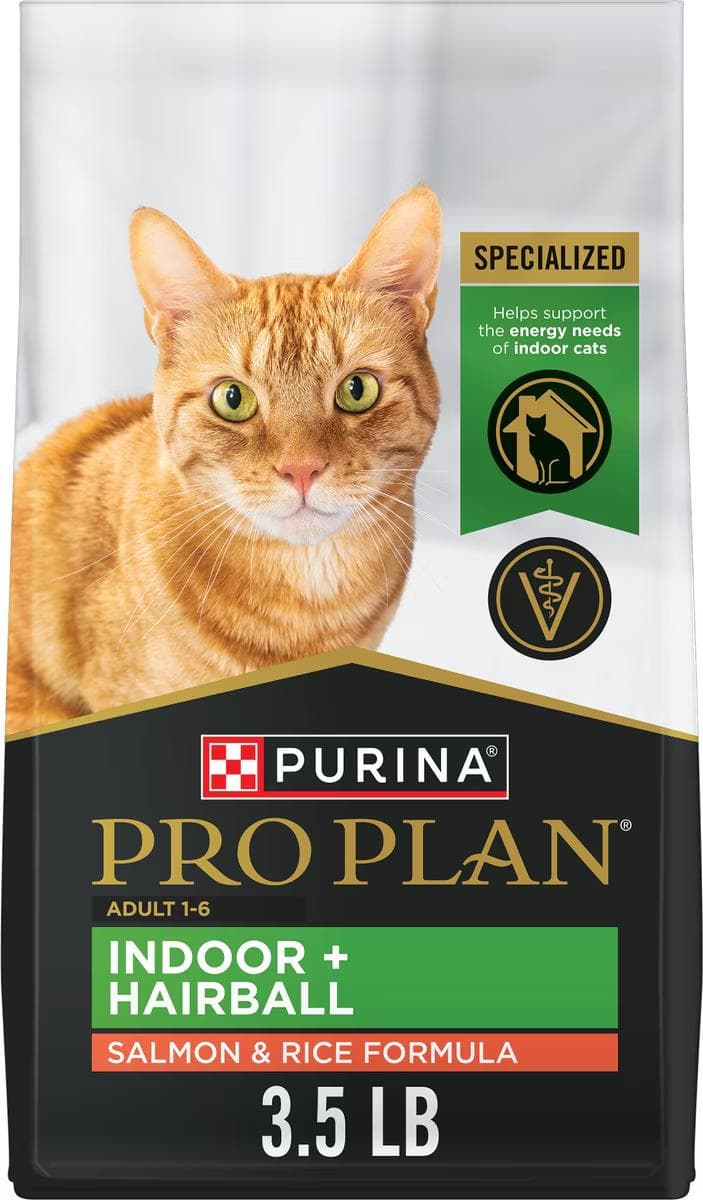
Best for Indoor Cats: Purina Pro Plan Adult Indoor Hairball Management Salmon and Rice Formula
Purina Pro Plan Adult Indoor Hairball Management Salmon and Rice Formula pairs hairball management with an indoor calorie profile, on a salmon and rice recipe rather than poultry.
Flavor route is the practical draw. Cats who have refused chicken formula after chicken formula sometimes take a fish recipe without argument, and a food your cat eats beats a food you believe in.
It suits a few common households:
- indoor-only adults
- picky eaters who have rejected poultry
- multi-cat homes where one bag serves several cats of similar age
The honest limitation is that "indoor" is a marketing category, not a clinical one. The published hairball trials sorted cats by coat length and fiber type, not by whether they go outside. The fiber does the work here, not the word on the front panel.
Best Weight-Management Option: Iams ProActive Health Indoor Weight and Hairball Care
Iams ProActive Health Indoor Weight and Hairball Care is an adult dry food that combines a weight-management calorie target with hairball control, which is a genuinely useful pairing for an indoor cat carrying extra weight.
Two problems often travel together. An overweight indoor cat grooms, sheds and swallows hair like any other cat, and a formula aimed at only one of those issues leaves the other unmanaged.

It suits a narrower group:
- indoor cats with a bit of extra weight
- multi-cat households feeding one bag
- owners testing whether a fiber change makes any difference at all before committing further
The honest limitation is that a weight-management calorie target is a real constraint, not a marketing flourish. Keep an eye on body condition after the switch, and speak to your vet before putting a cat on a reduced-calorie food.
SponsoredVet care that's always there
Unlimited video calls and messaging with licensed vets for less than a typical vet visit. One membership covers up to five pets.
Use code Pets30
Plans start at $11/month · covers up to 5 pets
- Licensed vets in most states
- Rx for 150+ conditions
- 4.7 on Trustpilot
How the Picks Compare

Webvet may earn a commission when you click through to Chewy, at no extra cost to you.
Two numbers are worth comparing across hairball foods. Crude fiber is printed as a minimum in the guaranteed analysis, and calories are printed in the calorie content statement as kcal per kilogram and kcal per cup.
Manufacturers revise both between production runs, so read them off the label in front of you rather than any published comparison.
| Pick | Form | Best for |
|---|---|---|
| Hill's Science Diet Adult Hairball Control Chicken Recipe | Dry | Widely stocked all-rounder for healthy adult cats |
| Royal Canin Feline Care Nutrition Hairball Care Adult | Dry | Longhaired and mediumhaired cats |
| Royal Canin Hairball Care Thin Slices in Gravy | Wet | Cats who refuse dry food |
| Purina Pro Plan Adult Indoor Hairball Management Salmon and Rice | Dry | Indoor cats and picky eaters who reject poultry |
| Iams ProActive Health Indoor Weight and Hairball Care | Dry | Indoor cats who also need calorie control |
Shop the available formulas: Hill's Science Diet Adult Hairball Control, Royal Canin Hairball Care Thin Slices in Gravy, Purina Pro Plan Adult Indoor Hairball Management, and Iams ProActive Health Indoor Weight and Hairball Care.
Two things the crude fiber figure will not tell you:
- It is a stated minimum rather than an exact value, so two bags printing the same number can differ.
- It does not separate generic bulk from the fiber types the trials tested, which is the distinction that decides whether the fiber does anything.
For scale, the diets that moved the needle in Veterinary Medicine and Science ran at 11% and 15% total dietary fibre, well above what a standard maintenance formula carries. Retail hairball foods are a gentler intervention than the research diets, which is worth remembering before you expect research-sized results.
Compare calories per cup rather than per bag. A higher-fiber formula is usually less calorie dense, so re-measure the portion instead of scooping the same volume out of habit.
Wet or Dry Food for Hairballs?
Neither wet nor dry food has been shown superior for hairballs. The Journal of Feline Medicine and Surgery review found no objective public-domain information on the efficacy of hairball-control diets at all, so anyone offering you a settled wet-versus-dry verdict is going beyond the evidence.
What the trials did manipulate was fiber. Fiber level and fiber type are the variables that produced measurable results, and a meaningful fiber level is easier to deliver in a dry formula than in a food that is mostly water.
That points to dry as the format matched to the research, without making wet food a mistake. Plenty of cats will not eat dry food, and a hairball formula that stays in the bowl does nothing at all.

The workable answer for most households is to let your cat's preferences decide the format and let the ingredient panel decide the product. Feed a measured hairball formula consistently, in whatever form your cat reliably eats.
Webvet may earn a commission when you click through to Chewy, at no extra cost to you.
If your cat drinks very little or you have questions about her water intake, that is worth raising with your vet directly rather than solving with a bag of food.
How to Switch Your Cat to a Hairball Food Safely
Switch your cat to a hairball food gradually rather than all at once, mixing a small amount of the new food into the old and raising the proportion in stages.
An abrupt change is the most common cause of the vomiting and loose stool that owners then blame on the new formula. Cats with sensitive stomachs need a slower, longer changeover than confident eaters.
A few rules separate a smooth switch from a wasted bag.
- Mix both foods in the same bowl. Two bowls side by side simply lets your cat eat around the new food.
- Change one thing at a time. Keep treats, feeding spots and schedule constant.
- Check the litter box daily. Stool consistency is your earliest and most honest feedback.
- If stool loosens, drop back to the previous ratio and hold there before advancing again.
- Do not transition during a move, boarding, building work, or a new pet's arrival.

If your cat refuses the new food, go back to the old one and try again later or with a different flavor. Do not wait a hungry cat out. Cornell Feline Health Center advises contacting a veterinarian without delay if a cat is lethargic and refuses food for more than a day or so.
The Downside of a High-Fiber Diet
A high-fiber diet is a genuine intervention with genuine trade-offs: looser stool, more gas, fewer calories per cup, and a palatability drop some cats reject outright.
The fibre levels that produced measurable results in research were high. The Veterinary Medicine and Science trial diets ran at 11% and 15% total dietary fibre, well above a standard maintenance food.
Here is what those trade-offs look like in practice.
- Loose stool. A softer stool for a few days during any food change is common and usually settles. Persistent diarrhea is not the food settling in, and our guide to why your cat has diarrhea covers when that becomes a veterinary problem.
- Gas. Owners often notice more of it after a fiber change. A cat who is simply gassier is usually fine. A cat who is uncomfortable, straining, hunched, or off food is not adjusting and needs a vet.
- Fewer calories per cup. Fiber contributes far less energy per gram than fat or starch, so a higher-fiber formula is usually less calorie dense. Feed the same volume you always have and you may be feeding fewer calories than you think. Weigh your cat regularly after a formula change.

Palatability. Cats are famously suspicious of new food, and higher-fiber formulas tend to be less energy dense and less aromatic than the diets they replace. Buy the smallest bag first.
None of this rules the food out. It simply means a hairball diet is a decision with consequences, not a free upgrade.
When Food Is Not the Answer
A food change is the wrong move when hairballs are a symptom of something else. VCA Animal Hospitals states that trichobezoars are more common in cats with underlying gastrointestinal disease, and that the single most important prevention strategy is addressing that underlying intestinal disease, which it ranks above diet.
The signal to act on is not a raw hairball count but a change in the pattern. The Journal of Feline Medicine and Surgery frames the clinical rule as a shift in frequency plus other signs such as weight loss or appetite change.
Coat length shapes the reading. Around 10% of otherwise healthy shorthaired cats regularly bring up hairballs, meaning two or more a year, with roughly double that incidence in longhaired cats, according to survey data in the Journal of Feline Medicine and Surgery.
The same review is blunt about the rest: in most shorthaired cats, frequent hairballs indicate an underlying chronic disease. Dietary intolerance and inflammatory bowel disease are common culprits, and managing the primary disease frequently reduces the hairball vomiting substantially.
Veterinary medicine defines chronic gastrointestinal signs as lasting longer than three weeks, an ACVIM consensus threshold applied in the surgical literature. Three weeks of vomiting is a workup, not a shopping trip.

The stakes are documented. In a six-hospital review published in the Journal of Feline Medicine and Surgery, 44 cats had surgery for obstructive trichobezoars. Alimentary small cell lymphoma was diagnosed in 10 of them, 22.7%, and all ten had a chronic history of gastrointestinal signs.
Across the same group, 24 of 44 (54.5%) had chronic signs before surgery. Within that chronic group, vomiting was present in 95.8% and weight loss in 20.8%.
Documented predisposing factors, catalogued in the Journal of Feline Medicine and Surgery, include:
- a long-haired coat
- flea allergy dermatitis
- inflammatory bowel disease
- eating non-digestible plant material
Several of those are treatable in ways no food addresses.
Cornell Feline Health Center names repeated episodes of unproductive retching as a reason to contact a vet without delay. VCA Animal Hospitals lists vomiting, abdominal pain and lack of bowel movements as obstruction signs.
VCA also notes that with an obstructing trichobezoar you may see no hair in the vomit at all. A hairball diet, a lubricant gel, a fiber supplement and a hairball treat are all the wrong response to a possible blockage, and reaching for one costs time a blocked cat does not have.
Our guide to the warning signs of a hairball blockage covers what happens next. Two more distinctions are worth carrying with you.
- A cough is not a hairball. A cough is routinely mistaken for a cat bringing up a hairball, but no hairball appears, and VCA Animal Hospitals notes that coughing points to lower respiratory disease, usually bronchitis.
- Food, bile or foam is a different problem. If the vomiting brings up food, bile or foam rather than hair, our page on other reasons a cat throws up is the better place to start.
The Merck Veterinary Manual keeps the instruction simple: see a veterinarian for frequent hairballs or repeated vomiting, because something more serious could be to blame.
What to Pair a Hairball Diet With
Before anything in this section, one boundary. Everything below is for a cat who is eating, drinking, passing stool and otherwise well.
If your cat may be obstructed, nothing sold over the counter is an appropriate response, food included. Repeated unproductive retching, no stool, abdominal pain, or an inability to keep down food or water means a vet today, not a gel, a supplement or a different bag.
For a healthy cat, diet is one lever among several. Brushing works further upstream, reducing how much hair your cat swallows rather than managing hair that is already inside. That is mechanism-based reasoning rather than a trial result: no published study has measured whether brushing reduces hairballs.

Our guide to a brushing routine matched to your cat's coat covers tools and frequency by coat type, which matters more for a Persian than for a shorthaired tabby.
Lubricant gels, psyllium supplements, hairball treats and grooming tools each have a role, and we compare them directly in our roundup of the best hairball remedies for cats.
How much of any of them to give is a question for your vet and for our guide to helping a cat pass a hairball, not for a food article.
Keep the endpoint in view as well. The same review notes that lifelong medication to control hairballs should not be necessary, and that a diligent search for underlying disease should come first.
Frequently Asked Questions
Its ingredient panel lists psyllium seed husk, the fiber that trial tested. Note too that the trial used experimental diets at defined fibre levels rather than a retail bag, so its 81% and 113% figures should not be read as what any product on the shelf delivers.
A change in your cat's own pattern matters more than any average.
If nothing has changed, and especially if your cat is shorthaired, the next step is a veterinary workup rather than a different bag.
Frequently Asked Questions
Does hairball control cat food actually work?
Partly, and less dramatically than the packaging implies. The Journal of Feline Medicine and Surgery found no objective public-domain information on hairball-diet efficacy. Added fiber can increase how much hair leaves in the feces, most clearly in longhaired cats. Trials that counted vomiting instead split both ways. Expect a modest change, not a cure.
What is the best food for controlling hairballs in cats?
For most healthy adult cats already on dry food, Hill's Science Diet Adult Hairball Control Chicken Recipe is a sensible default: widely stocked and easy to keep feeding. For a longhaired cat, Royal Canin Feline Care Nutrition Hairball Care is the pick matched to the coat-length research.
What kind of cat food can help with hairball removal?
Look for an adult maintenance formula with elevated crude fiber and a named fiber source on the ingredient panel, not just the word hairball on the front. Which fiber is best is unsettled: the trials tested psyllium, sugarcane fibre and cellulose, and they disagree. Knowing what you are feeding still beats guessing.
What food helps cats pass hairballs?
Higher-fiber food is what the trials tested, and what they measured was more hair leaving in the stool. Veterinary Partner notes that in a healthy cat, swallowed hair travels through the stomach and intestines and exits in the feces. A hairball formula aims to make that ordinary route more reliable, fed consistently over weeks.
Is wet or dry cat food better for hairballs?
Neither has been shown superior, because the Journal of Feline Medicine and Surgery found no objective public-domain information on hairball-diet efficacy in the first place. A meaningful fiber level is easier to deliver in a dry formula than in a food that is mostly water, and fiber level is the variable the research manipulated. Wet food wins for a cat who refuses kibble, because an uneaten formula does nothing.
How often is it normal for a cat to have hairballs?
Cornell Feline Health Center describes one hairball every week or two as nothing to worry about. Survey data in the Journal of Feline Medicine and Surgery is stricter: among 48 apparently healthy shorthaired cats, 35 (73%) had never been known to bring one up.
How long should I give a hairball food before deciding it works?
Give it a consistent run after the transition ends, and keep a written tally of episodes before and after so you are comparing records rather than impressions. For scale, the psyllium and slippery elm chew trial ran two weeks and the sugarcane fibre study ran 42 days.
The Bottom Line
The best cat food for hairballs is a modest, sensible intervention rather than a fix. Fiber can measurably increase how much hair leaves in the stool, most reliably in longhaired cats.
But the Journal of Feline Medicine and Surgery is clear that no objective public-domain evidence establishes that these diets work, and the trials that counted vomiting disagree with each other.
Which bag depends on your cat:
- Longhaired and healthy. Royal Canin Feline Care Nutrition Hairball Care is the pick matched to the evidence, with the ingredient panel checked for psyllium.
- After a widely available all-rounder. Hill's Science Diet Adult Hairball Control is the default.
- Indoor and also needing calorie control. Iams ProActive Health Indoor Weight and Hairball Care covers both.
Change the food gradually, watch the litter box, and weigh your cat regularly after the switch.
And keep the boundary in mind. A shorthaired cat whose hairballs have recently become frequent needs a veterinary workup, not a new bag of food. A cat who may be blocked needs a vet the same day, and no product on a shelf is a substitute for that.
Pair whatever you feed with regular brushing. For the full comparison of gels, supplements and grooming tools, our roundup of the best hairball remedies for cats covers the rest of the toolkit.

Editor
The Webvet Editorial Team is the in-house group of pet-care editors and writers behind Webvet, operated by Smart Pet Collective. The team researches, writes, and maintains Webvet's pet health, behavior, and medication content. Every article follows a defined editorial process: research from reputable veterinary and scientific sources, careful drafting, mandatory review of medical content by a credentialed veterinarian, and dated publication. Health and medication articles are medically reviewed by a licensed veterinary professional before they go live and are kept current over time.
Veterinarian · BVMS MRCVS
Dr. Pippa Elliott, BVMS, MRCVS, is a veterinarian with nearly 30 years of experience in companion animal practice. Dr. Elliott earned her Bachelor of Veterinary Medicine and Surgery from the University of Glasgow. She was also designated a Member of the Royal College of Veterinary Surgeons. Married with 2 grown-up kids, Dr. Elliott has a naughty Puggle named Poggle, 3 cats and a bearded dragon.
Related reading

In Home Pet Euthanasia: Cost, What Happens, and How to Choose a Provider

Dog Dementia: Signs, Stages, Treatment, and When to Say Goodbye

Dog Cold Symptoms: Treatment and How to Tell It From Kennel Cough
