Best Dog Wheelchairs and Rear-Support Harnesses: Vet-Reviewed Picks by Size
A dog wheelchair gives a dog with weak or paralyzed back legs the chance to walk, sniff, and toilet on their own. Here is who needs a cart, how to measure for one, and the Chewy carts and lift harnesses we would choose.

BVMS MRCVS
Medically reviewed by Dr. Pippa Elliott, BVMS MRCVS · Last reviewed

This article contains affiliate links. Webvet may earn a commission when you buy through them, at no extra cost to you.
A dog wheelchair lets a dog with weak or paralyzed back legs walk and sniff on its own front legs while a saddle and wheels carry the hind end. Carts are used for neurological and orthopedic disease, sometimes temporarily during recovery and sometimes for life, according to a caretaker survey in Frontiers in Veterinary Science.
Choosing the right dog wheelchair starts before the product page: confirm the cause with your vet, decide whether a lift harness is enough for now, then measure rear leg height.
| Product | Best fit | Format | Sizing on the Chewy listing | Main tradeoff |
|---|---|---|---|---|
| Walkin' Pets Walkin' Wheels Dog Wheelchair, Seafoam, Small: 9 to 13-in rear leg height | Small dogs, 11 to 25 lb per the maker | Adjustable rear-support cart | 9 to 13 in rear leg height | Height band is a retailer figure, so measure first |
| Walkin' Pets Medium Dog Wheelchair, Blue, 26-50 lbs, 15-18" leg | Medium dogs | Adjustable rear-support cart | 26 to 50 lb, 15 to 18 in leg | Maker lists 26 to 49 lb, so dogs near 50 lb sit between frames |
| Walkin' Pets Large Dog Wheelchair, Blue, 70-150 lbs, 17-19" leg | Large and giant dogs | Aluminum rear cart that converts to full support | 70 to 150 lb, 17 to 19 in leg | Highest price in this group |
| Walkin' Pets Walkin' Wheels Corgi Dog Wheelchair, Blue, Small: 8 to 11-in rear leg height | Corgis, Dachshunds, and other long-backed small dogs | Breed-specific rear cart | 8 to 11 in rear leg height, 11 to 25 lb | Built for long-backed breeds only |
| Best Friend Mobility Elite Wheelchair, Medium Dog, 16-20" Tall | Budget cart for a medium dog | Adjustable rear-support cart | 16 to 20 in tall | Weight range and frame specs not verified from the maker |
| WALKABOUT Airlift One Rear Support Dog & Cat Lifting Harness, Medium | Dogs that still walk but need hind-end help | Rear lift harness | Medium | You do the lifting; it is not a cart |
 Sponsored
Wondering why your dog seems stiff or sore?
Talk to a licensed vet at Dutch over video, often the same day. They can recommend treatment and prescribe it when it's appropriate.
Use code Pets60
Plans start at $12/month · covers up to 5 pets
- Licensed vets in most states
- Rx for 150+ conditions
- 4.7 on Trustpilot
Which dogs benefit from a wheelchair, and which need a harness first
A dog wheelchair works best for a dog with strong front legs and weak or paralyzed rear legs. VCA Animal Hospitals says such pets often learn quickly to use a wheelchair they pull behind them. Measure rear leg height first, and with disc disease, let the vet decide when a cart is safe.

- 1A rear cart suits a dog with weak or paralyzed back legs and strong front legs; a dog that still walks may only need a lift harness for now.
- 2A dog recovering from intervertebral disc disease needs the vet's or surgeon's clearance before any cart.
- 3Measure rear leg height with the dog lying on its side, plus body length and weight, since weight sets the frame size.
- 4Plan for supervised sessions, help with toileting, and daily skin checks for pressure sores.
Do vets recommend dog wheelchairs?
Veterinary sources treat a cart as one option, not a blanket recommendation. Cornell University College of Veterinary Medicine lists a wheelchair to support the hind limbs for degenerative myelopathy, and VCA suggests a sling, harness, or wheelchair for pets paralyzed only in the hind limbs.
The University of Illinois Veterinary Teaching Hospital rehabilitation service says wheelchairs are available for weak, painful, or paralyzed pets and helps owners order, fit, and acclimate them. In the University of Florida caretaker survey, 62% of responses for dogs reported a better quality of life with a cart, though that is owner-reported, not a controlled trial.
Usually suits a rear cart:
- Rear limb paralysis or profound hind-end weakness in a dog with strong front legs.
- Hind-limb-only paralysis where the dog drags its back end, which VCA says can cause skin sores.
- Degenerative myelopathy once the hind legs can no longer carry the dog.
- Recovery from an injury such as a torn cruciate ligament, a use named on Chewy's Walkin' Wheels listings, once the vet agrees.
Usually needs a harness, rest, or treatment first:
- A dog that still walks but slips, wobbles, or has back legs trembling, which needs a diagnosis before equipment.
- Arthritis and hip dysplasia, where weight loss, physical therapy, and pain relief come first.
- A new disc injury, where strict rest comes before any cart.
- A three-legged (tripod) dog, since Merck says three-legged dogs generally have a good quality of life.
A rear lift harness such as the WALKABOUT Airlift One Rear Support Dog & Cat Lifting Harness, Medium lets you take part of the hind-end weight while the dog still walks on all its working legs. Our guide to mobility aids for dogs, including harnesses, ramps, and more compares those options in more detail.
Frame size follows weight and measurements. Walkin' Wheels frames run from 11 to 25 pounds for the small cart up to a large frame for a big dog, which the maker rates for 70 to 180 pounds. Corgis and Dachshunds have long backs and need specially designed chairs.
Adjustable carts set height, length, and width on the frame, and a front wheel attachment can turn some Walkin' Wheels rear carts into full-support carts.
Our picks: the best dog wheelchairs and rear-support harnesses
Each pick is a rear-support cart or a rear lift harness sold on Chewy. Prices are Chewy listings from when we checked in October 2026 and change often.
Chewy and the maker sometimes give different weight ranges for the same cart. When they do, go by the maker's measuring method, since it decides the frame.
Walkin' Pets Walkin' Wheels Dog Wheelchair, Small: best for small dogs
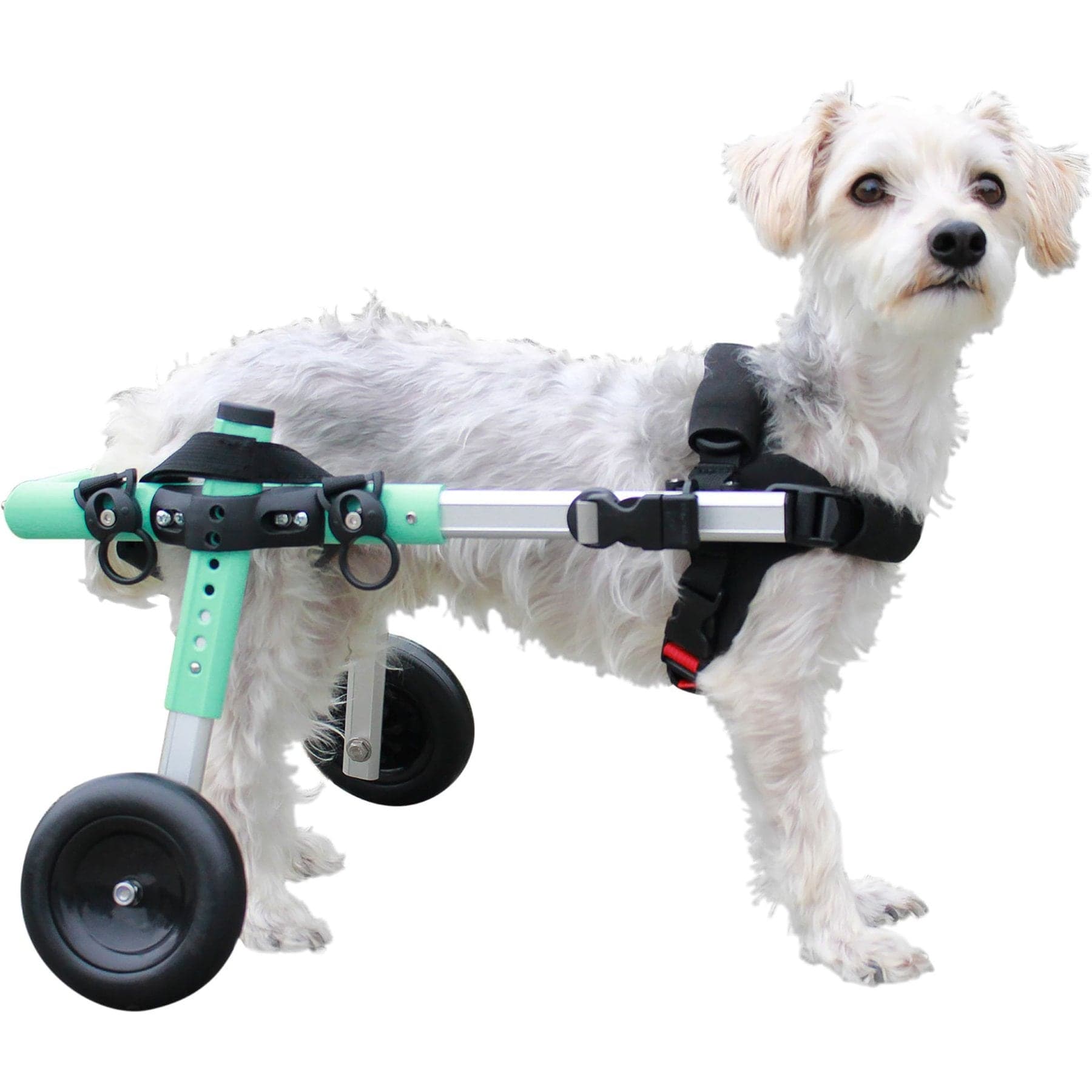
Adjustable rear-support cart for small dogs, set by rear leg height, length, and width.
Webvet may earn a commission when you click through to Chewy, at no extra cost to you.
The small Walkin' Pets Walkin' Wheels is a rear wheelchair the maker lists for pets weighing 11 to 25 pounds. The frame adjusts in length, width, and height, and the foam wheels sit on struts. Chewy listed this size for a 9 to 13 inch rear leg height at $319 when we checked.
- Who it suits: small dogs with rear leg weakness or paralysis from IVDD or degenerative myelopathy, as the Chewy listing describes, once the vet has cleared cart use.
- Room to grow: a front wheel attachment converts this small frame into a full-support (quad) cart if the front legs weaken later.
- Tradeoff: the rear leg height band comes from the Chewy title, while the maker's page sizes by weight and its own measuring method, so measure before ordering.
Walkin' Pets Medium Dog Wheelchair: best for medium dogs
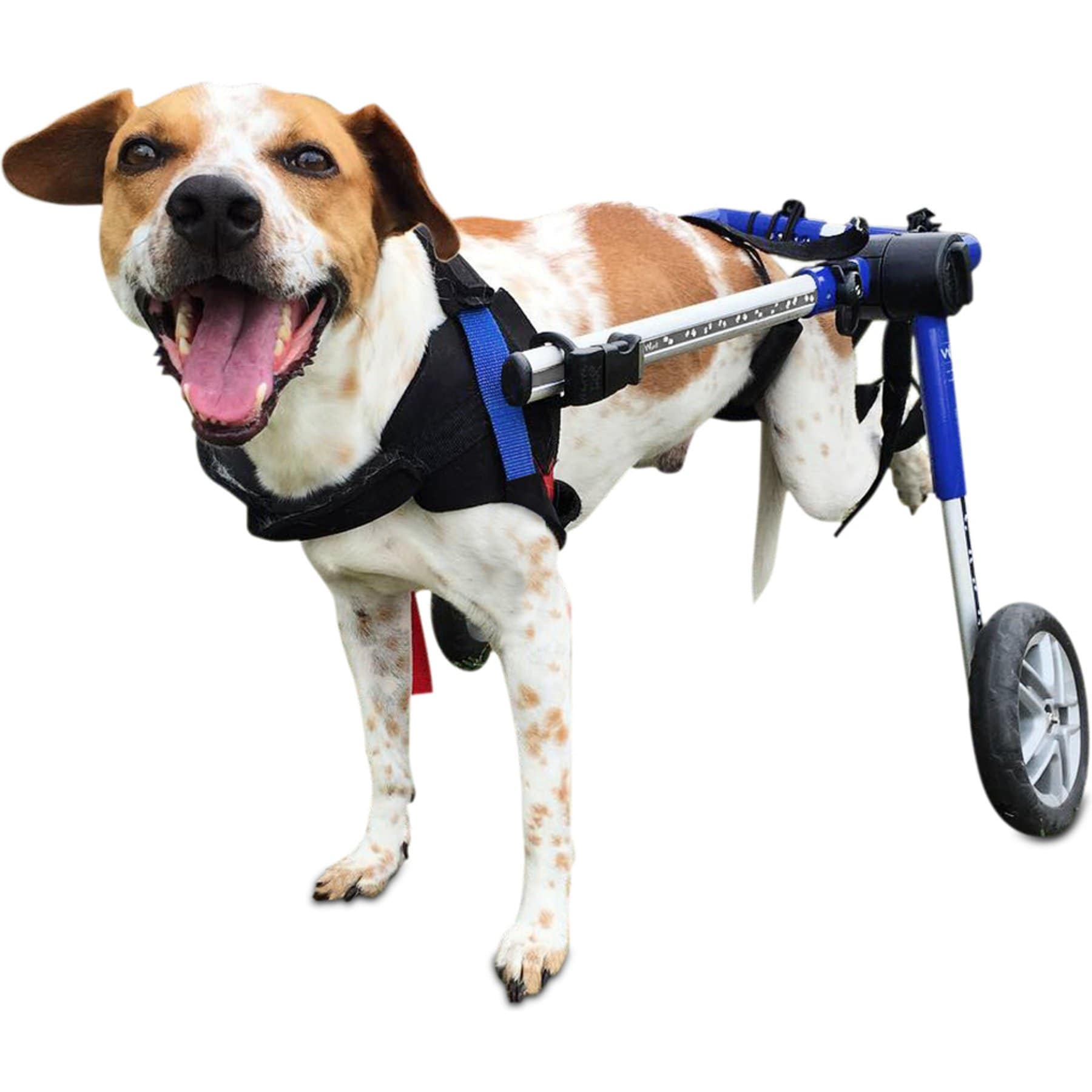
Adjustable rear-support wheelchair for medium dogs with weak, unstable, or paralyzed hind legs.
Webvet may earn a commission when you click through to Chewy, at no extra cost to you.
The medium Walkin' Wheels is an adjustable rear-support cart. Chewy listed it at $499 when we checked, for dogs of 26 to 50 pounds with a 15 to 18 inch leg. The maker's own page lists 26 to 49 pounds, with a separate Med/Large cart for 50 to 69 pounds.
- Who it suits: medium dogs whose hind legs have grown weak or unstable, paralyzed dogs, and dogs recovering from a torn cruciate ligament, the uses the Chewy listing names.
- Tradeoff: a dog close to 50 pounds sits at the edge of two frames, so let the maker's measurements, not the retail title, decide.
Walkin' Pets Large Dog Wheelchair: best for large and giant dogs
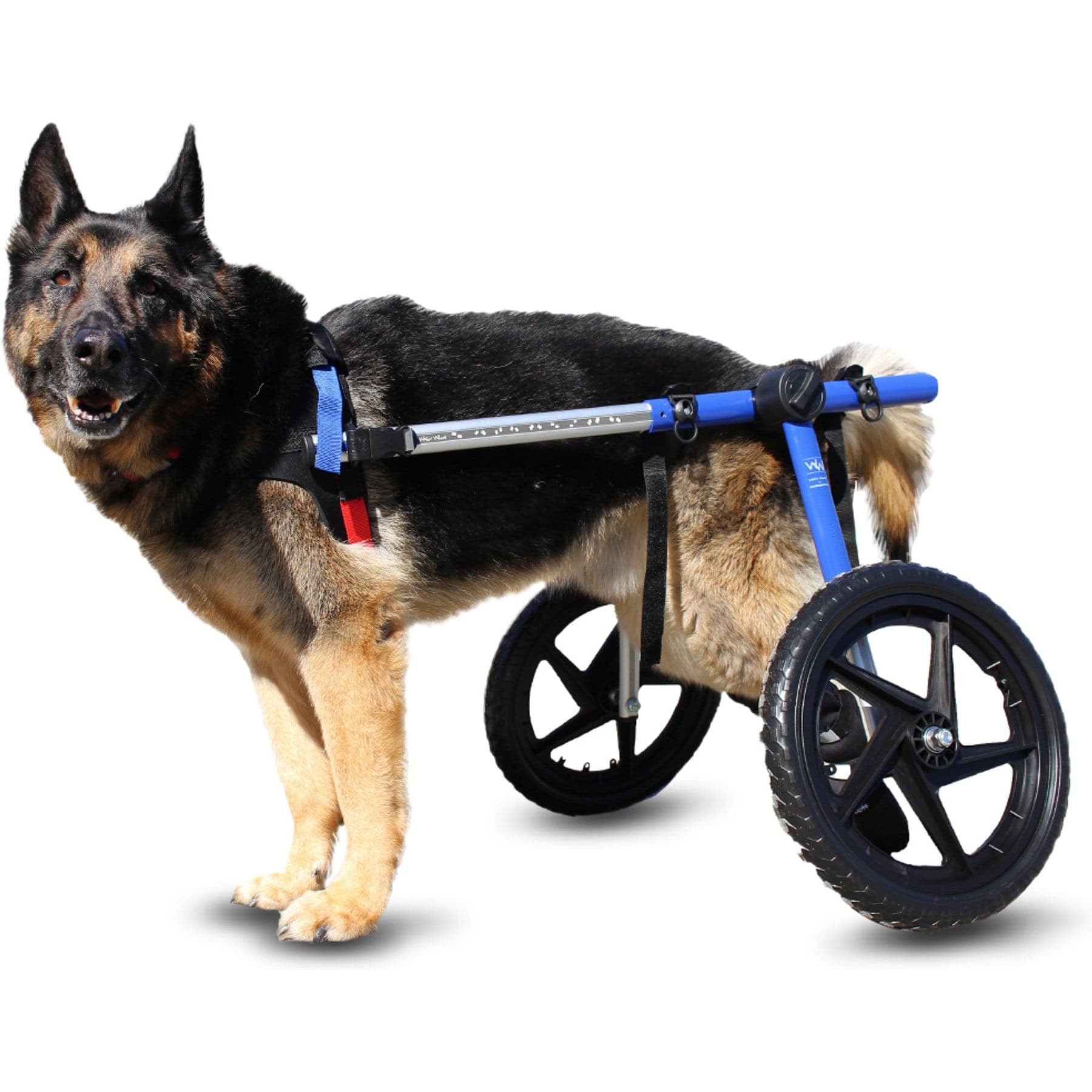
Aluminum rear-support cart for big dogs with hind-end weakness, convertible to full support later.
Webvet may earn a commission when you click through to Chewy, at no extra cost to you.
The large Walkin' Wheels has an extruded aluminum frame, dense foam all-terrain wheels, and full adjustment in height, length, and width, according to the Walkin' Pets large wheelchair page.
Chewy listed it at $529 when we checked, for 70 to 150 pounds and a 17 to 19 inch leg, while the maker rates the frame for 70 to 180 pounds.
- Who it suits: big dogs with hind-end weakness that still walk well on their front legs.
- How it is meant to be used: the maker describes it for bathroom breaks, exercise, and walks.
- Tradeoff: the maker says dogs should not lie down in it, because back or disc problems could worsen, so take the dog out to rest.
Walkin' Pets Walkin' Wheels Corgi Dog Wheelchair: best for corgis and dachshunds
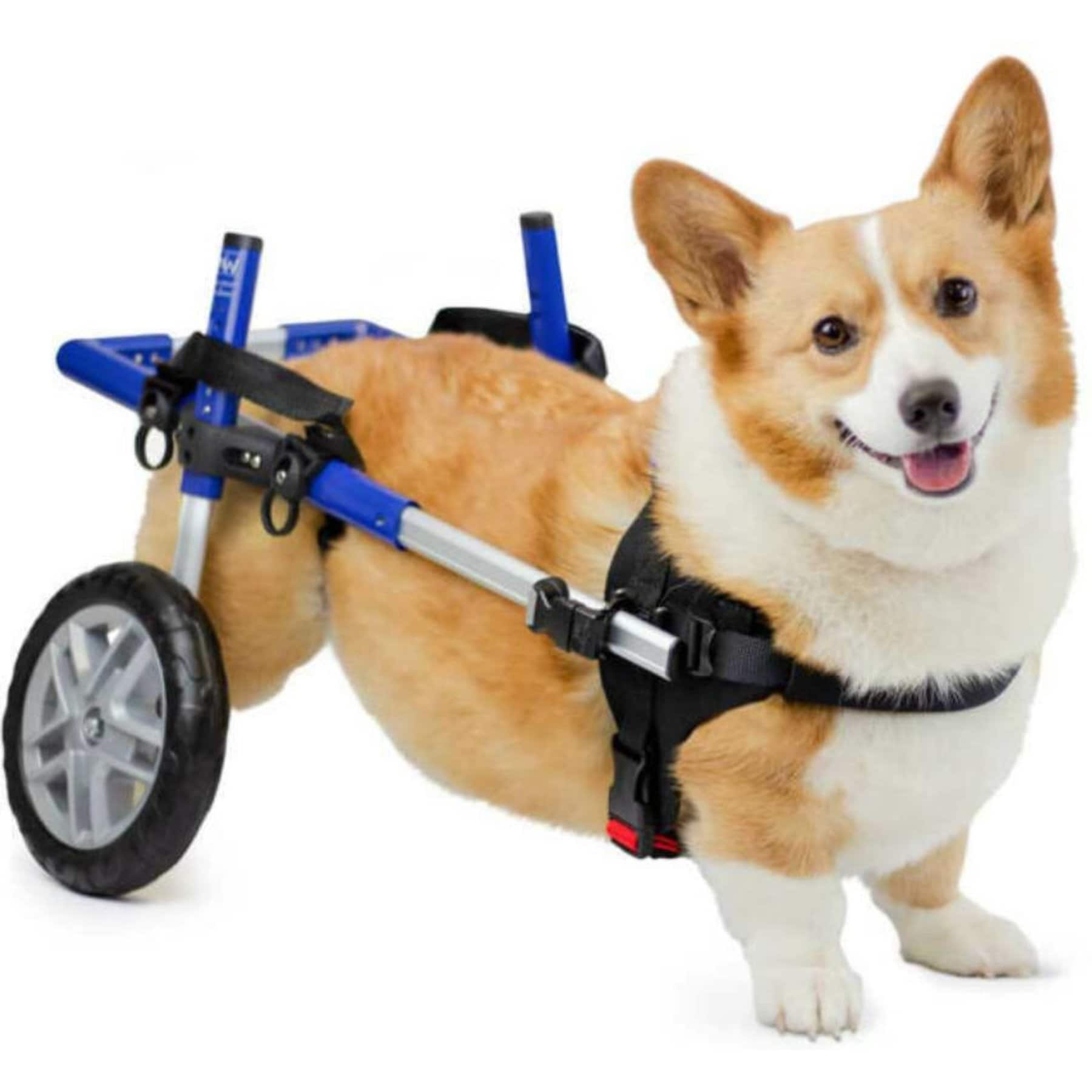
Rear wheelchair built for long-backed small breeds such as Corgis and Dachshunds.
Webvet may earn a commission when you click through to Chewy, at no extra cost to you.
Corgis and Dachshunds have long backs, and Walkin' Pets' measuring guide says those breeds need specially designed wheelchairs. Chewy listed this Corgi model at $340 when we checked, for small dogs weighing 11 to 25 pounds with an 8 to 11 inch rear leg height. It is a rear wheelchair that gives hind leg support.
- Who it suits: Corgis and Dachshunds of 11 to 25 pounds, the long-backed breeds the maker singles out.
- Tradeoff: the height band is a retail figure, so measure length from armpit to rump as well as rear leg height before you order.
Best Friend Mobility Elite Wheelchair, Medium: best value cart
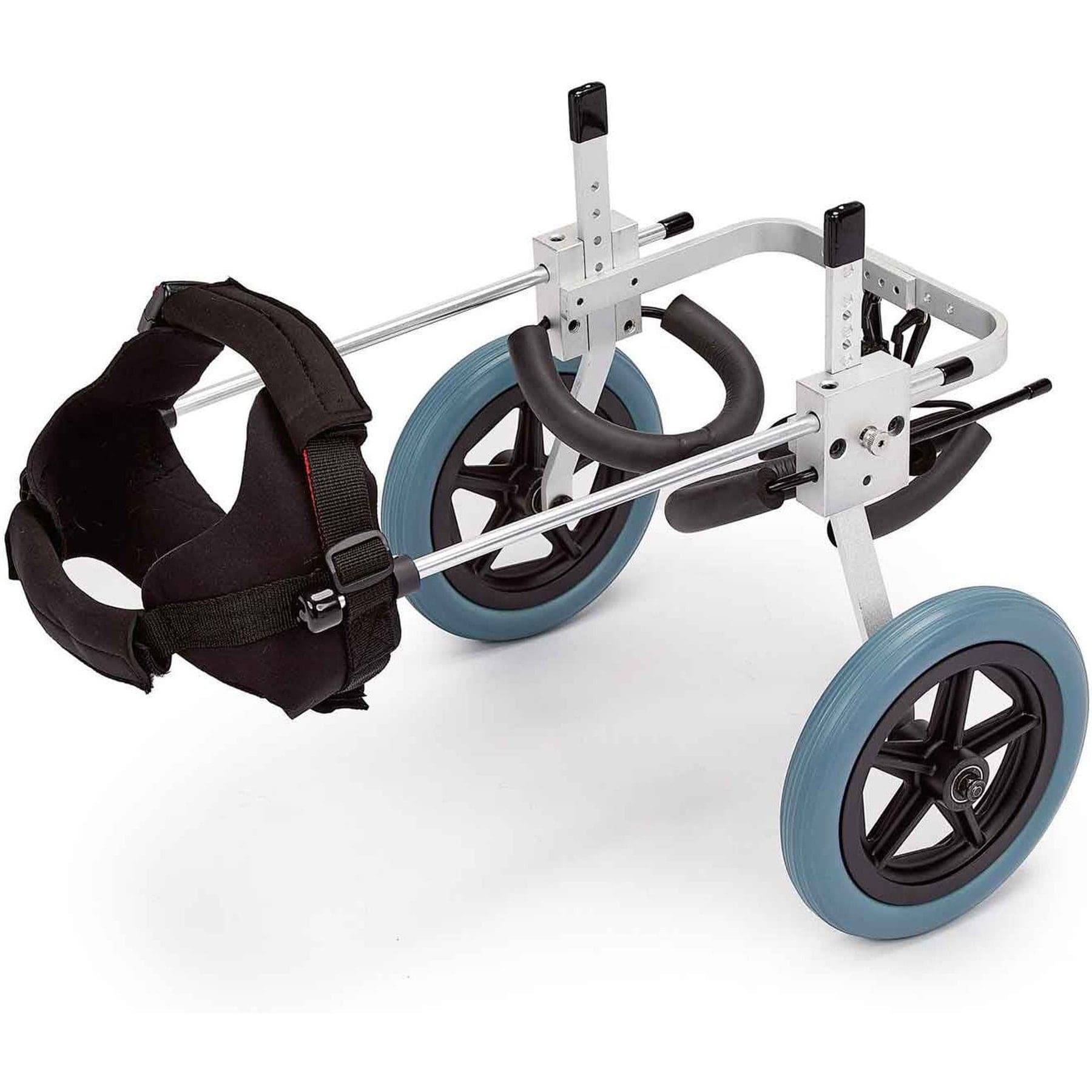
Lower-priced rear-support wheelchair for medium dogs, with a neoprene rear harness and padded shoulder support.
Webvet may earn a commission when you click through to Chewy, at no extra cost to you.
The Best Friend Mobility Elite is the lowest-priced cart in this group, listed at $233.52 on Chewy when we checked, for a medium dog listed as 16 to 20 inches tall. The Chewy listing describes rear leg support, a deluxe neoprene rear harness, padded shoulder support, and an adjustable design.
- Who it suits: owners on a tighter budget, or a dog that may need a cart only during recovery, since carts can be a temporary aid.
- Tradeoff: we could not confirm this model's weight range, frame material, or wheel type from the maker, so check sizing with the seller before ordering.
WALKABOUT Airlift One Rear Support Lifting Harness, Medium: best rear-support harness before a cart
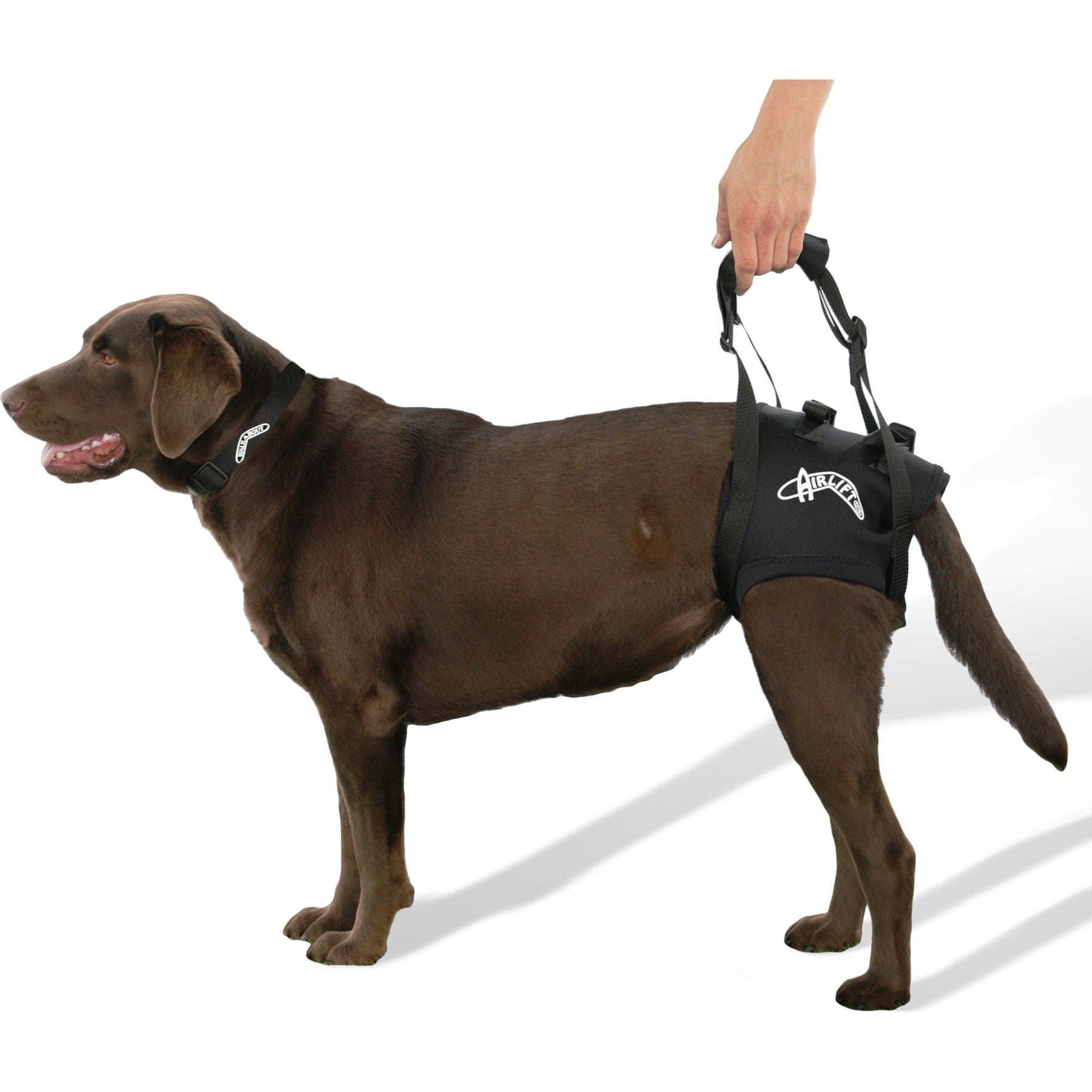
Rear lift harness that helps a dog with weak hind legs keep walking before a cart is needed.
Webvet may earn a commission when you click through to Chewy, at no extra cost to you.
The Airlift One is a back-end support harness, not a cart. Walkabout Harnesses describes it as a hind leg lift assist and mobility aid for cats and dogs of all sizes, and the Chewy listing names mobility issues such as arthritis and hip dysplasia. Chewy listed it at $64.95 in October 2026.
- Who it suits: dogs that still walk but need help with the hind end, and dogs whose owners are still deciding on a cart with the vet.
- Tradeoff: it helps only while you are lifting; it does not carry the dog's weight on its own the way a wheeled cart does.
 Sponsored
Vet care that's always there
Unlimited video calls and messaging with licensed vets for less than a typical vet visit. One membership covers up to five pets.
Use code Pets60
Plans start at $12/month · covers up to 5 pets
- Licensed vets in most states
- Rx for 150+ conditions
- 4.7 on Trustpilot
How to measure a dog for a wheelchair
Walkin' Pets sizes its carts by weight, rear leg height, and body length. Its measuring guide measures with the dog lying on its side, because many dogs that need a wheelchair have hind leg weakness or paralysis and cannot stand up straight.
Use this checklist before ordering:
- Rear leg height: with the dog lying on its side, measure from the crease where the thigh meets the body down to the toe pads. Leave a natural bend and never stretch the leg.
- Length: measure from the armpit of the front leg straight back to the rump, not to the tip of the tail.
- Weight: weigh the dog, because weight sets the frame size.
- Width: adjustable frames set width on the cart itself, and the maker's guide gives no separate width method, so ask the seller if your dog is unusually broad or narrow.
- Breed: note a long back, since Corgis and Dachshunds need breed-specific chairs.
Chewy's product titles add a rear leg height band, as in the Walkin' Pets Walkin' Wheels Dog Wheelchair, Seafoam, Small: 9 to 13-in rear leg height. The maker sizes by weight and its own measuring method, so if your dog falls between two bands, send all your measurements to the seller.
Matching the cart to the condition: IVDD, degenerative myelopathy, arthritis, and amputation
The cause of hind-end weakness decides whether a dog needs rest, a harness, a rear cart, or a full-support cart, and when to start. A dog with a new disc injury is rarely a cart candidate on day one, while a dog with degenerative myelopathy may move from harness to rear cart to full support over months.

| Condition | First support | When a cart fits | Ask the vet first about |
|---|---|---|---|
| Intervertebral disc disease (IVDD) | Strict crate rest and the surgeon's or vet's plan | Only after clearance, since many dogs walk again within weeks | Surgery, length of rest, bladder care, and whether lying down in a cart is safe |
| Degenerative myelopathy | Harness or sling plus physical therapy | Rear cart once the hind legs cannot carry the dog; full support if the front legs weaken | Measuring rear leg height, temperament, and pressure sores |
| Arthritis and hip dysplasia | Weight loss, soft-surface exercise, physical therapy, pain relief, and a lift harness | Not first-line care in the sources reviewed | Pain control and a physical therapy plan |
| Amputation | Usually none, as three-legged dogs generally do well | Not routinely | Waiting 3 to 6 months before amputating a limb with suspected nerve injury |
| Paralysis without pain perception | Nursing care: bladder emptying, padding, and turning | Rear cart for exercise and toileting once stable | Bladder expression, urinalysis, and pressure sores |
Before you order, run through this short check with your vet:
- The diagnosis is confirmed, and for disc disease the surgeon has cleared activity.
- The front legs are strong enough to pull the dog, or you are planning for full support.
- You have measured rear leg height lying down, plus length and weight.
- You can supervise every session and check the skin daily for pressure sores and saddle rubs.
IVDD
Intervertebral disc disease happens when a ruptured or bulging disc presses on the spinal cord, causing anything from severe pain to weakness to paralysis, according to VCA's guide to disc disease in the neck. VCA says strict rest is required for the first 3 to 6 weeks after a disc protrusion or rupture, with or without surgery.
For dogs that cannot walk, a Journal of Veterinary Internal Medicine study notes a consensus that surgical decompression is superior to conservative care. Its conservatively managed dogs had 4 weeks of strict cage rest, with leash walks only to urinate and defecate 4 to 5 times a day.
Recovery is common. In that study, 96% of non-walking dogs that could still feel deep pain, and 48% of those that could not, walked again within 12 weeks, with median times of 11 and 25 days. That makes a cart a later decision made with the surgeon, not a first purchase.
Degenerative myelopathy
Degenerative myelopathy is inherited, typically starts around age 8 or older, and progresses to an inability to walk after six to twelve months, according to Cornell. There is no cure, but physical therapy may slow progression and help maintain muscle mass.
Because weakness may spread to the forelimbs late in the disease, a rear cart that can take a front wheel attachment later is a practical choice. VCA adds that early signs can resemble osteoarthritis, and that a dog's nature and temperament decide whether a wheelchair improves quality of life in the short term.
Arthritis and hip dysplasia
For osteoarthritis in dogs, the Merck Veterinary Manual lists weight loss, exercise on soft surfaces, and warm compresses, with anti-inflammatory drugs for pain. For hip dysplasia, VCA calls physical therapy highly effective and strongly recommends weight loss for overweight dogs.
Neither source lists a cart as first-line care for arthritis. A senior dog with arthritis or hip dysplasia usually starts with treatment and a lift harness, and a cart becomes a question only if the vet finds the hind legs can no longer carry the dog.
Amputation
The Merck Veterinary Manual says three-legged dogs generally have a good quality of life, so losing one leg is not by itself a reason for wheels. For a leg paralyzed by suspected permanent nerve injury, Merck advises waiting 3 to 6 months before amputating to see whether regeneration occurs.
Can a dog live with paralyzed back legs?
Yes, many do. Most dogs with acute spinal cord injury recover adequate or even normal function, according to a Frontiers in Veterinary Science review. For dogs that never regain pain perception, independent walking ranges from 10 to 59% across studies, and some stay incontinent.
For those dogs, a cart can help with getting around, but the larger commitment is nursing care: emptying the bladder, keeping the skin clean, and preventing sores. A cart works best as one part of that routine, set up with your vet.
Rear-support carts versus full-support and front-wheel carts
Veterinary carts are a saddle or harness on a rigid frame with two to four wheels. The saddle support carries the hind end, and which layout a dog needs depends on which legs are weak:
- Rear-support (two wheels): for weak or paralyzed back legs with strong front legs. All five carts above are this type.
- Full-support or quad (four wheels): for weakness in both the front and back legs. Walkin' Pets sells a front wheel attachment that turns its small rear cart into a full-support quad wheelchair.
- Front-wheel (front support): for a dog with weak front legs while the hind legs still work. VCA notes modified wheelchairs exist when the front legs are compromised.
The evidence favors the first two. In the University of Florida survey, quality of life improved for both quad and hind-wheel cart users, but caretakers did not report an improvement for front-wheel cart users. A front-support cart is therefore a conversation for a rehabilitation veterinarian rather than a quick order.
For a progressive disease, buying a rear cart that converts later can save a second purchase. The Walkin' Pets Large Dog Wheelchair, Blue, 70-150 lbs, 17-19" leg is one example: the maker says this rear wheelchair converts to full support with the addition of a front wheel attachment.
Lift harnesses split the same way. Walkabout sells a back-end harness, the WALKABOUT Airlift One Rear Support Dog & Cat Lifting Harness, Medium, and a separate front-end harness, which the company says veterinary and rehabilitation specialists recommend; treat that as the maker's claim.
Introducing the wheelchair and daily use: toileting, time limits, and skin checks
Getting a dog used to a cart takes patience and supervision. VCA says pets with rear limb weakness often learn quickly, and rehabilitation services such as the Illinois teaching hospital help with fitting. The survey authors add that a caretaker must place the dog in and out of the cart and supervise to avoid fatigue or injury.
Expect your dog to tire sooner than before. Texas A&M's veterinary college explains that the front legs do all the driving, so short, watched sessions are a sensible start.
A dog cannot lie down to rest in a cart. The survey authors note that a fully resting posture is not physically possible during use, so rest happens out of it.

Can dogs use the bathroom while in a wheelchair?
Yes. Walkin' Pets describes its large cart as made for bathroom breaks, exercise, and walks. Paralyzed dogs often still need help, though: Texas A&M says many need assistance with urination several times a day, and VCA advises emptying a paralyzed pet's bladder at least three to four times daily.
The Merck Veterinary Manual adds that dogs that cannot urinate properly may need bladder expression or a catheter, with urinalysis every 2 to 4 weeks to watch for infection. Incontinence also makes skin hygiene harder, so clean urine and feces off the skin promptly.
How long can a dog stay in a wheelchair?
No veterinary source we found sets a maximum number of minutes, and the University of Florida survey found no significant link between daily cart time and quality of life. Let fatigue and your rehabilitation veterinarian set the limit, and take the dog out to rest fully.
Daily skin checks
Skin is where carts cause the most trouble. In the survey, 64% of animals had at least one cart complication, and 53% of those complications were wounds. Wounds appeared most often on the inner thigh, then the armpit area and the tops of the paws, likely from the saddle, harness, and ground contact.
Check these spots after every session:
- The inner thighs, where the saddle sits.
- The armpits, under any front strap or shoulder support.
- The tops of the paws, which can scuff the ground.
- Elbows and hips, the pressure points where pressure sores form when the dog rests.
- Any skin left damp by urine; VCA warns that diapers raise the risk of skin damage and must be changed often.
Out of the cart, VCA says soft bedding combined with regular position changes reduces pressure sores, and Merck advises keeping a paraplegic dog on padding and turning it every 4 to 6 hours. A supportive orthopedic dog bed makes that easier. For steps and car rides between sessions, see our guide to the best dog ramps.
Cost, used carts, and financial help

Texas A&M put wheelchair costs at roughly $200 to $400 depending on pet size, but that figure dates from 2010. When we checked Chewy in October 2026, the Walkin' Wheels carts were listed higher, and price tracked frame size:
- Walkin' Pets Walkin' Wheels Dog Wheelchair, Seafoam, Small: 9 to 13-in rear leg height: $319
- Walkin' Pets Walkin' Wheels Corgi Dog Wheelchair, Blue, Small: 8 to 11-in rear leg height: $340
- Walkin' Pets Medium Dog Wheelchair, Blue, 26-50 lbs, 15-18" leg: $499
- Walkin' Pets Large Dog Wheelchair, Blue, 70-150 lbs, 17-19" leg: $529
- Best Friend Mobility Elite Wheelchair, Medium Dog, 16-20" Tall: $233.52, the lowest-priced cart here, though we could not confirm its weight range or frame specs from the maker
- WALKABOUT Airlift One Rear Support Dog & Cat Lifting Harness, Medium: $64.95, a lift harness rather than a cart
Second-hand carts can work if the frame adjusts to your dog's measurements. Walkin' Pets runs a Re-Roll Program of refurbished, pre-owned Walkin' Wheels chairs that it says are vetted for safety and quality, a more predictable route than an unverified sale listing.
How can I get a free dog wheelchair?
Several nonprofits help, listed in a financial aid directory hosted by Walkin' Pets. It is a manufacturer-curated list rather than an independent veterinary one:
- Handicapped Pets Foundation: donates wheelchairs to caretakers with demonstrated financial need, through an online application.
- Gunnar's Wheels: a loaner program; you use the cart while it is needed, then return it to be refurbished and matched with the next pet.
- Rescued Rollers: refurbishes donated wheelchairs and gives them free or at low cost to rescues, shelters, and people who cannot afford one.
If your dog no longer needs its cart, donating it to one of these groups keeps it in use.
Where can I find a cheap dog wheelchair?
Start with refurbished and loaner options: the Re-Roll Program for a pre-owned Walkin' Wheels, Gunnar's Wheels for a loaner, then a lower-priced new cart such as the Best Friend Mobility Elite. A loaner program is the closest thing to a cart rental.
A veterinary rehabilitation service can also point you to suppliers. The University of Illinois teaching hospital, for example, does not sell carts but knows many companies and helps owners order, fit, and acclimate.
Dog wheelchair questions
Frequently Asked Questions
Is there a veterinarian-approved wheelchair for dogs?
We found no veterinary approval or certification standard for dog carts. What a vet adds is assessment and fit: rehabilitation services such as the University of Illinois teaching hospital help owners choose among brands, get the cart fitted, and acclimate the dog.
A vet fitting is not a guarantee, though. In the University of Florida survey, animals fitted by a veterinarian had a higher reported complication rate (72%) than those that were not (47%).
How do I know if my dog is a candidate for a wheelchair?
A rear cart assumes front legs strong enough to pull the dog forward while the wheels carry the hind end. Many good candidates cannot stand on their back legs, which is why the maker measures them lying down. If the front legs are also weak, ask about a full-support cart instead.
Can a dog with IVDD use a wheelchair?
Yes, in some cases, but not straight away. After a disc injury, strict crate rest comes first, and for dogs that cannot walk the surgeon may recommend decompression surgery. Ask the surgeon when a cart is safe, and never let a dog with disc problems lie down in it, which the maker warns could worsen the injury.
Can a dog sleep or lie down in a wheelchair?
No. Texas A&M says dogs must sleep without the device, and the large Walkin' Wheels page says to remove pets from the cart so they can rest fully. Keep every cart session supervised so the dog is never left alone in it.
What is the difference between a rear-support and a full-support dog wheelchair?
A rear-support cart has two wheels and carries only the hind end, so the dog walks on its own front legs. A full-support cart has four wheels and supports both ends, for dogs whose front legs are weak too, as can happen late in degenerative myelopathy. Some rear carts convert with a front wheel attachment.

Editor
The Webvet Editorial Team is the in-house group of pet-care editors and writers behind Webvet, operated by Smart Pet Collective. The team researches, writes, and maintains Webvet's pet health, behavior, and medication content. Every article follows a defined editorial process: research from reputable veterinary and scientific sources, careful drafting, mandatory review of medical content by a credentialed veterinarian, and dated publication. Health and medication articles are medically reviewed by a licensed veterinary professional before they go live and are kept current over time.
Veterinarian · BVMS MRCVS
Dr. Pippa Elliott, BVMS, MRCVS, is a veterinarian with nearly 30 years of experience in companion animal practice. Dr. Elliott earned her Bachelor of Veterinary Medicine and Surgery from the University of Glasgow. She was also designated a Member of the Royal College of Veterinary Surgeons. Married with 2 grown-up kids, Dr. Elliott has a naughty Puggle named Poggle, 3 cats and a bearded dragon.
Related reading

Dog ACL Surgery Cost: Procedures and Recovery Expenses

Luxating Patella in Dogs: Grades, Symptoms, Treatment, and Surgery

Hip Dysplasia in Dogs: Symptoms, Causes, Treatment, and Surgery Options
