Best Dog Food for Pugs: Choosing Meals and Portions
Choose an appropriate JustFoodForDogs recipe for your Pug and plan portions, treats, mixed meals, storage, and daily food cost using the exact product label.

This article contains affiliate links. Webvet may earn a commission when you buy through them, at no extra cost to you.
This article is sponsored by JustFoodForDogs. WebVet maintains editorial control and may earn a commission from qualifying purchases, at no extra cost to you.
Choosing the best dog food for Pugs involves two decisions: finding a complete food that suits your dog's life stage, and serving the right amount of it. A thoughtful product choice can be undermined by an uncounted handful of treats or by using the old food's scoop size for a new recipe.
JustFoodForDogs makes those decisions easier to compare with clearly identified recipes, life-stage statements, and calorie information. Its range includes fresh frozen choices for puppies and adults, plus a shelf-stable JustFresh option for adult dogs. Here is how four recipes differ and how to plan meals around the Pug who will actually eat them.
Choosing the best dog food for Pugs
JustFoodForDogs Chicken & Rice is our starting pick for a grain-inclusive fresh meal, with complete-and-balanced, all-life-stage suitability for puppy and adult consideration. Fish & Sweet Potato offers a fish-based alternative. JustFresh Chicken is our adult convenience pick when you want unopened pantry storage. Choose among them by life stage first, then calculate portions from the exact recipe's calories.
The AAFCO guide to reading pet food labels explains why nutritional adequacy matters. “Complete” means the necessary nutrients are present, and “balanced” refers to their appropriate ratios. Those attributes cannot be inferred simply from an attractive ingredient list or from the word “Pug” on the front of a bag.
Then narrow the practical choice. If you have freezer space and like weighing ready-to-serve meals, Fresh Frozen may fit well. If unopened pantry storage is more convenient, compare an eligible shelf-stable recipe. If you already feed dry food and want to add a fresh option, plan how its calories will replace part of the existing meal.
Match the food to life stage, confirm complete and balanced nutrition, and calculate the portion from the exact recipe's calories.
This guide uses current manufacturer information to compare the foods; it does not report a hands-on product trial. The aim is to help you choose from useful options without suggesting that one recipe is automatically ideal for every Pug. For more detail about adequacy statements, see our complete and balanced dog food guide.
Wet, fresh, and dry food for Pugs
Dry food, canned food, and prepared fresh meals can be compared using the same core criteria: nutritional adequacy, life stage, energy density, and practical feeding requirements. The best dry dog food for a Pug still needs an appropriate portion. A fresh or wet food needs that same attention, even if its texture makes the serving look more substantial.

Observe how your Pug manages the meal you offer. Consider the food's texture and whether the bowl gives your dog comfortable access. That is a practical observation, not a reason to claim that a particular bowl or food format treats a medical problem. A breed-specific package is only one possible design approach, not a substitute for watching the individual dog.
Moisture also affects comparisons. A greater weight of a moist food does not necessarily mean more calories than a smaller weight of dry food. Use the calorie label to compare servings, and avoid assuming that a food's protein percentage can be compared directly across wet and dry formats without accounting for water.
Fresh Frozen meals require frozen storage and appropriate thawing. JustFresh is shelf-stable before opening but needs refrigeration afterward. Choose the format whose handling instructions you can follow throughout the week, including when someone else is responsible for feeding your Pug.
- Dry: A practical choice when scoop-and-store convenience is the priority; the serving still depends on the label's calories.
- Canned wet: Convenient unopened storage, with refrigeration and the manufacturer's use period after opening.
- Fresh Frozen: Prepared meals with freezer and thawing planning built into the routine.
- Shelf-stable fresh: JustFresh Chicken offers unopened pantry convenience for adults, followed by refrigerated storage and use within three days.
JustFoodForDogs options at a glance
| Food | Useful fit | Format | Life-stage suitability | Labeled calories | What to plan |
|---|---|---|---|---|---|
| Chicken & Rice | Grain-inclusive fresh meals for puppy or adult feeding | Fresh Frozen | All life stages | 43 kcal/oz; 1,530 kcal/kg | Freezer storage and a recipe-specific serving |
| Fish & Sweet Potato | A fish-based recipe with a different energy density | Fresh Frozen | All life stages | 26 kcal/oz; 922 kcal/kg | More grams for the same calories than Chicken & Rice |
| Beef & Russet Potato | Adults whose owners prefer a beef recipe | Fresh Frozen | Adult maintenance | 44 kcal/oz | Keep adult meals separate from puppy food |
| JustFresh Home-Cooked Chicken | Adult feeding with unopened pantry convenience | Shelf-stable before opening | Adult maintenance | 36 kcal/oz; 1,254 kcal/kg | Refrigerate after opening; use within three days |
The most useful comparison is not which pouch looks largest. It is which appropriate recipe fits your dog's daily portion and your household's routine. Two meals can supply the same calories while looking quite different in the bowl.
JustFoodForDogs Chicken & Rice: grain-inclusive puppy and adult meals
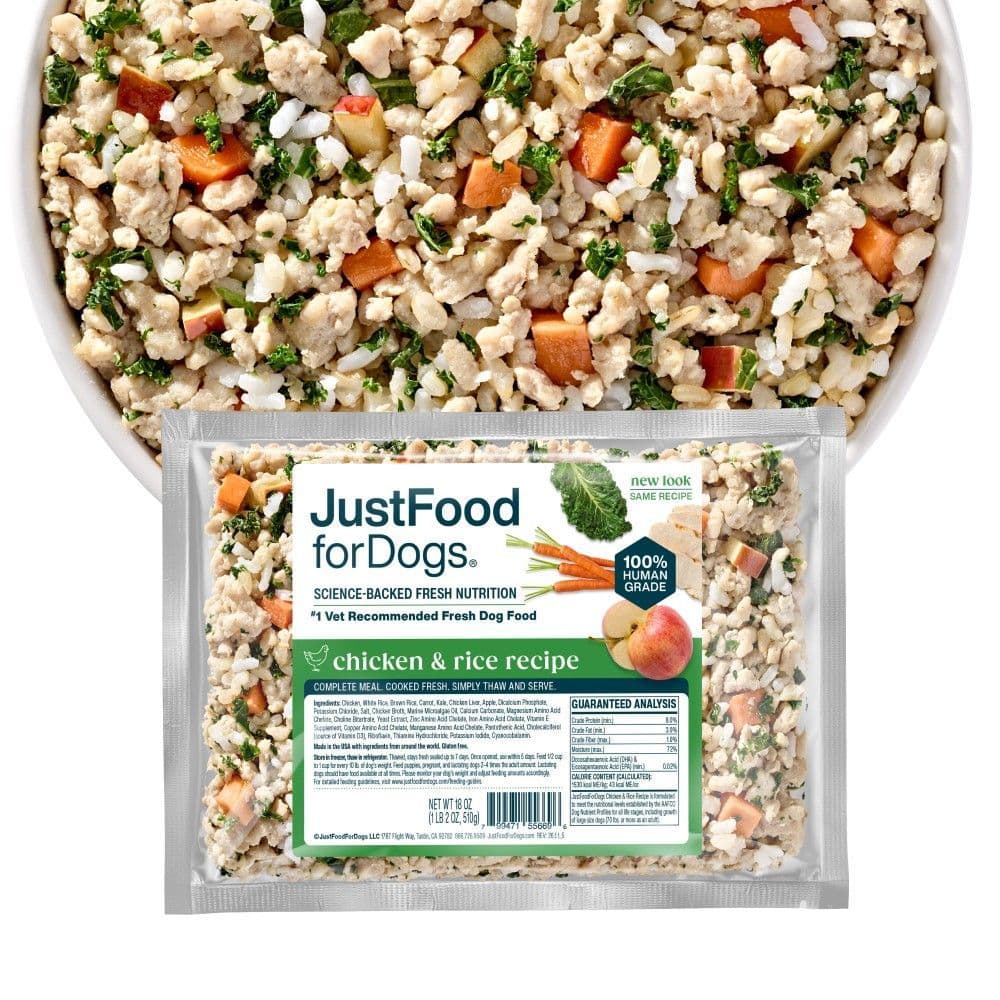
Chicken & Rice is a useful first comparison for Pug households seeking a grain-inclusive Fresh Frozen food. Its current recipe information lists chicken thighs and liver, white and brown rice, kale, carrots, and apples. The nutritional adequacy statement covers all life stages, including growth.
That statement makes the recipe relevant to puppy shopping as well as adult feeding. It does not mean the portion stays the same as the dog grows. A Pug puppy's feeding plan and an adult Pug's plan require different inputs, even if both ultimately use the same recipe.
The labeled 1,530 kcal/kg converts to 1.53 calories per gram. This is helpful when you want to weigh meals instead of relying on how full a bowl appears. Use the dog's individual food-calorie allowance and the current label to calculate the daily weight, then divide that amount into the planned meals.
- Choose it for: Growth-inclusive adequacy, grain-containing ingredients, and a measured fresh-food routine.
- Plan for: Freezer space and thawing, with the puppy's or adult's individual portion written down for each caregiver.
Webvet may earn a commission when you click through to JustFoodForDogs, at no extra cost to you.
JustFoodForDogs Fish & Sweet Potato: a fish-based fresh option
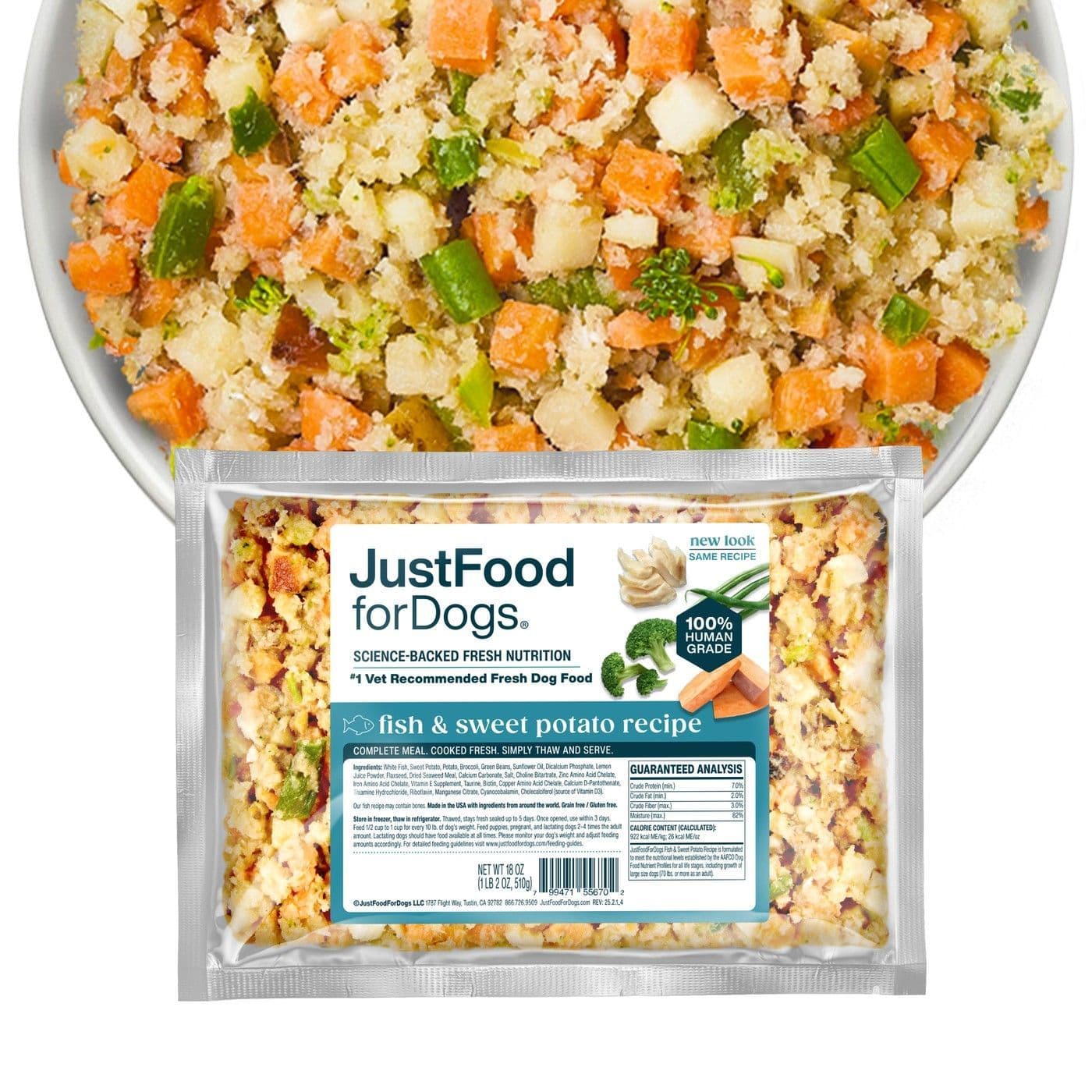
Fish & Sweet Potato is another all-life-stage recipe, providing a different ingredient and calorie profile within the fresh range. According to the current product information, it includes white fish, sweet potatoes, russet potatoes, green beans, and broccoli. Its labeled energy density is 922 kcal/kg, or 0.922 calories per gram.
For a Pug owner, that number creates a useful portion comparison. A fixed calorie allowance requires more grams of this recipe than of Chicken & Rice. You can use that label-based difference to plan the amount served, the number of meals in a package, and the food weight needed for a mixed-feeding routine.
Consider it when you prefer a fish-based fresh recipe and can accommodate the corresponding serving weight and storage needs. Since its adequacy statement includes growth, it can also be considered for puppy feeding with an appropriate puppy plan.
- Choose it for: A fish-based, growth-inclusive recipe with a clearly stated energy density.
- Plan for: A different serving weight from the chicken recipe. Its grain-free ingredient profile is one attribute to consider alongside the complete product and your dog's existing instructions.
Webvet may earn a commission when you click through to JustFoodForDogs, at no extra cost to you.
JustFoodForDogs Beef & Russet Potato: an adult beef recipe
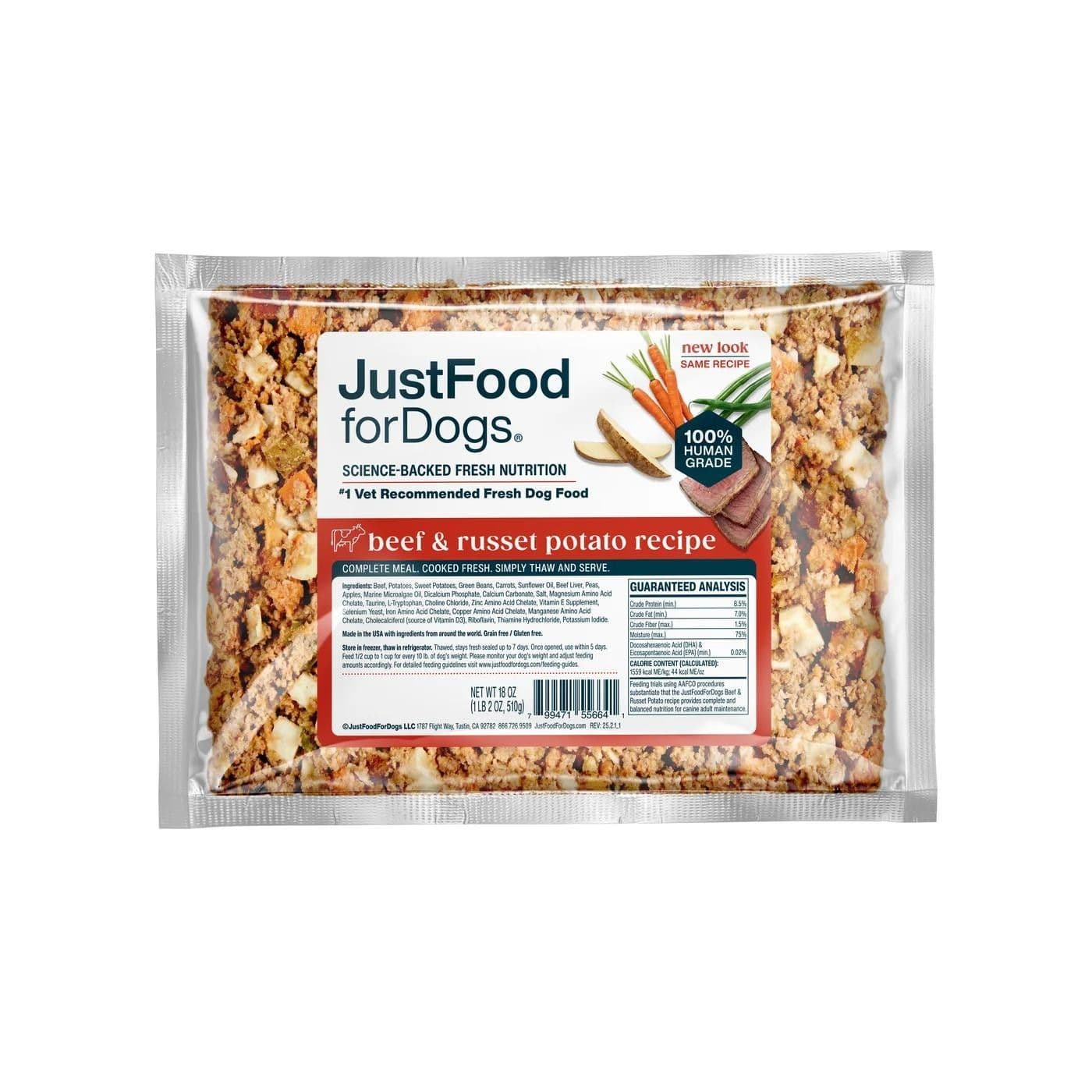
Beef & Russet Potato is an adult-maintenance Fresh Frozen recipe with a labeled 44 calories per ounce. It gives owners who prefer a beef-based meal a distinct option to compare. Check the current recipe page and the package you receive for the applicable feeding and storage directions.
Its adult-only life-stage statement is an important buying distinction. A food can be appropriate to consider for your adult Pug while being the wrong choice as a puppy's sole growth diet. In a mixed-age household, identify the meals clearly instead of assuming all recipes from one brand serve the same purpose.
Use calories per ounce consistently if that is the unit you choose for portions. For example, calculating the ounces needed for a known food-calorie allowance is more useful than transferring the number of scoops used for another recipe. Food texture and density can make an unchanged scoop particularly misleading.
- Choose it for: An everyday adult fresh meal built around beef and potatoes.
- Plan for: Adult-only feeding, using the current 44-calories-per-ounce figure to calculate portions and compare package value.
Webvet may earn a commission when you click through to JustFoodForDogs, at no extra cost to you.
JustFoodForDogs JustFresh Home-Cooked Chicken: adult meals without freezer storage
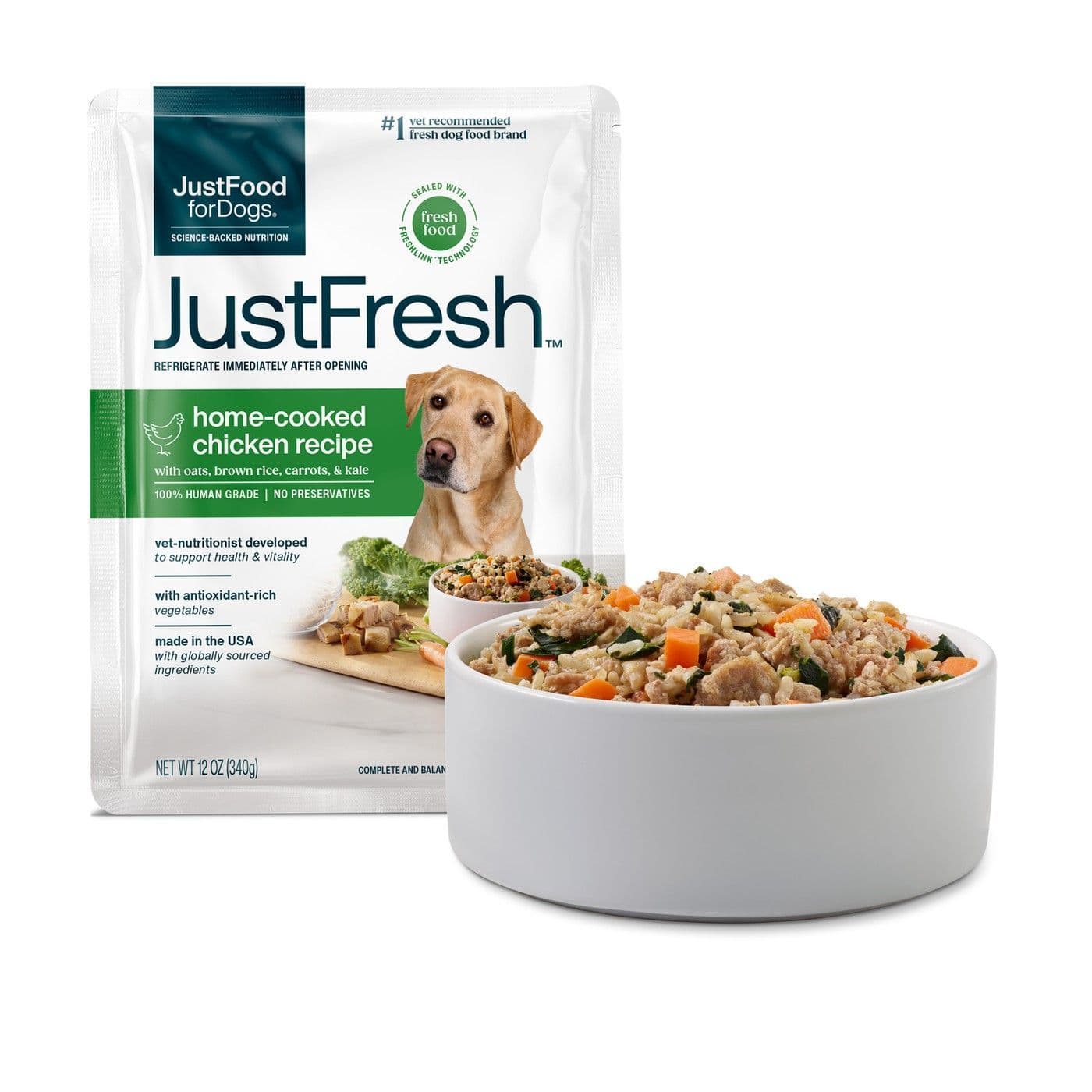
JustFresh Home-Cooked Chicken offers a different kind of convenience for adult Pug households. The unopened product is shelf-stable, so it does not compete with the family's frozen groceries for freezer space. After opening, refrigerate it and use it within three days.
Its product information lists adult maintenance and 1,254 kcal/kg, or 36 kcal/oz. Ingredients include chicken thighs and liver, oats, brown rice, carrots, and kale. It is an adult choice, not a puppy's sole growth food.
Think through the opened pouch as well as the unopened supply. Once you know your Pug's daily portion, you can estimate how much of the pouch the household will use within its refrigerated window. That is a more useful storage decision than assuming that every food described as fresh must be stored in the same way.
- Choose it for: Convenient unopened pantry storage for adult meals.
- Plan for: A three-day refrigerated use period after opening and a serving calculated from the JustFresh calorie label.
Webvet may earn a commission when you click through to JustFoodForDogs, at no extra cost to you.
How much food should a Pug eat?
Calculate a Pug's food amount from an individual calorie plan and the selected food's energy density. There is no single cup count that fits every adult or puppy Pug. Age, size, activity, and the exact recipe all matter when deciding on a starting amount and reviewing it over time.

First distinguish total daily calories from main-food calories. If an individual dog's plan allows 400 total calories and its treats contribute 40, the food calories remaining are 360. Giving 400 calories of meals and then adding 40 calories of treats would produce a different total.
Here is how that illustrative 360-calorie food allowance translates into two recipes. These are calculations, not daily calorie recommendations for a Pug:
| Recipe | Calories per gram | Example food allowance | Grams per day |
|---|---|---|---|
| Chicken & Rice | 1.53 | 360 calories | About 235 |
| Fish & Sweet Potato | 0.922 | 360 calories | About 390 |
A kitchen scale makes the resulting serving repeatable: tare the empty bowl, then add the calculated food weight. The formula is food calories divided by calories per gram. To obtain calories per gram from a kcal/kg label, divide by 1,000 first. Rounding the resulting food weight to a practical measuring amount makes sense, but keep the underlying example separate from your dog's individualized recommendation.
This makes a Pug food chart more useful than a breed-wide “cups per day” rule. It identifies the food and the assumed calorie allowance, so the reader can see why portions differ. A bowl that looks fuller is not automatically providing more energy.
Write down extras separately. Training rewards, food offered by family members, and additions to the bowl can be easy to overlook when they arrive in small amounts. Our guide to daily treat calories explains how to account for them.
Split the food allowance between recipes
For mixed feeding, replace calories rather than simply adding a second food. Suppose 90 of the example 360 food calories are allocated to another complete food. That leaves 270 food calories for the original recipe. Convert each part using its own label and make sure both products suit the dog's life stage.
The JustFoodForDogs feeding guide explains the brand's feeding calculation in more detail. Use the actual dog information and selected product, then monitor weight and body condition with your veterinary team. A calculated starting point should remain open to adjustment as the individual dog changes.
A two-recipe adult meal example
Suppose the owner of an adult dog wants to use Chicken & Rice for three-quarters of that illustrative 360-calorie food allowance and JustFresh Chicken for the remaining quarter. The food calories are 270 and 90, respectively. At 1.53 calories per gram, the Chicken & Rice portion is about 176 grams for the day. At 1.254 calories per gram, the JustFresh portion is about 72 grams.
If the owner divides the food equally between two meals, each meal contains approximately 88 grams of Chicken & Rice and 36 grams of JustFresh. The treats remain the separately counted 40 calories from the example. Nothing has been added on top of the assumed daily total; the new format replaces part of the original food allocation.
This example applies to an adult because JustFresh Chicken is labeled for adult maintenance. For a puppy, both components would need appropriate growth suitability. The dog's own calorie recommendation also has to be established before these calculations become a real feeding plan.
Make the plan clear for every caregiver
The same approach works when a caregiver serves the foods at different meals instead of mixing them in one bowl. Write down the daily totals for each recipe and the planned meal split. That prevents one person from serving the entire day's fresh allowance while another also gives an unchanged full portion of a second food.
Use consistent units and the label on the product you buy. Calories per ounce and per kilogram may be rounded differently, so small differences between calculations are possible. For a gram-based plan, use kcal/kg throughout, record rounded serving weights, and review the dog's response to the overall plan rather than treating a decimal place as a guarantee of precision.
Everyday feeding routines for Pugs
A practical Pug feeding schedule
An adult Pug's daily food allowance is commonly divided into two meals, such as breakfast and dinner. A general puppy schedule is four meals daily from weaning to about three months, then three meals from three to six months; follow individualized instructions for your puppy. Our dog feeding schedule explains the age-based pattern. Divide the day's measured food between those meals rather than serving the daily total each time.
Finding a food your Pug enjoys
There is no established favorite food shared by every Pug. Compare complete recipes your own dog accepts, with the correct life-stage statement and a texture it manages comfortably. The chicken, fish, and adult beef options above offer different ingredients within a prepared fresh-food routine; choosing among them does not require assuming one protein tastes best to the whole breed.
A Pug asking for more food does not by itself establish that its measured daily allowance is too small. Keep meal and treat records together so every caregiver follows the same plan. Review persistent appetite changes with your veterinary team instead of repeatedly adding extras or changing recipes without accounting for the daily total.
Food for Pug puppies
The best puppy food for a Pug should have a nutritional adequacy statement covering growth or all life stages. A small bite, soft texture, or appealing recipe name does not establish that on its own. Look at the exact product, not just the brand's general description.
Chicken & Rice and Fish & Sweet Potato are the growth-inclusive choices in this comparison. Beef & Russet Potato and JustFresh Chicken are adult-maintenance options. If you keep both puppy and adult foods in the same home, label the storage area or feeding instructions clearly enough that another caregiver cannot confuse them.
Pug puppy food amounts need review as the puppy grows. Record the current body weight, the actual recipe, and how the daily quantity is split between meals. A feeding chart that refers to a different food can give an inappropriate volume because that food may supply different calories per cup, ounce, or gram.
Meal timing as your puppy grows
Young puppies generally eat more frequently than adults. Use an age-appropriate schedule and divide the day's allowance accordingly; extra meals should not mean accidentally multiplying the whole daily amount. Our dog feeding schedule explains the distinction between meal timing and daily quantity.
For a two-month-old Pug puppy, keep the established feeding instructions available while you arrange ongoing veterinary guidance. Avoid improvising an adult-food plan from a generic online cup chart. As the puppy develops, the useful question is whether its current food and amount still match its growth stage, not whether it can continue eating the same-looking bowl forever.
Food for senior Pugs
Senior Pug food choices should be based on the older dog in front of you. Review the current calorie allowance, eating routine, food texture, and any individualized veterinary instructions. Age can be a reason to reassess feeding without assuming that every senior dog needs the same recipe or portion change.

Observe what happens at mealtime. Is the food easy for the dog to access? Is the full daily amount being measured consistently? Has the household continued giving the same portions and extras through a change in routine? Those observations give a feeding discussion useful context without attempting to diagnose a problem from a photograph or a food review.
The adult-maintenance foods above are everyday options to compare for an older adult whose feeding needs fit them. An all-life-stage statement also needs to be interpreted with the portion and individual circumstances in mind. Neither a senior marketing label nor an appealing ingredient list replaces an appropriate overall feeding plan.
If your Pug already has a prescribed diet, follow that plan instead of replacing it with one of these general buying-guide selections. Bring the current food label and measured daily amount to appointments so recommendations can be based on what the dog actually receives.
Planning fresh meals, storage, and cost
Start with the amount of food your dog will use each day. That figure connects the portion decision with the shopping decision: how long a package lasts, how much freezer or refrigerator space you need, and the cost of the meals you will actually serve.
For a current price illustration, the Chicken & Rice page displayed a regular price of $153.99 for fourteen 18-ounce packs on September 28, 2026. Divide $153.99 by 252 ounces to get about $0.61 per ounce. At the labeled 43 kcal/oz, the example 360-food-calorie allowance would require about 8.37 ounces and cost approximately $5.12 daily, excluding tax and shipping. The portion is illustrative, and prices or promotions may change.
Compare regular one-time prices with equivalent prices, and include relevant shipping charges. An introductory offer can affect the first order without representing the ongoing food budget. You can also make a one-time purchase of JustFoodForDogs instead of assuming a subscription is required.
Plan the opened food, too
For Fresh Frozen, plan storage and thawing using the directions for the selected recipe. For JustFresh Chicken, unopened pantry convenience still comes with a refrigerated, three-day use period after opening. Keep the label with the food so everyone feeding the dog follows the right instructions.
In a small-dog household, opened-food planning deserves particular attention. Calculate how much remains after a meal and when it will be used. A package that is convenient for a larger dog or multi-dog home may require different planning for your Pug. The right format is one you can use reliably, not simply the largest quantity available.
Can you make homemade food for a Pug?
Homemade Pug food needs the same attention to nutritional adequacy as purchased food. Combining familiar ingredients does not establish that a recipe supplies all necessary nutrients in appropriate amounts. Meat and vegetables alone should not be assumed to form a complete diet.
If home preparation is your preference, select a properly formulated recipe appropriate to the dog's life stage and follow it accurately. Required supplements and specified ingredient amounts are part of that recipe, not optional finishing touches. Substitutions can change the nutritional result.
Home preparation or ready-to-feed meals?
Homemade food for Pug puppies needs a formulation that specifically supports growth. An adult recipe cannot become a puppy recipe simply by serving more of it. Obtain a properly formulated growth recipe and its complete instructions before choosing home preparation; the exact supplement and ingredient quantities are part of the formulation.
Compare the practical workload, too. Home cooking means sourcing and weighing ingredients, preparing batches, and following the recipe's storage instructions. A complete prepared meal shifts the formulation and cooking work to the manufacturer, leaving you to choose the correct life stage, measure portions, and handle the food as directed. For owners seeking that simpler routine, growth-eligible Chicken & Rice and Fish & Sweet Potato are concrete prepared alternatives to compare.
Our homemade dog food guide explains the broader preparation and balancing considerations. Ready-to-feed JFFD meals offer a different route: compare the labeled recipes, choose one that suits the life stage, and calculate a serving. That can be useful when you want prepared meals without taking on the task of formulating and cooking a complete recipe yourself.
Foods and feeding shortcuts to avoid
Avoid turning treats, table scraps, or an unbalanced collection of ingredients into the main diet. Treats may have a place in the daily plan, but they are not automatically complete meals. AAFCO distinguishes products intended as snacks or treats from foods making a complete-and-balanced claim.
Also avoid relying on an adult-maintenance label for a growing puppy, transferring cup measurements between recipes, or adding fresh food without counting its calories. These are food-selection and portion mistakes you can prevent by keeping the exact label and daily plan together.
Keep chocolate, grapes, raisins, and xylitol-containing foods away from your Pug. These appear on the FDA's list of potentially dangerous items for pets; they are not ordinary treats to fit into a calorie budget. If your dog eats a potentially dangerous food, contact your veterinarian promptly rather than trying to solve the exposure by changing its next meal.
Pug food questions
Frequently Asked Questions
Can a Pug puppy eat the adult fresh recipes in this guide?
Choose by the exact life-stage statement. Chicken & Rice and Fish & Sweet Potato are growth-suitable options here; Beef & Russet Potato and JustFresh Chicken are adult-maintenance choices. A puppy needs an appropriate growth diet even when its body size resembles that of a small adult.
How can I include fresh food without replacing all my Pug's kibble?
Assign part of the existing calorie allowance to a suitable complete fresh recipe and the rest to the dry food. Calculate both portions from their own labels, then subtract the replaced dry calories. Keep treats within the overall plan instead of counting the fresh addition as free extra food.
What is the healthiest dog food for Pugs?
There is no single healthiest product for every Pug. Chicken & Rice is our grain-inclusive starting choice among these fresh meals because its current manufacturer label states complete and balanced nutrition for all life stages and lists 1,530 kcal/kg for portion planning. Fish & Sweet Potato is the fish-based alternative. Match either to individual calorie needs; JustFresh Chicken's adult-maintenance label makes it an adult-only choice here.
Does a Pug need a breed-specific formula?
A breed-specific formula can offer particular design features, but the breed name alone does not establish that it is the right food for your Pug. Check the nutritional adequacy statement, life stage, calorie density, and feeding directions as you would for another complete food. Observe how your dog manages the meal and use that information alongside the label. A suitable food does not have to be labeled exclusively for Pugs.
Can fresh food replace part of a Pug’s dry food?
Yes, provided the selected foods are appropriate for the dog's life stage and you replace calories rather than adding an unchanged fresh portion to an unchanged dry portion. Decide how the daily food allowance will be split, then calculate each food's quantity from its own calorie label. Introduce food changes gradually; our food-transition guide explains the process. Keep a written meal split so different caregivers follow the same plan.

Editor
The Webvet Editorial Team is the in-house group of pet-care editors and writers behind Webvet, operated by Smart Pet Collective. The team researches, writes, and maintains Webvet's pet health, behavior, and medication content. Every article follows a defined editorial process: research from reputable veterinary and scientific sources, careful drafting, mandatory review of medical content by a credentialed veterinarian, and dated publication. Health and medication articles are medically reviewed by a licensed veterinary professional before they go live and are kept current over time.


