Best Dog Food for Boston Terriers: A Practical Feeding Guide
Compare JustFoodForDogs recipes for Boston Terrier puppies and adults, with label-based choices, measured portions, storage guidance, and an illustrative daily cost.

This article contains affiliate links. Webvet may earn a commission when you buy through them, at no extra cost to you.
This article is sponsored by JustFoodForDogs. WebVet maintains editorial control and may earn a commission from qualifying purchases, at no extra cost to you.
The best dog food for Boston Terriers is a complete meal that fits your dog's life stage, daily energy needs, and feeding routine. A puppy needs a growth-suitable food; an adult needs an appropriate daily portion. Neither decision can be made from a breed picture on a package alone.
JustFoodForDogs offers several useful ways to put those principles into practice. Its Fresh Frozen recipes let you choose between different proteins and calorie densities, while JustFresh gives adult-dog households an option that does not need freezer space before opening. This guide compares four everyday choices and explains how to turn a food label into a practical feeding plan.
Choosing the best dog food for Boston Terriers
For a grain-inclusive moist fresh meal, JustFoodForDogs Chicken & Rice is our practical starting pick: its all-life-stage statement covers puppy and adult feeding, and its published calories make measured servings straightforward. Fish & Sweet Potato provides a fish-based alternative. For an adult whose owner prefers unopened pantry storage, JustFresh Chicken is the convenience pick.
The AAFCO label guide explains that “complete” refers to having the required nutrients and “balanced” to their appropriate ratios. A bag or pouch being marketed for small dogs does not replace that nutritional adequacy statement. Our guide to complete and balanced dog food explains how to recognize it.
Next, consider three everyday questions. Can you measure the food consistently? Can you store it as directed? And does its life-stage suitability match every dog who will be eating it? Those answers help you compare Boston Terrier food recommendations without assuming one recipe is the right choice for every household.
Choose life stage first, then a complete and balanced recipe, then a measured portion that fits your individual dog.
The choices below are compared using the manufacturers' current labels and preparation requirements. They are not ranked from a hands-on feeding trial. The differences that matter here are concrete: life stage, calorie density, protein ingredients, and how you will keep and serve the food.
Food for Boston Terrier puppies
Boston Terrier puppy food needs to support growth. That is why an adequacy statement covering growth or all life stages is the first filter when comparing puppy foods. An appealing ingredient list, small package, or soft texture does not establish suitability for a growing dog.

Among the four recipes compared here, Chicken & Rice and Fish & Sweet Potato carry all-life-stage statements. Beef & Russet Potato and JustFresh Chicken are adult-maintenance choices. Keep that distinction intact when shopping, even when products share the same brand name or look similar on a shelf.
Puppy food amounts also change as a dog grows. Record the current weight, the exact recipe, and the manufacturer's puppy feeding directions, then review the amount as your puppy develops. A portion calculated several weeks ago should not become a permanent rule simply because your puppy still finishes it.
For a Boston Terrier puppy food chart, use the chart associated with the actual food and the puppy's current information. If you need help choosing the starting amount, bring those details to your veterinary team rather than asking for a cup count without identifying the recipe. Our JustFoodForDogs feeding guide helps explain the brand's feeding calculation and the information you need to use it.
JustFoodForDogs options at a glance
| Food | Best practical fit | Format | Life-stage statement | Labeled calories | Planning consideration |
|---|---|---|---|---|---|
| Chicken & Rice | Grain-inclusive fresh meals for puppy and adult households | Fresh Frozen | All life stages | 43 kcal/oz; 1,530 kcal/kg | Plan freezer space and refrigerator thawing |
| Fish & Sweet Potato | A fish-based fresh recipe with fewer calories per gram than Chicken & Rice | Fresh Frozen | All life stages | 26 kcal/oz; 922 kcal/kg | The same calorie allowance requires more food by weight |
| Beef & Russet Potato | Adult households choosing a beef recipe | Fresh Frozen | Adult maintenance | 44 kcal/oz | Use for adult feeding, not as a puppy's growth diet |
| JustFresh Home-Cooked Chicken | Adult meals without freezer storage before opening | Shelf-stable before opening | Adult maintenance | 36 kcal/oz; 1,254 kcal/kg | Refrigerate after opening and use within three days |
These are different choices, not interchangeable portion sizes. A Boston Terrier eating a fish recipe may receive a larger weight of food than one eating chicken even when both portions provide the same calories. The comparison is useful only when the serving calculation follows the selected recipe.
JustFoodForDogs Chicken & Rice: grain-inclusive puppy and adult meals
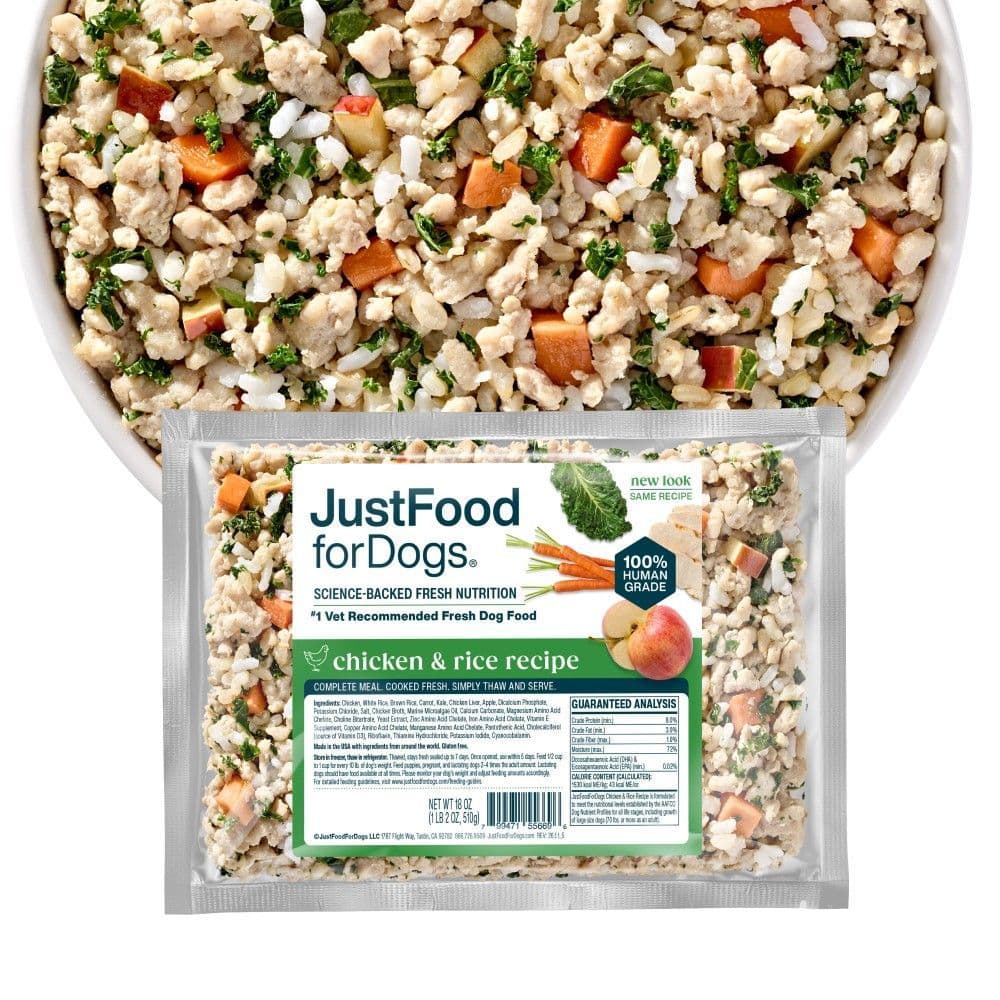
Chicken & Rice is a straightforward starting point for a household seeking a grain-inclusive fresh food that can suit more than one life stage. The current recipe includes chicken thighs and liver, white and brown rice, kale, carrots, and apples. Its nutritional adequacy statement covers all life stages, including growth.
For Boston Terrier owners, that growth statement creates a useful distinction from the adult-only choices below. A puppy can be considered for this recipe without relying on an adult-maintenance claim. An adult can also eat an all-life-stage food when the amount is appropriate for that individual dog; the wording does not mean a puppy and adult should receive the same serving.
The label lists 1,530 kcal/kg, which converts to 1.53 calories per gram. That makes a kitchen scale especially useful: once you have your dog's food-calorie allowance, you can calculate the daily weight and divide it into meals. The calculation is more portable than “one scoop,” since scoops differ and the amount packed into them can change.
- Useful fit: A grain-inclusive fresh option for a Boston puppy or adult, with servings adjusted individually.
- Home routine: Keep frozen meals on hand and thaw them according to the package directions.
Webvet may earn a commission when you click through to JustFoodForDogs, at no extra cost to you.
JustFoodForDogs Fish & Sweet Potato: a fish-based fresh option
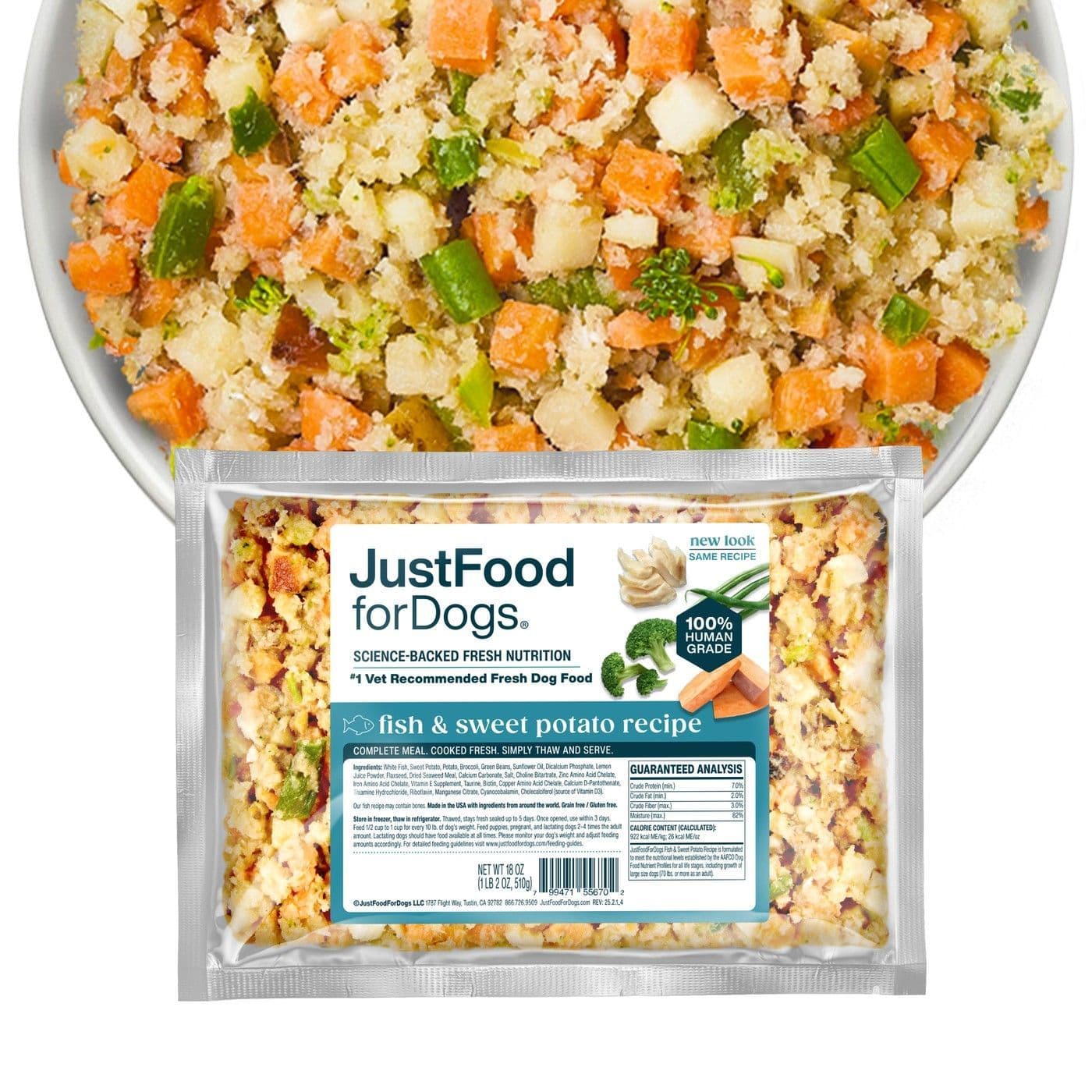
Fish & Sweet Potato offers another all-life-stage choice, with white fish, sweet potatoes, russet potatoes, green beans, and broccoli among its ingredients. Its current product label lists 922 kcal/kg, or 0.922 calories per gram. That is lower than the energy density of Chicken & Rice.
The practical benefit of knowing that number is better comparison. If two suitable foods are being considered for the same calorie allowance, you can see how much of each will need to fit into your bowls, refrigerator, and shopping budget. Its lower calorie density means a greater food weight for the same calories, giving you a clear way to plan the serving and supply.
For a Boston Terrier owner who prefers a fish-based recipe, this is a concrete alternative within the fresh-food range. It also remains eligible for puppy consideration because its adequacy statement includes growth. Check the full ingredient list before purchasing, especially if your dog already has specific feeding instructions.
- Useful fit: An all-life-stage fish recipe for owners who prefer that protein source.
- Home routine: Allow for the larger serving weight when comparing pack sizes and refrigerator space. Grain-free describes this recipe; the full nutritional profile remains the basis for selection.
Webvet may earn a commission when you click through to JustFoodForDogs, at no extra cost to you.
JustFoodForDogs Beef & Russet Potato: an adult beef recipe
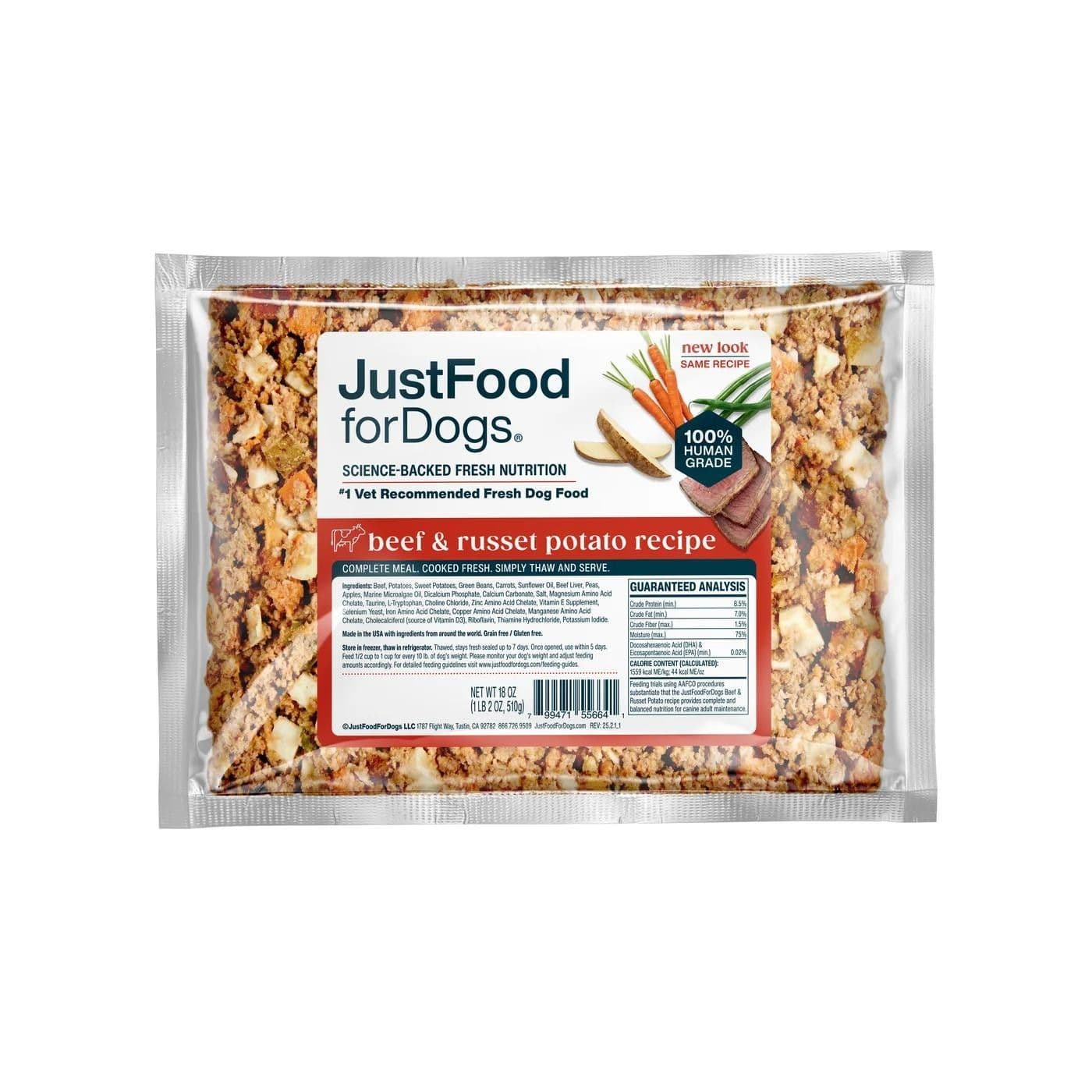
Beef & Russet Potato gives adult-dog households a different protein-based fresh option. Its product information identifies it as an adult-maintenance recipe and lists 44 calories per ounce. That makes the age distinction important: this is an adult pick, not a substitute for a puppy food with a growth statement.
The calorie figure also makes comparisons easier. If you are changing an adult Boston Terrier from another food, use the new recipe's own calories per ounce rather than copying the previous food's weight. A portion that looks similar can provide a different amount of energy.
Beef & Russet Potato is a sensible option to compare when beef is your preferred recipe ingredient and frozen storage fits your routine. Its adult-maintenance statement keeps the choice clear for homes with an adult dog. In a household that also has a puppy, separate and identify meals so that the growth-suitable food goes to the younger dog.
- Useful fit: A beef-based fresh meal for an adult Boston Terrier.
- Home routine: Work out the daily ounces before choosing a pack size, so you know how long the purchase will last and can compare daily portion cost.
Webvet may earn a commission when you click through to JustFoodForDogs, at no extra cost to you.
JustFoodForDogs JustFresh Home-Cooked Chicken: adult meals without freezer storage
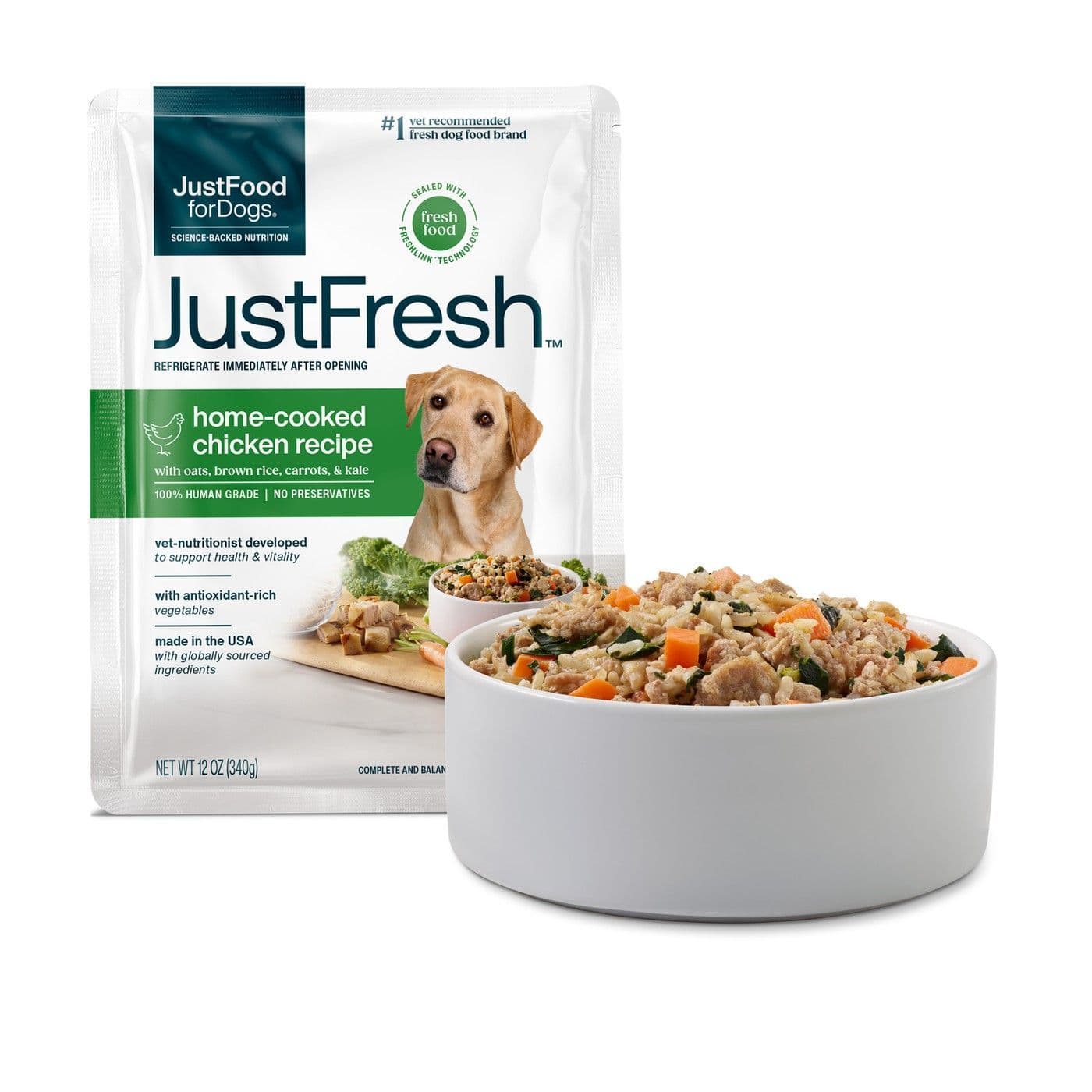
JustFresh Home-Cooked Chicken suits an adult-dog household looking for a convenient alternative to frozen storage. It is shelf-stable before opening, so unopened pouches can be stored according to their package directions without taking up freezer space. Once opened, the handling requirements change: refrigerate the food and use it within three days.
The JustFresh Chicken product information lists adult maintenance, 1,254 kcal/kg, and 36 kcal/oz. Its ingredients include chicken thighs and liver, oats, brown rice, carrots, and kale. The adult-maintenance statement means it should not be chosen as the sole growth diet for a Boston Terrier puppy.
For an adult Boston, this format can simplify the unopened-food side of the routine. You still need to consider how quickly your dog uses an opened pouch. A smaller daily serving may make opened-food planning more important, even when the unopened food is easy to keep in the pantry.
- Useful fit: Adult fresh-food feeding when unopened pantry storage is convenient.
- Home routine: Calculate the serving using the JustFresh label, then plan how the opened pouch will be used within three refrigerated days.
Webvet may earn a commission when you click through to JustFoodForDogs, at no extra cost to you.
How much food should a Boston Terrier eat?
A Boston Terrier's food amount depends on its individual calorie allowance and the calories in the selected food. Breed alone cannot supply an exact daily number. Start with a feeding recommendation for your dog, account for treats and other extras, then convert the remaining food calories into grams or ounces using the label.

Here is an arithmetic example, not a calorie prescription. Suppose an individual dog's plan allocates 400 calories per day to its main food. Chicken & Rice provides 1.53 calories per gram, so 400 divided by 1.53 equals approximately 261 grams per day. Fish & Sweet Potato provides 0.922 calories per gram, so the same 400 calories equals approximately 434 grams.
| Food | Calories per gram | Example food calories | Grams per day |
|---|---|---|---|
| Chicken & Rice | 1.53 | 400 | About 261 |
| Fish & Sweet Potato | 0.922 | 400 | About 434 |
The example demonstrates why a universal Boston Terrier food chart can be misleading. Both portions supply approximately the same calories, but their weights differ substantially. Neither amount is a recommendation for every Boston Terrier. Your dog's appropriate calorie target must be determined separately.
Treats belong in the same daily accounting. If the dog's total allowance were 400 calories and treats supplied 40, the food calories remaining would be 360. You would use 360 in the food calculation, not serve 400 calories of meals and add the treats afterward. Our daily treat-calorie guide explains how to plan extras.
For consistent measuring, place the empty bowl on the scale, tare it, then add the calculated food weight. If you divide the daily portion between caregivers, write down the daily total and how it is split. Otherwise, two carefully measured meals can still add up to too much when each person assumes someone else counted the snacks.
Review the amount when the routine changes
Review the plan when the recipe, activity routine, or life stage changes. Tracking the dog's weight and body condition helps your veterinary team assess whether the amount needs adjustment. The WSAVA nutrition tools provide body-condition resources that support that discussion.
Keep the latest portion instructions where meals are prepared. Include the food name and whether the number shown is a daily total or a single meal. That small distinction makes a calculation usable when a partner, sitter, or family member feeds your Boston instead of you.
Wet, fresh, and dry food for Boston Terriers
The best dry dog food for a Boston Terrier and the best fresh option should clear the same first hurdle: complete and balanced nutrition for the dog's life stage. Format then becomes a practical choice. Dry food is often convenient to measure and keep; fresh or other moist meals offer a different texture and come with their own storage instructions.
When comparing wet, canned, and fresh food, do not assume the names mean identical handling. A sealed canned food and a frozen fresh meal reach your kitchen in different ways. Even two shelf-stable products can have different directions after opening. Check the exact label rather than transferring instructions from the last food you bought.
Also compare calories, not bowl volume. Moist food contains water, so a large-looking serving does not necessarily provide more calories than a smaller serving of dry food. The labeled energy density is the useful number when calculating how much to serve or comparing the cost of a day's meals.
Combining meal formats
If you combine complete foods, allocate part of the day's food calories to each. Simply adding a fresh meal on top of an unchanged dry-food portion creates extra calories. Both foods should suit the dog's life stage, and the combined daily amount should still fit the feeding plan.
- Dry food: Convenient for owners who want to scoop or weigh food without thawing it; keep the package directions for storage and calorie calculations.
- Canned wet food: Convenient unopened storage, with refrigeration and the product's use period applying after opening.
- Fresh Frozen: Ready-made fresh recipes with planned freezer storage and thawing, useful when that routine fits your home.
- Shelf-stable fresh: Pantry convenience before opening; JustFresh Chicken then needs refrigeration and use within three days.
Food for senior Boston Terriers
Choosing food for a senior Boston Terrier still starts with the individual dog. Reassess the amount being served, how easily the dog manages the texture, and whether the household's existing routine still works. Do not assume an older Boston needs the same portion it ate years earlier, or that every senior requires the same change.
The adult-maintenance options in this guide can be compared as everyday foods for an older adult, alongside the dog's existing veterinary advice. A senior label is not a substitute for examining nutritional adequacy and the calorie information. Likewise, an all-life-stage food does not automatically become unsuitable at a birthday, but its serving still needs to fit the dog.
If a health condition comes with a prescribed feeding plan, follow that plan rather than substituting a product from an everyday buying guide. For routine shopping, bring the exact recipe and current daily quantity to your dog's checkups so any portion discussion starts with useful information.
Reading the label before you reorder
Keep a photograph of the exact label for the food you are using. That gives you a reference for the recipe name, nutritional adequacy statement, calorie content, and feeding instructions when you reorder or ask a question about portions. Product lines can contain several similarly named foods with different intended life stages.
Read the calorie unit carefully. Calories per ounce and calories per kilogram describe the same food in different units, often with rounding. Use one stated unit consistently for a calculation. If your scale measures grams, dividing kcal/kg by 1,000 gives calories per gram; if you weigh ounces, use the manufacturer's kcal/oz number.
The ingredient list answers another question: what is in the recipe? Ingredients are listed in descending order by weight, as explained by AAFCO. That list is useful for identifying proteins, grains, and other ingredients, but it does not independently tell you the appropriate daily serving. You still need the nutritional adequacy and calorie information.
Compare like with like
This is also why comparing a fresh food's protein percentage directly with a dry food's percentage can be misleading. The foods contain different amounts of water. Use the complete label and feeding information to compare the actual decision in front of you instead of choosing the larger-looking percentage from two different formats.
Matching meals to your Boston Terrier’s routine
Two adult Boston Terriers can have different routines. One may accompany its owner on regular walks and play sessions, while another has a quieter day. Their breed name does not erase differences in activity, size, age, or the amount of food they need.

When you review portions, describe the routine that actually happens. A planned long walk is not the same as a walk completed, and an occasional busy weekend does not necessarily represent the rest of the week. A simple record of meals, treats, and usual activity is more useful than labeling every Boston “high energy.”
Keep the feeding method repeatable when another person takes over. Leave the recipe name, daily food weight, meal split, and treat allowance together. That makes it easier to notice changes and avoids the common problem of several people feeding small extras that nobody adds up.
Planning fresh meals, storage, and cost
Choose a food format you can store and serve consistently. With Fresh Frozen meals, make room for the delivery and plan thawing using the package instructions. With JustFresh Chicken, consider both the unopened pantry supply and the three-day refrigerated window after opening. Shelf-stable before opening does not mean food can be left unrefrigerated afterward.

To compare daily portion cost, divide the package price by its food weight, then multiply by the daily portion. On September 28, 2026, the Chicken & Rice page displayed a regular price of $153.99 for fourteen 18-ounce packs. That is 252 ounces, or about $0.61 per ounce. At the labeled 43 kcal/oz, the illustrative 400-food-calorie allowance above would use about 9.30 ounces and cost approximately $5.68 per day, before tax and shipping. Prices and promotions may change; the calorie allowance is an example, not a breed recommendation.
Compare equivalent purchase conditions. A first-order discount and a regular one-time price answer different budget questions, and delivery charges can change the total. Use the serving you actually expect to feed, not the smallest amount shown in a marketing example.
Choose an order your household can use
That calculation also helps you choose a manageable order size. A larger purchase is useful only if you have the storage space and can follow the product's handling directions. A repeatable routine is more valuable than buying an oversized supply because its headline price looks attractive.
If several people shop for the dog, keep a simple reorder note with the full recipe name and format. “Chicken food” is not precise enough when the brand offers more than one chicken product. Note whether you need the growth-suitable Fresh Frozen recipe or the adult JustFresh product, along with the amount you normally use.
Separate food needed for the coming days from the longer-term supply using the package's storage directions. Keeping the relevant label with the food helps the next caregiver follow the same instructions. Do not assume an opened pouch has the same usable period as a thawed frozen package; follow the instructions for that exact product.
Changing to the selected food
Plan the change before the previous food runs out. Having both foods available lets you follow an appropriate gradual introduction instead of making a sudden switch because the cupboard is empty. Record which recipe is replacing which, since that also tells you which calorie values belong in the portion calculation.
Think about the daily calorie allocation as the balance shifts toward the new food. Combining equal weights of two foods does not necessarily mean half the calories come from each. This matters particularly when moving between a calorie-dense dry food and a moist recipe. Our transitioning dog food guide explains the broader changeover process.
Once the change is complete, keep the routine consistent long enough to know what you are actually feeding. Use the same measuring method, include treats in the record, and keep the current label available. If your dog already has individualized feeding instructions, use those instructions to guide the change rather than replacing them with a generic schedule.
Foods Boston Terriers should not eat
Keep chocolate, grapes, raisins, and xylitol-containing foods away from your Boston Terrier. The FDA identifies these as potentially dangerous items for pets. If your dog eats a potentially dangerous food, contact your veterinarian promptly. Treats and table scraps also should not replace a complete main meal. Chicken and rice can be ingredients in a formulated complete recipe such as the option above; plain chicken and rice alone is a different, nutritionally incomplete feeding plan.
Can you make homemade food for a Boston Terrier?
Homemade Boston Terrier food needs a complete recipe, not simply meat, rice, and vegetables assembled by eye. Cooking familiar ingredients does not by itself establish the right nutrient amounts or balance for the dog's life stage.
If you prefer preparing food yourself, use a properly formulated recipe and follow it accurately, including any specifically required supplement. Changing ingredients or leaving out a component can change the diet's nutritional profile. The details belong in our homemade dog food guide, which explains recipe selection and the limits of informal templates.
Compare the work involved
For homemade food, ask whether you can obtain a complete formulation for your Boston Terrier's life stage, weigh every specified ingredient, use the exact required supplement, and follow the cooking and storage instructions consistently. Buying the ingredients is only part of the job. Replacing a supplement with a different brand or swapping a protein changes the recipe you are following.
Prepared fresh meals shift that formulation and cooking work to the manufacturer. Your tasks become selecting a suitable label, measuring the daily amount, and handling the food correctly. That makes the prepared Chicken & Rice or Fish & Sweet Potato options useful comparisons for an owner who likes cooked meals but wants a simpler routine. Neither approach calls for a special homemade recipe based solely on the Boston Terrier breed name.
For owners who want prepared fresh meals, the labeled JFFD options above offer a more direct shopping route: select an appropriate recipe, calculate the amount, and follow the storage instructions. Keep homemade preparation and ready-to-feed meal selection as separate decisions rather than assuming they require the same planning.
Boston Terrier food questions
Frequently Asked Questions
What is the best wet dog food for a Boston Terrier?
For a moist fresh meal, Chicken & Rice is our grain-inclusive pick in this guide, with a growth statement that also suits puppy consideration. Fish & Sweet Potato is the fish-based alternative. Both are Fresh Frozen rather than canned. For an adult needing unopened pantry convenience, JustFresh Chicken is the shelf-stable option. Choose a complete wet meal by life stage and handling needs, not softness alone.
How often should a Boston Terrier eat a day?
An adult Boston Terrier's daily portion is commonly divided into two meals. A general puppy schedule is four meals daily from weaning to about three months, then three meals from three to six months, with the individual puppy's instructions taking precedence. The important distinction is between dividing the day's amount and multiplying it: two adult meals share the daily allowance. Our dog feeding schedule covers the age-based pattern.
Does a Boston Terrier need breed-specific dog food?
A breed-specific label is not the nutritional requirement. It may describe features a manufacturer designed for the breed, but you should still check nutritional adequacy, life stage, and calorie density. A complete food without “Boston Terrier” on the package can be considered using those same criteria. Choose based on what the exact food provides and how it fits your dog, rather than the breed name alone.
Can you rotate a Boston Terrier’s food?
If you choose to rotate suitable foods, plan a gradual transition and calculate servings from each food's new calorie density. Do not assume that an identical scoop or weight supplies identical calories. Keep a record of which recipe you are feeding so changes are easy to follow. Rotation should not be presented as a proven way to prevent food allergies. Our food-transition guide explains the changeover process.
Can a Boston Terrier eat fresh food without a subscription?
Yes. JustFoodForDogs offers one-time purchase options, so a subscription is not a requirement for feeding its fresh meals. Choose the recipe and order size around your dog's portion and the product's storage instructions. Check the current purchase terms when ordering, since discounts and delivery details can vary. For a first order, knowing how much your dog will use each day helps you choose a practical supply.

Editor
The Webvet Editorial Team is the in-house group of pet-care editors and writers behind Webvet, operated by Smart Pet Collective. The team researches, writes, and maintains Webvet's pet health, behavior, and medication content. Every article follows a defined editorial process: research from reputable veterinary and scientific sources, careful drafting, mandatory review of medical content by a credentialed veterinarian, and dated publication. Health and medication articles are medically reviewed by a licensed veterinary professional before they go live and are kept current over time.


