Screwworm in Dogs and Cats: Signs, What It Looks Like, and What to Do
New World screwworm is a fly whose larvae feed on living tissue in wounds, and it has been confirmed in pets in the southern United States. This guide covers where it is, what an infested wound looks like, how it differs from ordinary maggots, and what to do the same day.

BVMS MRCVS
Medically reviewed by Dr. Pippa Elliott, BVMS MRCVS · Last reviewed

This article contains affiliate links. Webvet may earn a commission when you buy through them, at no extra cost to you.
Screwworm in dogs and cats: what it is, the signs that matter, and why it needs a vet today
Screwworm in dogs is an infestation by the larvae of the New World screwworm fly, Cochliomyia hominivorax. The fly lays eggs on open wounds and body openings, and the FDA explains that the larvae burrow into the flesh and eat healthy living tissue, a condition called myiasis. Dogs and cats can both be infested.
A wound with larvae in it, a foul smell, or a wound that is getting bigger needs a vet the same day. Screwworm in dogs and cats is also a reportable disease, so a suspected case is reported to state and federal animal health officials, a step your vet usually starts.
- 1What screwworm is: a fly whose larvae eat living tissue in the wounds of dogs, cats, livestock, wildlife, and rarely people.
- 2Where it has been confirmed: USDA has confirmed 2026 cases in animals in Texas, New Mexico, and Arizona, including dogs in Lea County, New Mexico, and Cochise County, Arizona.
- 3It is not the same as ordinary maggots, which feed on dead tissue and wound debris.
- 4Larvae in a wound, a bad smell, or a fast-growing wound means a same day vet visit.
- 5A suspected case is reported to the state animal health official and USDA APHIS, usually through your vet.

Despite the name, this flesh-eating parasite is a fly, not a worm. USDA APHIS explains that the maggots burrow, or screw, into a wound as they feed, tearing tissue with sharp mouth hooks. The species name hominivorax roughly translates as maneater, according to the USDA Agricultural Research Service.
Is screwworm deadly? It can be. APHIS calls the damage serious and often deadly. The Merck Veterinary Manual, in a chapter by a Texas A&M AgriLife Extension author, says untreated infestations lead to the animal's death within 7 to 14 days. Those effects come from larvae eating living flesh.
The good news is that infested pets are treatable, and recovery usually continues at home after the clinic visit. A healing wound has to be protected from licking and chewing until it closes, which is what a recovery cone is for.
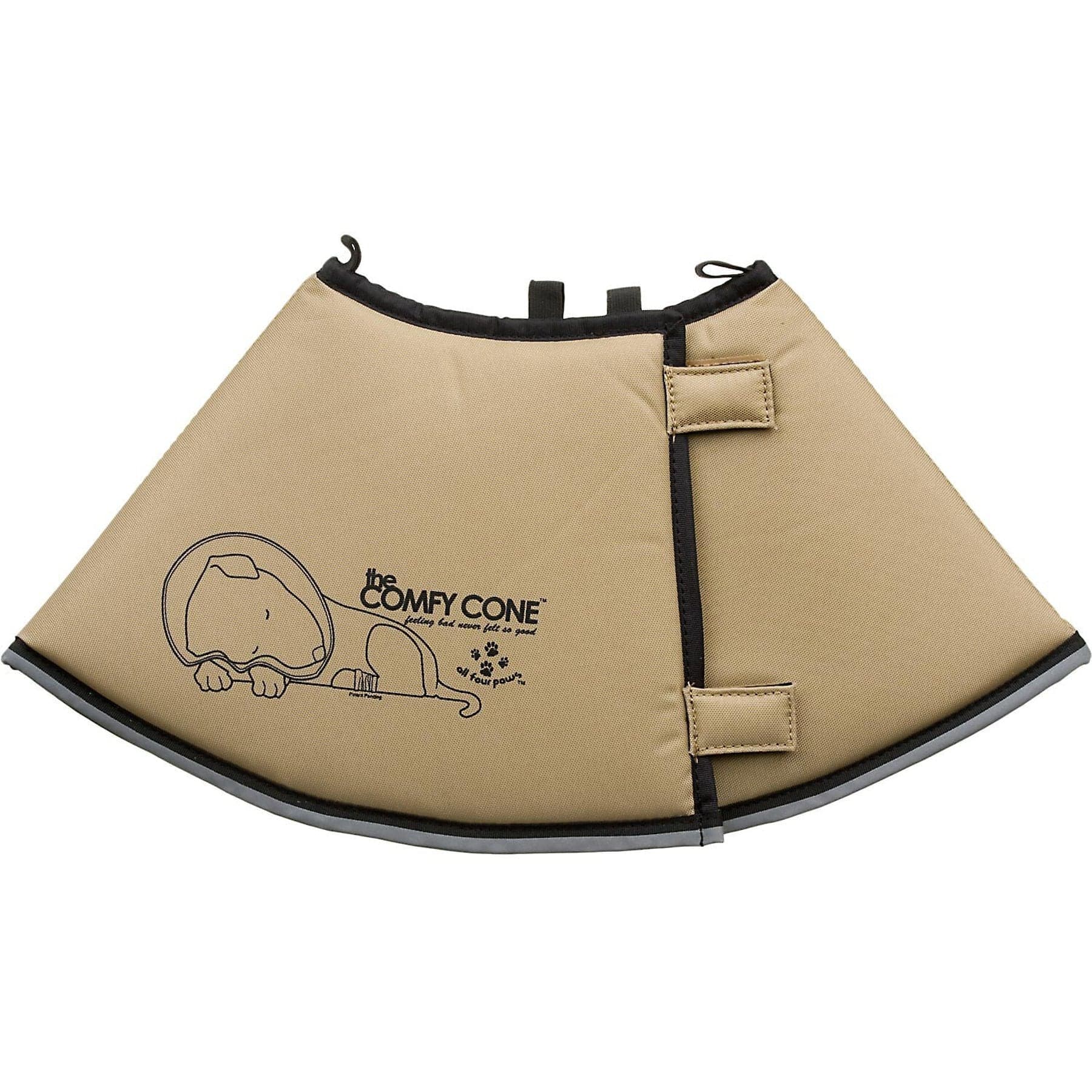
A soft recovery cone that keeps a dog or cat from licking or chewing a healing wound.
Webvet may earn a commission when you click through to Chewy, at no extra cost to you.
A few facts explain why officials treat every suspected case as urgent and why the dangers reach well past livestock:
- Native range and history: the fly is native to North and South America, according to Oklahoma State University Extension. In its historical distribution in the US, the flies overwintered in southern Texas, Florida, California, Arizona, and New Mexico.
- A former plague on American ranches: the Agricultural Research Service counts 230,000 US cases in 1935 alone.
- Where it lives now: APHIS lists it as endemic in Cuba, the Dominican Republic, and South America, and Merck notes models that predict suitable habitat in the southern US.
- Its return: after decades kept south by a barrier of sterile flies, effectively a living wall supplied by a facility in Panama, the fly moved north through Central America. APHIS restricted animal imports from Guatemala in 2024 after it was diagnosed there.
- It is back in the US: USDA confirmed the first US animal case of the current outbreak on June 3, 2026, and is tracking every confirmed detection on a public dashboard. More than 100 traps along the southern border watch for the fly, according to the Companion Animal Parasite Council (CAPC).
- Animals at risk: any warm-blooded animal, from cattle and hogs to dogs and cats, according to the California Department of Food and Agriculture (CDFA). Texas A&M AgriLife Extension lists wildlife ranging from squirrels and coyotes, and other predators, to white-tailed deer.
- People: rare, but possible. In August 2025 a person in Maryland was diagnosed after returning from El Salvador, CAPC reports.
- Border rules: dogs arriving from affected countries need a certificate stating they were inspected within 5 days and found free of screwworm, under 9 CFR 93.600.
- Reporting far from the border: the Illinois Department of Public Health notes that Illinois agriculture officials work with USDA APHIS on suspected cases in pets, so these states are not the only area where reporting rules apply.
- Seeing it: APHIS keeps a photo gallery and a printable Pest Alert for owners who want to know what the fly and larvae look like.
One characteristic sets screwworm apart: it is a problem of live flesh, not food. The Texas Animal Health Commission (TAHC) says the larvae do not infest meat, so beef and other food stay safe, and that it spent more than two years preparing for this resurgence. Restrictions on animal movement and sterile fly releases aim for a screwworm-free future again.

 Sponsored
Need flea, tick, or parasite care for your pet?
A licensed vet at Dutch can recommend the right preventive and prescribe it when it's appropriate. Annual members get 20% off their first flea and tick order.
Use code Pets60
Plans start at $12/month · covers up to 5 pets
- Licensed vets in most states
- Rx for 150+ conditions
- 4.7 on Trustpilot
How pets get screwworm: the fly, its life cycle, and where it is in the US now
Pets get screwworm when a female fly lays eggs on an open wound or body opening. APHIS guidance for veterinarians says the fly can infest wounds as small as a tick bite. APHIS also advises protecting pets from wound-causing parasites such as ticks. FDA has authorized over-the-counter Capstar (nitenpyram) tablets to prevent and treat screwworm larvae in dogs and cats that weigh at least 2 pounds and are at least 4 weeks old; ask your vet whether it fits your pet.
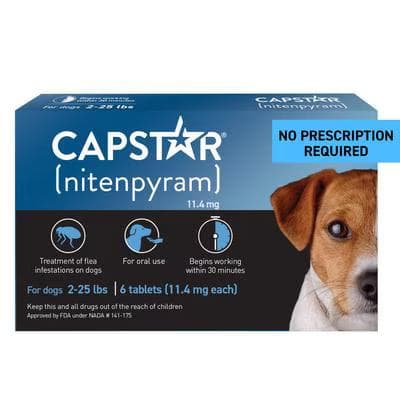
Over-the-counter nitenpyram tablets for dogs 2 to 25 lbs; FDA has authorized nitenpyram for screwworm larvae in dogs and cats.
Webvet may earn a commission when you click through to Chewy, at no extra cost to you.
What do screwworm flies look like? APHIS says the adult fly is about the size of a common housefly or slightly larger, with orange eyes, a metallic blue or green body, and three dark stripes along its back. That makes a screwworm fly vs house fly comparison hard by eye: normal blowflies such as green bottle and blue bottle flies share the metallic sheen, Merck notes, and CAPC lists the secondary screwworm, another blow fly, among the look-alikes found in wounds.

The screwworm life cycle is fast, which is why one infested animal matters:
- Females lay several hundred eggs at a time near open wounds or body openings, CAPC reports; Merck puts it at 200 to 400 eggs on the wound edges.
- The eggs hatch within 24 hours, and the larvae feed on living tissue for 5 to 7 days.
- Mature larvae drop off the host and pupate in the soil.
- Adult flies live about 7 to 10 days, and Merck says the whole cycle can take as little as 21 days in warm weather.
- Feeding larvae attract more females to lay eggs in the same wound, Merck adds.
Where did the screwworm come from? Its origin is the Americas. Sterile flies stop the cycle, and that is how APHIS eradicated the fly from the United States in 1966, after an eradication program that began in 1957, CAPC notes. A small outbreak in Key deer in the Florida Keys was eliminated in 2017.
The barrier then failed. Merck dates new outbreaks to Panama in 2022, Costa Rica in 2023, and Mexico in 2024 to 2025, while CAPC says Panama declared a nationwide outbreak in 2023. Merck names the Mexican states of Chiapas, Campeche, Tabasco, and Veracruz as critical dispersal points. Merck also says the spread follows animal movement and infested wildlife.
Is the flesh-eating New World screwworm in the US, and is it still spreading? Yes, it has been detected here. The dated official confirmations include:
- June 3, 2026, Texas: the Texas Animal Health Commission confirmed New World screwworm in a three-week-old calf with an umbilical lesion in Zavala County, the first detection in Texas since the fly's northward progression, and opened a joint incident response with USDA. CDC calls it the first US animal case in the current outbreak.
- June 8, 2026, New Mexico: a dog first reported by a veterinarian in Andrews County, Texas, was reclassified as New Mexico's first case because it lives in Lea County, USDA APHIS said. USDA's first release said early reports indicated the dog had recently been in Mexico; the follow-up said its travel and exposure history remained unknown.
- October 28, 2026, Arizona: APHIS confirmed screwworm in a dog in Cochise County, the first detection in Arizona, and set a 20-km infested zone.
- As of November 12, 2026: CAPC reports multiple cases in Texas, New Mexico, and Arizona. The APHIS current status page, last updated November 13, 2026, lets you search an address for an infested zone in those three states.
Case counts change quickly, so check the current number on USDA's public dashboard at screwworm.gov under Current Status, which USDA says is updated daily at 6:00 p.m. ET. The same page links state maps of each infested zone and location.
Texas has added entry requirements for livestock and fowl moving in from affected states, TAHC announced on October 1, 2026. Historically the fly ranged across much of Oklahoma in warm months, Oklahoma State University Extension notes. California, which has no infested zone, is running fly surveillance traps to keep the threat out, CDFA says.
How contagious is screwworm?
Screwworm spreads through flies, not through touch. CDC explains that an infestation begins when a female fly lays eggs on a wound or orifice of a live, warm-blooded animal. An infested pet still matters to the household and neighborhood, because mature larvae drop into the soil and become new flies, and feeding larvae draw more egg-laying females.
CDFA lists controlling flies around animals among its basic protection steps. The same nitenpyram authorization covers cats and kittens that weigh at least 2 pounds and are at least 4 weeks old, which matters for cats that go outdoors.
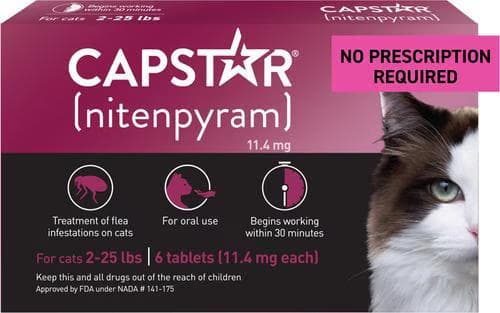
Over-the-counter nitenpyram tablets for cats; FDA has authorized nitenpyram for screwworm larvae in cats and kittens of at least 2 lbs.
Webvet may earn a commission when you click through to Chewy, at no extra cost to you.
Screwworm symptoms in dogs and cats: what the wound and the larvae look like
Screwworm symptoms in dogs and cats start at a wound or body opening, because this flesh-eating larva needs living tissue. APHIS lists irritated behavior, head shaking, the smell of decay, and fly larvae in wounds as signs to report. CAPC adds that wounds may smell bad, leak pus or blood-tinged fluid, pick up a secondary bacterial infection, and leave a pet generally ill.

What does a screwworm wound look like on dogs?
An infested wound looks worse each day instead of better. USDA describes draining or enlarging wounds with maggots or egg masses, and APHIS notes the wound grows larger and deeper as more larvae hatch and feed. Lesions often sit around the ears, nose, genital area, or navel, and Merck notes larvae can be found deep within the wound.
How do you know if your dog has a screwworm?
Only a laboratory can confirm it, but suspect it when a dog or cat has a wound plus any of these signs from CDFA:
- a wound that is getting worse instead of healing
- a bad smell coming from the wound
- maggots in or near the wound
- bleeding, discharge, or swelling
- licking, biting, shaking, or scratching at one area
- a new wound after travel from an area where screwworm is present
The same signs apply to screwworm symptoms in cats. These are the places APHIS asks vets to check, and they suit an owner's check at home too:
- skin folds around the face, eyes, and neck
- the mouth and ears, including the ear canals
- nail beds and paws
- the abdomen and navel
- areas the pet licks heavily, and recent surgical sites
Which pets are at higher risk? APHIS guidance for veterinarians lists dogs and cats that:
- spend significant time outside
- have skin folds, long hair, allergies, or other medical conditions
- are recovering from surgery or have recently given birth
- are infested with mites, fleas, or ticks
Travel adds risk: pets that go to or from affected countries face a higher chance of infestation, and USDA advises pre- and post-travel vet exams. Because any break in the skin is an opening for the fly, cleaning small cuts and scrapes promptly, as your vet directs, is one practical step every owner can take.
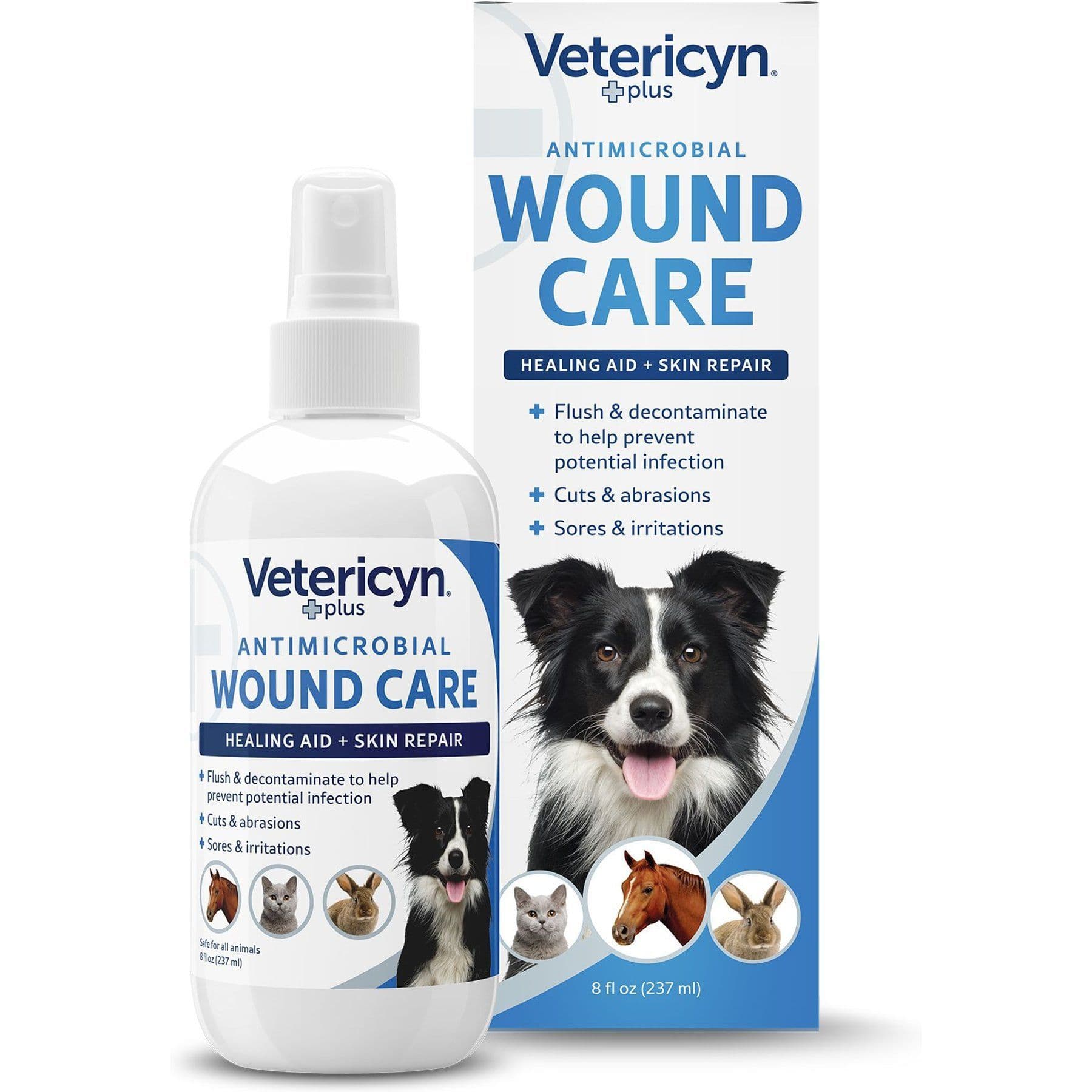
An antimicrobial wound and skin care spray for dogs and cats, for cleaning minor wounds as your vet directs.
Webvet may earn a commission when you click through to Chewy, at no extra cost to you.
What the larvae look like: CAPC describes mature New World screwworm larvae as about 15 mm (0.6 inch) long, pointed at one end and blunt at the other. CDFA says they carry small ridges that resemble the ridges of a screw. A regular maggot can look similar, and APHIS photos of larvae help with a size comparison.
 Sponsored
Vet care that's always there
Unlimited video calls and messaging with licensed vets for less than a typical vet visit. One membership covers up to five pets.
Use code Pets60
Plans start at $12/month · covers up to 5 pets
- Licensed vets in most states
- Rx for 150+ conditions
- 4.7 on Trustpilot
Screwworm vs ordinary maggots, botfly warbles, and other look-alikes
| What you see | What it may be | What to do today |
|---|---|---|
| Larvae deep in a wound that keeps growing into healthy skin, with a foul smell | Possible New World screwworm | Same day vet visit; the vet reports a suspected case |
| Maggots on the surface of a dirty wound or soiled coat, feeding on dead tissue and discharge | Ordinary maggots from blowflies (fly strike) | Same day vet visit so the vet can rule out screwworm |
| A single swelling about 1 cm across with a small breathing hole, usually late summer or autumn | Cuterebra botfly warble | Vet visit to remove the larva |
| A swollen, painful lump or draining wound with pus and no larvae | Abscess or infected wound | Vet visit; same day if the pet is unwell or the swelling spreads |
| Any larvae you cannot identify on a pet in or near Texas, New Mexico, or Arizona | Treat as possible screwworm | Call the vet for a same day visit; do not take the pet to another property unless the vet or an animal health official says to |
One characteristic separates screwworm from most look-alikes: it invades living tissue. The Merck Veterinary Manual says Cochliomyia hominivorax is the only fly in North America that is a primary invader of fresh, uncontaminated skin wounds. The others differ like this:
- Blowfly vs screwworm: ordinary maggots from a blowfly, the cause of fly strike, move about the wound surface eating dead cells and discharge, not live tissue, according to Merck. Myiasis in dogs covers these ordinary wound maggots.
- Housefly vs screwworm: a housefly is about the same size as the adult screwworm fly, so the adults do not settle the question.
- Secondary screwworm (Cochliomyia macellaria): a different blow fly despite the name; CAPC lists it with the black blow fly as a look-alike vets must rule out.
- Old World screwworm (Chrysomya bezziana): found in Africa, the Indian subcontinent, and southeast Asia, not the Americas, Merck says.
- Botfly (Cuterebra): not the same as screwworm. Merck describes a single swelling with a breathing pore, most common in late summer or early autumn; vets remove the larva by hand, as in treating cuterebra infestations in pets.
- Abscess: a hot, pus-filled lump without larvae; see the cat abscess and dog abscess guides.
Merck notes that field diagnosis of the maggot is not recommended, so whenever larvae are present, every row ends at the vet the same day.
What to do if you suspect screwworm: same-day vet care and reporting
The same-day vet step comes first. Then follow these steps from CDFA, TAHC, and CAPC:
- Call your veterinarian, say you suspect screwworm, and mention recent travel.
- Do not move the animal to another property unless your vet or an animal health official tells you to.
- Keep the pet away from other animals and keep flies off the wound.
- Do not pull out the larvae or throw them away. CDFA warns that removing larvae without veterinary care may leave some behind and make the cause harder to identify.
- Do not put home remedies or sprays into the wound. CAPC advises that treatment should not start before state and federal agencies are contacted.
The reporting step: APHIS says anyone who thinks they have found a screwworm should report it immediately to the state animal health official and the APHIS office. CDFA explains that the owner's first call is usually the veterinarian, who reports the concern; vets and officials must be notified within 24 hours of a suspected case.
In Texas, TAHC takes reports about domestic animals directly and explains how suspicious maggots are collected; Texas Parks and Wildlife lists the TAHC headquarters veterinarian on call, for after hours and weekends, at (800) 550-8242.

How do you know if a screwworm is on an animal?
Look for live maggots in an open wound, a foul, rotting-flesh smell, and an animal that keeps shaking its head or acting irritated, the signs Texas Parks and Wildlife lists. Sight alone cannot confirm it: samples go to the APHIS National Veterinary Services Laboratories in Ames, Iowa, which confirmed the Arizona dog case.
Your own health matters too. CDC says people can be infested, although rarely; if you see or feel maggots in a wound on your body, contact your doctor right away.
How vets diagnose and treat screwworm in pets
Vets confirm New World screwworm, Cochliomyia hominivorax, by identifying the larvae, not by the look of the wound. Under CAPC guidance, a suspected NWS case triggers a call to the APHIS Area Veterinarian in Charge and the State Animal Health Official, who open a foreign animal disease investigation.
How do vets test for screwworm in dogs?
The screwworm test in dogs is identification of the larvae themselves. CAPC says larvae are collected with forceps from the deepest part of the wound, ideally at different sizes, and stored in 70% ethanol or isopropyl alcohol, not formalin, only after consulting officials. Merck says experts identify them by pigmented tracheal tubes and segmental spines.
A Foreign Animal Disease Diagnostician usually collects the samples, CAPC adds. Each confirmed case sets off the USDA response: a 20-km infested zone with quarantines and movement controls, more trapping, and wildlife surveillance. That monitoring program is why prompt screwworm reporting matters, even for one pet.
How do vets treat screwworm?
Treatment starts with the vet removing every visible egg and larva and cleaning the wound, then, depending on severity, wound care, antibiotics, and pain relief, CAPC says. Drugs help kill or expel the larvae. As of November 3, 2026, the FDA had issued 16 Emergency Use Authorizations and three conditional approvals for animal drugs against New World screwworm, and no drug has full approval.
Some of these drugs need a veterinary prescription, and the vet decides whether one is right for a particular dog. FDA conditionally approved Credelio Quattro-CA1 (lotilaner, moxidectin, praziquantel, pyrantel) to treat screwworm larvae in dogs and puppies; the Credelio Quattro/Credelio Quattro-CA1 Chewable Tablets for Dogs, 12.1-25 lbs, 1 Chewable (1-mo. supply) is that prescription chewable.
Other products hold Emergency Use Authorizations, and the vet chooses the drug and sets the dose:
- NexGard and Simparica Trio: treatment of infestations in dogs and puppies (NexGard's covers treatment, not prevention)
- Credelio CAT: treatment in cats and kittens
- Capstar (nitenpyram): prevention and treatment in dogs and cats at least 2 pounds and 4 weeks old
Which drug kills screwworm larvae fastest, and how vets choose, is covered in screwworm treatment for dogs and cats.
Protecting your dog or cat and what recovery looks like
New World screwworm eradication in the Americas rests on the sterile insect technique. APHIS explains that sterile male flies are released to mate with wild females, which then lay unfertilized eggs. Because each female mates only once, the population dies out.

Screwworm control now depends on rebuilding that barrier. The Panama screwworm facility, run jointly by USDA and Panama, is the only sterile fly production facility operating in North America, APHIS says. CAPC reports a dispersal facility at Moore Air Base in Texas and a production facility under construction in southern Texas.
At home, the protection steps from CDFA, USDA, and CAPC are practical:
- Check your dog or cat for wounds regularly, and daily in or near an infested zone.
- Keep any wound clean and covered, and see the vet for wounds that do not heal.
- Control flies around animals and keep year-round flea and tick control in place.
- Book a vet check before and after travel to affected countries.
- Follow animal movement rules inside infested zones.
For routine control, the Seresto Flea & Tick Collar for Dogs, Over 18 lbs (8-Month Protection) covers fleas and ticks but is not on the FDA list of screwworm products; the best flea and tick prevention for dogs guide compares options.
The Simparica Trio Chewable Tablet for Dogs, 44.1-88 lbs, 1 Chewable Tablet (1-mo. supply) is a prescription chewable whose Emergency Use Authorization covers treating screwworm larvae in dogs, not preventing infestation, so wound checks still matter.
Can dogs recover from screwworm?
Yes, with prompt treatment. In naturally infested dogs, CAPC reports 100% overall efficacy for afoxolaner, lotilaner, and sarolaner, always alongside removal of larvae and supportive care. Speed matters, because Merck says untreated infestations can kill within 7 to 14 days.
Once the larvae are gone, healing follows the usual dog wound healing stages, and dog wound care covers home routines. For vet-directed cleaning, the vet may suggest a spray such as Vetericyn Plus Antimicrobial Wound Care Spray for Dogs, Cats, Horses, Birds & Small Pets, 8-fl oz bottle or Davis Chlorhexidine Dog & Cat Spray, 16-fl oz bundle; use only what the vet directs.
A healing wound also needs protection from licking. A soft cone such as the All Four Paws Comfy Cone E-Collar for Dogs & Cats, Tan, Medium is one option your vet may suggest while the skin closes.
Screwworm in dogs questions
Frequently Asked Questions
Can dogs get screwworm?
Yes. APHIS veterinary guidance says screwworm myiasis can affect all warm-blooded animals, including dogs. A female fly lays eggs on a wound, and the larvae hatch and burrow into it. USDA confirmed dog cases in New Mexico and Arizona during 2026.
Can cats get screwworm?
Yes. CDFA lists cats among the animals at risk, and FDA has authorized Credelio CAT to treat screwworm larvae in cats and kittens. Cats that spend time outdoors, or that have a wound, scratch, or recent surgery site, are the ones to watch most closely.
What does screwworm look like?
The adult is a metallic blue or green fly with orange eyes; the stage that harms pets is the larva. Texas Parks and Wildlife describes infestations as open sores or a wound holding live maggots, often with a rotted-flesh odor. The larvae burrow into the flesh as they feed.
Is screwworm in the US right now?
Yes. CDC reports that USDA confirmed the first US animal case of this outbreak on June 3, 2026, and cases have since been confirmed in Texas, New Mexico, and Arizona. CDC rates the current risk to the public and animals in the US as very low. The USDA dashboard at screwworm.gov shows the latest count.
What is the difference between screwworm and ordinary maggots?
Screwworm larvae need living tissue, while most ordinary maggots from blowflies eat dead tissue and wound debris. That is why a screwworm wound keeps growing into healthy flesh. Both need a vet, and only a laboratory can tell them apart for certain.
Veterinarian · BVMS MRCVS
Dr. Pippa Elliott, BVMS, MRCVS, is a veterinarian with nearly 30 years of experience in companion animal practice. Dr. Elliott earned her Bachelor of Veterinary Medicine and Surgery from the University of Glasgow. She was also designated a Member of the Royal College of Veterinary Surgeons. Married with 2 grown-up kids, Dr. Elliott has a naughty Puggle named Poggle, 3 cats and a bearded dragon.
Related reading

Myiasis in Dogs and Cats: Maggots in a Wound, Signs, and What to Do

Screwworm Treatment and Prevention for Dogs and Cats: What Works

Toxoplasmosis in Cats: Symptoms, Pregnancy Risk, Testing, and Treatment
