Glandex for Dogs: Does It Work, Side Effects, and Alternatives
Compare Glandex chews, powder, and wipes, understand what the evidence can show, and learn how to monitor results while recognizing anal gland problems that need veterinary care.

BVMS MRCVS
Medically reviewed by Dr. Pippa Elliott, BVMS MRCVS · Last reviewed

This article contains affiliate links. Webvet may earn a commission when you buy through them, at no extra cost to you.
Glandex for dogs is a fiber-containing supplement intended to support firmer stools and natural anal gland emptying. It may be useful for some dogs with recurring problems, but it cannot clear every blocked gland or treat an infection. The useful question is whether your dog's problem is one that a daily supplement can reasonably help.
The original chews, Advanced Vet Strength chews, oral powder, and rear-end wipes serve different needs. Here is how to compare them, what the published evidence actually shows, and how to judge a trial without overlooking a problem that needs treatment.
This expert analysis draws on product labels, manufacturer information, a published review paper, and veterinary guidance. No product was obtained and no hands-on product test was conducted. We may earn a commission from purchases made through links in this article.
What is Glandex for dogs?
Vetnique makes Glandex Anal Gland Health supplements, often identified by the phrase “Boot the Scoot.” The oral products combine fiber sources with other ingredients intended to support digestive and anal gland health. They are supplements, rather than a replacement for a veterinary diagnosis or a procedure to empty impacted anal sacs.
The basic idea is straightforward: a well-formed bowel movement can help apply pressure to the anal sacs as it passes. Improving stool consistency may therefore support normal emptying in a dog whose softer stools contribute to the problem. A chew does not travel to the glands and clean them out.
Before buying, establish three things:
- Your veterinarian has identified why your dog is scooting, licking, or having recurrent anal gland trouble.
- The exact product is an oral anal gland formula, rather than a wipe or a different Glandex digestive product.
- Its ingredients and label precautions fit your dog's diet, medicines, age, and health history.
For an owner starting with the original formula, the original peanut-butter soft chews in a 120-count container provide a pre-portioned option. Choose this format because your dog can eat its ingredients and you can follow the weight-based directions, rather than assuming every product with the Glandex name is equivalent.
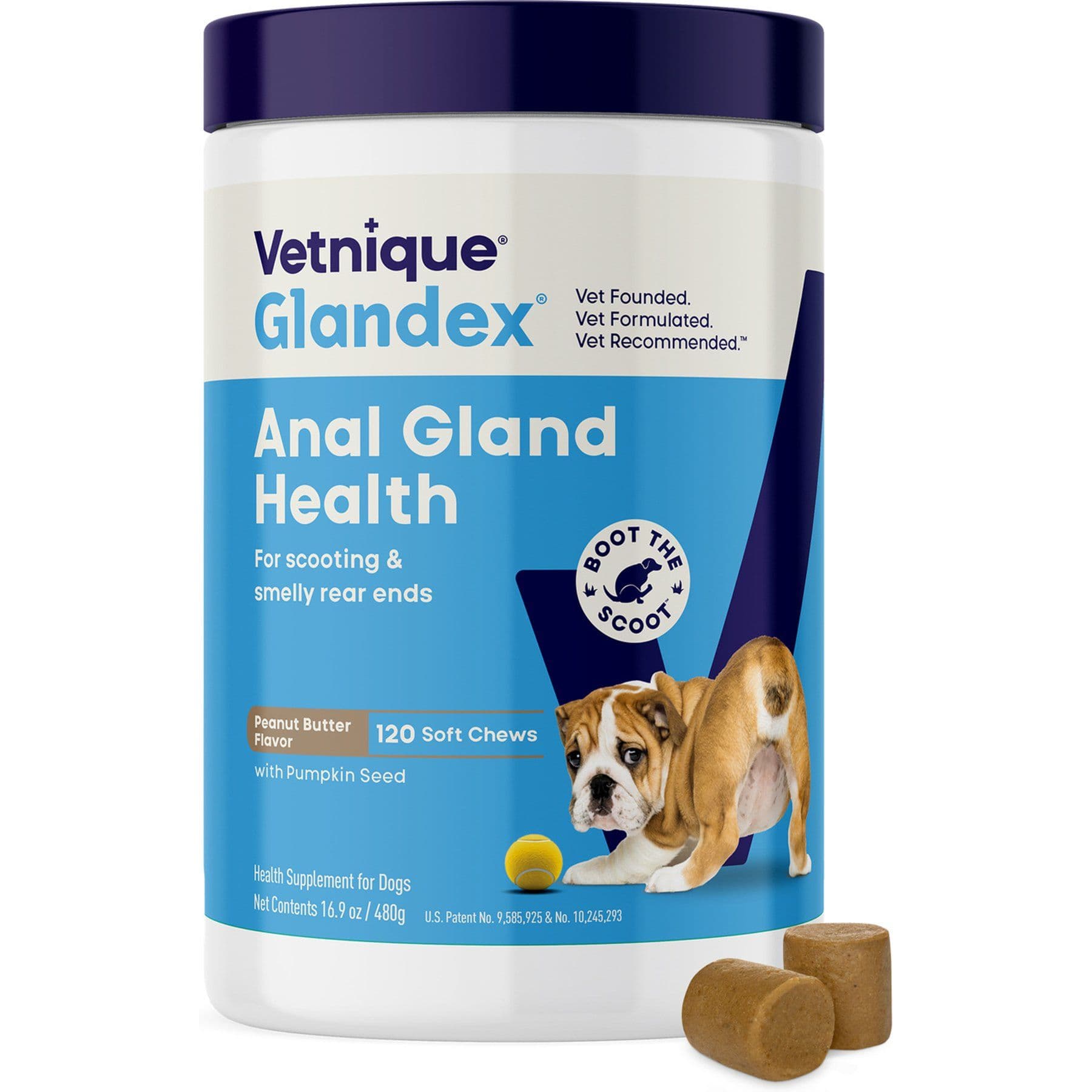
Original peanut-butter Glandex soft chews for dogs. Check ingredients, weight-based directions, and your veterinarian's advice before starting.
Webvet may earn a commission when you click through to Chewy, at no extra cost to you.
Original chews, Advanced Vet Strength, and powder
The best Glandex format is the one that matches the intended use and can be given consistently. Soft chewables and powder offer different ways to give it; powder is not automatically better than chews, and “Advanced” does not establish that a formula will work better for every dog. Compare the full label before switching, including active ingredients, flavoring, and the daily amount.

- Original soft chews suit a dog that readily takes a flavored chew. The peanut-butter formula reviewed here contains peanuts and soy lecithin, so check it carefully if your dog follows a restricted diet.
- Advanced Vet Strength is a separate formulation marketed with an enhanced fiber blend. Discuss it with your veterinarian if you are considering a different formula for recurring problems; do not simply replace each original chew with an Advanced chew at the same count.
- Original oral powder can suit an owner who prefers adding a measured supplement to food. Check that your dog finishes the portion containing it, and use that container's scoop and directions.
- Wipes address residue and odor on the outside of the rear end. They are not another way to deliver the oral supplement's fiber.
The Advanced Vet Strength duck-and-bacon chews are an option when that specific formulation fits the plan you have discussed with your veterinarian. The package name matters: Glandex Daily Prebiotic & Probiotic and Rapid products belong to different digestive-support lines. Do not treat them as interchangeable with the anal gland formulas compared here.
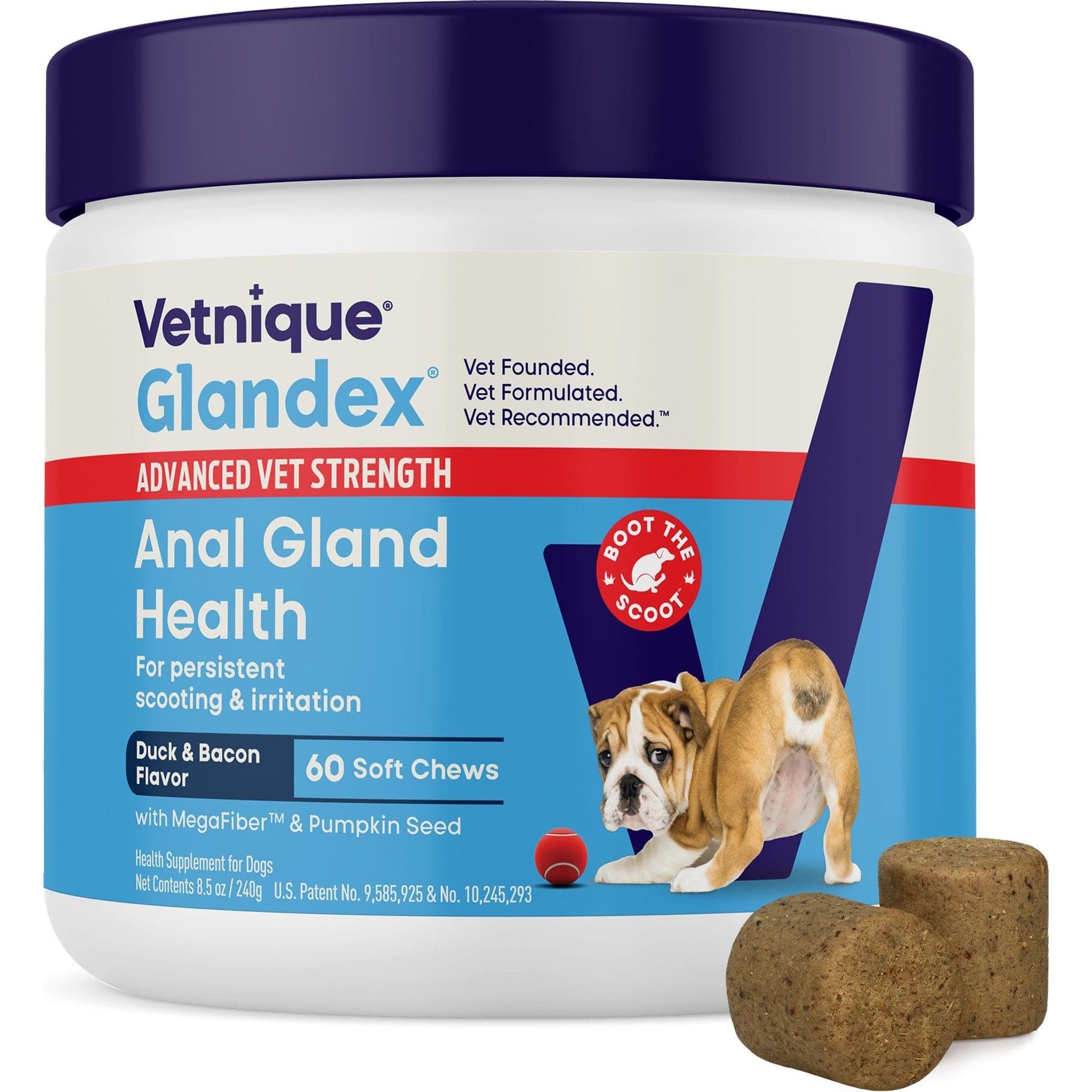
Glandex Advanced Vet Strength chews are a separate formulation. Compare the current label rather than treating them as extra original chews.
Webvet may earn a commission when you click through to Chewy, at no extra cost to you.
Compare cost per day, not just the jar price
To find the cheapest suitable option, divide the current container price by the number of days it will last at your dog's labeled amount. A 120-count Glandex Original peanut-butter chew container lasts 120 days at one chew daily, but 30 days at four chews daily. A larger jar may be better value per chew without being the lowest upfront purchase.
For powder, calculate days from the container's usable quantity and its own daily measure. Do not compare a teaspoon with a chew as though they were equivalent doses. Price, stock, package size, and retailer discounts change, so compare the actual listing before buying. A flavor or format your dog consistently leaves behind is poor value even when its advertised price is lower.
The original soft chews are offered in Peanut Butter and Bacon flavors. A listing for Glandex pork liver chews should not be assumed interchangeable with the current Bacon formula, which lists vegan bacon and vegan pork flavorings; compare the full ingredient labels before substituting. Check the ingredient list for the flavor you select rather than assuming they are identical. For a bundle or starter kit, compare the contents with what your dog needs: adding wipes to oral chews serves a cleaning purpose, not a stronger dose of the supplement.
Does Glandex work?
Glandex has a reasonable fiber-based mechanism, and some owners report improvement. Whether it actually works for your dog depends partly on why the anal glands are causing trouble and whether improving stools addresses that cause. The available product evidence does not establish a dependable success rate for an individual dog.
The Merck Veterinary Manual's discussion of anal sac disease explains that additional dietary fiber can increase fecal bulk and help compress and empty the sacs. That supports the general approach. It does not prove that Glandex is superior to another appropriate fiber strategy or that every current Glandex formula has the same effect.
- 1Fiber can support natural anal gland emptying when stool consistency is part of the problem.
- 2The published owner-report percentage is not a guarantee of success and is not controlled-trial evidence.
- 3Judge a trial by your dog’s comfort and recurrence, with veterinary reassessment if signs persist.
What the 86% improvement claim means
A 2018 published review of Glandex states that 85.7% of pet owners reported improvement in their animal's anal gland symptoms and discomfort in postmarketing surveillance. The review covers dogs and cats; this is not a dog-only response rate. That is the approximate 86% figure associated with the product. The paper is a review article, and that reported percentage is not accompanied by a described sample size, control group, or trial methods that would let a reader assess it as a controlled efficacy trial.
Owner reports can identify potentially useful changes, but they cannot separate the supplement's effect from diet changes, treatment, natural fluctuation, or differences between dogs. The figure is not an 86% guarantee for your dog. It also should not be transferred automatically to Advanced Vet Strength, powder, or another current formula.
How to judge reviews and a trial in your dog
Reviews of Vetnique Glandex soft chews and powder, including products carrying the “Boot the Scoot” name, can help with practical questions such as whether owners find a format convenient. They are weaker evidence for whether a product will treat your dog's particular condition. A report that a dog stopped scooting does not, by itself, confirm what caused the scooting or whether the glands were examined.
Look for useful context when reading a review:
- Was the dog's problem diagnosed, or did the owner assume all scooting meant full glands?
- Which exact formula was used, and for how long?
- Did food, medication, professional expression, or another supplement change at the same time?
- Was improvement measured by stool consistency, comfort, or a longer interval between needed treatments?
Weigh Glandex's pros and cons against a practical goal agreed with your veterinarian. Fewer uncomfortable episodes and an appropriate stool consistency are more meaningful than simply finishing a jar. If symptoms continue despite consistent use, reassess the cause rather than treating a positive average review as a reason to continue indefinitely.
Glandex pros and cons
Pros
- Original chews provide a labeled daily routine with pre-portioned amounts.
- A powder format offers a way to give the supplement with food.
- A fiber-based approach may help dogs whose stool consistency contributes to poor emptying.
Cons
- A supplement is not a substitute for treating impaction, infection, or an abscess.
- Owner reports do not establish comparative efficacy or a guaranteed response.
- Dietary restrictions, medication cautions, digestive tolerance, and ongoing cost can limit suitability.
 $65 · no membership
Worried about your dog's vomiting or diarrhea?
A licensed vet can examine your dog over video and prescribe treatment online when it's appropriate.
 Talk to a vet
- Licensed vets
- All 50 states
- same-day Rx
Webvet may earn a commission if you book.
What is in Glandex?
The original peanut-butter soft-chew label lists pumpkin seed powder, granulated pumpkin seed, and apple pectin as fiber-related ingredients. It also includes the probiotic Lactobacillus acidophilus, quercetin, bromelain, and vitamins. These ingredients explain the product's broader digestive-support positioning, but an ingredient list alone does not prove the finished product's clinical effectiveness.
For the original 4-gram chew, the label lists:
- Pumpkin seed powder: 158 mg.
- Granulated pumpkin seed: 68 mg.
- Apple pectin: 34 mg.
- Lactobacillus acidophilus: 480 million CFU.
The pumpkin and pectin ingredient weights are not a measurement of total dietary fiber. Adding those numbers together would not tell you how much actual fiber your dog receives. They also cannot establish an equivalent serving of canned pumpkin or a different fiber supplement.
Check inactive ingredients as well as the headline ingredients. The original peanut-butter chew contains peanuts and soy lecithin; it is not suitable to describe every Glandex formula as soy-free. Vetnique's current 4-ounce beef powder listing names pumpkin seed powder and granules, apple pectin cellulose powder, quercetin, Lactobacillus acidophilus, bromelain, and vitamins E and C. Its listed inactive ingredients are dried beef liver powder, rice flour and sorbic acid. This is the manufacturer's current formula listing; we have not verified the full package label on the exact retailer jar linked here. For a dog with a food sensitivity, confirm that jar's ingredients before switching from chews.
How to give Glandex and monitor results
Use the directions on the exact container you buy and confirm suitability with your veterinarian. The manufacturer's original-chew guidance is once daily, starting with half the recommended amount for the first 5–7 days. Introducing the fiber gradually may help reduce digestive upset. Provide fresh drinking water.

For the original soft chews, the manufacturer's weight chart lists these daily amounts:
- Under 15 pounds: half a chew.
- 15–25 pounds: one chew.
- 26–50 pounds: two chews.
- 51–75 pounds: three chews.
- Over 75 pounds: four chews.
These are original-chew label amounts, not a universal Glandex dosage. Small dogs need the smaller amount indicated by their weight. Advanced Vet Strength and powder have separate directions, and your veterinarian may give different advice for your dog's situation.
If your dog takes supplements more reliably in food, the original beef-liver flavored powder offers that format. Measure it with the package directions, mix it into a portion your dog will finish, and account for any food left uneaten. Do not estimate powder amounts from the original-chew chart.
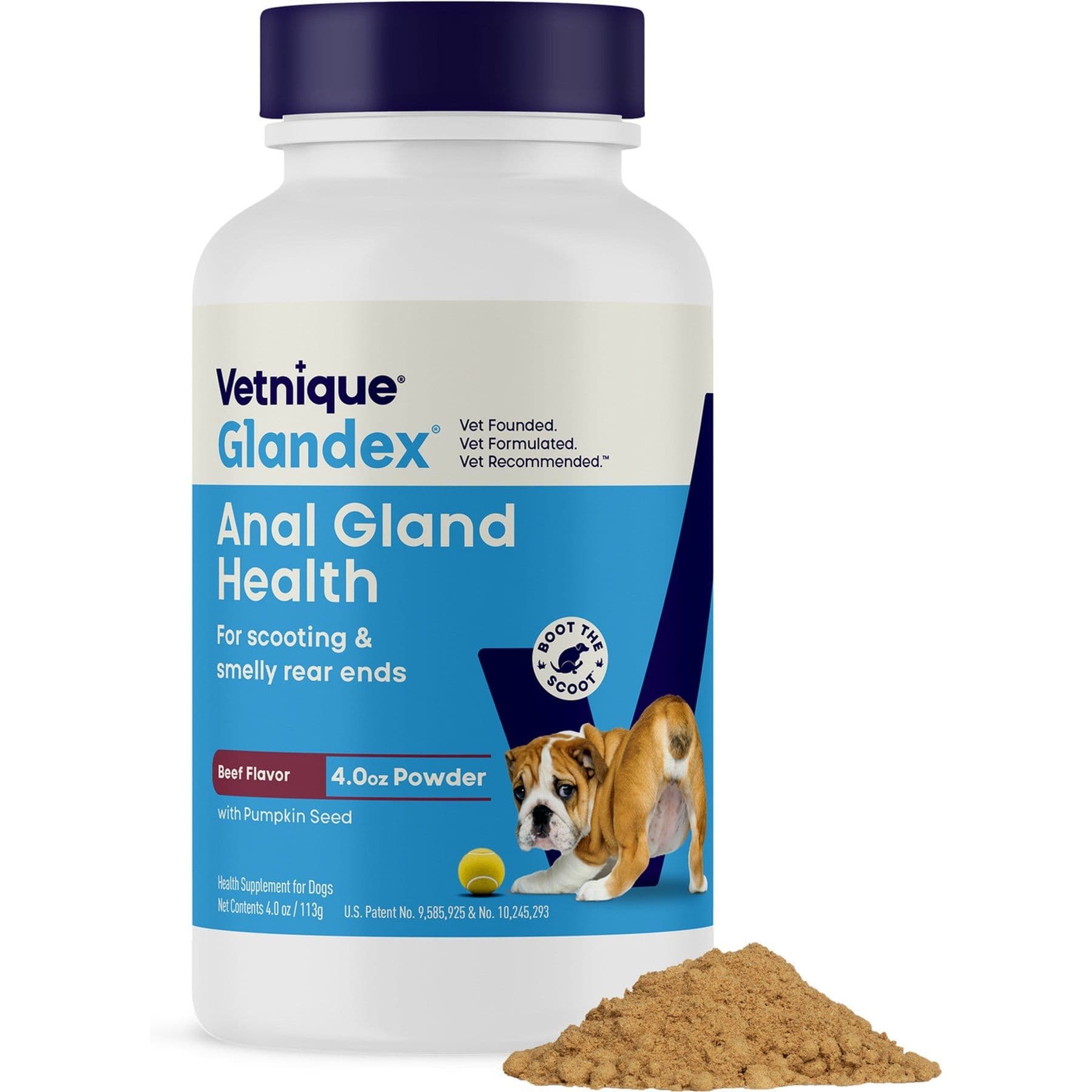
Glandex beef liver powder is a mix-in alternative for dogs that do not take soft chews. Its directions differ from the chew formula.
Webvet may earn a commission when you click through to Chewy, at no extra cost to you.
How long should you wait for a response?
The manufacturer's FAQ describes approximately 3–5 weeks as a typical timeframe for results. How quickly Glandex works will vary between dogs. That timeframe is a manufacturer expectation, rather than a guarantee or a reason to leave a painful dog untreated. You may notice stool changes before you can tell whether anal gland problems are recurring less often.
Keep a short record of the daily amount, stool consistency, scooting or licking, and any veterinary expression or treatment. Note other diet changes so you do not attribute every improvement or setback to Glandex. A simple record makes follow-up more useful than trying to remember how often your dog scooted last month.
If your veterinarian agrees that the supplement is helping, ongoing use may be appropriate; there is no single course length that fits every dog. Persistent or worsening signs need a reassessment, rather than an automatic increase in the amount. Follow the storage instructions on your own container. Do not assume Glandex powder needs refrigeration simply because it contains a probiotic; ask the manufacturer if the label leaves storage unclear.
What Glandex wipes can and cannot do
Vetnique Labs Glandex rear-end wipes are intended for external cleaning and deodorizing. They may be useful when a dog has residue on the surrounding fur or skin and needs a gentle cleanup. That is a different task from changing stool consistency or treating disease inside the anal sacs.

Vetnique's current 75-count hygiene-wipe listing includes water, glycerine, DeoPlex deodorizer, aloe juice, vitamin E, fragrance, and preservatives including phenoxyethanol and ethylhexylglycerin. It is a scented cleaning product, distinct from Glandex's medicated wipes. We verified that manufacturer listing, but not the full ingredient panel on the exact retailer 75-count tub linked here. If fragrance or another ingredient matters for your dog, obtain that tub's label before buying. Use the wipe on the external area as directed, rather than inserting it into an anal gland opening or attempting to express a gland with it.
The 75-count Glandex rear-end hygiene wipes are an optional cleaning product for this narrow purpose. They are not necessary for the oral supplement to work, and removing surface odor does not show that the underlying cause has resolved.
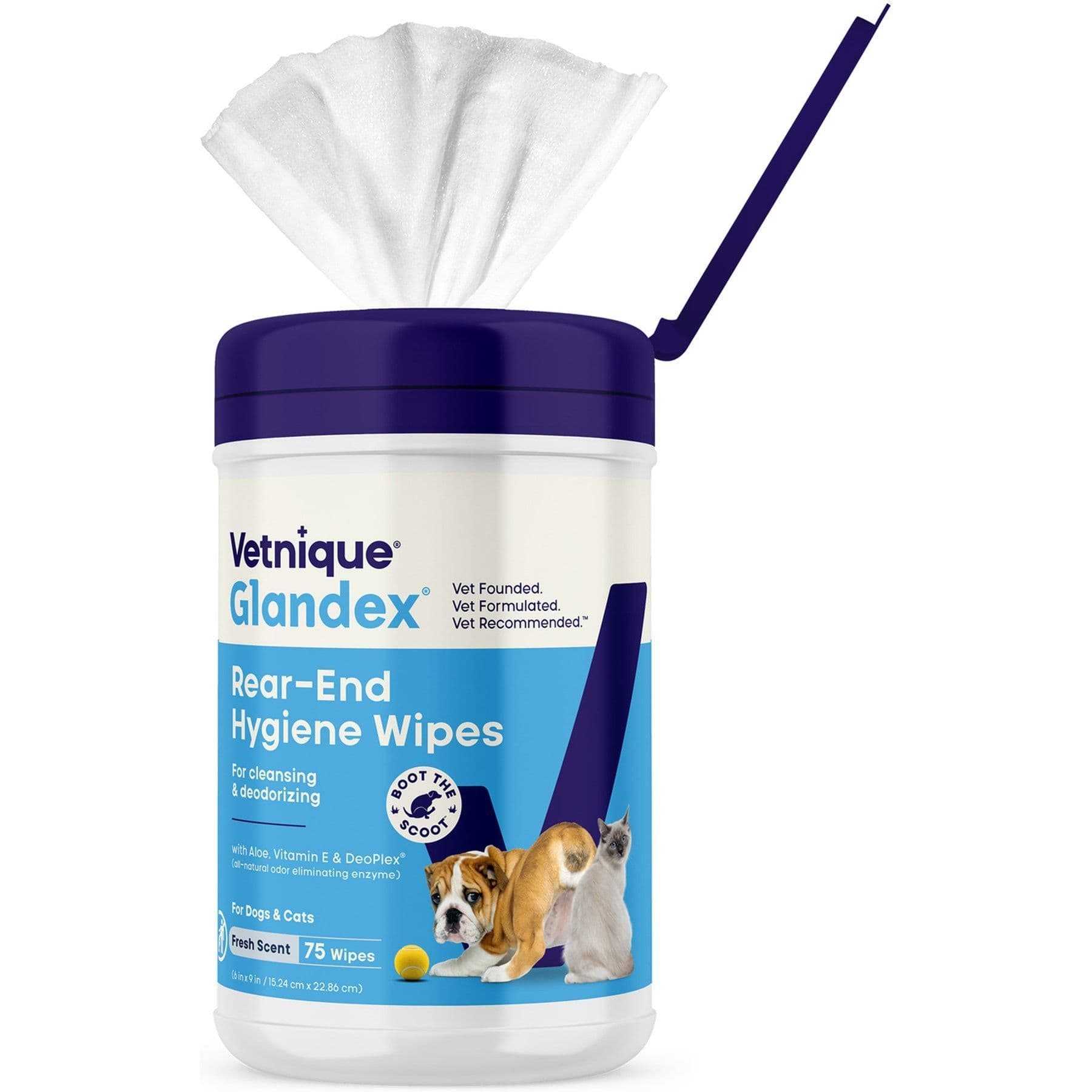
Glandex external hygiene wipes clean the skin and coat around the rear. They do not empty anal glands or treat an infection.
Webvet may earn a commission when you click through to Chewy, at no extra cost to you.
Treat these as separate decisions:
- An oral supplement may help an appropriate dog's stool consistency and natural emptying.
- A wipe can remove external residue during routine cleanup.
- Painful swelling, bleeding, or repeated leakage needs evaluation, even if cleaning temporarily improves the smell.
Glandex alternatives and pumpkin
The most useful alternative depends on what you are trying to change. If you want to feed your dog something to help the glands express naturally, your veterinarian may suggest a food adjustment or a measured fiber source when stool consistency is contributing to the problem. If a gland is impacted or infected, the alternative is appropriate treatment, rather than another supplement brand.
For a side-by-side look at label ingredients, daily servings and cost, compare anal gland supplements for dogs. A different brand is worth discussing when the formula or routine fits your dog better; changing products does not treat an impaction.
Vets may recommend plain, unsweetened pumpkin for dogs as a food-based source of fiber when it fits the stool-management plan. It differs from Glandex's combination of pumpkin seed ingredients, pectin, probiotic, and other components. Pumpkin pie filling is a different product and should not be substituted. Ask your veterinarian about a suitable amount for your dog's size, diet, and stool pattern instead of trying to match a spoonful to one chew.
Glandex versus pumpkin: the practical tradeoff
Glandex offers a labeled, weight-based routine and multiple ingredients in one product. Pumpkin offers a food-based option whose portion can be adjusted under veterinary guidance. Neither approach is established by the reviewed evidence as universally better for anal gland problems. Adding more fiber than your dog tolerates can create digestive trouble rather than solve it.
Compare the options on the decisions that matter:
- Goal: support stool consistency, rather than promise that glands will never fill again.
- Diet: consider the dog's complete food, treats, existing fiber intake, and dietary restrictions.
- Routine: use a measured serving you can give consistently and include it when accounting for food intake.
- Response: judge comfort and recurrence, not just whether the stool becomes larger.
A veterinarian-guided change to the main diet can also be more useful than layering pumpkin, Glandex, and another fiber supplement together. There is no food that reliably forces a blocked gland to empty. If your dog repeatedly needs help, investigate the reason for recurrence before increasing several supplements at once.
Side effects and when to stop Glandex
Possible side effects of Glandex for dogs include temporary soft stools, gas, or gastrointestinal upset when fiber is first introduced, according to the manufacturer's FAQ. That does not mean every episode of diarrhea after starting Glandex is harmless or definitely caused by it. Review the timing, amount, other dietary changes, and your dog's overall condition with your veterinarian when symptoms occur.
The same practical monitoring applies to soft chews and powder, but their ingredients differ. A dog that reacts to an ingredient in one formula may not tolerate that product even when the amount follows the label. Introduce only the agreed product so that a reaction is easier to investigate.
- Stop the supplement and seek veterinary advice if signs worsen or fail to improve, as the label directs.
- Contact your veterinarian for repeated vomiting, persistent diarrhea, constipation or difficult straining, marked discomfort, or a dog that seems unwell.
- Seek prompt care for blood, painful swelling, or an open wound near the anus; those signs should not be managed by adjusting fiber alone.
Glandex is not an all-purpose treatment for diarrhea or constipation. Fiber may help some stool problems, but those symptoms have different causes. A constipated dog, especially one straining without passing stool, needs an assessment rather than an assumption that more Glandex will help.
If you suspect a Glandex overdose, contact a veterinarian promptly with the package and estimated amount eaten. Do not treat a large accidental ingestion as the same situation as mild gas after a correctly measured serving.
The label also cautions against use with blood thinners, and safe use in pregnant or breeding animals has not been established. Give your veterinarian the complete medication and supplement list before starting. No supplement is automatically healthy or appropriate for every dog simply because it is sold without a prescription.
How fiber supports natural anal gland emptying

Dogs normally have anal sacs that produce a strong-smelling secretion. They are supposed to fill and empty as part of normal function; the goal is comfortable emptying, rather than permanently preventing any fluid from collecting. Stool bulk can contribute to the pressure that helps this happen.
Scooting, licking the rear end, discomfort, or leakage can occur when there is a problem, but those signs do not establish its cause. Puppies can also have rear-end irritation, and scooting alone is not proof that a puppy needs a supplement. Our guide to dog anal glands explains their function, common symptoms, and why gland problems recur. A new lump or persistent inflammation deserves an examination rather than a product trial based on symptoms alone.
When anal gland problems need veterinary care
A painful, swollen area beside the anus, bleeding, discharge, or a ruptured sore can indicate a problem that needs treatment. A blocked gland, infection, and an abscess are different stages or complications of anal sac disease; an oral supplement does not replace veterinary care for them.
Depending on the findings, treatment may include expression, flushing, medication, or further investigation. Costs vary with the condition and the treatment needed, so ask for an estimate after an examination rather than comparing a supplement price with a presumed abscess-treatment cost. Our guide to impacted anal glands in dogs explains the clinical problems and care options. Avoid trying to squeeze or drain painful swelling at home.
Can Glandex replace anal gland expression?
Some dogs may need less frequent professional expression if an appropriate stool-management plan helps their sacs empty normally. That does not mean Glandex can empty an already impacted gland, and expression is not something every dog needs on a fixed schedule.
A veterinarian can assess whether scooting, repeated licking, or discomfort reflects retained anal sac material and whether expression is needed. The material expressed is the sacs' secretion; its appearance and consistency vary. A dog whose discomfort comes from full sacs may feel better after appropriate emptying, but continuing pain can signal inflammation or another problem.
Our guide to how dog anal glands are expressed explains the procedure and the reasons to seek professional help. Do not repeatedly squeeze, “pop,” or attempt to empty glands yourself simply because a supplement has not stopped the scooting.
What if the fishy smell continues?
Anal gland secretion often has a strong, fishy odor. Occasional release and repeated leakage are not the same situation, and persistent smell does not tell you on its own whether the sacs need emptying. A wipe can clean residue while leaving the reason for ongoing leakage unresolved.
If odor continues with licking, scooting, or discomfort, arrange an assessment rather than increasing the supplement or relying on deodorizing wipes. Our guide to why a dog smells like fish covers other possible sources of the smell and when to seek help.
Glandex questions from dog owners
Frequently Asked Questions
Can I give Glandex every day?
The original oral chews are labeled for once daily use. Ongoing maintenance may be reasonable when your veterinarian agrees the product is appropriate and it is helping. Recheck the plan if your dog needs repeated treatment despite using it consistently; daily use does not remove the need to investigate recurrence.
Can puppies take Glandex?
The original-chew label is for dogs over 12 weeks of age. Ask your veterinarian before starting it for a puppy, even above that age, because scooting or loose stools can have causes that a supplement will not address. Use the puppy’s current weight and the exact product label.
Can Glandex be used with blood thinners?
The original product label says it is not to be used with blood thinners. Check with your veterinarian before adding Glandex if your dog takes medication that affects clotting. Do not stop a prescribed medicine to make room for a supplement; ask about an appropriate alternative for the anal gland problem.
Can pregnant dogs take Glandex?
The label states that safe use has not been proven in pregnant animals or animals intended for breeding. Have your veterinarian assess the need and alternatives before using it. That wording identifies a safety evidence gap; it does not establish that an uneventful experience in another dog makes use safe.
What if my dog eats too much Glandex?
Contact a veterinarian promptly for advice if your dog eats more than the labeled amount. Have the package, exact formula, estimated quantity, your dog’s weight, and the time of ingestion ready. Do not wait for symptoms or induce vomiting unless a veterinary professional instructs you to do so.
Are Glandex Daily probiotics the same as anal gland chews?
No. Glandex Daily Prebiotic & Probiotic is a different formula aimed at general digestive support. The shared brand name does not make its ingredients, labeled amounts, or intended use identical to the original Anal Gland Health chews. Rapid products are another distinct line; read the full name when ordering a replacement.
$65 · no membershipWorried about your dog's vomiting or diarrhea?
A licensed vet can examine your dog over video and prescribe treatment online when it's appropriate.
Talk to a vet- Licensed vets
- All 50 states
- same-day Rx
Webvet may earn a commission if you book.
Veterinarian · BVMS MRCVS
Dr. Pippa Elliott, BVMS, MRCVS, is a veterinarian with nearly 30 years of experience in companion animal practice. Dr. Elliott earned her Bachelor of Veterinary Medicine and Surgery from the University of Glasgow. She was also designated a Member of the Royal College of Veterinary Surgeons. Married with 2 grown-up kids, Dr. Elliott has a naughty Puggle named Poggle, 3 cats and a bearded dragon.


