Anal Gland Supplements for Dogs: How the Main Options Compare
Compare five anal gland and fiber-support products by their actual ingredients, serving routines, daily cost, and limitations, with practical guidance for choosing an option to discuss with your veterinarian.

BVMS MRCVS
Medically reviewed by Dr. Pippa Elliott, BVMS MRCVS · Last reviewed

This article contains affiliate links. Webvet may earn a commission when you buy through them, at no extra cost to you.
Anal gland supplements for dogs can be useful when stool consistency contributes to poor anal sac emptying. Choosing one means looking beyond the word “scoot” on the package: these products differ in fiber sources, other ingredients, serving instructions, and how easily a dog will take them.
This comparison covers Glandex Original, NaturVet No Scoot, Zesty Paws Scoot Away, Nutramax Filaquin, and Native Pet Pumpkin. We compared actual label ingredients and serving frequency using manufacturer information. We obtained no products and performed no hands-on testing. The recommendations describe which features may fit a particular routine, rather than ranking products by unmeasured results in dogs.
 $65 · no membership
Worried about your dog's vomiting or diarrhea?
A licensed vet can examine your dog over video and prescribe treatment online when it's appropriate.
 Talk to a vet
- Licensed vets
- All 50 states
- same-day Rx

Webvet may earn a commission if you book.
Comparing anal gland supplements for dogs
There is no single best anal gland supplement for every dog. Soft chews may suit an owner who wants a pre-portioned daily routine. A pumpkin powder may be easier for a dog that reliably finishes food but refuses chews. A simpler pumpkin product may be worth discussing when the goal is a modest food-based fiber addition rather than a multi-ingredient supplement.
Healthy dogs usually clear their own anal glands as they pass stool. To help a dog express the glands naturally, a veterinarian may recommend fiber that improves stool consistency and supports that natural emptying. A supplement cannot guarantee it. The Merck Veterinary Manual includes dietary fiber among measures that may help recurrent impaction. That supports the approach; it does not establish that one brand outperforms the others.
- Choose by the problem: a veterinarian should first determine whether stool consistency is part of your dog’s recurring difficulty.
- Choose by the full label: fiber, probiotics, herbs, enzymes, flavorings, and medication cautions all matter.
- Choose by the daily routine: the package count is less useful than the number of servings your dog actually needs.
- Choose by a result you can observe: comfortable bowel movements and fewer recurring problems matter more than a product’s ingredient count.
If you want to give your dog something instead of Glandex, you can discuss No Scoot, Scoot Away, Filaquin, or a suitable pumpkin product with your veterinarian. Which option to use depends on the formula and the dog’s needs; none is an interchangeable replacement dose. Anal glands continue producing their normal secretion, so the goal is comfortable emptying, not stopping the glands from filling. Repeated scooting despite reasonable stool quality deserves reassessment rather than another supplement added on top.
| Product | Selected package | Reason to consider | Main distinction |
|---|---|---|---|
| Glandex Original | 120 soft chews | Labeled daily chew routine | Multi-ingredient formula; review sensitivities |
| NaturVet No Scoot | 120 soft chews | Several listed fiber sources | Twice-daily directions; absorption caution |
| Zesty Paws Scoot Away | 90 soft chews | Different scooting-support formula | IMO is not equivalent dietary fiber |
| Nutramax Filaquin | 90 soft chews | Fiber, prebiotic and postbiotic ingredients | Weight determines daily chew count |
| Native Pet Pumpkin | 8-ounce powder | Food topper instead of a chew | Pumpkin blend, not plain puree |
Five options and the differences that matter
Glandex Original: a measured daily chew
Glandex Original peanut-butter soft chews suit owners who want a labeled, once-daily anal gland support product with a weight-based chew amount. This pick is the 120-count original formula, not Advanced Vet Strength or the separately formulated Glandex Daily digestive line. A shared brand name does not make those labels interchangeable.
The manufacturer’s original-chew information describes fiber sources alongside probiotic and digestive-enzyme ingredients. That combination may appeal when your veterinarian considers a multi-ingredient digestive supplement appropriate. It also creates more ingredients to check for a dog with food sensitivities or a restricted diet than a plain pumpkin product would.
Does Glandex actually work? It may help when stool consistency contributes to poor emptying, but the manufacturer’s owner-report findings do not prove that it will work for your dog or beat another supplement. Our Glandex for dogs guide explains the evidence, possible digestive side effects, time to assess a trial, and when continued daily use deserves veterinary review.
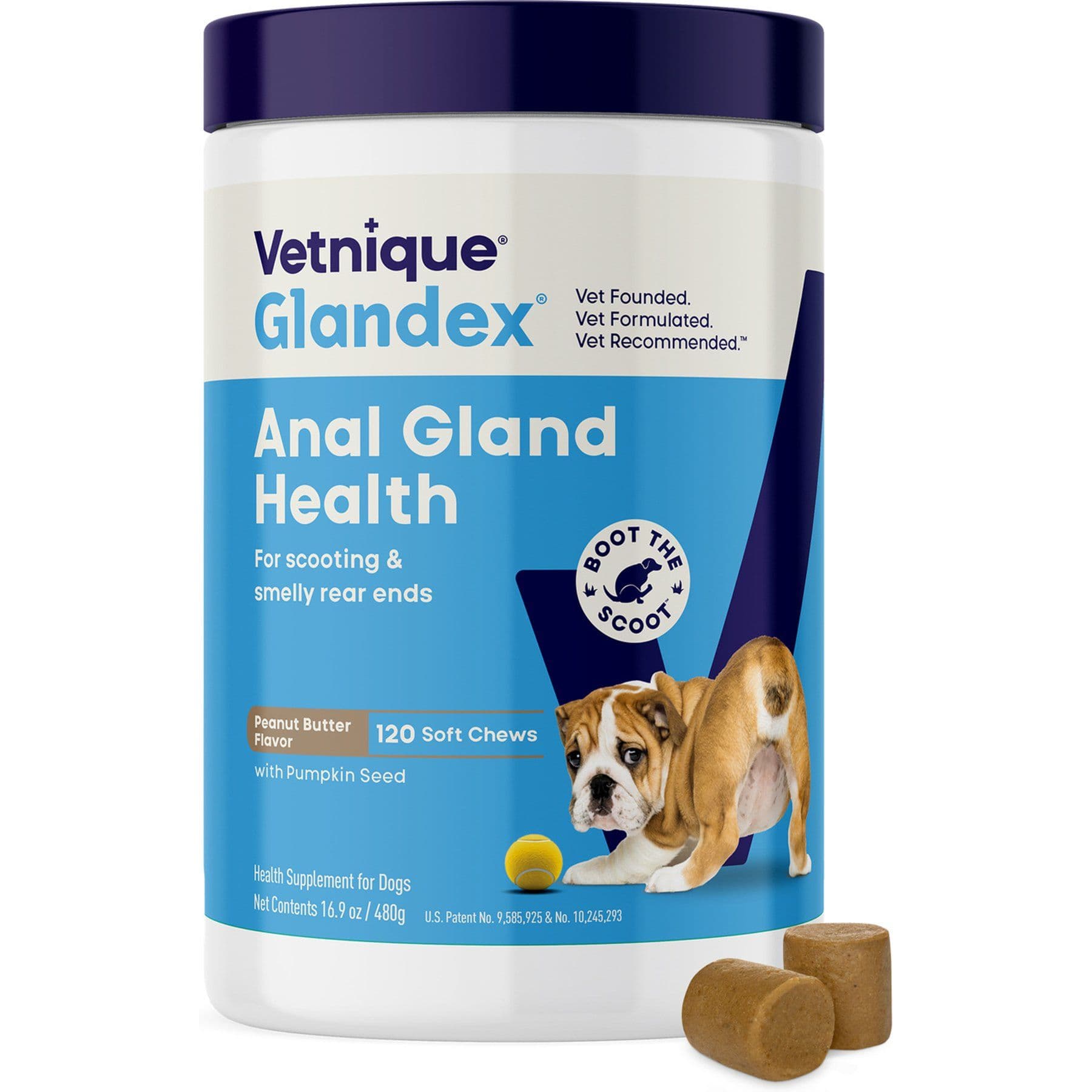
Original peanut-butter Glandex soft chews for dogs. Check ingredients, weight-based directions, and your veterinarian's advice before starting.
Webvet may earn a commission when you click through to Chewy, at no extra cost to you.
- Best fit to discuss: a dog that accepts soft chews and has a veterinary plan for recurrent anal gland support.
- Main tradeoff: more ingredients and a higher package price than some simpler options, without proof of superior clinical results.
- Buying detail: compare this original 120-count package with the exact formula you intend to use. Glandex powder has its own measuring instructions; chew directions cannot be transferred to it.
At the captured $59.99 price, this package costs about $0.50 per chew. That is a unit price, not automatically a daily cost: a dog’s label-directed amount may include a partial chew or multiple chews. For detailed powder-versus-chew reviews, side effects, and how long to continue a successful trial, use the full product guide rather than treating this short comparison as a dosing plan.
NaturVet No Scoot: a fiber blend in soft chews

NaturVet No Scoot 120-count soft chews are a useful comparison when you want a fiber-focused chew with a clearly stated serving frequency. The selected package is hickory-smoked-bacon flavored. The manufacturer’s No Scoot label lists a blend of beet pulp, flaxseed, and psyllium husk, plus dandelion root and pumpkin.
Per two chews, the label lists 1,000 mg of the fiber-ingredient blend, 50 mg of dandelion root, and 16 mg of pumpkin. Those numbers describe ingredient amounts. They do not mean the two chews contain 1,000 mg of measured dietary fiber, and the pumpkin amount should not be compared spoon-for-spoon with canned pumpkin. “Plus pumpkin” identifies an ingredient, not a reason to ignore the rest of the formula.
Directions call for one soft chew per 20 pounds of body weight twice daily, for dogs over 12 weeks old. The twice-daily detail matters: reading only “one chew” would underestimate both the daily amount and the ongoing cost. Follow the current package and ask the manufacturer or your veterinarian about any unclear weight interval rather than rounding up on your own.
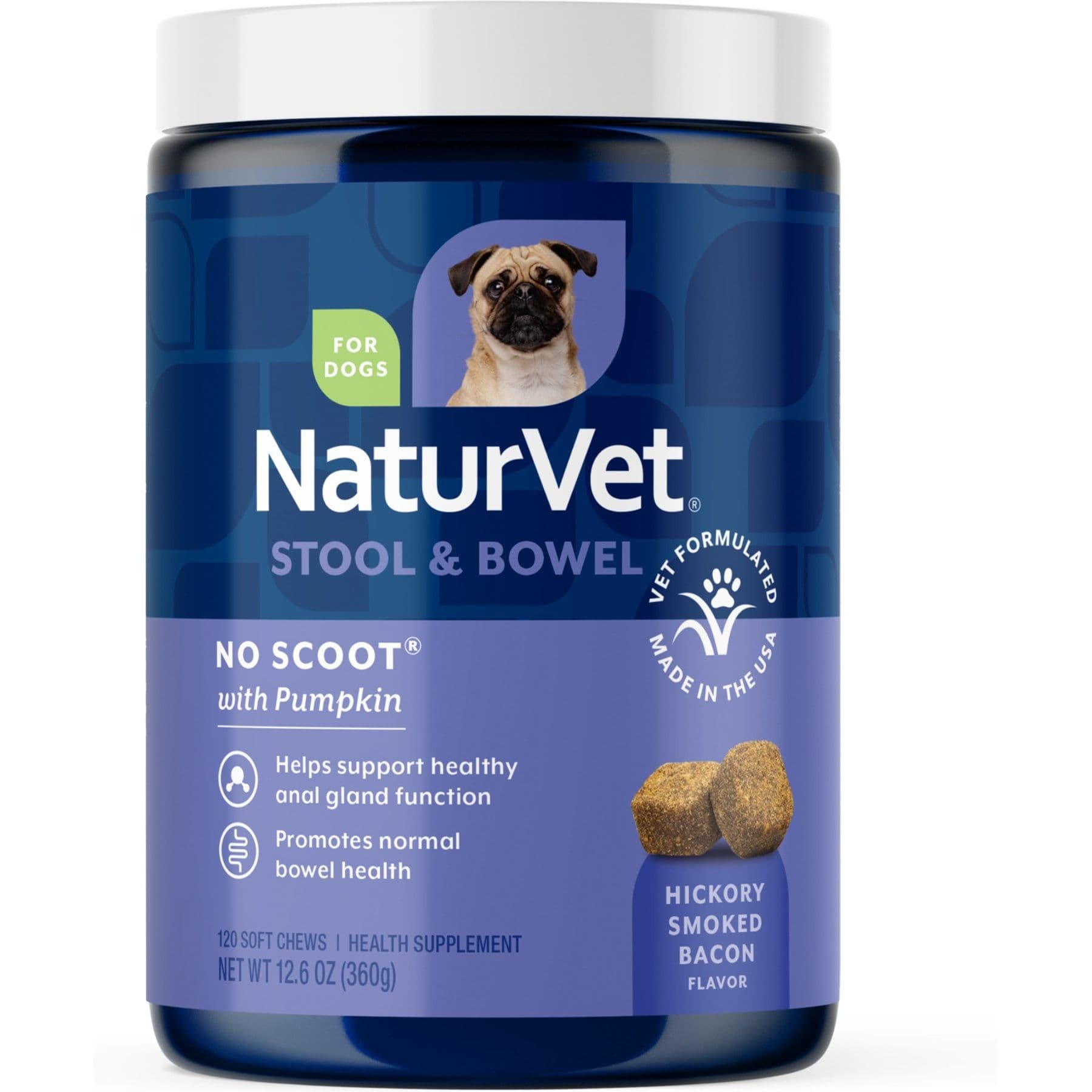
NaturVet's No Scoot chew combines several fiber sources. Compare the daily chew count and full label with the other options.
Webvet may earn a commission when you click through to Chewy, at no extra cost to you.
- Best fit to discuss: an owner who can maintain the twice-daily routine and wants several labeled fiber sources in one chew.
- Main tradeoff: more administration occasions than a once-daily product, with drug-absorption precautions that may matter for medicated dogs.
- Buying detail: this is the 120-count dog soft-chew product. Powder products and other brands called “No Scoot” should not inherit its directions.
At $28.77 for 120 chews, the unit price is about $0.24. A 20-pound dog receiving the labeled two chews per day would use the package in 60 days, or about $0.48 per day, before tax or shipping. This is a label-based cost example, not evidence that the serving is equivalent to another brand’s.
For owners reading No Scoot reviews, possible side effects and precautions deserve as much attention as scooting anecdotes. The label says to provide fresh water, notes that drug absorption may be delayed, and advises stopping use and consulting a veterinarian if the condition worsens or does not improve. New loose stools, gas, or discomfort after any diet addition should prompt a review of the plan, not an automatic increase.
Zesty Paws Scoot Away: read the IMO distinction

Zesty Paws Scoot Away chicken-flavored chews take a different ingredient approach. The selected US product is a 90-count package. Its manufacturer page lists VitaFiber, mineral oil, and a Scoot Away blend containing dandelion root, nettle root, and bromelain. Check the US label when comparing reviews because products sold in other markets may use different formulas.
The important label detail is VitaFiber, an isomalto-oligosaccharide ingredient, or IMO. Zesty Paws states that IMO is not recognized as dietary fiber by the FDA. It should therefore not be counted as an equivalent gram of dietary fiber when you compare Scoot Away with a psyllium-containing supplement, pumpkin, or a therapeutic high-fiber diet. A prominent ingredient amount is not the same measurement as total dietary fiber.
That distinction does not by itself establish that the product is ineffective. It means a “which has more fiber?” ranking based on front-label milligrams would be misleading. For Zesty Paws versus Glandex, compare the entire formulation, the daily serving on each package, your dog’s restrictions, and the outcome your veterinarian wants to monitor.
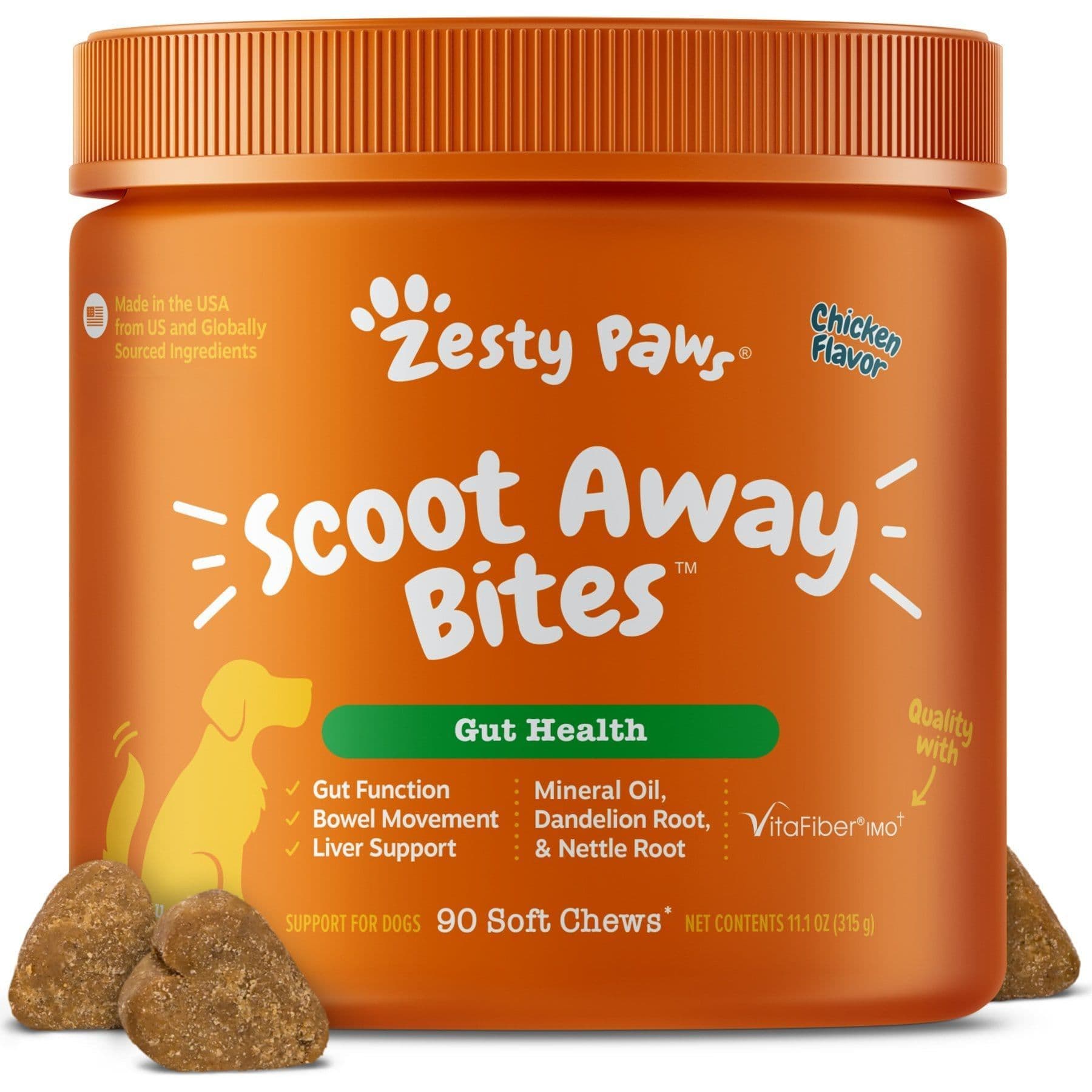
A chicken-flavored Scoot Away chew with a different ingredient approach. Its listed IMO amount is not interchangeable with grams of dietary fiber.
Webvet may earn a commission when you click through to Chewy, at no extra cost to you.
- Best fit to discuss: an owner considering this particular chew formula after checking its ingredients with the veterinarian.
- Main tradeoff: the IMO claim does not supply a directly comparable dietary-fiber dose.
- Buying detail: choose the chicken-flavored US Scoot Away soft chews shown here, and use that package’s weight-based serving instructions.
The verified chicken-chew label directs one chew daily up to 25 pounds, two at 26–75 pounds, and three above 75 pounds. Begin with half the suggested amount and increase gradually; the daily amount can be split between morning and evening. At $32.97 for 90 chews, the full one-chew daily serving costs about $0.37 per day. Do not transfer this chart to another formula.
Nutramax Filaquin: fiber with prebiotics and postbiotics

Nutramax Filaquin 90-count soft chews add a distinct option for owners comparing fiber with prebiotic and postbiotic ingredients. The manufacturer describes NMXFBR4 yeast extract containing beta-glucan, apple fiber, yeast culture as a postbiotic source, and psyllium husk. The product combines sources of soluble and insoluble fiber in a roasted-peanut-flavored chew.
The terminology matters. A probiotic supplies live microorganisms; a prebiotic supports beneficial microbes; a postbiotic is not simply another name for a live probiotic. Filaquin’s yeast-culture postbiotic description should not be treated as evidence that it contains the same probiotic strains or amounts as Glandex. More categories on a label also do not prove a better result for anal gland emptying.
Filaquin’s published daily chart lists half a chew below 15 pounds, one chew at 15–25 pounds, two at 26–50 pounds, three at 51–75 pounds, and four above 75 pounds. The chews can be broken apart. Use the current label for your dog’s weight, and ask for help with an unclear boundary rather than transferring directions from another supplement.
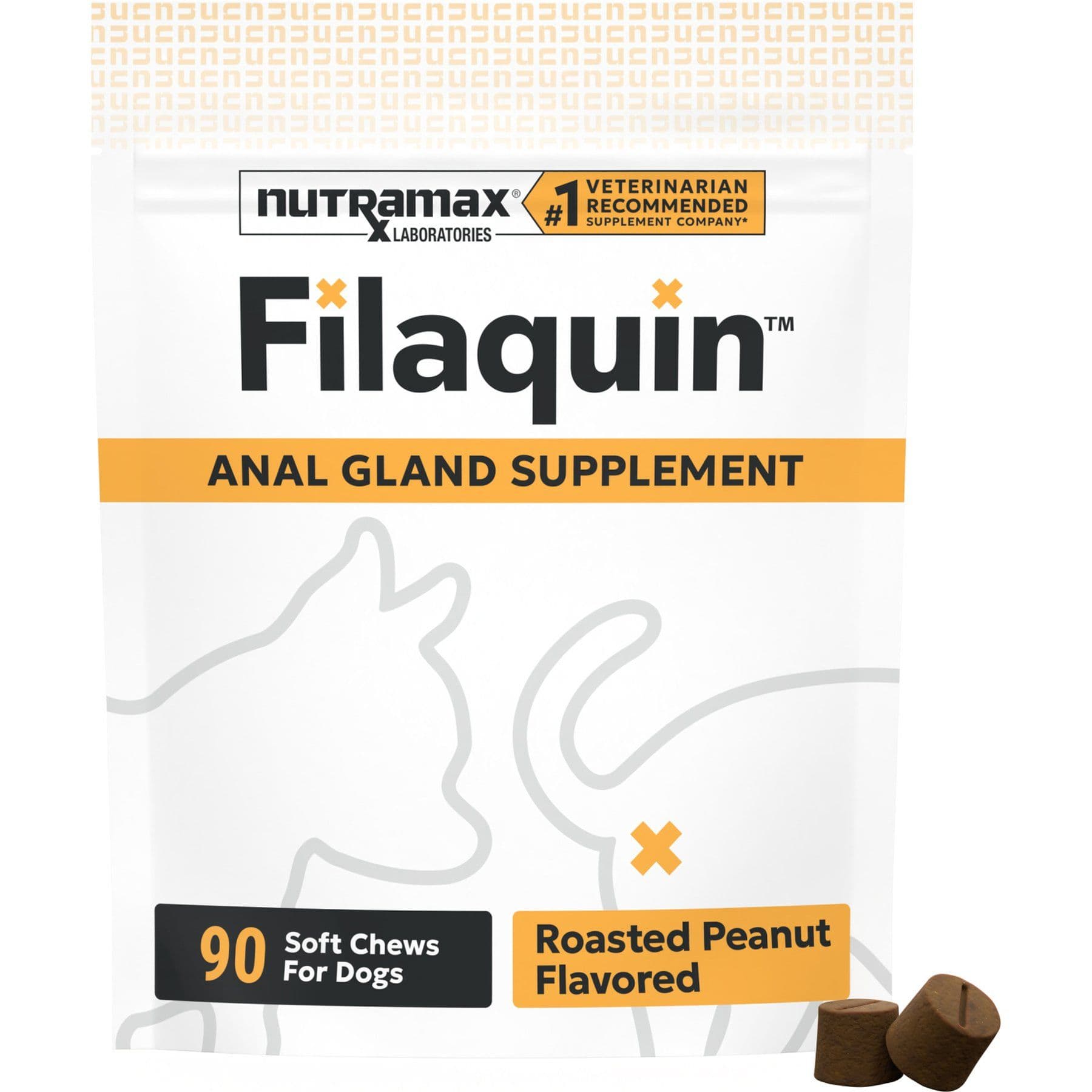
Filaquin pairs soluble and insoluble fiber sources with prebiotic and postbiotic ingredients. Compare its weight-based chew count and complete label with the other options.
Webvet may earn a commission when you click through to Chewy, at no extra cost to you.
- Best fit to discuss: an owner who wants to compare a fiber, prebiotic, and postbiotic formula with products built around a live probiotic or a simpler food topper.
- Main tradeoff: several ingredients still need checking against the dog’s diet and health plan, and this comparison does not establish a superior treatment effect.
- Buying detail: the selected package contains 90 chews. Larger dogs use the package faster because the daily amount rises with weight.
At $34.99, the unit price is about $0.39 per chew. A 15–25-pound dog on the labeled one-chew daily serving would get 90 days, about $0.39 per day. That arithmetic makes ongoing cost easier to compare with No Scoot’s twice-daily directions, while leaving the important clinical question open: whether the particular formula suits this dog.
Native Pet Pumpkin: a pumpkin-based fiber alternative

Native Pet Pumpkin powder, 8 ounces, offers a food-topper format for dogs that dislike chews. Its matching manufacturer label lists organic pumpkin, organic pumpkin seed, and organic apple. This is a pumpkin-based fiber blend, not plain canned pumpkin. Check the actual jar’s ingredient list and dry-powder directions before use.
Pumpkin can add fiber to a dog’s diet and may help stool consistency in some circumstances. That can support natural emptying of the anal glands, but pumpkin does not squeeze the sacs, remove an impaction, or treat infection. A dog whose stools are already consistently formed may need a different explanation for recurring trouble rather than progressively larger pumpkin portions.
If you want to feed something to help with emptying, discuss the whole diet first. A measured fiber addition is one possible tool; changing a complete diet or addressing an underlying digestive problem may be more appropriate. Adding a topper without considering the existing food can obscure what is helping and may contribute extra calories or unwanted ingredients.
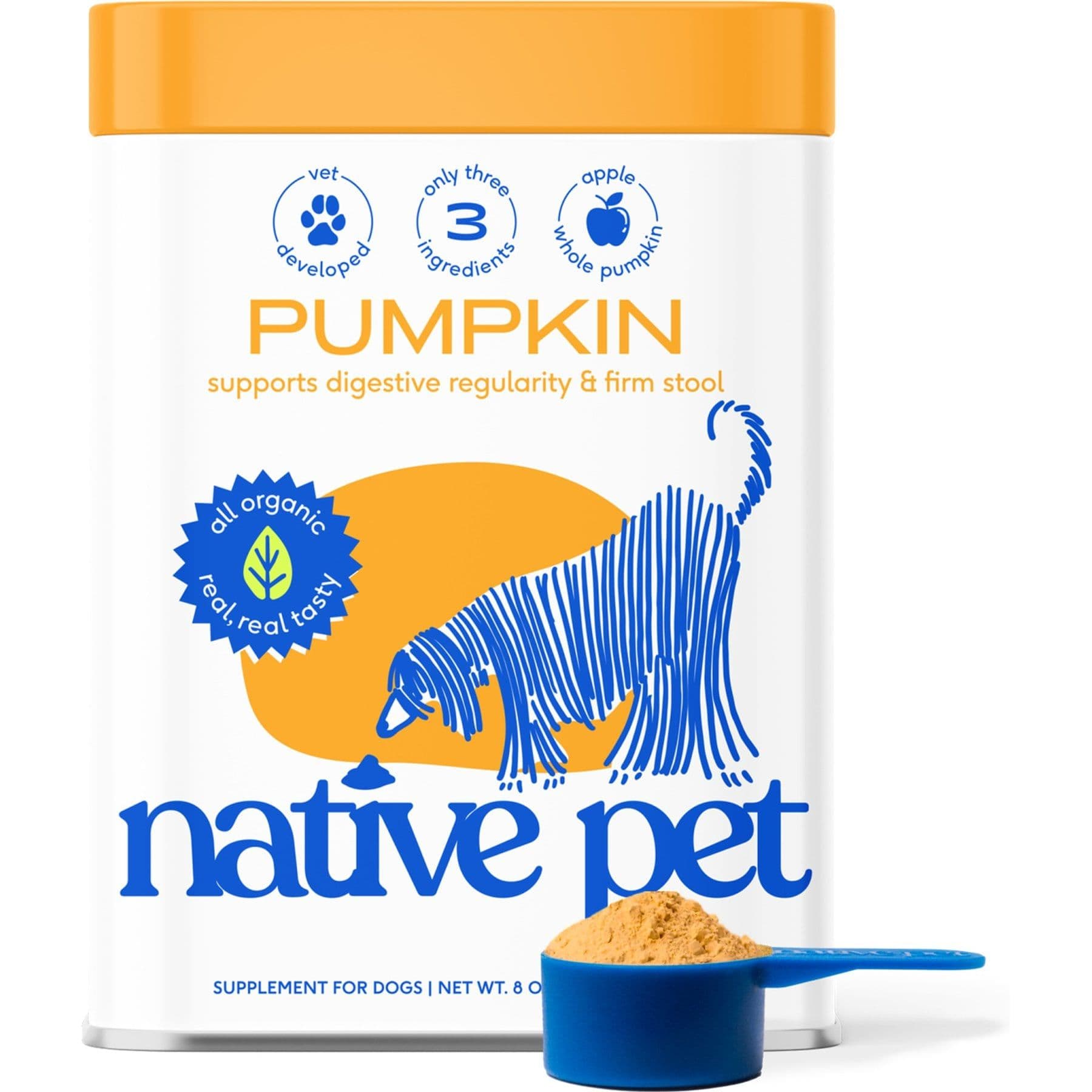
A pumpkin-based powder blend for owners who prefer a food topper to a chew. Compare the exact package ingredients and dry serving instructions; it is not plain canned pumpkin.
Webvet may earn a commission when you click through to Chewy, at no extra cost to you.
- Best fit to discuss: a dog that reliably finishes a meal and an owner who prefers to measure a powder rather than offer chews.
- Main tradeoff: the dog must eat the food containing the serving, and a blend does not provide the simplicity of plain pumpkin.
- Buying detail: use the exact jar’s scoop and weight-based directions. Dry powder, a reconstituted mixture, and wet pumpkin puree are not interchangeable spoon measures.
There is a serving discrepancy in the manufacturer’s current product images: the matching jar label defines a scoop as 1 tablespoon and directs one per 25 pounds, while a separate chart defines a scoop as half a tablespoon. Follow the actual jar’s directions and ask Native Pet to confirm any mismatch before feeding. At $24.99 per container, calculate daily cost only after confirming that serving; an assumed scoop count would give false precision.
When plain pumpkin is the alternative
Plain pumpkin is a separate choice from both Native Pet’s blend and a formulated anal gland supplement. Its appeal is a simple food addition; its limitation is that a practical serving may provide less fiber than an owner expects. Tufts veterinary nutrition guidance explains why pumpkin should not automatically replace a prescribed fiber supplement or therapeutic diet.
Our Glandex vs. pumpkin comparison walks through plain puree, pumpkin powder blends, and Glandex formats. It covers why scoop-for-scoop substitutions do not work and how to discuss a portion with your veterinarian. Choose plain pumpkin rather than pumpkin pie filling, and avoid assuming that a food product is suitable in unlimited amounts just because it is familiar.
How to choose and compare daily cost
Begin with the current package label and your dog’s current weight. Record the daily serving, serving frequency, calories where provided, active ingredients, other ingredients, and relevant cautions. A chew count is easy to compare; its contents may be very different. The same applies to powders whose scoops differ in size or whose directions change after an introductory period.
- 1Ingredient blend weight is not a measurement of total dietary fiber.
- 2A daily serving can be half a chew, several chews, or a measured powder amount.
- 3Compare cost per labeled day only after identifying the exact formula and daily serving.
The prices in this article were captured on October 4, 2026, and can change. Calculate daily cost as package price divided by the number of labeled days in the package. Count both administrations for a twice-daily product. Include a realistic allowance for opened pumpkin that must be discarded rather than assuming every gram in a large can will be used.
- Write down the starting stool pattern, comfort during bowel movements, and any recent veterinary treatment.
- Introduce one agreed change at a time so that improvement or digestive upset has a clearer possible explanation.
- Record acceptance as well as response. A powder left in the bowl has not delivered the planned serving.
- Agree on a review point with the veterinarian, especially if your dog has needed repeated expression or treatment.
This approach is more useful than buying the product with the longest ingredient list. It also makes a disappointing trial informative: poor acceptance, an unsuitable formula, and an underlying medical problem are different reasons to change course. There is no need to cycle through all five products before asking for another examination.
When a supplement is not the next step
Scooting, persistent licking, or a fishy smell can suggest an anal sac problem, but none proves the glands are simply full. Our guide to dog anal glands explains the normal anatomy and common signs. A veterinarian can determine whether there is a problem requiring expression or another cause for the behavior.
Pain, swelling, bleeding, discharge from a wound, or difficulty passing stool calls for prompt veterinary attention. A “natural” approach is not an adequate treatment for swollen, infected, or impacted sacs. Read about impacted anal glands in dogs for the distinction between dietary support and treatment of an active problem.
- Do not increase a supplement to try to relieve a painful blockage.
- Do not repeatedly squeeze the area because an online review says it helped another dog.
- Seek reassessment when signs persist, recur quickly, or appear despite consistently formed stools.
When expression is appropriate, removing retained anal sac secretion may relieve pressure and discomfort; infection or another disease can still need further treatment. The secretion is normally a strong-smelling fluid, while an abnormal appearance requires professional interpretation. Our anal gland expression guide explains assessment, what expression involves, and why painful cases need professional care.
Questions about anal gland supplements
Frequently Asked Questions
Can I combine two anal gland supplements?
Get veterinary advice before combining them. Duplicate ingredients can make the overall amount harder to judge and can add unnecessary calories or digestive upset. Bring both complete labels so your veterinarian can assess the combined formula, rather than assuming different brand names mean different ingredients.
Are chews better than powders?
Neither format is automatically more effective. Choose a measured serving your dog will reliably take. A chew can be convenient when accepted; a powder can work well when your dog finishes the food containing it. Measure powders with the appropriate tool and follow the exact product directions.
Can puppies use these supplements?
Check the product label, because age eligibility differs. NaturVet No Scoot and the original Glandex chews are labeled for dogs over 12 weeks of age. That does not establish that every product here is suitable for every puppy. Persistent scooting or abnormal stools in a puppy warrant veterinary assessment.
Should a dog on medication take a fiber supplement?
Ask the prescribing veterinarian first. NaturVet warns that drug absorption may be delayed, and the original Glandex label says not to use it with blood thinners. Do not stop a medicine or invent a spacing schedule yourself. Your veterinarian can decide whether to change the supplement, timing, or overall plan.
Does more fiber mean a better supplement?
No. The right type and amount depend on the dog and the rest of the diet. Blend weight describes the mass of a mixture; it is not necessarily measured dietary fiber. More of an unsuitable ingredient can add problems without addressing why the anal glands are not emptying normally.
Do supplements replace anal gland expression?
No. A supplement may support stool quality as part of a longer-term plan, but it does not remove a painful impaction. Impacted glands may need professional treatment, and infection may need additional care. Ask a veterinarian whether expression is appropriate rather than using either expression or supplements on an automatic schedule.
$65 · no membershipWorried about your dog's vomiting or diarrhea?
A licensed vet can examine your dog over video and prescribe treatment online when it's appropriate.
Talk to a vet- Licensed vets
- All 50 states
- same-day Rx
Webvet may earn a commission if you book.
Veterinarian · BVMS MRCVS
Dr. Pippa Elliott, BVMS, MRCVS, is a veterinarian with nearly 30 years of experience in companion animal practice. Dr. Elliott earned her Bachelor of Veterinary Medicine and Surgery from the University of Glasgow. She was also designated a Member of the Royal College of Veterinary Surgeons. Married with 2 grown-up kids, Dr. Elliott has a naughty Puggle named Poggle, 3 cats and a bearded dragon.


