Glandex vs Pumpkin: Which Fits Your Dog’s Anal Gland Routine?
Compare Glandex with plain pumpkin and dry pumpkin blends for a veterinary-guided anal gland routine. Learn how ingredients, portions, storage, and daily cost affect the choice.

BVMS MRCVS
Medically reviewed by Dr. Pippa Elliott, BVMS MRCVS · Last reviewed

This article contains affiliate links. Webvet may earn a commission when you buy through them, at no extra cost to you.
The useful question in a Glandex vs pumpkin comparison is what your dog needs the addition to do. Glandex provides a labeled, multi-ingredient supplement routine. Plain pumpkin provides a food-based source of fiber and moisture. Either may fit a veterinary plan for stool quality, but they are not equivalent servings and neither treats a painful anal gland blockage.
This is an expert analysis of manufacturer information and veterinary nutrition sources. We obtained no products and performed no hands-on testing or comparative trial in dogs. Product links may earn WebVet a commission. The choices below reflect formula, administration, storage, and cost differences rather than a claim that one product worked best in our own dog.
This comparison covers Glandex Original peanut-butter 120-count chews, Glandex Original beef-liver 4-ounce powder, Weruva plain pumpkin 2.8-ounce pouches in a 12-pack, and Native Pet Pumpkin 8-ounce blend.
Glandex vs. pumpkin: the practical difference
Glandex Original combines fiber ingredients with other digestive-support ingredients, including probiotics and enzymes. Plain pumpkin is a food, and the selected Weruva puree lists pumpkin and water. A pumpkin powder blend is a third category: drying changes how it is measured, and additional ingredients can make it different from plain puree.
For a dog that readily accepts chews, Glandex Original peanut-butter chews provide pre-portioned pieces with weight-based directions. The 120-count package shown here is the original anal gland formula. Choosing it is a decision about that formulation and routine, not proof that a chew is more effective than an appropriate food-based addition.
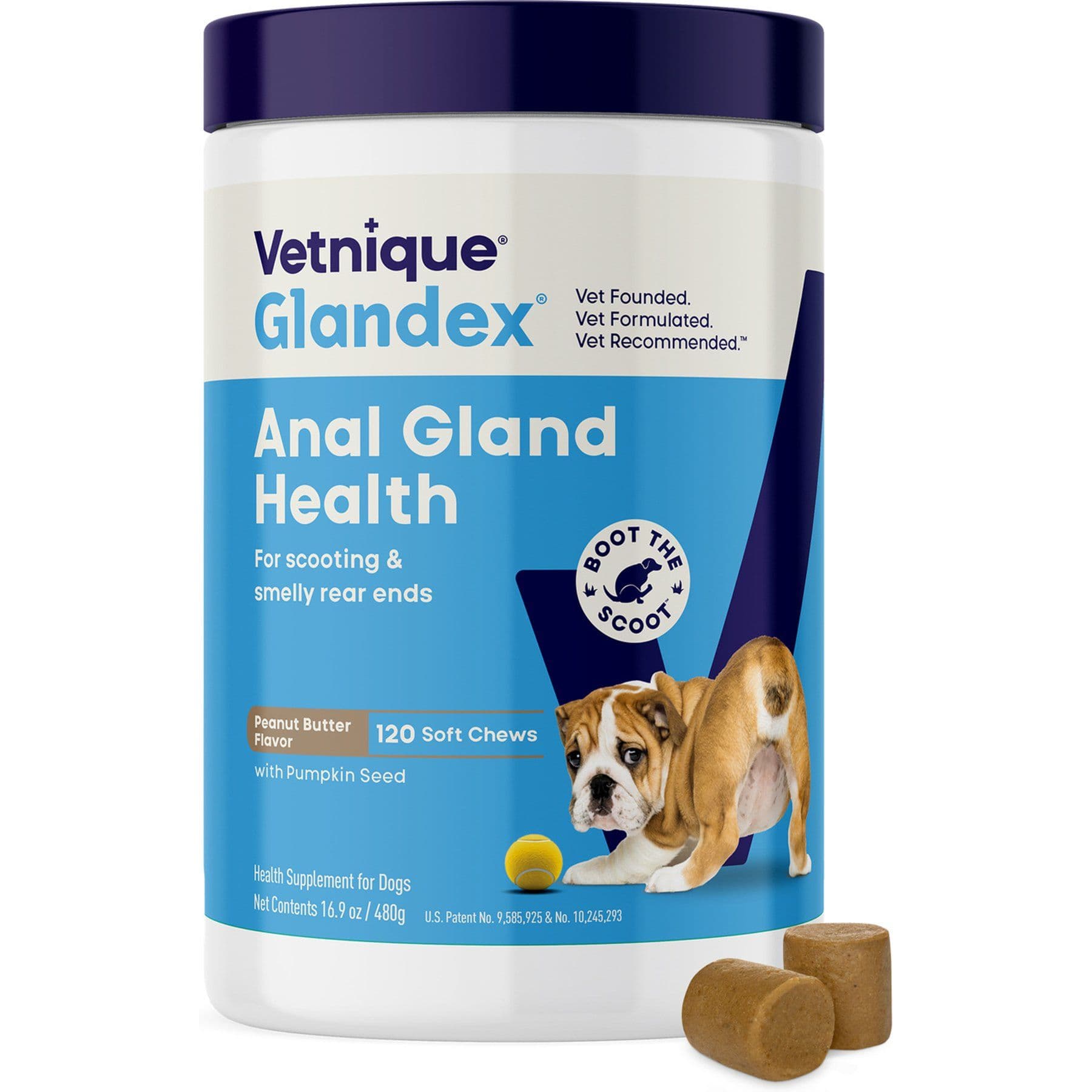
Original peanut-butter Glandex soft chews for dogs. Check ingredients, weight-based directions, and your veterinarian's advice before starting.
Webvet may earn a commission when you click through to Chewy, at no extra cost to you.
These distinctions matter because the aim is to improve stool consistency where that contributes to poor anal sac emptying. Normal glands keep producing secretion. You cannot prevent them from filling altogether; the goal is comfortable natural emptying when a dog passes stool. A dog with persistent trouble despite well-formed stools may need another approach.
| Option | What it provides | Administration difference | Main limitation |
|---|---|---|---|
| Glandex Original chews | Multi-ingredient anal gland supplement | Weight-based daily chew amount | Check all ingredients and label cautions |
| Glandex Original powder | A separate measured Glandex format | Mix according to its own directions | Dog must eat the food containing it |
| Weruva plain pumpkin puree | Pumpkin and water | Measure an agreed wet-food portion | Refrigerate unused portions; not an equivalent fiber dose |
| Native Pet Pumpkin blend | Pumpkin-based dry powder | Use the exact jar’s dry serving | Not plain pumpkin; check the full ingredient list |
This label comparison establishes neither scoop-for-scoop equivalence nor a guaranteed winner. The evidence reviewed here does not show that one choice treats anal gland disease better than the other. The decision is which option fits the support plan your veterinarian recommends.
- Consider Glandex when your veterinarian agrees that a formulated supplement is appropriate and you want a label-defined routine.
- Consider plain pumpkin when a modest, simple food addition fits the diet and the veterinarian’s fiber plan.
- Consider a dry pumpkin blend when storage or administration makes powder easier, after checking the exact ingredients and serving.
When a Glandex formula fits the routine
Glandex has the practical advantage of specific directions for the formula you buy. The original soft-chew manufacturer page describes a once-daily, weight-based serving. That can make it easier to maintain a consistent routine than an improvised spoonful of food, especially when several people feed the dog.
Formula complexity is the tradeoff. A multi-ingredient supplement adds more than pumpkin, so examine the full label when your dog has allergies, dietary restrictions, or medications. A positive response would not tell you which ingredient caused it. An upset stomach after starting it also deserves review rather than an automatic increase in the amount.
Glandex Original comes in a powder as well as soft chews. The original beef-liver-flavored powder, 4 ounces, is an option for a dog that refuses chews but finishes a meal reliably. It has its own directions and measuring requirements. A powder scoop cannot be substituted for a chew without checking the exact product label.
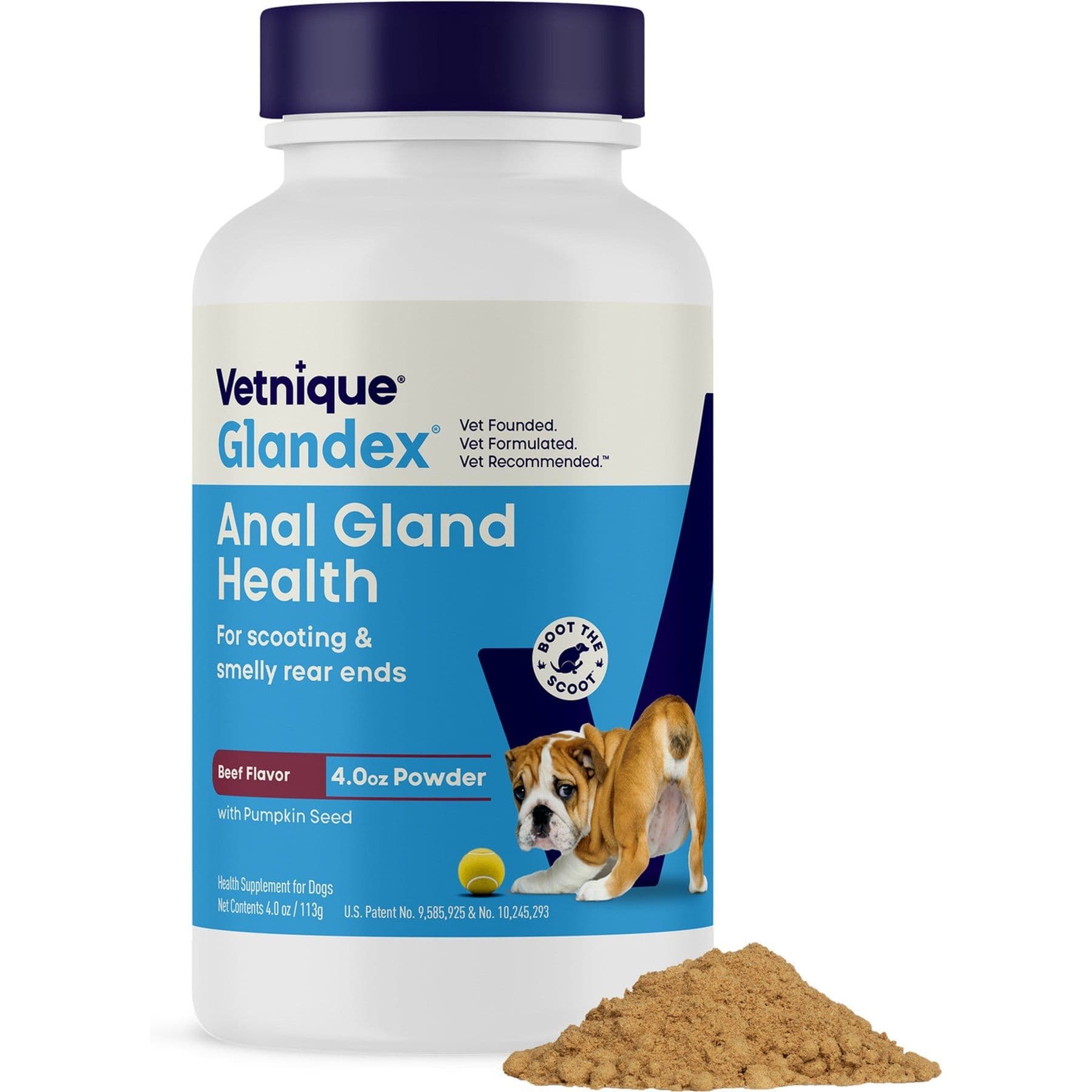
Glandex beef liver powder is a mix-in alternative for dogs that do not take soft chews. Its directions differ from the chew formula.
Webvet may earn a commission when you click through to Chewy, at no extra cost to you.

- Choose the chew when pre-portioned administration and acceptance make it easier to give the correct amount.
- Choose the powder when mixing into food is practical and you can confirm the dog eats the serving.
- Check the full product name when reordering. Glandex Daily and Rapid are different product lines, not alternate names for Original anal gland support.
The manufacturer’s reported owner experiences are not a controlled head-to-head trial against pumpkin. They cannot establish that Glandex will prevent your dog from ever needing expression or that it is the better choice for every cause of scooting. Fiber support is most relevant when the veterinarian thinks stool quality contributes to poor emptying.
Our Glandex for dogs guide covers the product’s evidence, formats, possible side effects, and label cautions in more detail. Digestive changes can occur after introducing a supplement, and the original label includes a blood-thinner restriction. Check suitability before starting it rather than assuming the presence of pumpkin makes the whole formula appropriate for every dog.
 $65 · no membership
Worried about your dog's vomiting or diarrhea?
A licensed vet can examine your dog over video and prescribe treatment online when it's appropriate.
 Talk to a vet
- Licensed vets
- All 50 states
- same-day Rx

Webvet may earn a commission if you book.
When plain pumpkin fits the routine

Plain canned pumpkin may be worth discussing for dogs whose anal gland plan includes a small fiber-containing food addition. It is easy to mix into food, contains moisture, and avoids the longer ingredient list of many supplements. Its usefulness still depends on the whole diet, the portion, and the reason the anal sacs are not emptying well.
Veterinarians may recommend pumpkin because fiber can influence stool consistency. That does not mean every dog needs it, that larger amounts work better, or that it empties glands directly. Some dogs need a more carefully measured fiber source or a therapeutic diet. Others need treatment for a cause unrelated to inadequate fiber.

The Weruva Pumpkin Patch Up plain puree shown here is a specific example of the simple-food option. This selection contains twelve 2.8-ounce pouches. According to Weruva’s product information, the ingredients are pumpkin and water sufficient for processing, and each 2.8-ounce pouch contains 15 calories. It is a supplement to a diet, not a complete meal.
Choose plain puree and prepare only the agreed portion
For canned or pouched pumpkin, read the ingredient list rather than choosing on brand name alone. Plain pumpkin or pumpkin with water is the category being compared here. Pumpkin pie filling, sweetened mixtures, seasoned pumpkin dishes, and flavored pet toppers are different products. “Pumpkin” in a product name does not establish that the rest of its ingredients fit your dog’s plan.
- Use a clean measuring spoon or scale to portion the amount agreed with your veterinarian.
- Mix it into a portion of food your dog will finish, rather than spreading it across food likely to remain in the bowl.
- Refrigerate unused Weruva puree as the manufacturer directs, and follow the package’s storage instructions.
- Discard spoiled food; do not use an opened container indefinitely because it still looks like pumpkin.
Ready-made plain puree does not need a recipe to become an appropriate topper. The useful preparation step is checking the contents and measuring the portion. For this comparison, a familiar grocery product is not automatically safer or less safe than a pet-branded pouch; the exact ingredients and amount matter more than where it was sold.
Package size affects the routine as well as the price. A small pouch may be convenient if your dog uses only a little puree, while an owner feeding several dogs may use a larger container efficiently. Decide where the opened food will be stored and how you will measure each portion before buying. The selected Weruva pouch gives you a clearly identified plain formula in a smaller package; that convenience is separate from whether pumpkin is the right fiber choice.
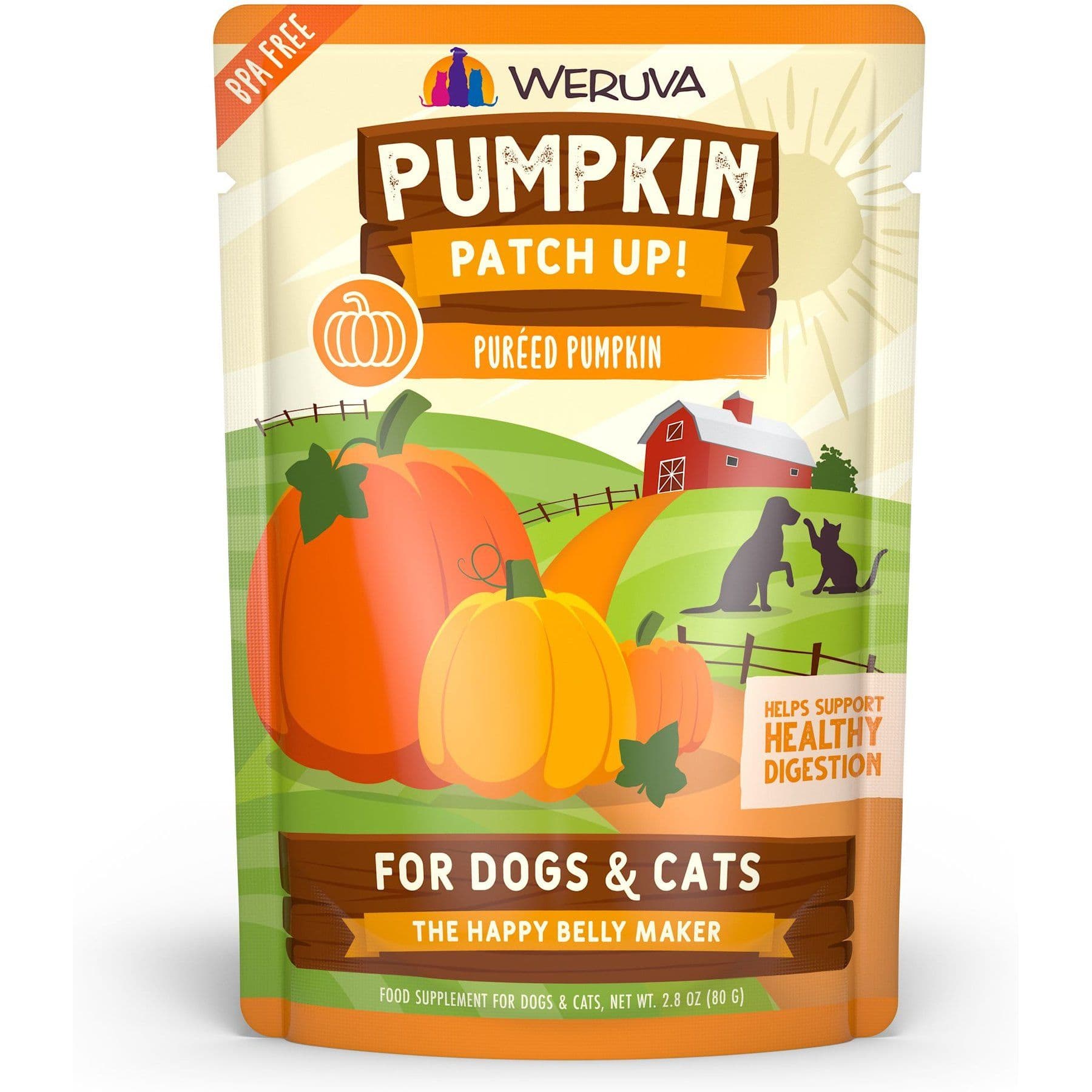
Original Pumpkin Patch Up pouches provide puréed pumpkin in individual portions. Choose the original product when comparing a simple pumpkin option.
Webvet may earn a commission when you click through to Chewy, at no extra cost to you.
Read the fiber figures carefully
Weruva lists crude fiber at a maximum of 3.5% and moisture at a maximum of 93%. Those are label limits, not a laboratory result for the exact pouch in your hand. Crude fiber is also not the same measure as total dietary fiber. These figures do not establish how many chews or powder scoops a spoonful replaces.
Tufts veterinary nutrition guidance explains a common problem with pumpkin advice: a small food portion may supply less fiber than people expect compared with a therapeutic diet or concentrated fiber plan. Trying to compensate by feeding a very large amount creates other problems. The useful question is whether the amount your dog can appropriately eat meets the intended purpose.
Canned pumpkin can therefore be a reasonable food addition without being a substitute for everything labeled “fiber.” If your veterinarian recommends a particular fiber source, ask whether plain pumpkin can serve the same role before switching. Do not replace a prescribed diet with a larger pumpkin portion based on a percentage printed on a pouch.
Pumpkin powder is a separate comparison
Pumpkin powder versus canned pumpkin is mainly a question of concentration, ingredients, and preparation. Removing water changes the amount of dry material in a spoonful. A powder may also include other ingredients. There is no general conversion that makes one teaspoon of any pumpkin powder equivalent to one teaspoon of wet puree.

Native Pet Pumpkin powder, 8 ounces, illustrates this distinction. The matching manufacturer label lists organic pumpkin, organic pumpkin seed, and organic apple. It is a pumpkin-based blend, not plain canned pumpkin. It may fit an owner who prefers a dry food topper and a dog that reliably finishes the food.
Check the scoop carefully: the manufacturer’s current product images show a matching jar label defining one scoop as 1 tablespoon, but a separate serving chart defines it as half a tablespoon. Use the actual package directions and ask Native Pet to confirm any mismatch before feeding. This is a specific reason not to borrow a scoop measure from an online chart.
- Measure dry powder using its own instructions; do not copy the amount recommended for wet puree.
- If directions call for water or mixing into food, prepare it as directed rather than improvising a concentration.
- Keep the container closed and follow its storage directions; a dry powder’s storage routine differs from opened wet pumpkin.
The powder format can reduce the inconvenience of storing an opened can or pouch, but it does not remove the need to measure servings. It also adds an acceptance question: some dogs finish a familiar wet topper but leave food containing a new powder. The more practical choice is the one that delivers the agreed serving reliably without making meals a struggle.
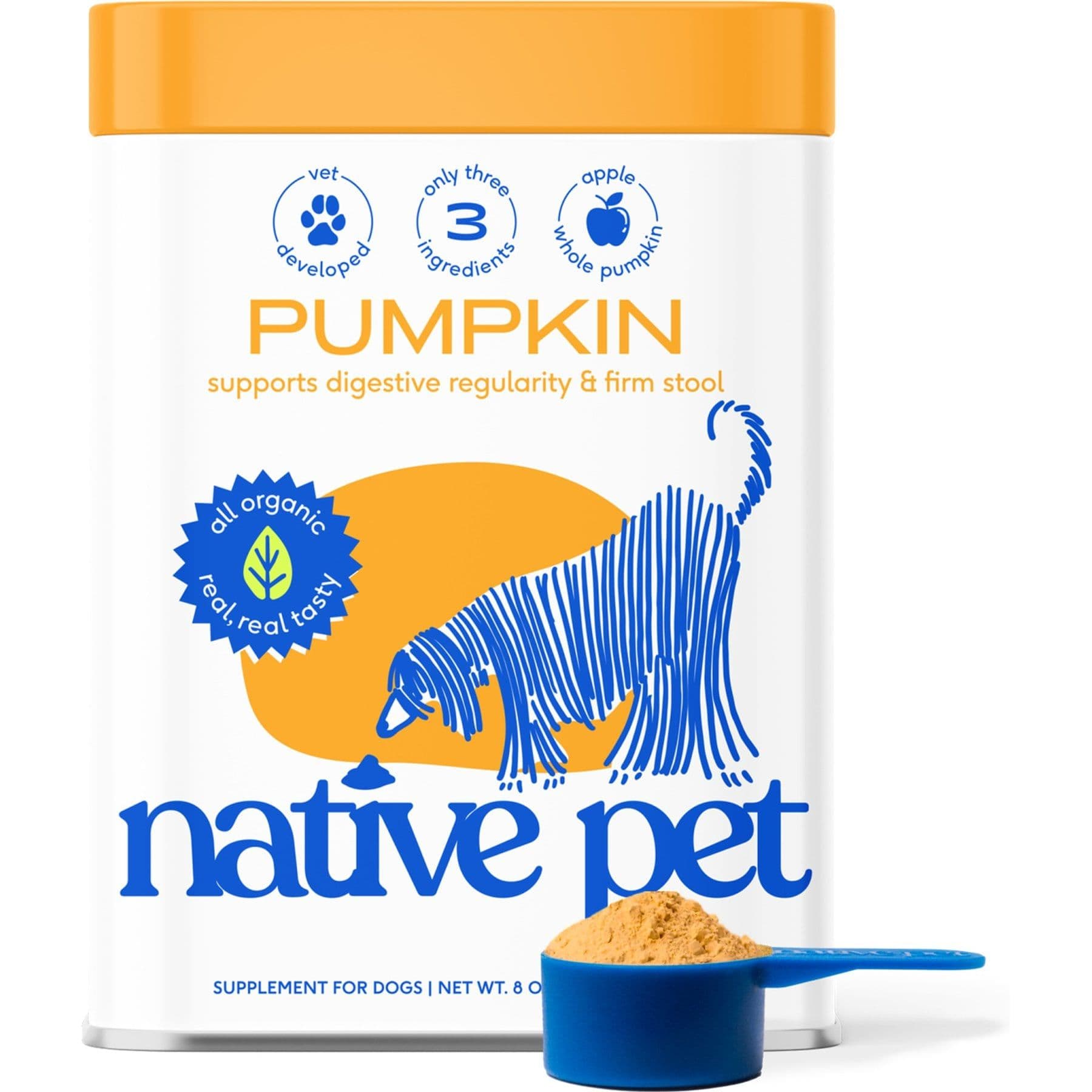
A pumpkin-based powder blend for owners who prefer a food topper to a chew. Compare the exact package ingredients and dry serving instructions; it is not plain canned pumpkin.
Webvet may earn a commission when you click through to Chewy, at no extra cost to you.
How much pumpkin belongs in the plan?
There is no universal anal gland dose of pumpkin that can be calculated from your dog’s weight alone. Size matters, but so do daily calories, the rest of the diet, the particular food or powder, stool quality, and medical conditions. Ask your veterinarian for an amount and a reason for using it rather than treating a generic internet tablespoon range as a treatment prescription.
A whole can of pumpkin puree is not an appropriate default serving. Can sizes vary, and feeding that much may displace balanced food or add more fiber than intended. The fact that a plain food is generally usable as a topper does not make every quantity useful. A small dog’s calorie allowance also leaves less room for extras than a large dog’s.
- 1A label’s ingredient amount or crude fiber maximum is not the same as total dietary fiber.
- 2A serving of wet puree cannot be converted directly into a chew or a scoop of dry powder.
- 3Fit pumpkin into the whole diet; adding more is not a substitute for reassessing persistent signs.
Tufts advises keeping food additions modest because large amounts can unbalance the overall diet. The familiar guideline that treats and other extras stay within about 10% of daily calories is a ceiling for otherwise appropriate extras, not a target pumpkin dose or proof that an amount will help anal glands. Dogs with a therapeutic diet or medical condition may need a different plan.
The same restraint applies to Glandex. Use the product-specific label and veterinary advice, not a pumpkin-to-chew conversion or an increase based only on continued scooting. If the agreed amount is not helping, the next step is to reconsider the cause and the plan, rather than assuming more fiber is always the answer.
How to compare results and cost
Practical daily cost depends on a serving your dog will actually receive. At the captured October 4, 2026 prices, the 120-count Glandex Original chew package is $59.99, about $0.50 per chew. The selected Weruva twelve-pack is $17.88, or $1.49 per 2.8-ounce pouch. Those are buying units; one chew and one pouch are not equivalent daily doses.
For a powder, divide the package price by the number of days at the exact label-directed amount, using the serving weight when available. For wet pumpkin, account for unused portions that must be discarded. A cheaper large can is not necessarily cheaper in practice if much of it goes to waste, and a higher package price does not establish better clinical value.
- Record the starting stool consistency, comfort, scooting frequency, and recent veterinary treatment.
- Make one agreed change at a time so that improvement or digestive upset is easier to interpret.
- Record the exact amount and whether your dog ate it. “Offered” and “consumed” are different measurements.
- Agree on a review point, including what would justify continuing, changing, or stopping the trial.
Fewer scooting episodes after starting a product can be encouraging, but they do not isolate its effect if the dog also had expression, medication, or a diet change. Look at comfort and recurrence over the agreed period rather than one good bowel movement. Bring the record to your veterinarian if results are unclear.
Other anal gland support choices
If neither a Glandex formula nor plain pumpkin fits, there are other approaches to discuss. Native Pet Pumpkin is one dry-blend option; other supplements use different fiber sources or different combinations of digestive-support ingredients. Our anal gland supplements for dogs comparison explains five products by their actual formulas and routines, including No Scoot, Scoot Away, and Filaquin.
A veterinarian-selected diet or measured fiber plan may be more appropriate than another topper, especially when your dog has persistent stool problems or a restricted diet. That is a different decision from choosing the most convenient retail package. Avoid cycling through multiple supplements without reassessing why the glands keep causing trouble.
When neither option is the next step
Dogs with full or irritated anal sacs may scoot, lick under the tail, resist sitting, or develop a strong fishy smell. Those signs do not prove that fiber is the missing ingredient. The dog anal gland guide explains the anatomy and signs that help a veterinarian decide what needs attention.
Painful swelling, bleeding, a draining wound, or difficulty passing stool needs prompt veterinary attention. Neither pumpkin nor Glandex can naturally “unblock” a painful impaction or treat an infected sac. See the guide to impacted anal glands for the difference between dietary support and treatment of an active problem.
Expression removes retained anal sac secretion, which normally has a strong odor. Relieving pressure may help a dog feel better, but infection or another cause can still require treatment. How often expression is needed depends on the dog; it is not a fixed schedule you can infer from the supplement label. Our anal gland expression guide explains the procedure and when professional assessment matters.
Questions about Glandex and pumpkin
Frequently Asked Questions
Is it okay to give a dog pumpkin every day?
A small daily amount may fit some dogs’ feeding plans, but there is no need to add it automatically to every complete diet. Account for daily calories and other extras, and check with your veterinarian when your dog has a medical condition or prescribed food. Continue only when the agreed plan remains useful and well tolerated.
How long does it take for pumpkin to kick in for dogs?
There is no fixed time that predicts an anal gland benefit. A change in stool consistency is not the same as resolving the cause of recurring gland trouble. Follow the review point agreed with your veterinarian, and seek help sooner for worsening signs. Do not wait for a topper to work when your dog appears painful.
Can I use Glandex and pumpkin together?
Ask your veterinarian before combining them. Duplicate fiber and other dietary changes can make the total intake harder to judge and can obscure which addition helped or caused upset. Starting with one change makes the response easier to interpret. There is no established general formula for adding a spoonful of pumpkin to a Glandex serving.
Can my dog eat Libby's 100% pure pumpkin?
Check the current ingredient list on the exact can. A product listing only pumpkin fits the plain-puree category discussed here, provided the portion is appropriate for your dog. Pumpkin pie filling is a different product. Brand recognition alone does not replace checking the label, storage directions, and your veterinarian’s advice about quantity.
What if my dog refuses the powder or pumpkin?
Do not assume the planned amount was delivered unless your dog finishes the food containing it. Ask about another format or a small portion of an approved food that reliably carries the measured serving. Avoid turning a simple addition into a succession of rich toppings, especially for a dog with digestive problems.
$65 · no membershipWorried about your dog's vomiting or diarrhea?
A licensed vet can examine your dog over video and prescribe treatment online when it's appropriate.
Talk to a vet- Licensed vets
- All 50 states
- same-day Rx
Webvet may earn a commission if you book.
Veterinarian · BVMS MRCVS
Dr. Pippa Elliott, BVMS, MRCVS, is a veterinarian with nearly 30 years of experience in companion animal practice. Dr. Elliott earned her Bachelor of Veterinary Medicine and Surgery from the University of Glasgow. She was also designated a Member of the Royal College of Veterinary Surgeons. Married with 2 grown-up kids, Dr. Elliott has a naughty Puggle named Poggle, 3 cats and a bearded dragon.


