World's Best Cat Litter Review: Clumping, Tracking, Flushing, and Which Cats It Suits
World's Best Cat Litter is the corn-based clumping litter that most owners try first when they leave clay. Here is how it performs on clumping, tracking, dust, and odor, what the flushing claim actually means, and which cats and homes it suits.

BVMS MRCVS
Medically reviewed by Dr. Pippa Elliott, BVMS MRCVS · Last reviewed

This article contains affiliate links. Webvet may earn a commission when you buy through them, at no extra cost to you.
World's Best Cat Litter is the corn-based clumping litter many owners try first when they move away from clay. The manufacturer says it is made from USA-grown corn with no added chemicals, and it sells versions for multi-cat homes, tracking, scent preferences, and litter box habits.
This World's Best Cat Litter review is expert analysis. WebVet did not obtain the product or test it hands-on, and no manufacturer or retailer paid for or reviewed this article. Each judgment weighs the brand's claims against guidance from Cornell, VCA, the ASPCA, the CDC, and the EPA, and unverified claims are flagged.
The core product here is World's Best Multi-Cat Unscented Clumping Corn Cat Litter in the 28-lb bag, with the Low Tracking and Dust Control, Scented Multiple Cat, and Boosters Good Habits products compared as formulas alongside it.
 Sponsored
Have a health question about your cat?
Talk to a licensed vet at Dutch over video or message, including nights and weekends.
Use code Pets60
Plans start at $12/month · covers up to 5 pets
- Licensed vets in most states
- Rx for 150+ conditions
- 4.7 on Trustpilot
World's Best Cat Litter at a glance: what it is and who it suits
Our verdict: World's Best is a sound corn-based clumping litter for adult cats in homes that scoop daily and want low dust. Its weak spots are tracking in the standard formula, clumps that crumble when left too long, a higher price per pound than clay, and a flushable claim that conflicts with public-health advice.
- 1What it is: USA-grown corn with no added chemicals that, according to the brand, traps waste before it sticks to the box.
- 2Performance versus clay: low dust is the clearest advantage, while odor and tracking depend on daily scooping and on choosing the Low Tracking formula.
- 3On flushing: bag used litter instead, because EPA tells septic owners never to flush cat litter and Toxoplasma may survive sewage treatment.
- 4On fit: a strong choice for adult cats in homes that scoop every day; vigorous diggers and cats that resist new litter may do better staying on clay.
WebVet did not obtain the product and was not paid or sponsored by any manufacturer or retailer for this review. WebVet may earn an affiliate commission on Chewy links, and that relationship did not influence this assessment.
Most owners should start with an unscented formula. The ASPCA says most cats prefer clumping, unscented litter, and Multiple Cat Unscented is the brand's unscented multi-cat formula for homes with more than one cat.
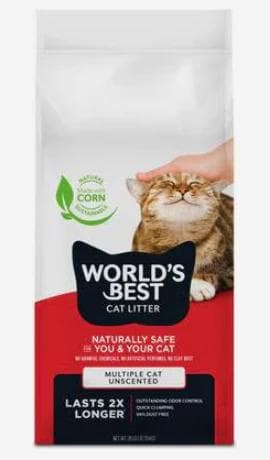
Unscented, clumping corn litter in a 28-lb bag, the litter type ASPCA says most cats prefer, sized for multi-cat homes.
Webvet may earn a commission when you click through to Chewy, at no extra cost to you.
Is World's Best Cat Litter actually good?
For most adult cats, yes, with conditions. It is a low-dust, corn-based clumping litter with multi-cat and low-tracking formulas. Its biggest marketing numbers, such as 99% dust-free and up to 60% more absorbent than clay, come without a published test basis. It performs best with daily scooping, and its flushable label is no reason to flush.
What it does well:
- Low dust: the brand says corn is free of clay dust, which suits cats with respiratory sensitivity.
- A firm clump when scooped daily: a PetSmart listing advertises quick clumping and easy scooping, with no chiseling.
- A fix for scatter: the Low Tracking formula reduces scatter with larger granules.
- Plant-based: made from corn with no added chemicals, and a reasonable choice for kittens once your vet agrees on timing.
Where it falls short:
- Tracking: in our assessment, the standard formula's lighter granule tracks more than clay.
- Clumps left too long: without daily scooping, clumps can crumble.
- Price: about $1.25 per pound for a 28-lb bag, higher per pound than clay.
- Flushing: the flushable claim conflicts with Toxoplasma guidance and with EPA septic advice.
How World's Best Cat Litter performs: clumping, odor, dust, and tracking

Dust and tracking
Dust is the clearest advantage, and it matters for cats with respiratory sensitivity. The manufacturer calls the litter 99% dust-free because corn is free of clay dust, but gives no test method, and the PetSmart listing for the Low Tracking formula says 99.9%. Read both as low dust rather than as measurements.
Tracking is weaker. No source gives a measured tracking figure for World's Best versus clay, but based on granule weight, our assessment is that the standard formula's lighter granule tracks more than heavy clay.
The brand's fix is the Low Tracking & Dust Control formula, which reduces scatter: PetSmart describes it as a multiple cat strength formula with larger granules that keep litter in the box.
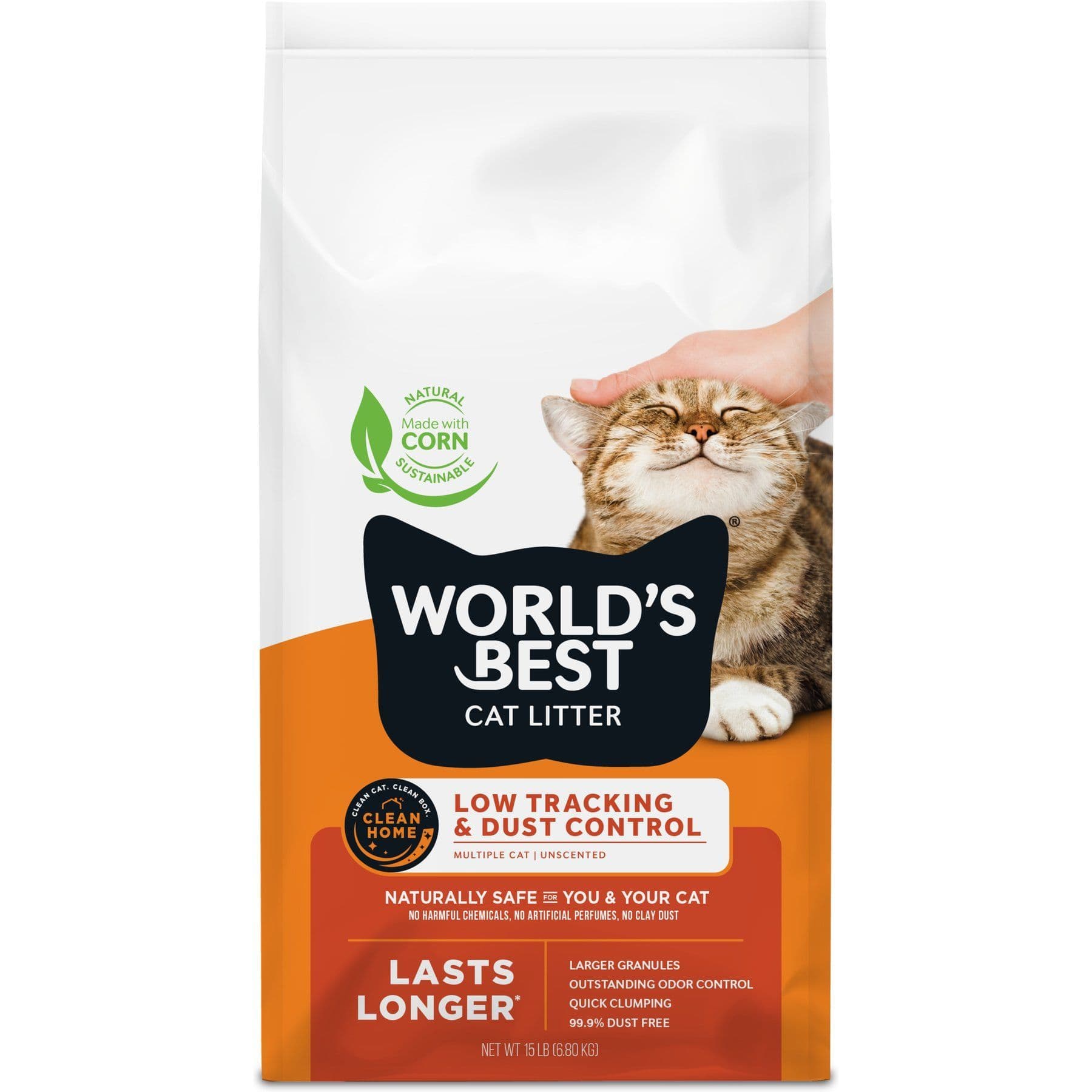
Larger corn granules that PetSmart says keep litter in the box, in an unscented multiple cat strength formula.
Webvet may earn a commission when you click through to Chewy, at no extra cost to you.
What it is made of and how to read the bag
Every litter in the line, from Comfort Care Unscented to the Multiple Cat formulas, shares one base: the products page says all are made in the USA with naturally absorbent corn. No full ingredient lists are published, so how the corn is processed is unknown, but the brand positions it as a corn alternative to sodium bentonite clay.
Shoppers often ask about the difference between the red and green bags. No source reviewed here maps bag colors to formulas, so at any pet store, go by the formula name printed on the front, such as Multiple Cat, Comfort Care, or Low Tracking & Dust Control, which tells you scent and granule size.
Clumping and scooping
The manufacturer says corn traps waste before it sticks to the box, and PetSmart's Low Tracking listing promises quick clumping with no chiseling. No published independent test of clump strength was found, and no source reviewed covers automatic boxes such as the Litter-Robot, so this assessment weighs the brand's claims against veterinary guidance on clumping litters.
Expect a firm clump that holds together when you scoop it promptly. Clumps left for long periods can crumble, so daily scooping matters. The Cornell Feline Health Center gives the same advice for any clumping litter: remove clumps daily and add clean litter as needed. Our clumping cat litter guide compares other brands.
Odor control
The odor mechanism is absorption: corn soaks up moisture and traps waste, and the homepage claims the litter is up to 60% more absorbent than traditional clay, against an unnamed leading U.S. brand. No independent check of that figure was found, and no published finding compares how well World's Best holds back ammonia odor against clay.
Our assessment, weighed against veterinary guidance on litter box hygiene: odor control holds for one or two cats with daily scooping but weakens in multi-cat boxes scooped less than daily. If odor is your main complaint, our guide to the best cat litter for odor control compares other options.
How long does World's Best Cat Litter last?
The brand advertises 30 days of performance from one bag but states no cat count or litter depth behind that number, and no independent test of bag life was found. Real-world life depends on your cat count, fill depth, and scooping habits. Cornell advises changing litter often enough that it looks and smells dry and clean.
SponsoredVet care that's always there
Unlimited video calls and messaging with licensed vets for less than a typical vet visit. One membership covers up to five pets.
Use code Pets60
Plans start at $12/month · covers up to 5 pets
- Licensed vets in most states
- Rx for 150+ conditions
- 4.7 on Trustpilot
Is World's Best Cat Litter flushable and is flushing a good idea?
The brand says yes, with conditions. Its homepage calls the litter "tested and proven flushable" and safe for septic and sewer systems, with an asterisk. The footnote to that flushable statement limits it to well-maintained systems and one or two clumps at a time. WebVet recommends bagging used litter instead.

Why vets and municipalities disagree with the flushable claim
The septic-system cautions and the Toxoplasma objections come from different places:
- Septic systems: the U.S. EPA tells septic owners never to flush cat litter, because it could clog the system and cause a failure. That directly contradicts a septic-safe label.
- The parasite: the CDC says cats play a key role in the spread of toxoplasmosis, the infection caused by Toxoplasma gondii.
- Sewage treatment: a UC Davis study reported by ScienceDaily found that primary and secondary sewage treatment may not kill Toxoplasma oocysts, which have a tough outer shell.
- Wildlife: the same study found Toxoplasma in 42 percent of live sea otters and 62 percent of dead ones.
The evidence is not one-sided. That study found no association with municipal sewage and linked otter infection to freshwater runoff from land, so sewage was not confirmed as the route. Sources disagree on how much household flushing matters, but none of the public-health guidance reviewed here endorses it.
Can you flush clumping cat litter?
Not as a routine, and never into a septic system. EPA lists cat litter among items septic owners should never flush, with no exception for clumping or corn types. Even World's Best, marketed as flushable, limits the claim to well-maintained systems and a clump or two at a time. The honest answer on routine flushing is no.
Bagging fits the parasite's timeline. The CDC says Toxoplasma in cat feces does not become infectious until 1 to 5 days after it is shed, so daily scooping removes waste before that point. A sealed disposal pail keeps bagged clumps contained until trash day; our Litter Genie review looks at one option.
World's Best formulas compared: Multi-Cat, Low Tracking, Scented, and Boosters
The differences between the Multi-Cat, Low Tracking, Scented, and Boosters products come down to granule size, scent, and multi-cat strength.
Multi-Cat Unscented
This is the default choice for most homes: the unscented, clumping type the ASPCA says most cats prefer. Its tagline, "More cats shouldn't mean more mess," promises mess control, but the products page gives no tracking, dust, or odor numbers. Chewy carries World's Best Multi-Cat Unscented Clumping Corn Cat Litter in the 28-lb bag.
Scented Multiple Cat
The scented multi-cat version is positioned on odor control; the brand promises lots of odor control and a little lavender. Chewy lists the 28-lb bag at $34.99, about $1.25 per pound. It suits homes where the box sits in a small room, as long as the cat accepts scent, since most cats prefer unscented litter.
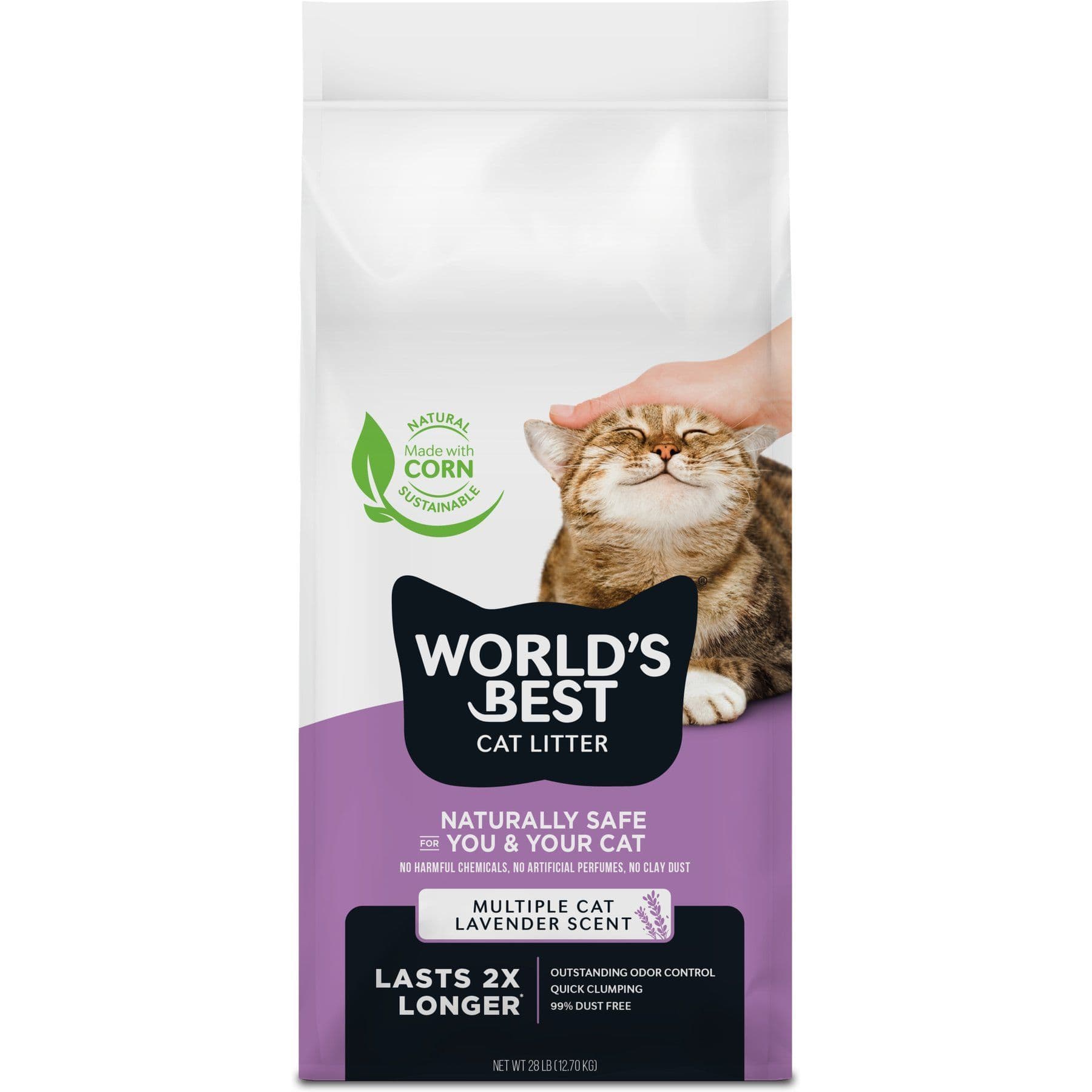
The lavender-scented multi-cat corn formula, for owners who want a light scent and a cat that accepts it.
Webvet may earn a commission when you click through to Chewy, at no extra cost to you.
Low Tracking & Dust Control
Choose this formula when scatter is the problem. The manufacturer positions it on low dust, and PetSmart calls it a multiple cat strength formula. Chewy lists the 15-lb bag at $19.15, about $1.28 per pound; PetSmart lists the 28-lb bag at $34.95, about $1.25 per pound. Watch a texture-sensitive cat on the larger granule.
Here is a formula-by-formula comparison table of all four products:
| Formula | Granule | Scent | Tracking | Multi-cat rating | Best for |
|---|---|---|---|---|---|
| Multi-Cat Unscented, 28-lb bag | Standard corn granules | Unscented | Standard; the lighter granule can travel | Built for multi-cat homes | Most cats, including multi-cat homes and cats that prefer unscented litter |
| Low Tracking & Dust Control, 15-lb or 28-lb bag | Larger corn granules | Unscented | Marketed as low tracking; larger granules stay in the box | Multiple cat strength formula | Homes where scatter or dust is the main complaint |
| Scented Multiple Cat, 28-lb bag | Standard corn granules | Lavender | Standard; the lighter granule can travel | Multiple cat formula aimed at odor control | Owners who want a light scent, with a cat that accepts it |
| Boosters Good Habits, 18-oz | Additive, not a litter | Plant-based herbal attractant | Not applicable | Added to existing litter in any home | Litter switches and cats that miss the box |
Boosters Good Habits
Boosters Good Habits is not a litter. The 18-oz additive is a plant-based herbal attractant meant to draw a cat to the box, according to a PetSmart Canada listing. Chewy lists it at $12.99. It is most useful for a picky cat during a litter switch.
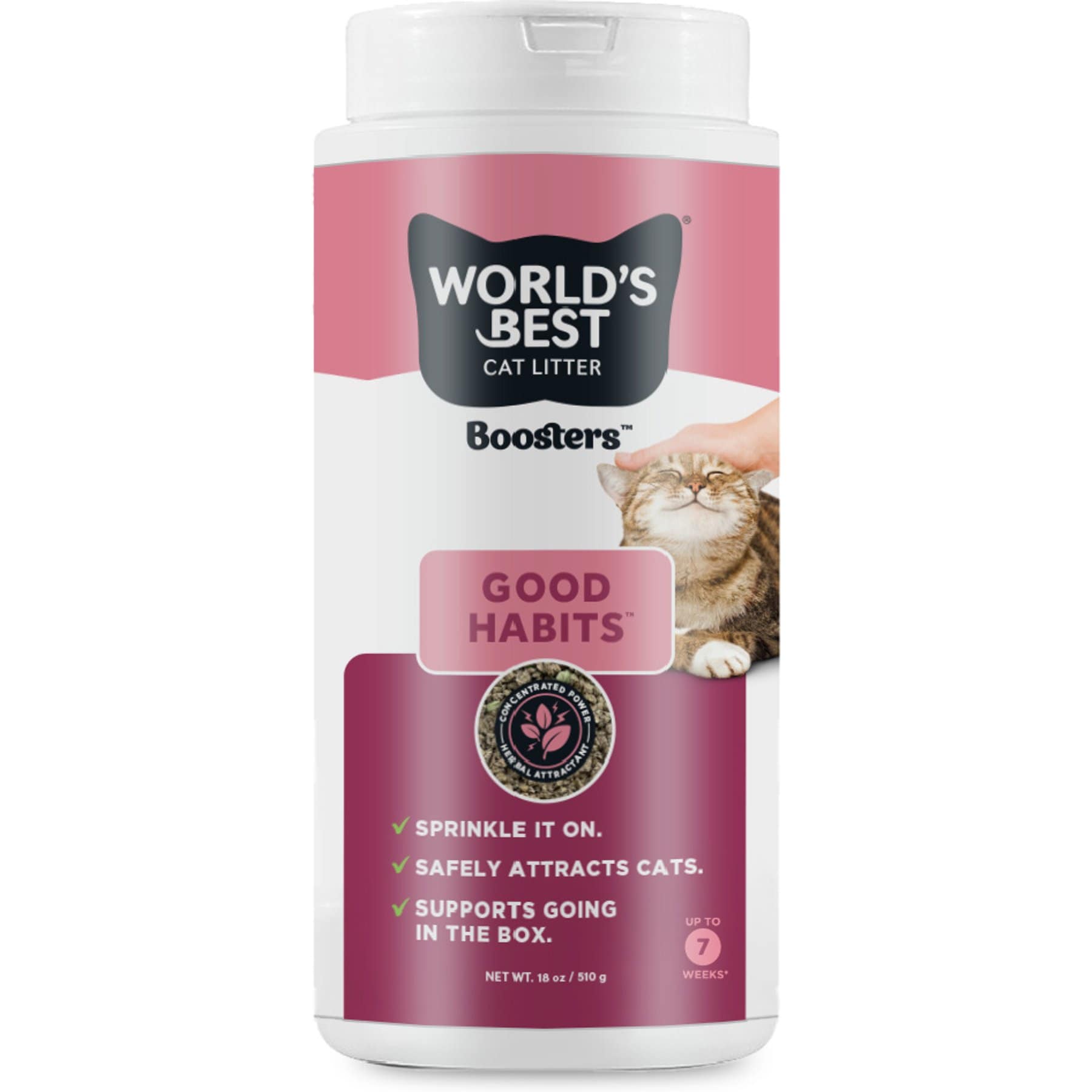
A plant-based herbal attractant added to the litter to help draw a cat back to the box during a switch.
Webvet may earn a commission when you click through to Chewy, at no extra cost to you.
Prices, bag sizes, and where to buy
The full lineup is broader than these four. The manufacturer lists:
- Litters: Comfort Care Unscented, Multiple Cat Unscented, Multiple Cat Lavender Scent, Multiple Cat Lotus Blossom Scent, Low Tracking & Dust Control, and Good Habits.
- Boosters additives: Health Check-In, Good Habits, and Poop Fighter.
Chewy and PetSmart both list the multi-cat formulas. Prices change with sales and coupons, so compare price per pound, not bag price; at the listed prices, a 28-lb bag works out to about $1.25 per pound.
Our assessment of value: the price per pound is higher than clay, but a 28-lb bag should last about as long as the same weight of clay for one cat, so the monthly cost difference is moderate rather than dramatic.
World's Best Cat Litter vs clay and other natural litters
Clay is still the benchmark. VCA Animal Hospitals says most cats seem to like clay clumping litter, typically sodium bentonite clay, so corn is an alternative, not a proven preference winner.
World's Best's case against clay rests on brand claims: corn is free of clay dust, it is up to 60% more absorbent than traditional clay, and it is made from USA-grown sustainable corn, which appeals to owners who want a green, plant-based litter.
Texture matters too. Cornell says most cats prefer unscented, finer-textured litter about one to two inches deep. That favors the unscented corn formulas and adds a question mark for the larger-granule Low Tracking version with a texture-sensitive cat.

How it compares with the litters shoppers most often weigh it against, in our assessment:
- Heavy clumping clay, such as Dr. Elsey's Ultra or Arm & Hammer: heavier granules that track less, but it is still clay, with more dust than corn by World's Best's account.
- Budget clay, such as Tidy Cats: cheaper per bag, but it carries the same clay-dust tradeoff, with more dust than a corn litter.
- Wood or paper litters, such as Okocat: plant-based like World's Best, with softer clumps.
If tracking is what is pushing you back toward clay, try World's Best Low Tracking & Dust Control Multiple Cat Litter before giving up on corn.
Which cats should stay on clay or a different natural litter:
- Cats that dig hard, and homes that scoop less than daily, may do better with a heavy clumping clay such as Dr. Elsey's Ultra.
- Cats raised on clay that resist change. The ASPCA notes cats usually develop litter type and scent preferences as kittens.
- Cats with a history of litter box aversion, for whom any switch carries risk.
- Owners who want the lowest dust with a softer texture can consider a paper or wood litter instead.
If you are still choosing a brand, which cat litter is best, and which to avoid, depends on the cat. VCA lists litter dust and perfume among possible asthma triggers, so very dusty or heavily scented litters are the usual ones to skip. Our best cat litter roundup compares the field.
The healthiest cat litter is a low-dust, unscented one your cat will reliably use. Our natural cat litter guide compares corn with other plant-based options.
Is World's Best safe for kittens and cats with respiratory issues?
For most cats, yes. It is plant-based, and its main advantage is low dust. The open questions are dust-sensitive airways and kittens, and the evidence is stronger for the first than for the second. This assessment weighs the litter's ingredient composition against veterinary guidance on respiratory irritants and on litter ingestion.
Cats with asthma or sensitive airways
VCA Animal Hospitals lists dust from cat litter, cigarette smoke, and perfume among possible feline asthma triggers, and suggests low-dust litter as part of management. The Cornell Feline Health Center lists dusty kitty litter among suspected allergens, while noting specific triggers often stay unidentified.
The Merck Veterinary Manual says avoiding environmental aeroallergens, dust included, must be considered in managing cats with feline asthma. That makes a plant-based, low dust litter a reasonable choice for cats with respiratory disease. Skip the scented formulas for these cats, because perfume is on VCA's trigger list.
For more options built around airways, see our low dust cat litter guide. Some owners suspect their cat is allergic to the litter itself; none of the sources reviewed here documents a corn litter allergy in cats. If new signs appear after a switch, go back to the old litter and talk to your vet.
Kittens and cats that eat litter
No primary veterinary source we found sets an age at which corn litter is safe for kittens. Secondary pet sites disagree on when clumping litter is appropriate, roughly 3 versus 4 months, and none of it is corn-specific. A plant-based, low dust litter is a reasonable choice for a kitten once your vet agrees on timing.
Ingestion is the other question owners ask about, usually after seeing a cat eating litter. No primary source describes what happens when a cat eats corn litter, so any litter eating in a kitten or adult cat warrants a vet visit rather than a brand change.
Being safe for your cat is also separate from being septic safe. EPA advises septic owners never to flush cat litter, whatever the label says.
How to switch a cat to World's Best without litter box accidents
The ASPCA notes that cats usually develop litter type and scent preferences as kittens, so a sudden swap from clay risks a refusal. The safer plan is a gradual transition: Cornell advises switching brands gradually by adding small amounts of new litter to the old.
For a reluctant or picky cat, World's Best Boosters Good Habits Unscented Cat Litter Additive is the brand's plant-based attractant for drawing a cat to the box. Its retail listing shows no directions text, so follow the package label.

How to transition a cat gradually, step by step:
- Keep the box at the depth your cat already uses; Cornell says most cats prefer about one to two inches.
- Mix a small amount of World's Best into the old litter, then raise the share gradually while your cat keeps using the box.
- If your cat hesitates, set up a second box beside the first, as the ASPCA suggests, and place an equal amount of each litter in each box, as VCA recommends for testing litter. Our stainless steel litter box guide covers one option for that second box.
- In multi-cat homes, keep as many boxes as cats plus one, per Cornell, and scoop daily so each box stays clean during the switch.
- Once your cat uses the new litter reliably, retire the old one.
When accidents mean a vet visit, not a litter problem
VCA defines litter box aversion as elimination that is never or rarely in a litter box. Cornell adds that any medical condition interfering with normal urination or defecation can cause litter box problems.
A cat that suddenly avoids the box needs a vet check before you blame the new litter. Our guide to cat peeing outside the litter box covers causes and next steps.
World's Best Cat Litter questions
Frequently Asked Questions
Does World's Best Cat Litter track less than clay?
Not in its standard formula. No source gives a measured tracking figure, but a lighter granule is easier for paws to carry out of the box than heavy clay. If tracking bothers you, switch to the larger-granule Low Tracking version and put a litter mat at the box exit to catch stray granules.
Is World's Best Cat Litter dusty?
Very little, by the brand's account; low dust is its strongest claim, though the printed dust-free percentages come with no published test method. Even a low-dust litter can release fine particles as it is poured, so pour slowly and close to the litter surface, ideally while your cat is out of the room.
Can World's Best Cat Litter grow mold or attract bugs?
No primary source we found documents mold or insect problems with corn litter specifically. Because it is plant-based, careful handling is sensible: keep unopened bags in dry storage off damp floors, move an opened bag's contents into a sealed container, and change litter often enough that it looks and smells dry and clean, as Cornell advises.
How much World's Best Cat Litter do I need per month?
No reliable published figure exists, because use depends on the number of cats, fill depth, and how often you scoop.
Depth is the lever you control. The ASPCA recommends one to two inches of litter rather than three to four, so filling to two to three inches uses more than you need. A 28-lb bag lasts longer at the shallower depth, and a home with several boxes goes through more.

Editor
The Webvet Editorial Team is the in-house group of pet-care editors and writers behind Webvet, operated by Smart Pet Collective. The team researches, writes, and maintains Webvet's pet health, behavior, and medication content. Every article follows a defined editorial process: research from reputable veterinary and scientific sources, careful drafting, mandatory review of medical content by a credentialed veterinarian, and dated publication. Health and medication articles are medically reviewed by a licensed veterinary professional before they go live and are kept current over time.
Veterinarian · BVMS MRCVS
Dr. Pippa Elliott, BVMS, MRCVS, is a veterinarian with nearly 30 years of experience in companion animal practice. Dr. Elliott earned her Bachelor of Veterinary Medicine and Surgery from the University of Glasgow. She was also designated a Member of the Royal College of Veterinary Surgeons. Married with 2 grown-up kids, Dr. Elliott has a naughty Puggle named Poggle, 3 cats and a bearded dragon.
Related reading

Litter Genie Review: Does It Really Work, What Refills Cost, and the Best Alternatives

Best Litter Box Enclosures and Litter Furniture: What Vets Say About Enclosed Boxes

Best Stainless Steel Litter Boxes: Vet-Reviewed Picks and Why They Beat Plastic
