Best Low Dust Cat Litter: 7 Vet-Checked Picks
Compare seven vet-reviewed low-dust litter picks, learn how pouring and scooping affect particles, and know when breathing changes need urgent veterinary care.

BVMS MRCVS
Medically reviewed by Dr. Pippa Elliott, BVMS MRCVS · Last reviewed

This article contains affiliate links. Webvet may earn a commission when you buy through them, at no extra cost to you.
Low dust cat litter reduces visible airborne particles compared with dustier formulas, but no loose litter should be assumed literally dust-free. Material, manufacturing fines, bag handling, pouring height, scooping, and vigorous digging all affect what becomes airborne.
Our seven picks represent soft wood, clumping clay, silica crystal, corn, grass, recycled paper, and pine. Catalyst Pet Multi-Cat leads with a very-low-dust soft-wood formula; Dr. Elsey's Ultra Unscented is the lower-dust clay option; PrettyLitter Health Monitoring adds a crystal comparison; World's Best Multi-Cat Unscented supplies a corn-based route; SmartCat Unscented Clumping Grass adds lightweight grass; Fresh News Unscented Non-Clumping Paper adds recycled-paper pellets; and Feline Pine Original adds pine pellets.
- 1Treat low dust as a relative performance claim, not a guarantee of zero airborne particles.
- 2Pour slowly near the box surface, refill while the cat is elsewhere, and damp-wipe settled dust.
- 3Material matters, but two products made from the same material can release different amounts of fines.
- 4A low-dust litter can support a cleaner setup; it does not treat feline asthma or other respiratory disease.
- 5Coughing, wheezing, rapid breathing, increased effort, or open-mouth breathing requires veterinary attention.
 Sponsored
Have a health question about your cat?
Talk to a licensed vet at Dutch over video or message, including nights and weekends.
Use code Pets60
Plans start at $12/month · covers up to 5 pets
- Licensed vets in most states
- Rx for 150+ conditions
- 4.7 on Trustpilot
The best low-dust cat litter at a glance
Keeping cat litter from being dusty starts with a lower-fines product and continues with careful handling. These seven products cover distinct material and cleanup preferences:
- Catalyst Pet Multi-Cat: Best overall low-dust litter. The very-low-dust offer claim and lightweight soft wood directly address filling, scooping, and carrying.
- Dr. Elsey's Ultra Unscented: Best low-dust clay. The documented 99% dust-free position gives clay-preferring cats a lower-dust route.
- PrettyLitter Health Monitoring: Best low-dust crystal. Large absorbent crystals provide a distinct low-visible-dust comparison with a monitoring prompt.
- World's Best Multi-Cat Unscented: Best low-dust natural option. Corn granules add a plant-based alternative whose dust and tracking can be tested at home.
- SmartCat Unscented Clumping Grass: Best lightweight grass option. The lightweight grass formula offers a clay-free candidate for a controlled dust and tracking trial.
- Fresh News Unscented Non-Clumping Paper: Best paper pellet. Larger recycled-paper pellets provide an unscented non-clumping alternative to loose fine granules.
- Feline Pine Original: Best pine pellet. The non-clumping pine-pellet format offers a materially different low-fines comparison.
| Pick | Material | Format | Best fit | Main tradeoff |
|---|---|---|---|---|
| Catalyst Pet Multi-Cat | Upcycled soft wood fiber | Clumping soft fiber | Low-dust lightweight handling | Fibrous texture and light tracking |
| Dr. Elsey's Ultra Unscented | Bentonite clumping clay | Unscented clumping | Balanced everyday clay | Heavy bag and fine-granule tracking |
| PrettyLitter Health Monitoring | Silica crystal | Non-clumping crystal | Moisture control and color prompt | Different texture and cleanup routine |
| World's Best Multi-Cat Unscented | Corn | Unscented clumping | Corn-based alternative | Dry storage and texture acceptance |
| SmartCat Unscented Clumping Grass | Grass | Unscented clumping | Lightweight grass-based option | Light-granule tracking and storage |
| Fresh News Unscented Non-Clumping Paper | Recycled paper | Unscented non-clumping pellets | Recycled-paper pellet preference | Saturation and broader replacement |
| Feline Pine Original | Pine wood | Non-clumping pellets | Pine-pellet preference | Rigid texture and wet breakdown |
No ranking can guarantee the least dusty result in every bag and home. Shipping abrasion, product depth, room airflow, cat digging, and material breakdown change exposure. The best current pick is therefore the accepted formula that produces the least visible dust under the household's normal controlled technique.
What low-dust cat litter really means
Low dust is a relative product and handling description, not a medical or allergy certification. A person with dust allergies should review exposure with a healthcare professional and avoid assuming a pet-product percentage predicts human symptoms. For the cat, coughing, wheezing, rapid breathing, or effort needs veterinary evaluation.
Is there a true dust free cat litter? Loose granules can generate some particles through abrasion, pouring, scooping, and digging. Large paper pellets or crystals may show less visible cloud than fine clay, but each introduces different moisture, texture, and cleanup tradeoffs.
How we chose low-dust cat litter
We required a credible material or offer-level reason for each low-dust position and then examined the rest of the use case. Dust is not the only outcome: the cat still needs to accept the texture, the litter needs to manage moisture, and the household needs a workable scooping and disposal routine.
We did not treat percentages from different manufacturers as laboratory comparisons. A 99% dust-free claim and a very-low-dust description may use different methods, samples, and thresholds. They are useful product attributes, but your controlled home trial supplies the comparable evidence.
WebVet selected these exact formulas from current product documentation, retailer availability, customer-demand evidence, and veterinary-reviewed fit and safety criteria. We did not conduct controlled dust testing, so every product still needs the same careful pour, scoop, bottom-of-bag check, and cat-acceptance trial at home.
Our 7 best low-dust cat litter picks
Best overall low-dust litter: Catalyst Pet Multi-Cat
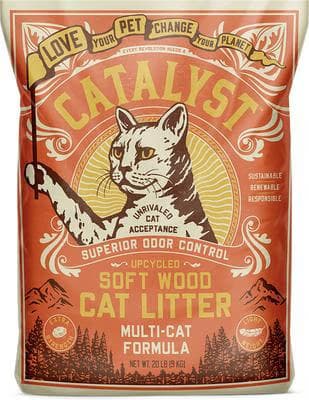
Upcycled soft-wood cat litter with superior odor control, very low dust, and a simple natural composition (no clay, no synthetic fragrance) - a gentler box for cats that nibble at their litter.
Webvet may earn a commission when you click through to Chewy, at no extra cost to you.
Catalyst Pet Multi-Cat is our best overall low-dust litter choice because the current product description documents very low dust, soft wood fiber, and no synthetic fragrance. Its upcycled soft wood fiber material and lightweight clumping fiber with no synthetic fragrance format give it a specific job in this airborne dust and handling comparison rather than a claim to be best for every cat.
The very-low-dust offer claim and lightweight soft wood directly address filling, scooping, and carrying. The result still depends on normal box use, so watch whether the cat enters, digs, eliminates, covers, and returns without hesitation.
Catalyst combines its low-dust position with a bag that is much easier to lift than dense clay. Pour close to the box and avoid shaking the scoop, because even a low-dust loose material can release fines through rough handling. The important home test is whether the cat accepts the soft wood texture without digging or exit behavior changing.
Catalyst Pet Multi-Cat: strengths and tradeoffs
Pros
- The current product description documents very low dust, soft wood fiber, and no synthetic fragrance.
- Best for households prioritizing low-dust lightweight handling whose cats will accept a soft wood texture.
Cons
- The light fibrous texture differs from clay, may travel on long fur, and can produce a different clump feel.
- Skip it if your cat strongly prefers fine clay, lightweight fibers collect on long paw fur, or the household dislikes a softer wood-fiber clump.
- Use it well: Pour slowly because even a low-dust loose material can release fines.
- Use it well: Watch long paw fur and the exit mat for light fiber tracking.
- Use it well: Test scoop openings against the fiber size without vigorous shaking.
Best low-dust clay: Dr. Elsey's Ultra Unscented
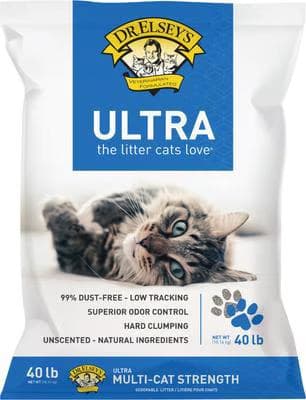
99% dust-free, low-tracking clumping clay litter with superior odor control and hard clumping. Unscented, natural ingredients, multi-cat strength.
Webvet may earn a commission when you click through to Chewy, at no extra cost to you.
Dr. Elsey's Ultra Unscented is our best low-dust clay choice because it combines a familiar fine texture with unscented clumping and a documented low-dust position. Its bentonite clumping clay material and unscented hard-clumping granules format give it a specific job in this airborne dust and handling comparison rather than a claim to be best for every cat.
The documented 99% dust-free position gives clay-preferring cats a lower-dust route. The result still depends on normal box use, so watch whether the cat enters, digs, eliminates, covers, and returns without hesitation.
This is the clay option for a reader who wants to preserve fine, familiar granules while reducing visible pouring dust. It still deserves a controlled test: bag transport, pouring height, and vigorous scooping can change what becomes airborne. The dense bag and tracked fine grains remain separate tradeoffs.
Dr. Elsey's Ultra Unscented: strengths and tradeoffs
Pros
- It combines a familiar fine texture with unscented clumping and a documented low-dust position.
- Best for adult cats that already accept fine clumping clay and households seeking a balanced fragrance-free baseline.
Cons
- Clay is dense to lift and discard, fine granules can track, and the material does not answer households seeking a plant-based substrate.
- Skip it if lifting and discarding dense clay is difficult, your cat tracks fine granules heavily, or you specifically want a plant-based substrate.
- Use it well: Maintain enough depth to keep urine from bonding to the box floor.
- Use it well: Allow a fresh clump to set before lifting it from underneath.
- Use it well: Compare dust through the full bag because shipping fines can settle.
Best low-dust crystal: PrettyLitter Health Monitoring
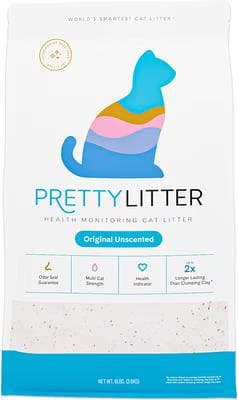
Crystal litter that changes color alongside some urinary changes, as a prompt to call your vet.
Webvet may earn a commission when you click through to Chewy, at no extra cost to you.
PrettyLitter Health Monitoring is our best low-dust crystal choice because it adds moisture absorption and an observational color feature that can prompt a veterinary call. Its silica crystal material and non-clumping absorbent crystals with a color-change prompt format give it a specific job in this airborne dust and handling comparison rather than a claim to be best for every cat.
Large absorbent crystals provide a distinct low-visible-dust comparison with a monitoring prompt. The result still depends on normal box use, so watch whether the cat enters, digs, eliminates, covers, and returns without hesitation.
PrettyLitter avoids the daily clay-clump routine because its crystals absorb urine and are stirred according to the current directions. That can mean less visible powder during ordinary scooping, but crystal texture is a significant change for some cats. Its color chart is an observation aid only and cannot diagnose or exclude urinary disease.
PrettyLitter Health Monitoring: strengths and tradeoffs
Pros
- It adds moisture absorption and an observational color feature that can prompt a veterinary call.
- Best for adult cats that accept crystal texture and owners who understand that a persistent color change requires veterinary interpretation.
Cons
- Crystals feel different from fine clumping litter, the product does not create removable urine clumps, and color cannot diagnose disease.
- Skip it if your cat rejects crystal texture, you want removable urine clumps, or anyone in the home may mistake the color chart for a veterinary diagnosis.
- Use it well: Read the current color chart and directions before the first use.
- Use it well: Treat persistent or concerning change as a reason to call, not self-diagnose.
- Use it well: Do not use color to rule out illness when symptoms are present.
SponsoredVet care that's always there
Unlimited video calls and messaging with licensed vets for less than a typical vet visit. One membership covers up to five pets.
Use code Pets60
Plans start at $12/month · covers up to 5 pets
- Licensed vets in most states
- Rx for 150+ conditions
- 4.7 on Trustpilot
Best low-dust natural option: World's Best Multi-Cat Unscented
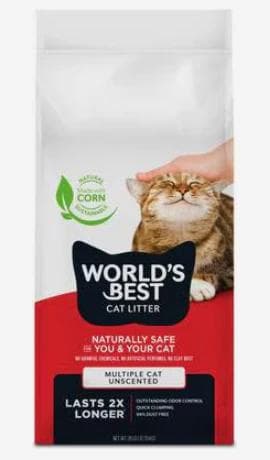
Webvet may earn a commission when you click through to Chewy, at no extra cost to you.
World's Best Multi-Cat Unscented is our best low-dust natural option choice because it provides a direct corn-based clumping alternative with an unscented multi-cat formula. Its corn material and unscented plant-based clumping granules format give it a specific job in this airborne dust and handling comparison rather than a claim to be best for every cat.
Corn granules add a plant-based alternative whose dust and tracking can be tested at home. The result still depends on normal box use, so watch whether the cat enters, digs, eliminates, covers, and returns without hesitation.
World's Best supplies a lighter corn comparison for readers who want plant-based clumping. Its useful question is not whether corn is categorically cleaner than clay, but whether this exact bag pours with fewer visible fines in the reader's setup. Keep it sealed from moisture and compare tracking on the same mat.
World's Best Multi-Cat Unscented: strengths and tradeoffs
Pros
- It provides a direct corn-based clumping alternative with an unscented multi-cat formula.
- Best for cats that accept plant granules and households that want clumping performance without a clay substrate.
Cons
- Corn needs dry sealed storage, the natural material odor and texture may be unfamiliar, and lightweight granules can track.
- Skip it if you cannot keep a plant-based litter sealed and dry, your cat rejects the corn texture or raw-material smell, or lightweight tracking is a persistent problem.
- Use it well: Store the bag sealed and discard material that becomes damp or abnormal.
- Use it well: Introduce the corn texture beside the familiar box rather than forcing it.
- Use it well: Evaluate clump strength only after the product's normal setting time.
Best lightweight grass option: SmartCat Unscented Clumping Grass
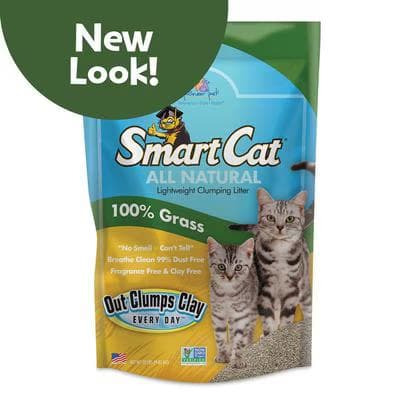
Unscented grass-based clumping litter for cats, with a lightweight clay-free formula.
Webvet may earn a commission when you click through to Chewy, at no extra cost to you.
SmartCat Unscented Clumping Grass is our best lightweight grass option choice because it combines a clay-free grass material with unscented clumping and lightweight handling. Its grass material and lightweight unscented clumping granules format give it a specific job in this airborne dust and handling comparison rather than a claim to be best for every cat.
The lightweight grass formula offers a clay-free candidate for a controlled dust and tracking trial. The result still depends on normal box use, so watch whether the cat enters, digs, eliminates, covers, and returns without hesitation.
SmartCat Unscented Clumping Grass fills a distinct airborne dust and handling role because its grass material and lightweight unscented clumping granules format change the texture, cleanup, handling, or storage decision. Trial the exact formula beside the familiar litter and judge normal box use before changing every box.
SmartCat Unscented Clumping Grass: strengths and tradeoffs
Pros
- It combines a clay-free grass material with unscented clumping and lightweight handling.
- Best for cats that accept fine plant granules and households prioritizing a lightweight unscented clumper.
Cons
- Light granules can travel beyond the box, the texture differs from clay, and plant material needs dry storage.
- Skip it if lightweight granules track heavily in your setup, your cat rejects grass texture, or dry storage is unreliable.
- Use it well: Use the same mat and cleaning interval when comparing lightweight tracking.
- Use it well: Keep the bag sealed and dry between refills.
- Use it well: Give clumps time to set and lift them from underneath.
Best paper pellet: Fresh News Unscented Non-Clumping Paper
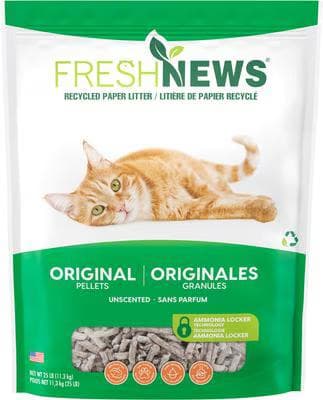
Unscented recycled-paper pellet litter for cats that does not clump.
Webvet may earn a commission when you click through to Chewy, at no extra cost to you.
Fresh News Unscented Non-Clumping Paper is our best paper pellet choice because it provides a recycled-paper, unscented pellet option that is genuinely different from fine clumping granules. Its recycled paper material and unscented non-clumping pellets format give it a specific job in this airborne dust and handling comparison rather than a claim to be best for every cat.
Larger recycled-paper pellets provide an unscented non-clumping alternative to loose fine granules. The result still depends on normal box use, so watch whether the cat enters, digs, eliminates, covers, and returns without hesitation.
Fresh News Unscented Non-Clumping Paper fills a distinct airborne dust and handling role because its recycled paper material and unscented non-clumping pellets format change the texture, cleanup, handling, or storage decision. Trial the exact formula beside the familiar litter and judge normal box use before changing every box.
Fresh News Unscented Non-Clumping Paper: strengths and tradeoffs
Pros
- It provides a recycled-paper, unscented pellet option that is genuinely different from fine clumping granules.
- Best for cats that accept paper pellets and households that prefer unscented non-clumping cleanup.
Cons
- The pellets do not form urine clumps, saturated material can require broader replacement, and some cats reject the larger texture.
- Skip it if your cat rejects larger paper pellets, you need removable urine clumps, or frequent saturated-area replacement is impractical.
- Use it well: Remove stool daily and replace wet or saturated areas according to the current label.
- Use it well: Track the full-change interval because urine does not form a removable clump.
- Use it well: Offer the paper pellets in a second box before changing an established setup.
Best pine pellet: Feline Pine Original
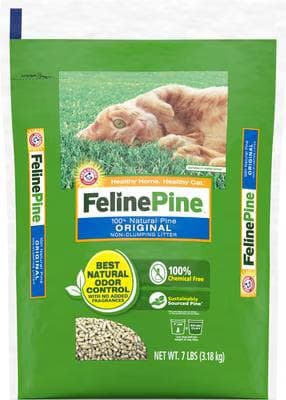
Non-clumping wood-pellet litter made from natural pine for cats.
Webvet may earn a commission when you click through to Chewy, at no extra cost to you.
Feline Pine Original is our best pine pellet choice because it adds a widely established pine-pellet option with a simple non-clumping format. Its pine wood material and non-clumping wood pellets format give it a specific job in this airborne dust and handling comparison rather than a claim to be best for every cat.
The non-clumping pine-pellet format offers a materially different low-fines comparison. The result still depends on normal box use, so watch whether the cat enters, digs, eliminates, covers, and returns without hesitation.
Feline Pine Original fills a distinct airborne dust and handling role because its pine wood material and non-clumping wood pellets format change the texture, cleanup, handling, or storage decision. Trial the exact formula beside the familiar litter and judge normal box use before changing every box.
Feline Pine Original: strengths and tradeoffs
Pros
- It adds a widely established pine-pellet option with a simple non-clumping format.
- Best for cats that accept larger wood pellets and households comfortable with non-clumping maintenance.
Cons
- Rigid pellets feel different from sand-like litter, wet pellets break down rather than clump, and pine has a noticeable raw-material odor.
- Skip it if your cat dislikes rigid pellets, you need removable urine clumps, or the pine material odor is unwelcome.
- Use it well: Remove stool daily and replace saturated or broken-down pellets on schedule.
- Use it well: Use a second box so the cat can choose between pellets and the familiar texture.
- Use it well: Compare paw comfort carefully for kittens, seniors, and mobility-limited cats.
How to compare low-dust claims before you buy
Treat every dust percentage or low-dust phrase as evidence about that exact formula, not as a universal laboratory ranking. Manufacturers may use different samples, transport conditions, measuring equipment, and particle thresholds. Confirm the product name, material, fragrance statement, and current bag directions, then compare visible dust in the same room with the same pouring height, box depth, scoop, and cleaning routine.
Inspect more than the first pour. Fine material can settle at the bottom of a bag during shipping, and lightweight granules can break down after repeated digging. Record visible clouds during filling, residue on nearby hard surfaces, material collected during damp cleaning, and whether the cat's behavior changes. Stop the trial and contact a veterinarian when coughing, wheezing, rapid breathing, or increased effort appears.
Which cat litter materials create the least dust?
| Material | Potential low-dust advantage | What can still create particles | Other tradeoffs |
|---|---|---|---|
| Soft wood fiber | Light fibers can be screened for low fines | Broken fibers and rough pouring | Different texture, light tracking |
| Clumping clay | Dense granules and dust-control processing | Fines from transport and aggressive scooping | Heavy bags, mining footprint |
| Silica crystal | Large porous crystals often create little visible cloud | Broken crystals and bag fines | Texture acceptance, non-clumping format |
| Corn | Coarser lightweight granules | Abrasion, storage damage, vigorous digging | Plant odor, dry-storage need |
| Paper pellets | Large fiber pellets commonly release little dust | Pellet breakdown when saturated | Usually non-clumping |

Why cat litter gets dusty
Manufacturing and bag transport
Screening removes small particles during production, but abrasion continues as bags are filled, stacked, shipped, dropped, and carried. Fine material can settle at the bottom even when the first pours look clean. Compare a product across the whole bag, not only the top layer.
Store the bag upright and dry. Repeatedly rolling or crushing a partially used bag can create more fines. If you transfer litter, pour gently into a sealed container and retain the label and lot information.
How to pour and scoop litter with less dust
A high stream gives particles time to separate and become airborne. Lower the container near the empty box and pour slowly. Keep the cat out of the room during a full refill, allow particles to settle, and ventilate without aiming a fan across the box.
During daily care, slide the scoop rather than whipping it back and forth. Shake only enough to return clean granules. Empty waste close to the bag opening so clumps do not fall through a long dusty path.
What can you use instead of a litter mat? A longer washable runner, a smooth hard-floor route that can be damp-cleaned, or a stable low-pile utility rug may capture particles without an abrasive plastic surface. Avoid unstable, looped, strongly scented, or difficult-to-clean materials, and never block an older cat's accessible entry.

Digging and litter depth
Some cats dig with great force or excavate to the box floor. Too much depth can increase the amount thrown and stirred; too little can make urine adhere to the bottom and require vigorous scraping. Begin with the product directions and adjust within a comfortable range while watching the cat's normal behavior.
High sides may contain scattered granules, but the entry must remain accessible. A covered box can trap odor and dust and may feel cramped, so it is not a universal respiratory solution.
When to call a veterinarian about coughing or breathing
Asthma is an inflammatory airway disease diagnosed and treated by a veterinarian. Environmental irritants can matter, but changing litter cannot confirm the cause of a cough or replace medication. Cats may cough in a crouched posture that owners mistake for a hairball attempt, and respiratory signs can also arise from other serious conditions.
Record a short video if it can be done without stressing the cat, note the breathing rate and context, and contact the veterinary team. Do not force the cat near a dusty box to reproduce the event. Follow the treatment and environmental plan given for that individual cat.

There is no true dust-free guarantee that makes ongoing respiratory signs safe to monitor at home. Move the cat away from airborne particles, minimize stress, and call the veterinary team. Open-mouth breathing, blue or pale gums, collapse, or obvious effort is an emergency. A litter switch may later support the treatment plan, but it is not the treatment.
What to observe at home
- Visible cloud during filling or scooping, including whether it worsens near the bottom of the bag.
- Dust film on the box rim, nearby floor, furniture, or the cat's paws and coat.
- Coughing, wheezing, rapid breathing, or a changed resting posture before, during, or after box use.
- Litter avoidance, perching, shortened digging, or choosing a different box.
- Changes in urine or stool that may explain repeated box visits independently of dust.
How to test a new low-dust litter at home
Set up a second clean box with the candidate litter and keep the accepted box available. Use comparable box dimensions, depth, location, and cleaning frequency. This protects litter-box reliability and lets you compare visible dust without forcing the new texture.
Take a photo of the surrounding floor and rim immediately after cleaning. Recheck at the same time each day. Note pouring dust, settled film, tracked particles, clump quality, odor, and the cat's choice. Do not create artificial dust clouds or shake litter to test it.

A fair comparison needs the same handling
Pouring one product from shoulder height and another from a scoop invalidates the result. Use the same container, distance, box, depth, and maintenance rhythm. Compare across several refills because the concentration of fines can change through the bag.
If the low-dust formula creates weaker clumps or more tracking, decide which tradeoff is manageable. A mat, slower scoop, or adjusted depth may solve a minor secondary issue. Cat avoidance or breathing signs are reasons to stop the trial.
How to keep dust from building up around the box
Move the cat away before cleanup. Damp-wipe hard surfaces so particles are captured rather than swept into the air. A vacuum with effective filtration can help, but empty or service it according to the manufacturer and away from the cat. Avoid aerosol cleaners and strong fragrances around the box.
Wear a well-fitting mask if household dust exposure is a concern for you, wash hands after handling waste, and clean the scoop and box on an appropriate schedule. Replace cracked plastic that holds residue. Ventilate the room without creating a strong draft across loose litter.
Place a washable mat beyond the exit, not underneath an unstable box. Launder or damp-clean it before accumulated fines are kicked back into the air. Wipe the box rim, nearby baseboard, and storage-bin lid on a regular schedule. If visible dust returns immediately after every cleaning, compare the bottom of the bag with the top and consider ending the product trial.
Keep unopened and open litter away from furnace returns, fans, and the cat's sleeping or feeding area. A quiet room with ordinary air exchange is preferable to a strong airflow across the substrate. Store cleaning tools separately from kitchen and grooming supplies, and do not use compressed air to clear granules from automatic-box parts.

Compare the best cat litter roundup, clumping cat litter guide, unscented litter guide, and natural litter guide when dust is only one part of the decision.
Low-dust cat litter questions
Frequently Asked Questions
Which cat litter is the least dusty?
Catalyst is our best current soft-wood low-dust match, while Dr. Elsey's Ultra is the clay alternative. No formula is guaranteed least dusty in every home because shipping, pouring, scooping, and digging affect particles. Compare candidates with identical handling.
What litter is best for a cat with asthma?
Ask the treating veterinarian. A low-dust, unscented formula may be one part of an environmental plan, but asthma needs diagnosis and medical treatment. Open-mouth breathing or obvious respiratory distress is an emergency.
Is crystal litter low dust?
Many crystal formulas produce little visible airborne dust, but broken granules and bag fines can still occur. Texture, moisture handling, cost, and cat acceptance also need evaluation.
Sources
Veterinary guidance used for this low-dust litter guide includes the AAFP and ISFM house-soiling guidelines, the AAFP and ISFM feline environmental-needs guidelines, and AAHA general litter-box considerations. Product selection remains an editorial judgment based on each exact formula's documented material and performance attributes.
Respiratory safety language also references the Cornell Feline Health Center asthma guide.

Editor
The Webvet Editorial Team is the in-house group of pet-care editors and writers behind Webvet, operated by Smart Pet Collective. The team researches, writes, and maintains Webvet's pet health, behavior, and medication content. Every article follows a defined editorial process: research from reputable veterinary and scientific sources, careful drafting, mandatory review of medical content by a credentialed veterinarian, and dated publication. Health and medication articles are medically reviewed by a licensed veterinary professional before they go live and are kept current over time.
Veterinarian · BVMS MRCVS
Dr. Pippa Elliott, BVMS, MRCVS, is a veterinarian with nearly 30 years of experience in companion animal practice. Dr. Elliott earned her Bachelor of Veterinary Medicine and Surgery from the University of Glasgow. She was also designated a Member of the Royal College of Veterinary Surgeons. Married with 2 grown-up kids, Dr. Elliott has a naughty Puggle named Poggle, 3 cats and a bearded dragon.
Related reading

Ruffwear Polar Trex Review: Winter Dog Boots for Snow, Ice, and Salt

Canada Pooch Dog Boots Review: Soft Shield, Hot Pavement, and Suspender Fit

Pawz Dog Boots Review: Rubber Balloon Boots for Salt, Heat, and Hardwood
