Best Cat Litter: 8 Vet-Checked Picks
Compare eight vet-reviewed cat litter picks for clumping, low dust, low tracking, natural materials, fragrance-free use, pellets, odor control, and monitoring prompts.

BVMS MRCVS
Medically reviewed by Dr. Pippa Elliott, BVMS MRCVS · Last reviewed

This article contains affiliate links. Webvet may earn a commission when you buy through them, at no extra cost to you.
The best cat litter is the one your cat reliably accepts and your household can keep clean. For many adult cats, a fine-grained, unscented clumping litter is a practical starting point, but there is no universal winner. Dust, tracking, odor control, fragrance, clump strength, bag weight, disposal, and material preferences can change the right choice.
Our eight picks cover distinct jobs rather than pretending every product solves the same problem. Dr. Elsey's Ultra Unscented leads as the balanced general-purpose option; World's Best Multi-Cat Unscented supplies a corn-based natural choice; Catalyst Pet Multi-Cat emphasizes low-dust soft wood; PrettyLitter Health Monitoring adds a health-monitoring prompt; Scoop Away Complete Performance targets scented multi-cat odor control; Tidy Cats Free & Clean Unscented offers a straightforward unscented clay alternative; Dr. Elsey's Clean Tracks focuses on tracked granules; and Feline Pine Original adds a non-clumping pine-pellet choice.
- 1Start with cat acceptance: normal entry, digging, elimination, covering, and return visits outrank owner-only preferences.
- 2For many adult cats, fine-grained unscented clumping litter is a useful baseline, not a rule that overrides an individual cat's history.
- 3Compare dust, tracking, fragrance, clump strength, odor management, weight, disposal, and cost per usable day.
- 4Switch gradually or offer a second box so the cat can choose; do not remove a reliably used litter overnight.
- 5A health-monitoring color change is a prompt to contact a veterinarian, not a diagnosis.
 Sponsored
Have a health question about your cat?
Talk to a licensed vet at Dutch over video or message, including nights and weekends.
Use code Pets60
Plans start at $12/month · covers up to 5 pets
- Licensed vets in most states
- Rx for 150+ conditions
- 4.7 on Trustpilot
Our picks at a glance
There is no single litter most recommended by every veterinarian because the cat, the box, the home, and the medical context all matter. A veterinarian is more likely to prioritize reliable box use, a clean setup, a texture the cat accepts, and the absence of avoidable irritants than to prescribe one retail brand to every patient.
- Dr. Elsey's Ultra Unscented: Best overall. Its unscented hard-clumping clay offers the broadest balance of scoopability, familiarity, and low-dust positioning in the current slate.
- World's Best Multi-Cat Unscented: Best natural. Its corn formula provides the most direct plant-based clumping alternative among the exact current offers.
- Catalyst Pet Multi-Cat: Best low dust. The offer's very-low-dust soft-wood position directly matches the use case without presenting litter as respiratory treatment.
- PrettyLitter Health Monitoring: Best health-monitoring feature. Its crystal color prompt gives owners an additional observation while maintaining a firm boundary against diagnosis.
- Scoop Away Complete Performance: Best scented multi-cat option. Its defined multi-cat odor role is useful for households that already know their cats accept added fragrance.
- Tidy Cats Free & Clean Unscented: Best straightforward unscented clay. Its fragrance-free identity covers the core clay job without requiring a specialty material or monitoring feature.
- Dr. Elsey's Clean Tracks: Best low-tracking clay. Its exact unscented hard-clumping formula is designed to reduce the granules carried away from the box.
- Feline Pine Original: Best non-clumping pellet. Its established pine-pellet format gives pellet-preferring cats a distinct non-clumping option.
| Pick | Material | Format | Best fit | Main tradeoff |
|---|---|---|---|---|
| Dr. Elsey's Ultra Unscented | Bentonite clumping clay | Unscented clumping | Balanced everyday clay | Heavy bag and fine-granule tracking |
| World's Best Multi-Cat Unscented | Corn | Unscented clumping | Corn-based alternative | Dry storage and texture acceptance |
| Catalyst Pet Multi-Cat | Upcycled soft wood fiber | Clumping soft fiber | Low-dust lightweight handling | Fibrous texture and light tracking |
| PrettyLitter Health Monitoring | Silica crystal | Non-clumping crystal | Moisture control and color prompt | Different texture and cleanup routine |
| Scoop Away Complete Performance | Clumping clay | Scented clumping | Multi-cat odor control | Added fragrance and clay weight |
| Tidy Cats Free & Clean Unscented | Clumping clay | Unscented clumping | Straightforward fragrance-free clay | Clay weight, dust, and tracking |
| Dr. Elsey's Clean Tracks | Bentonite clumping clay | Unscented hard clumping | Reduced-tracking clay | Heavy bag and remaining fines |
| Feline Pine Original | Pine wood | Non-clumping pellets | Pine-pellet preference | Rigid texture and wet breakdown |

How we chose these cat litters
We first defined the job each product needs to do. An overall pick should balance acceptance, scoopability, dust, fragrance, and routine availability. A natural pick needs a clearly identified plant or wood material. A low-dust pick needs a documented low-dust position plus handling that does not create unnecessary airborne particles. A health-monitoring pick needs careful language that separates an observation from a medical conclusion.
We then matched those jobs to exact formulas, not broad brand families. The product name behind each button is fixed so a scented, lightweight, crystal, or differently sized variant cannot silently replace the reviewed item. We also avoid rankings based on star ratings alone because review populations, formulas, and expectations change.
WebVet selected these formulas from current product documentation, retailer availability, customer-demand evidence, and veterinary-reviewed fit and safety criteria. We did not conduct controlled hands-on product testing, so manufacturer performance claims are reasons to trial a formula, not directly comparable laboratory results.
No litter was treated as risk-free. Loose materials can create some dust, tracked granules can be swallowed during grooming, fragrance can affect acceptance, and plant-based products require dry storage. We considered how a reader can trial the product, observe the cat, and reverse course without destabilizing litter-box habits.
The 8 best cat litters
Best overall: Dr. Elsey's Ultra Unscented
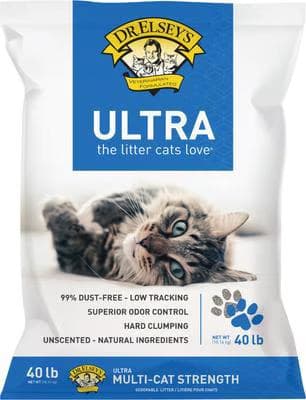
99% dust-free, low-tracking clumping clay litter with superior odor control and hard clumping. Unscented, natural ingredients, multi-cat strength.
Webvet may earn a commission when you click through to Chewy, at no extra cost to you.
Dr. Elsey's Ultra Unscented is our best overall choice because it combines a familiar fine texture with unscented clumping and a documented low-dust position. Its bentonite clumping clay material and unscented hard-clumping granules format give it a specific job in this best cat litter comparison rather than a claim to be best for every cat.
Its unscented hard-clumping clay offers the broadest balance of scoopability, familiarity, and low-dust positioning in the current slate. The result still depends on normal box use, so watch whether the cat enters, digs, eliminates, covers, and returns without hesitation.
The practical appeal is familiarity. Fine clay is close to the texture many adult cats already use, while hard clumps make daily urine removal and output checks straightforward. Give fresh clumps time to set and lift them from underneath. The tradeoff is physical: a 40-pound bag and dense used clumps can be difficult to carry, especially in a home with stairs.
Dr. Elsey's Ultra Unscented: strengths and tradeoffs
Pros
- It combines a familiar fine texture with unscented clumping and a documented low-dust position.
- Best for adult cats that already accept fine clumping clay and households seeking a balanced fragrance-free baseline.
Cons
- Clay is dense to lift and discard, fine granules can track, and the material does not answer households seeking a plant-based substrate.
- Skip it if lifting and discarding dense clay is difficult, your cat tracks fine granules heavily, or you specifically want a plant-based substrate.
- Use it well: Maintain enough depth to keep urine from bonding to the box floor.
- Use it well: Allow a fresh clump to set before lifting it from underneath.
- Use it well: Compare dust through the full bag because shipping fines can settle.
Best natural: World's Best Multi-Cat Unscented
Webvet may earn a commission when you click through to Chewy, at no extra cost to you.
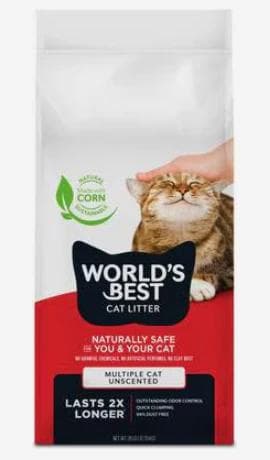
World's Best Multi-Cat Unscented is our best natural choice because it provides a direct corn-based clumping alternative with an unscented multi-cat formula. Its corn material and unscented plant-based clumping granules format give it a specific job in this best cat litter comparison rather than a claim to be best for every cat.
Its corn formula provides the most direct plant-based clumping alternative among the exact current offers. The result still depends on normal box use, so watch whether the cat enters, digs, eliminates, covers, and returns without hesitation.
Corn makes this a clear plant-based alternative in the eight-product slate without giving up clumping. Expect a lighter bag, a different raw-material smell, and granules that may feel unfamiliar to a clay-preferring cat. Keep the product sealed and dry, introduce it in a second box, and follow local disposal rules rather than assuming a plant litter belongs in a toilet or compost pile.
World's Best Multi-Cat Unscented: strengths and tradeoffs
Pros
- It provides a direct corn-based clumping alternative with an unscented multi-cat formula.
- Best for cats that accept plant granules and households that want clumping performance without a clay substrate.
Cons
- Corn needs dry sealed storage, the natural material odor and texture may be unfamiliar, and lightweight granules can track.
- Skip it if you cannot keep a plant-based litter sealed and dry, your cat rejects the corn texture or raw-material smell, or lightweight tracking is a persistent problem.
- Use it well: Store the bag sealed and discard material that becomes damp or abnormal.
- Use it well: Introduce the corn texture beside the familiar box rather than forcing it.
- Use it well: Evaluate clump strength only after the product's normal setting time.

Best low dust: Catalyst Pet Multi-Cat
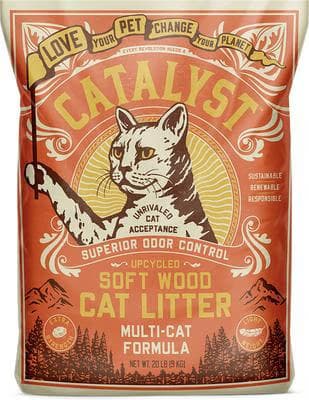
Upcycled soft-wood cat litter with superior odor control, very low dust, and a simple natural composition (no clay, no synthetic fragrance) - a gentler box for cats that nibble at their litter.
Webvet may earn a commission when you click through to Chewy, at no extra cost to you.
Catalyst Pet Multi-Cat is our best low dust choice because the current product description documents very low dust, soft wood fiber, and no synthetic fragrance. Its upcycled soft wood fiber material and lightweight clumping fiber with no synthetic fragrance format give it a specific job in this best cat litter comparison rather than a claim to be best for every cat.
The offer's very-low-dust soft-wood position directly matches the use case without presenting litter as respiratory treatment. The result still depends on normal box use, so watch whether the cat enters, digs, eliminates, covers, and returns without hesitation.
Catalyst is the handling pick as much as the dust pick. The soft wood fiber is substantially lighter than dense clay, which can make carrying and pouring easier. Its fibrous texture and clump feel are also the biggest adjustment. Pour close to the box, use a scoop that releases clean material without vigorous shaking, and watch whether light fibers collect on long paw fur or the exit mat.
Catalyst Pet Multi-Cat: strengths and tradeoffs
Pros
- The current product description documents very low dust, soft wood fiber, and no synthetic fragrance.
- Best for households prioritizing low-dust lightweight handling whose cats will accept a soft wood texture.
Cons
- The light fibrous texture differs from clay, may travel on long fur, and can produce a different clump feel.
- Skip it if your cat strongly prefers fine clay, lightweight fibers collect on long paw fur, or the household dislikes a softer wood-fiber clump.
- Use it well: Pour slowly because even a low-dust loose material can release fines.
- Use it well: Watch long paw fur and the exit mat for light fiber tracking.
- Use it well: Test scoop openings against the fiber size without vigorous shaking.
Best health-monitoring feature: PrettyLitter Health Monitoring
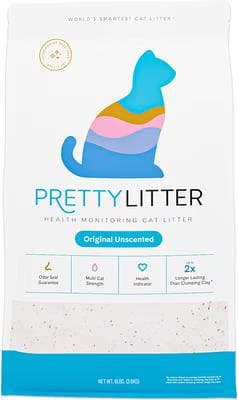
Crystal litter that changes color alongside some urinary changes, as a prompt to call your vet.
Webvet may earn a commission when you click through to Chewy, at no extra cost to you.
PrettyLitter Health Monitoring is our best health-monitoring feature choice because it adds moisture absorption and an observational color feature that can prompt a veterinary call. Its silica crystal material and non-clumping absorbent crystals with a color-change prompt format give it a specific job in this best cat litter comparison rather than a claim to be best for every cat.
Its crystal color prompt gives owners an additional observation while maintaining a firm boundary against diagnosis. The result still depends on normal box use, so watch whether the cat enters, digs, eliminates, covers, and returns without hesitation.
PrettyLitter changes the cleaning routine because its crystals absorb urine rather than forming removable urine clumps. Follow the current stirring and replacement directions so one wet area does not distort what you see. The color chart can add an observation to share with a veterinarian, but a normal-looking color cannot rule out illness and a concerning color cannot identify the cause.
PrettyLitter Health Monitoring: strengths and tradeoffs
Pros
- It adds moisture absorption and an observational color feature that can prompt a veterinary call.
- Best for adult cats that accept crystal texture and owners who understand that a persistent color change requires veterinary interpretation.
Cons
- Crystals feel different from fine clumping litter, the product does not create removable urine clumps, and color cannot diagnose disease.
- Skip it if your cat rejects crystal texture, you want removable urine clumps, or anyone in the home may mistake the color chart for a veterinary diagnosis.
- Use it well: Read the current color chart and directions before the first use.
- Use it well: Treat persistent or concerning change as a reason to call, not self-diagnose.
- Use it well: Do not use color to rule out illness when symptoms are present.
Best scented multi-cat option: Scoop Away Complete Performance
Webvet may earn a commission when you click through to Chewy, at no extra cost to you.
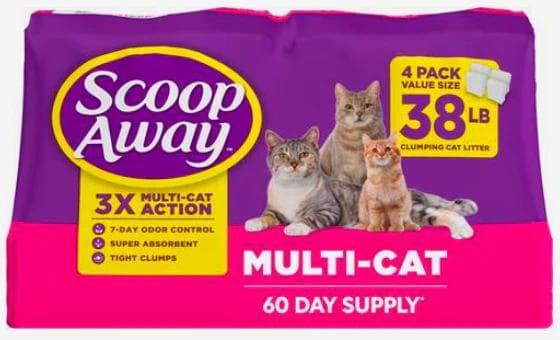
Scoop Away Complete Performance is our best scented multi-cat option choice because it is explicitly positioned for multi-cat odor control and firm daily clumping. Its clumping clay material and fresh-scented multi-cat clumping granules format give it a specific job in this best cat litter comparison rather than a claim to be best for every cat.
Its defined multi-cat odor role is useful for households that already know their cats accept added fragrance. The result still depends on normal box use, so watch whether the cat enters, digs, eliminates, covers, and returns without hesitation.
This is the only scented choice in the lineup, so it belongs in homes that already know their cats accept fragrance. Multi-cat positioning describes clumping and odor performance, not a license to use fewer boxes or scoop less often. Keep resources separated around the home, watch each cat for hesitation, and offer an unscented alternative if the scent or fine clay texture changes normal box use.
Scoop Away Complete Performance: strengths and tradeoffs
Pros
- It is explicitly positioned for multi-cat odor control and firm daily clumping.
- Best for multi-cat homes that already know their cats accept this scented clay format and prioritize odor performance.
Cons
- Added fragrance is not a good default for every cat or sensitive household, and dense fine clay can be heavy and track.
- Skip it if your cat or household is sensitive to added fragrance, or if the weight and tracking of fine clay are already dealbreakers.
- Use it well: Do not use fragrance to extend the interval between scooping.
- Use it well: Offer an unscented alternative if any cat hesitates or perches.
- Use it well: Spread boxes through the home rather than relying on one multi-cat box.
Best straightforward unscented clay: Tidy Cats Free & Clean Unscented
Webvet may earn a commission when you click through to Chewy, at no extra cost to you.
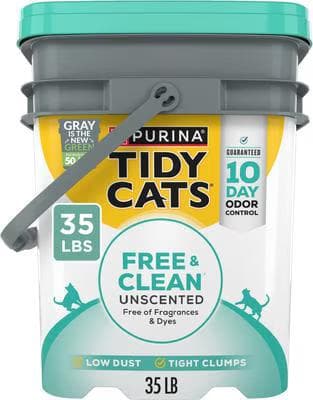
Tidy Cats Free & Clean Unscented is our best straightforward unscented clay choice because it offers a straightforward unscented clay identity without asking the reader to pay for an unrelated specialty feature. Its clumping clay material and fragrance-free clumping granules format give it a specific job in this best cat litter comparison rather than a claim to be best for every cat.
Its fragrance-free identity covers the core clay job without requiring a specialty material or monitoring feature. The result still depends on normal box use, so watch whether the cat enters, digs, eliminates, covers, and returns without hesitation.
Tidy Cats Free & Clean keeps the decision simple: familiar clumping clay without added fragrance. It is useful when a household wants a direct unscented alternative and does not need crystal monitoring or a plant material. Unscented does not mean dust-free, tracking-free, or odor-proof, so judge those traits separately and keep the box clean enough that perfume is not being asked to hide overdue maintenance.
Tidy Cats Free & Clean Unscented: strengths and tradeoffs
Pros
- It offers a straightforward unscented clay identity without asking the reader to pay for an unrelated specialty feature.
- Best for adult cats that prefer fine clay and households seeking a direct fragrance-free alternative.
Cons
- It retains the weight, mining, dust, and tracking considerations of clumping clay even without added fragrance.
- Skip it if you want to avoid clay, need a lighter bag, or have not solved an existing dust or tracking problem with fine granules.
- Use it well: Check that the received bag says Free & Clean Unscented.
- Use it well: Measure tracking and dust separately from fragrance acceptance.
- Use it well: Maintain depth and lift clumps from below to reduce breakage.
SponsoredVet care that's always there
Unlimited video calls and messaging with licensed vets for less than a typical vet visit. One membership covers up to five pets.
Use code Pets60
Plans start at $12/month · covers up to 5 pets
- Licensed vets in most states
- Rx for 150+ conditions
- 4.7 on Trustpilot
Best low-tracking clay: Dr. Elsey's Clean Tracks
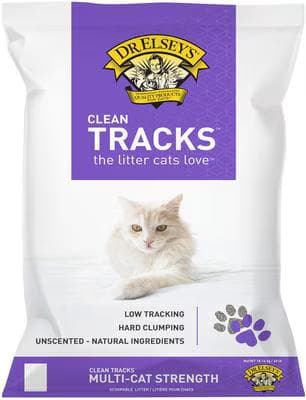
Unscented hard-clumping clay litter designed to reduce tracking in multi-cat homes.
Webvet may earn a commission when you click through to Chewy, at no extra cost to you.
Dr. Elsey's Clean Tracks is our best low-tracking clay choice because its exact unscented formula is designed around hard clumping and reduced tracking in multi-cat homes. Its bentonite clumping clay material and unscented hard-clumping granules designed to reduce tracking format give it a specific job in this best cat litter comparison rather than a claim to be best for every cat.
Its exact unscented hard-clumping formula is designed to reduce the granules carried away from the box. The result still depends on normal box use, so watch whether the cat enters, digs, eliminates, covers, and returns without hesitation.
Dr. Elsey's Clean Tracks fills a distinct best cat litter role because its bentonite clumping clay material and unscented hard-clumping granules designed to reduce tracking format change the texture, cleanup, handling, or storage decision. Trial the exact formula beside the familiar litter and judge normal box use before changing every box.
Dr. Elsey's Clean Tracks: strengths and tradeoffs
Pros
- Its exact unscented formula is designed around hard clumping and reduced tracking in multi-cat homes.
- Best for clay-preferring cats in households where tracked granules are the main performance problem.
Cons
- Dense clay is heavy to carry and discard, low tracking is not zero tracking, and dust still needs to be judged from the received bag.
- Skip it if lifting dense clay is difficult, you need a plant-based substrate, or any remaining fine-granule dust is unacceptable.
- Use it well: Use the same box, depth, and mat when comparing tracked material.
- Use it well: Allow fresh clumps to set before lifting them from underneath.
- Use it well: Pour close to the box and check visible dust through the full bag.
Best non-clumping pellet: Feline Pine Original
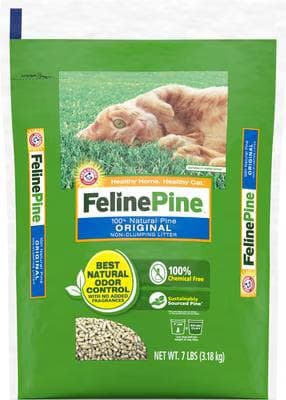
Non-clumping wood-pellet litter made from natural pine for cats.
Webvet may earn a commission when you click through to Chewy, at no extra cost to you.
Feline Pine Original is our best non-clumping pellet choice because it adds a widely established pine-pellet option with a simple non-clumping format. Its pine wood material and non-clumping wood pellets format give it a specific job in this best cat litter comparison rather than a claim to be best for every cat.
Its established pine-pellet format gives pellet-preferring cats a distinct non-clumping option. The result still depends on normal box use, so watch whether the cat enters, digs, eliminates, covers, and returns without hesitation.
Feline Pine Original fills a distinct best cat litter role because its pine wood material and non-clumping wood pellets format change the texture, cleanup, handling, or storage decision. Trial the exact formula beside the familiar litter and judge normal box use before changing every box.
Feline Pine Original: strengths and tradeoffs
Pros
- It adds a widely established pine-pellet option with a simple non-clumping format.
- Best for cats that accept larger wood pellets and households comfortable with non-clumping maintenance.
Cons
- Rigid pellets feel different from sand-like litter, wet pellets break down rather than clump, and pine has a noticeable raw-material odor.
- Skip it if your cat dislikes rigid pellets, you need removable urine clumps, or the pine material odor is unwelcome.
- Use it well: Remove stool daily and replace saturated or broken-down pellets on schedule.
- Use it well: Use a second box so the cat can choose between pellets and the familiar texture.
- Use it well: Compare paw comfort carefully for kittens, seniors, and mobility-limited cats.
What these cat litter rankings can and cannot tell you
A useful ranking can narrow a crowded shelf to a few exact formulas with clearly different jobs. It can identify the material, whether the product clumps or absorbs, whether fragrance is added, what the current manufacturer or retailer says about dust, and which handling tradeoffs are likely to matter. It can also stop a similarly named variant from taking the place of the product actually reviewed.
A ranking cannot predict whether one cat will accept a new texture or how a bag will behave after shipping and storage. It cannot standardize dust percentages reported through different test methods, guarantee that a clump will remain intact in every box, or turn a monitoring color into a diagnosis. Those questions require a controlled home trial, direct observation, and veterinary care when symptoms are present.
Price should be compared over the usable life of the bag rather than by sticker alone. Record how much litter creates the starting depth, how often the box needs topping up, how much clean material leaves with each clump, and when residue forces a full change. A cheaper product can become expensive when weak clumps contaminate the box, while a premium feature has little value if the household does not need it.
Availability is part of performance because abrupt substitutions can disrupt an established box routine. Before committing every box to a new litter, confirm that the exact formula can be reordered and keep enough of the accepted product for a gradual transition. If a manufacturer changes the label, ingredients, granule size, or directions, treat the replacement bag as a new trial rather than assuming the old result still applies.
How to switch cat litter without box avoidance
The lowest-risk method is a second clean box containing the candidate litter beside or near the established box, while keeping box style and location comparable. This gives the cat control and produces readable preference data. If space makes that impossible and the cat has no history of house-soiling, blend a small amount of new litter into the familiar product and increase it only while use remains normal.
Do not change litter, box type, location, depth, cleaner, and room access at the same time. If the cat hesitates, restore the last accepted setup. Punishment, carrying the cat to the box, or confining the cat with a disliked substrate can increase stress and obscure a medical cause.

A seven-day observation plan
- Day 1: photograph the starting setup and record box dimensions, litter depth, location, and cleaning time.
- Days 2 to 3: offer a small controlled amount of the new litter and watch approach, digging, posture, covering, and exit behavior.
- Days 4 to 5: compare clump integrity, odor before scooping, tracked material, and the cat's preference without changing other variables.
- Days 6 to 7: continue only if elimination and comfort remain normal; extend the trial for a cautious cat rather than forcing a deadline.
- At any point: restore the accepted setup and contact a veterinarian for sudden avoidance, pain, straining, blood, reduced output, or systemic illness.
How to choose the best cat litter for your cat
What kind of litter is best for cats? For many healthy adults, begin with a clean, fine-grained, unscented clumping product and then honor the individual cat's established preference. Age, litter eating, paw comfort, respiratory signs, wounds, urine-collection needs, box design, and household handling can make another material more appropriate.
Begin with your cat's established preference
A cat that has used one texture for years may value familiarity more than a household values a new feature. Look at the entire elimination sequence: approaching the box without hesitation, stepping in, digging, assuming a normal posture, eliminating, covering, and leaving calmly. Perching on the rim, eliminating beside the box, rushing away, or repeatedly investigating without using it can signal that the box, litter, location, cleanliness, social setting, or a medical problem needs attention.
If the current litter is working and there is no safety reason to change it, improvement should be defined carefully. Less tracking for the person is not an improvement if the cat avoids the box. Offer the candidate in a second comparable box and keep every other variable stable. That simple choice test is more informative than pouring a new formula into the only accepted toilet.
Decide whether clumping is appropriate
Clumping litter forms removable masses when wet, which makes daily urine removal and output observation easier. Clump quality depends on particle size, absorbent material, depth, moisture load, and how quickly the scoop reaches the spot. Very hard clumps can reduce crumbling, while soft clumps may leave residue that gradually increases odor.
Non-clumping litter absorbs moisture without creating one removable mass. It can be useful for particular kittens, recovery plans, or cats that prefer pellets, but the whole box often needs more frequent replacement. Our dedicated guide to clumping cat litter owns the detailed material and scoopability comparison, while the kitten guide handles age-specific non-clumping questions.
Treat low dust as a spectrum
No loose granular litter should be assumed literally dust-free. Manufacturing fines, bag transport, pouring height, vigorous scooping, and a cat's digging can all release particles. A low-dust claim is most useful when paired with your own observation during filling and daily maintenance.
Pour close to the empty box, add litter slowly, keep the cat away while refilling, and wipe settled dust with a damp cloth. A cat that coughs, wheezes, breathes rapidly, or shows increased effort needs veterinary evaluation rather than a series of litter experiments. The low-dust guide explains how to compare materials without presenting litter as asthma treatment.
Separate unscented from odorless
Unscented usually means no added fragrance; it does not mean the raw material has no smell or that a used box will remain odorless. Odor control comes from timely waste removal, enough absorbent litter, a clean box, appropriate ventilation, and materials that trap or bind odor. Perfume may change what a person smells without correcting the maintenance cause.
Some cats tolerate scented litter, and one scented multi-cat pick is included for households that already know it is accepted. For a new baseline, however, fragrance-free products make it easier to judge the material itself. The unscented litter guide compares seven exact fragrance-free options and a transition plan.
Measure tracking where it actually happens
Tracking is affected by particle size and shape, paw fur, box depth, exit speed, mat design, and how far the cat must walk before reaching carpet or furniture. Large pellets may travel less but feel unfamiliar underfoot. Fine granules often appeal to cats yet cling more readily to paws.
Test with the same box and mat for at least several normal days. Sweep or vacuum a defined area at the same time each day and compare what is recovered. A covered box is not a universal tracking fix because it may trap odor, restrict movement, or be disliked by the cat.
Calculate usable cost, not bag price alone
The least expensive bag can cost more per month if weak clumps break apart, saturated litter requires frequent full changes, or the cat scatters a large amount outside the box. Conversely, a premium product does not create value if its special feature is irrelevant to your home.
Record the purchase price, starting depth, top-up amount, full-change interval, and waste removed over a trial period. For multi-cat households, calculate per box rather than assuming one larger box or stronger fragrance substitutes for enough clean toileting locations.
Account for lifting and storage
Dense clay can be effective but difficult to carry, pour, and dispose of for people with limited strength or stairs. Lightweight wood, corn, or crystal products may be easier to handle, though their texture and tracking pattern differ. Choose a package size that can be stored dry and poured with control.
Transfer litter only into a clean, dry, sealed container that cannot be opened by pets or children. Keep the product label or photograph it so ingredients, lot information, and instructions remain available. Never mix unidentified remnants from several products into one storage bin.
Consider the box system, not only the substrate
Even excellent litter performs poorly in a cramped, dirty, unstable, or socially guarded box. The box should allow the cat to turn and dig comfortably. A senior or mobility-limited cat may need a low entry, while a vigorous digger may need higher sides without an inaccessible doorway.
Place boxes where the cat can reach them without being cornered by another pet, noisy appliance, or busy hallway. In multi-cat homes, separated resources are more valuable than several boxes lined up as one station. Cleanliness and safe access are load-bearing parts of the product test.
If you are choosing a new box as well, see our guide to the best cat litter boxes for options that suit different cats and homes.
A 30-day cat litter trial
A bag can look promising during the first refill and fail after ordinary use reveals bottom-of-bag dust, weak clumps, tracking, odor, or rejection. Plan a trial long enough to observe the full product cycle while protecting the familiar box. Record the starting date, box, depth, product lot, cat using the box, and unchanged comparison setup.
During week one, focus on voluntary entry, digging, posture, elimination, covering, and exit. During week two, compare clump integrity or saturation, visible dust, tracking distance, and odor immediately before daily scooping. During week three, record top-ups, waste volume, cleaning time, and whether residue is accumulating. During week four, review storage stability and the expected full-change interval.
Make the final decision from a scorecard
Give cat acceptance the greatest weight, followed by reliable waste removal and the household's highest-priority constraint. Cost should use actual bag duration rather than the shelf price alone. Marketing claims can help select a candidate, but observed behavior and maintenance decide whether it stays. Preserve the notes so a formula change or future comparison starts from evidence rather than memory.

Cat litter types and tradeoffs compared
Material changes several variables at once. Clay usually delivers familiar fine texture and strong clumping, but it is dense and mined. Corn and other plant materials can clump while reducing reliance on clay, yet they need dry storage and may smell or feel different. Wood fiber and pellets vary widely in softness and clumping. Paper is often low tracking but usually non-clumping. Silica crystals absorb moisture efficiently but feel different and should not be confused with a medical test.
What is the number-one rated cat litter? Ratings change by retailer, bag size, formula revision, and reviewer expectations, so there is no durable universal title. Use a rating to find recurring complaints, then make the decision from exact material, fragrance, dust, tracking, clump behavior, storage, and the cat's controlled preference trial.
| Material | Typical clumping | Dust and tracking | Best reason to consider | Watch for |
|---|---|---|---|---|
| Clay | Strong in clumping formulas | Fine particles may track; dust varies | Familiar texture and scoopability | Weight, mining footprint, fragrance |
| Corn | Often clumping | Usually lightweight; tracking varies | Plant-based alternative | Dry storage, texture acceptance |
| Soft wood | Formula dependent | Often lightweight and low dust | Renewable or upcycled fiber options | Texture change, clump strength |
| Paper | Usually non-clumping | Low dust and larger pellets | Recovery or pellet preference | More frequent full changes |
| Silica crystal | Usually absorbs rather than clumps | Low airborne fines in many formulas | Long moisture control or monitoring prompt | Texture acceptance, ingestion, cost |
Clay litter
Clumping clay remains common because many cats accept its sand-like feel and owners can remove urine daily. Sodium bentonite expands and binds when wet, but formulas differ in particle size, additives, dust control, and fragrance. The bag can be heavy, and broken clumps leave moist fragments behind. Choose clay for the familiar mechanics, not because every clay formula performs identically.
Plant and wood litter
Corn, wheat, grass, tofu, walnut shell, and wood products are not one interchangeable category. They differ in granule shape, absorbency, clumping binders, odor, susceptibility to moisture during storage, and sourcing claims. A cat may readily accept fine corn granules and reject hard pellets. Evaluate the exact formula and the cat's response instead of treating the word natural as a performance guarantee.
Crystal and paper litter
Silica crystal litter absorbs moisture inside porous granules and may change color in monitoring products. Paper litter uses recycled or virgin fiber formed into pellets or granules and is commonly non-clumping. Both can reduce some problems associated with fine clay, but neither is automatically best. Texture, ingestion behavior, box-cleaning method, and veterinary instructions still control the decision.
How to read a cat litter label
Begin with the exact formula name, not only the brand family. One product line can contain scented and unscented bags, lightweight and standard versions, clay and crystal products, or several granule sizes. Confirm the material, added-fragrance statement, clumping behavior, bag weight, disposal directions, and any age or handling warnings on the item that will actually ship.
Performance percentages need context. A dust-free percentage, odor-duration claim, or absorption comparison may come from the manufacturer's own method and should not be used to create a precise ranking against a competitor tested differently. Treat the statement as one reason to trial the product, then use consistent pouring, depth, scooping, and observation at home.
Ingredient lists may identify clay, corn, wood, silica, carbon, fragrance, or binders without disclosing every processing detail. If a cat has a known sensitivity, pica, respiratory disease, wound, or veterinary urine-collection plan, send the exact label to the veterinary team before changing the box. General terms such as natural, premium, clean, or healthy do not resolve that individual question.
Retain the bag until the trial is complete. The lot code and contact information matter if the granules look abnormal, the clean product smells spoiled, clumping differs sharply from prior bags, or foreign material appears. Stop using a suspect bag, preserve photographs and the label, and keep a familiar safe litter available while the issue is investigated.
Recheck the label when reordering. Manufacturers can revise ingredients, package sizes, and instructions while retaining a familiar family name. Carefully compare the new and old lot descriptions before assuming the experience will be identical. A cat that suddenly rejects a replacement bag may be reacting to a product change, but pain, urinary disease, constipation, stress, or box access can create the same visible behavior. Restore the accepted setup and seek veterinary advice when avoidance is sudden or accompanied by symptoms.
What cat litter do veterinarians recommend avoiding?
Avoid any litter your cat persistently refuses, any formula that produces obvious irritating dust in your setup, and any product used contrary to its label. Do not use litter contaminated by moisture, mold, chemicals, pests, or unknown substances. Strongly scented products are a poor default for a cat that shows hesitation or a household sensitive to fragrance.
Kittens that taste or ingest litter need age-appropriate guidance, and some veterinarians recommend non-clumping options during the youngest exploratory stage. Cats with surgical wounds, paw injuries, respiratory disease, unusual eating behavior, or prescribed urine collection may need a temporary material chosen by the treating veterinarian. A general roundup cannot replace that case-specific instruction.
How household needs change the best litter choice
Multi-cat homes
A multi-cat label can describe odor-control or clumping performance, but it does not reduce the need for enough safe box locations. One assertive cat can block a hallway or guard a single litter station. Spread boxes so a cat can approach and leave without passing another cat at close range, and scoop at least daily so output changes remain visible.
The best product in this setting is one all resident cats accept. If preferences differ, separate boxes can carry different substrates. A standardized box log helps identify which cat uses which location and whether a new litter shifts behavior.
Kittens, seniors, and mobility changes
Young kittens explore with their mouths and may need non-clumping guidance. Senior cats may value a soft familiar texture and a low-entry box more than a new odor-control feature. Cats with arthritis can avoid a box because the route, entry, or posture hurts even when the litter itself is acceptable.
Do not solve a mobility problem solely with a lightweight bag or a behavior problem solely with fragrance. Adjust the whole system: box dimensions, entry height, location, lighting, nonslip access, cleaning frequency, and litter depth.
Pregnancy and immune suppression in the household
The concern is exposure to infected cat feces, not a particular retail litter brand. The CDC recommends daily litter-box cleaning because Toxoplasma generally needs time after shedding to become infectious, plus handwashing and appropriate precautions. A pregnant or immunocompromised person should discuss individual risk with a healthcare professional and have someone else clean the box when possible.
How to keep any litter box working well
Scoop urine and feces at least daily and more often when several cats share the household. Top up only enough to maintain a comfortable depth; endlessly adding fresh litter to a dirty base preserves residue. Wash the empty box on a schedule appropriate to the material and product directions, rinse away cleaner, and dry it fully before refilling.
If litter is being carried beyond the box, our cat litter mat guide compares texture, landing area, and cleaning methods while keeping comfortable box access the priority.
Use a dedicated scoop and wash your hands after handling waste. Do not flush cat litter unless local infrastructure and the exact product directions explicitly allow it; septic guidance says cat litter should not enter the system. Bag waste securely and follow local disposal rules.

When the litter is not the problem
A cat may eliminate outside the box because of urinary pain, constipation, diarrhea, arthritis, cognitive change, fear, inter-cat conflict, an inaccessible location, a dirty box, or a learned preference for another surface. The shape and location of accidents can provide clues, but they do not establish a diagnosis.
Use WebVet's guides to cat peeing outside the litter box, pooping outside the litter box, and medically significant litter-box changes when the question has moved beyond product selection. Preserve a urine or stool sample only if the veterinary team instructs you how.
For deeper product decisions, see our clumping cat litter guide, low-dust cat litter guide, unscented cat litter guide, natural cat litter guide, odor-control litter roundup, and non-clumping litter guide for kittens.
Best cat litter questions
Frequently Asked Questions
What is the #1 recommended cat litter?
There is no universal number-one litter. For many adult cats, a fine-grained unscented clumping formula is a practical starting point. The best choice is the one the cat uses reliably and the household can keep clean, with acceptable dust, tracking, odor, weight, and cost.
What is the healthiest cat litter?
No material is automatically healthiest. Choose an accepted formula with manageable dust and no unnecessary fragrance, store it dry, keep the box clean, and prevent ingestion. Cats with respiratory disease, wounds, unusual eating, or prescribed urine collection need individualized veterinary guidance.
How often should cat litter be changed?
Scoop at least daily. Full-change timing depends on whether the litter clumps, the number of cats and boxes, box size, product directions, and residue left after scooping. Replace the contents and wash the box when odor, dampness, crumbling, or residue shows that topping up is no longer sufficient.
Sources
Veterinary guidance used for this broad cat-litter selection guide includes the AAFP and ISFM house-soiling guidelines, the AAFP and ISFM feline environmental-needs guidelines, and AAHA general litter-box considerations. Product selection remains an editorial judgment based on each exact formula's documented material and performance attributes.
Public-health and disposal guidance referenced here includes the CDC toxoplasmosis prevention guidance and EPA septic-system care guidance.

Editor
The Webvet Editorial Team is the in-house group of pet-care editors and writers behind Webvet, operated by Smart Pet Collective. The team researches, writes, and maintains Webvet's pet health, behavior, and medication content. Every article follows a defined editorial process: research from reputable veterinary and scientific sources, careful drafting, mandatory review of medical content by a credentialed veterinarian, and dated publication. Health and medication articles are medically reviewed by a licensed veterinary professional before they go live and are kept current over time.
Veterinarian · BVMS MRCVS
Dr. Pippa Elliott, BVMS, MRCVS, is a veterinarian with nearly 30 years of experience in companion animal practice. Dr. Elliott earned her Bachelor of Veterinary Medicine and Surgery from the University of Glasgow. She was also designated a Member of the Royal College of Veterinary Surgeons. Married with 2 grown-up kids, Dr. Elliott has a naughty Puggle named Poggle, 3 cats and a bearded dragon.
Related reading

Ruffwear Polar Trex Review: Winter Dog Boots for Snow, Ice, and Salt

Canada Pooch Dog Boots Review: Soft Shield, Hot Pavement, and Suspender Fit

Pawz Dog Boots Review: Rubber Balloon Boots for Salt, Heat, and Hardwood
