Senior Dog Vitamins: What To Consider
Older dogs need an individualized nutrition plan, not simply more vitamins. Review diet, muscle condition, medicines, and nutrient overlap before considering a senior dog multivitamin.

This article contains affiliate links. Webvet may earn a commission when you buy through them, at no extra cost to you.
Senior dog vitamins should fit the dog in front of you: what they eat, whether their weight or appetite has changed, which medicines they receive, and what your veterinarian wants a supplement to accomplish. Getting older is a good reason to reassess nutrition. Age alone is not proof that a dog needs more vitamins.
When that assessment supports a daily multivitamin, PetLabCo.® Multivitamin Chews offer broad supplemental nutrients in a soft-chew format. Their usefulness comes from fitting an individual plan, not from promising to reverse aging. Here is how to make that decision and bring the right information to your next veterinary visit.
Sponsored content: WebVet maintains editorial control over this article, which is sponsored by PetLabCo.®. WebVet may earn a commission from purchases made through its affiliate links.
Key Takeaways
- 1A senior dog eating an appropriate complete diet may already receive adequate vitamins.
- 2Review appetite, weight, muscle condition, disease, and medicines before assuming a new change reflects deficiency.
- 3Vitamin B12, vitamin E, vitamin A, and vitamin D have important normal functions; more is not automatically better.
- 4PetLabCo.® Multivitamin Chews may fit a veterinarian-guided daily routine, with half-, one-, or two-chew servings according to weight.
- 5Use a total-intake worksheet to record food and every supplement, including the reason for each product.
Does your senior dog need extra vitamins?
Some older dogs benefit from specific nutritional support, but the decision should follow assessment rather than an age cutoff. If a dog eats an appropriate complete and balanced diet, adding a multivitamin is not automatically necessary. The first question is what the dog currently receives and whether a particular nutrient need has actually been identified.
A veterinary nutrition review may uncover a change that matters: reduced food intake, an unsuitable home-prepared recipe, a disease affecting nutrient handling, or a treatment plan that calls for targeted supplementation. These are different situations. A product that is helpful for one does not necessarily answer the others.
Start with a short description of the goal:
- “We want to check whether the current diet still suits this dog.”
- “Appetite has changed, and we need to understand why.”
- “The veterinarian recommended a specific supplement for an identified need.”
- “We want to review several overlapping products before adding another.”
Those statements lead to a more useful decision than “senior dogs need vitamins.” The American Kennel Club’s nutrition guidance distinguishes essential vitamin functions from the need to supplement a diet that already supplies them. A veterinarian’s recommendation should make that distinction specific to your dog.
If broad daily supplementation is appropriate, PetLabCo.® Multivitamin Chews can be discussed as a convenient option. The full label, including nutrient amounts and flavor ingredients, belongs in the conversation. For an older dog already taking several products, that detail is especially helpful because the same nutrient may appear in more than one container.
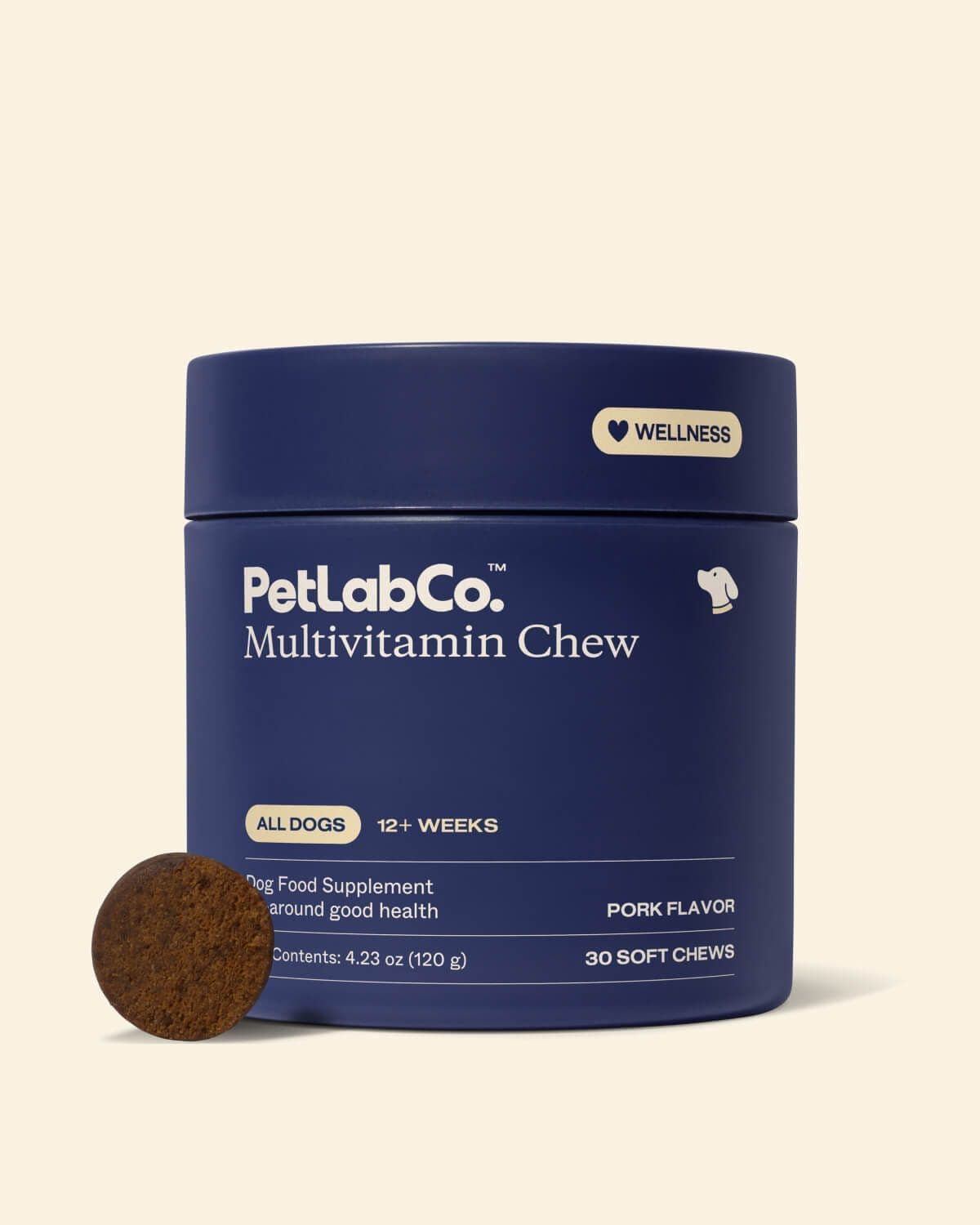
Daily soft chews with vitamins and minerals for a veterinarian-guided supplemental nutrition routine.
Webvet may earn a commission when you click through to PetLabCo.®, at no extra cost to you.
What do vets recommend for senior dogs?
Vets recommend senior care based on the dog's diet, condition, and health findings, rather than routinely recommending vitamins to every older dog. A vitamin supplement may be part of that plan when there is an identified reason. Diet review, comfortable activity, and evaluation of new changes remain part of the wider discussion; a multivitamin addresses only one nutritional decision.
What aging changes, and what it does not
Aging can change a dog’s activity, calorie needs, appetite, body composition, and ability to manage illness. These changes call for individual assessment. They do not establish that all senior dogs absorb vitamins poorly, need a high-dose formula, or should receive the same supplement at the same birthday.
The AAHA senior-care nutrition guidance emphasizes weight, body condition, muscle condition, diet, and health. A scale reading alone does not capture the whole picture. An older dog can lose muscle even if body weight changes little, so the veterinary team may assess both fat stores and muscle separately.
Useful observations to bring include:
- Whether the dog eats the usual amount of complete food.
- Changes in weight, body shape, or muscle over the back and limbs.
- Difficulty picking up food, chewing, or finishing a meal.
- New thirst, vomiting, diarrhea, constipation, or unusual fatigue.
Energy and behavior need context
An older dog that seems less energetic may need an adjustment in activity, pain assessment, examination for illness, or a feeding review. A vitamin participates in energy metabolism, but adding it is not the same as supplying calories or treating a cause of fatigue. Record the change and how it affects daily life instead of describing it only as “slowing down.”
Evening restlessness or confusion is sometimes described as sundowning. It can occur in dogs with cognitive dysfunction, but an owner cannot establish that diagnosis from timing alone. Pain, sensory changes, sleep disruption, and other medical problems can also affect behavior. A new pattern deserves assessment rather than an assumption that a multivitamin will restore cognition.
What vets recommend for senior dogs
The foundation is a senior dog health plan that combines regular assessment with suitable nutrition, activity, comfort, and disease management. Supplement decisions sit inside that plan. They should become more specific as the dog’s needs become clearer, not more complicated simply because the dog is older.
For example, a dog maintaining weight and muscle on an appropriate diet has a different question from a dog losing weight despite eating. A dog with a prescribed therapeutic diet has another set of considerations. Bring those differences into the discussion so that the proposed supplement has a reason beyond its “senior” label.
Vitamin priorities: B12, E, A, and D
The vitamins most often discussed for older dogs are important because of their normal physiological roles. Those roles help explain why adequate nutrition matters. They do not prove that every senior dog benefits from an extra amount, and they do not turn a broad multivitamin into a treatment for changes in nerves, vision, immunity, or mobility.
Vitamin B12
Vitamin B12 is involved in normal cellular, metabolic, and neurological processes. When a veterinarian suspects or identifies a B12 problem, the appropriate form, amount, and follow-up depend on the underlying reason. That can be a targeted clinical plan rather than a general multivitamin decision.
If an older dog has digestive disease or unexplained weight loss, mention those signs before choosing a B12-containing product. A nutrient’s presence in a soft chew does not show that it will address the cause or provide the prescribed amount. Keep any targeted supplementation in place unless the clinician directs a change.
Vitamin E
Vitamin E contributes to antioxidant and cellular functions and normal fat metabolism. Adequate intake supports normal health, but the claim “supports antioxidant function” should not be read as a guarantee of stronger immunity or longer life from additional supplementation. Consider the food and all other products that supply it.
This is especially relevant when several daily supplements overlap. A dog may receive vitamin E through the complete diet, a multivitamin, and another nutritional product. The veterinary team needs those labels to judge the combined plan; the owner does not need to construct a home treatment dose from isolated numbers.

Vitamin A
Vitamin A has normal roles in vision, growth, cellular function, and other processes. It is a fat-soluble vitamin, so indiscriminate supplementation is not a sensible response to cloudy eyes or other age-related changes. A vision concern needs an eye assessment; a nutrient label cannot establish its cause.
The practical step is to include vitamin A in the total dietary review. Ask whether the existing food and supplements already provide the intended intake, and whether a proposed new product adds anything useful. A well-described formula is helpful only when its amounts fit that overall picture.
Vitamin D
Vitamin D helps regulate mineral balance, including calcium and phosphorus. Excess intake can be harmful, so it is particularly important to avoid combining products casually. An owner should not select a higher vitamin D amount simply because an older dog has stiff movement or seems frail.
Your veterinarian may recommend specific nutritional changes for a medical condition, but those changes are individualized. Keep vitamin D products and all supplement containers out of reach; accidental consumption of multiple servings is a separate safety problem requiring prompt professional advice.
How to choose the priority
The useful priority is the dog’s demonstrated need, not a predetermined shopping list. Ask which of these situations applies:
- Adequate intake from the complete diet, with no additional supplement needed.
- A broad supplemental routine the veterinary team considers appropriate.
- A specific nutrient problem requiring targeted management.
- A diet or medical issue that must be addressed before a product is chosen.
PetLabCo.®’s senior vitamin education offers additional brand context. Use the current product label and the veterinary assessment together when translating nutrient roles into a real plan for your dog.
Daily soft chews with vitamins and minerals for a veterinarian-guided supplemental nutrition routine.
Webvet may earn a commission when you click through to PetLabCo.®, at no extra cost to you.
A multivitamin is different from joint or brain support
A multivitamin is designed to provide a combination of nutrients. A targeted joint supplement, a cognitive-support diet, and a prescribed medicine may have different ingredients and intended roles. These categories should not be treated as interchangeable simply because all are marketed to owners of older dogs.
For a dog with reduced mobility, distinguish the nutritional discussion from the pain discussion. Reluctance to jump, difficulty rising, a changed gait, or less interest in walks can have several causes. WebVet’s guide to signs of senior dog joint pain helps identify changes worth reporting. A vitamin chew does not replace that assessment.
When joint supplementation is part of the plan, compare it as a separate decision. A senior dog vitamin containing glucosamine is not automatically the best supplement for an older dog’s joints. Likewise, vitamins alone are not an arthritis care plan; the veterinarian should assess pain and choose the appropriate treatment and supportive measures. Our joint supplements for senior dogs guide focuses on that category. Check overlap if you use multiple products rather than assuming a “senior” multivitamin supplies the same formulation as a dedicated joint supplement.
Cognitive concerns need their own assessment
The same distinction applies to cognitive concerns:
- A vitamin’s normal neurological role is not evidence that a product reverses cognitive dysfunction.
- A change in sleep, orientation, or behavior needs a medical assessment.
- Any nutrition or supplement plan should work alongside the veterinarian’s broader recommendations.
It is reasonable to ask whether one broad product can simplify a routine. The answer depends on what each current product is there to do. If a targeted product serves a specific clinical purpose, replacing it requires a conversation with the professional overseeing that purpose. Convenience is valuable, but the plan still needs to retain the parts the dog actually needs.
What to look for in a senior dog multivitamin
Look for a clear formulation, measurable serving directions, a format your dog can comfortably take, and a reason to use the product. Those criteria matter more than whether the package says “senior.” A product labeled for adult dogs may fit an older dog, while a senior-branded product may still be unsuitable for that individual’s diet or health.
Check the following before purchase:
- Serving basis: Are amounts listed per chew, scoop, milliliter, or daily serving?
- Weight directions: Which row applies to your dog’s current weight?
- Ingredient overlap: Which nutrients also appear in other foods or supplements?
- Dietary fit: Are flavors or other ingredients compatible with restrictions?
- Administration: Can the dog take the complete amount without discomfort?

Chew, liquid, or powder?
A soft chew may be convenient for a dog that accepts it readily. A liquid or powder may fit another routine, provided the amount is measured correctly and the dog consumes it. No format is universally superior, and a format change can also mean a different formulation or concentration.
For an older dog who eats a full bowl reliably, a powder such as PetLabCo.® DF-14 Daily Foundation can deliver vitamins together with wider daily support in one measured scoop. Choose the format your dog will actually take every day.
If chewing has become difficult, address the reason rather than assuming every soft product is comfortable. Ask the veterinary team how to administer the chosen product and whether an alternative is suitable. Do not alter a prescribed preparation or make a new dosing mixture without instructions.
WebVet’s multivitamin format comparison explains the general buying choices in more detail. This senior guide adds the older-dog context: current medicines, changing intake, comfortable administration, and periodic reassessment. Keep the exact formula and daily amount at the center of both decisions.
Interpreting reviews and natural claims
Owner reviews can describe acceptance or ease of use, but a report of more energy cannot establish that a vitamin corrected a deficiency. Likewise, “natural” does not tell you whether an amount is appropriate or whether ingredients overlap. Use these descriptions as context, while grounding the decision in the label and your dog’s actual needs.
A vet-recommended dog vitamin should fit this specific dog, whether the eventual choice is an adult multivitamin or a more targeted product. For a broader buying comparison, the linked multivitamin guide explains format, label, and life-stage choices.
Where PetLabCo.® Multivitamin Chews fit
PetLabCo.® Multivitamin Chews are a broad daily supplement for dogs 12 weeks and older, including adult and senior dogs when appropriate. The pork-flavored soft chew lists vitamins and minerals together with taurine and L-carnitine. It can offer a manageable format for an owner whose veterinary nutrition plan includes general supplemental support. Related reading: Petful’s guide to L-carnitine for dogs.
The brand describes the formula as featuring 22 vitamins and minerals. The most useful way to assess it is to read the actual analysis, because the listed components have different roles and some, such as taurine and L-carnitine, are not vitamins. Ingredient count is a description of the formula, not a measure of how much an older dog needs it.
Selected amounts in a full 4 g soft chew include:
If you want vitamins delivered inside broader whole-body support, PetLabCo.® DF-14 Daily Foundation is the alternative to consider. It is a once-daily powder with size-specific scoops for dogs 12 weeks and older, and its ingredients include vitamin C, vitamin E and beta-carotene alongside a probiotic blend, taurine, L-carnitine, glucosamine, chondroitin and krill. Multivitamin Chews concentrate on vitamins and minerals in a soft chew; DF-14 spreads a smaller vitamin contribution across gut, joint, skin and immune support. Review both labels with your veterinarian and choose one, not both, unless the team plans the overlap deliberately.
- Vitamin A: 3,500 IU.
- Vitamin D: 64 IU, equivalent to 1.6 micrograms.
- Vitamin E: 30 IU, equivalent to 20 mg.
- Vitamin B12: 0.18 mg.
- Taurine and L-carnitine: 50 mg each.

Those are full-chew label amounts, not an individual prescription. The current daily directions are half a soft chew below 25 lb, one soft chew at 25–75 lb, and two soft chews above 75 lb. Your dog’s current weight determines the labeled row; being older is not a reason to increase it.
The practical appeal is a consistent, savory format with a defined nutrient profile. For a dog whose clinician agrees with the broader formula, it may be simpler than managing several separate general-wellness additions. Review the other products first so that simplification is based on their functions rather than on the number of tubs in the cupboard.
The product contains pork liver, which matters for dogs with dietary restrictions or food trials. It is intended for supplemental feeding, not as a complete meal or an automatic balancing supplement for homemade food. If a recipe or a therapeutic diet has precise requirements, ask the professional managing it before adding the soft chew.
What the product information establishes
Current product information supports those formulation and serving facts. It does not establish that the soft chew reverses cognitive decline, restores vision, extends lifespan, or treats arthritis. Its appropriate role is supporting a nutritional routine that has been chosen for the individual dog.
Daily soft chews with vitamins and minerals for a veterinarian-guided supplemental nutrition routine.
Webvet may earn a commission when you click through to PetLabCo.®, at no extra cost to you.
What a useful daily combination can offer
When the dietary review supports this choice, PetLabCo.® Multivitamin Chews provide a convenient way to include several nutrients in one measured daily serving. Vitamin B12 is involved in normal metabolism and nerve function. Vitamin E supports antioxidant defenses and normal immune function, and vitamin A contributes to normal vision. L-carnitine helps move fatty acids into mitochondria, where they can be used in energy production. These functions explain the formula's role in everyday nutrition without promising a particular change in an individual older dog.
The serving label also makes administration easier to communicate between caregivers. Someone helping with the dog's meals can follow the same specified chew amount, rather than choosing between several loosely measured powders. Keep the tub's directions with the feeding record, especially when a sitter or family member takes over. A consistent, simple routine can be valuable even when there is no dramatic outward change to track.
For the owner, the useful question is whether this combination meets the agreed nutritional purpose in a format the dog accepts. For the veterinary team, the ingredient amounts allow that choice to be assessed alongside the rest of the diet. Both parts matter: a theoretically suitable supplement is less useful if the dog routinely leaves it uneaten, while an appealing chew still needs to fit the nutritional plan.
Consider providing a total-intake worksheet for your veterinarian
A total-intake worksheet helps the veterinary team see the whole feeding plan at once. It is a record of what the dog receives, not a calculator for creating a medical dose at home. Include the reason for each product so that the review can distinguish an established need from something added without a clear purpose.
Bring the containers or clear photos of their complete labels. A brand name alone may not identify the formulation, especially if the company sells several products or has changed the label. Record the amount actually given, including partial chews and food that remains uneaten.
| Source | What to record | Reason for each product | Question for the veterinary team |
|---|---|---|---|
| Complete food | Exact formula, life stage, amount actually eaten | Main nutrition | Does this still fit current weight, muscle, and health? |
| Treats and toppers | Names and typical daily amounts | Training, enjoyment, or appetite support | Do extras meaningfully change the feeding balance? |
| Multivitamin | Full label, serving, start date | Agreed broad nutrient goal | Is it appropriate alongside the complete food? |
| Targeted supplements | Ingredients and amounts in each | Specific joint, skin, gut, or other goal | Which ingredients overlap? |
| Prescriptions | Medicine names and instructions | Diagnosed condition | Does the proposed supplement change timing or suitability? |
Example: a dog with several daily products
Imagine an older dog receiving a complete senior food, a joint product, a coat supplement, and a proposed multivitamin. The worksheet’s first job is not to decide which products to remove. It is to make each label and reason visible so the clinician can assess the combination.
The owner might discover that multiple products list the same vitamin. That finding does not tell the owner to stop everything or calculate a new dose independently. It identifies a concrete question for the review: does the combined plan make sense, and is every product still serving its intended purpose?
Example: reduced food intake
Consider a senior dog that now eats only part of its usual meals. A multivitamin cannot replace missing protein, calories, or a diagnosis of why appetite changed. The worksheet records the smaller amount actually eaten, recent weight changes, and any new signs. Those observations help the vet decide whether the feeding strategy or medical care needs to change.
If supplementation is recommended after that assessment, it then has a place in the plan. The order matters: identify the problem, choose the response, and record the reason. Adding several products first can make the situation harder to interpret.
Example: a home-prepared diet
An owner cooking for an older dog should bring the exact recipe, ingredient amounts, substitutions, and specified balancing product. A broad multivitamin should not silently replace that recipe’s supplement. Two products can contain some of the same nutrients while supplying very different amounts or omitting something the recipe requires.
The worksheet makes these differences easier to discuss without requiring the owner to become a nutritionist. Its value is complete information. Update it whenever food, supplements, medicines, or the dog’s daily intake changes, and keep the current version with the dog’s care records.
Daily soft chews with vitamins and minerals for a veterinarian-guided supplemental nutrition routine.
Webvet may earn a commission when you click through to PetLabCo.®, at no extra cost to you.
Introduce the plan and track useful changes
Once the veterinary team agrees on a supplement, follow the selected product’s directions and the individual instructions you received. Record when it starts and the reason for use. Keeping the routine stable makes it easier to assess acceptance and any new digestive or behavioral change.
For PetLabCo.® Multivitamin Chews, confirm the dog’s current weight and the correct daily serving. Do not give an extra soft chew because an older dog seems tired, or because a serving was missed, without checking the instructions. Changes in health call for reassessment, not automatic dose escalation.

Track information that is useful to the plan:
- Whether the dog takes the full intended serving comfortably.
- Normal food intake and any change in appetite.
- New vomiting, loose stool, or another change after introduction.
- Weight, muscle, activity, or other measures your veterinarian wants followed.
These observations do not prove that a product caused every change. Older dogs often have several factors affecting their health at once. Share the timing and the actual observations with the veterinary team so they can decide what needs attention.
Agree on when to review continued use. That may be at the next planned nutrition or senior-care appointment, or sooner if a new issue arises. A dog whose food or medicines change may need an earlier supplement review even if the old routine was well tolerated.
The aim is a manageable plan with a clear purpose. An appropriate supplement can support that plan, while good records help keep it current as your dog’s needs change.
Make the feeding record easy for another caregiver to use
A record works best when someone else can follow it without guessing. Write the full product name, the serving for this dog, and how the serving is offered. “One vitamin” is ambiguous if the cupboard contains a multivitamin chew, a joint product, and a prescribed supplement. Include the usual food and meal amount on the same page so that the whole routine stays visible.
For a senior dog receiving PetLabCo.® Multivitamin Chews, the current weight-based directions use half a soft chew below 25 lb, one soft chew from 25 to 75 lb, and two soft chews above 75 lb. Record the dog's actual agreed serving rather than copying all three options into a sitter's instruction line. Keep the original labeled container available so the identity and ingredient list remain clear.
Useful handover details include:
- Whether today's serving has already been given.
- Whether the dog finished the usual meal and supplement.
- The veterinary contact and any individualized instructions.
- The date the feeding or supplement plan last changed.
Recording a partially eaten serving is more informative than quietly offering an extra one. If you are unsure how to handle it, ask the veterinary team for an instruction that fits the product and dog. Add that answer to the care record so the same uncertainty does not recur at the next meal.
These practical details are particularly useful when several people share care or when an older dog's routine changes during travel. They help everyone follow the same plan and give the veterinarian an accurate account of intake at the next review.
Frequently Asked Questions
Is scrambled egg good for senior dogs?
A small amount of plain cooked egg may fit some dogs’ feeding plans, but it is an extra food rather than a replacement for a complete diet or a prescribed nutrient. Preparation, amount, dietary restrictions, and the rest of the ration matter. Ask your veterinarian how treats and toppers fit if your older dog has a medical diet or reduced appetite.
What age is considered very old for a dog?
There is no single age that applies to every dog. Size and breed influence expected lifespan, and individual health can differ greatly between dogs of the same age. Use the veterinarian’s life-stage assessment and the dog’s actual condition to plan care. A birthday alone does not establish a vitamin deficiency or the need for a higher supplement serving.
Can my senior dog take vitamins with prescription medicine?
Ask the prescribing veterinarian to review the full ingredient list, amount, and the dog’s other supplements before adding one. Compatibility depends on the exact formula, medicine, and patient, not just the word “vitamin.” Do not stop prescribed treatment or invent a universal spacing rule. Keep a current list so the team can reassess the combination when medicines change.
Will vitamins restore my older dog’s energy?
Not necessarily. Vitamins support normal metabolic functions, but new fatigue can have an underlying cause that extra supplementation will not address. Record when the change started, what the dog can do comfortably, and any appetite, breathing, or weight changes. A veterinary assessment can identify the next step; more energy should not be promised from a general multivitamin.
Are senior vitamin powders better than chews?
Choose according to the exact formulation, reliable intake, and chewing comfort. A powder can suit a dog that eats the complete serving of supplemented food, while a soft chew may be easier for another dog. Neither format is universally superior. If oral discomfort has changed how your dog eats, have that assessed and ask how to administer the chosen supplement safely.
How is DF-14 Daily Foundation different from Multivitamin Chews?
Multivitamin Chews are a vitamin-and-mineral soft chew. DF-14 Daily Foundation is a multifunctional powder whose ingredients include vitamin C, vitamin E and beta-carotene plus probiotics, joint and skin support ingredients. If your veterinarian wants targeted vitamin support, the chew fits that brief; if the goal is full-body daily support that also includes vitamins, DF-14 is the option to discuss. Both are labeled for dogs 12 weeks and older, and neither replaces a complete diet or treatment for a diagnosed deficiency.
Sources and Product Information
PetLabCo.® products are not intended to diagnose, treat, cure, or prevent any disease. Consult your veterinarian before starting a new supplement regimen.

Veterinarian · DVM
Athena Gaffud, DVM, is a licensed veterinarian and writer based in the Cagayan Valley of the northern Philippines. She runs the website countryvetmom.com. Dr. Gaffud earned her Doctor of Veterinary Medicine degree from the University of the Philippines Los Baños in 2011, ranking in the top 10 and receiving the Best Undergraduate Thesis Award in Large Animals. With over a decade of experience, she has worked as a researcher, a practitioner for small and large animals, and in veterinary technical sales, marketing, and pet insurance. A published author, Dr. Gaffud promotes responsible pet ownership and combats misinformation on animal care through her platforms, including the DocAthena Facebook Page and DocAthena YouTube channel. She is a writer and editor for various pet-related websites such as Total Vet, Honest Paws, PangoVet, Dogster, Catster, My Best PH, Paw Origins, Bully Max, Not a Bully, Paws and Claws CBD, many others. She was also cited in different pet-related media articles such as The Dog People, USA Today, Newsweek, New York Post, Reader’s Digest, Smithsonian Magazine, Woman’s World, Dog Time, Patch, Kinship, Martha Stewart, and many others. Moreover, she is also a published fiction author on Kindle.


